Specs are compiled from manufacturer listings and verified buyer reviews and can change over time — please confirm the key details on the product page before buying.
Buying a vent for an over-the-range microwave is really about one thing: stopping outside air, rain and cold drafts from coming back down the duct when the fan is off. Get that right and your kitchen stays warm and your exhaust actually pushes smoke outside. Get it wrong and you spend the winter with a cold breeze on your neck and a flap that rattles every time the wind picks up. The five picks below cover the two jobs most people are actually shopping for — a wall cap that finishes the outside of the house, and a duct transition that connects your microwave’s rectangular opening to round pipe.
This guide is built by comparing the manufacturers’ published specifications and the patterns across verified customer reviews, so you get each pick’s real strengths and trade-offs instead of marketing spin.
Before you buy anything, measure the duct opening on your microwave and confirm whether it is rectangular or round, because every pick here is built for one shape or the other.
Top Picks

How To Choose The Best Vent for Over the Range Microwave
A lot of people buy the wrong part here because two very different pieces of hardware get called the same thing. One is a wall cap — the cover that sits on the outside of your house at the end of the duct. The other is a transition adapter — the piece that changes a rectangular duct opening into a round pipe so it can connect to flexible hose. Work out which one you are missing before anything else, because they are not interchangeable.
Start With The Shape And Size Of Your Duct
Most over-the-range microwaves vent through a rectangular opening that is 3-1/4 inches by 10 inches. That is the standard rectangular duct size in this country, and it is the number printed on every wall cap and transition built for a microwave. If your duct is round instead, you need a transition with a round collar, and the diameter on those runs in whole inches — 4 inch and 6 inch are the two you will see most. Measure the opening with a tape measure and write the numbers down. Do not guess from a photo on a product page, because the difference between a 4 inch and a 6 inch collar is the difference between a part that fits and a part that gets returned.
Check The Damper, Not Just The Cover
The damper is the flap inside the vent that swings open when the fan pushes air out and drops shut when the fan stops. It is the part that keeps cold air, rain and small animals from coming back down the pipe. A weighted damper shuts under its own gravity; a spring-loaded one uses spring tension and often sits against a cushion pad for a tighter seal. Either design can work well, but a flap with a weak closure is the most common complaint in this category. Look at how the flap is built before you look at the paint.
Match The Material To Where It Lives
Galvanized steel is the standard choice for an exterior vent because the zinc coating resists rust and the price stays sensible. Stainless steel costs more and handles harsh weather and coastal air better. Both are fine for most homes, but if you live somewhere with heavy rain, salt spray or long freezing winters, the more corrosion-resistant option tends to be the wiser purchase. Whichever you pick, check that the vent ships with the screws and any gasket you need, because a bargain cap that arrives without fasteners is not a bargain once you make a second trip to the hardware store.
Side-by-Side Comparison
| Model | Best For | Duct Fit | Material | Damper Type | Amazon |
|---|---|---|---|---|---|
| Imperial VT0500 Range Exhaust Hood Vent★ Best Overall | Finishing the outside wall on a standard rectangular duct | 3-1/4 x 10 in. rectangular | Galvanized steel | Weighted backdraft damper | Amazon |
| Wall Vent Cap for Microwave Vent Range HoodBest Exterior Finish | Bird-proof exterior cap with an easy-clean screen | 3-1/4 x 10 in. rectangular | 28 gauge galvanized steel | Spring-loaded with silicone cushion pad | Amazon |
| Wall Vent Cover. Exhaust Duct kit Outside The House (5 Inch) | Replacing an exterior cover without buying extra pipe | 5 inch, pre-installed 8 in. pipe | Stainless steel | Magnet-assisted flapper with rubber gasket | Amazon |
| Tandefio 6″ Dia Microwave Vent Kit Duct Transition | Switching a rectangular opening to 6 inch round pipe | 3-1/4 x 10 in. to 6 in. round | Galvanized steel | No damper (transition only) | Amazon |
| 4” Dia. Round to Rectangular Duct Transition Adapter | Tight budgets and small spaces needing 4 inch round | 3-1/4 x 10 in. to 4 in. round | Galvanized steel | No damper (transition only) | Amazon |
Detailed Reviews
1. Imperial Range Exhaust Hood
Our pick — 4.5+★ from 650+ verified ratings; the strongest balance of quality and price.
The vent that shuts hard against a north wind and stays shut.
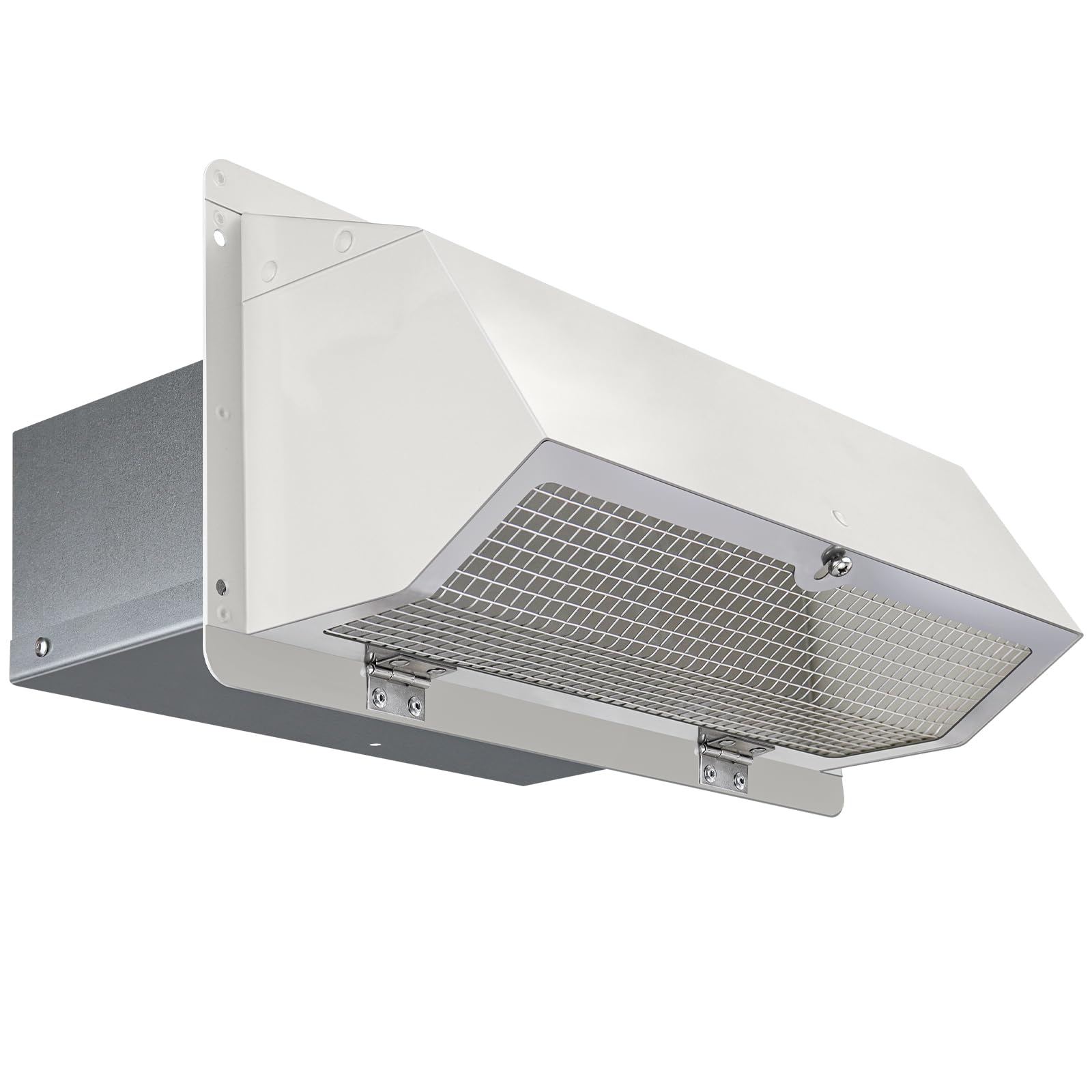
If you want the outside of the house finished once and not thought about again, this Imperial cap is the pick. It is built for the 3-1/4 x 10 inch rectangular duct that most over-the-range microwaves use, so it bolts onto the standard setup without a transition piece. The white painted finish blends into siding instead of shouting at you from the wall.
The weighted backdraft damper is the reason it leads this list. A weighted damper closes under gravity alone, so when the microwave fan stops, the flap drops flat and the wall is sealed again — no spring to weaken and no magnet to lose its pull over a winter. That gravity seal is what stops cold air whistling back down the duct and drafting across the counter while you cook. The air-tight body holds that seal and cuts heat loss through the duct.
Buyers keep coming back to this cap because it lasts outdoors: the heavy-duty galvanized steel has a zinc coating that shrugs off rain and corrosion, so it can sit outside year after year. It ships with the screws and the damper (the flap that closes when the fan stops) in the box, so you skip a second trip to the hardware store mid-install. The honest catch is fit. A 3-1/4 x 10 inch opening is a standard, but not every builder cut the wall to standard, so measure your duct before ordering instead of assuming the cap will line up. One number worth flagging if you are comparing this to the round-duct pick below: the round-to-rectangular GlowGeek transition has a smaller overall footprint at 10 x 7 x 9.06 inches, while this cap’s job is to close the wall, not change the shape of the duct.
What earns the top spot
- Weighted damper drops shut on its own, so the wall seals every time the fan stops.
- Heavy-duty galvanized steel resists corrosion and handles outdoor weather.
- Air-tight body seals the duct against heat loss and drafts.
- Screws and backdraft damper both included, so installation needs no extra parts.
- White painted finish sits quietly against exterior siding.
Where it asks a little of you
- Fit is the one mixed note — some wall cuts are not true to 3-1/4 x 10 inches, so measure first.
- Built for rectangular duct only; a round pipe setup needs a transition instead.
Worth buying if: your microwave vents through a standard 3-1/4 x 10 inch rectangular duct and you want the exterior sealed with a damper that does not rely on a spring.
Look elsewhere if: your duct is round — the Tandefio or GlowGeek transitions are the parts that change duct shape.
2. Wall Vent Cap
A screen you can open in seconds when the leaves pile up.
This cap keeps birds and pests out of your duct while it vents your kitchen. It fits the same 3-1/4 x 10 inch rectangular duct as the Imperial above, but its angle is different: a bird-proof screen covers the opening so nothing nests inside the pipe, and that screen opens with a Phillips screwdriver when you need to clear it.
That screw-off screen saves you a miserable afternoon. Instead of pulling the whole exterior cover off the wall to clear a wad of leaves, you back out a screw and lift the screen away. That pays off in autumn, when leaves pile up against the screen. The spring-loaded damper (the flap that closes when the fan stops) sits against a silicone cushion pad, which does two things: it holds a tight seal when the fan is idle, and the pad damps the vibration and noise a loose metal flap makes in a gust.
Construction is 28 gauge galvanized steel — a real gauge number, which is what you want to see rather than a vague “heavy duty” claim. The pre-drilled holes mean you are not drilling the wall yourself, and aluminum foil tape finishes the seal around the duct. Sizing runs 10-1/4 inches wide by 3-2/5 inches high overall, with the duct fitting extending 4-7/8 inches from the cap for a solid connection. The catch is the flap seal — that is the mixed note on this one. A few caps do not close as snugly as buyers expect, so check the damper travel on arrival and make sure it beds against the pad cleanly. This is not a dryer vent cap, so do not grab it for that job.
The clean-out advantage: being able to open the screen with a screwdriver and clear debris without removing the cap is the feature that makes this one worth the extra thought over a plain cover.
Worth knowing before you order: the duct collar has to slide onto your existing pipe, so measure the rectangular opening and confirm it matches 3-1/4 x 10 inches before the box shows up.
Reach for this one if: trees hang over your exhaust wall and you are tired of digging leaves out of the duct.
Pass it by if: you need a vent for a clothes dryer — this cap is built for microwave and range hood exhaust.
3. Wall Vent Cover 5 Inch

Ships with its own pipe, so the install starts the moment it lands.
Most exterior covers are a shell and nothing else — you buy the cap, then discover you also need a length of duct to bridge the wall to the flap. This one closes that gap by arriving with a galvanized pipe already attached, 8 inches long, plus a rubber gasket and 4 screws in the box. Nothing else to source.
The material choice is where the money goes. Stainless steel resists rust, rain and extreme temperatures in a way galvanized steel cannot match over a long stretch, which matters if your exhaust wall takes weather straight on. The built-in rubber gasket seals against air leaks, drafts, moisture and insects — the same seal that the gasket fights for on the Imperial, done here with rubber rather than a cushion pad. The maker states it is made in the USA and backed by a 12-month warranty.
The flapper is the honest weak point. It uses a small magnet to help hold the flap closed, and that magnet is not strong enough on some units to keep the flap fully shut in a stiff breeze. If your house faces a prevailing wind, expect to check the flap now and then or add a little weight of your own. The size is the other thing to verify — this is the 5 inch version with its own pipe, and the duct collar the cap mates to has to match what leaves your microwave. Compared with the Tandefio duct transition, which spans 13.7 x 7.87 x 7.08 inches, this cover is a slightly tighter package at its own dimensions because the pipe is built in rather than a separate adapter.
The value read: the included pipe, gasket and screws turn a two-trip job into a one-box job, and the stainless body is the more weather-hardy of the two steel options here.
Fair warning: the magnet-assisted flap is the piece most likely to disappoint, so a windy exposure is the one situation to think twice about.
The right call for: a replacement cover on a wall that gets battered by weather, where stainless steel and a pre-fitted pipe both earn their keep.
Think twice if: your exhaust wall takes constant wind, because the magnet flap is the known soft spot on this design.
4. Tandefio 6″ Dia Microwave Vent Kit

Turns a flat microwave duct into a 6 inch round pipe.
If your wall cap and your microwave do not agree on duct shape, this is the part that settles the argument. One end takes the standard 3-1/4 x 10 inch rectangular opening; the other end is a 6 inch round collar that connects to flexible hose. The rectangular section runs 10 inches along its length, not counting the edges, so there is real overlap to tape and screw down.
The interior is smooth rather than corrugated. A smooth interior reduces wind resistance, which means the fan pushes air out with less effort and less turbulence behind the wall. The galvanized plate is rust-proof and built for indoor or outdoor use, so it survives a damp crawl space or an exterior run without flaking apart. The silver finish is tidy enough that it does not look like scrap metal where it shows.
Sizing is the thing to get right, and it is where this pick carries a real caveat. A few buyers have found it will not convert a 10 x 3.25 inch opening to a 6 inch round collar cleanly on their particular wall, so dry-fit the piece before you tape anything down. It also arrives without installation accessories, and the manufacturer notes the interface can show scratches or compression from shipping. Compared with the GlowGeek transition at 10 x 7 x 9.06 inches, this Tandefio piece is the larger unit overall at 13.7 x 7.87 x 7.08 inches, which is worth knowing when you have a tight exterior cavity.
Why people choose it
- Converts the standard 3-1/4 x 10 inch rectangular duct to a 6 inch round collar.
- Smooth interior reduces airflow resistance for a more efficient exhaust run.
- Rust-proof galvanized plate works indoors and outdoors.
- Full 10 inch rectangular length gives plenty of surface for tape and screws.
The trade-offs
- No installation accessories in the box — you supply the tape and screws.
- Fit is the mixed note; some walls need a dry fit before committing.
- Shipping can leave scratches or compression at the interface.
Built for: anyone whose microwave duct is flat and whose exhaust system downstream is 6 inch round.
Not for: a 4 inch round system, which needs the smaller GlowGeek adapter instead.
5. 4” Dia. Round to Rectangular Duct Transition Adapter

Three pieces in the box and not a single extra trip to the store.
Here is a duct adapter that assumes you have nothing at home. You get the galvanized rectangular-to-round transition, a roll of aluminum foil tape measuring 10m (32ft), and a pair of work gloves. For someone changing a vent for the first time, that is the difference between one evening’s work and a week of hardware runs.
This adapter lets you join a rectangular microwave duct to a round pipe without a custom build. It handles the 3-1/4 x 10 inch opening on one side and a 4 inch round collar on the other, which suits smaller microwave exhaust runs and tight exterior cavities. Fitting it is a matter of cleaning the surface, taping the connection and screwing it down. Like the Tandefio above, the smooth interior keeps airflow resistance low so the fan is not fighting a bottleneck. The galvanized steel resists rust and corrosion, and it is rated for both indoor and outdoor use, even in harsh weather.
Owners approve of this adapter most for its fit, especially on microwave installs where the rectangular side is the awkward end. What you give up is size range: a 4 inch collar moves less air than a 6 inch one, so if your run to the outside wall is long or your microwave is a high-CFM model (one that moves a lot of air per minute), the Tandefio 6 inch version is the better fit. For a short, simple run on a standard unit, this adapter does the job without overbuying.
The kit math: tape and gloves in the box remove the hidden extras that usually push a vent project past its budget.
The limit to accept: the 4 inch round side is smaller than the 6 inch Tandefio, so long exhaust runs will feel the restriction.
Pick this if: you are converting a microwave’s rectangular duct to 4 inch round pipe on a short run and want the tape and gloves included.
Skip the round-down if: your system already uses 6 inch pipe — go with the larger Tandefio transition.
Know the Specs
Duct Size: Rectangular vs. Round
Duct size is the single number that decides whether a vent fits or comes straight back. The standard rectangular duct on an over-the-range microwave is 3-1/4 inches by 10 inches, and that is the opening a wall cap mates to. Round duct sizes come in whole inches, with 4 inch and 6 inch being the common options for transitions. The trick is that a wall cap and a transition are two different jobs. A cap closes the exterior wall on a duct that is already the right shape. A transition changes the shape — rectangular on one end, round on the other. Most people who buy the wrong part bought a cap when they needed a transition, so measure the opening on the microwave itself before anything else.
Backdraft Dampers And Sealing
The damper is the movable flap inside a vent cap, and it is the part that separates a sealed wall from a drafty one. A weighted damper closes by gravity. A spring-loaded damper uses spring tension and often rests against a cushion pad, which also damps vibration and reduces the rattle a loose metal flap makes in wind. Either design can give a tight seal when the fan is off, and that seal is what keeps cold air, moisture, insects and small animals out of the duct. A rubber gasket around the closure adds another layer to that barrier. If the flap does not close fully, everything upstream still works but you feel it as a draft and hear it as a flutter. Check the damper design as carefully as the metal it is housed in.
Common Questions
Do I need a wall cap or a duct transition for my over-the-range microwave?
Will a 3-1/4 x 10 inch vent cap fit every over-the-range microwave duct?
What is a backdraft damper and why does it matter in a kitchen exhaust vent?
Can I use a 6 inch transition on a microwave made for 3-1/4 x 10 inch duct?
Is galvanized steel good enough for an outdoor vent or do I need stainless?
Why does my vent flap rattle or fail to close all the way?
What size duct should I vent my microwave through if I want the strongest exhaust?
Do these vents come with the screws and tape I need to install them?
Can I use a microwave wall vent cap for a dryer or bathroom fan instead?
How do I stop cold air coming in through my kitchen exhaust vent in winter?
The Bottom Line
For most kitchens, the best vent for over the range microwave is the Imperial VT0500 Range Exhaust Hood Vent. The weighted damper (the flap that closes when the fan stops) is the deciding factor: it shuts on gravity alone, so the wall stays sealed every time the microwave fan stops, and the heavy-duty galvanized steel is built to sit out in the weather without rusting through. It holds 4.5+ stars across 600+ ratings, and reviewers single out the construction most often. If you want the cleaner look and a screen you can pop open to clear leaves, the screened wall vent cap is the better exterior finish and its spring-loaded damper has a silicone pad to hold the seal. And if your microwave duct is rectangular but your pipe downstream is round, the GlowGeek transition kit gets you the adapter, the tape and the gloves in one box, while the Tandefio 6 inch transition is the one to grab when you need a bigger collar.
The one thing worth doing before you order any of them: measure the duct opening on the microwave, write the number down, and buy to that number. Every return in this category starts with a guess.
How we choose
We do not accept paid placement. Every pick is matched to a real buyer and a real use-case; we do not hands-on test units.
Sources
Specifications: manufacturer listings and product documentation. Review insights: verified customer reviews, as of November 2026. Pricing: not shown on this page (it changes often); check the current price via the retailer link.
As an Amazon Associate, Tactical Gear Guy earns from qualifying purchases. This does not affect which products we feature.