Specs are compiled from manufacturer listings and verified buyer reviews and can change over time — please confirm the key details on the product page before buying.
If your tap water smells like a swimming pool and leaves a film in your mouth, the fix is a filter that lists chlorine reduction as a stated capability — not a vague “great taste” promise. That one line on the spec sheet is what separates a real chlorine filter from a pitcher that only looks the part. Below are nine options that actually name chlorine, sorted by how much daily effort each one asks of you.
This guide is built by comparing the manufacturers’ published specifications and the patterns across verified customer reviews, so you get each pick’s real strengths and trade-offs instead of marketing spin.
Some of these sit under your sink, some live in the fridge door, and one needs no plumbing or power at all. Each listing below names the chlorine claim and the filter life so you can match one to your kitchen. Here is how the best water filter for chlorine taste sorts out by capacity, filter life, and how much counter space it eats.
Top Picks


How To Choose The Best Water Filter for Chlorine Taste
Chlorine is added to municipal water to keep it safe on the way to your tap, and it does that job well. The problem is what it does to the taste — that sharp, chemical edge and the flat smell that lingers in a glass. Carbon is what removes it, so the question becomes which shape of carbon filter fits how you actually drink water.
Start with the chlorine claim, not the star rating
Look for the words “reduces chlorine, taste and odor” printed on the box, and look for an NSF/ANSI 42 line if you want third-party proof. That standard is the one that covers chlorine taste and odor reduction specifically. A filter that only advertises “cleaner water” without naming chlorine is not the filter you are looking for here.
Match the format to your counter and your patience
A pitcher holds a batch in the fridge and asks you to wait while it drips through. A faucet-mount unit filters on demand but takes up spout room. An under-sink system hides completely and gives you full flow at the tap. A gravity system needs no plumbing and no power, which makes it the pick for a cabin, an RV, or a kitchen where you cannot touch the plumbing.
The filter life math that actually matters
Filter life is quoted in gallons or months, whichever comes first, and it varies wildly here — from a cartridge rated at 40 gallons to one rated at 11,000. A short-life cartridge means more swaps and more ongoing cost. A long-life cartridge means one less chore on your list. Neither is wrong; you just want to know which one you are signing up for.
Do you want minerals kept or stripped?
Standard carbon filters leave dissolved minerals alone. Some multi-stage systems pull out nearly all dissolved solids along with the contaminants, which changes the mouthfeel. If you like the taste of your local water apart from the chlorine edge, a carbon-only filter is usually the gentler choice.
Side-by-Side Comparison
| Model | Best For | Filter Life | Capacity | Install Type | Amazon |
|---|---|---|---|---|---|
| Brita Large 10 Cup Pitcher★ Best Overall | Everyday fridge water | 2 months / 40 gallons | 10 cups | Freestanding | Amazon |
| Amazon Basics Under Sink SystemLongest Filter Life | Whole-household tap supply | 12 months / 11,000 gallons | 11,000 gallons | Under Sink | Amazon |
| BLINGARTY Faucet Mount FilterBest for Renters | Renters and small kitchens | — | 1 gallon | Faucet Mount | Amazon |
| Brita 10-Cup with BritaPlus | Wider contaminant list | 60 days / 40 gallons | 10 cups | Countertop | Amazon |
| Culligan ZeroWater 23-Cup | Big batches, PFAS worry | 2 months | 184 fluid ounces | Countertop | Amazon |
| Waterdrop PT-09W Glass Pitcher | Plastic-free countertop | 100 gallons / 2 months | 10 cups | Countertop | Amazon |
| PIURIFY Electric Pitcher | Speed over drip | 6 months / 130 gallons | 50 fluid ounces | Freestanding | Amazon |
| InSinkErator F-1000S | Dedicated drinking tap | 6 months / 500 gallons | 500 gallons | Under Sink | Amazon |
| Purewell 2.25G Gravity System | No plumbing, no power | 6 months / 3,000 gallons per filter | 2.25 gallons | Countertop | Amazon |
Detailed Reviews
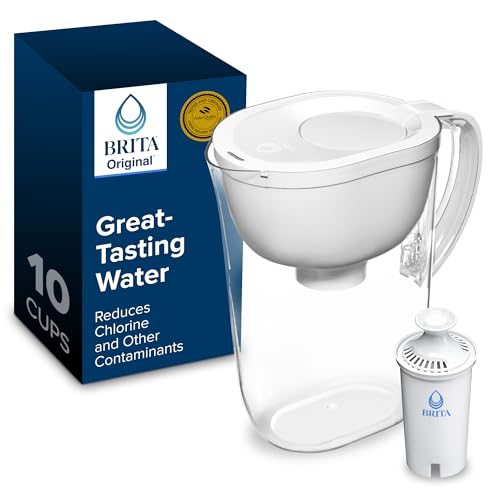
1. Brita Large 10 Cup Water Filter Pitcher
Our pick — 4.5+★ from 60,000+ verified ratings; the strongest balance of quality and price.
A 10-cup fridge-door pitcher with an explicit chlorine taste-and-odor claim and NSF/ANSI 42 certification.
Ten cups is the number to start with, because it means one fill covers three 24-ounce reusable bottles — a full day of drinking for one person, or a jug that lasts a household through breakfast. The body is BPA-free, the lid locks down so it does not swing open when you pour, and it is built to sit on a refrigerator shelf without eating the whole shelf. Ten cups is big enough to matter and small enough to store on a fridge shelf.
You get a clear chlorine promise here: the brand says this standard filter reduces chlorine taste and odor, plus mercury, copper, zinc, and cadmium. It also carries WQA and NSF/ANSI 42 certification (independent standards for taste and odor reduction). The cartridge lasts 40 gallons, or about 2 months, so you trade frequent swaps for pitcher convenience. Compare it with the Amazon Basics under-sink system below, whose cartridge is rated at 12 months: two months versus a year is the biggest practical difference between these two formats.
What wins people over here is the quality of the filtered result combined with how little thought the routine takes: fill, wait, pour, repeat. The recurring annoyance is the lid and reservoir assembly, which wants gentle handling rather than being yanked off. And the value question is real — a pitcher plus a steady stream of short-life cartridges adds up, so if you drink a lot of water, the math tilts toward an under-sink system. For the crowd that wants one pitcher in the fridge and no tools involved, it holds a 4.5+ star rating across 60,000+ ratings, and that number is the best argument in the whole category.
Ten cup capacity
- 10-cup capacity covers three 24-ounce bottles in a single fill
- Explicit chlorine taste and odor reduction, WQA and NSF/ANSI 42 certified
- Locking easy-fill lid and a footprint that fits refrigerator shelves
- Widely available replacement filters, so restocking is never a hunt
Filter replacements needed
- Cartridge life is 40 gallons or roughly 2 months — frequent swaps
- Lid and reservoir want careful handling rather than force
- Gravity drip means waiting for a fresh batch after every fill
Large households: you want chlorine taste gone with zero installation and a pitcher that lives in the fridge door.
Small kitchens: you go through several pitchers a day — the 2-month cartridge cadence gets old fast.
2. Amazon Basics Under Sink Water Filter System
A single under-sink cartridge rated for 11,000 gallons, or 12 months on municipal water.
Here is the number that reframes the whole category: 11,000 gallons of service life from a single filter, or 12 months on municipal water. Put that next to the Brita pitcher’s 2 months and the difference is not subtle — six times the filter life. You install it once under the counter, connect it to the cold feed, and the only recurring task becomes an annual cartridge swap. For a family that drinks tap water all day long, that is the least-effort route to chlorine-free water in the entire list.
The filtration itself is activated carbon block with polypropylene, certified by IAPMO against NSF/ANSI 42 for chlorine, taste and odor reduction and NSF/ANSI 372 for lead-free materials. Installation is genuinely short: twist-and-lock construction plus push-to-connect fittings, and the box includes the 3/8-inch line, a 3/8-to-1/2-inch converter set, screws, and Teflon tape. It connects to standard US sink feed valves, so most kitchens need no special parts run. A 3-second cartridge replacement is the claim, and the design backs it up — the whole cartridge twists out as one piece.
The honest catch is flow. Some owners find the water pressure at the tap drops more than they expected once the filter is inline, so if you are used to a hard blast at the sink, expect a gentler stream. The other thing worth knowing is scope: this reduces chlorine, taste, and odor — it is not a system that strips dissolved solids or targets PFAS. If chlorine is your specific complaint, that is exactly the right job for it. Installation is the aspect people praise most here, and it is easy to see why a three-minute job earns that.
Under sink value: you are buying a year of filtered water for the cost of a few months of pitcher cartridges, with no counter footprint at all.
Installation required: it must feed from a cold-water line only, and the flow at the faucet is noticeably softer than unfiltered.
Budget setups: a household that wants chlorine taste solved once and forgotten about, with the plumbing access to make it happen.
Renters: you rent and cannot touch the under-sink plumbing, or you need dissolved solids reduced too.
3. BLINGARTY Faucet Mount Water Filtration System
Screws onto your existing tap and shows you the filter’s remaining life on a little screen.
No drilling, no plumbing, no landlord conversation — the whole install is picking the right adaptor out of the thirteen in the box and screwing the unit onto your faucet spout. That adaptor spread is the real story for apartments, because it covers thread adaptors and universal connectors for a wide range of tap types. Before you order, check your spout: this one is not suitable for pull-out faucets, square spouts, or induction faucets, and that limitation is stated plainly rather than buried.
The cartridge is a 13-stage stack of coconut shell carbon fiber and PP cotton layers, claimed to reduce 99.9% of chlorine plus asbestos, particulates, benzene, taste and odor. One cartridge is rated to purify around 780 gallons. The clever bit is the power source: a patented turbine generates electricity from the water flow itself, so the LED display and blue light run with no batteries and no cord. Switch to filtered mode and the screen shows water temperature and remaining filter life; when the indicator turns red, the cartridge is done. Just know the display only lights up in filtered mode — that is by design, not a fault.
Quality is the part that earns the most goodwill, with the fit and finish reading better than the price bracket suggests. The honest caveat is reliability: a share of units stop working early and leakage comes up too, which is the risk you take on a lower-cost faucet-mount design. If yours arrives sound it does its job daily; if it does not, the return window is your friend. The hydro-powered display remains a genuinely neat piece of engineering at this level.
Quick retrofit: you rent, you have a standard screw-on spout, and you want chlorine taste handled without a single tool.
High volume use: your faucet pulls out or has a square spout — this unit will not mount on it at all.
4. Brita Large 10-Cup Water Filter Pitcher

Same ten-cup shape as the classic Brita, but the Plus filter traps twice the contaminants.
The step up here is the cartridge. BritaPlus is a high-density filter the maker rates to trap twice as many contaminants as the standard Brita filter, covering chlorine, mercury, cadmium, copper, and zinc in one pass. The chlorine taste and odor reduction is the headline for your purposes, and it is WQA certified to NSF/ANSI standards. If your tap water tastes off in more ways than one — a metallic note under the chlorine, say — this catches more of that than the entry Brita above.
Two practical upgrades come with the pitcher itself. A SmartLight indicator sits on the lid as a filter change reminder, so you are not guessing at the two-month mark. And the shape is fridge-door friendly: it is a 10-cup BPA-free body with an easy-fill lid, and it is built to slide into most door bins. Brita also states the Plus filter helps retain the beneficial minerals and electrolytes already in your water, which keeps the mouthfeel closer to tap than a stripping system would.
Cartridge life is 40 gallons or about 2 months, the same cadence as the standard Brita, so this is still a pitcher you maintain regularly. Compared with the Amazon Basics under-sink unit’s 12-month cartridge, you are trading convenience of install for more frequent filter changes — that is the pitcher format’s inherent cost, not a flaw in this model. Durability is the one place opinions split, so treat the reservoir with a little care and it should serve well. The 10-cup size keeps a household hydrated without a mid-morning refill.
BritaPlus filter included: the Plus cartridge’s broader contaminant list, plus a change indicator that removes the guesswork from filter swaps.
Pitcher footprint: the 2-month cartridge cadence still applies, and the reservoir rewards gentle handling.
Countertop filtering: you want the fridge-pitcher routine but a filter that goes after metals and chlorine together.
Fridge door space: you would rather set a filter and not touch it for a year.
5. Culligan ZeroWater 23-Cup Water Filter Dispenser
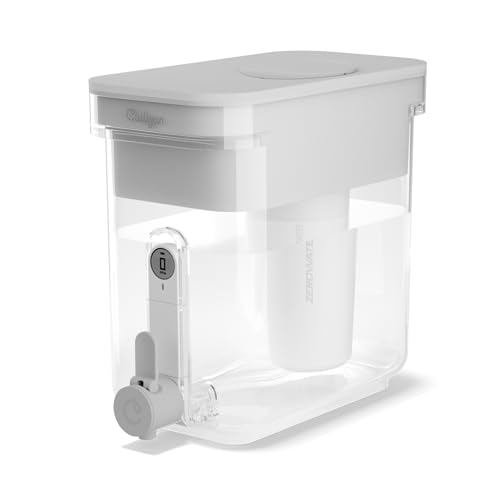
A countertop dispenser that holds nearly two gallons and comes with a meter to prove it works.
At 184 fluid ounces — that is 23 cups — this holds more than twice the batch of the 10-cup pitchers here, so a big family can fill glasses and bottles without a queue. It is a pour-through dispenser rather than a lift-and-tip pitcher, which makes sense at this size; you set a glass under the spout instead of hefting the whole thing. The body is BPA-free and the footprint is designed for small fridges or a spot on the counter.
The filtration goes further than chlorine. Culligan’s 5-stage system is IAPMO-certified to reduce Total PFAS, lead, chlorine, mercury, and more, and the maker claims 99.9% dissolved-solids removal. That last part is a real difference from the carbon pitchers: this one strips the water down hard, which is why the TDS meter is included. Use it to test the water any time; the meter reading above 6, or an amber light, tells you the filter is spent, and a reading of 0 means it is pulling out virtually all dissolved solids.
Here is the trade-off you should weigh carefully. Filtration speed also divides opinion: this is a gravity-fed dispenser, so a fresh batch takes time. Set it to refill overnight and the slowness stops mattering. For anyone specifically worried about PFAS in their water, the certification is the draw that other pitchers here do not offer.
Big families: larger households, or anyone whose concern extends past chlorine to PFAS and lead, with a spot on the counter to spare.
Tight counters: you want fast refills and cheap cartridges — this dispenser is slow-filling and pricier to maintain.
6. Waterdrop 10-Cup Large Glass Water Filter Pitcher, PT-09W

The pitcher that swaps plastic for glass and still handles chlorine in one pass.
If the nagging thought with a plastic pitcher is what leaches into the water over time, this answers it: the outer body is high-quality glass, non-toxic and easy to clean, with a sturdy plastic inner liner for durability. That liner is the bit to remember if you were hoping for an all-glass interior. It is not dishwasher-safe, so hand washing is the routine.
The 5-stage cartridge combines carbon fiber, ion exchange resin, and activated carbon block, third-party lab tested to reduce chlorine, mercury, taste and odor, copper, cadmium, PFOA/PFOS, sand, and sediment. It carries NSF/ANSI 42 for chlorine, taste and odor, NSF/ANSI 53 for mercury, and NSF/ANSI 372 for lead-free materials. Flow is quick for a gravity pitcher — 8.5 oz per minute means an 8-ounce cup fills in under a minute, notably faster than the slow drip of a standard pitcher. Filter life runs up to 100 gallons or 2 months, and it does not lower TDS, so minerals stay put.
The two things to know before you buy: it is heavier than a plastic pitcher thanks to the glass, and hand washing adds a small chore. Neither makes it a bad pick — it makes it a deliberate one for someone who wants glass on the counter. Between this and the Culligan dispenser above, the split is clear: Culligan strips dissolved solids and targets PFAS, while this Glass pitcher keeps minerals and focuses on chlorine, taste, and metals.
Plastic free homes: a countertop where looks and plastic-free materials count as much as the chlorine fix.
Drop prone kitchens: you want to load the pitcher in the dishwasher — the glass body needs hand washing.
7. PIURIFY Compact Electric Water Filter Pitcher

Tap a button and 50 ounces of filtered water arrives in under two minutes.
Speed is the entire pitch, and the numbers back it: a single tap delivers 50 ounces — about six glasses — in under 2 minutes, where standard gravity pitchers take 5 to 10 minutes of dripping. That changes how you use a pitcher. You are not filling it the night before and hoping there is enough; you tap it when you want water and it is ready. If your household drinks in bursts, this removes the bottleneck the other pitchers here impose.
Each filter treats up to 130 gallons or 6 months, and an indicator light tells you when it is due. The twist-off swap takes 3 seconds. The bigger jump is the battery: it is USB-C rechargeable and lasts up to 30 days per charge, so there is no cord tethering it to the counter. Independent SGS lab testing reports microplastics above 99.9%, lead above 99.8%, PFOA/PFOS at 99.7%, chlorine above 99.4%, copper at 99.1%, and mercury above 97.5%. The body is BPA-free plastic with a glass-like finish.
Plan around two things. First, it keeps the beneficial calcium and magnesium, so a TDS meter (a tool that counts dissolved solids in water) reads about the same before and after. That is normal here, not a failed filter, so test for lead or chlorine instead. Second, reliability is the weak spot in buyer feedback: some units do not hold up as well as the idea deserves, which matters given the higher price of an electric pitcher. When it works, it is far more convenient than a drip pitcher.
Compact electric pumping: six glasses in under two minutes, a six-month filter, and a USB-C battery that lasts up to 30 days between charges.
Needs charging: an electric pitcher costs noticeably more to run than a passive one, and reliability is the weak point to watch.
Small apartments: busy kitchens where nobody remembers to fill a pitcher the night before.
Off grid trips: you want the simplest, cheapest-to-maintain filter and do not mind waiting on gravity.
8. InSinkErator Water Filtration System F-1000S

A compact under-sink canister made to sit beneath a drinking-water tap or dispenser.
If your kitchen already has a dedicated drinking tap, this 12.5-inch by 2.25-inch filtration canister pairs with an instant hot or cold water dispenser to filter that tap’s water. The F-1000 chlorine cartridge is rated for 500 gallons and reduces particulates and chlorine taste and odor. Stainless steel construction and a 0.75 gpm flow rate (gallons per minute, so about three-quarters of a gallon each minute) round out the physical specs. It is NSF 42 certified.
The service routine is short: swap the cartridge every six months at rated capacity, and the twist-and-lock head with 1/4-inch quick-connect fittings does the job while automatically shutting off the water flow during a change. That auto-shutoff is a small feature with real value — no scrambling for the under-sink valve every time. The package includes the filter head, tubing, fittings, and mounting screws, so it is a one-box installation for someone who has done a little plumbing before.
Filter performance is what people reward most here, and a 500-gallon cartridge landed in a compact canister is a tidy result. Value is the point that divides: the cartridges fetch a premium and some find it steep relative to the engineering. The 1-year “We Come to You” limited warranty covers the system but not the cartridge, so factor that in. This is a special-purpose unit — it belongs under a dispenser tap, not as a general sink filter.
Tap taste upgrade: a kitchen with an instant hot or cold water dispenser that wants chlorine and particulates reduced at the drinking tap.
Portable needs: you do not have a dispenser system, or you want a plain sink faucet filter — this unit is designed around the tap, not the main spout.
9. Purewell 2.25G Gravity Water Filter System

The stainless steel gravity system that asks for no plumbing, no batteries, and no wall socket.
Gravity does the work here, with two chambers and two cartridges. You pour tap water into the top chamber and it drips down to the lower one for dispensing, so you can set it on a counter, a cabin bench, or a camper table and skip plumbing entirely. A transparent window lets you check the water level without lifting a lid.
The filtration stack is a composite: a 0.01-micron hollow fiber UF membrane, a silver ion membrane, and an activated carbon block that reduces chlorine and traps rust, sediment, organic matter, and heavy metals. Its 0.01-micron membrane is far finer than the 0.2-micron figure other gravity systems typically state, so it catches more sediment. Despite the tight pores it still moves 4 gallons per hour, which keeps the fill-and-wait cycle manageable for household use. Each cartridge is rated up to 3,000 gallons, so the pair covers up to 6,000 gallons before you need more.
The recurring notes worth knowing: some setups show leakage and filtering time divides opinion, so seat the cartridges and chambers carefully on day one and give it room to drain. It also will not lower TDS — a cheap meter will read about the same before and after, which is expected. Do not top the upper chamber while the lower one is full, per the maker’s instruction; that is the guidance that prevents the leak complaint. For off-grid use, the no-electricity requirement is the winning detail.
Gravity fed system: the finest pore size on the list at 0.01 microns, a 4-gallon-per-hour flow, and two cartridges rated up to 3,000 gallons each.
Slow flow rate: occasional leakage and variable filtering time mean careful assembly matters, and it will not lower TDS.
Off grid cabins: a cabin, RV, or off-grid kitchen where plumbing and power are off the table and volume matters.
Fast paced homes: you need a low TDS reading or a filter that works without any attention to seating and levels.
Know the Specs
Filter life (gallons vs. months)
Filter life is the measure of how much water a cartridge will treat before it stops reducing chlorine effectively. It is quoted in two ways at once — a gallon capacity and a replacement interval — and both apply: whichever comes first wins. That is why a pitcher rated at 40 gallons or 2 months needs a new cartridge on the two-month clock, while an under-sink system rated at 11,000 gallons lasts a full year. Short-life cartridges mean frequent swaps and steady cost; long-life cartridges mean one chore a year. Match the number to how much water you actually drink.
NSF/ANSI 42 certification
NSF/ANSI 42 is the third-party standard that verifies a filter actually reduces chlorine taste and odor, plus particulates. Seeing that line on the box is your proof the claim has been tested, not just printed. You will also see NSF/ANSI 53 for mercury and NSF/ANSI 372 for lead-free materials — different tests for different contaminants. A filter can carry one, two, or all three. If chlorine flavor is your specific complaint, 42 is the one that matters most, but 53 and 372 add real value if your water has other issues.
Dissolved solids (TDS) and what a meter tells you
TDS stands for total dissolved solids — the minerals and salts suspended in water. A carbon pitcher like the Brita models here leaves most of them alone, so the water keeps its natural mineral content. A system like the Culligan ZeroWater is designed to strip them out, which is why it ships with a TDS meter to show you the drop. Neither result is “better” across the board: minerals can help mouthfeel, but stripping them removes more contaminants and some people prefer that clean, flat taste.
Pore size and filtration speed
Pore size is the width of the openings in a filter membrane, measured in microns. A smaller pore catches finer particles, and a larger one lets more through. The Purewell system’s 0.01-micron membrane is narrower than the 0.2-micron figure other gravity systems commonly state, so it catches more sediment — but tighter pores can slow the flow, so it is a balance. Flow rate is quoted in gallons per hour or gallons per minute. A rate of 4 gallons per hour on a gravity system feels workable; a 0.06 gpm rate feels slower when you are waiting at the spout.
Common Questions
Does a standard Brita filter remove chlorine?
Will a chlorine filter also remove the chlorine that keeps my water safe?
How often do I change a pitcher cartridge vs an under-sink cartridge?
Can I put a faucet-mount filter on a pull-out kitchen tap?
Does a chlorine filter change the TDS reading of my water?
Is an under-sink system better than a pitcher for chlorine taste?
How small a pore size do I need to remove chlorine?
Do these filters need electricity or a battery?
Will a chlorine filter make my water taste flat?
How do I know when to replace a filter without a gauge?
The Bottom Line
Most households face two routes for a water filter for chlorine taste: a pitcher that skips installation, or a system that skips filter swaps. The Brita Large 10 Cup Pitcher wins the pitcher route, with ten cups, a locking lid, and a chlorine claim that fits a fridge shelf and a 40-gallon cartridge cadence. If your kitchen has under-sink access and you would rather swap a cartridge once a year, grab the Amazon Basics Under Sink System, with an 11,000-gallon service life that leaves pitchers far behind.
For a countertop where plastic-free materials count, the Waterdrop Glass Pitcher is the pick, and it handles chlorine in under a minute per cup. If speed is the whole point, the PIURIFY Electric Pitcher fills 50 ounces in under two minutes. And if your water worries go past chlorine to PFAS and lead, the Culligan ZeroWater Dispenser is certified for it with a TDS meter in the box to prove it. And for a cabin or off-grid setup, the Purewell Gravity System runs on nothing but gravity.
How we choose
We do not accept paid placement. Every pick is matched to a real buyer and a real use-case; we do not hands-on test units.
Sources
Specifications: manufacturer listings and product documentation. Review insights: verified customer reviews, as of November 2026. Pricing: not shown on this page (it changes often); check the current price via the retailer link.
As an Amazon Associate, Tactical Gear Guy earns from qualifying purchases. This does not affect which products we feature.