Specs are compiled from manufacturer listings and verified buyer reviews and can change over time — please confirm the key details on the product page before buying.
Replacing a dead motor is a measuring job, not a shopping spree. Four measurements decide whether your new motor drops straight in or sits in a box: the bolt circle, the shaft diameter, the frame number, and the old unit’s enclosure type. That enclosure is either open drip-proof (ODP, an open shell with vents that only suits dry indoor air) or totally enclosed fan-cooled (TEFC, a sealed shell with its own cooling fan). Get those four right and the install is an afternoon. Get one wrong and you are drilling new mounts.
This guide is built by comparing the manufacturers’ published specifications and the patterns across verified customer reviews, so you get each pick’s real strengths and trade-offs instead of marketing spin.
The picks below are grouped by what they actually bolt onto — compressor duty, pool flange, general-purpose shop work — so you can match frame and voltage before anything else. Every entry here is a current option worth weighing when you are shopping for worldwide electric motors.
Top Picks

How To Choose The Best Worldwide Electric Motors
An electric motor is a bolt-pattern purchase first and a performance purchase second. If the new unit does not line up with the old mount and shaft, nothing else about it matters. Start with the physical fit, then work toward the electrical side.
Match the frame and shaft before anything else
A frame number is the motor industry’s shorthand for a fixed set of mounting dimensions — bolt hole spacing, shaft height, and flange shape. A 56 frame and a 56C frame share footprint basics, but the C means a face-mount flange instead of feet. A 56HZ frame on a Baldor compressor motor carries a bigger 7/8″ shaft, so a pump built for a 5/8″ keyed shaft will not slide on. Measure your old shaft with calipers before you order.
Decide ODP or TEFC by where the motor lives
ODP (open drip-proof) motors breathe through open vents and are meant for clean, dry indoor air. Put one on a damp pool pad or in a sawdust-heavy shop and the windings take the hit. TEFC (totally enclosed fan-cooled) seals the shell and drives its own fan, which suits dusty, humid, or outdoor-adjacent spots. One pick here carries an IP55 rating, where the IP number describes how well the housing keeps out dust and water.
Understand the horsepower label and the service factor
Several compressor motors here are sold as “SPL,” which means special — a rating that does not follow the full continuous-duty standard. That is normal for compressor duty, but it explains why some buyers feel the output is less than the number implies. The service factor (SF) is the safe overload ceiling: an SF of 1.15 means the motor can carry a bit more than its nameplate rating for short periods. Choose the horsepower your pump or machine actually calls for, not the biggest number you can find.
Side-by-Side Comparison
| Model | Best For | Horsepower | Voltage | Frame / Shaft | Amazon |
|---|---|---|---|---|---|
| VEVOR 2HP SPL Air Compressor Motor★ Best Overall | Compressor swaps on a budget | 2 hp SPL | 115V/230V | 56 frame / 5/8″ | Amazon |
| VEVOR 3HP Air Compressor MotorBigger Builds | Bigger compressor builds | 3 hp | 230V | 56 frame / 5/8″ | Amazon |
| JIAXINPRO 2HP Air Compressor MotorQuiet Runner | Quiet shop replacements | 2 hp | 115V/230V | NEMA 56 frame / 5/8″ | Amazon |
| EMZ 2 HP SPL Compressor Duty Motor | Plug-and-play compressor duty | 2 hp SPL | 120V/240V | 56 frame / 5/8″ | Amazon |
| A.O. Smith B2852 Pool Motor | Square-flange pool pumps | 3/4 hp | 230/115V | 56Y frame | Amazon |
| Cuilvu 1.5HP Electric Motor | Dusty or damp industrial spots | 1.5 hp | 115V/230V | 56 frame / 5/8″ | Amazon |
| A.O. Smith SQ1102 Pool Motor | 1 HP pool pump swaps | 1 hp | 115/230V | 48Y frame | Amazon |
| BALDOR 5HP Air Compressor Motor | Heavy compressor duty, US-made | 5 hp | 208/230V | 56HZ frame / 7/8″ | Amazon |
Detailed Reviews
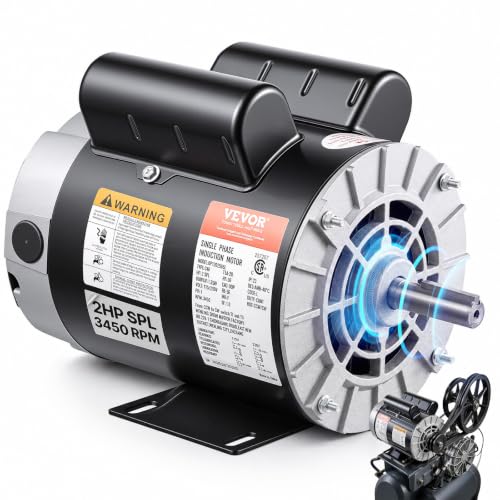
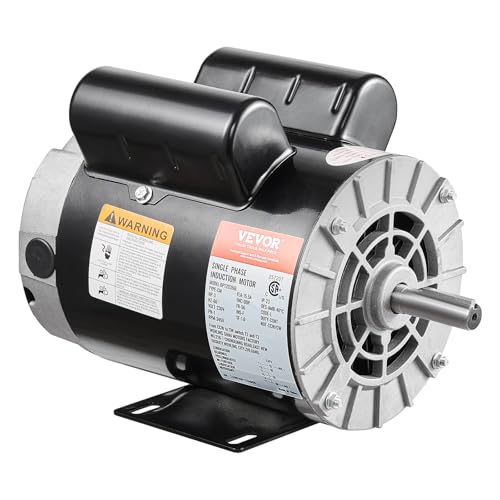
1. VEVOR 2HP SPL Air Compressor Motor
Our pick — 4.5+★ from 350+ verified ratings; the strongest balance of quality and price.
The compressor motor that slips onto old mounts with barely a fight.
If you have a dead compressor motor and a workshop that already runs one voltage, this is the straightforward swap. It delivers a 2 hp SPL rating at 3450 RPM (revolutions per minute — how fast the shaft spins) on a single phase, and a single phase simply means it runs on ordinary household-style power rather than three-phase industrial current. You wire it to 115V at 20 amps or 230V at 10 amps by moving the leads on the terminal board. So the same motor works whether your shop is wired for household 115V or a heavier 230V circuit.
The physical fit is the part that wins people over. It uses a 56 frame with a 5/8″ keyed shaft measured at 1.88″ long, and a keyed shaft means a flat slot cut into the steel so the pulley’s keyway locks in and the pulley cannot spin free. That 5/8″ shaft is the common compressor size, which is why owners describe bolting it straight onto original mounts, including a 40-year-old Craftsman table saw that needed no drilling. Shaft length of 1.88″ is the other critical number — too short and your pulley sits half on the shaft, too long and it fouls the housing.
Two honest notes before you order. The motor is open drip-proof (ODP), so it needs clean, dry indoor air and is not the choice for a damp pool pad or a dirt-floor shop. And it is rated at 95 db, which is loud enough that you will want ear protection nearby — the JIAXINPRO below runs at a 75dB rating, so if quiet is the priority that one leads on noise. The breaker sizing VEVOR specifies is 50 amps at 115V and 25 amps at 230V, so check your panel before you start.
What It Gets Right
- Dual 115V/230V wiring covers both common shop circuits
- 23 pounds — the lightest body of the compressor motors here
- 5/8″ keyed shaft at 1.88″ long matches most compressor pulleys
- Reversible CCW/CW rotation eases wiring in either setup
Where It Asks Patience
- Open drip-proof housing suits dry indoor air only
- 95 db noise rating is the loud end of this list
- SPL rating is not a full continuous-duty horsepower figure
Bolt it on if: you have a 56 frame compressor mount with a 5/8″ shaft and a dry indoor shop.
Measured check: take your shaft and bolt spacing before ordering, because a 56HZ frame motor will not line up here.
2. VEVOR 3HP Air Compressor Motor
Three horsepower in the same 56 frame footprint, if your shop runs 230V.
Here is the head-to-head that matters most in this category: this motor carries a 3 hp rating against the 1 hp VEVOR general-purpose motor further down this list. That is a 3.0x gap in nameplate horsepower, and it is why this one drives big compressors while the 1 hp unit drives pumps and lathes. At 3450 RPM with 15.5 amps drawn at 230V, this unit is meant for a serious compressor that needs real pulling power.
It keeps the same 56 frame and 5/8″ keyed shaft at 1.88″ length as the top pick, so the mounting story is familiar. The weight bumps to 27 pounds, which is the physical cost of the extra copper and steel inside. A rolled steel shell and CSA certification round out the build, and the motor reverses between CW and CCW (clockwise and counterclockwise) so you can wire it to spin whichever way your pump wants. VEVOR calls for a 40 amp breaker here.
The catch is honest and worth hearing. This is 230V only — there is no 115V option — so a shop wired for household current cannot run it without a new circuit. Some owners also feel the delivered power does not fully match the 3 hp on the label, so size it to the job rather than expecting headroom beyond what the pump needs.
Voltage reality: the 230V-only wiring is the first thing to check; if your panel cannot feed a dedicated 40 amp circuit, look elsewhere in this list.
Right for: a 230V shop with a big compressor that needs a genuine step up in horsepower.
Think again if: you are feeding it from a 115V circuit — that is simply not what this motor accepts.
3. JIAXINPRO 2HP Air Compressor Motor
The compressor motor built to kill the racket, not just spin the pump.
Noise is where this one separates itself. JIAXINPRO rates it at 75dB against the top pick’s 95 db — a 27% lower noise figure. You feel that drop the moment the compressor kicks on in a garage where you also work. If you run an air compressor in a space where you talk to customers or share a wall with the house, that number is the headline.
The build carries a NEMA 56 frame with that standard 5/8″ keyed shaft at 1.88″ length, pre-drilled mounting holes, and an ODP (open drip-proof) enclosure for dry indoor use. A manual-reset overload protector sits on the outside — if current spikes, the motor trips and you push the red button to reset, which saves a service call. It switches between 115V and 230V on the wiring terminal board and reverses CW/CCW electrically for different setups.
At 31 pounds it is the heaviest of the 2 hp compressor motors reviewed here — the 23-pound top pick is noticeably lighter to lift onto a bracket alone. That extra mass is the price of the quieter running and the heavier wound build. Owners describe reliable replacement service, including one unit dropped into a Craftsman table saw with no complaints on performance.
For a noisy shop: this is the compressor motor to pick when the old unit was driving you out of the room.
Lift help advised: 31 pounds on a bracket overhead is a two-hand job, so plan for it.
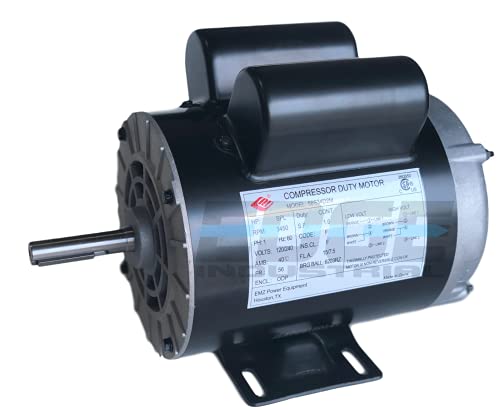
4. NEW 2 HP SPL Compressor Motor
A continuous-duty compressor motor that wires to either household or shop current.
This one is built around the wiring, not the spinning. It runs a 2 hp SPL rating at 3450 RPM and accepts 120V/240V — which is nearly the same as the top pick’s 115V/230V, just on a slightly different voltage figure. Its 120V/240V rating sits 4% above the VEVOR’s 115V/230V, a distinction that matters only if your panel and old motor nameplate disagree.
The amperage split tells you what circuit you need: 15 FLA at 120V or 7.5 FLA at 240V, where FLA means full load amps — the current the motor draws at rated output. At 15 FLA on 120V, a standard household circuit runs it without a rewire, which is why owners call it plug-and-play. It is also a capacitor start and capacitor run continuous-duty design, so it starts with a kick and keeps going through the workday. One note on voltage: it is not suited for 208V incoming service.
The shaft is the standard 5/8″ diameter on a 56 frame, and the rotation is CCW (counterclockwise) viewed from the shaft end. The ODP enclosure wants dry indoor air. The recurring gripe is durability — some units run for years, and a few do not reach the 2 hp that the SPL label implies. Buy it knowing the SPL rating runs optimistic and sell it to your own needs.
What you get: a continuous-duty compressor motor that runs on ordinary 120V current and starts under load.
Pick this for: a home compressor on a 120V circuit where rewiring is not on the table.
The honest caveat: the SPL horsepower on the box is not a full-rated figure, so size the job around 2 hp of real demand.
5. A.O. Smith B2852 Pool Motor

A pool-pump motor built around the square flange, not the compressor bracket.
Pool pumps are their own world, and this motor is built for it. It runs 3/4 hp at 3450 RPM, draws 10.8 amps at 115V or 5.4 amps at 230V, and carries a 1.25 service factor — a generous overload headroom for the start-up surge a pool pump throws at a motor. It uses a 56Y frame with a square flange, where the Y designation marks a specific pool pump mount. So this is not a motor you swap onto a compressor.
The install story is what people speak about. The square flange slides on and bolts up, and the shaft is secured with a wrench during the swap — straightforward enough that owners describe it as a simple replacement. Stainless steel construction and 3450 RPM round out the build. Do check the local rules before you order: the listing notes this motor is banned for sale in California and New York.
The trade-off is mixed noise and durability. Some owners find it much quieter than the motor it replaced, and a few report it growing louder over time. That is the honest picture on a pool motor — bearing wear eventually shows up as noise. It is built for a wet pool pad in a way the compressor motors here are not.
Fit for a pool pad: a square-flange pump that needs a 3/4 hp motor with service factor headroom.
Check first: residents of California or New York should confirm local availability before ordering.
6. Cuilvu 1.5HP Electric Motor

The sealed-shell motor for shops where dust and damp never leave.
Every other unit here is open drip-proof. This one is TEFC — totally enclosed fan-cooled — and carries an IP55 rating, where the first 5 describes dust protection and the second 5 describes resistance to water spray. That combination is exactly what a sawdust-heavy workshop or a damp agricultural shed demands, because the windings stay sealed while a fan on the end cools the outside. A big cooling fan runs through hours of operation even in dusty or damp air.
Electrically it sits between the 1 hp and 2 hp options: 1.5 hp at 3450 RPM, 14.2 amps at 115V or 7.1 amps at 230V, single phase on 60Hz. It wires on the standard 5/8″ keyed shaft at 1.88″ and a 56 frame, and reverses CW/CCW. The insulation is rated class F, which is the temperature class the windings are built to withstand. The steel housing and stable frame give it the weight you want on a motor that bolts to farm equipment or a pump.
The honest catch is that a sealed TEFC motor runs its own fan, so it is not the quietest and it is not cheap to build. That sealed shell is why it suits hard environments the ODP motors avoid. If your shop is clean and dry, an ODP unit will do the job for less fuss. If it is dusty, wet, or outdoors, this sealed housing is the reason to pick it.
Why It Fits Tough Spaces
- TEFC sealed shell with IP55 dust and water-spray rating
- High speed cooling fan keeps windings cool in dusty or damp air
- 1.5 hp at 3450 RPM with 14.2A/7.1A dual voltage
What To Weigh First
- The sealed fan-cooled design is louder than an open motor
- You pay for the enclosure over a clean-air ODP unit
Reach for it when: the motor sits in dust, damp, or an agricultural environment that ruins open housings.
Choose differently if: your shop is dry and indoors — an ODP motor here costs less and runs quieter.
7. A.O. Smith SQ1102 1 HP, 3450 RPM, 48Y Frame Pool Motor

A 1 hp pool motor with the frame that owners already have on the pad.
The pool-pump crowd will recognise this one. It runs 1 hp at 3450 RPM on a 48Y frame — a smaller frame than the compressor motors here, and the Y marks it as a square-flange pool mount. It draws 19.2 amps at 115V or 9.6 amps at 230V and carries a 1.65 service factor, which is a high overload headroom for start-up surges. Copper windings and 22 pounds of build round it out.
The design point is matching the pump you already have. Owners describe it dropping in as the exact replacement for their previous motor, fitting the flange and bolting up without modification. That is also why so many pool owners pick this one: if the old motor’s frame number matches, you do not measure anything else.
Two things are worth hearing honestly. Noise and durability come back mixed — some motors run super quiet, others get noisy over time, and a few do not last as many seasons as hoped. The impeller assembly also comes up as a fit point for a handful, which usually means the pump housing, not the motor, needs attention. Treat the SQ1102 as the right frame match and check the housing while you are in there.
Right at the flange: a 48Y square-flange pool pump that needs a 1 hp motor with roomy service factor.
Take the guesswork out: if your old frame number reads 48Y, this is the motor that matches it.
Worth knowing: noise and lifespan split down the middle, so check the pump housing during the swap.
8. BALDOR 5HP Air Compressor Motor

Five horsepower of US-built compressor motor on a heavier 7/8″ shaft.
If you run a big compressor, this is the heavyweight of the list. It delivers 5 hp single phase at 3450 RPM, draws 21.5 amps at 230V or 23.5 amps at 208V, and carries a 1.15 service factor. Baldor builds and assembles it in the USA under the ABB umbrella, an origin that matters to buyers who want a motor to outlast the compressor it sits on. The 56HZ frame pairs with a 7/8″ shaft — larger than the 5/8″ shaft on every other compressor motor here.
Two practical points set it apart. It is usable at 208V as well as 230V, which is unusual among the units here, so a shop running 208V three-phase-derived single phase can still use it. The ODP enclosure suits clean indoor air. It also reverses CW/CCW for different setups, and ships with mounting hardware and a wiring schematic. At 50 pounds it is the heaviest motor in the group, so plan for a lift.
The honest limit is the build on a difficult job. Some owners mention that wiring takes a moment to sort which leads run either direction. Durability comes back mixed — plenty of these run hard for years, and a few failed within months. Install it on a correctly sized breaker and lean on the 1.15 service factor rather than overloading it.
what separates it
- 5 hp single phase on 208/230V — the strongest compressor motor here
- US-made by Baldor / ABB with mounting hardware and wiring schematic
- Customers note it running quieter than the motor it replaced
The Weight And Wiring
- 50 pounds is a two-person install onto an improve compressor base
- Wiring direction takes a careful look at the schematic first
Best for heavy compressor duty: a high-duty compressor where 5 hp of real pulling power and a 7/8″ shaft are what you need.
Get help lifting: 50 pounds onto the top of a compressor is not a solo job, and a 5/8″ pulley will not fit the 7/8″ shaft.
Know the Specs
Frame And Shaft Diameter
The frame number (56, 56C, 56HZ, 48Y) is a fixed set of mounting dimensions — bolt spacing, shaft height, flange shape. The shaft diameter is the number you measure with calipers: 5/8″ is common on compressor motors, 7/8″ appears on a heavy 5 hp unit, and pool pumps use their own square-flange mounts. Get frame and shaft wrong and the motor will not bolt up, no matter the horsepower.
ODP vs TEFC Enclosure
Open drip-proof (ODP) motors breathe through vents and want clean, dry indoor air. Totally enclosed fan-cooled (TEFC) motors seal the shell and drive their own fan, suiting dusty, damp, or outdoor-adjacent spots. An IP55 rating on a TEFC motor describes how well the housing keeps out dust and water spray. Match the enclosure to where the motor lives, not to what looks rugged.
Service Factor And Horsepower Labels
A service factor of 1.15 or 1.25 means the motor can carry a little past its nameplate rating for short periods — useful on a pump that surges at start-up. An SPL horsepower rating is a compressor-duty figure that does not follow the full continuous-duty standard, so a 2 hp SPL motor may not deliver 2 hp the way a full-rated unit would. Size around the real job, not the biggest label.
Wiring Voltage And Rotation
Dual-voltage motors switch between 115V and 230V (or 120V and 240V) on a terminal board. A reversible motor spins CW or CCW so you can match the pump. The breaker size matters: the top pick wants 50 amps at 115V, and 25 amps at 230V; the 3 hp VEVOR calls for 40 amps. Check your panel before wiring.
Common Questions
How do I know which frame number my old motor has?
What does SPL mean on a compressor motor?
Can I run a 230V motor on a 115V circuit?
Will a pool pump motor fit a compressor mount?
Is a TEFC motor better than ODP in a dusty shop?
Do I need a run capacitor or a start capacitor on a replacement motor?
Can these motors run in either direction?
How do I wire a dual voltage motor for 230V?
Will a larger shaft diameter motor fit my existing pulley?
How long should a replacement motor last?
The Bottom Line
For most buyers, the worldwide electric motors winner is the VEVOR 2HP SPL Air Compressor Motor because it threads the needle on dual-voltage wiring, standard 56 frame and 5/8″ shaft fit, and a 23-pound body that is the easiest of the compressor motors to lift onto a bracket. It is the crowd favorite at 4.5+ stars across hundreds of owners, and its one condition is a dry indoor shop for the ODP housing. If you need more pulling power on a 230V circuit, the VEVOR 3HP is the step up. If you need a sealed shell for dust or damp, the Cuilvu 1.5HP TEFC is the one built for that. For a pool pad, match the frame first — the A.O. Smith SQ1102 handles the common 48Y swap.
How we choose
We do not accept paid placement. Every pick is matched to a real buyer and a real use-case; we do not hands-on test units.
Sources
Specifications: manufacturer listings and product documentation. Review insights: verified customer reviews, as of November 2026. Pricing: not shown on this page (it changes often); check the current price via the retailer link.
As an Amazon Associate, Tactical Gear Guy earns from qualifying purchases. This does not affect which products we feature.