Specs are compiled from manufacturer listings and verified buyer reviews and can change over time — please confirm the key details on the product page before buying.
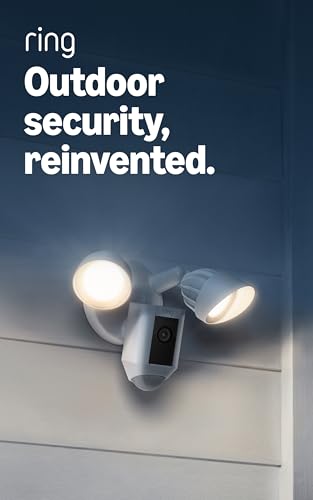
If your driveway, side gate, or back fence has a gap nobody watches, that gap is the whole problem — and it is why you are shopping. The short answer: for most yards, a wired floodlight camera like the Ring Floodlight Cam Wired Plus (2nd Gen) is the one to buy. It runs on constant wired power, throws 2000 lumens of floodlight (a brightness measure — bright enough to light up a driveway), and packs an 85dB siren (a loud alarm, about as loud as a truck horn) in one unit. It also carries 4.5+ stars across 44,000+ owners, the largest owner base of any camera here. Below, you will see when a solar wireless camera makes more sense and where each one falls short.
This guide is built by comparing the manufacturers’ published specifications and the patterns across verified customer reviews, so you get each pick’s real strengths and trade-offs instead of marketing spin.
Wireless solar units free you from an outlet but ask you to think about sun angles and Wi-Fi reach. Wired floodlights solve power forever but need a mounting spot near a junction box. This breakdown covers both, from 2K to 4K, so you can pick the yard security cameras that actually fit your property and your power situation.
Top Picks
How To Choose The Best Yard Security Cameras
The camera that fails you is rarely the one with the worst picture. It is the one that lost power, lost Wi-Fi, or pointed at the wrong patch of fence. Pick the power source first, then the lens, then the storage — in that order.
Wired Power Versus Solar And Battery
A hardwired unit like the Ring Floodlight Cam Wired Plus (2nd Gen) never needs a charge, so you never lose a night of footage because the sun did not show up. The trade-off is installation: you need a mounting location you can feed power to. Solar cameras trade that wiring job for a sunlight job. Small panels on the camera need steady direct sun, and a battery handles the cloudy stretches. A detached panel lets you point the panel at the sun and the lens at your gate, which is a real advantage on a shaded porch.
Resolution Is Not The Same As Night Performance
Two cameras can both claim 4K and look wildly different at 2 a.m. A 4K sensor with spotlights shows a face in color; a 2K sensor with a strong spotlight can be easier to read than a washed-out 4K frame. Look for a camera that states its night mode plainly, whether that is full-color night vision with built-in spotlights or infrared for quiet black-and-white.
Storage And Subscriptions
Local storage means the footage lives on a microSD card or a base station in your house, so nothing leaves your property and nothing bills you monthly. Cloud plans add longer history and smarter alerts, but they are a recurring cost. If you want to skip monthly fees entirely, pick a model that records to a card or a base station and check the card size it supports before you buy.
Side-by-Side Comparison
| Model | Best For | Resolution | Power Source | Local Storage | Amazon |
|---|---|---|---|---|---|
| Ring Floodlight Cam Wired Plus (2nd Gen)★ Best Overall | Front-of-house coverage with floodlights | — | Hardwired | — | Amazon |
| eufy Security eufyCam C37Best Solar Value | Zero-fee solar coverage with 360° tracking | 2K | Solar + battery | microSD up to 256GB | Amazon |
| WYZE Solar Cam PanLoudest Alarm | Wide pan-tilt sweeps on a budget | 2K | Solar + battery | microSD up to 512GB | Amazon |
| Ring Floodlight Cam 2K | Sharp 2K floodlight with enhanced zoom | 2K | Wired | — | Amazon |
| REOLINK E1 Outdoor Pro | Highest resolution with 3x optical zoom | 4K | Plug-in | microSD up to 512GB | Amazon |
| Tapo C610 KIT (2-Pack) | Two-camera coverage from one app | 2K | Solar + battery | microSD up to 512GB | Amazon |
| aosu T2 Pro | Dual-lens overview plus close-up detail | 3K | Solar + battery | microSD up to 256GB | Amazon |
| Arlo Pro (6th Gen) 4-Cam | Whole-property wireless with a base kit | 2K HDR | Rechargeable battery | — | Amazon |
| aosu D1 Max 4-Cam Kit | Full 4K kit for a large property | 4K | Solar + battery | 32GB included, up to 1TB | Amazon |
Detailed Reviews
1. Ring Floodlight Cam Wired Plus
Our pick — 4.5+★ from 44,500+ verified ratings; the strongest balance of quality and price.
A camera that replaces the floodlight you already have and never asks for a charge.
The headline here is 2000 lumens of floodlight — enough to turn a dark driveway bright the moment motion trips it. The floodlight does the deterring; the camera records whoever stays. The camera then catches whoever stuck around, and the 85dB siren (about as loud as a busy kitchen, and piercing in a quiet yard) can be triggered from the Ring app with a tap.
The best comparison on this list is against the newer Ring Floodlight Cam 2K. That model holds the edge on raw picture detail, but if your priority is flooding a large area with light and never touching a battery, this wired unit is the simpler choice. Hardwiring means nonstop power from a connection to your home, so there is no solar angle to plan and no charge level to check before a trip.
What wins people over is how quick the hardwired setup goes — the single most-praised part of this camera, and the reason its 44,000+ installs make it the safest bet here. The recurring gripe is the smart stuff behind the camera. Ring Protect is a paid subscription, and without it you lose the scroll-back history and the AI alerts that tell you what actually happened. The one honest caveat: motion detection does not satisfy everyone, with a share of buyers finding it trips late or too often depending on placement. Angle it at a walkway rather than a tree line and you avoid most of that.
Where it earns its keep
- 2000 lumen floodlights light a large outdoor area on motion
- Hardwired setup means nonstop power and no recharging
- 85dB siren triggered straight from the app
- Customizable motion zones let you focus on the areas that matter
What to plan around
- Full smart alerts and history need a Ring Protect subscription
- Motion detection draws mixed feedback depending on placement
Reach for this if: you have a junction box near the driveway or back door and want light plus video in one hardwired unit.
Look elsewhere if: there is no power near the spot you need to watch — a solar pick further down handles that wall.
2. eufy Security eufyCam C37
One 3W solar panel you can aim separately from the lens, and a camera that never sends you a bill.
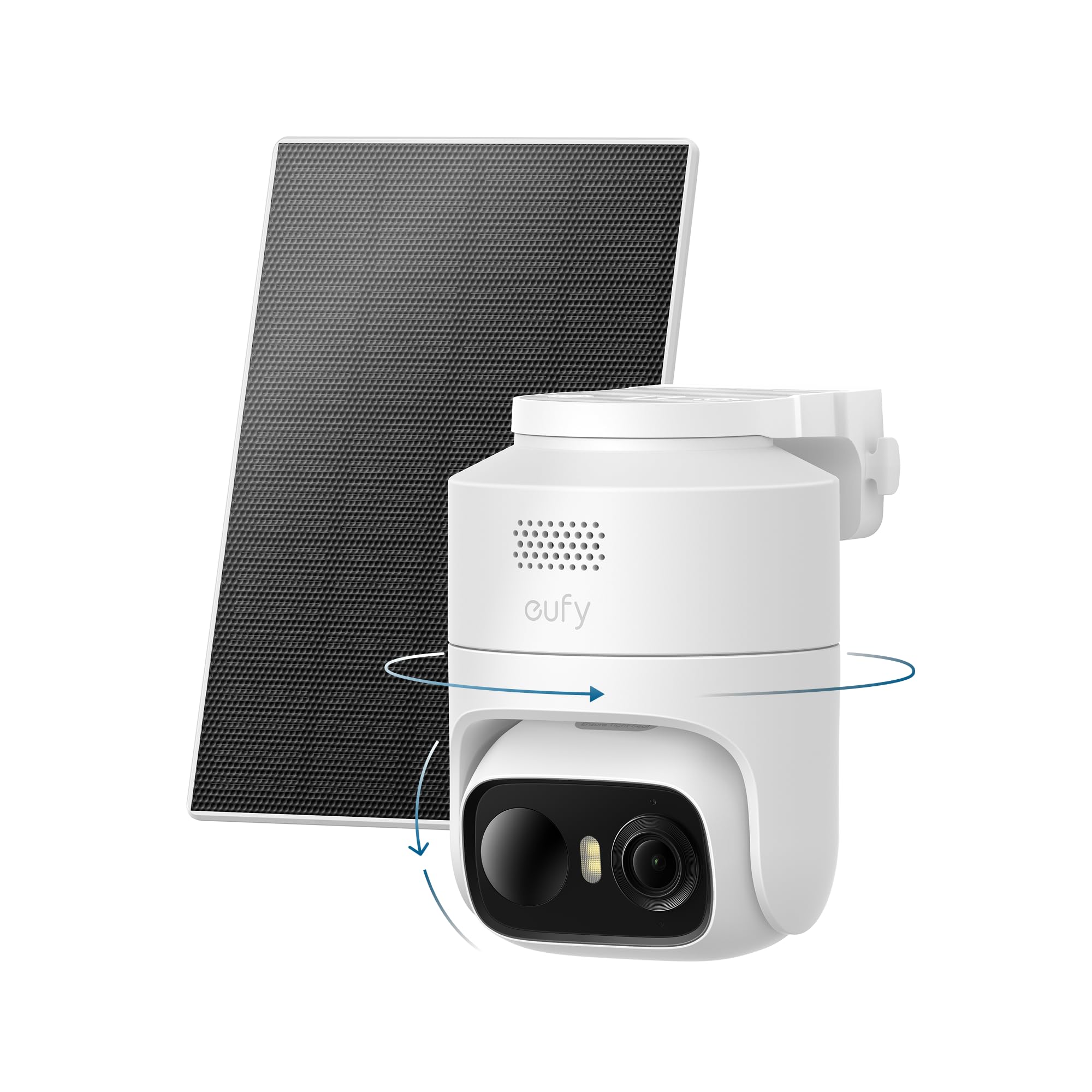
Most solar cams glue the panel to the body, which forces a compromise between where the sun hits and where the camera points. The C37 splits them. Each 3W solar panel mounts separately, so you can tilt the panel toward the sky and the camera toward the gate without either suffering. The 2K sensor and its built-in spotlight pull faces and plate details into color after dark, and the pan-and-tilt head swings a full 360° so a single install can sweep the whole yard.
Your long-term cost stays low because no cloud subscription is required — rare among the Ring and Arlo picks here. You slide a microSD card (a small memory card, like the one in a phone) up to 256GB into the camera, sold separately, or pair it with a HomeBase (a home storage hub) and every clip stays on your property. The WYZE Solar Cam Pan below takes up to 512GB, so that 256GB ceiling is the smaller figure. If you want the longest possible on-card history, the WYZE wins on raw capacity.
Two things to know before you mount it. First, it runs on 2.4GHz Wi-Fi only, so do not expect it to join a 5GHz-only network. Second, it will not work with HomeKit, HomeBase2, or the E50 recorder, so check your existing gear against the supported list before committing. Set expectations on the app side too: it wants eufy App version 6.0.10 or newer for smooth pan and tilt.
Why the split panel wins: a detached solar panel means sun angle and camera angle stop fighting each other, which is the single biggest reason solar cams end up undercharged.
The Wi-Fi limit to respect: 2.4GHz only is fine for most yards, but a mesh network that pushes devices onto 5GHz will give this camera trouble.
Best for: a renter or homeowner who wants local-only footage and no monthly fee, with the sun doing the charging.
Not for: a HomeKit household or anyone already deep in the old HomeBase2 ecosystem.
3. WYZE Solar Cam Pan
The siren on this one is genuinely mean, and it pans a full circle while you watch.
Start with the number that separates it: a 105dB siren. That is painfully loud up close, and it is the loudest on this list by a clear margin — the Ring Floodlight Cam Wired Plus tops out at 85dB, so the WYZE is 24% louder on paper. Pair that with a motion-triggered spotlight and you have a camera that does more than record; it reacts.
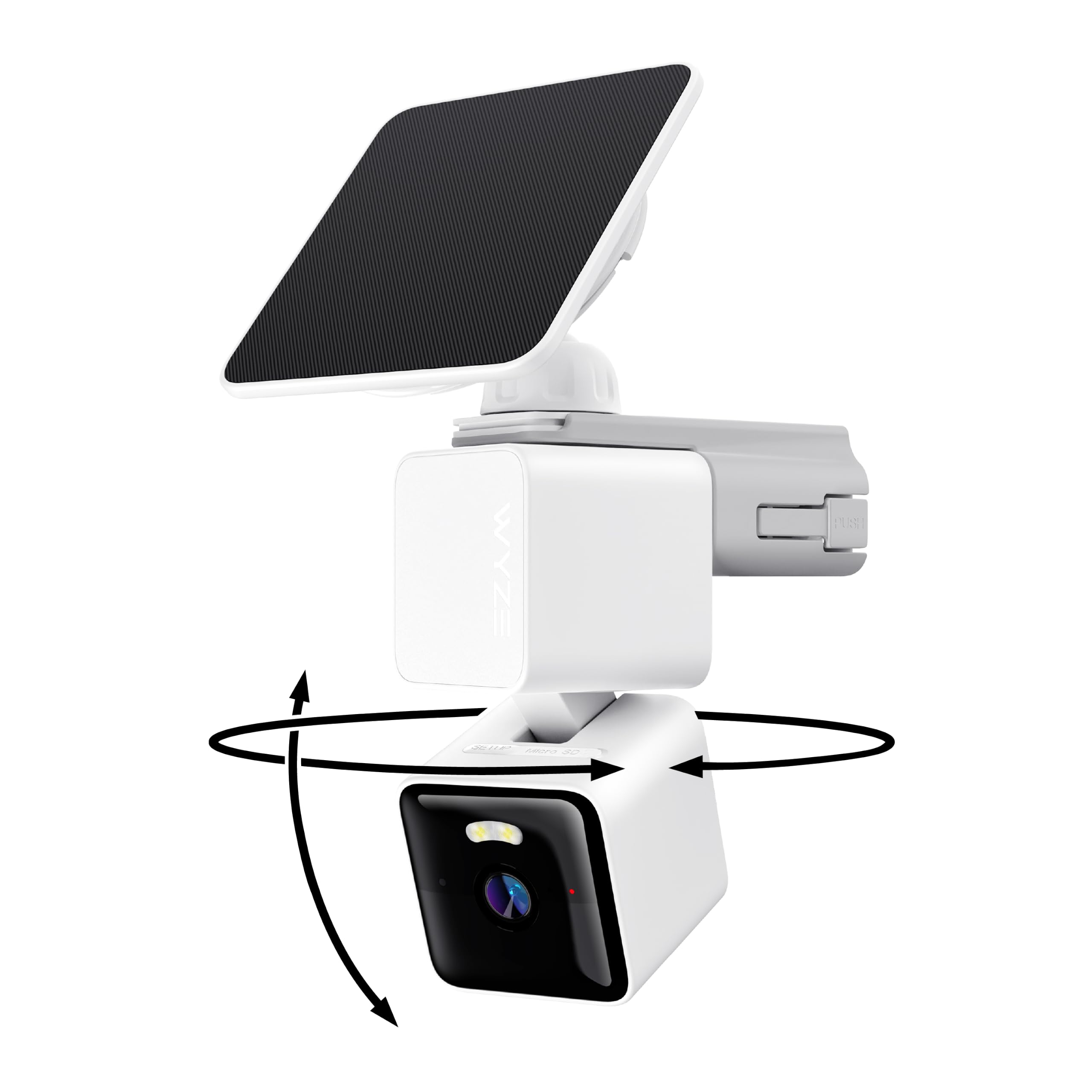
One unit can watch a whole back fence line: the 360° pan and 70° tilt sweep the full view, and the AI tracker keeps a walking person centered in frame. The 2K sensor (2560×1440 pixels, sharper than basic HD) with full-color night vision holds enough detail to read a face at the gate. It runs on a solar panel that needs only about an hour of direct sun a day to stay topped up. Local storage goes up to 512GB on a microSD card, which beats the eufy C37’s 256GB ceiling if archive length matters to you.
Here is the honest trade-off: the recurring tension with this camera is power and connection, not picture. The battery behavior and the 2.4GHz-only Wi-Fi (5GHz is simply not supported) draw the most mixed notes, and a weak signal at the far corner of a yard will show up as dropped events. It is also a budget-tier build — polycarbonate body, 10.72 ounces — so mount it out of easy reach rather than at shoulder height.
Standout strengths
- 105dB siren is the loudest alert on this list
- 360° pan and 70° tilt cover a wide yard from one mount
- IP65 weather resistance rated for rain, heat, and snow
- Up to 512GB local storage on a microSD card
Sized-down caveats
- 2.4GHz Wi-Fi only, so 5GHz networks are out
- Battery and connectivity behavior split opinion at the edges of coverage
Pick this when: you want a camera that actively scares someone off, not just films them, and your Wi-Fi reaches the spot.
Skip the mount-and-forget: plan its position so the panel gets sun and the Wi-Fi stays strong, or its best features stay idle.
4. Ring Floodlight Cam 2K

The cleaner picture of Ring’s two floodlights, with a zoom that reaches across the whole driveway.
Retinal 2K video is the draw, and 6x Enhanced Zoom is what makes it usable. A camera mounted over a garage sees a person at the far curb as a small figure — zoom pulls that detail in. Ring notes the video quality can vary with your internet bandwidth and the device’s temperature, so a strong Wi-Fi signal at the camera is part of the setup, not an afterthought.
Picture quality is the thing people talk about most here, and the brightness adjustments get consistent appreciation — you can dial the motion-triggered light so it illuminates without blasting the whole block. Against the older wired Ring above, this 2K model is the one to take if you care about crisp footage of faces and details; the 2000 lumen floodlight on the other Ring still wins on raw light output. Two-way talk and live view round it out so you can speak to a delivery driver from your phone.
The catch is the same Ring trade-off that runs through both units: the good stuff sits behind a Ring Protect Plan. Live View and alerts work without it, but scroll-back history and the intelligent alerts need the paid tier. A few buyers also find the lighting and sound quality only adequate rather than exceptional. Neither is a reason to walk away — it is a reason to know what you are buying into.
The zoom that earns the upgrade: 6x Enhanced Zoom turns distant movement into something you can actually identify, which is the difference between “someone was there” and “that was the neighbor’s kid.”
What a plan open up: the Ring Protect subscription is optional on paper, but the history and smart alerts that make this camera feel smart sit inside it.
Suits you if: you want a hardwired floodlight with the sharpest Ring footage and are willing to add a plan for the full feature set.
Think twice if: you want every feature to work without a subscription — the REOLINK pick below leans local.
5. REOLINK E1 Outdoor Pro

The only 4K camera here with real optical zoom — and infrared night vision that reaches 100ft.
This is the resolution leader of the group. 4K HD on an 8 megapixel sensor gives you roughly double the pixel count of the 2K cameras here, so a face at the fence line carries genuinely more detail. Add 3x optical zoom — optical, not digital, so the image stays sharp as you push in — and infrared night vision (invisible light the camera uses in the dark) reaching up to 100ft, and this is the pick for identifying someone at the far end of a long yard.
The PTZ head pans 355° and tilts 50°, and the camera auto-tracks people and vehicles it recognizes. Wi-Fi 6 with both 2.4GHz and 5GHz support means it can ride a modern mesh network better than a 2.4-only cam. It is plug-in powered, so there is no charging to babysit, and it records to a microSD card up to 512GB. A 2-year limited warranty backs it, which is note given it sits in the premium tier.
The honest limit is the connection. Wi-Fi feedback splits here more than on any other pick — some report strong signals, others fight to connect even on their own network. Panning also draws more complaints than praise, which is odd for a PTZ camera and worth knowing. And the waterproofing has a quirk: for outdoor use Reolink says the camera must be mounted upside down for best water performance. Read that twice before you drill.
What the 4K buys you: an 8MP sensor and 3x optical zoom mean real identification detail, not the smeared digital crop you get from interpolated “zoom.”
The mounting rule nobody skips: mount it inverted outdoors, per Reolink’s own guidance, or the waterproof rating will not do its job.
Go here for: the sharpest footage on the list and an outlet nearby to feed it power.
Hold off if: your Wi-Fi is patchy at the mounting spot — this one is fussier about signal than the wired Rings.
6. Tapo C610 KIT
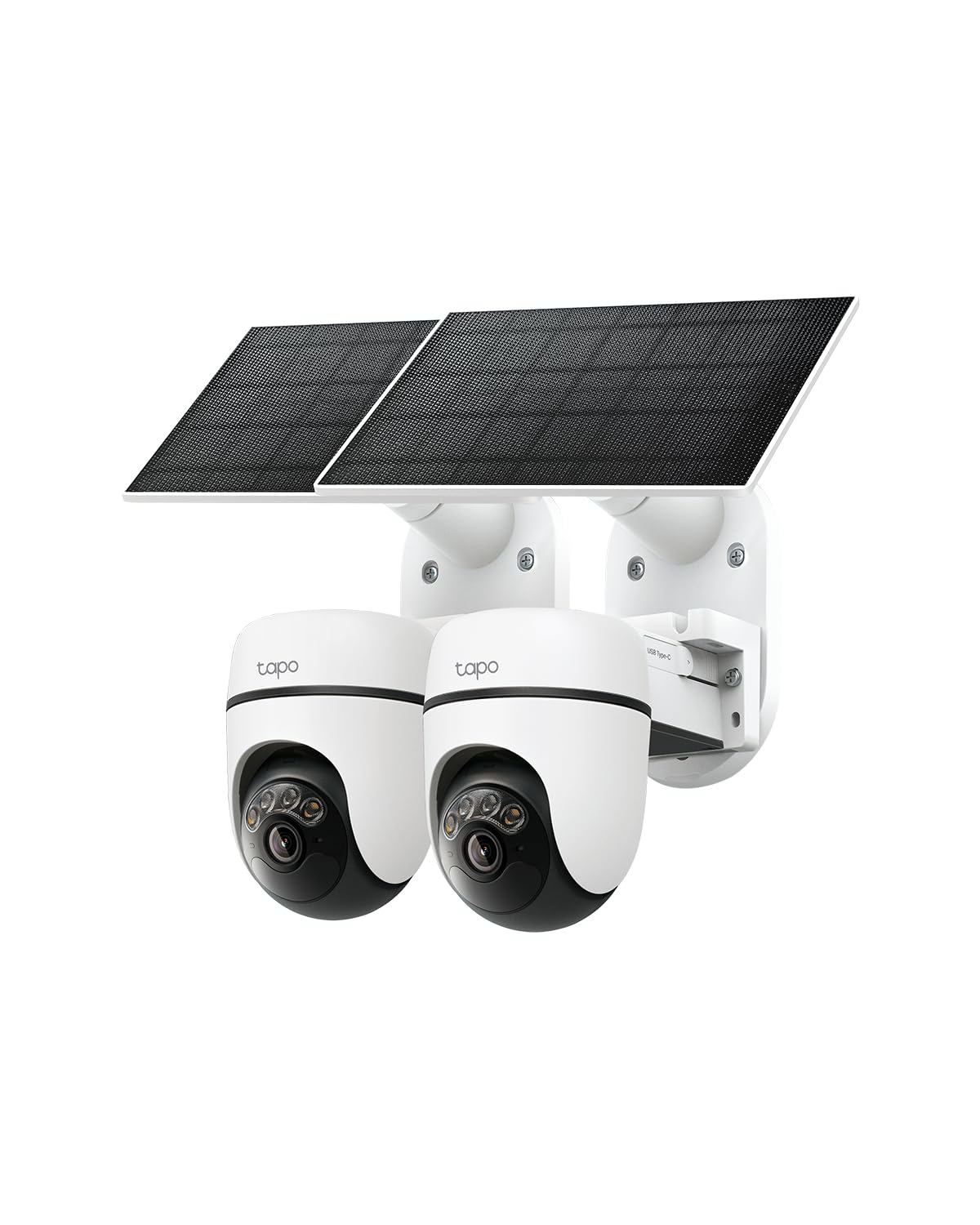
Two pan-tilt cameras and two solar panels, watching both ends of the house at once.
One camera always leaves a blind spot; two cover the front entrance and the backyard at the same time, and the Tapo app shows both in split-screen so you are not flipping between feeds. Each camera pans a full 360° horizontally and 130° vertically, which Tapo notes actually exceeds the mechanical pan range once you count the viewing angle.
The charging math is simple: 45 minutes of direct sunlight powers a full day of use, and the built-in battery carries up to 3 months on a charge through cloudy stretches. The one hard limit is temperature — solar charging needs the air above 32°F, so a deep-freeze week means the panel sits idle. On-device AI sorts people from general motion locally, and you can record to a microSD card up to 512GB with no monthly fee, or add Tapo Care if you want cloud backup.
Owners come away impressed by the picture and the night detail, and the battery behavior earns particular favor — the panels top the cells back up quickly on a sunny run. It works with Alexa and Google, and it runs on 2.4GHz Wi-Fi. Against the single-camera picks, the two-pack wins on coverage: for roughly the same outlay you watch two zones instead of one.
Why the pair pays off
- Two cameras cover front and back, viewed together in split-screen
- 45 minutes of sun gives a full day of power
- Battery holds up to 3 months through cloudy days
- Up to 512GB local storage with no monthly fee
Worth knowing first
- Solar charging stops below 32°F
- 2.4GHz Wi-Fi only, so a 5GHz-only network won’t connect
Right for: a home with two areas to watch and a sunny spot for each panel.
Wrong for: a shaded yard in a cold climate, where the solar panels will spend winter waiting for warmer air.
7. aosu T2 Pro
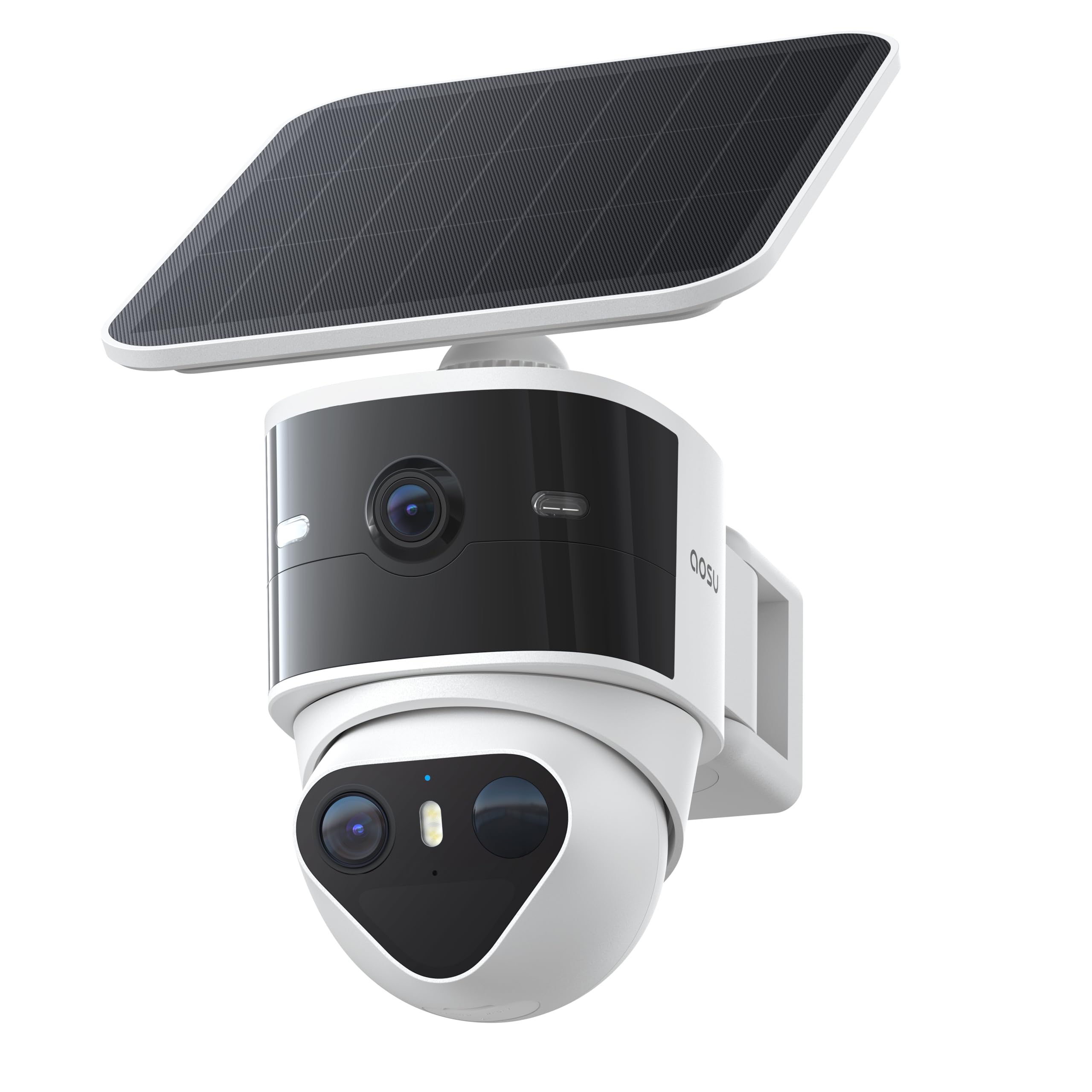
Two lenses in one body: a fixed wide eye that watches everything and a zoom head that chases details.
Most cameras make you choose between a wide view and a close-up. The T2 Pro sidesteps that. A 170° fixed wide-angle lens holds the whole scene while a 360° PTZ camera zooms and follows movement, so you see the driveway in overview and the person’s face in the same event. Tap anywhere on the wide view and the PTZ swings there, which turns a fence line into a clickable map.
Both lenses pull 3K footage, and up to 8x hybrid zoom helps you read activity at distance. Power comes from a 5W solar panel paired with a built-in 9200mAh battery — a large reserve, and aosu says 90 minutes of direct sun a day keeps it running. The panel detaches so you can place it for sunlight while the camera points where the coverage is needed. Local storage maxes at 256GB on a microSD card, or you can add cloud backup.
This is the pick for a long or oddly shaped property where a single fixed lens leaves gaps. The wide overview plus tracked close-up is genuinely more useful than a plain pan-tilt cam. Do mind the app and network basics — 2.4GHz Wi-Fi only, and setup runs through Bluetooth, a QR code scan, or the aosu app.
The dual-lens advantage: a 170° fixed lens never loses the big picture, which a pan-tilt camera does the moment it swings away.
Battery you can trust: a 9200mAh cell is a substantial reserve, so cloudy weeks are a worry, not a crisis, provided the panel sees some sun.
Choose it for: a yard with awkward angles where you want both the whole view and a close-up of whoever triggers it.
Pass if: you would rather have one simpler camera — the dual-lens design asks more of the app and the setup.
8. Arlo Pro Wireless Security Camera 2K HDR (6th Gen) – 4-Cam

Four rechargeable cameras that blanket the whole property, with a swap-and-go battery design.
Covering a full property with four cameras is the entire point here, and the swappable, rechargeable battery is what makes it practical. Instead of running wire or waiting on the sun, you pop the battery, charge it, and drop it back in — the camera goes right back to work. Each 2K HDR sensor uses a 160° panoramic field of view, and HDR (high dynamic range) keeps both the shaded porch and the sun-blasted driveway readable in one frame.
Smart detection is where the Arlo ecosystem shines if you feed it. The Arlo Secure plan open up 60-day video history, AI detection, and event captions that describe what happened, plus a keyword search so you can find the clip of the car that drove past. Live streaming and basic alerts work without the plan, so the camera is functional out of the gate. Auto zoom with motion tracking follows whatever moves, and 12x zoom pulls detail in further.
Two honest notes. Reliability and value draw mixed feelings — the recurring theme is the subscription, which some feel they cannot fully escape for the advanced features. The battery life is generous enough for a multi-month rotation, and with four cams you can swap one at a time without pulling the whole system. This is the biggest single investment in the group, so it fits a buyer who wants an ecosystem, not a lone camera.
Where four cams earn the spend: front door, driveway, back gate, and side alley in one system, with a swappable battery that keeps each unit in service.
The plan question: 60-day history and AI detection sit behind Arlo Secure; basic live view and alerts don’t, so weigh how much you want the extras.
Best for: a large home or small business that wants four wireless cameras covering every approach.
Look elsewhere if: you want zero subscriptions or you would rather start with one camera — this is a full system buy.
9. aosu D1 Max
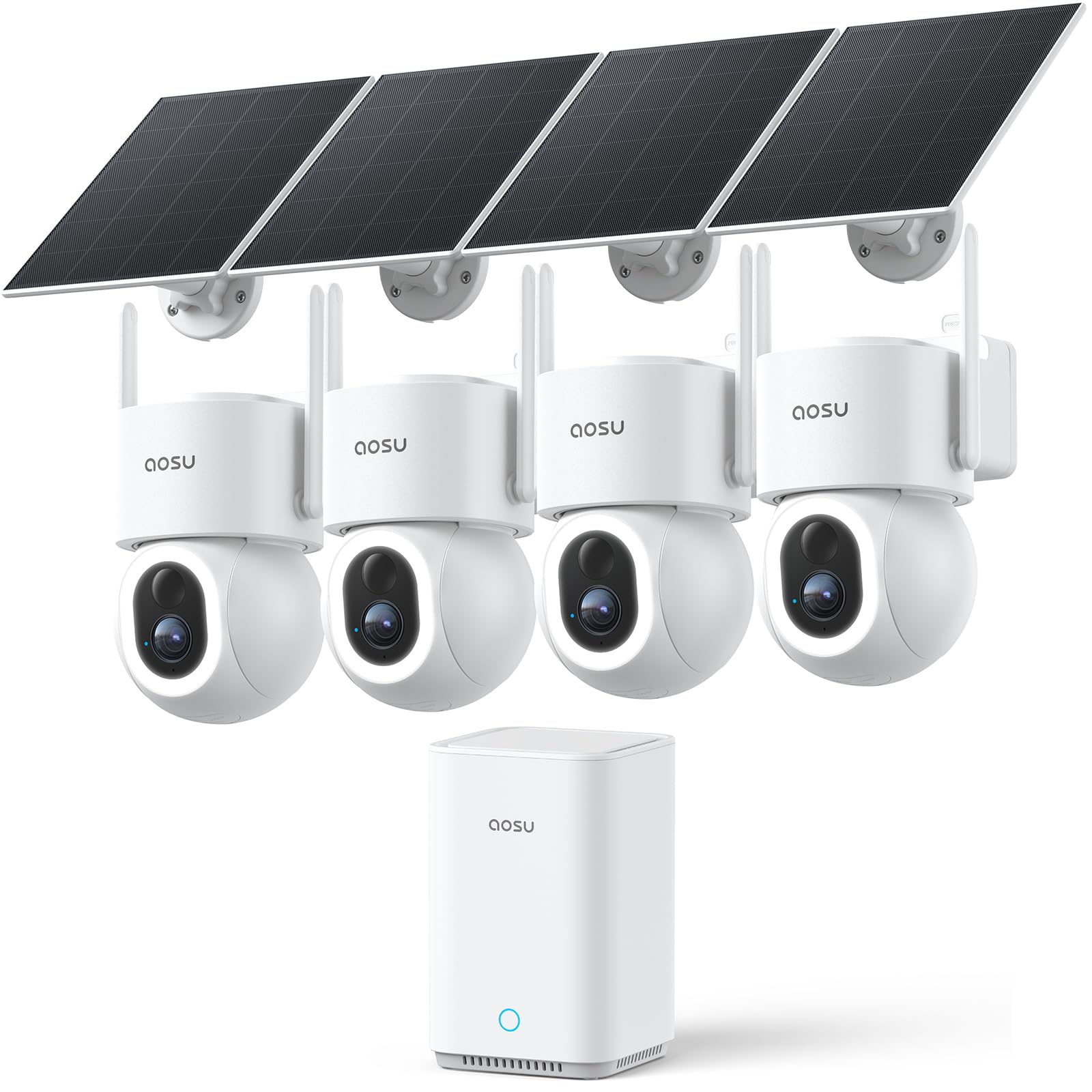
Four 4K cameras, a base station that stitches them together, and no monthly bill to do it.
This is the full-property answer with the highest resolution in a multi-cam kit: 4K Ultra HD from an 8MP sensor, with 6x digital zoom and enough clarity to read a license plate up to 33ft away, per aosu. Each camera pans, tilts, and auto-tracks people and vehicles. The aosuBase ties the four together, grouping cross-camera clips into one continuous timeline so a subject moving from the front yard to the side gate shows up as a single story.
Storage stays in your house. The kit ships with 32GB included and expands up to 1TB, and there is no subscription required to keep the footage. Each camera runs on a detached solar panel so you can angle it for sun, backed by a 5200mAh battery inside. The base station also carries the connection — cameras talk to it over wireless, and it hardwires to your router over Ethernet, which is more stable than a chain of Wi-Fi links.
The mixed side is what you’d expect from a system this ambitious. Reliability and battery life draw divided feedback, and Wi-Fi between the cameras and base can falter over long distances in a big house — the Ethernet backbone helps, but it is not magic. On the plus side, setup itself earns strong praise, so the DIY install stands the panels and brackets in a couple of hours rather than a weekend.
What a big kit delivers
- Four 4K cameras cover the whole property in a single system
- Base station stitches cross-camera clips into one timeline
- 32GB included, expandable to 1TB, with no subscription
- Ethernet-backed base gives steadier connections than pure Wi-Fi
Plan around this
- Long distances strain the camera-to-base wireless link
- Battery life feedback is divided on this bigger system
Built for: a large property where one 4K kit should cover four zones and local storage is a must.
Overkill if: your yard is small — a single strong camera like the top pick covers a driveway just fine.
Know the Specs
Resolution And Optical Zoom
Resolution counts the pixels in a frame; 2K is sharper than 1080p, and 4K (around 8 megapixels) is sharper still. More pixels help you read a face or a plate, but only if the lens can actually bring the subject in. That is where zoom splits into two kinds: optical zoom moves the lens physically and keeps the image sharp, while digital zoom crops and enlarges the pixels you already have. The REOLINK E1 Outdoor Pro’s 3x optical zoom is a real lens move; a digital zoom claim is a crop and softens as it climbs.
Solar Panels, Batteries, And Sun Angle
How long a solar camera keeps running depends on two numbers: panel wattage and battery capacity. Panel wattage (like the 3W on the eufy C37 or 5W on the aosu T2 Pro) is how fast the sun refills the battery. Battery capacity (measured in mAh, like the 9200mAh on the T2 Pro) is how long it lasts through cloudy days. A detached panel lets you aim the panel at the sun while the camera points at your gate — that split is what saves most undercharged installs. Cold weather is the other factor: the Tapo kit notes solar charging needs air above 32°F.
Local Storage Versus Cloud Plans
A microSD card or base station keeps footage on your property with no monthly cost, which is why local storage matters if you do not want another bill. A card up to 512GB (Tapo, WYZE, REOLINK) holds more archive than a 256GB cap (eufy C37, aosu T2 Pro). A base station like the aosu D1 Max brings 32GB included and expands to 1TB. Cloud plans and subscriptions add history and smarter alerts, but they are recurring spend — decide if you want the features or the fee before you buy.
Sirens, Weather Ratings, And Wi-Fi Bands
A siren’s loudness is rated in decibels (dB), and the difference is real: the WYZE Solar Cam Pan’s 105dB siren is 24% louder than the Ring Floodlight Cam Wired Plus’s 85dB. Weather ratings like IP65 mean the housing resists dust and water spray, so the camera survives rain, heat, and snow. On the network side, most of these cameras run on 2.4GHz Wi-Fi only, which reaches farther through walls than 5GHz but offers less speed — if your router pushes devices onto 5GHz, check compatibility first.
Common Questions
Do yard security cameras need Wi-Fi to record?
How long does a solar security camera’s battery last?
Is 4K really better than 2K for a yard camera?
Can I use these cameras without a monthly subscription?
What does IP65 weather-resistant actually mean?
Which camera covers the widest area from one mount?
Will a wired floodlight camera work if my driveway has no outlet?
Do these cameras work with Alexa and Google Assistant?
How far should a yard camera be mounted from the router?
Is a loud siren or a bright light better for deterring intruders?
The Bottom Line
For most yards, the yard security cameras winner is the Ring Floodlight Cam Wired Plus (2nd Gen). It pairs 2000 lumen floodlights with nonstop hardwired power and an 85dB app siren — no charging, no solar angle to plan, and the deepest install experience behind it. If you would rather have local-only footage with no monthly fee and the freedom to mount it anywhere the sun reaches, grab the eufy Security eufyCam C37. And when the goal is sharp identification at the far end of a long driveway, the REOLINK E1 Outdoor Pro leads on resolution with 4K and 3x optical zoom.
One nudge: the Ring Floodlight Cam Wired Plus carries both the highest rating here and the largest owner base behind it, so it is the lowest-risk place to start if you have power where you need it. Match the power source to your property first — wired for a junction box, solar for an open sunny wall — and the rest of the choice gets a lot simpler.
How we choose
We do not accept paid placement. Every pick is matched to a real buyer and a real use-case; we do not hands-on test units.
Sources
Specifications: manufacturer listings and product documentation. Review insights: verified customer reviews, as of November 2026. Pricing: not shown on this page (it changes often); check the current price via the retailer link.
As an Amazon Associate, Tactical Gear Guy earns from qualifying purchases. This does not affect which products we feature.