Specs are compiled from manufacturer listings and verified buyer reviews and can change over time — please confirm the key details on the product page before buying.
Buying a saw blade is simpler than the packaging suggests: the tooth count and the kerf decide almost everything you will feel on the cut. A blade with few teeth rips fast and leaves a rough edge you have to sand. A blade with many teeth leaves a glass-smooth edge but cuts slower and costs more. Below you will find nine blades that actually work on wood, sorted by what each one does best — ripping, crosscutting, or finish work that needs no sanding afterward.
This guide is built by comparing the manufacturers’ published specifications and the patterns across verified customer reviews, so you get each pick’s real strengths and trade-offs instead of marketing spin.
You will learn which tooth count suits ripping versus crosscutting, why kerf thickness matters for your motor, and which arbor size fits your saw. The clearest way to sort through woodworking circular saw blades is to match the tooth count to the job before you look at anything else.
Top Picks

How To Choose The Best Woodworking Circular Saw Blades
Most beginners buy one blade and expect it to rip, crosscut, and finish — no single blade does all three well. A 24-tooth blade and an 80-tooth blade are built for opposite jobs, and swapping between them is how you get clean results without fighting your saw. Start with the cut, then work backward to the tooth count.
Match tooth count to the cut, not the brand
Low tooth counts — 24 to 40 — clear chips fast and rip boards along the grain without bogging down the motor. High counts — 60 to 80 — make many small passes and leave a smooth edge for crosscuts and finish work. If you frame houses, a 24-tooth blade is the workhorse. If you build cabinets, you want 60 teeth or more.
Understand kerf before you buy
Kerf is the width of the slot the blade carves out — thin kerf removes less wood and puts less load on the motor, which matters most on portable and cordless saws. A thick kerf blade is stiffer and stays true in deep rips on a table saw. Neither is better; they suit different tools and different depths of cut.
Check the arbor and the diameter
The arbor is the center hole that mounts on your saw’s spindle — 5/8-inch is the common size on 10-inch table and miter saws. A 7-1/4-inch blade fits a standard circular saw; a 10-inch blade fits a table or miter saw. Measure your saw’s arbor and guard clearance before ordering, because a blade that does not mount is money wasted.
Side-by-Side Comparison
| Model | Best For | Diameter | Teeth | Arbor | Amazon |
|---|---|---|---|---|---|
| DEWALT DWA11040★ Best Overall | All-purpose table saw work | 10″ | 40 | — | Amazon |
| CMT P07060 ITK PlusMelamine Master | Two-sided melamine and plywood | 7-1/4″ | 60 | 5/8″ | Amazon |
| DEWALT DWA1714243Best Three-Pack | Framing and rough cuts | 7-1/4″ | 24 | — | Amazon |
| FOXBC FOX10-60T | Crosscutting oak and moulding | 10″ | 60 | 5/8″ | Amazon |
| BOSCH DCB760 | Extra-fine finish on sheet goods | 7-1/4″ | 60 | 5/8″ | Amazon |
| Diablo D0760A | Ultra finish crosscuts and rips | 7-1/4″ | 60 | 5/8″ | Amazon |
| Makita B-66977 | High-volume miter saw trim work | 10″ | 80 | — | Amazon |
| Freud LM74R010 | Glue-ready rip cuts | 10″ | 30 | — | Amazon |
| Freud LU85R010 | Picture-frame and fine crosscuts | 10″ | 80 | 5/8″ | Amazon |
Detailed Reviews
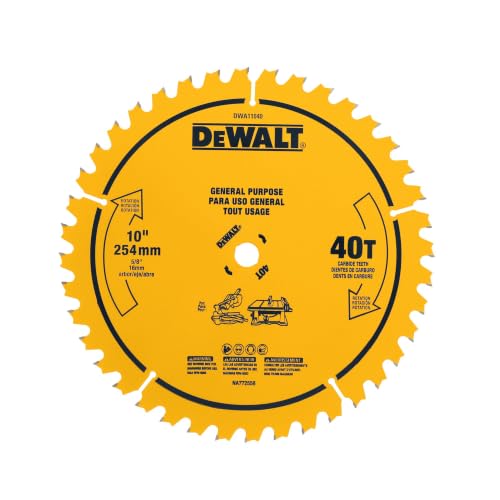
1. DEWALT DWA11040 Table Saw Blade
Our pick — 4.5+★ from 550+ verified ratings; the strongest balance of quality and price.
Forty teeth that rip red oak and still leave a finish edge — the do-it-all table saw blade.
If you own one table saw and want one blade on it most of the time, this is the one. Forty teeth is the middle ground of the blade world — enough teeth for a clean crosscut, few enough to keep the motor from straining in a long rip. DEWALT’s own listing points to a tooth geometry tuned for accuracy, and the carbide tips stay sharp through hardwood. 500+ owners have rated it at 4.5+ stars, which is why it takes the top spot here.
The cutting reports are the interesting part. Red oak is the benchmark hardwood in most shops, and this blade reportedly handles a 2-inch cut with ease and rips through a one-inch red oak threshold without complaint. That is the test that separates a real 40-tooth blade from a shelf filler — soft pine hides a dull blade, oak does not. The Ultra Sharp carbide shears oak fibers cleanly instead of crushing them, so you spend less time at the sander.
What wins people over most is plain build quality — it is the most-discussed strength of this blade by a wide margin, ahead of cut quality. That reads as a blade that arrives flat, stays true, and does not throw a wobbly cut on the first board. The one caveat worth naming: a 40-tooth blade is a compromise, not a specialist. It will not match an 80-tooth blade on picture-frame trim, and it will not rip as fast as a 24-tooth framer’s blade.
What earns it the top slot
- 40 teeth handle both crosscuts and rip cuts in hardwood without swapping blades
- Carbide tips hold an edge through red oak and other dense stock
- Anti-kickback tooth geometry designed for accuracy over the life of the blade
- 10-inch diameter fits standard table saws and many miter saws
Where it gives ground
- Not a specialist — an 80-tooth blade will beat it on fine trim
- Rips slower than a low-tooth framing blade in thick stock
- 0.59 kg of steel means it has real heft on the arbor
Reach for this if: you want one blade that handles cabinet plywood and framing lumber on the same saw.
Look elsewhere if: every cut you make is finish trim on expensive veneer — you want more teeth.
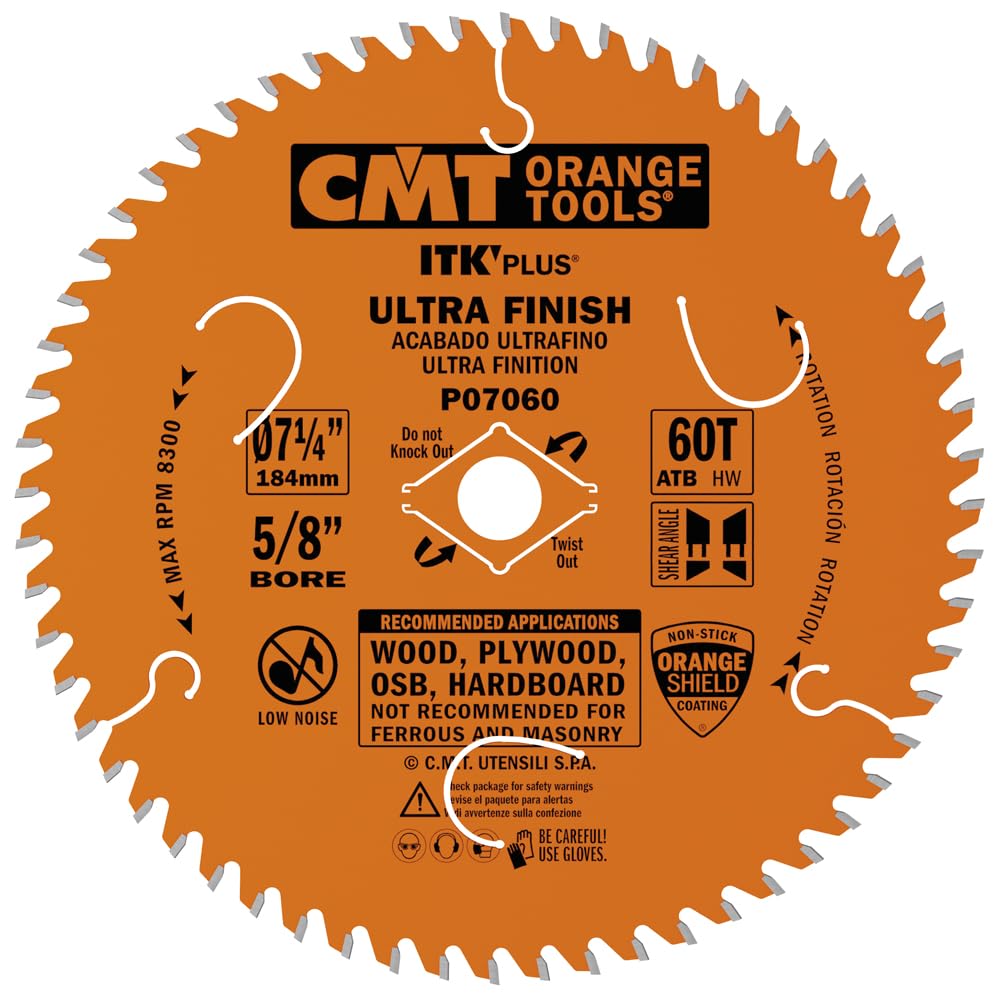
2. CMT P07060 ITK Plus Saw Blade
The 7-1/4-inch blade that treats two-sided melamine like a finished surface, not a risk.
Melamine is the blade killer in every cabinet shop. Cut it with the wrong tooth grind and you get chip-out on the bottom face that no edge banding will hide. CMT built this blade for exactly that job: 60 teeth in a 10-degree ATB grind, plus a shear angle designed to slice the surface instead of lifting it. The kerf thickness is 0.069 inches and the plate is 0.043 inches, which makes this a super-thin blade that wastes less material per cut.
What the shop floor keeps coming back to is the finish. Zero tear-out on two-sided melamine is the claim that gets repeated, and it matters because that is the one cut where a bad blade means a scrapped panel. The thin kerf also cuts down the load on a portable circular saw, so an 18-volt cordless saw does not bog down in plywood the way it might with a thicker blade. Fits both portable and cordless circular saws, with a 5/8-inch bore.
Build quality is the most-praised trait here, which tracks with CMT’s orange Shield coating — a non-stick finish meant to stop pitch build-up and corrosion. For panel work, that is a fair trade.
Finish first: The 10-degree ATB shear tooth and the 0.069-inch kerf combine for clean two-sided cuts in melamine and plywood, with the coating keeping resin off the plate.
The honest caveat: 60 teeth and a thin plate are a crosscut recipe — long rips in thick hardwood are better served by a heavier blade.
The panel-work pick: cabinet builders and anyone cutting melamine, plywood, or OSB sheets on a portable saw.
Wrong tool for: deep rips in 8/4 hardwood, where a stiff thick-kerf blade tracks better.
3. DEWALT DWA1714243 Circular Saw Blade 3 Pack
Three 24-tooth framers in one box, built to chew through nail-embedded 2x4s all day.
Here is the number that tells the story of this pack: 6.56 ounces per blade, against 14.4 ounces for the Diablo 7-1/4-inch blade further down this list. That is less than half the weight, and on a handheld circular saw that lightness is the difference between a saw that feels balanced and one that feels nose-heavy on a long cut. Twenty-four teeth means fast, aggressive material removal — the framing and demolition end of woodworking.
The tooth design is DEWALT’s patent-pending ToughTrack geometry, which is aimed at keeping the blade tracking accurately over its whole life rather than just the first few cuts. The high-density tungsten carbide and the reinforced shoulder are there for the rough stuff — the shoulder is built to take impact in nail-embedded wood, which is exactly the scenario that snaps cheaper teeth. Cut 2×4 boards like a hot knife through butter is how buyers describe it, and pressure-treated 6×6 stock comes up as another job this pack handles without drama.
Value is where this pack really lands — it is the second most-discussed strength, right behind quality, and three blades for the price bracket of one premium blade is hard to argue with if you go through blades. The honest limit is finish. Twenty-four teeth are not going to give you a glue-ready edge, and the thin kerf design is aimed at smooth fast cuts, not furniture-grade surfaces.
Best for volume: Framers, deck builders, and anyone burning through blades on pressure-treated lumber — three at once keeps you cutting.
Set your expectation: This is a rough-cut blade. Plan a finish pass with 60 teeth or more on anything you plan to see.
Stock-up choice: rough framing, decking, and nail-embedded demolition where speed beats surface quality.
Not for the finish pass: visible trim and cabinet work need a higher tooth count.
4. FOXBC 10 Inch Table Saw Blade

A 60-tooth crosscut blade that owners rank alongside the premium names, at half the swagger.
Sixty teeth in a 10-inch blade is the classic crosscut recipe, and this FOXBC runs a 0.087-inch kerf with an ATB grind — a tooth shape that alternates bevel angles left and right to shear fibers cleanly. The 5/8-inch arbor is the common size on 10-inch table and miter saws, and the fit list names DeWalt, Skil, Metabo, and Makita saws, including specific models like the DeWalt DWE7491RS and the Skil TS6307-00. If your saw is on that list, you know it mounts.
Sharpness is what this blade is known for more than anything else, and the reviews back the tooth count with real results — virtually no splinters or tear-out in oak, pine, melamine, plywood, and moulding. The comparison that keeps surfacing is that it performs as well as Diablo and Freud blades, which is a bold claim for a blade that sits in the mid-range bracket. High-density tungsten carbide and a thin plate built for less vibration and noise are the reasons it can make that claim with a straight face.
One thing to plan around: 60 teeth cut slower than a ripping blade, so if most of your work is long rip cuts in thick stock, you will feel the pace. For crosscuts, miters, and trim, that tooth count is the whole point.
Why crosscutters like it
- 60 ATB teeth leave clean edges in oak, pine, melamine, plywood, and moulding
- 0.087-inch thin kerf with a plate built to cut vibration and noise
- 5/8-inch arbor fits a broad list of 10-inch table and miter saws
- Owners put its cut quality in the same conversation as premium blades
What to plan around
- 60 teeth trade speed for finish — long rips feel slow
- Thin kerf means a gentler feed rate in dense hardwood
Great match for: miter saw trim, cabinet crosscuts, and any job where the edge has to be ready to finish.
Skip if: the bulk of your cutting is ripping thick stock on a table saw.
5. BOSCH DCB760 Circular Saw Blade

Drop it in a cordless saw and plywood edges come off the saw needing no touch-up.
Most stock circular saw blades leave a plywood edge that needs a sanding block before it looks decent. Bosch built this one to change that: 60 triple-sharp teeth in a 7-1/4-inch blade sized for a portable circular saw, with a 5/8-inch arbor and a diamond knockout. The C3 carbide is the premium grade Bosch uses, and it starts sharp and stays sharp — that is the claim the design hangs on.
What owners keep noticing is the cut quality against whatever stock blade came with their saw. Clean cuts in sheet goods is the specific job this blade gets praised for, which makes sense given the tooth count and the thin kerf. The Speed Coat finish is there to cut friction and heat, and a cooler-running blade holds its edge longer and leaves less burn on the wood. Reviewers consistently report long edge life, and at 7.8 ounces it keeps a handheld saw balanced.
The trade-off is not hidden: at 60 teeth on a 7-1/4-inch blade, this is a finish blade for a circular saw, not a ripping blade. Feed it too fast in thick hardwood and you will feel it slow down. Used for what it is built for, the difference over a stock blade is immediate.
The upgrade that shows up instantly: Three sharpened edges per tooth and Bosch’s C3 carbide turn a rough-cut saw into a finish tool on sheet goods.
Where it stops: This is a crosscut and finish blade — fast rips in thick lumber are another blade’s job.
Best for: cutting plywood, MDF, and sheet goods on a handheld circular saw where the edge will be seen.
The limitation: 60 teeth on a 7-1/4-inch blade need a steady, unhurried feed in dense wood.
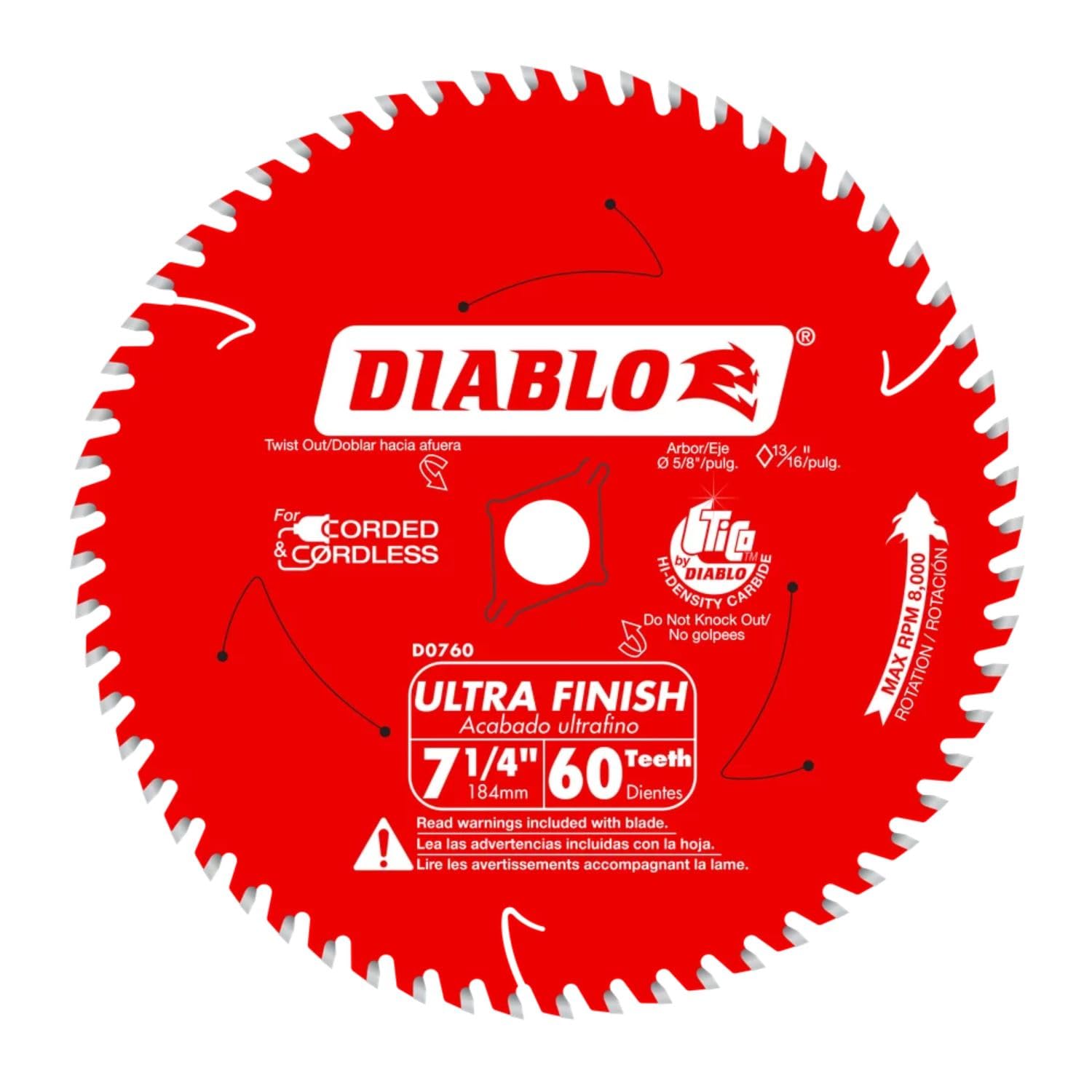
6. Diablo D0760A Saw Blade
Diablo’s ultra-finish blade brings cabinet-shop edges to a handheld circular saw.
The spec sheet on this one is a workshop in itself: a 0.059-inch kerf, a 0.040-inch plate, a 5/8-inch arbor, a 10-degree hook angle, and an 8000 max RPM rating. That kerf is remarkably thin for a 7-1/4-inch blade — it carves a narrow slot, wastes less material, and puts a lighter load on a cordless saw’s motor. Sixty ATB teeth are the finish end of the range, built for crosscuts and rip cuts in wood, plywood, and melamine.
Diablo’s TiCo carbide is the reason the blade earns its premium label. It is a high-density carbide blend tuned to each application for longer edge life, and the Perma-SHIELD non-stick coating keeps heat, gumming, and corrosion off the plate. The Tri-Metal shock-resistant brazing is the part that matters for durability — it lets the carbide tips take impact without snapping off, which is the failure mode that ends most blades early. A hardened steel body keeps the plate flat so the cut needs less sanding or finishing afterward.
Weight is the one figure worth flagging against the rest of this list: at 14.4 ounces, it is noticeably heavier than the DEWALT three-pack blades on the same 7-1/4-inch platform. On a handheld saw that is a real difference in feel over a long cut. It is a fair trade for the finish quality, but it is a trade.
What the premium buys: The 0.059-inch kerf and TiCo carbide leave a finish that needs less sanding, while Tri-Metal brazing protects the tips against impact.
The weight note: 14.4 ounces on a 7-1/4-inch blade is heavier than most, so a small cordless saw will feel it.
The finish-first pick: trim carpenters and cabinet makers who judge a blade by the edge it leaves.
Think twice if: you are ripping rough lumber all day — the finish teeth and the weight are wasted there.
7. Makita B-66977 Miter Saw Blade

Eighty teeth built to run a miter saw through trim all day and still cut like new.
Here is the tooth-count comparison that frames this blade: 80 teeth on a 10-inch disc, against 24 teeth on the DEWALT 7-1/4-inch three-pack. Forty extra teeth across a wider blade means each tooth takes a smaller bite and the edge comes out smoother — the reason 80-tooth blades live on miter saws doing finish trim. Makita’s ATAFR grind (alternate top, alternate face, with a raker tooth) is a variation on the theme that combines a smooth face with fast chip clearing.
The efficiency claims are Makita’s own and worth repeating as claims, not facts: Makita claims up to 100% faster cutting and up to 30% more cuts per charge than standard blades.. The thin kerf design is what backs the second one — less drag on the motor means the saw works less and the battery lasts longer. That matters most on a cordless miter saw, where every cut is drawn from the same pack. Trim crews running it in production report 800 square feet of material cut before the blade dulls.
Cutting performance is the top thing this blade gets praised for, with blade quality right behind it. The miter saw crowd compares it directly to the 90-tooth Diablo and comes out preferring this one, which is a serious endorsement in the trim world. The one you should know about: at 10 inches and 80 teeth, this is a dedicated miter saw blade, not a table saw workhorse.
Why trim crews reach for it
- 80 ATAFR teeth leave smooth faces on trim and moulding
- Thin kerf reduces load on the motor for more cuts per charge
- Holds up through large production runs without dulling out
- Smooth, fast cutting on a 10-inch miter saw platform
Know before you mount it
- Built for miter saws — not the blade for general table saw ripping
- 80 teeth cut slower than a low-tooth blade in thick stock
For the miter station: trim carpenters and finish crews who measure blade life in board feet of moulding.
Not your blade if: you need a general-purpose rip blade for a table saw.
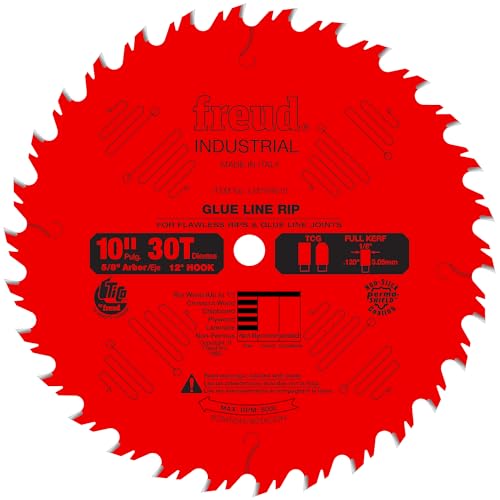
8. Freud LM74R010 Ripping Saw Blade
Thirty teeth in a triple-chip grind that leaves a rip edge ready for glue, not sandpaper.
Thirty teeth sounds low for a premium blade, and that is the point. This is a ripping blade — it cuts along the grain, and ripping generates long chips that need room to clear. The Triple Chip Grind (TCG) is the tooth shape that does exactly that, with a flat-topped raker tooth between beveled cutters that planes the bottom of the kerf flat. That flat bottom is why Freud calls this a glue-line blade: the edge comes off true enough to join without a jointer pass.
Freud’s TiCo high-density carbide blend in a ripping formulation is designed for edge retention in tough stock, and the Perma-Shield coating keeps pitch and resin from building up on the plate. The laser-cut anti-vibration slots are the quiet hero here — they reduce vibration and sideways movement in the cut, which keeps the kerf true and extends blade life. A thick kerf and reinforced plate give the blade stability and flatness in deep rips, which is where a thin blade starts to wander.
What shops report is smooth rips through all wood types with edges left ready for gluing, straight and true, including on melamine and plywood. The honest note: a 30-tooth TCG blade is built for the rip, and it is not a crosscut blade. Long-grain rips are its home ground; crosscutting with it will leave a rougher edge than a 60- or 80-tooth blade.
Built for the join: A 30-tooth Triple Chip Grind with anti-vibration slots delivers rip edges flat enough to glue up without jointing.
One-direction blade: It rips beautifully and crosscuts only passably — plan a second blade for trim.
Made for: furniture and cabinet builders who glue up panels and want to skip the jointer.
Two-blade shop: keep a crosscut blade alongside it; this one is a ripper first.
9. Freud LU85R010 Saw Blade
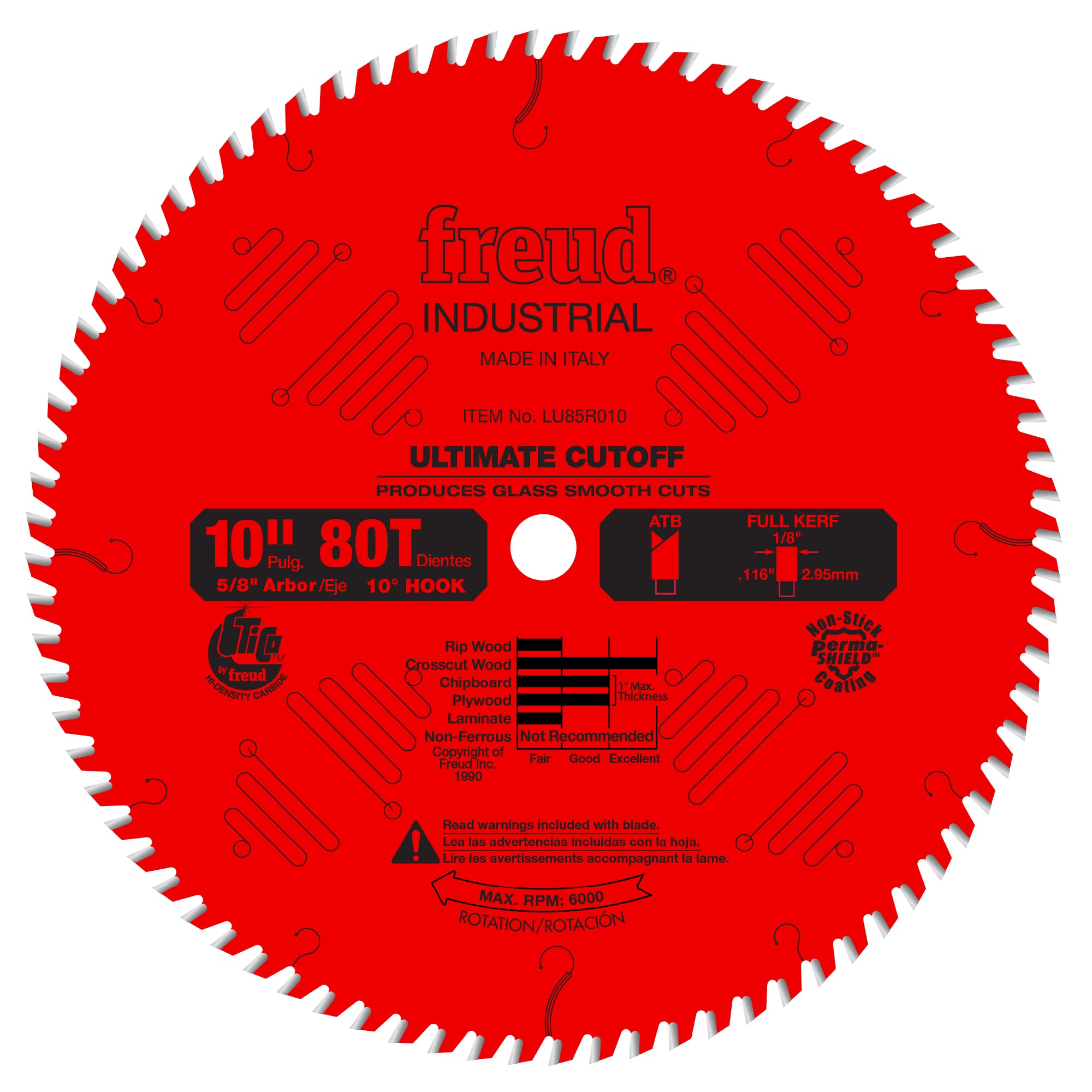
Eighty ATB teeth on a tensioned steel plate, aimed at picture-frame corners and fine trim.
The specs read like a precision instrument: 80 teeth, a 0.116-inch kerf, a 0.098-inch plate, a 10-degree hook angle, and a 38-degree ATB tooth with a positive cutting angle. That thicker kerf and heavier plate make it stiffer than the thin-kerf blades elsewhere on this list — stiffer means less wander and a flatter, truer cut in a deep pass. The 5/8-inch arbor fits standard saw machines, and the anti-vibration design is aimed at eliminating movement for flawless cuts.
This blade carries a reputation earned on the cut itself: razor-sharp, smooth clean edges that come off the saw without needing sanding. The build details back it up — 48 Rockwell steel plate, laser-cut and tensioned so the body stays flat and true over the blade’s life, and Tri-Metal brazing that gives the carbide teeth flexibility and impact resistance. The Silver I.C.E. coating cuts heat and protects against rust and corrosion, and the Perma-Shield non-stick coating reduces drag and pitch build-up. Being able to resharpend it inexpensively is the detail that becomes clearer the longer you own it.
Durability is where the reviews split — the smooth cut quality earns consistent praise, but a few buyers report carbide teeth arriving broken. Blade quality is the strength this blade gets praised for above everything else.
The case for the LU85R010
- 80 ATB teeth leave smooth, clean edges without a sanding pass
- 0.098-inch plate on 48 Rockwell steel stays flat and true for accuracy
- Anti-vibration design reduces movement in fine trim cuts
- Silver I.C.E. and Perma-Shield coatings fight heat, drag, and pitch
The refinements to know
- Some units arrive with broken carbide teeth — inspect on delivery
- 0.116-inch kerf is thicker than a thin-kerf blade, so more wood is lost per cut
Where it belongs: miter saws building picture frames, trim, and any cut where the edge is the finish.
Check on arrival: look over the carbide tips before the return window closes.
Know the Specs
Tooth count and grind
Tooth count sets the speed-versus-finish trade. A 24-tooth blade removes material fast and leaves a rough edge — that is a framing blade. A 60- or 80-tooth blade takes smaller bites and leaves a smoother edge for trim and finish work. The grind is the tooth shape: ATB (alternate top bevel) alternates bevel angles for a clean sheared edge on crosscuts, while TCG (triple chip grind) uses a flat raker tooth to plane the kerf bottom flat for glue-ready rips.
Kerf, plate, and arbor
Kerf is the width of the slot the blade cuts — thinner kerf removes less wood and puts less drag on the motor, which helps cordless saws stretch a charge. The plate is the steel body; a thicker plate stays stiffer in deep cuts and wanders less. The arbor is the center mounting hole, and 5/8-inch is the common size on 10-inch table and miter saws. Match the arbor to your spindle and check your saw’s guard clearance for the blade diameter before you order.
Common Questions
How many teeth should a woodworking circular saw blade have?
What is the difference between ATB and TCG tooth grinds?
Will a 7-1/4-inch blade fit my circular saw?
Can I use a table saw blade on a miter saw?
What does thin kerf actually mean for my saw?
How do I stop tear-out when cutting melamine or plywood?
Do more teeth mean a better blade?
How long should a carbide-tipped woodworking blade last?
Can a circular saw blade be resharpened?
Does arbor size matter when choosing a blade?
The Bottom Line
For most woodworkers, the woodworking circular saw blades winner is the DEWALT DWA11040 because 40 teeth handle both crosscuts and rip cuts in hardwood, and it has real backing across hundreds of owners. If you are cutting melamine and panel goods, grab the CMT P07060 for its clean two-sided finish. And for glue-ready rip cuts without a jointer, the Freud LM74R010 is the one to reach for. If you cut trim all day, the Makita B-66977 earns its place with 80 teeth aimed at smooth miter saw work. Pick the blade that matches your most common cut, and a second blade for the opposite job will keep the work moving.
How we choose
We do not accept paid placement. Every pick is matched to a real buyer and a real use-case; we do not hands-on test units.
Sources
Specifications: manufacturer listings and product documentation. Review insights: verified customer reviews, as of November 2026. Pricing: not shown on this page (it changes often); check the current price via the retailer link.
As an Amazon Associate, Tactical Gear Guy earns from qualifying purchases. This does not affect which products we feature.