Specs are compiled from manufacturer listings and verified buyer reviews and can change over time — please confirm the key details on the product page before buying.
Your pop-up camper has a problem no rooftop panel can fix: a roof that folds. That single moving part rules out most of the rigid solar panels sold for RVs, because a 50-inch glass-and-aluminum slab cannot ride on a collapsible roof. So you need either a foldable panel you carry out and lean at the sun, or a rigid one you bolt to a rail or rack that travels with the rig. This guide breaks down both routes, watt by watt and pound by pound, so you end up with a panel that fits your camper’s roof and storage bay instead of one you have to return.
This guide is built by comparing the manufacturers’ published specifications and the patterns across verified customer reviews, so you get each pick’s real strengths and trade-offs instead of marketing spin.
Weight and folded size decide whether a panel rides in the camper or stays home, and efficiency decides how many watts you get per pound. Here is how to match a solar panel for pop-up camper to your roof, your battery bank, and the way you camp.
Top Picks

How To Choose The Best Solar Panel for Pop-Up Camper
Start with your roof, not the wattage. A pop-up camper roof is either a hard folding lid or a fabric-and-frame shell, and neither one takes a big rigid panel bolted flat without some thought about how it folds down. Decide up front whether you are mounting a panel permanently or carrying a portable one that lives in the camper while you drive and comes out at camp.
Rigid roof mount or portable suitcase
A rigid module gives you more watts per dollar and needs no daily setup, but it lives outdoors year-round and takes the weather. A folding suitcase panel packs down small, leans at the best angle, and follows the sun, which helps when your campsite is half-shaded. On a pop-up, portability usually wins because you can chase the light instead of accepting whatever hits the roof.
Match the panel to your battery bank
A 12V system is the usual setup in a pop-up camper, and most of the panels here are built for it. Watts determine how fast you refill the battery, while the charge controller — the box that regulates power into the battery — protects it from overcharging. Some kits include a controller, some do not, so check that before you order.
Weight and folded size matter more than you think
You will lift this panel in and out of the camper on every trip. A 10-pound suitcase and a 24-pound rigid module feel very different at the end of a long day. Measure your storage bay or the space under the bunk before you buy, because folded dimensions decide whether the panel rides inside or on the roof.
Side-by-Side Comparison
| Model | Best For | Max Power | Weight | Efficiency | Amazon |
|---|---|---|---|---|---|
| Callsun N-Type 16BB 200W Bifacial★ Best Overall | Best overall for roof-mount power | 200 watts | 23.8 pounds | 25.6% | Amazon |
| DOKIO 100W Portable SuitcaseBudget Champion | Weekend campers on a budget | 100 watts | 10.1 pounds | High Efficiency | Amazon |
| Hoysicy 100W Kit with ControllerBest for Storage | Battery maintenance between trips | 100 watts | — | A++ | Amazon |
| Callsun 2×100W N-Type Pair | Tight roofs that need flexibility | 200 watts | 11.4 pounds | 25% | Amazon |
| WUZECK 200W 12V/24V Kit | Full off-grid cabin-style setup | 200 watts | — | 23% | Amazon |
| Renogy ShadowFlux 200W | Shaded, treed campsites | 200 watts | 23.8 pounds | 25% | Amazon |
| Ecosonique 200W Foldable | Power stations and multi-device charging | 200 watts | 11 pounds | 23.5% | Amazon |
| Renogy 200W Portable Blanket | Backpack-size storage in a small camper | 200 watts | 8.8 pounds | 25% | Amazon |
Detailed Reviews
1. Callsun N-Type 16BB 200W Bifacial Solar Panel
Our pick — 4.5+★ from 500+ verified ratings; the strongest balance of quality and price.
The highest efficiency on this list, and a split-cell design that keeps working when half the panel is shaded.
If you plan to bolt a panel to a rail on your pop-up or carry one on a roof rack, this is the one that earns the top slot. It turns sunlight into usable power at up to 25.6% efficiency — meaning about a quarter of the light that hits it becomes electricity — thanks to N-type cells and a 16BB busbar layout (the fine metal lines that collect current across each cell). In practice that means you get your 200 watts from a smaller footprint than a cheaper panel would need.
The bifacial build is the real story for off-grid camping. The back of the panel is transparent, so it also catches light bouncing up off sand, pale gravel, or a white roof — which is why buyers report output above the 200-watt rating in full sun. The panel is also split into two independent halves, so when a tree branch shades one side the other keeps pushing power instead of the whole thing collapsing. It measures 51.3″L x 30.3″W x 1.4″H and weighs 23.8 pounds, so plan a roof or rail mount rather than a daily lift.
For a camper, the shade tolerance is the feature you will actually notice. Parked under a canopy of oaks, a plain panel can flatline; this one keeps a usable trickle coming in. The 200-watt panel carries an 8.43 A amperage rating and a 23.74 V maximum voltage, and it runs on 60 cells behind 3.2mm tempered glass in an aluminum frame with an IP68 junction box (IP68 means it is sealed against dust and long water immersion).
What earns its keep
- 25.6% efficiency squeezes more watts from a compact 51.3 x 30.3 inch footprint
- The bifacial backsheet collects reflected sunlight the roof alone would miss
- Split twin-cell design means half the panel keeps charging when one side is shaded
- A low -0.3%/K temperature coefficient keeps output steadier in summer heat
- IP68 junction box and tempered glass handle rain, snow, and dust
Where it holds you back
- At 23.8 pounds it is a roof-mount panel, not something you toss in and out each night
- It ships as one panel — you will need your own charge controller and wiring
- A rigid module that lives outside needs mounting planned around your folding roof
Settle on this: you want maximum output per square inch and are willing to mount it permanently on a rack or rail.
Think twice if: you want a panel that folds into a bag and travels under the bunk.
2. DOKIO 100W Portable Solar Panel Suitcase
The fold-and-go suitcase that clips straight to your battery — controller and cable already in the box.
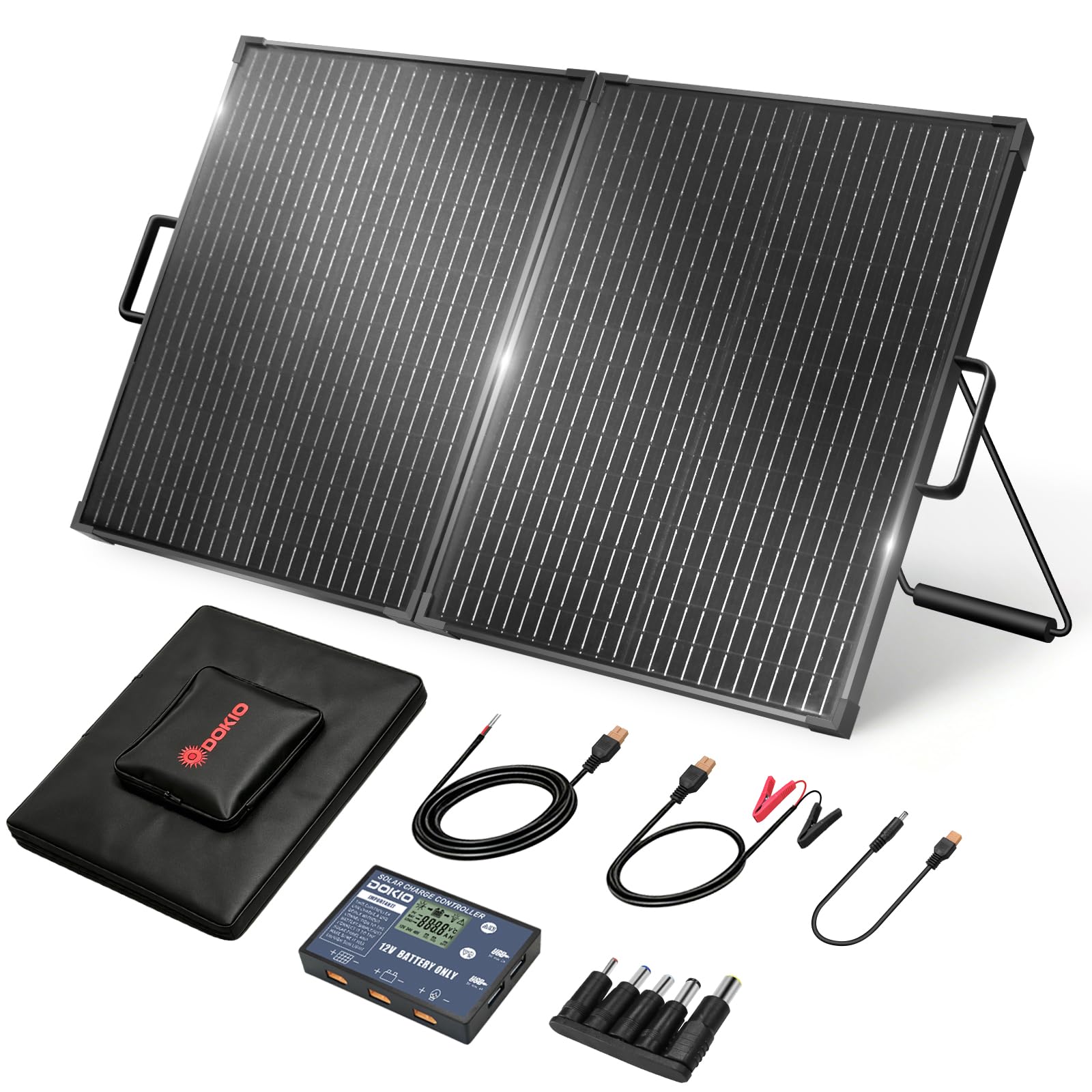
For a pop-up camper owner who does not want to wire anything, this is the simplest path to solar. Unfold it, clip the alligator leads to the battery, and it charges. The integrated PWM controller (pulse-width modulation — a simple, reliable way to regulate charging) handles reverse polarity, overcharging, short-circuit, and reverse current, so a mistake at the battery posts does not cook anything. It rides at 10.1 pounds and folds into a suitcase shape, which is the right weight class to carry out of the camper each morning.
The spec that matters most here is the cable length: 9.8 feet. That lets you set the panel out in the sun while the camper sits in shade, without dragging the whole rig around. There is also an adjustable bracket so you can angle it toward the sun. Output is 100 watts at 5.56 A and 18 V, and the corrosion-resistant aluminum frame is meant for years outside. The built-in 5V 2A USB ports let you top a phone straight from the panel.
Owners consistently like how it works the first time out, and the storage bag and easy setup come up a lot. The honest trade-off is sturdiness — the frame and stand fold for portability and feel light rather than rugged. Treat the stand gently and set it out of the wind, and it serves you fine. The value case is strong with the controller included — 100 watts versus the bifacial pick’s 200 watts — and it still comes in a package you can carry one-handed.
Where it fits best: a weekend camper running one 12V battery who wants solar without an install project. Clip, angle, done.
The catch to plan for: the folding frame prefers calm, level ground. On a windy ridge, weight the panel down or skip the stand.
Grab it when: you want a plug-and-play 100W suitcase with the controller already wired in.
Pass if: you need full-size roof output rather than a carry-out panel.
3. Hoysicy 100W Solar Panel Kit 12V Battery Maintainer
A 100W kit built to keep a stored camper battery topped off through the off-season.
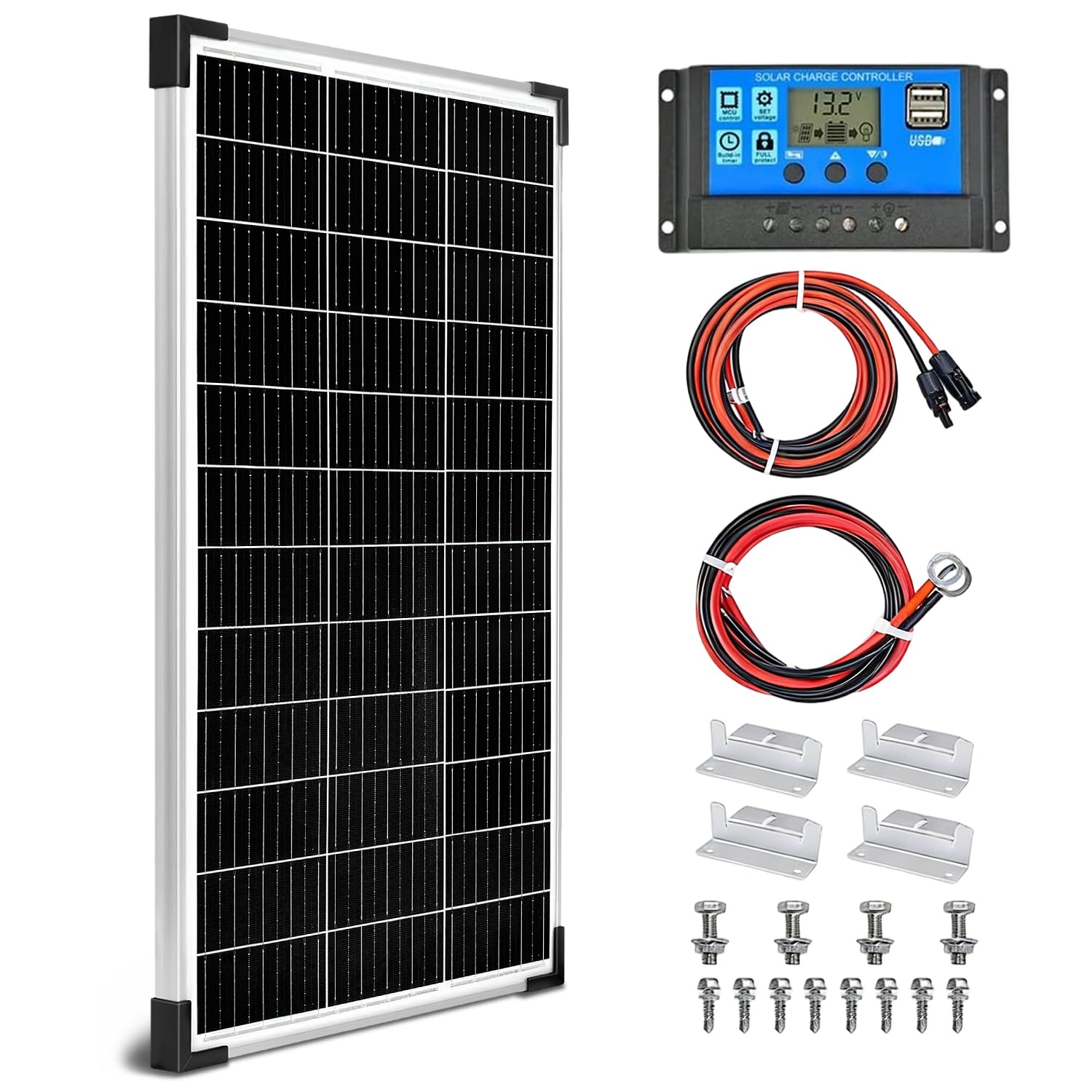
The name says it: this is a maintainer first and a power plant second. At 100 watts, 5.19 A, and 19.28 V, it pushes enough to keep a 12V battery from drifting flat while the pop-up sits in the driveway for weeks. The bundled 20A charge controller adds overcharge, over-discharge, over-voltage, and short-circuit protection, and it includes a built-in LCD screen so you can read battery state at a glance. There are USB ports on the controller too, so a phone can charge off the same box.
The weatherproofing is where this kit earns trust for a camper that lives outside: waterproof junction box, edge-seal waterproofing, and a corrosion-resistant aluminum frame rated to handle hail, snow, and rain. You also get 16.4ft extension cables, which gives you room to place the panel where the sun actually lands instead of where the camper sits. The panel itself is 20.1″L x 1″W x 39.8″H and built from monocrystalline cells behind tempered glass.
Owners agree the performance side works, and the reviews read mostly as exactly-as-advertised. The thing to plan around is the fit-and-finish question — the kit’s build quality draws a mixed read, so inspect it on arrival and expect a lighter-duty frame than the roof-mount class. For its job, though, gentle duty as a battery tender, that trade is reasonable. Skip the wall charger and let this hold the battery at full between trips.
Right answer for: keeping a stored camper battery healthy and having a readable controller doing it.
Look elsewhere if: you want heavy daily charging output from a rugged frame.
4. Callsun N-Type 16BB 200 Watt Solar Panel, 2×100W
Two compact panels that fit where one big module cannot — 200 watts that adapt to a folding roof.
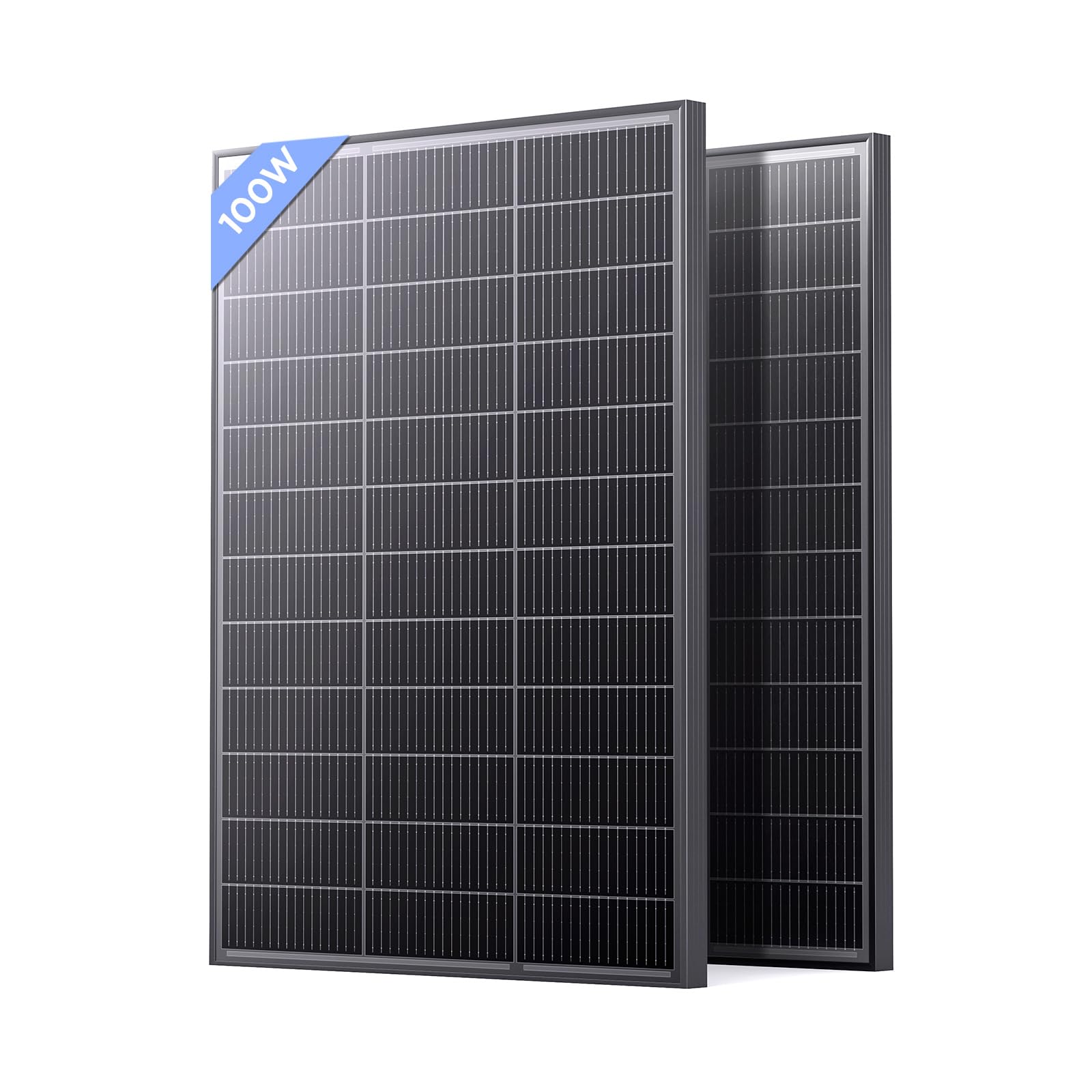
This is the clever workaround for a pop-up camper. Instead of one 51-inch slab, you get two 100W panels at 31.1″L x 22.7″W x 1.1″H each, which gives you fit options a single module never has — one on each side of a roof rack, or split across an uneven surface. Each panel weighs 11.4 pounds, making it the lightest rigid option here and genuinely manageable to hand up onto a roof. The 25% N-type efficiency and 16BB cell layout (the same busbar approach as the top pick) do the conversion work.
Where this pair shines is shade and heat. The low -0.3%/°C temperature coefficient keeps summer output steadier, and the compact cells handle partial shade well. Each panel is built from 3.2mm low-iron tempered glass with reinforced corner guards, in a corrosion-resistant aluminum frame with IP68 protection, rated to 2400 Pa wind and 5400 Pa snow loads. That is serious weather engineering in a small footprint. You get 200 watts total at 25% efficiency across the pair.
The quality read on these is genuinely strong, and shade performance and compact size both come up as wins. The honest note is on output expectations: spec-wise it is rated at 200 watts total, and how much you see depends on your sun and wiring. Because there is no weight listed for the set, check the box weight on arrival if you are tight on payload. Two panels also mean twice the mounting, so budget the time for both.
The fit that matters: if your folded roof will not carry a full-size module, this pair lets you build 200 watts around the shape you have.
One thing to accept: doubled mounting means doubled holes to drill — plan the layout before you start.
Choose this if: a full-size panel will not fit your camper’s roof or rack, but two smaller ones will.
skip it if: you want one module to mount and forget.
5. WUZECK 200 Watt 12V/24V Solar Panel Kit
Two 100W panels plus the controller, brackets, and cables — one box, one weekend of installation.
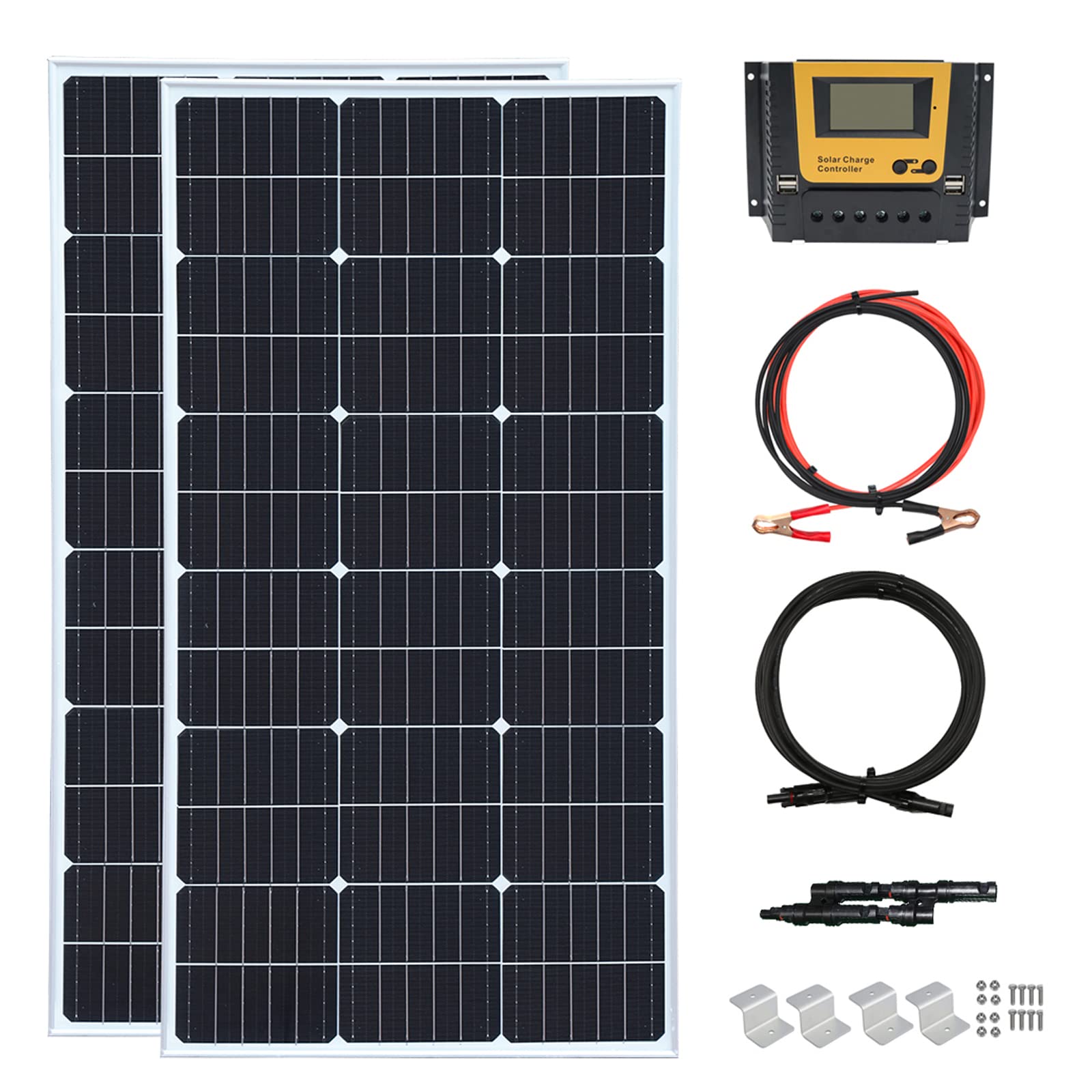
If you want to build the whole solar system in a single order, this kit is the least fussy way to do it. You get 2x 100W monocrystalline panels, a 20A charge controller, black and red battery cables, a black extension cable, eight Z-mounting brackets, and the male and female connectors. Nothing else to source for a basic 12V or 24V setup. The PC monitor-style junction box protection — a built-in bypass diode — keeps the panel from overheating and lets it keep producing when partly shaded.
The frame is pre-drilled for the included Z-brackets, which suits a pop-up camper rail or a small roof rack. Each panel is 41.14″L x 21.65″W x 0.98″H, and the encapsulation is rated IP65+ (protected against dust and water jets) with 2400 Pa wind and 5400 Pa snow load ratings. The controller works with four battery chemistries — sealed, gel, flooded, and lithium — so it plays nice with whatever is in your camper. The PERC cells convert at 23% efficiency.
This kit sells in smaller numbers than the rest of the list, so draw your confidence from the spec sheet rather than review volume. It is a full, honest off-grid starter: panels, controller, mounting, and cabling all matched. Because the pieces arrive separately, read the manual once and lay it out before you climb the ladder.
Best for: a buyer who would rather install one complete kit than hunt down a controller and brackets separately.
Keep in mind: the controller and cables are part of the box, so plan wiring once and verify every piece against the manual.
6. Renogy ShadowFlux 200 Watt N-Type Solar Panel
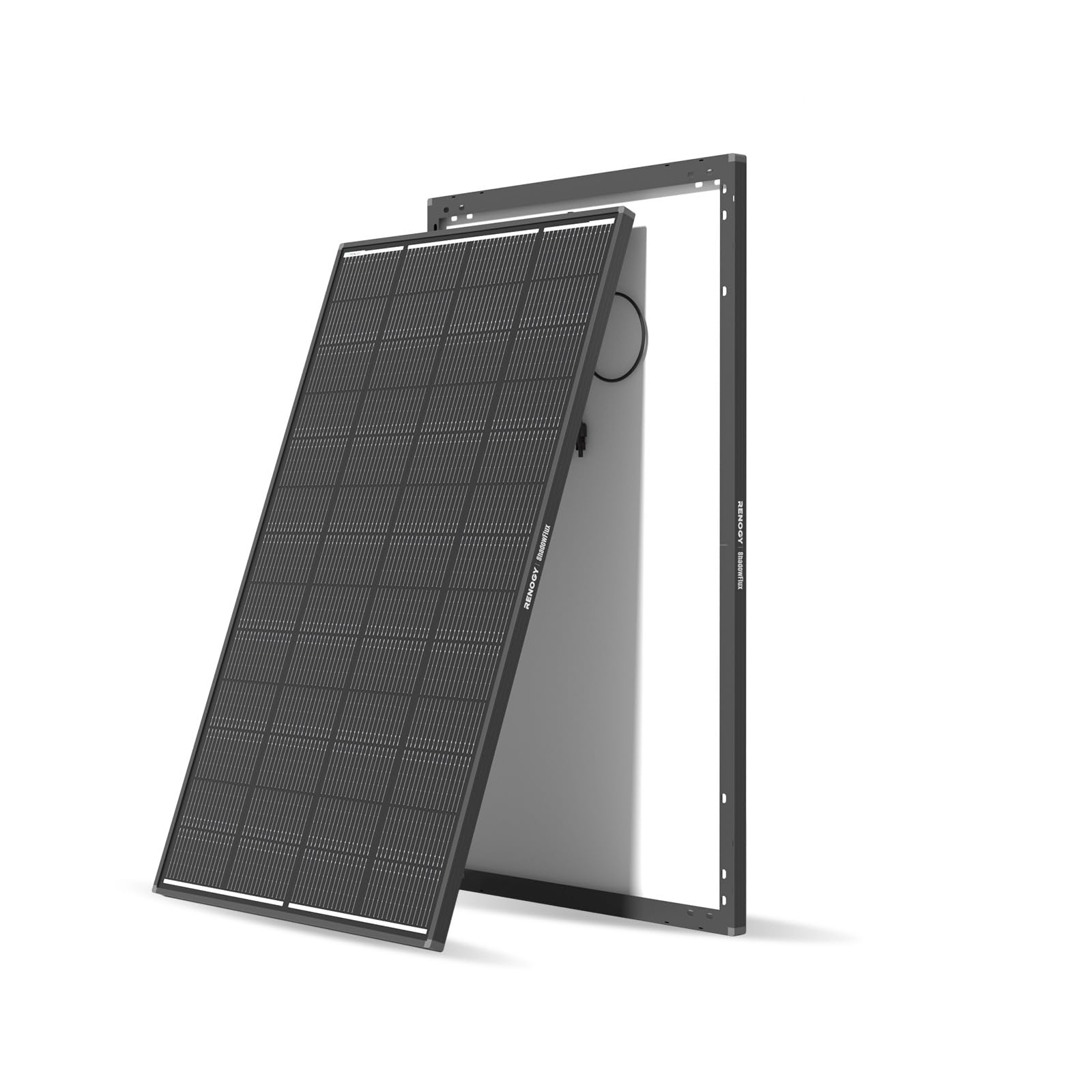
A 200W module engineered to keep producing when trees, rooftops, or leaf debris throw shade across it.
Wooded campsites are the enemy of camper solar, and ShadowFlux is Renogy’s answer. The anti-shading design cuts hot-spot risk — hot spots being the overheated patches that form when one cell is shaded while the rest are making power — and keeps output flowing in partial shade. That is the exact condition you meet under a canopy of trees at a state park, which is where many pop-up trips happen. Next to a plain panel, this keeps charging when you would otherwise see the battery stall.
The cells run N-Type with 16BB technology at 25% efficiency, so the panel is compact for its output. It measures 49.69″L x 30.08″W x 1.18″H and weighs 23.8 pounds, and Renogy rates it as smaller and more compact than a PERC panel of equal wattage. Maximum voltage is 36.5 V. Weather protection is ≥ IP67 (dust-tight and sealed against water immersion), built to shrug off snow, rain, and small hail.
Owners consistently flag strong output even under shade, with several owners reporting output above the 200-watt rating on clear days. The fit here is the serious camper who camps under trees and wants a rigid module with real shade engineering. pass on it if you need a portable panel — this one wants a permanent mount and is priced as a premium module.
The real reason to pay up: if your go-to sites are shaded, the anti-shading tech is the difference between a charging battery and a dead one.
The honest limit: at 23.8 pounds it is a permanent-mount panel, not a carry-out one — plan where it lives.
For you if: tree cover is a fact of your camping and you want a roof module that does not quit in shade.
Not for you if: you want to fold the panel away when you break camp.
7. Ecosonique 200W Portable Foldable Solar Panel

A 200W six-fold panel that packs into a briefcase and feeds power stations, laptops, and phones.
This is the foldable that tries to be everything: a full 200 watts for your power station plus a charging hub for the small stuff. It weighs 11 pounds and folds down to 18″ x 16.3″, so it stows in a camper cabinet or behind a seat without eating real space. The 200W output runs at 20 V and 10 A through MC4 connectors, and the package includes adapters for XT60, Anderson, DC7909, and DC5525 — the plug types popular power stations use. Four adjustable kickstands let you angle it at the sun.
For a pop-up camper, the appeal is flexibility. Set it on the ground, hang it off the camper, or lean it at the sun with a kickstand. The conversion rate is 23.5%, and you also get USB-C PD3.0 at 45W and USB-A QC3.0 for phones and laptops. The fabric is weather-resistant Oxford cloth with CPC lamination, and the built-in chip guards against over-current, over-voltage, and short-circuit. A 3M MC4 cable is in the box.
People like how it folds into a briefcase and works with a power station out of the gate. The honest caution is durability and stability — the leatherlike fabric is the part to protect, so avoid dragging it over gravel and stake it down in wind. Charging speed is a hit with owners, and one owner reported a 300Wh power station going from 13% to full in an hour. It is a portable panel, so treat it as one.
Why it earns its spot: one panel that charges your power station and your phone through the same foldable sheet.
What to watch: the fabric-backed panel wants care — lay it on a mat and weight the kickstand in breeze.
Reach for this if: you camp with a portable power station and want a big foldable that also tops up devices directly.
Look elsewhere if: you want a rugged panel that shrugs off rough ground.
8. Renogy 200W Portable Solar Panel for Power Stations
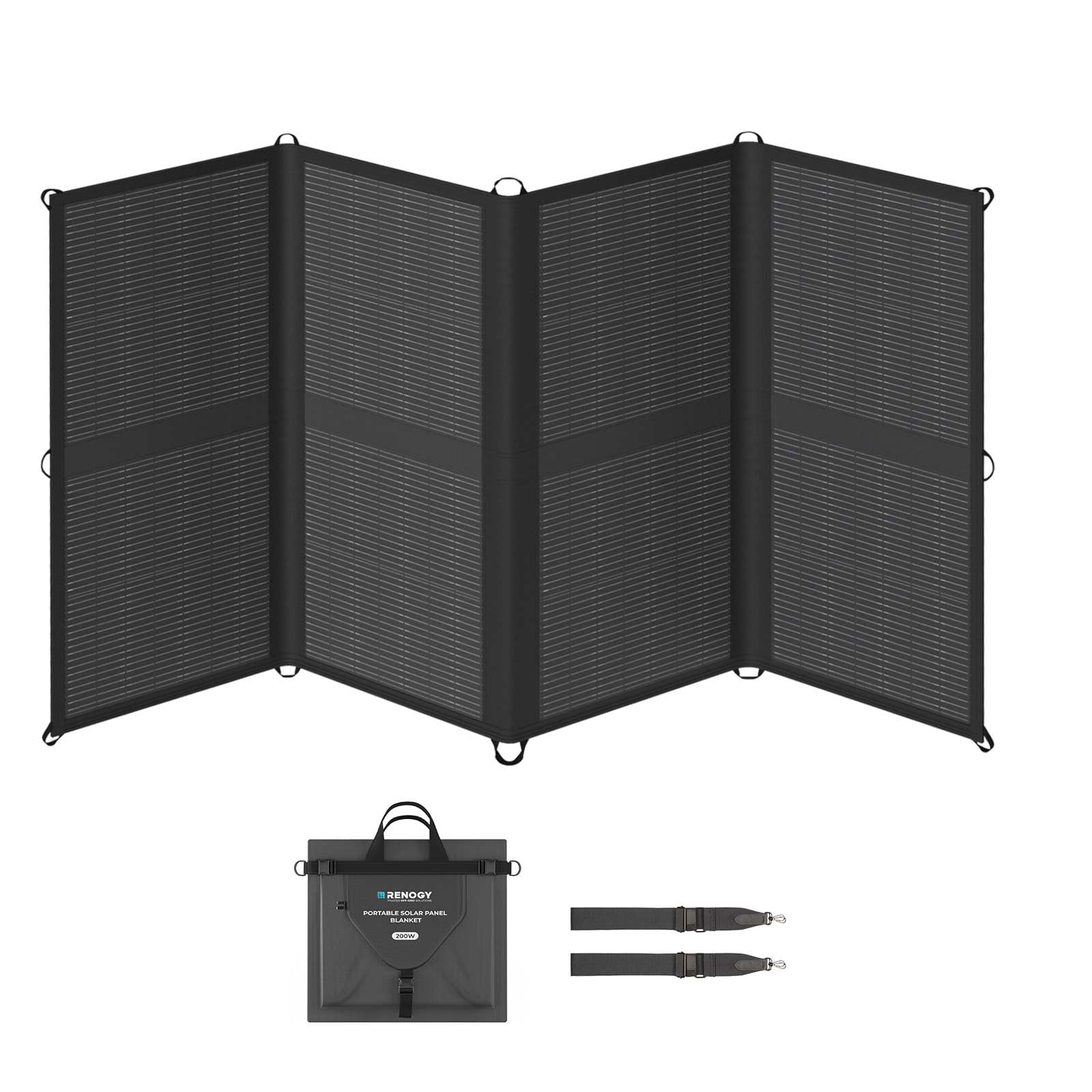
An 8.8-pound blanket that folds to backpack size and hides in a tiny camper corner.
If storage is your ceiling — and in a pop-up camper, it usually is — this is the panel built for it. At 8.8 pounds and folded to 16.14 x 15.35 x 3.07 inches, it disappears into a cabinet or slides behind the dinette. The 8-fold design runs on 16BB N-Type cells at 25% efficiency, and it puts out 200 watts at 13.1 A. That amperage rating is the highest portable spec here, which helps when you want to move power fast into a power station.
Renogy rates the cells as outperforming standard 9BB panels at 22.5%, which is the efficiency edge you pay for in a thin folding blanket. You charge three devices at once through one USB-C and two USB-A ports. The panel is IP65-rated (dust-tight and splash-resistant) and works from -10°C to 65°C with ETFE lamination and reinforced stitching. It also has a handle and shoulder straps, so carrying it to a sunny spot is genuinely easy.
Owners like the compact fold and the charging speed, with several reporting fast top-ups on a power station. The honest note: it is sold as a panel with MC4 output cables only, and a separate Renogy 4-in-1 adapter is needed for many power stations, so factor that into your plan. Output also depends on how squarely you face it at the sun. As a packable 200W panel for a space-tight camper, it is a strong fit.
Made for you if: every inch of storage counts and you want real 200W output from a backpack-size fold.
Factor in: you may need a separate adapter cable to connect your power station, so order it alongside.
Know the Specs
Watts and battery charging speed
A “200W” panel means its maximum power rating under standard test conditions is 200 watts. That number tells you roughly how fast it refills a 12V camper battery — higher watts, faster refill. But real output swings with sun angle, clouds, and heat, so treat the rating as a ceiling rather than a promise. Match the total wattage to your daily power draw.
Efficiency and cell type
Efficiency is the share of sunlight that becomes electricity — 25% efficiency means roughly a quarter converts. N-type cells tend to hold output better in heat and shade than older P-type designs. Higher efficiency lets a smaller, lighter panel deliver the same watts, which matters when roof space and carry weight are limited in a pop-up camper.
IP ratings and weather sealing
An IP number describes how well a panel keeps out dust and water. IP65 handles dust and water jets; IP67 and IP68 go further into water resistance. For a camper that lives outside, look for a sealed junction box and a corrosion-resistant aluminum frame. The rating applies to the enclosure, not to the cells themselves, so a well-sealed junction box is what keeps moisture out over the years.
Charge controllers and battery types
A charge controller sits between the panel and the battery and regulates the incoming power so the battery is not overcharged. Some panels include one; many do not. Check compatibility with your battery chemistry — sealed, gel, flooded, and lithium all behave differently. A controller with an LCD display lets you read battery state without a separate meter.
Common Questions
Can I mount a solar panel on a pop-up camper roof?
Is a portable or rigid panel better for a pop-up camper?
How many watts do I need to keep a camper battery charged?
Can a solar panel charge my camper battery without a controller?
Do solar panels work on cloudy days?
What does the efficiency percentage on a solar panel mean?
Will a folding solar panel work with my power station?
How long should a camper solar panel last?
Can I install solar myself on a pop-up camper?
Does shade hurt solar panel output that much?
The Bottom Line
For most campers, the solar panel for pop-up camper that covers the most ground is the Callsun N-Type 16BB 200W Bifacial — 25.6% efficiency, a bifacial backsheet that collects reflected light, and a split-cell design that keeps charging when half the panel is shaded. If you want solar without touching a wire, the DOKIO 100W Portable Suitcase clips straight to the battery with the controller already inside. And if storage is your ceiling, the Renogy 200W Portable Blanket folds to backpack size while still delivering 200 watts.
How we choose
We do not accept paid placement. Every pick is matched to a real buyer and a real use-case; we do not hands-on test units.
Sources
Specifications: manufacturer listings and product documentation. Review insights: verified customer reviews, as of November 2026. Pricing: not shown on this page (it changes often); check the current price via the retailer link.
As an Amazon Associate, Tactical Gear Guy earns from qualifying purchases. This does not affect which products we feature.