Specs are compiled from manufacturer listings and verified buyer reviews and can change over time — please confirm the key details on the product page before buying.
Top Picks


How To Choose The Best Thermometers for the Forehead
A forehead thermometer lives or dies on one thing: whether you trust the number it gives you. That trust comes from a handful of concrete details — how far the sensor sits from the skin, whether the device repeats itself, and how quickly you can read it in a dim room. Get those right and a fever check takes about a second.
Distance is the reading
No-touch models fire an infrared beam (invisible heat light) at the forehead from a set distance — the Goodbaby unit wants about 1.5 inches from the forehead center. Hold it too far or too close and the number drifts. Look for a model that either states its measuring distance clearly or has a distance assist to guide your hand. Holding that distance steady affects accuracy more than any feature on the box.
How repeatable it is matters more than one perfect read
The question worth asking is not the first number but the second. Take three readings a minute apart and see whether they land in the same neighborhood. Forehead sensors are sensitive to skin temperature, so a cool room or a just-wiped brow can shift a reading. Allow roughly 10 seconds between measurements and let skin settle for a few minutes after cleaning, as the Goodbaby guidance suggests.
Display and alarm in a dark nursery
You will take most of these readings at night, in low light, with a child half asleep. A backlit LCD (a screen that lights itself) makes the difference between a quick glance and fumbling for a lamp. Color-coded results help too — many units flash green for normal, yellow for fever, and red for high — so you can read the verdict before the number.
Body mode versus object mode
A dual-mode unit also reads surface temperatures, which is handy for a baby bottle, bathwater, or the room itself. That second mode turns one thermometer into a bottle and bath checker too. If you regularly warm bottles, object mode saves you reaching for a separate checker.
Side-by-Side Comparison
| Model | Best For | Reading Method | Display | Memory / Battery | Amazon |
|---|---|---|---|---|---|
| Goodbaby No-Touch Forehead Thermometer★ Best Overall | Everyday family checks | No-touch infrared, ~1.5 in from forehead | Clear digital, °F/°C | — / 2 AAA (included) | Amazon |
| AmpMed Amplim Medical GradeDual-Mode Pick | Forehead plus ear readings | No-touch infrared, 1-second | LED with fever indicator | — / 2 AAA (included) | Amazon |
| Elate Medical Grade Non-ContactClinical Style | Clinical-style home checks | No-touch infrared, 1-second | Digital with fever indicator | — / — | Amazon |
| Greater Goods No-Touch Infrared | Tracking trends over days | No-touch infrared, body + object | Large LCD, sound on/off | 30 readings / 2 AAA (included) | Amazon |
| Munchkin Forehead Thermometer | Pocket and travel carry | No-touch infrared, 1-second | LCD with color-coded indicators | — / 1 CR2032 (included) | Amazon |
| Beurer FT90 3-in-1 | Deep history and night reads | No-touch forehead, body/surface/room | Large blue backlit LCD | 60 readings / 4 AAA (included) | Amazon |
| Kinsa QuickScan Smart | App-based family tracking | No-touch infrared, Bluetooth | Large lighted digital | App-logged / 2 AAA (included) | Amazon |
| Medline No Touch Infrared | Color-coded clinical reads | No-touch infrared, human + surface | Backlit, red/green/blue indicators | — / — | Amazon |
| Braun No Touch 3-in-1 | Silent checks on sleeping kids | No-touch infrared, body/food/bath | Color-coded LCD with audio alerts | 10 readings / 2 AAA | Amazon |
Detailed Reviews
1. Goodbaby No-Touch Forehead Thermometer
Our pick — 4.5+★ from 119,500+ verified ratings; the strongest balance of quality and price.
The one-second reader thousands of families reach for first — point it, press the button, and you have a number.
The Goodbaby forehead thermometer gets the basics so right that families keep it handy for everyone from infants to grandparents. You hold it roughly 1.5 inches from the center of the forehead, press one button, and get a reading in about a second. It shows results in either Fahrenheit or Celsius, and it can switch to a room or object mode when you want to check a bottle instead of a brow. The body is built from ABS plastic — a firm, grippable housing that is easy to keep hold of even when a child is squirming.
What wins people over is how little fuss it takes: it works right from the start, and the pick-up-and-read simplicity is why it is the crowd favorite here at 4.5+ stars across 119,000+ ratings. Even the two AAA batteries come in the box. The instructions spell out the finer habits that keep readings steady — hold it steady at forehead center, let clean skin settle for about 10 minutes, and leave about 10 seconds between back-to-back measurements. It works best in stable room temperatures between 50°F and 104°F.
The honest catch is consistency. Your first reading is quick, but the second can wander if you rush or hold it at the wrong distance. That is the trade-off of a no-touch sensor: the device is only as steady as your hand and the room. Hold still, give skin a moment, and the numbers line up. Do not expect a hospital-grade probe — expect a fast everyday check you can trust enough to act on.
What earns it the top spot
- About a one-second read, so you are not wrestling a squirmy child to hold still.
- Reads in Fahrenheit or Celsius and works for forehead, room, or object.
- Firm ABS body with an ergonomic grip.
- Batteries and manual included — usable the moment it arrives.
Where it asks for patience
- Consistency depends on holding a steady 1.5-inch distance and waiting between reads.
- Readings drift in very cool rooms — the guidance wants stable temps from 50°F to 104°F.
Best fit for: families who want one simple, well-priced no-touch thermometer that covers babies to grandparents.
Worth knowing: give it a steady hand and a few seconds between checks, and the numbers stay in line.
2. AmpMed Amplim Infrared Forehead and Ear Thermometer
One device that reads a forehead without contact, or an ear if you want the second opinion.
The AmpMed Amplim covers two measuring styles in one body: a no-touch infrared forehead read and an ear mode. That means if a forehead reading feels off, you can cross-check the other way without hunting for a second gadget. Both run off infrared and finish in about one second, and the LED display includes a fever indicator that flags a high reading so you are not decoding numbers half asleep. It is rated for newborns, infants, toddlers, kids, youth, and adults.
For a device that reads both ways, it is compact. It runs 3.4 ounces and 5.91 inches long — noticeably larger and heavier than the 2.36-ounce, 6.04-inch Goodbaby, but not so heavy that you mind holding it. The ABS shell keeps it light in the hand. It arrives with two AAA batteries, a manual, a warranty card, and a certificate, so it is ready to use on arrival.
The follow-up question is obvious: does it do both modes equally well? A unit that splits its sensor between forehead and ear rarely matches a single-purpose model on both counts. Treat ear mode as the backup, and let the forehead stay your default.
Why pick it: you get forehead and ear in one unit, plus a fever indicator and LED display, with batteries included.
The trade-off to weigh: a split-purpose sensor can be the second-best option at both jobs — lean on forehead mode and keep ear as your backup.
Reach for this if: you want the option of a forehead and an ear reading from one handheld unit.
Pass if: you only ever check foreheads — a single-mode model will serve you just as well.
3. Elate Medical Grade Non-Contact Forehead Thermometer
A slim black no-touch unit with a fever indicator, built to look as clinical as the settings it is meant for.
The Elate reads a forehead by infrared in about a second, with no skin contact — the same hands-off approach that keeps a sleeping child undisturbed. A fever indicator flags a high reading on the display so you can act without decoding the number. It is rated for all ages, from newborns through adults, which is why it turns up in home, school, and nursery settings alike.
What people lean on is that it simply functions as promised — the no-touch design is hygienic for back-to-back checks, and the value holds up well for a medical-grade unit. It meets CE standards and is FSA/HSA eligible, which matters if you want to spend health-account funds on it. Sick-day checks on multiple family members stay quick because nothing touches skin between them.
The caveat is the usual one for this price band: the accuracy reads as mixed, so some mornings it lands right on and others it needs a second pass. Give it a steady hand and a moment between reads. If you want a clean, compact no-contact checker and can live with occasional repeat readings, it earns its place. If a single rock-solid reading every time is non-negotiable, favor a model with the longest track record.
What it gets right: quick one-second, no-contact reads with a fever indicator, CE standards, and FSA/HSA eligibility for a compact black unit.
Where it wobbles: repeatability — expect to confirm a surprising number with a second read before you act on it.
Good match for: someone who wants a hygienic, all-ages no-touch checker and values the FSA/HSA eligibility.
Think twice if: you would rather not have to re-take readings to feel confident.
4. Greater Goods No-Touch Infrared Digital Thermometer

Thirty past readings in memory — enough to see whether a fever is climbing or breaking.
The Greater Goods unit stores up to 30 readings, which changes how you use a thermometer. Instead of a single snapshot, you get a small timeline you can scroll back through to watch a child’s temperature move over a day. It reads a forehead without contact and switches between Fahrenheit and Celsius, with a larger display than most of its rivals and a single-button operation. There is a sound on/off control too, so you can mute it during a nap.
Its second mode handles objects — bathwater, a baby bottle — so it doubles as a kitchen and bath checker. An auto-shutdown protects battery life between uses. The fit-and-finish is what wins people over most: the housing feels solid in hand, the button is simple, and the reading comes quickly. It ships with two AAA batteries, a drawstring bag, and a quick-start guide, backed by a one-year limited warranty and US-based support.
The one thing to size up is the temperature range — it is narrower than some clinical units, so if you need extreme-low or extreme-high readings, check the range first. For everyday fever checks and warm-bottle duty, that limit rarely comes up. It suits a household that wants to track a fever over days, not just spot-check once.
Reasons it stays in the drawer by the crib
- Stores 30 readings so you can follow a fever trend, not just one number.
- Body and object modes plus a sound on/off switch for nap-time checks.
- Large, readable display and simple one-button control.
- Comes with a drawstring bag, batteries, and US-based support.
What to check before you buy
- The object-temperature range is limited compared with some clinical models.
- Not the right tool if you need extreme high or low surface readings.
Best for: a family that wants to watch a fever rise and fall over days, with plenty of memory to show it.
Skip if: you need a wide object-temperature range for extreme surface checks.
5. Munchkin Forehead Thermometer White

The pocket-sized pick — this one disappears into a scrubs pocket or a diaper bag and travels anywhere.
The Munchkin is built for portability above all. It measures 2.1 inches by 0.95 inches by 0.95 inches and weighs 22.5 g, so it is dramatically smaller than the 6.04-inch Goodbaby and slips into the smallest pocket without a bulge. It delivers a one-second no-touch reading in Fahrenheit or Celsius, and the digital LCD uses color-coded indicators so you can read the verdict before you focus on the digits. It handles newborns, kids, and adults, and it arrives with a travel-ready carrying case and a CR2032 battery.
What makes it easy to keep on you is the size and the case — this is the kind that lives in a bag or a uniform pocket and never gets left on a shelf. It suits a nurse moving between rooms as much as a parent on a road trip. The quick-read design means a check takes seconds even in a parking lot or a stranger’s living room.
The small body asks something in return: accuracy and reliability read as mixed, so consistency is not guaranteed every time. Treat a surprising number with a second read and it holds up fine. If your priority is a thermometer that is always with you, the size wins; if you check from one fixed spot at home, a larger screen buys you more.
The case for it: it slips into a scrubs pocket or a travel bag, because it measures just 2.1 by 0.95 by 0.95 inches. A color-coded display shows the reading at a glance, and a carrying case keeps it protected on the move.
The honest limit: a tiny sensor body can wander off the mark, so confirm any number that looks off with a second read.
Pick this when: portability is the whole point — it should live in a bag or pocket and go everywhere.
Leave it if: you want a large, fixed-position screen for a single spot at home.
6. Beurer FT90 3-in-1 Forehead Non-Contact Thermometer

Sixty past readings and a backlit screen the size of a small phone — this is the deep-history option for a house with a bug going round.
The Beurer FT90 stores a maximum of 60 previous measurements, so you can chart a fever’s arc over an entire illness instead of guessing how yesterday compared to today. It reads a forehead without contact, measures an object such as a baby’s bottle, and even reports room temperature, so one unit covers body, surface, and the air in the room. The XL backlit LCD means you can read it in the dark without turning on a light.
The fever alarm is easy to interpret: it rings when a reading hits 100.4 degrees or above, and a smile or frown icon tells you at a glance where you stand. It runs on four AAA batteries, all included. For the parent who wants a clean record to show a doctor, the memory is the draw. What wins people over most is the build and feel — it reads as a solid, well-made device rather than a flimsy gadget.
The thing to weigh is precision. Accuracy reads as mixed, so some readings land dead-on and others need a confirming pass. A quick second measurement settles that for most users.
Why the memory matters: 60 stored readings plus a blue backlit LCD let you follow an illness over days and read it in the dark.
What to expect: body, object, and room modes in one unit, but accuracy that benefits from a confirming second read.
Best for: a household that wants a full fever record and a bright, easy-to-read night screen.
Maybe not if: you want the simplest possible single-button check with no extras.
7. Kinsa QuickScan Smart No-Touch Digital Forehead Thermometer
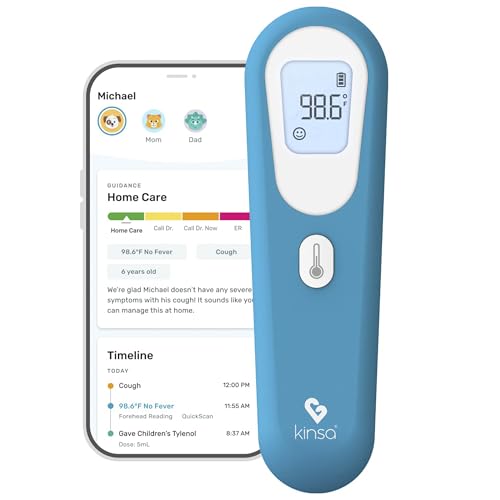
The only one here that logs a sick child’s whole week in an app and hands you a symptom-based pointer.
The Kinsa QuickScan pairs with the Kinsa app over Bluetooth to track fever, symptoms, and recovery for each family member. That is the real difference: instead of a number you have to remember, you get a running record per person that you can share with a doctor or another caregiver. The forehead reads hands-free so you never wake a sleeping child, and it is rated for babies, kids, adults, and seniors. Readings come in seconds on a large lighted display with fever indicators.
The app adds diagnostic context — it shows illness in the area and offers symptom-based recommendations based on age. It is a simple one-button unit, so the smart layer does not get in the way of a quick check; you read the display as you would on any no-touch thermometer. It uses two AAA batteries, both included.
The catch is the phone. This is the right pick only if you will actually use the app — the value lives in that tracking layer. If you would rather keep it a standalone thermometer, you are paying for smart features you will not touch, and its plain forehead read is no more accurate than simpler, cheaper units. For a family that wants every illness logged and shareable, it earns the extra.
The smart edge: app-tracked fever and symptom history per family member, shareable with a doctor, on top of a hygienic no-touch read.
The catch: the draw is the app — skip it if you want a self-contained thermometer with no phone involved.
Made for: the family that wants a logged, shareable illness record and symptom guidance from their phone.
Not for: someone who wants a no-frills thermometer and will never open the app.
8. Medline No Touch Infrared Forehead Thermometer
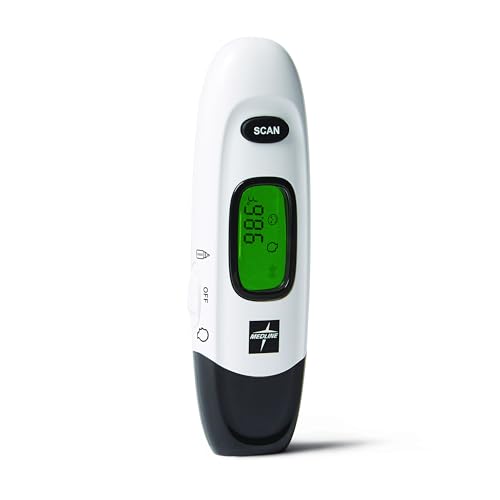
Reads body or surface, then tells you the verdict in color — red for fever, green for clear, blue while it works.
The Medline takes both human and surface temperatures in Celsius or Fahrenheit, and it does it without any patient contact. The result indicators do the interpreting for you: red flags a fever, green signals a healthy reading, and blue shows a measurement is in progress. That color system is the point — in a dark room you catch the color before you can even read a number. It is approved for both clinical and home use, and its compact body sits easily on a nightstand.
The backlit screen is easy to read, and the whole thing sets up without fuss for a quick check. Its small build keeps it light in the hand and easy to set on a nightstand. It suits a caregiver who wants a clear, immediate verdict on whether a reading is in the fever zone.
The trade-off, as expected in this category, is accuracy: readings read as mixed, so some come in sharp and others need a confirming pass. The temperature settings and value also read as mixed, so match it to a simple routine rather than clinical precision. If you want color-coded clarity and a device approved for both home and clinic, it delivers; if one perfect read matters most, look at a longer-track-record model.
What stands out: traffic-light color results and a backlit screen, plus human and surface modes, in a unit approved for home and clinical use.
Where it asks for care: accuracy and temperature settings read as mixed, so a steady hand and a second read help.
A good fit for: a caregiver who wants an at-a-glance color verdict for fever checks at home.
Look elsewhere if: you need lock-tight repeatability over the convenience of a color read.
9. Braun No Touch 3-in-1 Thermometer for Adults, Kids, Babies

A silent-mode switch for a sleeping child, and a color screen that says fever before you read the number.
The Braun No Touch 3-in-1 flips to silent mode with a button press, which is the one feature you will thank it for at 3 a.m. A sleeping child never stirs for the check. The color-coded LCD screen routes green for a normal result, yellow for a fever, and red for a high fever, backed by ten short beeps. It reads body, food, and bath water temperatures in about two seconds, so it doubles as a bottle-and-bath checker.
Built-in memory recalls the last 10 temperatures so you can spot a trend rather than a single spike. The Sensian 4 forehead sensor works without contact, and the unit is rated at ±0.4°F accuracy in the maker’s spec. Its lower temperature range is listed at 54°F. It runs on two AAA batteries and is a recognized name in the caregner space, which is why many households reach for it as a first-aid-kit staple.
The recurring gripe is consistency — accuracy and reliability read as mixed, so some checks land sharp and others need a repeat. Treat a single odd number as a prompt for a second read, not a verdict. For quiet checks and a clear color verdict, it is a strong fit; for hands-off simplicity with a longer track record, a simpler unit may please you more.
The appealing bit: silent mode for sleeping kids, color-coded results with audio alerts, and body/food/bath readings in about two seconds.
Be aware: consistency reads as mixed, so a confirming second read is worth the few extra seconds.
Worth reaching for: nighttime checks where a silent mode and a color fever warning matter most.
Pause if: you want the steadiest repeatability and would rather not re-take readings.
Know the Specs
Measuring distance and accuracy
A no-touch forehead thermometer reads heat by infrared, so the gap you hold between the sensor and the skin changes the number. The Goodbaby guidance asks for about 1.5 inches from forehead center. Some units add a distance assist to keep your hand steady. A stated accuracy figure, like the Braun’s ±0.4°F spec, tells you how close the reading should sit — but only when you hold it correctly. A steady 1.5-inch gap matters more than the accuracy figure on the spec sheet.
Memory, batteries, and display
Memory storage is how many past readings the device keeps — the Beurer holds up to 60 and the Braun the last 10. More memory lets you chart a fever trend over days rather than a single snapshot. On batteries, most units run on two or four AAA cells, and several come with them included. A backlit LCD matters in a dark nursery, and color-coded indicators let you read a fever verdict before you focus on the digits.
Common Questions
How far should I hold a forehead thermometer from the skin?
Why do I get two different readings in a row?
Can a forehead thermometer be used on a newborn?
What does the fever alarm threshold mean?
Is a forehead thermometer as accurate as an ear or oral one?
How many past readings can each model store?
Can these thermometers read object temperatures like bathwater?
Do any of these need an app to work?
What kind of batteries do these use?
Is a higher-spec forehead thermometer worth the extra?
The Bottom Line
The best forehead thermometer for most homes is the Goodbaby No-Touch — a one-second, no-touch read that works from newborns to grandparents, with batteries in the box. It carries the largest track record here at 4.5+ stars across 119,000+ ratings, and it is the one most families will simply reach for and trust. If you want to track a fever over days, the Beurer FT90 brings 60-reading memory and a bright backlit screen. For a thermometer that lives in a pocket or scrubs, the pocketable Munchkin is the one to grab.
How we choose
We do not accept paid placement. Every pick is matched to a real buyer and a real use-case; we do not hands-on test units.
Sources
Specifications: manufacturer listings and product documentation. Review insights: verified customer reviews, as of November 2026. Pricing: not shown on this page (it changes often); check the current price via the retailer link.
As an Amazon Associate, Tactical Gear Guy earns from qualifying purchases. This does not affect which products we feature.