Specs are compiled from manufacturer listings and verified buyer reviews and can change over time — please confirm the key details on the product page before buying.
If your table saw leaves scorch marks and fuzzy edges, the blade is the problem — not your technique. A sharp, well-matched blade turns the same saw into a tool that leaves cuts clean enough to glue straight off the saw.
This guide is built by comparing the manufacturers’ published specifications and the patterns across verified customer reviews, so you get each pick’s real strengths and trade-offs instead of marketing spin.
I’ll walk you through kerf, tooth count, hook angle, and which blade suits ripping versus crosscutting, then rank the picks that handle each job best. Here are the woodworking saw blades worth putting on your arbor.
Top Picks

How To Choose The Best Woodworking Saw Blades
The single biggest mistake buyers make is grabbing one blade and expecting it to rip a 2×4 and crosscut trim with equal grace. Different jobs ask different things of the teeth, and matching the blade to the job is most of the battle.
Match tooth count to the cut
Fewer teeth clear chips faster, which suits long rips down the grain. More teeth leave a smoother edge, which suits crosscuts and finish work. A 24-tooth blade rips with less effort, while a 40- or 50-tooth blade is built for cleaner crosscuts. If you can only own one, a combination blade splits the difference.
Know your kerf and arbor
Kerf is the width of the slot the blade cuts. A thin kerf removes less wood, so the saw works less hard and you save material. The arbor is the hole in the center — a 5/8-inch arbor is common on 10-inch table saws, while some 12-inch saws use a 1-inch arbor. Check your saw’s arbor size before ordering, because the wrong bore simply won’t mount.
Grind and hook angle explain the finish
Grind describes the shape of the tooth tips, and it decides how cleanly the blade slices. Hook angle is the tilt of the tooth toward the wood — a steep angle pulls the blade into the cut aggressively, while a shallower angle feeds more gently. On hardwoods a controlled feed often gives the cleaner, burn-free edge.
Side-by-Side Comparison
| Model | Best For | Diameter | Teeth | Kerf | Amazon |
|---|---|---|---|---|---|
| Freud LM75R010★ Best Overall | Glue-ready rips | 10″ | 30 | .091″ | Amazon |
| DEWALT DWA11040Do-Everything Pick | All-purpose table saw work | 10″ | 40 | — | Amazon |
| DEWALT DW3112Budget Ripping Pick | Fast ripping on a budget | 10″ | 24 | — | Amazon |
| Diablo D0724VPX | Framing and construction | 7-1/4″ | 24 | — | Amazon |
| CMT 250.024.10 | Hardwood ripping | 10″ | 24 | 0.102″ | Amazon |
| CMT 256.050.10 | Combination workhorse | 10″ | 50 | 0.102″ | Amazon |
| Freud LU84R011 | Combination rips and crosscuts | 10″ | 50 | 0.09″ | Amazon |
| Forrest WW10407125 | Premium finish cuts | 10″ | 40 | .125″ | Amazon |
| WEN BL1248 | 12-inch saw general cutting | 12″ | 48 | 1/10″ | Amazon |
Detailed Reviews
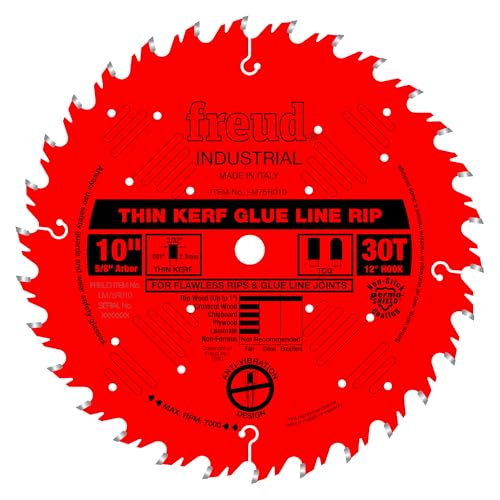
1. Freud LM75R010 10″ Ripping Blade
Our pick — 4.5+★ from 900+ verified ratings; the strongest balance of quality and price.
The rip blade that leaves an edge ready for glue, not for the sander.
The number that defines this one is the.091-inch kerf. That is a thin slot, which means the saw pushes through less wood on every rip — and the blade spends less energy turning material into dust. The.071-inch plate that carries those teeth is proportionally stiff, so the blade holds a flat line instead of wandering sideways mid-cut. Thirty carbide teeth handle the long grain work, and a 12-degree hook angle pulls the blade into the wood with enough drive for hard stock without feeling grabby.
What wins people over is the finish. Owners describe rips through plywood that come off tear-free and glue-ups that close with no planing, and bamboo and hickory are named again and again as woods that don’t scorch. The Perma-Shield coating plays a quiet role here — it keeps pitch from welding onto the plate, so the blade keeps cutting the way it did on day one instead of dragging through resin. Laser-cut anti-vibration slots do the rest, killing the sideways chatter that shows up as a rippled edge.
You get fast, clean rips, but you pay in weight and commitment. At 16 ounces, this is a blade you mount for a ripping session, not something you swap in for one quick crosscut. Its 30 teeth and ripping grind are built for cutting with the grain, so crosscutting trim with it will show tear-out. If you want one blade that does everything, look at the combination picks below. If rips are your bread and butter, this is the one to buy.
for clean rips: Buy this if long rips down hardwood and plywood are the job you do most, and you want an edge that goes straight to the glue-up.
if you need thick kerf: It is a dedicated ripping blade — crosscutting finish trim with it is not what those 30 teeth were shaped for.
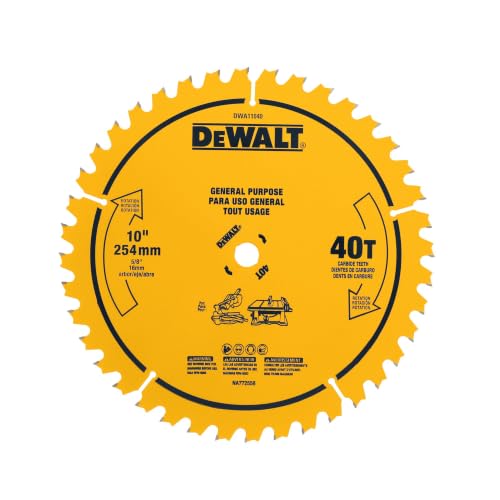
2. DEWALT DWA11040 10″ 40-Tooth Fine Finish Table Saw Blade
Forty teeth that split the difference between a fast rip and a clean crosscut.
For a woodworker who owns one table saw and one blade, this is the shape that makes sense. Forty teeth is the middle ground — enough to leave a clean edge on crosscuts, few enough to keep ripping from feeling like a chore. The tune tooth geometry is designed for accuracy, and the ultra-sharp carbide is what gives it the reputation for cutting wood cleanly through 2-inch red oak.
Quality is the thing that carries this blade’s reputation, and the cut quality is right behind it. It handles a one-inch red oak threshold without complaint, and the smooth operation is what keeps it in the saw rather than on the shelf. At 0.59 kg it is a lighter blade than the WEN 12-inch below, which matters if you swap blades often — less heft means less fuss on the arbor.
The catch is that DEWALT markets it as a fine finish blade, so if you expect rip-blade speed on thick hardwood, you will feel the 40 teeth working. For general-purpose work on a table saw, though, this is the balance most home shops actually need.
fine finish cuts: Forty teeth, tune geometry, and a clean cut through 2-inch red oak make it the practical pick for a single-blade shop.
slow on thick stock: It trades raw ripping speed for finish — thick hardwood rips go slower than a dedicated 24-tooth blade would manage.
for trim work: You want one blade that crosscuts trim and still rips stock without changing anything on the arbor.
for rough framing: Every cut you make is a thick hardwood rip — the 40-tooth count is the wrong tool for that job.
3. DEWALT DW3112 10″ 24-Tooth Thin Kerf Miter/Table Saw Blade
Twenty-four teeth and a thin kerf, built to eat through 4x4s without slowing down.
This blade is built to rip, and it does that fast. Its 24 teeth on a 10-inch plate clear chips quickly, and the thin kerf (the narrow slot the blade cuts) means the saw removes less wood with every pass. That gives the motor less to push against, so long rips go quicker. The computer-balanced plate cuts vibration, which keeps your cut line straight instead of drifting. And the wedge shoulder design puts more steel behind each carbide tip, so the edge holds up to repeated use.
Owners notice the cutting performance first, and there is a reason. Buyers report running this through 4x4s and it cuts without hesitation, and the durability holds up to repeated rips. Compared with the CMT 250.024.10 below, both share the same 24-tooth count and diameter, but this one is the value pick. For a spare blade in the truck or a second arbor, that is a sensible spot to be.
The honest limit is sharpness from the start. The edge is decent rather than exceptional, and on the hardest stock you will feel it working harder than a premium carbide blade would. For jobsite rips and rough framing cuts, that is a fair trade — this is not the blade you reach for when the joint has to be glue-ready.
for quick framing: Fast, cheap rips through framing lumber and 4x4s where a glue-ready finish is not the goal.
for polished trim: You need a fine, burn-free edge on hardwood — that calls for the higher tooth counts above.
4. Diablo D0724VPX 7-1/4″ Circular Saw Blades 2-Pack

The lightest blade here at 6.4 ounces, sized for the circular saw you actually keep in the truck.
This is a different animal from the table-saw blades above — it is a 7-1/4-inch framing blade, meant for a handheld circular saw. At 6.4 ounces it is a fraction of the weight of the Freud LM75R010’s 16 ounces, which matters when you are carrying a saw up a ladder all day. Twenty-four teeth on a 7-1/4-inch plate is the classic framing count: fast, aggressive, and built to go through pressure-treated lumber, 2x stock, plywood, and hardwood without loading up.
Two features do the real work. Tracking Point technology is Diablo’s name for tooth geometry that keeps the blade running true through the cut. Laser-cut stabilizer vents reduce noise and vibration, so the saw stays under control. The TiCo Hi-Density carbide is the same family of tip material used on the premium table-saw blades. And the Perma-SHIELD coating resists heat, gumming, and corrosion, so the blade doesn’t bog down in pitch after a day of treated lumber.
The value here is the pair. Two blades means one stays sharp while the other is in the saw, and framing work is exactly where you burn through edges. What you give up is finish — 24 teeth at this diameter is not a trim blade, and crosscutting cabinet parts with it will show a rougher edge than a 40-tooth table-saw blade.
tracking point tip: Framing, roofing, and remodel work where speed and a pair of fresh blades matter more than a furniture-grade edge.
smaller cut depth: It is a 7-1/4-inch circular saw blade — it will not fit a 10-inch table saw arbor.
for cordless saws: Your work happens on a jobsite with a handheld circular saw and treated lumber, and you want two blades ready to go.
for deep ripping: You are outfitting a table saw — the 7-1/4-inch diameter is the wrong size entirely.
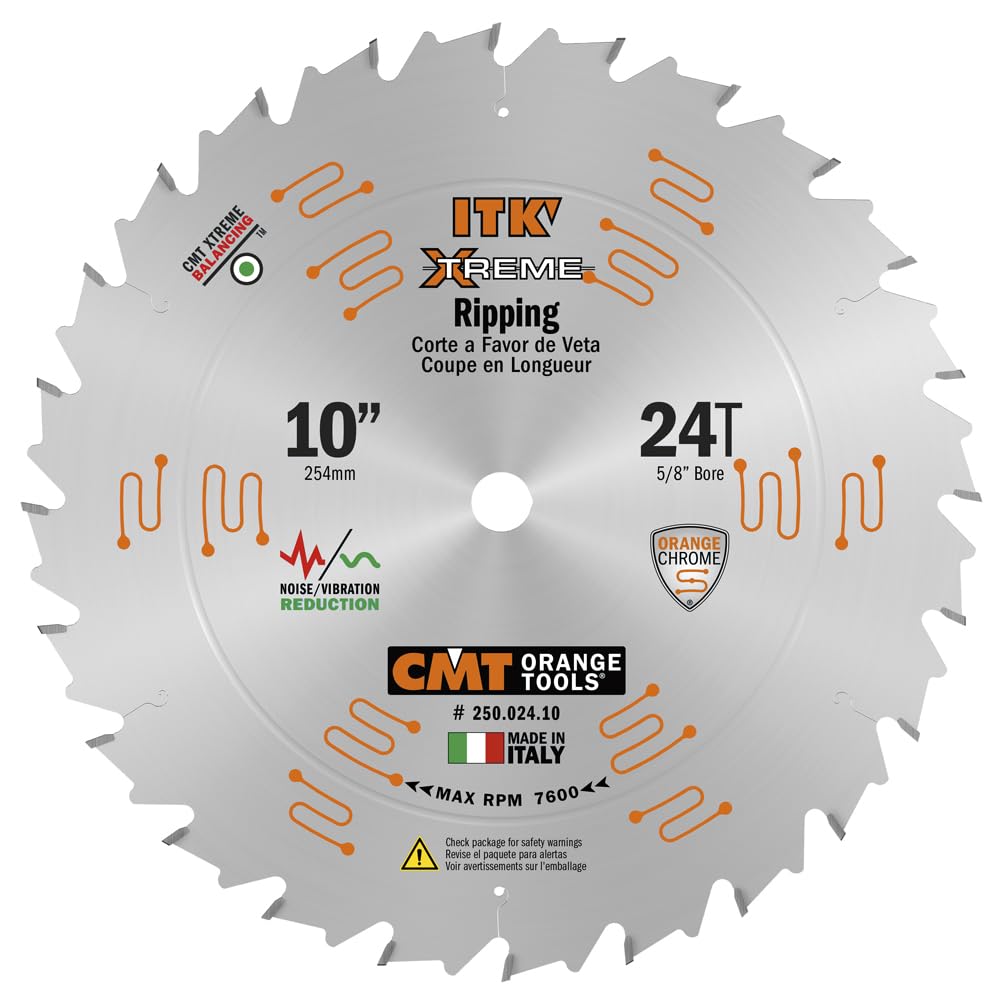
5. CMT 250.024.10 ITK XTreme 10″ 24-Tooth Ripping Saw Blade
A 10-degree hook angle built for hardwoods that fight back.
Here is the spec that explains the whole blade: a 10-degree hook angle. Compare it with the CMT combination blade below, which runs a 15-degree hook — that 10 degrees is a gentler feed, pulling the blade into the wood less aggressively so it doesn’t over-bite on dense stock. The 0.102-inch kerf and 0.071-inch plate give it a thin but stable body, and 24 ATB teeth are shaped for clean rips through soft and hardwood, plywood, OSB, and pressure-treated lumber.
Hardwood is where this blade earns its keep. Owners mention running it through 8/4 oak in a single pass and describe walnut cutting like butter. The carbide tips can be sharpened multiple times, so the cost spreads out over years of use instead of one edge. At 449 grams it is lighter than the WEN 12-inch below, which means less rotating mass and quicker spin-up on a jobsite saw.
What you should know before buying: this is a ripping blade, so don’t expect it to leave a polished crosscut on trim. And a 10-degree hook angle feeds more gently, which some users find feels less aggressive than a high-hook ripping blade — you push a little more, but you get control on hard stock in return.
controlled ripping: The 10-degree hook angle and 24 ATB teeth give hardwoods a controlled, clean pass — 8/4 oak in one go is the kind of work it’s built for.
premium price tag: Crosscutting finish work is not its job, and the gentler feed means you push a little harder than with an aggressive high-hook rip blade.
for serious rippers: Someone running a stationary or portable table saw who rips dense hardwood regularly and wants a blade that can be resharpened and kept for years.
for budget shoppers: Anyone who wants one blade for trim and finish crosscuts — that’s a different tooth count entirely.
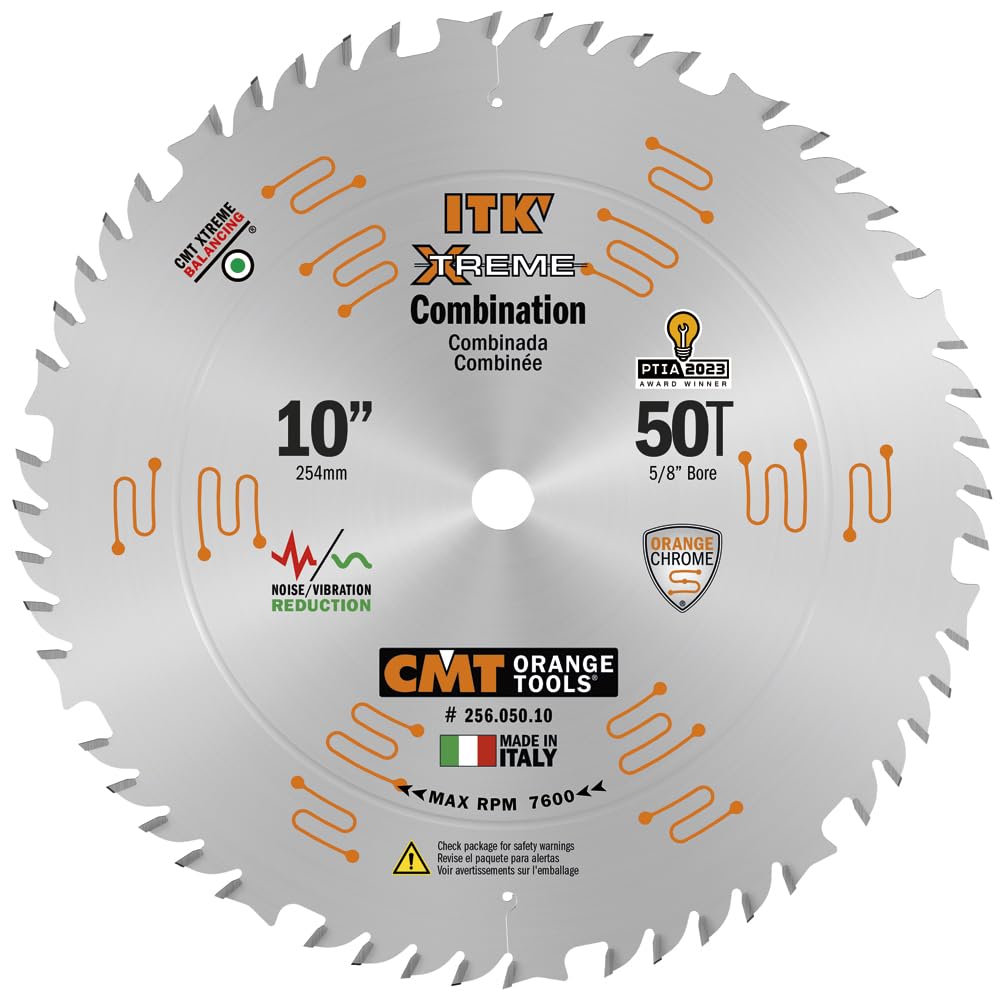
6. CMT 256.050.10 10″ 50-Tooth Combination Saw Blade
Fifty teeth in a combination grind, built to crosscut cleanly and rip without complaint.
If your shop runs one blade for everything, this is the one. Its 50 teeth — the same count as the Freud LU84R011 below — give it the tooth density to leave a smooth edge on crosscuts and plywood. The combination grind with one flat tooth mixes ripping capability into the same plate. The 15-degree hook angle is noticeably more aggressive than the CMT rip blade above at 10 degrees, so it feeds into the cut with less push from you.
The 0.102-inch kerf (the width of the slot it cuts) is a full-kerf slot rather than a thin one. That makes the blade more stable but takes a wider bite out of the wood. Customers note hardwood cutting like butter and a nice smooth edge off the saw, and it holds up without needing a resharpening trip. The quiet operation is a real plus on a saw that runs all day. Plywood and MDF work is where it earns particular praise, because the high tooth count doesn’t tear out veneer the way a low-tooth rip blade will.
The 1.7-pound weight is heavier than the DEWALT DWA11040 at 0.59 kg, so if you swap between blades constantly you will notice the difference on the arbor. That said, for a combination blade that stays mounted, the mass is part of what keeps the cut stable.
for mixed tasks: The woodworker who wants a single mounted blade for plywood, MDF, and mixed rips and crosscuts without sacrificing a smooth edge.
for single-purpose work: You want a thin kerf to save material on every cut — the full 0.102-inch kerf removes more wood.
7. Freud LU84R011 10″ 50-Tooth Combination Saw Blade
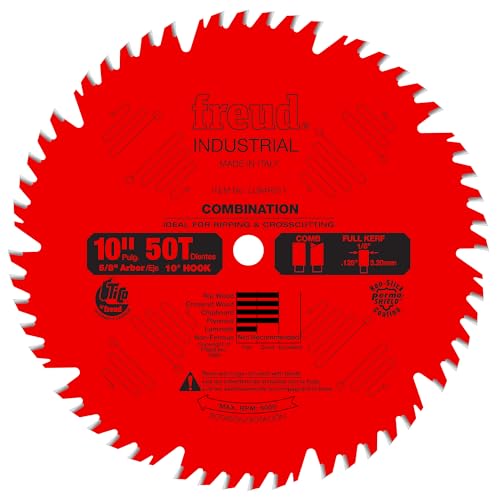
One flat tooth, four beveled teeth, and large gullets — the anatomy of a true do-it-all blade.
The tooth configuration is the story here, and it is worth understanding. Each group combines one flat tooth for efficient ripping with four alternate top bevel teeth for smooth crosscutting. That is what makes a combination blade work — the flat tooth scoops material away fast, and the beveled teeth clean up the edges. Large gullets sit in front of the flat-top raker teeth to clear chips quickly, which keeps the blade from loading up in thick stock.
The point is the blend of flat and beveled teeth, not the tooth count. Reviewers point out crisp cuts with a smooth finish on a table saw. The Perma-Shield coating keeps residue from building up on the plate, so the blade stays clean through a long session. Laser-cut anti-vibration slots handle the sideways movement that would otherwise show up as chatter marks. At 2 pounds it is the heaviest 10-inch blade in this guide, and that mass is part of why it cuts so steadily.
Two honest notes. The durability is mixed — teeth can break off if you push it through material it doesn’t like, so treat nails and embedded grit as the enemy. And the flatness and burn resistance draw some complaints, meaning on very thick hardwood rips you may see more burn than with a dedicated rip blade.
balanced combo teeth: One flat tooth plus four beveled teeth per group gives you ripping speed and crosscut smoothness in a single mounted blade.
not a dedicated ripper: Teeth have been known to break, and very thick hardwood rips can show burn — treat this as a generalist that dislikes abuse.
for general shop: A home shop that keeps one blade mounted for mixed rips and crosscuts on a table saw and wants a clean, crisp edge without changing blades.
for heavy ripping: If your diet is thick hardwood rips all day, a dedicated rip blade with fewer teeth will run cooler.
8. Forrest WW10407125 Woodworker II 10″ 40-Tooth ATB Saw Blade

The blade furniture makers reach for when the edge has to be right off the saw.
This is the premium pick, and the specs explain why. Forty teeth in a 30-degree ATB grind — a steeper bevel than the combination and rip blades above — slice rather than scrape, which is what gives the smooth edge people talk about. The.125-inch kerf is a full kerf and the widest here, so it removes more material per cut than the Freud LM75R010’s.091-inch kerf, but that width is part of what keeps the blade stable in deep cuts.
Owners run it through 8/4 walnut and get glue-ready edges with minimal sanding. The 30-degree ATB tooth style is designed to stop the blade from bottom splintering on radial crosscuts, and the geometry is set up to reduce jump-in for better pull control. At 2.2 pounds it is the heaviest blade in this article, which is the mass that keeps it tracking straight through dense stock.
The catch is maintenance and cost of ownership. A full-kerf premium blade this heavy wants a saw with enough motor behind it, and it is the most expensive route to a clean edge here. For a production shop or a serious hobbyist, that math works. For occasional weekend cuts, the combination blades above deliver most of the finish for a lot less commitment.
for fine woodworking: Glue-ready edges on hardwoods matter enough that you want minimal sanding and are willing to run a heavy full-kerf blade on a saw that can push it.
for casual cutting: Your saw is underpowered or you cut occasionally — the mass and.125-inch kerf ask more of the motor.
9. WEN BL1248 12″ 48-Tooth Carbide-Tipped Saw Blade

A 12-inch blade for the miter or jobsite saw that needs a bigger disc.
Size is the whole point here. This is a 12-inch blade with a 1-inch arbor — a different mounting standard from the 10-inch, 5/8-inch-arbor blades that dominate this guide, so check your saw before you order. The 12-inch diameter is 20 percent wider than the 10-inch Freud LM75R010, and it is rated up to 6000 RPM. Forty-eight carbide-tipped teeth cover general-purpose cutting through hard and softwoods, and the ultra-thin 1/10-inch kerf keeps the cut efficient.
At 1.12 kg it is heavier than the DEWALT DWA11040’s 0.59 kg, which is simply the physics of a bigger disc. Buyers rate the quality highly and the sharpness draws consistent praise — enough that it gets compared favorably to an 80-tooth Diablo. It fits the majority of 12-inch miter saws, jobsite saws, and table saws, so if you run a 12-inch miter saw for trim, the 48-tooth count is a sensible match for clean crosscuts.
Durability is the one split opinion. Some owners expect it to last a lifetime, while others report it wearing faster than expected. Given that spread, treat this as a value blade you expect to replace periodically rather than a buy-once heirloom — at its price tier, that is a reasonable arrangement.
big blade value: A 12-inch, 48-tooth blade with a 1-inch arbor and a 6000 RPM rating covers 12-inch miter and jobsite saws that 10-inch blades can’t fit.
needs 12 inch saw: Durability is a split verdict, so plan on it being a replaceable value blade rather than a forever edge.
for large saws: You run a 12-inch miter or jobsite saw with a 1-inch arbor and want a capable general-purpose disc without a premium commitment.
for compact saws: Your saw takes a 5/8-inch arbor — this blade will not mount on it.
Know the Specs
Kerf — how much wood the blade removes
Kerf is the width of the slot a blade cuts, and it decides two things: how hard the saw has to work and how much material you lose per cut. A thin kerf — like the.091-inch on the Freud LM75R010 — removes less wood, so the motor strains less and you stretch your lumber further. A full kerf — like the.125-inch on the Forrest — takes a wider bite but adds stability in deep cuts. If your saw bogs down easily, a thin kerf often makes it feel stronger.
Tooth count and grind — the finish and the speed
Tooth count sets the trade-off between speed and smoothness. Fewer teeth clear chips fast for ripping, while more teeth leave a cleaner edge for crosscuts. Grind is the shape of the tooth tips: ATB (alternate top bevel) teeth slice at an angle for clean cuts, while a combination grind adds one flat tooth per group for faster ripping. A combination blade with both is the compromise that lets one blade do most jobs.
Hook angle — how aggressively the blade bites
Hook angle is the tilt of each tooth toward the wood. A steeper angle pulls the blade into the cut, feeding faster with less push from you. A shallower angle — like the 10-degree hook on the CMT 250.024.10 — feeds more gently, which gives you more control on dense hardwood. Neither is better; it’s a match to the wood and your saw’s power.
Arbor size — the fit that stops you cold
The arbor is the center hole that mounts on your saw’s spindle. A 5/8-inch arbor fits most 10-inch table saws, while a 1-inch arbor is common on 12-inch saws like the WEN BL1248. Diameter and arbor both have to match your saw, because the wrong size will not mount at all. Measure before you order and you avoid a return.
Common Questions
Will a 10-inch blade fit my 12-inch miter saw?
What is the difference between a ripping blade and a crosscut blade?
Does a thin kerf blade really save wood?
How long does a carbide saw blade last before it needs sharpening?
Can I cut plywood with a ripping blade?
What does the hook angle on a saw blade actually do?
Is a combination blade good enough as my only blade?
Why does my saw blade leave burn marks on the wood?
Are more teeth always better on a table saw blade?
Can I use a circular saw blade on a table saw?
The Bottom Line
For most woodworkers, the woodworking saw blades winner is the Freud LM75R010 because its.091-inch thin kerf and glue-line rip grind leave an edge ready for the glue-up, with no burn on hardwoods like hickory and bamboo. If you want one blade that covers rips and crosscuts, grab the DEWALT DWA11040 with its 40-tooth all-purpose geometry. And for a 12-inch miter or jobsite saw, the WEN BL1248 is the one to reach for, with its 48 teeth and 1-inch arbor sized for bigger saws.
How we choose
We do not accept paid placement. Every pick is matched to a real buyer and a real use-case; we do not hands-on test units.
Sources
Specifications: manufacturer listings and product documentation. Review insights: verified customer reviews, as of November 2026. Pricing: not shown on this page (it changes often); check the current price via the retailer link.
As an Amazon Associate, Tactical Gear Guy earns from qualifying purchases. This does not affect which products we feature.