Specs are compiled from manufacturer listings and verified buyer reviews and can change over time — please confirm the key details on the product page before buying.
Cutting stone is not the same job as cutting wood, and the saw that fails you is usually the wrong type for the material in front of you. A wet tile saw keeps dust down and leaves a clean edge on porcelain and marble slabs. A small dry masonry saw gets into tight spots on brick and block. A heavy cut-off saw powers through reinforced concrete when nothing lighter will finish the pass. Decide what you are actually cutting first, then match the blade, the depth of cut, and the dust control to that job — the picks below are sorted around exactly those decisions.
This guide is built by comparing the manufacturers’ published specifications and the patterns across verified customer reviews, so you get each pick’s real strengths and trade-offs instead of marketing spin.
Below you will find a full breakdown of each machine, the specs that actually decide a clean cut, and the trade-offs that matter before you commit. Read on for the saws that handle real stone work, chosen for the jobs they actually suit and the limits they honestly carry — the right saw for stone cutting is the one matched to your material and depth.
Top Picks

How To Choose The Best Saw for Stone Cutting
Most ruined stone jobs come from a saw mismatched to the slab, not a defective saw. A 4-3/8-inch blade tops out at 1-3/8 inches of depth, so a cinderblock needs a bigger blade. A 91-pound wet saw stays on its cart; a 5.9-pound trim saw is what goes up the ladder. Settle the stone type and the deepest pass first; blade, arbor, and dust control follow from those two.
Start with the stone, not the saw
Porcelain, marble, travertine, and ceramic tile want a wet saw with a continuous-rim diamond blade, because water cools the blade and carries the dust away from you. Concrete, brick, block, and pavers suit a segmented diamond blade (a blade with cut-out notches around the rim that clear debris fast) on a dry or wet cut-off saw. Reinforced concrete and deep foundation work call for the biggest blade and the most motor you can justify.
Match the blade diameter to the cut depth
Your maximum depth of cut is set by blade size, so buy for the deepest pass you will actually make. A small saw with a short blade means multiple passes on thick material, which multiplies both time and the chance of a wandering line. On thick slabs, a 16-inch blade cutting 6 inches in one pass beats a 4-3/8-inch blade making four.
Decide how you will handle dust
Dry cutting stone throws fine silica dust into the air, so look at what the tool gives you: an integrated water feed, a dual-sided water suppression system, a dust port, or a dust bag. Wet cutting is the cleaner route on tile and slab. On quick masonry repairs, a dust-extraction attachment and a mask may be enough.
Side-by-Side Comparison
| Model | Best For | Blade Diameter | Max Cut Depth | Power / Speed | Amazon |
|---|---|---|---|---|---|
| DEWALT D24000S Wet Tile Saw★ Best Overall | Large tile and stone slabs, wet | 10 inches | 3 1/8” | 1.5 peak HP, 120V | Amazon |
| Evolution R6DCT Concrete SawBest for Paving | Paving, brick and block | 6 inches | 2 inches | 1600W, 13A | Amazon |
| XtremepowerUS 9-Inch Cut-Off SawMid-Size Muscle | Mid-size masonry cut-offs | 9 inches | 3-1/2” | 1800W | Amazon |
| Makita 4100NHX1 Masonry Saw | Trim cuts and countertops | 4-3/8 inches | 1-3/8” | 9.6 A, 14,500 RPM | Amazon |
| XtremepowerUS 2600W 16-Inch Saw | Deep concrete and foundation cuts | 16 inches | 6 inches | 2600W, 20A, 4,700 RPM | Amazon |
| Makita 4100KB Dry Masonry Saw | Dust-managed dry cutting | 5 inches | 1-9/16” at 90° | 13 A, 12,200 RPM | Amazon |
| SKILSAW SPT79-00 Medusaw | Flagstone and flat concrete work | 7 inches | — | 15 A worm drive | Amazon |
| VEVOR Wet Tile Saw with Stand | Big-format tile and marble | 10 inches | 3.8” / 95 mm | 15 A, 4500 RPM | Amazon |
| Husqvarna K 770 Power Cutter | Remote jobs with no power outlet | 14-inch class | 5 inches | Gasoline | Amazon |
| DEWALT D36000S Wet Tile Saw | Very large tile and heavy site work | 10 inches | — | 15 A, 1220 MWO | Amazon |
Detailed Reviews
1. DEWALT Wet Tile Saw with Stand, 10-Inch, Corded (D24000S)
Our pick — 4.5+★ from 800+ verified ratings; the strongest balance of quality and price.
A 10-inch wet saw that holds a straight line within 1/32 inch over an 18-inch cut.
If your stone work runs to slabs — porcelain, marble, travertine, big-format tile — this is the machine that makes the job feel finished rather than fought through. The 10-inch blade with a 5/8-inch arbor (the hole in the blade’s center) cuts to a maximum depth of 3 1/8 inches. That is deep enough to slice most countertop and floor slabs in a single pass instead of two.
The 1.5 peak horsepower motor on a 120V cord keeps the blade turning through dense material, and the submersible pump (a pump that sits in the water pan and lifts water to the blade) feeds the cut while cooling the edge. Water containment is where this saw earns its keep — the pan and side trays are built to keep the wet spray off your floor and your client’s walls. Buyers report the cutline indicator and stainless steel rollers “provide stable, accurate cutting to within 1/32 inch over 18 inch cuts”, which is the kind of tolerance that lets you butt tiles tight.
What wins people over here is straight performance across the whole job — it sets up fast, cleans down fast, and handles marble and travertine without complaint. The honest trade-off is weight: at 69 lbs it is a wheeled site machine, not something you carry up a stairwell on a whim. Two owners find the frame compact enough for a vehicle, and that is the realistic way to move it.
Why the Pros Go Here
- 10-inch blade and 5/8-inch arbor cut deeply through thick stone slabs.
- Water tray and side trays keep spray contained and the work area cleaner.
- Cutline indicator plus stainless rollers hold your line accurately.
- 45-degree bevel capacity handles edge and corner angle work.
- Includes the stand, XP4 porcelain blade, and pump — ready to cut on arrival.
What to Weigh First
- 69 lbs means it lives on its wheels and needs two hands to position.
- The 36” x 29” footprint wants real workspace, not a tight corner.
- Blade life and durability draw mixed notes, so expect to swap blades on the hardest stone.
Go wet and big: this is the pick for slab and large-tile installers who want accuracy without a second finishing pass.
Move it with a plan: if you work solo on upper floors, budget your lifting — the 69 lbs is the price of that rigidity.
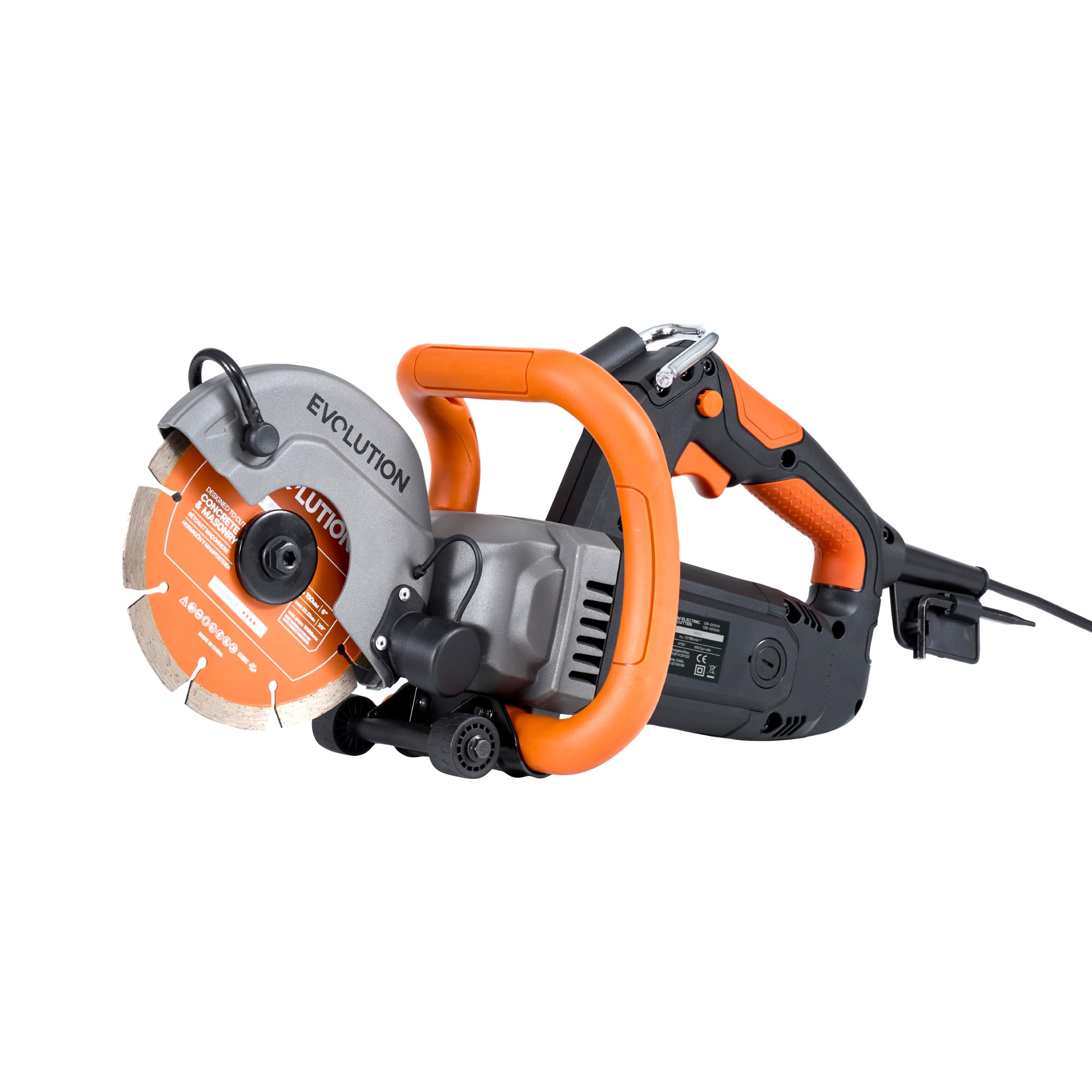
2. Evolution R6DCT 6-Inch Electric Concrete Saw
The compact paving cutter that sprays water onto the blade instead of dust into your face.
Most stone-cutting jobs on a driveway or patio are small cuts on hard material, and that is exactly where a 6-inch saw with a 2-inch cutting depth earns its place. That depth handles common paving slabs and tiles in a single pass. The 1600W motor runs on mains power, so there is no fuel mixing and no exhaust in a tight garden.
The design decision that matters most is the dual-sided water feed, which applies water straight to the blade and the cutting area to knock airborne dust down at the source and cool the edge as it goes. Flow is adjustable at the tool, so you can dial it back for a quick score and open it up for a full slab. A balanced belt-drive system separates the motor from the blade for better weight distribution, and a wheeled metal skid plate (a smooth plate under the saw that runs along the cut) keeps the cutter tracking where you point it.
Compared with the DEWALT wet saw above, the blade here is 6 inches against 10 inches — a saw for paving rather than a slab station. Quality and functionality are what buyers talk about most, and it is genuinely a tool you can hand to a helper without a long lesson. The recurring honest note is build durability and dust suppression on the hardest pours; treat the saw as a controlled cutter for paving and block, not a demolition tool.
Everyday control: the active load indicator shows how hard the motor is working, so you can ease off before you bog the blade down, and a soft start plus an electronic blade brake keep the tool predictable.
The realistic limit: the 2-inch depth is the ceiling — thick foundation work needs the 16-inch XtremepowerUS further down this list.
Best for paving crews: patio slabs, brick, block, and porcelain paving with the right specialized diamond blade.
Look elsewhere for: repeated deep cuts in reinforced concrete, where the 2-inch maximum will leave you finishing with a second tool.
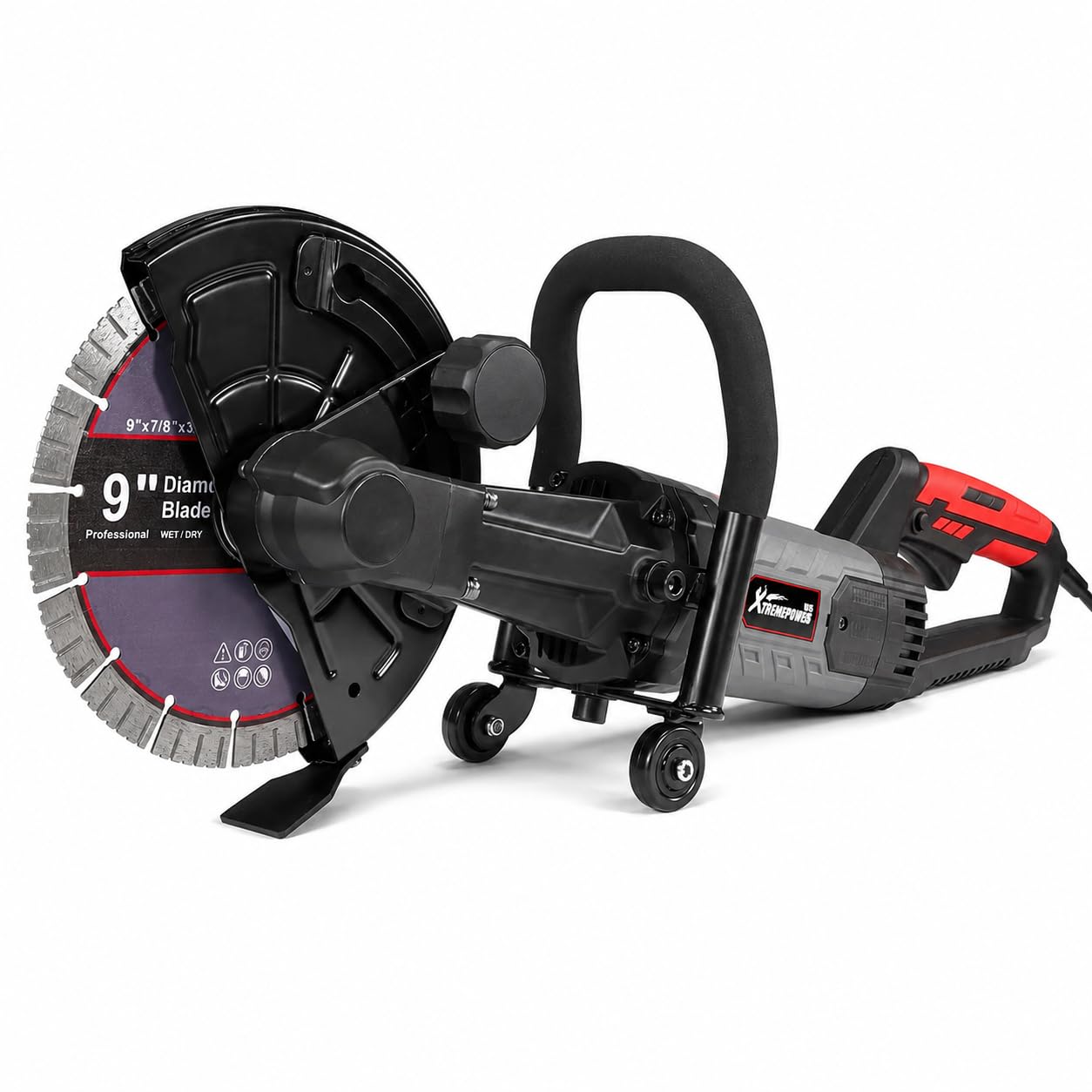
3. XtremepowerUS 9-Inch Electric Concrete Saw, 1800W
An 1800W cut-off saw with a 3-1/2 inch reaching depth and guide rollers to keep you straight.
When a paving slab or a run of brick is too tall for a trim saw but the site does not justify a 16-inch monster, this is the middle ground. The 1800W motor gives you steady cutting power without gasoline, and the included 9-inch segmented diamond blade is built to chew through concrete, brick, stone, masonry, and pavers. Maximum cut depth lands at 3-1/2 inches through cutting.
Two features do the practical work. The built-in guide rollers support and stabilize the saw as you move, which makes a straight line far easier to hold on a long cut. And the adjustable blade guard can be repositioned for different angles, keeping the protection where you need it as the cut changes direction. The dual-handle design pairs a non-slip auxiliary handle and a rear trigger grip with a safety lock, so you have real control on long passes.
At 22 lbs, it sits at the working middle of this list — lighter than the 16-inch saw and easier to set up than a full wet station, yet heavier than the Makita trim saw at 5.9 lbs. It also works both wet and dry, which gives you the option to knock dust down when the job allows. It runs wet or dry on brick, block, and pavers, so one corded saw covers mixed renovation cuts.
What it solves: a no-fuel cut-off saw that handles brick, block, and stone in that awkward mid-depth band most jobs actually fall into.
The honest catch: this is a low-volume listing with thin buyer feedback, so treat it as a solid mid-tier tool rather than a proven workhorse — inspect the guard and rollers on arrival.
Reach for this if: you do mixed renovation and landscaping work and want one corded cut-off saw that runs wet or dry.
Hold off if: you need deep foundation cuts or proven long-term durability data — the bigger saws below carry more confidence there.
4. Makita 4100NHX1 4-3/8″ Masonry Saw, with 4″ Diamond Blade

The 5.9-pound trim saw you grab for countertop and repair cuts, not whole slabs.
At 5.9 lbs, this is the saw you can hold in one hand and carry up a ladder without thinking about it. The 9.6 amp motor spins at 14,500 RPM, giving a high power-to-weight ratio for its size.
Its maximum cut runs to 1-3/8 inches, which is perfect for scoring and trimming tile, stone veneer, and countertop edges rather than cutting through thick block. An easy-to-adjust depth gauge makes precision work repeatable. Owners mention it cuts through granite, quartz, and porcelain easily, and that it feels simpler to use than dragging out a wet saw for a small job. That is the real pitch — dry, fast, and light. The blade size draws fair mixed feedback: at 4-3/8 inches it is not going to halve a cinderblock.
Two 4-inch turbo diamond blades come in the box, so you can start cutting without a second order. On value, opinions split — some see it as a strong tool for the size, others expect more blade for the money. For trim and countertop cuts where a wet saw is overkill, the 5.9-lb dry body is the point.
The standout: 14,500 RPM in a 5.9-lb body means dense stone gets cut by speed rather than by bulk.
Who it is not for: anyone needing deep masonry cuts — the 1-3/8 inch depth is a trim ceiling, not a foundation tool.
Confident verdict: the tight-access trim saw for countertops, veneer, and small stone repairs.
Know the ceiling: the short blade and 1-3/8 inch depth mean deep block or thick slab will need a bigger machine.
5. XtremepowerUS 2600W 16-Inch Electric Concrete Saw
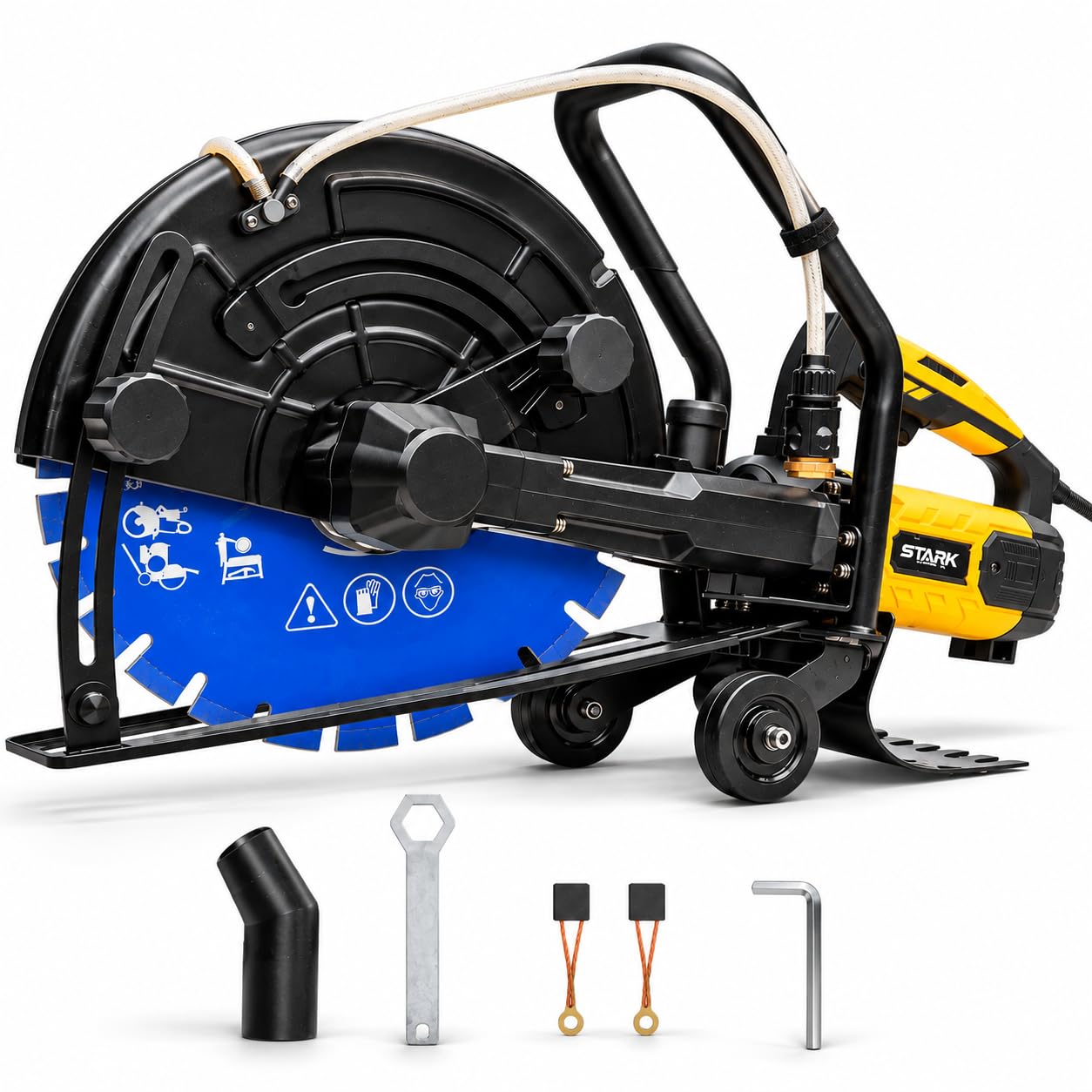
A 16-inch blade with a 6-inch cut depth — this is the saw that reaches the bottom of a deep pour.
When the job is foundation, curb, or thick slab, everything else on this list runs out of depth before this saw does. The 16-inch blade cuts to a maximum of 6 inches, which means fewer passes and faster completion on deep work. The 2600W motor holds a no-load speed of up to 4,700 RPM, keeping steady through concrete, large stone blocks, and cement-based material without stalling mid-cut.
Power draw is serious: the saw runs on a 20A current rating, so check your circuit before you rely on it. That is a real operational note, and it matches what shows up around the tool — 20A service and a breaker that trips if you push it hard are the practical limits here. The dual protection switch requires both the trigger and the safety lock to be engaged at once, which reduces accidental startups, and a built-in GFCI (ground-fault protection) in the cord adds another layer of shock protection on damp ground.
For dust, the integrated water feed has a valve to control flow, and there is a metal-bladed dust port to vent debris and keep your cutting line visible. At 40 lbs it is a two-person tool on a long day, though lighter than the big wet saws below. Compare this to the 6-inch Evolution: 2600W against 1600W and a 16-inch blade against 6 inches — this is simply a different class of machine for a different job.
The depth payoff: a 6-inch maximum cut on a 2600W motor covers the concrete and foundation work smaller saws cannot finish.
Set up your power first: the 20A rating and the breaker tripping that shows up around this saw make circuit capacity the first thing to confirm on site.
For the deep jobs: foundations, thick slabs, and large stone blocks where a 6-inch cut saves passes.
Watch the circuit: plan for a 20A supply and treat heavy continuous cuts gently to avoid tripping the breaker.
6. Makita 4100KB 5″ Dry Masonry Saw, with Dust Extraction
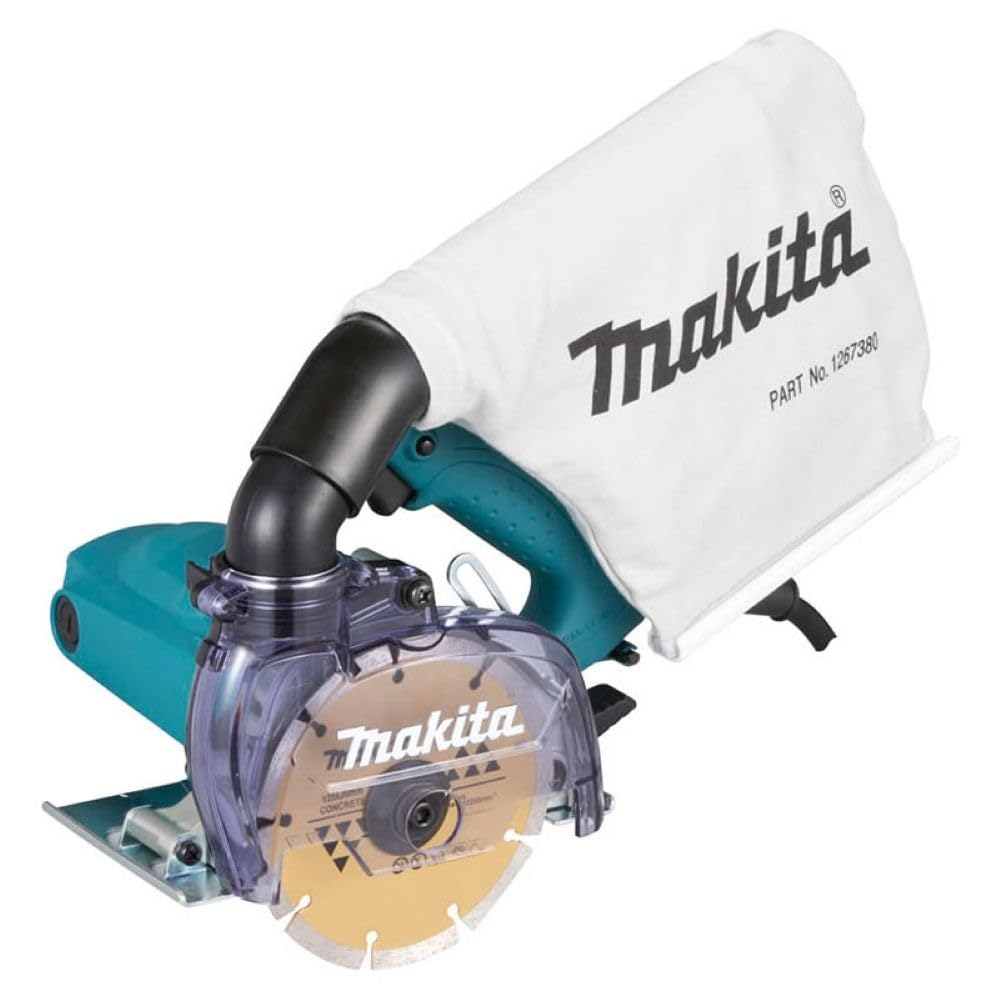
A dry masonry saw that puts dust in a bag instead of in the air around you.
Indoor stone work is where dust control stops being a nice extra and becomes the reason you pick one saw over another. This 5-inch dry saw ships with a dust bag, so debris is captured at the cut rather than thrown across a room you still have to live in. The transparent upper guard dust cover keeps your eye on the blade and the cutting line, which matters on detailed work.
Under the hood, a 13 amp motor delivers 12,200 RPM, and depth capacity tops out at 1-9/16 inches at 90 degrees. That is enough for shallow pockets in concrete, tile, and stone detailing. Dust management is what owners praise most, with plenty of positive notes on performance and how easy the tool is to use. It also fits an optional guide rail with an adapter for long, straight cuts — a neat route to cleaner lines on repeated passes.
Weighing 6.6 lbs, it sits between the lightest trim saw and the mid-size cut-off saw, so all-day overhead and detail work stays comfortable. The trade-off to know about is blade life, which draws mixed reports — budget for blade changes if you are cutting dense stone all afternoon. If you want a dry saw that keeps the dust contained, this is the cleaner choice; if you have access to water, the wet saws above do more of the cooling for you.
Built around dust: the included dust bag and transparent guard dust cover make indoor and detail work far more pleasant.
Blade budget: plan for replacement blades on long stretches of dense stone — blade life is the cost of dry cutting.
Pick it for: indoor masonry detail, shallow pockets, and any job where dust needs to stay contained.
Better elsewhere: deep wet slab work, where the 1-9/16 inch depth and an unpowered water source leave you finishing by hand.
7. SKILSAW SPT79-00 15-Amp Medusaw Worm Drive for Concrete

A 7-inch worm-drive cutter built to roll across flat concrete instead of fighting it.
Worm drive gearing (a gear set that turns the motor’s speed into more turning force at the blade) is why this saw holds its speed through hard, flat material — flagstone, pavers, and flat concrete being its clear use case. The integrated rolling foot plate has rubber wheels so the saw glides across the surface, and that single design choice makes long, straight cuts on flat stone far more controlled than dragging a saw by hand.
Cutting stays on line thanks to an adjustable plunge lock and a retractable front pointer that tracks the cut and then tucks away in tight spaces. Dust is handled by a wet/dry system, with a dual water spray arrangement that quenches the dust as it is thrown up. The 15 amp motor delivers the constant torque worm drive is known for, and GFCI protection reduces the shock risk that comes with wet cutting on a jobsite.
Quality is what this saw is known for, and customers note it works perfectly for flagstone cutting, with clean, straight cuts and easy handling. It weighs 16.9 lbs and comes with the vacuum hose adapter, water feed assembly, and multi-function wrench. The metal handle and rust-resistant brackets and fasteners suit wet cutting day after day without rust creeping in.
The standout: the rolling foot plate plus worm-drive torque make flat stone cuts feel steady and repeatable.
A fair note: it is a flat-ground specialist — for deep vertical cuts or thick block you still want more blade than 7 inches.
The flagstone answer: flat patio stone, pavers, and concrete slabs where rolling guidance beats carrying weight.
Not the one for: deep foundation cuts or thick masonry, where the 7-inch blade and moderate depth leave you short.
8. VEVOR Wet Tile Saw with Stand 10 Inch
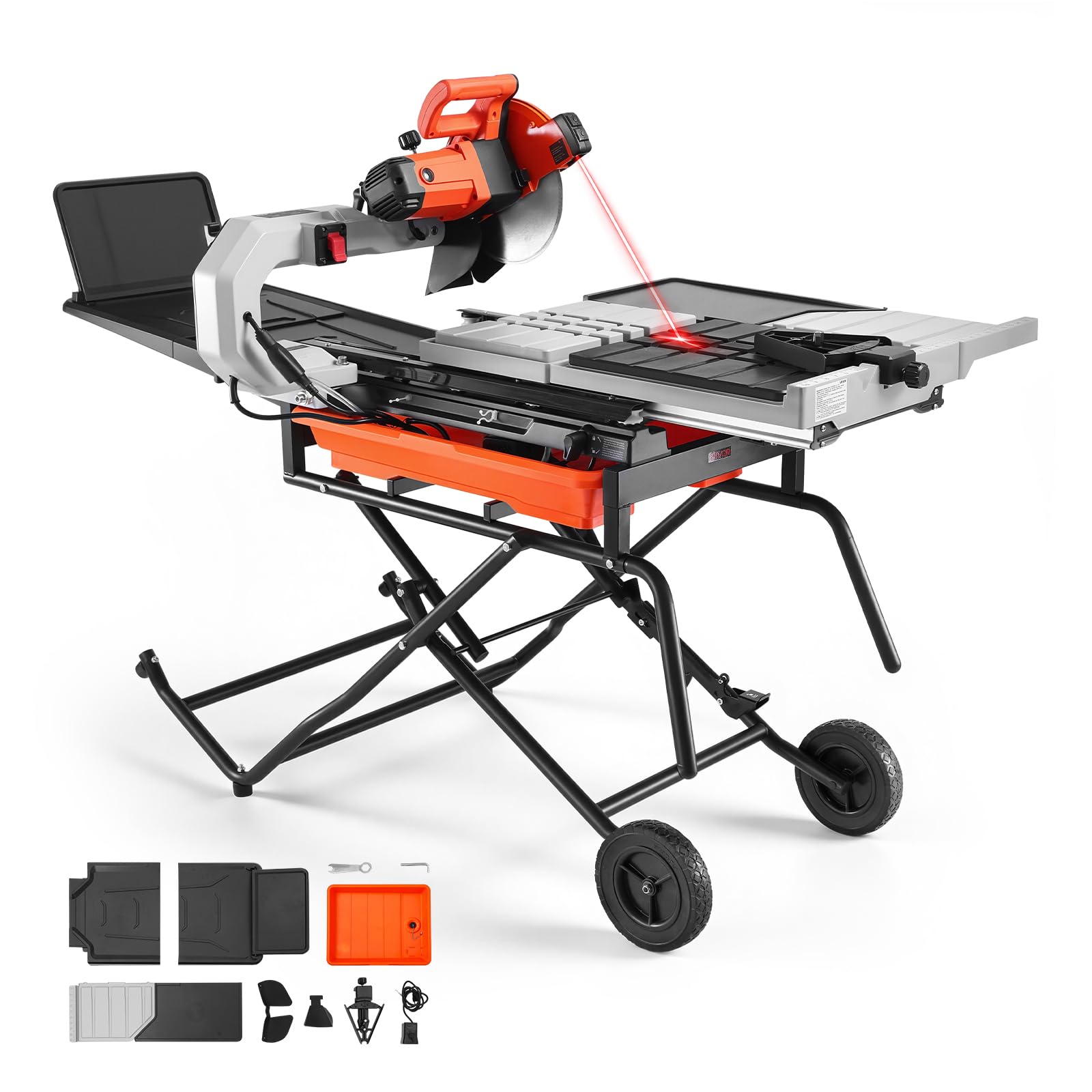
A rolling wet saw that takes big-format tile and marble up to a 3.8 inch depth.
Large-format tile is a two-person wrestling match unless your saw can hold it. This model handles a 36-inch tile capacity and a 24-inch diagonal cutting capacity, so full slabs stay supported through the cut. Depth reaches 3.8 inches (95 mm), and the cutting angle adjusts from 0° to 45° with stops marked at 0°/22.5°/45° for bevel work on corners and edges.
Power comes from a 15 amp motor driving a 65Mn steel blade at 4500 RPM — enough for smooth, continuous cuts through ceramic, porcelain, floor tile, and marble. The wet system uses a detachable PP water reservoir and a pump to keep water on the blade, reducing dust and keeping the working area drier. An infrared guide line helps you align cuts accurately, and a built-in scale makes straight and diagonal cuts repeatable. Two non-slip rubber wheels on the base let the whole rig move between rooms and sites.
Weighing 116.4 lbs, this is a stay-put machine for a big install rather than a carry-along tool. Functionality and value are the themes buyers come back to, and the blade gets praise for being well made; it also takes 6×6 and smaller tile without fuss. Park it where the tile is staged, and the 36-inch capacity does the work the weight would otherwise cost you.
Room for the big stuff: 36-inch tile capacity and 24-inch diagonal cuts keep large slabs supported and on line.
The reality of size: 116.4 lbs means you plan the install around where the saw sits, not the other way around.
For big installs: large-format porcelain, floor tile, and marble where the saw can sit for the whole project.
Consider the alternative: on one-off small jobs, this much weight and setup is more saw than you need.
9. Husqvarna 967682101 K 770 Gasoline Power Cutter

Where there is no outlet, this gas cutter still reaches a 5-inch depth.
Every corded saw on this list stops when the power does. That is the whole case for a gasoline power cutter: a worksite far from an outlet, a roadside cut, or a job where dragging a cord is a hazard. This machine cuts to a maximum depth of 5 inches, and it weighs 22.4 lbs — light enough for its power class and a genuinely compact body.
Durability is built in. A cast magnesium crankcase uses a 3-bolt joint to attach the cutting head, which gives higher torsional rigidity (less twist under load) than a 2-bolt design. Semi-automatic smart belt tension minimizes the risk of under- or over-tensioning, and a poly-v belt with a maintenance-free durastarter and active air filtration keeps service intervals long. In practice, that means fewer breakdowns on remote jobs where a trip back to the shop costs a day.
Reliability is what buyers lean on most — running great right from the start and starting on the first pull come up again and again. Two things to know before you commit: the blade is not included, so factor in a diamond blade for the material you cut, and the weight draws mixed reactions depending on how long you hold it. Gas also means fuel, exhaust, and a bit more maintenance than plugging in a cord.
The freedom factor: no cord and no outlet needed, with a 5-inch depth and a compact 22.4-lb body.
Budget the blade: the saw ships without one, so add a diamond blade before your first cut.
For remote sites: off-grid cutting where an outlet is not an option and a 5-inch depth covers the job.
Stay corded if: you work near power and want to skip fuel, exhaust, and engine upkeep.
10. DEWALT Wet Tile Saw with Stand, 10 Inch, 15-Amp (D36000S)

A 91-pound wet saw with a 37-inch rip capacity built to split oversize tile in half.
When a job is nothing but giant tile, the saw’s capacity decides whether you can do it at all. This one rips to 37 inches, or 41 inches with the plunge, and gives 18 inches of cutting clearance left of the blade — enough to halve a 36-inch by 36-inch tile. The 15 amp motor delivers 1220 MWO (motor output watts, a truer measure of cutting power than amps alone) to keep the blade loaded through dense porcelain.
Accuracy comes from the cutline indicator, rigid frame, and stainless-steel rollers, which hold the cut to within 1/32 inch over 30-inch cuts. Water containment is well thought out: 18-inch by 36-inch and 24-inch by 24-inch tile sit fully inside the water tray system, keeping the area cleaner. Integrated storage for the cart extension, miter guide, and wrenches means the accessories travel with the saw, and at 28-7/8 inches wide from column to cart edge it rolls through standard 30-inch door frames.
It weighs 91 lbs, so it moves on the cart, not in your arms. Assembly draws mixed feelings — some find it straightforward, others say it takes patience to set up. Blade quality and cutting performance are what owners come back to, and it handles 24-inch by 36-inch tile with no problem. For a tile contractor working large formats daily, that capacity is the whole point.
Capacity that matters: 37-inch rip cuts and a 36-by-36 tile halved cleanly set this apart from the 10-inch D24000S.
Fitting it through: the 91 lbs and 28-7/8 inch width mean it is a cart machine that fits standard 30-inch door frames on site.
For big-format pros: contractors cutting oversize tile daily who need the width and water containment.
Think twice if: your work is small tile and tight spaces — the setup time and 91 lbs are a lot to lug for a quick job.
Know the Specs
Blade Diameter and Cut Depth
Blade diameter sets how deep the saw can reach, so it is the first number to check against your material. A 4-3/8 inch blade tops out around 1-3/8 inches of cut, while a 16-inch blade reaches 6 inches. Buy for the deepest pass you will actually make — a short blade means more passes and more chances to wander off line on thick stone.
Motor Power: Amps, Watts, and RPM
Hard stone needs steady turning force, not speed for its own sake. Amperage (how much current the motor draws) and wattage tell you the muscle, while RPM (revolutions per minute) tells you blade speed. Makita’s 4100NHX1 runs 14,500 RPM on 9.6 amps for trim work; the XtremepowerUS 16-inch runs 2600W for deep concrete. Match the power to the depth you are cutting.
Wet Cutting Versus Dry Cutting
Wet cutting feeds water to the blade to cool it and knock dust down at the source, which suits tile, marble, and slab work. Dry cutting with a dust bag or extraction port is the route for quick indoor detail and small masonry repairs. Many cut-off saws do both, giving you a choice per job.
Segmented Versus Continuous Blades
A segmented diamond blade has notches around the rim that clear material fast, so it suits concrete, brick, and block. A continuous rim (a smooth edge) on a wet saw gives a cleaner cut on porcelain and marble. Check that the blade matches the stone and the saw’s arbor size before you cut.
Common Questions
Can I cut natural stone with a wet tile saw?
Do I need a diamond blade to cut concrete or brick?
What is the difference between a segmented and a continuous-rim diamond blade?
How deep can a small masonry saw cut?
Is a worm-drive saw better for cutting flat stone?
How do I control dust when cutting stone indoors?
Why does my concrete saw trip the breaker?
Can a wet tile saw cut large-format tile in one pass?
Is a gas power cutter worth it over a corded saw?
The Bottom Line
For most people cutting stone, the saw for stone cutting that earns the top spot is the DEWALT D24000S — a 10-inch wet saw that cuts to 3 1/8 inches with water containment and holds its line within 1/32 inch on an 18-inch cut. It is the crowd favorite too, holding a 4.5+ rating from a deep base of owners who value the accuracy and the clean water handling. If paving, brick, and block are your daily work rather than slabs, the Evolution R6DCT is the compact cutter to reach for, with its dual-sided water feed and 2-inch single-pass depth. And for deep concrete and foundation work where nothing smaller finishes the pass, the XtremepowerUS 2600W 16-Inch delivers a 6-inch cut — just plan your 20A supply first.
How we choose
We do not accept paid placement. Every pick is matched to a real buyer and a real use-case; we do not hands-on test units.
Sources
Specifications: manufacturer listings and product documentation. Review insights: verified customer reviews, as of November 2026. Pricing: not shown on this page (it changes often); check the current price via the retailer link.
As an Amazon Associate, Tactical Gear Guy earns from qualifying purchases. This does not affect which products we feature.