Specs are compiled from manufacturer listings and verified buyer reviews and can change over time — please confirm the key details on the product page before buying.
If your pool sits unused because the water never gets above bracing-cold, the fix is almost never a bigger flame — it is the right heater matched to your gallon count. This guide sorts seven real pool heaters by what they can actually warm, what they plug into, and where each one falls short. The crowd favorite carries a 4.5+ star rating across 200+ owners.
This guide is built by comparing the manufacturers’ published specifications and the patterns across verified customer reviews, so you get each pick’s real strengths and trade-offs instead of marketing spin.
The details most buyers skip are the ones that decide their season: the heating capacity in BTUs, the electrical outlet the unit needs, and the pool volume it is rated to warm. Get those three right and installation is straightforward. This is where a careful read of the best swimming pool heater specs saves you a wasted summer.
Top Picks
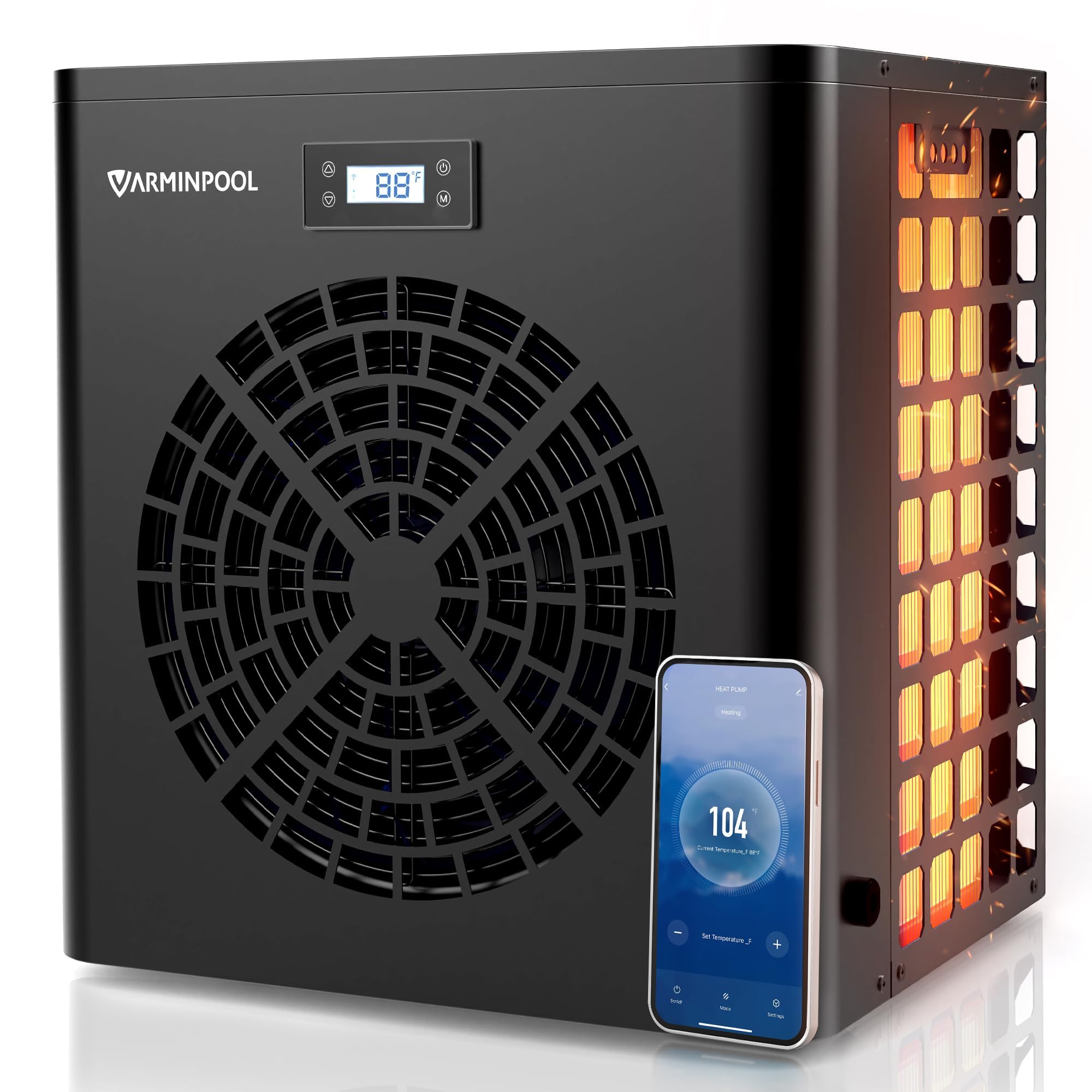
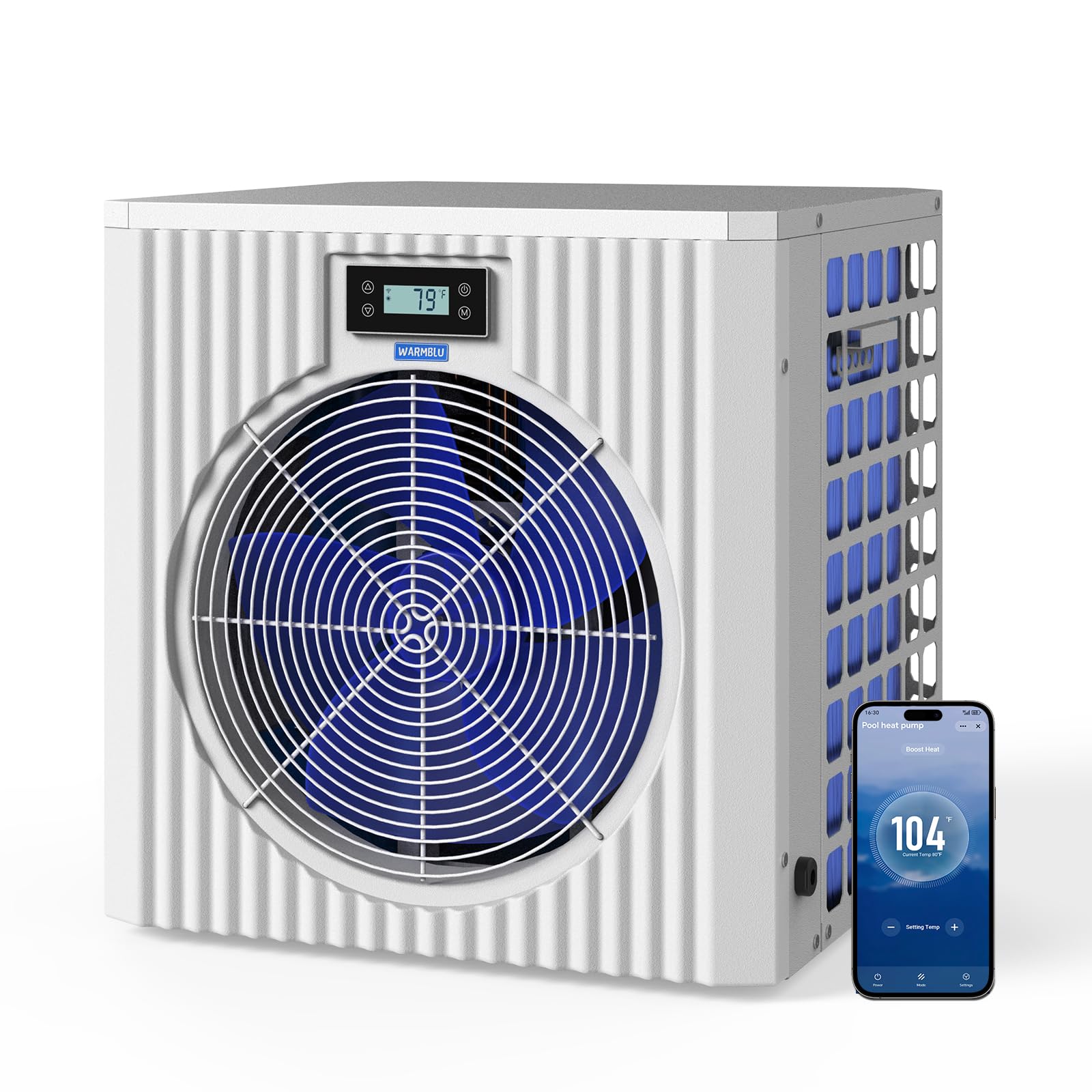
How To Choose The Best Swimming Pool Heater
The mistake nearly every first-time buyer makes is buying by price or brand instead of by math. A heater is a heat pump or a burner, and either way it must move enough warmth into your water to hold a comfortable temperature through the evening. Get the sizing wrong and you will run the unit flat out just to keep pace with the night air.
Match BTU output to your gallon count
BTU (British thermal units) is simply how much heat the unit can move into the water each hour. As a rough guide, the higher the BTU figure the more gallons it is rated to warm. Small above-ground pools in the low thousands of gallons sit comfortably in the 16,000–18,450 BTU range, while larger pools push toward 30,000 BTU and beyond. Buying a heater rated well under your pool’s volume means it will never quite keep up.
Check the outlet before you check anything else
Some heat pumps run on an ordinary 110–120V household outlet, which means plug-in installation with basic hose connections. Others require a 240V circuit, which is a different job altogether. If you are not wiring a dedicated line, confirm the voltage first. A 240V heater is useless if your pad only has a 110V outlet.
Factor in COP and quiet running
COP (coefficient of performance) is a heat pump’s efficiency score — how many units of heat it moves for each unit of electricity it uses. A higher COP means less electricity for the same warmth. Noise is the other daily factor: heat pumps measured in the low 50 dB range run about as quiet as a refrigerator hum, which matters if the pool sits near a bedroom window.
Side-by-Side Comparison
| Model | Best For | Heating Output | Pool Size Rated | Power / Weight | Amazon |
|---|---|---|---|---|---|
| Swimming Pool Heater for Above Ground Pool 18450BTU★ Best Overall | Small family pools, plug-in ease | 18,450 BTU | Up to 6,000 gallons | 110–120V / 77.8 lbs | Amazon |
| 5,500 Gallons Above Ground Pool Heater 110VQuiet Performer | Large above-ground pools, quiet | COP 4.1 | Up to 5,500 gallons | 110V / 73.8 lbs | Amazon |
| 16000BTU Swimming Pool Heat Pump Up to 5000 Gallons 110v | Highest rated, tight budget | 16,000 BTU / COP 4.3 | Up to 5,000 gallons | 120V / 74.8 lbs | Amazon |
| 30,000 BTU Pool Heater | Bigger pools, heat and cool | 30,000 BTU / COP 5.8 | Up to 7,000 gallons | 120V / 115.8 lbs | Amazon |
| MICOE 58,000 BTU Pool Heat Pump | Large pools up to 16,500 gal | 58,000 BTU | Up to 16,500 gallons | AC / — | Amazon |
| FibroPool FH270 70,000 BTU | Inground, 240V setups | 70,000 BTU | Up to 15,000 gallons | 240V / 157 lbs | Amazon |
| Hayward H-Series Natural Gas Pool Heater 250,000 BTU | Fast gas heating, large inground pools | 250,000 BTU | Up to 750 sq ft | Natural gas / 171 lbs | Amazon |
Detailed Reviews
1. Swimming Pool Heater for Above Ground Pool 18450BTU
Our pick — 4.5+★ from 200+ verified ratings; the strongest balance of quality and price.
The plug-and-play heat pump that turns a chilly backyard pool warm without an electrician.
The whole pitch here is convenience that does not cost you heating power. You get 18,450 BTU of warmth aimed at pools holding up to 6,000 gallons, and it runs off a standard 110–120V household outlet. That means basic hose connections and no special wiring — the seller quotes under 30 minutes to set up. For a family with a 10–14 ft above-ground pool, that is the difference between a pool you use and one you walk past.
What wins buyers over is how reliably it does the basic job. Buyers report steady water temperature for evening swims and quiet running, and the corrosion-resistant titanium heat exchanger (a metal core that shrugs off salt and chlorine) means it holds up season after season in either type of pool.
The catch is the app. Wireless connectivity is the one part owners push back on — some report the heater dropping off the WiFi and the smartphone controls going unresponsive. It heats fine regardless, but if remote scheduling from your phone is the reason you are buying, temper that expectation. The other thing to know is the sizing ceiling: at 6,000 gallons this suits small to mid above-ground pools, not a sprawling inground setup.
What earns its keep
- 18,450 BTU warms pools up to 6,000 gallons
- 110–120V household outlet, no electrician needed
- Titanium exchanger handles saltwater and chlorine
- Runs quiet enough for evening swims
Where it asks patience
- WiFi app can drop off and need reconnecting
- 6,000-gallon ceiling rules out large pools
Made for: the above-ground pool owner who wants warm water this weekend without a wiring project.
Look elsewhere if: your pool runs past 6,000 gallons or you need rock-solid phone control.
2. 5,500 Gallons Above Ground Pool Heater 110V
The heat pump that keeps a big above-ground pool warm without announcing itself to the neighbors.
Start with the number that makes this one worth a look: a noise level under 50 dB, which the maker compares to a refrigerator hum. If your pool sits within earshot of a patio conversation or a bedroom, that quiet matters as much as the heat. It is rated for pools up to 5,500 gallons, runs on 110V, and centers on a pure titanium heat exchanger for saltwater and chlorine compatibility.
The efficiency story is the COP of 4.1 — its score for how much heat it moves per unit of electricity. An intelligent inverter control constantly adjusts operation, which the maker says trims running costs compared with gas or conventional electric heaters. Daily control comes through an app or a touch panel, and the design separates water from electrical components, which is the safety detail to check on any outdoor heater sitting next to your pool.
One honest frame: this is a smaller-capacity heater for above-ground pools in the thousands of gallons, and at 73.8 pounds it is a stout unit to move into place. It is the right call for someone who values near-silent running and efficiency over covering a very large pool volume.
Its real strength: sub-50 dB operation and a COP of 4.1 make it a quietly efficient choice for mid-size above-ground pools up to 5,500 gallons.
The honest limit: it tops out at 5,500 gallons, so a larger pool or a long inground stretch needs more heating output.
Reach for this if: silence and running efficiency top your list for a mid-size above-ground pool.
Keep looking if: your pool volume runs well past 5,500 gallons.
3. 16000BTU Swimming Pool Heat Pump Up to 5000 Gallons 110v
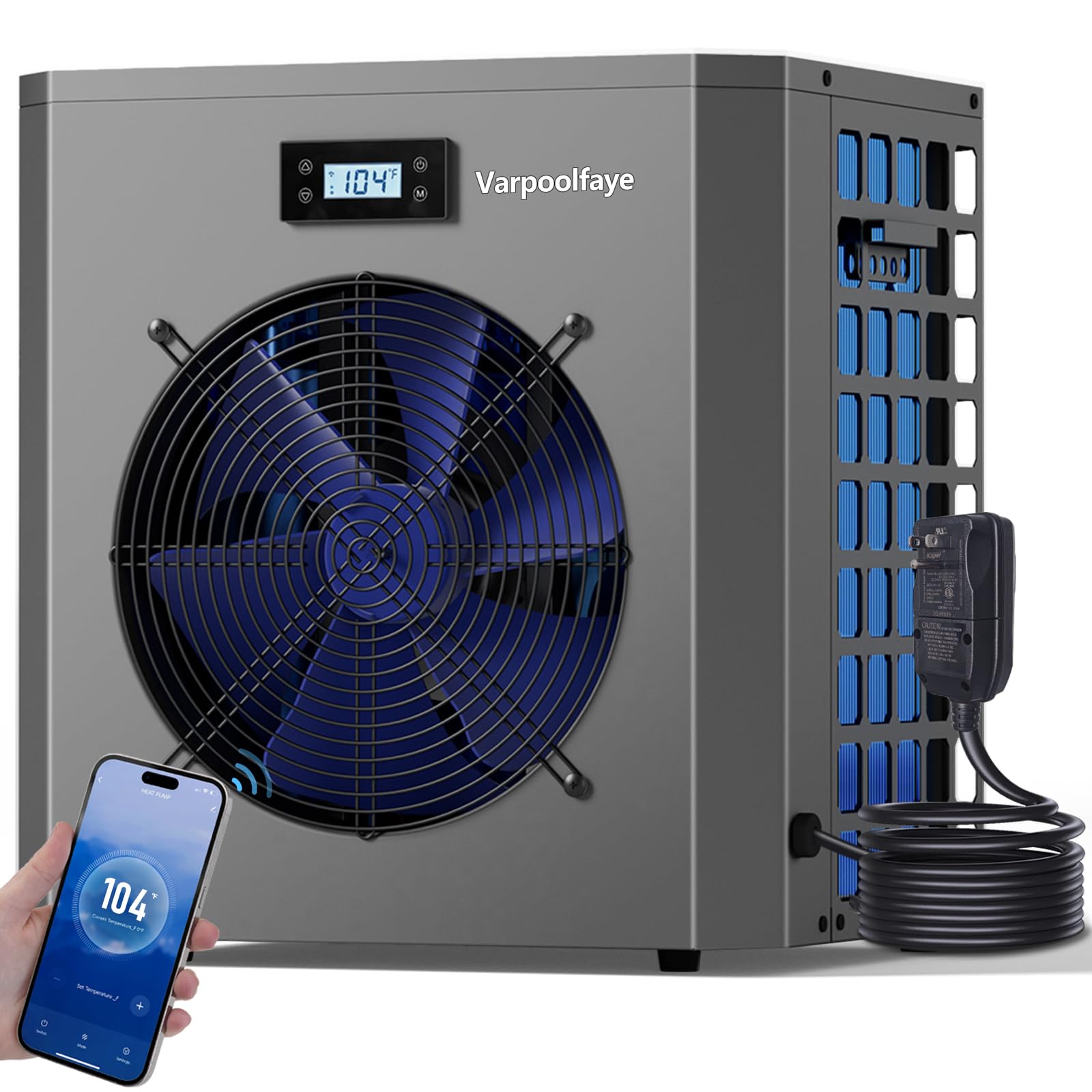
The small-pool heat pump that quietly climbed to the top of the ratings on efficiency and price.
Its efficiency claim is the headline: a COP of 4.3 from a unit drawing on a 120V supply, meaning it pulls warmth from the air and moves it into the water rather than burning fuel to make it. It is rated for pools up to 5,000 gallons and works in both freshwater and saltwater. Owners mention it heats efficiently — as owners put it, it “holds and climbs to 82°F” — and they consider it worth the money.
Setup is genuinely gentle. The box includes hose adapters for 1.25-inch and 1.5-inch connectors plus a 118-inch power cord, so you have reach to your outlet without hunting for an extension. Running noise sits as low as 50 dB with extra soundproofing components, and automatic defrost keeps it working when the air turns cold. There is an app and a control panel for scheduling heating cycles.
Understand its ceiling before you commit. At 5,000 gallons this is a small-to-mid above-ground pool heater, and the seller is upfront that a pool cover sharpens efficiency and a pump flowing 700–1,000 GPH is the target. It also notes condensation dripping from the base is normal during heat exchange — not a fault. For a pool at or under 5,000 gallons, this is the value pick of the bunch.
Why the ratings climb
- COP of 4.3 moves plenty of heat per unit of electricity
- Works in freshwater and saltwater
- 118-inch cord and 1.25/1.5-inch adapters included
- Runs as low as 50 dB with auto-defrost
Sizing reality
- 5,000-gallon ceiling limits it to smaller pools
- Wants a cover and 700–1,000 GPH flow to shine
Best fit for: an above-ground pool up to 5,000 gallons where you want efficient, quiet heating at a fair value.
Not for: large pools that need far more BTU than this unit delivers.
4. 30,000 BTU Pool Heater
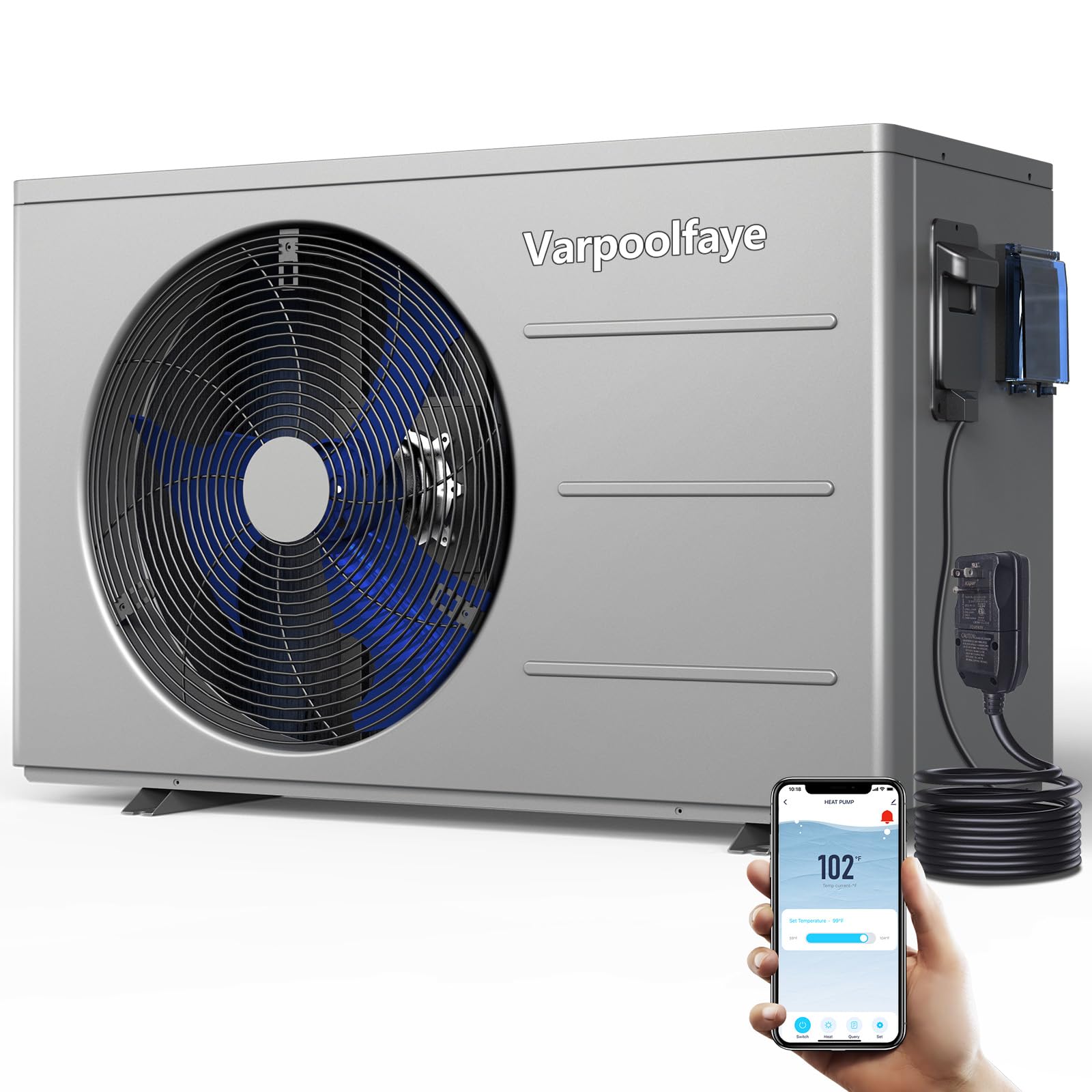
A dual-mode heat pump that warms a 7,000-gallon pool and can cool it when summer turns brutal.
The defining figure is 30,000 BTU of max output from a heat pump rated for pools up to 7,000 gallons across 14, 16, 18, 21, and 23-foot sizes. The high-pressure compressor drives a COP of 5.8 — a strong efficiency score that means fast, stable heating on minimal electricity. Unlike the small 5,000-gallon units, this one has real headroom for a bigger backyard pool.
what separates it is that it works both ways. It heats from 46°F to 104°F and cools from 46°F to 82°F, so you can take the edge off a scorching summer pool the same way you warm it in spring. WiFi control lets you set temperature and schedules from your phone, a titanium exchanger (a metal core that resists salt and chlorine corrosion) suits freshwater or saltwater, and it runs at 52 dB (about the level of a quiet conversation). It is a much heavier unit than the compact picks — 115.8 pounds versus 73.8 pounds on the 5,500-gallon model — so plan on a solid pad to sit it on.
Two practical notes from the listing: use a pool cover to sharpen heating, and expect condensation to drip from the base during heat exchange and defrost, which is normal. The unit ships with 1.5-inch connectors and a 126-inch power cord for a straightforward hookup.
What it brings: 30,000 BTU, a COP of 5.8, and cooling down to 82°F make it the flexible pick for bigger above-ground pools up to 7,000 gallons.
What to plan for: at 115.8 pounds it is a two-person lift onto the pad, and you will want a cover to hold the heat.
Pick this when: you want heat and cooling in one unit for a pool in the 7,000-gallon range.
Pass if: a compact, easy-to-move unit matters more than capacity and cooling.
5. MICOE 58,000 BTU Pool Heat Pump
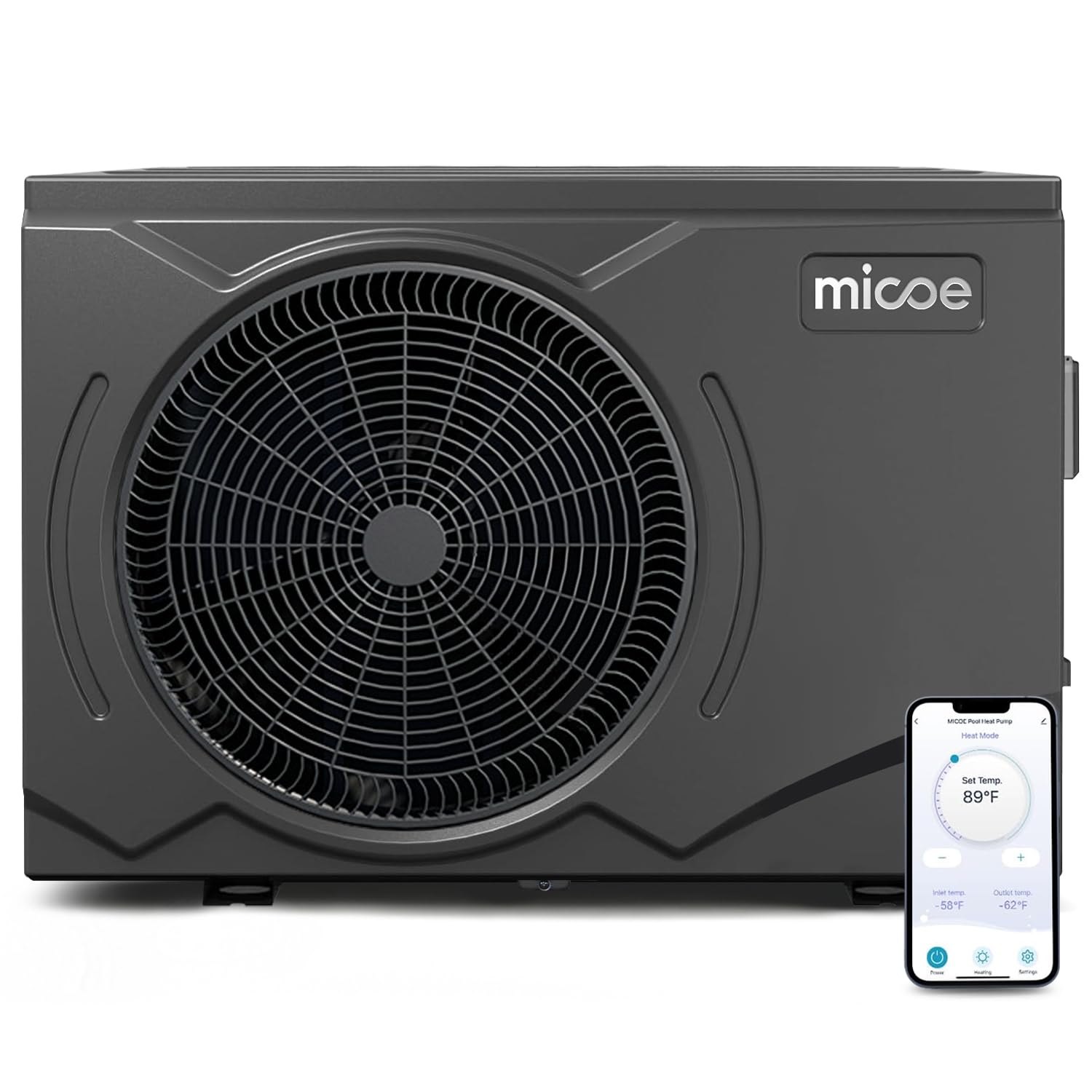
The 58,000 BTU workhorse built to warm a genuinely large pool, not a paddling pool.
The number that decides everything here is 58,000 BTU, aimed at above-ground and inground pools up to 16,500 gallons. That is the highest gallon rating in this group — it covers a pool the 5,000-gallon units simply cannot. It uses air-source heat pump technology to move warmth from the surrounding air into the water, and a titanium exchanger makes it safe for freshwater or saltwater.
Owners say it heats about 1 degree per hour and keeps pools around 80 degrees into November, with one buyer describing 86-degree temperatures. It operates from outdoor air as cold as 32°F up to 109°F, with heating from 46°F–104°F and cooling from 45°F–82°F, so it stretches your season into spring and fall. Auto-defrost keeps it running in colder weather, and the app or onboard panel handles control.
The trade-off worth naming is value perception: some buyers feel the price-to-performance sits lower than they hoped, and this is the premium tier of the group. Noise sits around 52 dB, and the ABS cabinet shrugs off UV, corrosion, fading, and cracking for outdoor life. If your pool is large and you want one unit that covers spring through fall, this is the heater for that job.
The case for the big unit
- 58,000 BTU rated for pools up to 16,500 gallons
- Operates in outdoor air from 32°F to 109°F
- Titanium exchanger for fresh or salt water
- Auto-defrost and app control
What to weigh
- Premium-tier pricing draws mixed value feedback
- Overkill if your pool is small
Made for: owners of large pools up to 16,500 gallons who want one heater to cover spring, summer, and fall.
Think twice if: your pool is on the small side — this unit is built for far more water than that.
6. FibroPool FH270 Pool Heat Pump
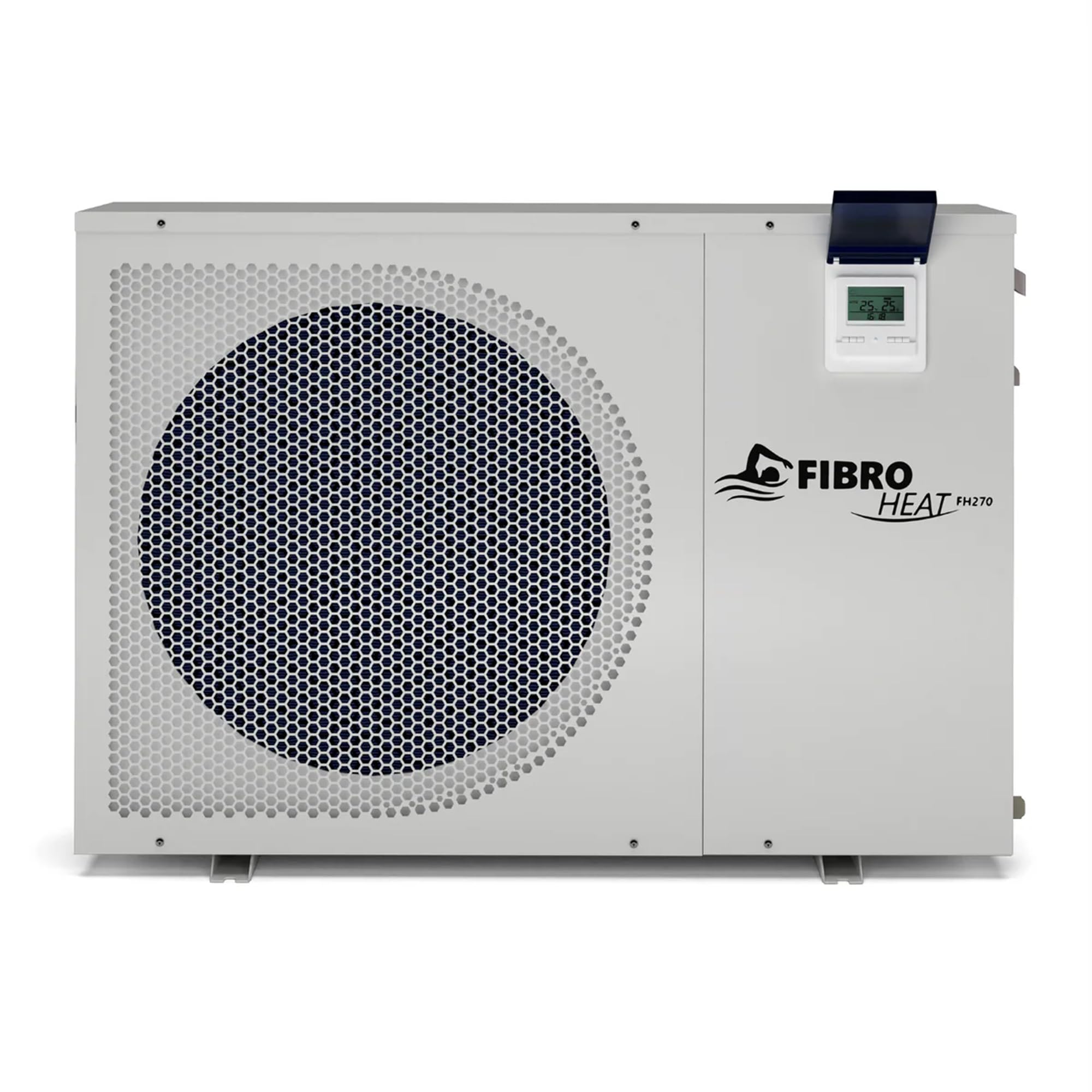
The heavy-duty heat pump for a 240V inground setup that wants fast, steady warmth.
At 70,000 BTU this is the most powerful heat pump in the lineup, rated for inground pools up to 15,000 gallons and above-ground pools of 27 ft round or 18 x 33 ft oval in mild climates. It pairs a titanium heat exchanger with a high-pressure compressor for steady output across a long season, and it runs on a dedicated 240V circuit. That voltage is the gate: this is not a plug-into-the-wall unit.
Owners describe it heating fast — one report has it raising water from 77 to 82–84°F in about 4 hours — and setup instructions land well with buyers. The build is enamel-coated steel that resists weather and corrosion, in a slim profile that fits tight equipment pads. A digital display shows and sets water temperature, with an optional extension for the control panel. It ships with 1 1/2 in fittings.
This one is for the buyer who already has 240V at the pad and wants serious heat-pump capacity. At 157 pounds it is the heaviest electric unit here, so plan the install with a second set of hands. If your hookup is a household outlet, look back at the 110V picks instead — this unit will not run on one.
The draw: 70,000 BTU and a titanium exchanger deliver fast heating for inground pools up to 15,000 gallons, with a slim cabinet that fits a tight pad.
The gate: it needs a 240V circuit, so a standard outlet buyer is out before the box even opens.
Right for: an inground pool owner with 240V service who wants proven fast heat-pump output.
Wrong for: anyone hoping to plug into a normal household outlet.
7. Hayward H-Series Pool Heater

The natural-gas bruiser that heats an inground pool fast — if you already have the gas line.
This is a different animal from every heat pump above: a 250,000 BTU natural-gas heater for in-ground pools and spas up to 750 sq ft. That output dwarfs the heat pumps, and it does what gas does best — heats quickly. It connects through a built-in 3/4″ gas connection and allows flexible gas and electric hookups on the right or left side. It is certified for low-NOx emissions, which matters in regions that regulate burner emissions.
Owners confirm the fast heat and easy installation, and the control panel is genuinely useful: a digital LED display with self-diagnostic capabilities that show water temperature and monitor the unit’s performance. The build protects against corrosion caused by unbalanced water chemistry, and the maker notes it can reduce pump run time for energy savings.
Here is the honest half. Reliability feedback is split — some call it excellent, others describe units that did not work properly — and this is the oldest, most established name in the group at a premium tier. It also absolutely requires a natural-gas line; there is no outlet-plug workaround. If you have gas service and a large inground pool to heat fast, it fits. If you are building around electricity, the heat pumps above are your lane.
Why gas still wins for some
- 250,000 BTU heats an inground pool fast
- Suits pools and spas up to 750 sq ft
- Low-NOx certified operation
- Self-diagnostic LED control panel
The honest costs
- Requires a natural-gas line — no plug-in option
- Reliability feedback is genuinely mixed
Suits you if: you have natural-gas service and want the fastest heat for a large inground pool or spa.
skip it if: your property has no gas line — this unit cannot be adapted to run on electricity alone.
Know the Specs
BTU and pool volume
BTU (British thermal units) measures how much heat a heater moves into the water per hour. The higher the figure, the more gallons it is rated to warm. A 16,000 BTU heat pump suits smaller pools in the low thousands of gallons, while a 30,000 BTU unit stretches to around 7,000 gallons and a 58,000 BTU model reaches up to 16,500 gallons. Buying a heater rated under your pool’s gallon count means it never quite catches up.
COP and running cost
COP (coefficient of performance) is a heat pump’s efficiency score — how much heat it moves per unit of electricity. A higher COP means less power for the same warmth, which is why heat pumps tend to cost less to run than gas or resistance heaters over a season. In this group the scores run from 4.1 to 5.8, all of which beat heating with straight electricity.
110V vs 240V hookup
Voltage decides where you can install a heater. Units rated for 110–120V plug into an ordinary household outlet with basic hose connections and no electrician. A 240V unit needs a dedicated circuit, which is a wiring job. Choose by the power you already have at the equipment pad, because a more powerful heater you cannot plug in is no use.
Titanium exchangers
The heat exchanger is the metal core that moves warmth into the water, and a titanium one is built to resist corrosion from saltwater and chlorine. That is the part to check for a salt pool, because it is what keeps the unit alive across multiple seasons. Most heat pumps here list a titanium exchanger, which is the durability marker worth having.
Common Questions
How many BTUs do I need for my pool size?
Will a heat pump work on a saltwater pool?
Can I plug a pool heater into a normal household outlet?
Is a heat pump or a gas heater faster to heat a pool?
How long does it take a heat pump to warm the water?
Why does my heat pump leak water from the bottom?
Do I need a pool cover to make a heater work well?
What water flow does a heat pump need from my pump?
Will these heaters work for an inground pool as well as above ground?
Do I need a dedicated circuit for a 240V unit?
The Bottom Line
For most backyard pools, the best swimming pool heater is the Swimming Pool Heater for Above Ground Pool 18450BTU. It plugs into a standard outlet, warms up to 6,000 gallons, and handles salt or chlorine with a titanium exchanger — all without an electrician. Want maximum efficiency per watt in a smaller footprint? The 16000BTU Swimming Pool Heat Pump pairs a COP of 4.3 (it moves 4.3 units of heat for every unit of electricity it uses) with a low noise floor for above-ground pools up to 5,000 gallons. And if you are heating a genuinely large pool, the MICOE 58,000 BTU covers up to 16,500 gallons while a FibroPool own
How we choose
We do not accept paid placement. Every pick is matched to a real buyer and a real use-case; we do not hands-on test units.
Sources
Specifications: manufacturer listings and product documentation. Review insights: verified customer reviews, as of November 2026. Pricing: not shown on this page (it changes often); check the current price via the retailer link.
As an Amazon Associate, Tactical Gear Guy earns from qualifying purchases. This does not affect which products we feature.