Specs are compiled from manufacturer listings and verified buyer reviews and can change over time — please confirm the key details on the product page before buying.
You want an outlet that charges your phone and laptop straight from the wall, without hunting for a bulky adapter every night. Every pick below keeps both 15A AC receptacles alongside the USB-C port. The short answer: match the per-port USB-C wattage to your biggest device, pick GFCI for wet rooms, and confirm the wall plate is in the box.
This guide is built by comparing the manufacturers’ published specifications and the patterns across verified customer reviews, so you get each pick’s real strengths and trade-offs instead of marketing spin.
Nine models are broken down below, from GFCI units for wet rooms to 65W laptop chargers that replace a whole power brick. By the end you will know which wattage and GFCI rating fits each room. These nine USB-C in-wall outlets cover phone charging, 65W laptop power, and GFCI wet-room duty.
Top Picks


How To Choose The Best USB-C In-Wall Outlet
An in-wall outlet with USB-C puts a PD port in the wall so no adapter or cable sits on the counter. The trick is matching per-port wattage to your device and GFCI protection to the room. Get wattage and GFCI right and the finish is just preference.
Match the USB wattage to the device you charge most
Phones and tablets top out quickly, so a modest USB-C port handles them comfortably. A laptop needs a much higher wattage to charge at full speed, and that is where a high-power outlet earns its place. If you plan to run a notebook from the wall, look for a model that states a high per-port USB-C wattage rather than only a shared total. A shared total means the combined output across all ports, so one port can drop when a second device joins. A per-port maximum tells you what one cable gets on its own.
Decide if you need GFCI protection
GFCI stands for ground-fault circuit interrupter — a safety switch that cuts power when it senses current leaking to an unintended path, which is the protection code usually calls for near water. In a bathroom, kitchen, garage, laundry, or outdoors, a GFCI version is the one to fit. A self-testing GFCI runs its own check on a timer and uses a status light to tell you it is still working, so you are not guessing. If the outlet sits in a dry living room or bedroom, a standard non-GFCI model is fine and usually simpler.
Check the box fit and the small parts
A 15-amp receptacle is the standard North American wall outlet, and it replaces a normal one in the same wall box. The catch most people hit is the wall plate. Some models ship with a screwless plate included; others sell it separately, so confirm before you buy or you will be making a second trip. Back and side wiring both work on most of these units, and clamp-style terminals let you slide the wire under a plate and tighten instead of bending a loop around a screw.
Side-by-Side Comparison
| Model | Best For | USB Output | GFCI | Wall Plate | Amazon |
|---|---|---|---|---|---|
| ELEGRP 5-Pack USB A/C★ Best Overall | Whole-home upgrades | 3.6A total | No | Included | Amazon |
| DEWENWILS 15A GFCIWet-Room Safe | Kitchens and baths | 4.8A / 24W combined | Yes | Screwless, included | Amazon |
| Leviton T5638-WSimple Swap | Bedside overnight charging | 18W combined | No | Sold separately | Amazon |
| BESTTEN GaN 65W | Laptop charging | 65W per port max | No | Screwless, included | Amazon |
| LIDER 6.0A 30W | Value installs | 30W / 6.0A total | No | Included | Amazon |
| LIDER USB-C 36W PD | Visible wall styling | 30W + 6W | No | Screwless, included | Amazon |
| ELEGRP 42W 4-Port | Family charging hubs | 42W max total | No | Screwless, included | Amazon |
| Legrand Radiant GFCI | Bathroom convenience | 3.1A shared | Yes | Not stated | Amazon |
| Leviton GUAC1-W | High-traffic GFCI spots | 4.8A / 24W | Yes | Not stated | Amazon |
Detailed Reviews
1. ELEGRP USB Wall Outlets 5 Pack
Our pick — 4.5+★ from 200+ verified ratings; the strongest balance of quality and price.
Five outlets in one box, so every room gets a USB-C port in a single afternoon.
This is the pick to buy if you are upgrading several rooms at once. You get five complete 15-amp receptacles, each with a USB-C port and a USB-A port, and the pack math is the whole story — five units against the single DEWENWILS outlet for roughly the same money. Buyers describe the install as simple, and the faceplate screws straight onto the receptacle without a fight. The crowd verdict on this one sits at 4.5+ stars across 200+ ratings, which is why it holds the top spot.
Each unit feeds out 3.6A total across its two USB ports, with a 3.0A maximum on the USB-C side and 2.4A on the USB-A side when used on its own. In plain terms, that is a solid phone-and-tablet charger, not a laptop power source. Pair a phone on the C port with earbuds on the A port and both fill overnight without drama. The ports carry a protocol chip that reads what the device wants and matches it, so an iPhone and a Samsung both charge at their own pace rather than a fixed trickle.
What earns it the top slot is build and honesty about safety. The housing is polycarbonate thermoplastic with fire-resistant materials and child-proof shutters behind every slot. The USB-C port is rated for 10,000 insertions and the USB-A for 8,000, so a daily plug-in lasts a very long time. It carries UL certification tested to UL1310 and UL498, uses under 75mW of standby power at the Department of Energy Level VI level, and is backed by a 2-year support window.
Where the five-pack wins
- Five receptacles turn a whole home one-and-done, versus a single unit from DEWENWILS
- 3.0A USB-C and 2.4A USB-A single-port maximums handle phones and tablets comfortably
- 10,000-insertion USB-C life and 8,000 on USB-A speak to long daily use
- Under 75mW standby draw keeps the vampire load tiny
What you give up
- 3.6A shared total will not fast-charge a laptop
- No GFCI protection, so it is not the right call beside a sink
- White only in this pack
Reach for this if: you are rewiring several bedrooms or a whole floor and want one order to cover it.
Think twice if: your main charger is a laptop — you want the BESTTEN GaN unit below instead.
2. DEWENWILS 15A GFCI Outlet with USB Ports
A bathroom outlet that checks its own safety switch every thirty seconds.
If the outlet is going near a sink, a garage door, or a laundry tub, this is the one to fit. It combines a 15-amp GFCI receptacle with USB-A and USB-C ports that push a combined 4.8A at 24W. That is more USB juice than the ELEGRP five-pack offers from any single unit, and it puts real ground-fault protection in the same footprint. The green light stays on when the GFCI is working, so a glance tells you the safety switch is alive.
What sets this outlet apart is its self-test cycle: every 30 seconds it checks whether it can still trip on a ground fault (a safety switch that cuts power when current leaks to ground). The indicator lights tell you the state in plain color — green for good, solid red when a leak was detected and power was cut, flashing red when the GFCI function itself fails, and no light for a plain power outage. Wiring is handled with clamping plates: you slide the wire under the plate and tighten, with terminal markings and color guides to keep you straight. No looping wire around a screw.
It arrives with a screwless wall plate so the finished face is flush and clean, and it is ETL-certified with tamper-resistant shutters to stop objects going in where a child or pet might try. Weigh the fit honestly: this is a single outlet, so a whole-house upgrade means buying several. The USB side is also a shared 4.8A, meaning two devices split it rather than each getting the full figure.
Best room for it: A GFCI outlet with USB deserves the bathroom, the kitchen counter, or the garage wall. It replaces a standard outlet and gives you the protection code tends to call for near water, plus a C port for the phone you charge on the counter.
Install in your head first: It handles both back and side wiring, and copper wire is what it wants. If your box is tight or your wire gauge is unusual, check the clearance before you start — that is the step that slows most installs.
The pick for wet zones: a self-testing GFCI with USB-C in one device.
Not for: a dry bedroom where a standard outlet does the same job for less fuss.
3. Leviton T5638-W USB Type-A/C In-Wall Charger
The narrowest body here, built for squeezing into a tight wall box.
At 1.71 inches wide and 4.17 inches long, this is the most compact outlet on the list. The BESTTEN GaN model measures 2.91 inches wide by comparison, so if you are working with a shallow or crowded box, this Leviton slides in where a bulkier unit fights you. The trade is wattage: 18W combined across the two ports is well short of the BESTTEN’s 65W per port, and the LIDER 30W unit tops it too. It also does not provide Power Delivery, which Leviton states plainly on the box.
What it does, it does for overnight charging. A built-in smart chip reads each device’s needs and adjusts the current, so a phone fills steadily while you sleep and the two AC receptacles stay free for a lamp and a clock. Buyers describe it as working fine with both older and newer gear, and the construction feels solid in hand. The tamper-resistant shutters cover both slots, so the outlet is safe with kids in the house.
One thing to plan for: the wall plate is sold separately. That is easy to miss and it means a second order before you can finish the job. The 15-amp receptacle part is standard, so it drops into any normal box, and the plastic body keeps the weight down during installation. It is the sensible choice for a nightstand or hallway where you charge a phone and nothing heavier.
Its real strength: Fit. A 1.71-inch width and 4.17-inch length is the smallest footprint in this lineup, and that matters when the wall box is already full of wire nuts and cable.
The honest catch: 18W combined and no Power Delivery means it will not charge a laptop, and the missing wall plate adds a step to your install.
Good fit: a bedside or hallway outlet where a phone charges overnight and space is tight.
Look elsewhere: if a laptop ever plugs in here, or if you want the plate in the same box.
4. BESTTEN GaN 65W USB C Wall Outlet

The only outlet here that can genuinely replace a laptop power brick.
Two USB-C PD 3.0 ports at 65W max each, plus one USB-A Quick Charge 3.0 port at 30W max, and the outlet still leaves both AC sockets free. That combination is rare: most wall outlets here cap out well below laptop range. When several devices charge at once, the main USB-C port holds a stable 45W, which is enough to keep a notebook topped up while a phone takes the other port. GaN is the material inside the charger — it switches power faster and generates less waste heat, which is why the maker can squeeze 65W into a wall plate. The efficiency is stated at over 90%.
Build quality is where it draws the most praise, with a polycarbonate body and a screwless wall plate in the box. The footprint is bigger than the Leviton at 4.69 inches long by 2.91 inches wide, so measure your box depth before you commit. Installation suits back or side wiring, and it carries ETL and cETL listing. Built-in detection matches each device’s power draw so nothing overcharges.
The honest caveat is the USB-A port. Buyers report: “However, reliability is mixed, with several customers reporting that the USB-A plug stopped working after two months.” The USB-C charging itself has not drawn the same complaint, and the C ports are the ones that matter most for a laptop. Treat the A port as a bonus slot rather than the reason to buy, and this becomes an easy recommendation for anyone with a notebook on the desk.
Why it replaces your brick
- 65W per USB-C port beats the 18W Leviton and the 30W LIDER by a wide margin
- 45W sustained on the main C port even with all three ports busy
- Two PD 3.0 C ports plus a QC 3.0 A port charge three devices and leave both AC sockets free
- Screwless wall plate included and ETL listed
Read before buying
- 4.69 x 2.91 inch body needs box clearance — verify depth first
- A-port reliability is mixed, so lean on the C ports
- No GFCI protection
Buy it for: a desk or kitchen counter where a laptop, phone, and tablet all want to charge at once.
Skip if: your wall box is shallow — the footprint is the widest in this lineup.
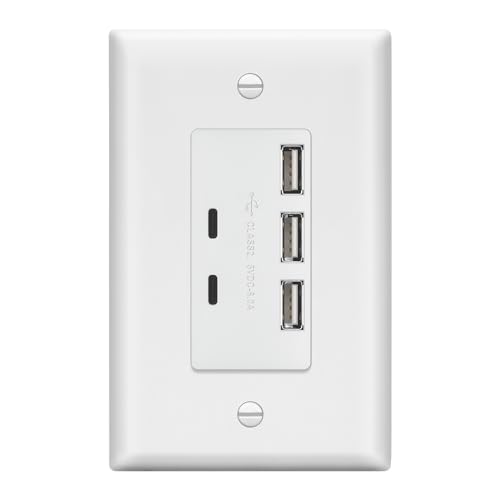
5. LIDER 6.0A 30W USB A&C In-Wall Charger
A 30W split AC/DC charger with a wall plate in the box and a long warranty.
Here is the compromise many homes want: enough USB power for phones and tablets, but not laptop-grade. This LIDER pushes 30W total across its C and A ports, with a 6.0A rated current. Compare that to the 18W combined on the Leviton above and it is a clear step up, without stepping into BESTTEN’s laptop territory. The Type-C port on its own is rated 5V at 1.5A, while the Type-A is 5V at 2.4A — so the A port is actually the quicker one here for a standard phone cable.
The housing is polycarbonate thermoplastic chosen for heat and fading resistance, and the flammability rating guards against the discoloration you see on cheap outlets after a few years of sun. It comes with a wall plate so you finish the install in one go, and the terminals are simple to wire with a step-by-step guide. A 3-year warranty backs it. Buyers consistently call it an easy install that handles phones and tablets without complaint.
One honest read: the spec sheet lists the outlets as 1 11/16 inches wide by 2 11/16 inches high by 1 13/16 inches deep, so it stays compact behind the plate. It wants copper wire only, which almost every home has. The USB total is shared, so plugging two devices in splits the 30W rather than giving each the full figure. If you mostly charge one device at a time, that is a non-issue.
Where it lands: A step above the entry-level Leviton in USB power, a step below the BESTTEN in laptop capability, and it includes the wall plate and a 3-year warranty. For a kitchen or hallway outlet, that is a sensible middle.
The trade: USB-C at 5V/1.5A is not fast by modern standards, so a new phone charges at a steady pace rather than at speed.
Pick this one if: you want a plate included, a long warranty, and enough USB for a household of phones.
Pass if: a tablet or phone needs the fastest possible top-up — the Type-C port here is the slower of the two.
6. LIDER USB-C 36W Power Delivery Wall Outlet
The one you fit when the outlet sits in plain sight on a nice wall.
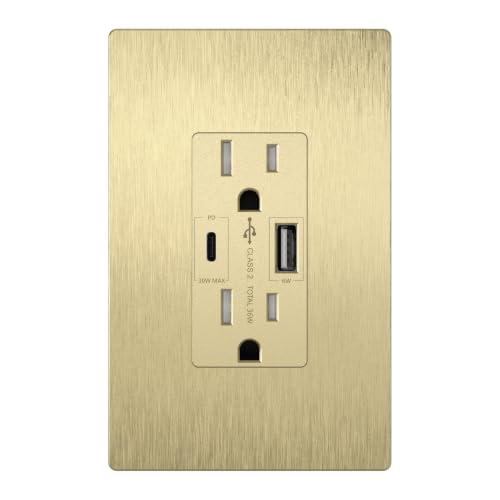
This is a Power Delivery outlet dressed in brushed gold, and that finish is the reason to choose it. A screwless brushed wall plate is included, and the faceplate snaps on cleanly — the kind of detail that makes a kitchen backsplash look finished instead of patched. The appearance wins over its buyers first, then the quality of the build confirms it. Power Delivery, for the uninitiated, is the USB standard that lets a device and a charger agree on the fastest safe wattage, so a supported phone charges quickly rather than at a default trickle.
On specs, the Type-C port delivers 30W with PD across multiple voltage steps, while the Type-A port delivers 6W at 5V/1.2A, for a 30W plus 6W combined output. The receptacle itself is a 15-amp duplex with tamper-resistant shutters, wired for #14 to #12 AWG copper. It carries UL listing and a UL94 V2 flammability rating on the polycarbonate thermoplastic housing. A 3-year warranty backs the whole unit.
Set expectations on the power. That 30W C port beats the Leviton’s 18W combined, but it will not match the BESTTEN’s 65W laptop class. It is happiest feeding a phone or a tablet, and the 6W A port is best treated as a slow top-up sidekick. If you are choosing on looks for a spot guests will notice, this is the one to fit; if raw wattage is the goal, the charger-grade outlets above win on paper.
What it delivers: A 30W PD USB-C port, a 6W USB-A port, a 15A tamper-resistant duplex, and a screwless brushed gold plate that finishes the wall. UL listed and covered for 3 years.
The limit to know: 30W is phone-and-tablet grade, not laptop grade, and the 6W A port is slow.
The fit: a visible outlet in a styled kitchen or hallway where the plate is part of the decor.
Not the fit: a desk where you need to fast-charge a laptop from the wall.
7. ELEGRP 42W 4-Port USB Charger

Four ports in one wall plate — the family charging hub of the lineup.
Two USB-C and two USB-A ports share 42W of total output, which is the most USB ports of any outlet here. That count matters in a busy spot: a family of four can leave a phone on each port overnight and still have both AC sockets free for a lamp and a coffee maker. Built-in protocol chips handle PD 3.0, Apple protocols, Samsung AFC, Huawei FCP, and standard BC1.2, so an iPad and a Galaxy phone each get matched power. Buyers describe phones charging from low to full without trouble.
The face is matte with a screwless wall plate included, and the thermoplastic housing resists impact and scratches. The C ports are rated for 10,000 insertions and the A ports for 8,000, so daily use has plenty of headroom. Fire-resistant materials and child-proof shutters cover safety, and it carries FCC, UL, and cUL certification. The 42W total is shared across all four ports, so the more devices plugged in, the less each one gets.
Where it differs from the 65W BESTTEN is specialization. This ELEGRP spreads 42W across four ports for many small devices; the BESTTEN concentrates 65W on one C port for a laptop. If your household is all phones, tablets, earbuds, and watches, this is the more useful shape. If one of the devices is a notebook, the BESTTEN is the better fit.
Why four ports earn their keep
- Two C and two A ports is the highest port count here
- 42W total with protocol chips for Apple, Samsung, and Huawei devices
- 10,000-insertion C ports and 8,000 on A back the daily-use claim
- Screwless plate included, FCC, UL, and cUL certified
Where it stops
- 42W is shared across four ports, so each gets less when all are busy
- Not a laptop-class 65W single-port output
- No GFCI protection
The pick for: a family counter or living-room wall with several small devices charging nightly.
Wrong pick if: a laptop charges here — go for the 65W BESTTEN instead.
8. Legrand Radiant GFCI Outlet USB Type A/C

A GFCI with USB in the Radiant line, aimed squarely at bathrooms and kitchens.
This Legrand takes the GFCI-plus-USB idea and wraps it in the Radiant collection’s cleaner face. Two 5V DC USB ports — one A, one C — work with USB 2.0 and 3.0 devices on a 3.1A shared capacity. That is a modest figure next to the DEWENWILS 4.8A and the Leviton GUAC1-W 4.8A, so this one is about form and the P&S Radiant look rather than maximum USB juice. The convenience of avoiding bulky adapters in the bathroom or kitchen is the pitch, and buyers confirm it delivers that.
The build uses high-impact resistant thermoplastic with long-term blade retention, so the AC slots hold the plug tight over years. Back and side wire terminals take #10 to #14 AWG stranded and solid copper, so it fits most existing boxes. The install is described as a straightforward swap of a standard outlet with a screwdriver, and the tamper-resistant shutters protect the slots. As a GFCI, it adds the ground-fault protection code tends to call for in wet areas.
The honest read on power: 3.1A shared is enough for a phone and a tablet, but a fast charger it is not. If you need the quickest top-up near the sink, the Leviton GUAC1-W below puts 4.8A on tap. If you want the smooth Radiant face and a tidy integrated USB port, this is the one that finishes the room.
Its case: A GFCI outlet with USB in the P&S Radiant line, with a clean face, tamper-resistant slots, and #10-#14 AWG wiring flexibility. Ideal behind a bathroom mirror or on a kitchen wall.
Worth knowing: 3.1A shared is on the gentle side, and a wall plate is not called out in the listing, so plan for that.
Choose it for: a bathroom or kitchen where the outlet is visible and a tidy GFCI-plus-USB face matters.
Choose the Leviton instead: if you want the fastest charge near the sink.
9. Leviton GUAC1-W GFCI Outlet with USB-A/C

The most-reviewed GFCI on the list, with 4.8A USB and a self-testing switch.
This is the outlet a lot of buyers land on because it is a known name with a huge track record — the crowd favorite for a GFCI with USB, sitting at 4.5 stars across 600+ ratings. It packs two high-powered ports at 4.8A of charging power, and smart chip technology pushes more power than many rival GFCI-USB outlets for a quicker fill. It automatically self-tests to confirm it can respond to a ground fault, and a status light gives you straightforward feedback.
Safety is the core of the pitch here. It delivers continuous ground-fault protection and meets NEC requirements wherever GFCI protection is called for. The two USB ports share the 4.8A, so a phone on the C port and a tablet on the A port each get a fair split rather than a full 4.8A apiece. Two AC receptacles stay free for whatever else lives on that wall. It handles smartphones, tablets, laptops, and small appliances per Leviton’s own compatibility list.
The honest caveats are about the install and the fit. Installation is described as mixed — some find it easy, others run into difficulty — so give yourself time and room in the box. Fit is the other recurring note, and at 6.15 inches long by 4 inches wide with 6.56 ounces of body, it is the bulkiest unit in this lineup. Check your box depth and the opening size before you commit. Do that, and it is a workhorse for a high-traffic wet-adjacent spot.
Where it shines: A self-testing GFCI with 4.8A of USB power and NEC compliance, backed by a long, well-worn track record. Ideal for a kitchen, garage, or laundry outlet that sees daily use.
The two things to plan: The 6.15 x 4 inch body needs box room and a clean opening, and install experiences vary — measure and check clearance first.
Best for: a high-traffic GFCI spot that needs both code-grade protection and quick USB charging.
Check first: your box depth and wall opening — this is the bulkiest unit here.
Know the Specs
USB wattage and amps
Wattage is the raw power the port can send; amps at a given voltage are the other way of saying the same thing. A 65W port moves far more power than an 18W port, and that gap is what separates a laptop-capable outlet from a phone charger. When a listing gives a combined total across several ports, split that figure in your head — one device on its own often gets more than two sharing. Match the per-port figure to your biggest device, not the total.
GFCI and tamper resistance
GFCI is the ground-fault safety switch required near water; it cuts power when current leaks to an unintended path. Some models self-test on a timer and show the result with a status light, which tells you the protection is still alive. Tamper resistance is a separate feature — shutters that block objects from entering the slots. Both are worth having on any outlet a child or pet can reach, and GFCI is close to mandatory beside a sink or in a garage.
Wall plate and box fit
A screwless wall plate snaps over the device and hides the screws for a flush look; some models include one and some do not, so confirm before ordering. “15-amp receptacle” is the standard North American outlet and it swaps into a normal box, but the body size still matters. Measure the depth and width of your box against the outlet before you cut power, because a wide body or a crowded box can turn a ten-minute job into an hour.
Power Delivery and GaN
Power Delivery is the USB standard that lets a charger and a device negotiate the fastest safe wattage, so a supported phone or laptop charges quickly instead of slowly. Not every USB-C outlet includes it — some provide only a fixed 5V output. GaN, or gallium nitride, is a semiconductor material used inside a charger; it runs cooler and more efficient than older designs, which is how a wall outlet can deliver 65W in a small plate.
Common Questions
Can a USB-C in-wall outlet really charge a laptop?
Do I need a GFCI outlet with USB for a bathroom?
What is the difference between combined USB output and per-port output?
Will a USB-C wall outlet replace a standard 15-amp receptacle?
Does a self-testing GFCI need to be tested by hand?
Is the wall plate included with these outlets?
How many devices can I charge at once from one outlet?
What does tamper-resistant mean on a USB outlet?
Can I install one of these myself, or do I need an electrician?
Why do some USB-C outlets say they do not support Power Delivery?
The Bottom Line
For most homes, the usb-c in-wall outlet that earns its place is the ELEGRP 5-Pack, because five complete 15-amp receptacles with USB-A and USB-C cover a whole floor in one order — and its 4.5+ star standing across 200+ ratings backs that up. If a laptop is your main charger, reach for the BESTTEN GaN 65W instead; nothing else here puts 65W on a single USB-C port while leaving both AC sockets free. And when the outlet sits beside a sink or in a garage, the DEWENWILS 15A GFCI is the one to grab, with its 30-second self-test and 4.8A of USB power keeping the safety switch honest.
One last nudge: match the per-port wattage to your biggest device, confirm the wall plate is in the box, and measure your wall box before you cut power. Do those three things and any pick here installs cleanly the first time.
How we choose
We do not accept paid placement. Every pick is matched to a real buyer and a real use-case; we do not hands-on test units.
Sources
Specifications: manufacturer listings and product documentation. Review insights: verified customer reviews, as of November 2026. Pricing: not shown on this page (it changes often); check the current price via the retailer link.
As an Amazon Associate, Tactical Gear Guy earns from qualifying purchases. This does not affect which products we feature.