Specs are compiled from manufacturer listings and verified buyer reviews and can change over time — please confirm the key details on the product page before buying.
Walk into any shower and turn the tap. Whether you get hot water in five seconds or ninety depends almost entirely on one thing: matching the heater’s flow rate to the fixtures you actually run. A small under-sink unit keeps a kitchen sink happy all day. A whole-house tankless unit runs two showers and a dishwasher without a temperature wobble. Pick the wrong size and you will be running out mid-shampoo forever.
This guide is built by comparing the manufacturers’ published specifications and the patterns across verified customer reviews, so you get each pick’s real strengths and trade-offs instead of marketing spin.
Read the GPM flow rate and the breaker requirement before you compare anything else. Buying on tank size alone is how you end up cold mid-shower. The right best water heater is the one sized to your faucets, your wiring, and the space you have.
Top Picks


How To Choose The Best Water Heater
The most common water heater mistake is buying the biggest tank you can afford instead of the right flow rate. Tank volume tells you how much hot water sits stored and ready. It tells you nothing about how fast that water gets replaced once you drain it. A small unit with a fast heating element can feel better in daily use than a big tank that runs cold halfway through a second shower.
Start with flow rate, not tank size
Flow rate is measured in GPM, or gallons per minute — the volume of hot water the unit can push out while it keeps heating. A single bathroom sink needs very little. Two showers plus a dishwasher running at the same time needs a lot. Tankless gas units list their GPM at a specific temperature rise, which is the number of degrees the unit heats the incoming water. A unit rated 4.42 GPM at a 35°F rise can handle two showers and a sink. A mini-tank rated 2.5 GPM is built for one tap at a time.
Confirm your power source before you buy anything
Electric tankless heaters draw serious amperage. A 24kW unit at 240 volts typically needs multiple dedicated double-pole breakers and a large household service panel. If your panel cannot support that, a mini-tank that plugs into a standard 120-volt outlet is the honest choice. Gas units need a vent, a gas line sized for the BTU load, and a licensed installer in most areas. Confirm whether you have gas or a panel that can carry electric tankless before you pick a model.
Match the unit to where the water actually goes
A point-of-use heater sits right under the sink or next to the shower it serves. That short pipe run means hot water arrives faster and you waste less water waiting. A whole-house unit centralizes the heat but has to push water through long pipes before it reaches you. For a cabin, RV, food truck, or garage workshop, a small point-of-use tank is often the practical answer. For a family home with multiple bathrooms, a whole-house unit rated 7 GPM or higher is the better fit.
Side-by-Side Comparison
| Model | Best For | Type | Capacity / Flow | Heat Output | Amazon |
|---|---|---|---|---|---|
| Stiebel Eltron SHC 2.5 Mini-Tank★ Best Overall | Single sink, cabin, off-grid | Electric mini-tank | 2.5 gal | 1300W | Amazon |
| Feelrogast 8 Gallon Under SinkBest for Off-Grid | RV, food truck, under-sink | Electric tank | 8 gal | 1500W | Amazon |
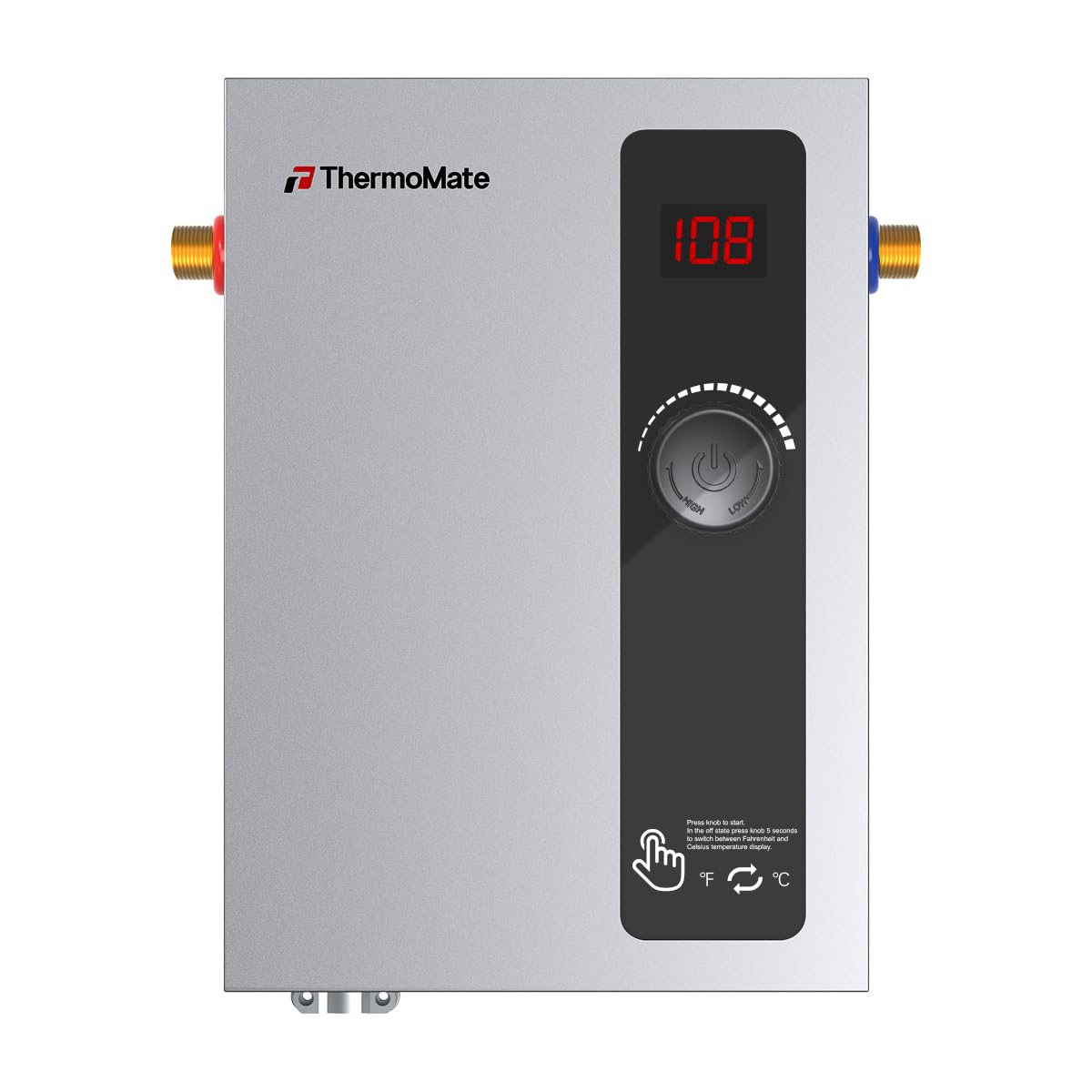
| ThermoMate 11kW TanklessBest Point-of-Use | Point-of-use bathroom or break room | Electric tankless | 2.15 GPM | 11,000W | Amazon |
| GE 18 Gallon Plug and Play | Small home, condo, booster | Electric tank | 18 gal | 140°F max | Amazon |
| APUS 95,000 BTU Gas Tankless | 2 showers plus a sink | Natural gas tankless | 4.42 GPM | 95,000 BTU | Amazon |
| VEVOR 30 Gal Electric Tank | Families of 3-5, small commercial | Electric tank | 30 gal | 5000W | Amazon |
| Westinghouse 24kW WiFi Tankless | Smart-home whole-house | Electric tankless | 5.56 GPM | 24,000W | Amazon |
| Rheem RTEX-24 | Whole-house electric, space-saver | Electric tankless | 5.9 GPM | 24kW | Amazon |
| Rheem RTG-70DVLN-3 | Whole-house gas, 2-3 showers | Natural gas tankless | 7.0 GPM | 160,000 BTU | Amazon |
| Stiebel Eltron Tempra 29 Plus | Whole-house electric, premium | Electric tankless | 3 GPM | 28,800W | Amazon |
| Rinnai RX199iN | Large families, 7 fixtures | Condensing gas tankless | 11.1 GPM | 199,000 BTU | Amazon |
Detailed Reviews
1. Stiebel Eltron SHC 2.5 Mini-Tank Electric Water Heater
Our pick — 4.5+★ from 450+ verified ratings; the strongest balance of quality and price.
The little tank that ends the ninety-second wait at the kitchen sink.
This is the pick for anyone tired of running the tap and waiting. It holds 2.5 gallons of already-hot water in a glass-lined tank, then recovers quickly after you draw it down. That matters most at a single sink, a cabin tap, or an off-grid setup where you are not trying to heat a whole house. The 1300-watt element runs off a standard 120-volt outlet, so there is no new breaker to add.
You get hot water in about five seconds, not the ninety-second wait of a cold pipe run. That speed comes from a build you usually only see on bigger units: a glass-lined tank and an included T and P valve (temperature and pressure relief valve — the safety part that releases pressure before it becomes a problem). Buyers describe the install as so simple it barely registers as a project. The included wall bracket lets it hang out of the way under a cabinet.
Here is the catch: it is a 2.5-gallon tank, so it is not a shower unit for back-to-back use, and it is not meant to feed more than one tap at a time. Think of it as a dedicated sink heater, not a replacement for a whole-house system.
What earns its keep
- Glass-lined tank with a 6-year tank warranty
- Runs on a standard 120V outlet — no new circuit needed
- Wall-mount bracket and T and P valve both included
- Delivers hot water in roughly five seconds at the tap
Where it draws the line
- 2.5 gallons is a single-fixture supply, not a shower system
- Recovery between draws takes time under heavy use
Reach for this if: you want instant hot water at one sink without touching your breaker panel.
Look elsewhere if: you need to feed two showers at once.
2. Feelrogast 8 Gallon Under Sink Electric Water Heater
An eight-gallon tank built to tuck under a counter or ride along in a camper.
For an RV, a food truck, or a workshop sink, the appeal here is fitting 8 gallons of hot water into a footprint that slides under a cabinet. The 1500-watt element runs on 110/120 volts and the unit wants a 15-amp breaker. A 59-inch power cord means you have real reach to an outlet. You can wall-mount it, rack-mount it, or set it on the floor.
The tank itself is 1.88mm stainless steel with a 500-800μm enameled layer meant to resist cracking and rust. Temperature adjusts from 86-167°F, and the 316 stainless heating element is rated for up to 99% heat utilization. The safety stack is thorough: a leakage protection plug, high-temp limiting device, and automatic temperature control.
The honest note is that heat output and durability get mixed reactions depending on the install. Some setups produce all the hot water a mancave needs, while others report it stops getting hot, which usually traces back to sizing or wiring. Fit it to a low-demand point-of-use job and it does its work. Treat the 109 PSI max pressure and the 15-amp breaker spec as hard limits, not suggestions.
Size it right first: 8 gallons at 1500 watts is a point-of-use unit — a sink, a small shower, a camper galley. Push it past that and the recovery cannot keep up.
The durability question: the enameled stainless tank is built for rust resistance, but realistic expectations matter here. This is a budget-friendly workhorse, not a whole-house lifer.
Suits: RV owners, food-truck builders, and anyone heating one sink where a full tank is overkill.
Think twice if: you are wiring it into a big household loop that expects endless hot water.
3. ThermoMate 11kW 240V Electric Tankless Water Heater
Tankless hot water for a bathroom or break room, with no tank to run dry.
If you have ever watched a mini-tank go cold mid-shower, this is the fix. There is no stored water to exhaust — the 11kW element heats on demand and pushes a 2.15 GPM flow. That is enough for a bathroom, a small sink, or an office break room, and it supports up to three faucets. Max temperature reaches 131°F. It weighs just 11 pounds, so hanging it is a one-person job.
The head-to-head is stark against the Stiebel Eltron mini-tank: 11,000 watts versus 1,300 watts. The heating chamber is cast aluminum with the element separated from the water lines, which keeps scale and corrosion off the element and is the main reason it holds efficiency over time.
The self-modulating control is the quiet win. It reads incoming water temperature and flow rate, then adjusts energy draw to match, rated at 99% heating efficiency. Translation: it heats only what you are actually using. The catch buyers need to plan for is electrical — 11 kilowatts at 240 volts pulls a max 46 amps and needs a double-pole 50-amp breaker with 6 AWG wire. This is not a plug-in appliance.
Why it holds up
- 11,000W output with 2.15 GPM — no tank to run cold
- Cast aluminum chamber keeps the element away from scale
- Self-modulating draw rated at 99% heating efficiency
- 11 pounds, wall-mount, ETL certified with dry-fire protection
Read before you order
- Needs a 50-amp double-pole breaker and 6 AWG wire — real electrical work
- Point-of-use sizing, not a whole-house unit
Pick it for: a single bathroom or sink where endless hot water and a small wall footprint matter most.
Hold off if: your panel cannot take a 50-amp double-pole breaker.
4. GE Appliances 18 Gallon Plug and Play Electric Water Heater

Eighteen gallons of storage on ordinary house current — no 240V project required.
A small condo, a garage, or a cabin often cannot host a 240-volt tankless unit. This GE runs on a standard 120-volt supply with standard 3/4-inch NPT connections, so it can go where the wiring already exists. It holds 18 gallons and heats at a much slower rate than a tankless unit. It works standalone or inline as a booster ahead of a washing machine or a long pipe run.
Reliability is the trait that carries this model — the stainless steel heating element resists rust, and an anode rod inside the tank adds corrosion protection that extends service life. The adjustable thermostat lets you set the temperature you want. The warranty is generous on paper: 8 years on tank and parts, 1 on labor. It weighs 54 pounds, so plan for two people and a solid wall or floor spot.
Where buyers split is on hot water temperature and price-to-value. Some find the water plenty hot, others find it only warm, and that is a function of the 120-volt power ceiling rather than a fault. It is a space-saving, easy-install unit that fits an apartment or cabin. It is not a fast-recovery whole-house heater, and the 140°F heat output rating is the top of its range, not a promise you will feel at every tap.
What it does well: it puts real storage capacity into a 120-volt hookup, which opens up cabins, condos, and garages that cannot run a 240-volt line.
The honest trade: 120 volts heats slowly, so expect stable rather than fast. If you want scalding recovery, this is not the unit — if you want dependable warm water without rewiring, it is.
Made for: cabins, condos, and garages where 120-volt power is the only option and 18 gallons of storage is enough.
Not your pick if: you need rapid recovery for a full family home.
5. APUS Natural Gas Tankless Water Heater, 95,000 BTU
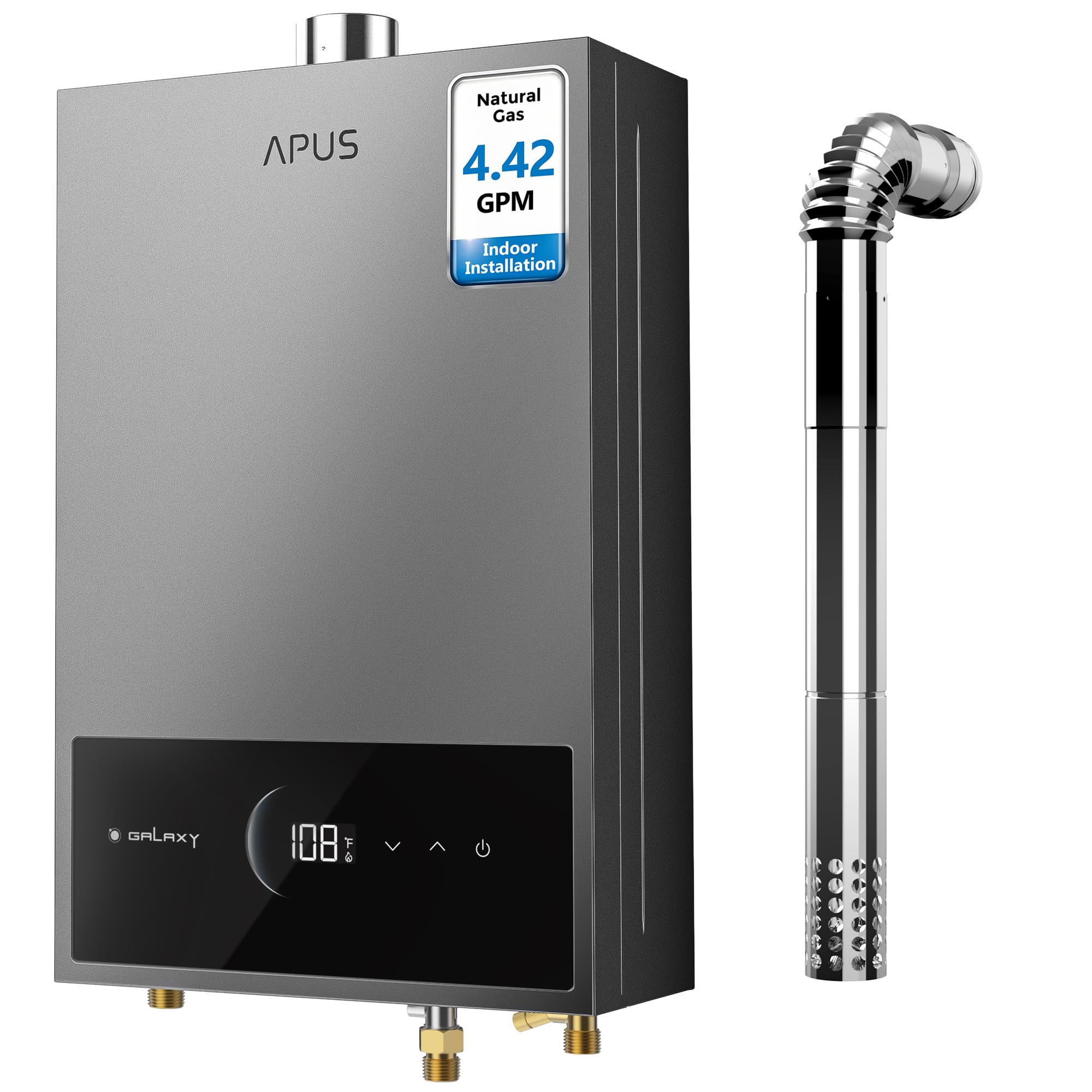
Ninety-five thousand BTU of gas heat in a body that hangs flush and runs quiet.
Two showers and a sink at the same time is the design brief here. The 95,000 BTU burner pushes a 4.42 GPM flow, and a precision CPU holds water temperature within ±1°F of your setting. The adjustable range runs 95°F to 140°F. A 0.66 GPM low-flow start means it still fires up for a trickle, which matters for small sinks and low-flow fixtures.
Space and noise are where it separates from the electric competition. It measures 5.91 inches deep and hangs on the wall, so it frees up floor space entirely — against a 17-inch-deep under-sink tank, that is a genuinely smaller footprint. It runs at a quiet 36dB, quieter than most household appliances, and it needs only a standard 120V AC connection for its controls.
Built-in freeze protection kicks in automatically when the surrounding air nears or drops below 41°F, so the unit protects itself in a cold garage. You still need to drain it if it will sit unused in cold weather. Buyers disagree on heat output and flow — some report plenty of hot water, others only lukewarm results. That split often depends on gas line sizing and installation quality. Plan on a licensed gas installer, and note the 2-year coverage before you commit.
Where the numbers help
- 4.42 GPM handles two showers plus a sink simultaneously
- ±1°F temperature control, adjustable 95°F to 140°F
- 36dB operation — about as quiet as a modern fridge
- Only 5.91 inches deep and 19.2 pounds on the wall
The fine print
- Gas line and venting need a licensed pro to be safe
- Drain it before freezing weather if unused for long stretches
Best match for: a household running two showers and a sink at the same time who wants quiet, wall-mounted gas heat.
skip it if: you have no natural gas line and no ventilation pathway.
6. VEVOR 30 Gal Electric Tank Hot Water Heater, 5000W
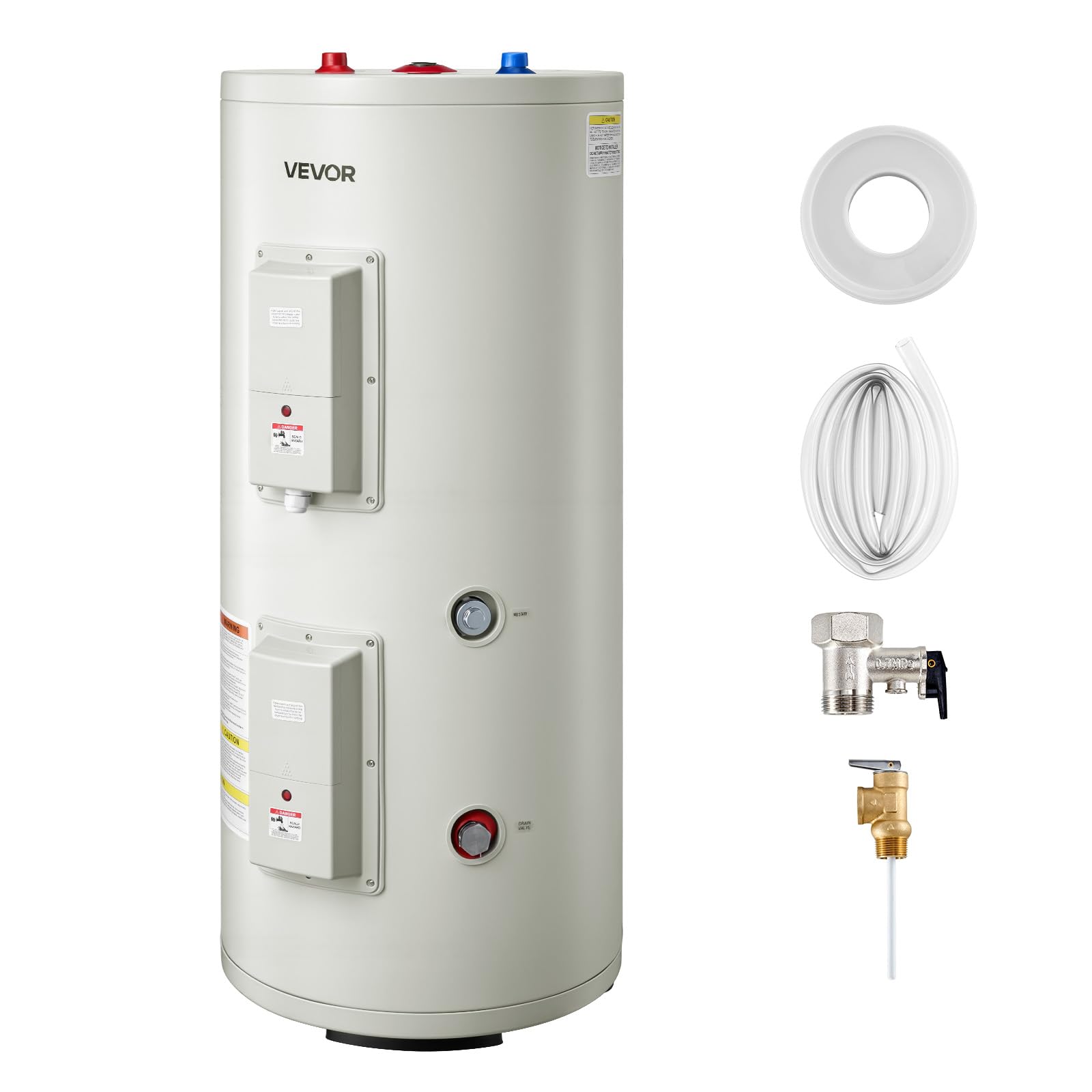
Thirty gallons of stored hot water built for three to five people drawing at once.
Simultaneous demand is the whole point of this tank. It holds 30 gallons and feeds 3-4 outlets, so a shower, a kitchen sink, and a washbasin can all run without the temp diving. The 5000-watt element gets the tank back up to temperature fast, and a 20mm thick foam insulation layer holds that heat between draws so the element fires less often. The enamel interior resists high temperature and corrosion.
The control side is refreshingly simple: a rotary knob sets the temperature up to 167°F, and an LED indicator shows whether the element is heating. It weighs 74.5 pounds, so this is a floor-standing install with help. Built-in dry-fire, over-heat, and over-pressure protection plus an IPX4 waterproof rating (rated to handle splashing) round out the safety side. Performance carries this unit — during a generator outage it kept a shower running, which is the kind of reserve a tankless unit cannot offer.
The trade-off is the physical footprint. At 40.16 inches tall and 74.5 pounds it needs real floor space and a sturdy position, and it takes a 240-volt supply. It is the opposite of a wall-hung unit in every way — you trade space for stored water that survives a power cut.
Capacity is the pitch: 30 gallons serving 3-4 outlets is enough for a family of three to five or a small commercial space.
Where it costs you: floor space and a 240-volt circuit. This is a standing tank, not a wall-hang.
Built for: families or small commercial spaces that need several taps drawing hot water at once.
Weigh the trade: 74.5 pounds of floor-standing tank — confirm you have the space before ordering.
7. Westinghouse 24kW Tankless Water Heater Electric, WiFi
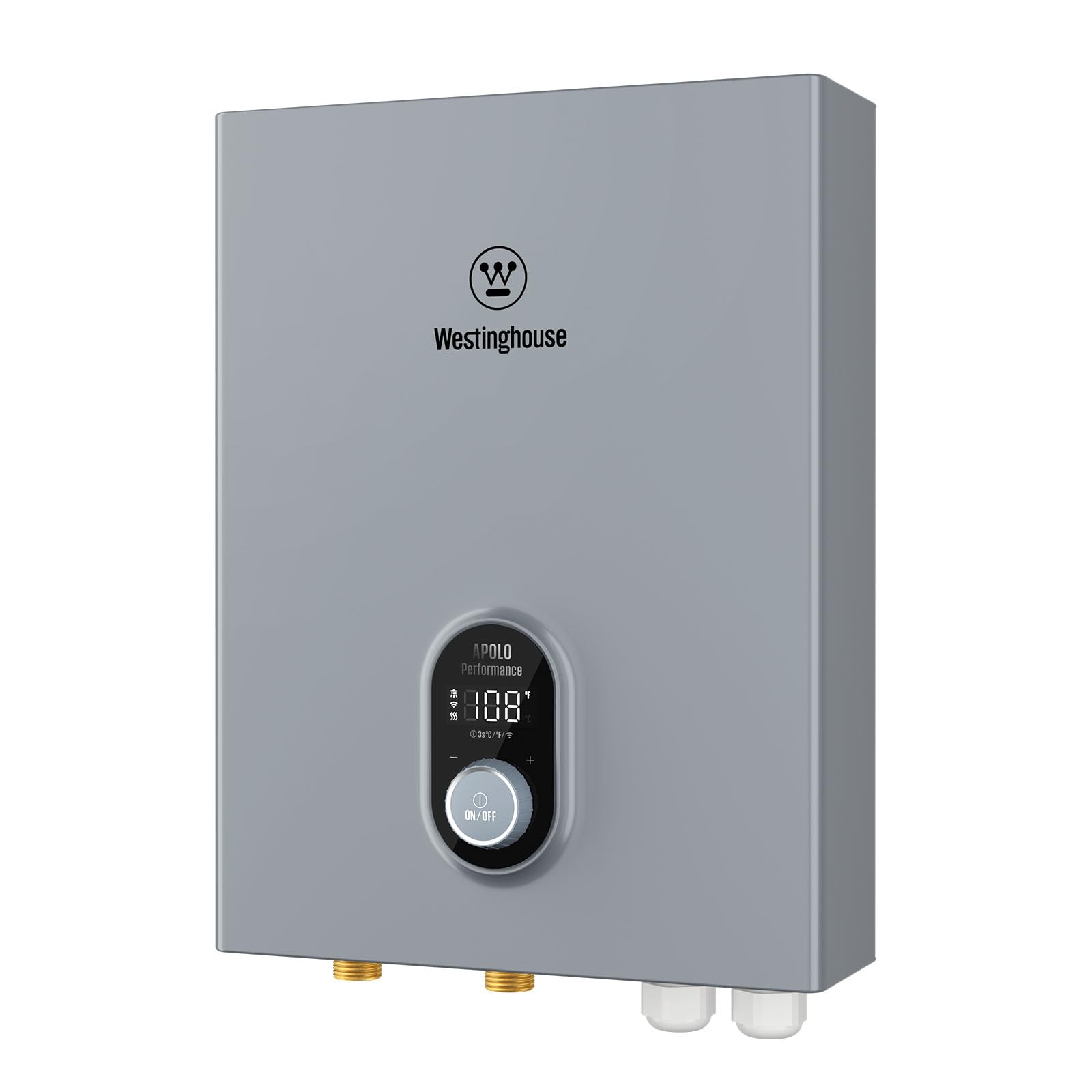
A whole-house electric tankless unit you can talk to through Alexa or Google Home.
Remote temperature and usage monitoring is the differentiator here. The built-in Wi-Fi lets you adjust temperature from an app or by voice, which is genuinely useful if your mechanical room is in a basement or crawlspace. The 24kW element at 240 volts delivers a 5.56 GPM flow, and the unit mounts flush at just 4.3 inches deep — zero floor space used.
Against the Rheem RTEX-24 below, this one moves 5.56 GPM (gallons per minute — how much hot water flows at once) versus 5.9 GPM from a slightly slimmer body. The real split is the smart controls and the 100A breaker compatibility, so check your electrical panel before you buy. Connections are 3/4-inch NPT (a standard threaded pipe fitting). At 17 pounds it is a manageable wall-hang for a two-person install. It is sized for an apartment, a home, or a cabin bathroom and kitchen.
The factual limit is the electrical draw. 24kW at 240 volts means substantial amperage and a 100A breaker setup — this is not a DIY panel project. Plan for a licensed electrician to confirm your service panel can carry it.
Smart-home angle: app and voice control over temperature and usage makes this the pick for someone who already runs their home on Alexa or Google Home.
Panel check first: 24kW at 240V with 100A breaker compatibility is a serious electrical requirement — confirm it before ordering.
Good fit for: smart-home owners who want whole-house tankless with app control and a slim wall footprint.
Look elsewhere if: you want a simple dumb unit or your panel cannot support the draw.
8. Rheem RTEX-24 24kW 240V Electric Tankless Water Heater

The whole-house electric tankless unit that fits on a wall and gives up the tank entirely.
Space savings is the headline. This unit is 90% smaller than a traditional tank water heater by the maker’s own figure, and at 3.5 inches deep it mounts flush against a wall. The 24kW element at 240 volts delivers up to 5.9 GPM and runs multiple fixtures. Digital thermostatic controls adjust in 1-degree steps from 80°F to 140°F, so you can dial in an exact shower temperature instead of guessing between settings.
No venting is required, which simplifies the install relative to a gas tankless unit. Performance and installation are what owners talk about most — the unit keeps up with demand and provides unlimited hot water, and installers find it straightforward. It weighs 17.8 pounds. The real prep work is electrical: three 40-amp double-pole breakers, three sets of #8 AWG copper conductors with ground, and a recommended 200-amp service panel.
Where buyers split is on heat generation — some find it heats water quickly, others find it does not reach the temperature they want, which usually points back to incoming water temperature and fixture flow. Size it to your ground water temperature and you get consistent results. The 5-year leak and 1-year parts warranty is note before you commit.
What makes it a top performer
- 5.9 GPM flow with 24kW output for whole-house use
- 90% smaller than a tank unit and only 3.5 inches deep
- 1-degree temperature steps from 80°F to 140°F
- No venting required — simpler than a gas tankless install
What the install demands
- Three 40-amp double-pole breakers and a 200-amp panel
- Can under-deliver on temperature in cold incoming water
Choose it when: you want to reclaim floor space and run multiple fixtures on whole-house electric tankless.
Reconsider if: your electrical panel cannot deliver the three-breaker service it needs.
9. Rheem RTG Series 7.0 GPM Natural Gas Tankless Water Heater
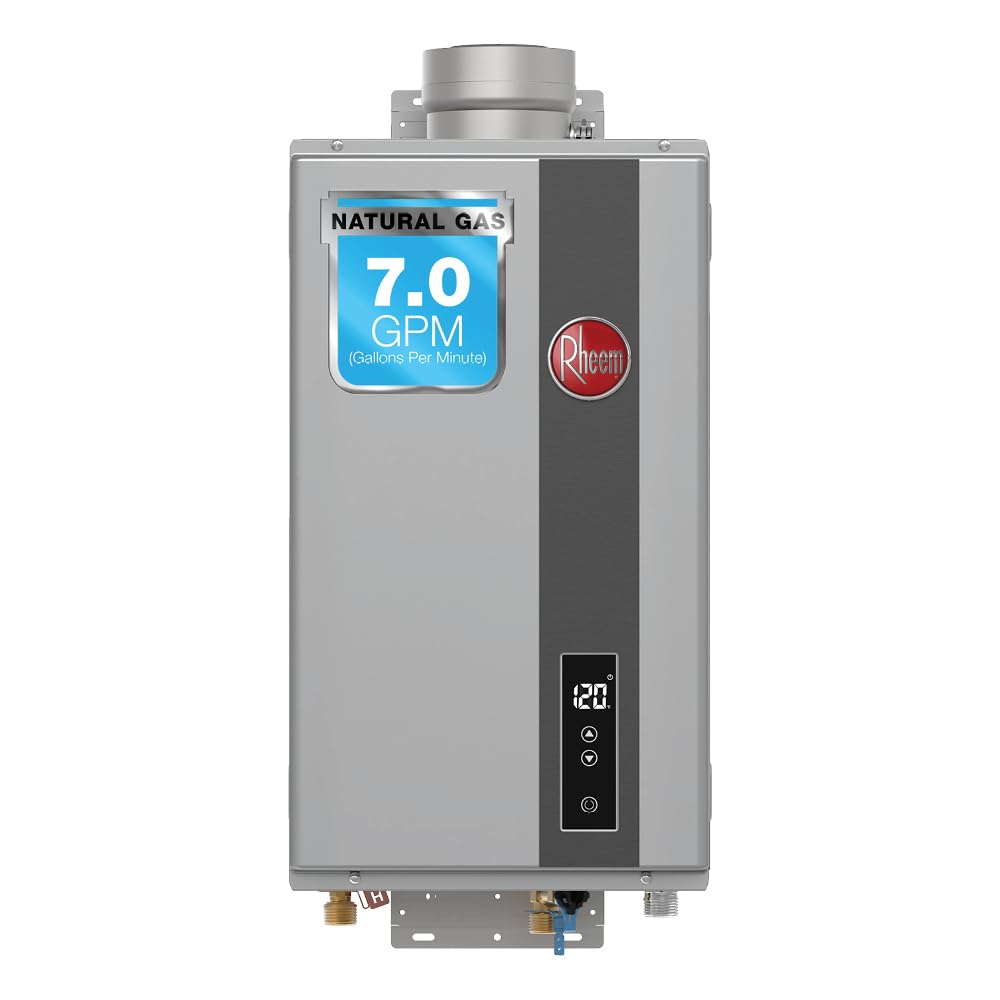
Two or three showers at once from a stainless heat exchanger that never runs dry.
This is the gas answer for a large family or a multi-bathroom home. The 160,000 BTU burner delivers 7.0 GPM at a 35°F temperature rise, which covers 2-3 simultaneous showers and keeps going. It is non-condensing with a 0.82 Uniform Energy Factor (UEF — the efficiency score for water heaters), and the maker figures it saves up to 34% on energy costs compared with a 50-gallon electric tank heater. That figure is the maker’s, so treat it as a reference point rather than a promise.
The digital LED control panel holds temperature within ±1°F, and the multi-point safety system includes flame failure protection and built-in freeze protection. LeakGuard detection flags any internal leak, large or small. Against the APUS below, this one raises the gas output from 95,000 BTU to 160,000 BTU and the flow from 4.42 to 7.0 GPM — the gap between two showers and three. It weighs 46.5 pounds and mounts on the wall, freeing up the floor a tank would occupy.
The requirement that trips people up is the direct vent system — this is an indoor gas unit and needs proper venting to the outside. Plan on a licensed installer for the gas and vent work. The warranty stack is strong on the exchanger side: 15 years on the heat exchanger, 5 on parts, 1 on labor.
Gas power that scales: 160,000 BTU and 7.0 GPM is enough for 2-3 showers running together, plus the dishwasher and laundry.
The install precondition: it needs direct venting to the outdoors and a licensed gas installer — this is a professional job, not a weekend project.
Count on it for: large families and multi-bathroom homes with natural gas and a venting path.
Rethink if: you have no exterior vent route or want to avoid a professional install.
10. Stiebel Eltron Tempra 29 Plus Electric Tankless Water Heater
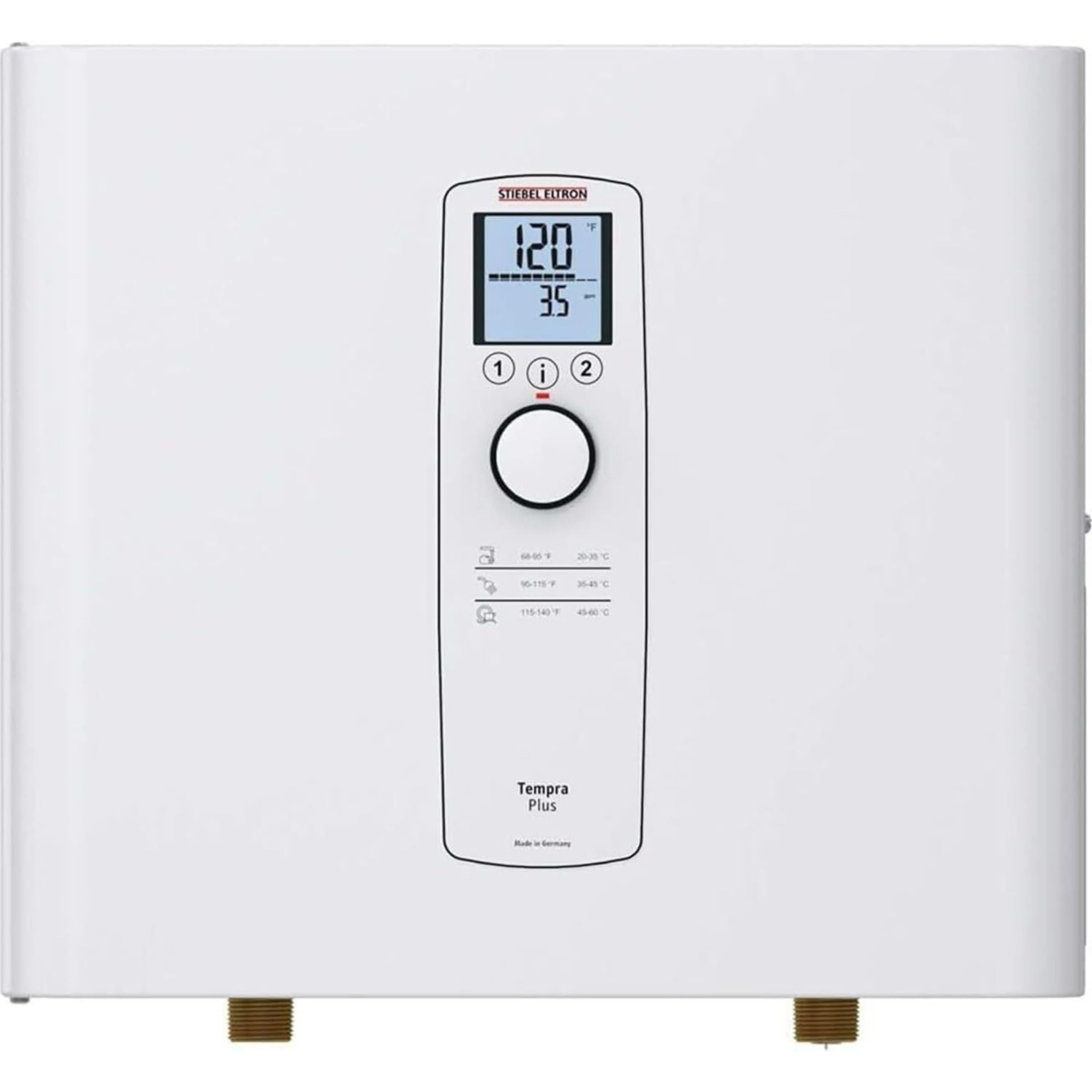
Nearly 29 kilowatts of German-built electric heat with two temperature memory presets.
The power ceiling is what you are buying here. At 240 volts this unit draws 28,800 watts and outputs 3 GPM; at 208 volts it draws 21,600 watts. The Advanced Flow Control and two temperature memory presets let you save your shower setting and your sink setting separately, so you are not re-dialing the knob every time. It is made in Germany with a copper heat path, no venting required, and the maker rates whole-home energy and cost savings up to 34%.
Set against the Rheem RTEX-24, this one pushes more raw wattage (28,800 versus 24kW) from a unit that mounts on the wall with no tank at all. Performance and installation are the strengths owners lean on. The 150 PSI max pressure rating gives it headroom on a typical household supply.
The honest catch is delivered flow. At 3 GPM (gallons per minute) this feeds one or two fixtures comfortably, not four. The electrical demand is steep too: three separate 40-amp breakers with 8-gauge copper wire and a minimum 200-amp service to the house. Buyers report mixed results on water temperature and flow, which depends on how well the unit is sized to the home. Sized to your incoming water temperature it holds steady heat; pushed past 3 GPM it runs cool.
Built for the long haul: German manufacturing, no venting, and up to 34% energy savings in whole-home use by the maker’s numbers.
Flow is the limit: 3 GPM is a one-or-two-fixture ceiling, and three 40-amp breakers is a heavy electrical ask.
Right for: a whole-home electric setup with a large service panel that values build quality and preset memory controls.
Don’t force it if: you routinely run three or four fixtures at once.
11. Rinnai RX199iN Condensing Smart Sense Tankless Water Heater

Eleven point one gallons per minute — seven fixtures running at once and still steady.
This is the top of the whole lineup on capacity. The condensing burner delivers 199,000 BTU and up to 11.1 GPM, enough for 7 fixtures at once. Against the Rheem RTG-70DVLN-3 below, that is 11.1 versus 7.0 GPM — the difference between someone waiting for a shower and nobody waiting at all. The 0.98 UEF efficiency rating is the best figure in this article, and the unit is only about the size of a small suitcase.
What makes it flexible is the Smart Sense gas control, which lets it run on either propane or natural gas. With the Versa Vent system and the RX-OVC vent cap it installs indoor or outdoor, so it fits wherever you have room. Quick Flush simplifies the maintenance flush, and there is an easy-to-use interface on the panel. The 55-pound body is heavier than the electric units, which speaks to the stainless heat exchanger inside.
One thing to plan for: Wi-Fi control needs the Controlr module, which is not included. Rinnai also recommends professional installation and does not recommend going without a technician. The residential warranty is strong — 15 years on the heat exchanger, 5 on parts, 5 on labor — but it requires product registration within 90 days of installation or the labor warranty defaults to 1 year.
The case for the high end
- 11.1 GPM serves 7 fixtures at once
- 0.98 UEF — the highest efficiency in this lineup
- Runs on propane or natural gas, installs indoor or outdoor
- 15-year heat exchanger warranty
Loosen the wallet warnings
- Wi-Fi control needs a Controlr module that is not included
- Needs professional installation and timely registration to keep full labor coverage
Go this route if: you are heating a large home with seven fixtures and want the highest efficiency and capacity available.
Pass it by if: you have a small home, a tight budget, or no licensed installer lined up.
Know the Specs
GPM Flow Rate
GPM, or gallons per minute, is the volume of hot water the unit can deliver while it is heating. It is the single spec that tells you how many fixtures can run at once. A point-of-use unit around 2.5-3 GPM feeds one tap or shower. A whole-house gas unit in the 7-11 GPM range runs multiple showers and laundry together. Always read the flow figure at the temperature rise it is quoted for — a flow number without a rise number hides how much heating it assumes.
BTU vs Wattage
BTU and watts are both measures of heat output, but gas units list BTU and electric units list watts. A natural gas tankless unit might list 95,000 or 160,000 BTU; an electric tankless unit lists kilowatts like 11kW or 24kW. You cannot compare them directly without conversion, but you can compare within type. Higher output means faster temperature rise at a given flow — the trade is that gas needs venting and electric needs serious amperage.
Electrical Requirements
Electric tankless heaters pull heavy current. A 24kW unit at 240 volts commonly needs multiple dedicated double-pole breakers and a large household service panel, and some premium units want a 200-amp service. If you are not sure your panel can carry that, a mini-tank on a standard 120-volt outlet is the practical alternative. Always confirm breaker, wire gauge, and panel capacity before ordering.
Point-of-Use vs Whole-House
A point-of-use heater sits beside the sink or shower it serves, so hot water travels a short distance and arrives fast. A whole-house unit centralizes the heat but pushes water through long pipes first. For an RV, cabin, garage, or single bathroom, point-of-use usually wins on speed and simplicity. For a family home with several bathrooms, whole-house capacity is the better fit.
Common Questions
How many GPM do I need for two showers at once?
Can I install a tankless electric water heater myself?
Is a gas or electric tankless heater better for a whole house?
How long does a mini-tank water heater take to recover?
Do tankless water heaters work during a power outage?
What is the difference between condensing and non-condensing gas tankless?
Can a water heater work in an RV or food truck?
Why does my tankless heater sometimes run only warm?
Does a tankless water heater really save energy?
Can I mount a water heater outdoors?
The Bottom Line
For most homes, the best water heater depends entirely on your power source and how many taps you run at once. If you want instant hot water at a single sink without touching your breaker panel, the Stiebel Eltron SHC 2.5 Mini-Tank is the pick. Its glass-lined tank, six-year tank warranty, and standard 120-volt plug make it the simplest fix for the ninety-second wait at the kitchen tap. Not ready to run new breakers for a whole-house tankless unit? This is the sensible starting point.
If you want whole-house capacity on natural gas, the Rheem RTG Series delivers 7.0 GPM at 160,000 BTU, enough for two or three showers at once. And for a large family running seven fixtures, the Rinnai RX199iN tops the list with 11.1 GPM and a 0.98 UEF. Each wins on a different spec — GPM, BTU, or breaker load — so match that number to your home before you buy.
How we choose
We do not accept paid placement. Every pick is matched to a real buyer and a real use-case; we do not hands-on test units.
Sources
Specifications: manufacturer listings and product documentation. Review insights: verified customer reviews, as of November 2026. Pricing: not shown on this page (it changes often); check the current price via the retailer link.
As an Amazon Associate, Tactical Gear Guy earns from qualifying purchases. This does not affect which products we feature.