Specs are compiled from manufacturer listings and verified buyer reviews and can change over time — please confirm the key details on the product page before buying.
Hanging baseboard or shoe molding in a finished room goes faster when you don’t have to drag a compressor and air hose through the doorway. The short answer: the ATOMIC 23-gauge pin nailer is the best all-round pick for fine trim and delicate assembly, and the Metabo HPT NT1850DG is the best choice if you need full 18-gauge holding power in a compact body. Everything below explains why, and what each tool is actually good at.
This guide is built by comparing the manufacturers’ published specifications and the patterns across verified customer reviews, so you get each pick’s real strengths and trade-offs instead of marketing spin.
Three specs decide whether a nailer holds up: gauge (the nail thickness it fires), shots per charge, and how the depth adjustment feels in your hand. This breakdown of the wireless nail gun market covers all three so you can pick with confidence.
Top Picks

How To Choose The Best Wireless Nail Gun
The biggest mistake first-time buyers make is treating every cordless nailer as interchangeable. They are not. A 23-gauge pin nailer and an 18-gauge brad nailer leave very different holes, drive into different materials, and suit different stages of a job. Get the gauge wrong and you will either split delicate trim or watch a molding pull loose because the fastener was too thin.
Gauge decides the job before anything else
Gauge is the thickness of the fastener, and the number runs backwards — a smaller number means a thicker nail. An 18-gauge brad is a beefier fastener that holds baseboard, casing, and window trim with real grip. A 23-gauge pin is a hair-thin fastener that leaves almost no visible mark, which makes it right for decorative face frames, small moldings, and assembly where you cannot fill a hole afterward. If you are installing baseboards, you want 18-gauge. If you are pinning on a cabinet face or securing a delicate trim return, the 23-gauge pin nailer is the cleaner tool.
Battery platform and shots per charge
Shots per charge tells you how many fasteners the tool drives on a single battery fill, and it is the number that decides whether you finish a room in one sitting. Some nailers are sold as bare tools — the housing alone with no battery or charger — so they only make sense if you already own that brand’s batteries. Others come as kits with the battery and charger included. Check which one you are buying before you commit, because a bare tool with no matching battery on your shelf is a paperweight.
Jams, depth, and the controls that save your afternoon
Three features separate a smooth tool from a frustrating one. Tool-free jam release lets you clear a stuck fastener without hunting for an Allen key. Tool-free depth adjustment changes how deep the nail sits without you disassembling anything. A dry-fire lockout stops the tool from firing on an empty magazine, which protects both the workpiece and the firing mechanism. None of these appear in a headline spec, but they decide whether you finish the trim run or stop to clear a jam.
Weight and balance in real use
A nailer you hold overhead to set crown molding feels twice as heavy as one you use at waist height. Weight figures vary widely in this category, and balance matters as much as the number. A low center of gravity keeps the nose steady against the work, which means fewer marred surfaces and straighter nails. If you plan long overhead sessions, favor the lighter, more compact tools.
Side-by-Side Comparison
| Model | Best For | Gauge | Weight | Shots Per Charge | Amazon |
|---|---|---|---|---|---|
| ATOMIC 20V MAX 23 Ga. Pin Nailer★ Best Overall | Fine trim and delicate assembly | 23 Ga | 4.45 pounds | 2,000 nails | Amazon |
| Metabo HPT NT1850DGCompact Pick | Compact 18-gauge all-rounder | 18 Gauge | 5.5 pounds | 700 nails | Amazon |
| Milwaukee M18 FUEL Gen II 18-GaugeTop Performer | Heavy daily trim production | 18 Gauge | 6.5 pounds | — | Amazon |
| Metabo HPT NT1850DFT | Long runtime brushless kit | 18 Gauge | 4.4 pounds | 1,300 nails | Amazon |
| WORX WX842L | Fast firing across many tasks | 18 Gauge | 7.06 pounds | — | Amazon |
| SKIL PWR CORE 20 NA1800B-10 | USB-C charging convenience | 18 Gauge | 7.4 pounds | 1,000 nails | Amazon |
| CRAFTSMAN V20 CMCN618B | Budget 18-gauge entry point | 18 Gauge | 6.8 pounds | 420 nails | Amazon |
| Ryobi ONE+ P321 | ONE+ battery owners on a budget | 18 Gauge | 6 pounds | — | Amazon |
| WEN 20512 | Kit with battery and nails included | 18 Gauge | 7.84 pounds | — | Amazon |
Detailed Reviews
1. ATOMIC 20V MAX 23 Gauge Pin Nailer
Our pick — 4.5+★ from 900+ verified ratings; the strongest balance of quality and price.
The featherweight pin nailer that leaves almost no hole to fill afterward.
You get a tool built for the finish work that shows. The ATOMIC drives 23-gauge pin nails from 5/8 inch up to 1-1/2 inches, and that thin fastener disappears into face frames, small moldings, and assembly joints where a filled hole would stand out. The brushless motor (an efficient electric motor with fewer wearing parts) keeps it running cool across a long trim session, and you run it with no hoses, compressors, or gas cartridges.
At 4.45 pounds it is the lightest tool on this list, and that matters when you are holding it overhead to pin a crown return. The comparison is stark: the WEN 18-gauge nailer weighs 7.84 pounds, so the ATOMIC is a far easier tool to keep steady above your shoulder. Battery life is the headline — the tool drives 2,000 nails on average per charge, which is well beyond the CRAFTSMAN’s 420 nails per charge. For fine trim and delicate assembly, that is a full afternoon of work on one fill.
What wins people over is how the tool handles the small controls. The jam release is tool-free, the depth adjustment is tool-free, and a low-nail lockout with an LED indicator tells you when to reload instead of letting you fire on empty. The honest catch: this is a bare tool, so no battery or charger is in the box, and it only makes sense if you already run the 20V MAX platform. Buy it as an addition to a battery system you own, not as a first power tool.
Where it earns its keep
- 2,000 nails per charge on average, far beyond most 18-gauge tools here
- 4.45 pounds — the lightest pick in this guide
- 23-gauge pins from 5/8 inch to 1-1/2 inches leave a nearly invisible hole
- Tool-free jam release and depth adjust keep the run moving
What to plan around
- Bare tool only — battery and charger sold separately
- 23-gauge pins are too thin for heavy baseboard holding power
Go this way if: you already own 20V MAX batteries and need a fine-finish pinner that runs all afternoon.
Think twice if: you need to drive thick brads into baseboard — that is an 18-gauge job.
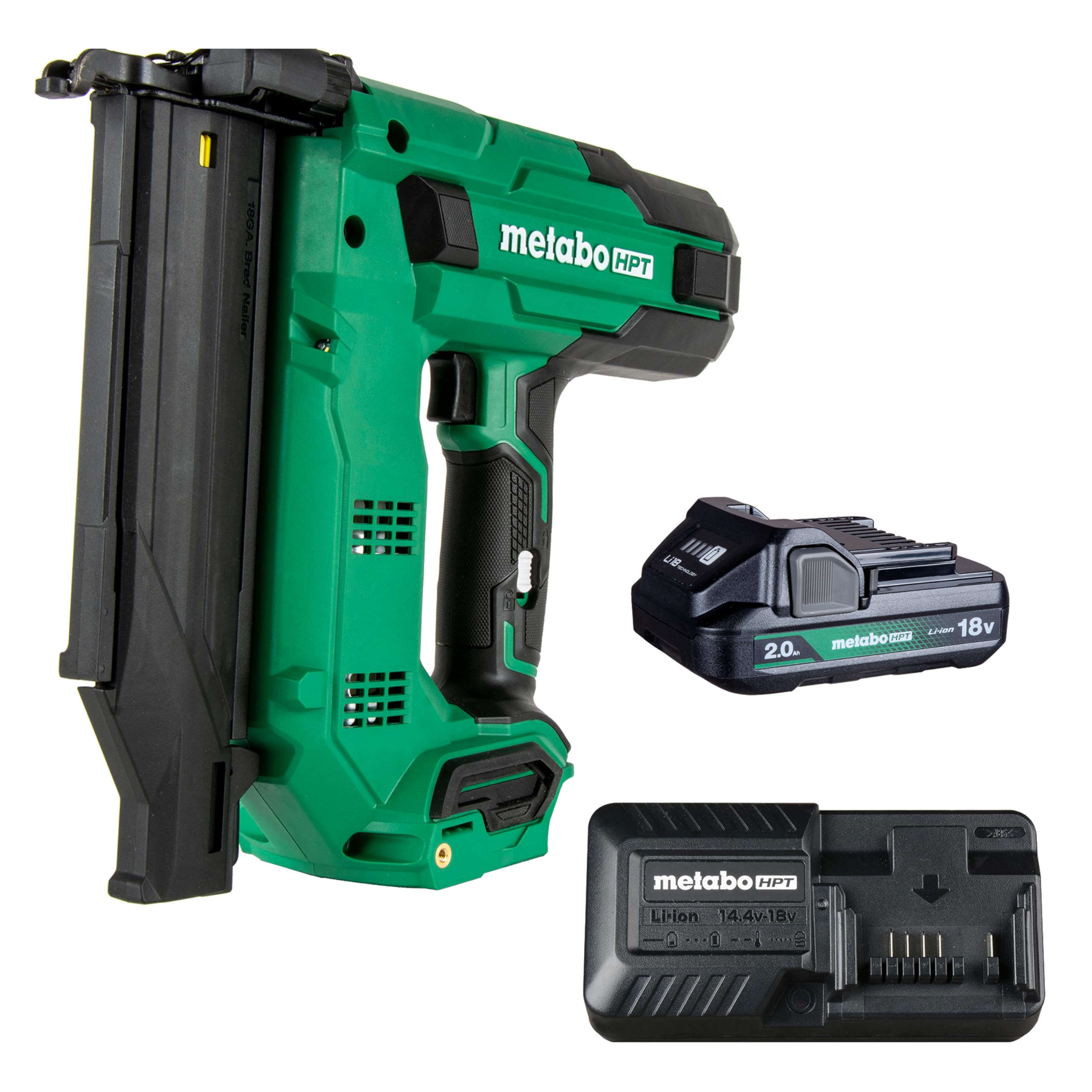
2. Metabo HPT Brad Nailer, 18 Gauge Cordless, 18V Kit, NT1850DG
A full 18-gauge kit that weighs 5.5 pounds and fires with no ramp-up.
If you want real brad holding power without a heavy tool in your hand, this is the one to beat. The Metabo HPT NT1850DG drives 5/8-inch up to 2-inch 18-gauge brads from a mechanical spring drive, and it comes as a complete kit with the 2.0Ah battery and charger included. At 5.5 pounds it sits comfortably below the WEN 18-gauge at 7.84 pounds, so overhead casing work is far less tiring.
Runtime is 700 nails per charge with the included battery, and the fuel gauge on the battery tells you where you stand before you start a run. The response between nails is immediate with no ramp-up time, so you set a rhythm and keep it. A bright LED lights the work area, and the depth of drive adjusts without tools, which means you can dial the nail flush to the surface as the material changes.
The thing everyone raves about is the build. Buyers describe it as a solid, durable tool that works better than air-powered models in their experience, and the convenience of not dragging out a compressor and hose comes up again and again. It has the highest score of any 18-gauge pick here. One note on the platform: this is Metabo HPT’s own 18V battery system, and this kit includes its battery, so you are not locked into buying one separately.
Best-fit buyer: the trim carpenter or serious DIYer who wants full 18-gauge power in a kit that arrives ready to run, complete with battery, charger, no-mar nose caps, a hook, and safety glasses.
One thing to weigh: weight is the most-discussed trade-off on this tool, and some hands find it heavier than expected — try it overhead before committing to a long crown-molding day.
The short verdict: the strongest all-round 18-gauge cordless nailer here, and the kit means you fire it the day it arrives.
Look elsewhere if: you need to pin delicate face frames — a 23-gauge pinner leaves a cleaner hole.
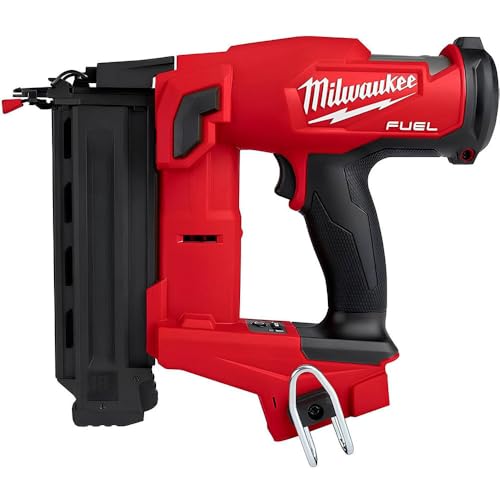
3. Milwaukee M18 FUEL Gen II 18-Gauge Brad Nailer (Tool-Only)
The one production crews reach for when the nailer has to run all day without complaint.
This is an 18-gauge, 6.5-pound bare tool built for volume. The brushless FUEL motor is the efficient, low-maintenance type, and buyers describe it performing consistently with zero ramp-up time between shots. It is lighter than the WORX at 7.06 pounds and the WEN at 7.84 pounds, which keeps long sessions manageable without wearing out your wrist.
Reliability is the theme in the feedback — this tool keeps firing without drama, and replacing a manual stapler with it changes how fast trim work goes. One detail worth knowing: the battery life impresses enough that a full day on an 8ah battery gets mentioned specifically, so a high-capacity M18 pack turns this into an all-day tool. Note that this is a bare tool, so that battery is not in the box — it assumes you are already on the M18 platform.
The trade-off is honest and expected for a pro-grade nailer: weight draws mixed opinions, with some hands finding it heavy, and opinions on jamming split. For a nailer built for constant production use, that is the expected trade-off rather than a flaw. If you are a Milwaukee owner doing steady trim production, the fit is obvious.
Why crews stick with it
- Brushless FUEL motor for efficient, low-maintenance running
- Zero ramp-up between shots keeps a fast rhythm
- 6.5 pounds is lighter than several 18-gauge rivals here
- Runs a full day on a high-capacity pack
The honest give-and-take
- Bare tool — battery and charger sold separately
- Some hands find the balance heavy over long overhead sessions
Pick it when: you are already invested in M18 batteries and want a nailer that never slows a production day.
Hold off if: you are buying your first battery platform — the bare-tool format leaves you needing a pack and charger too.
4. Metabo HPT NT1850DFT Brad Nailer Kit

The 4.4-pound brushless kit that drives up to 1,300 brads on one charge.
Runtime and weight rarely arrive together, but this kit makes the case. The NT1850DFT drives up to 1,300 brad nails per charge from the included 2.0Ah lithium-ion battery with a fuel gauge (a built-in battery-level indicator), and the whole tool weighs just 4.4 pounds — lighter than the CRAFTSMAN at 6.8 pounds and the WEN at 7.84 pounds. That combination means fewer battery swaps and less arm fatigue on a long trim day.
The brushless motor is the efficient, low-maintenance type, and the maker describes it as powering the tool to up to 2 nails per second with no ramp-up time. It drives 5/8-inch to 2-inch 18-gauge brads, and the depth adjustment is tool-free for quick changes. A selective actuation switch flips between sequential and bump fire mode, so you can move from careful one-at-a-time placement to rapid-fire when the job calls for it.
What stands out in the feedback is how well it performs on the actual cut. Owners describe it working perfectly on all wood trim angles and penetrating both soft and hard woods effectively, with longer-than-expected battery life and quick charging. The maker lists it as 30% smaller and 31% lighter than the previous model, which makes it easier to maneuver in tight corners. The one real limitation to know: it is a kit built around Metabo HPT’s own 18V platform, so it stands alone rather than sharing batteries with another brand’s tools.
The case for it: the best runtime-to-weight balance in this guide, with 1,300 nails per charge in a 4.4-pound body — ideal if you are working tight spaces and long runs.
Worth flagging: that battery only serves Metabo HPT tools, so this is a platform decision as much as a tool purchase.
Reach for this if: runtime and a light hand matter more to you than sharing batteries with an existing tool lineup.
Pass if: you are committed to another brand’s battery system and do not want a second set of packs.
5. WORX Cordless Brad Nailer, 20V 18GA Nail Gun, WX842L

Fires up to 80 nails a minute — this one is built to move fast.
The WX842L runs on NailForce Air Impact Technology, which the maker describes as an air-spring approach that secures brad nails up to 2 inches into hardwood. Where it separates itself is speed: it fires up to 80 nails per minute, so long runs of panel molding and small baseboards go down quickly. It handles a wide range of jobs, from window trim to fastening panel molding.
The battery story is a genuine convenience if you already own WORX tools. The same Power Share batteries that run this nailer work across a large lineup of other WORX tools, outdoor equipment, and lifestyle products, so one pack serves your whole shed. On the safety side, an anti-ejection design keeps nails from flying when you open the magazine or clear a jam, and the jam release itself is tool-free.
The feedback reads like a mid-tier tool that delivers: buyers describe it working extremely well and producing quality results for trim work, with loading nails and clearing jams both called out as easy. At 7.06 pounds it is heavier than the NT1850DFT at 4.4 pounds, so it is less comfortable overhead. That weight is the most-discussed trade-off, and some hands find it on the heavier side — a fair point if you plan long sessions above your head.
Made for: anyone already on the Power Share platform who wants fast firing and one battery lineup for the whole shop.
Less ideal if: you work overhead for hours — the 7.06-pound body tires more than the lighter picks here.
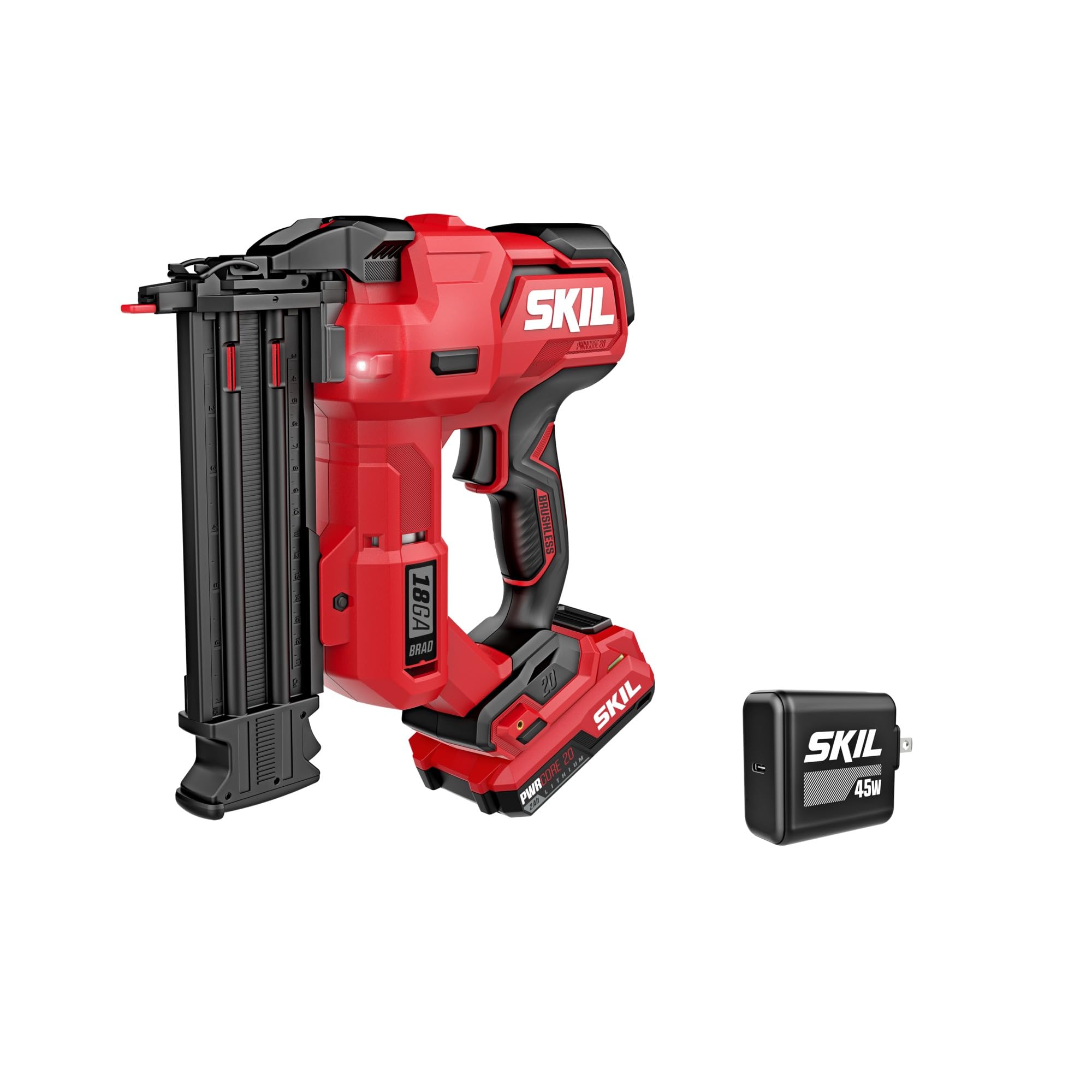
6. SKIL PWR CORE 20 NA1800B-10 Brad Nailer Kit
The only kit here that charges its battery over USB-C.
SKIL’s NA1800B-10 arrives as a full kit: the nailer, a 2.0Ah lithium USB-C battery, a 45W USB-C PD charger, 100 18-gauge 2-inch nails, and two no-mar tips. That USB-C charging is a real practicality win — the same kind of charger you use for a laptop or phone tops up the battery, so you are not hunting for a brand-specific dock. Runtime is 1,000 nails on a single charge with the included battery, which is far beyond the CRAFTSMAN’s 420 nails per charge.
On the firing side, the brushless motor drives up to two nails per second with minimal ramp-up time, and it accepts 5/8-inch to 2-1/8-inch 18-gauge fasteners — a slightly wider range than the Metabo HPT kit. Dual LED lights brighten dim corners, a quick depth adjustment wheel sets nail depth, and a dry-fire lockout stops the tool from firing on an empty magazine so you do not mar the surface. A mode select switch flips between sequential and bump mode, and jam clearance is tool-free.
Owners describe it as well-built, powerful, and easy to use, with the long-lasting battery and value standing out. It also draws comments for working well across different brad nail sizes. The trade-off is weight: at 7.4 pounds it is on the heavier side of this group, and that is the most-discussed gripe — fine for bench work, less fun overhead.
Where it shines: the complete-kit packaging plus USB-C charging means you are ready to fire on delivery, and dual LEDs keep dim rooms workable.
The weight note: 7.4 pounds is heavier than most here — keep it at waist height where possible.
Choose this if: you want a ready-to-run kit and love the idea of charging your tool battery over USB-C.
Skip if: you already own a different brand’s batteries and would rather not start a new platform.
7. CRAFTSMAN V20 CMCN618B Brad Nailer

A budget-friendly 18-gauge entry point for anyone already on the V20 platform.
This is the value play in the group, and it targets a simple job: get into cordless 18-gauge nailing without a big outlay. The CMCN618B drives up to 420 nails per charge, and the fully cordless design cuts out compressors, hoses, and gas cartridges entirely. The maker notes it provides firing power across various climate conditions and materials, and it keeps a belt hook within reach.
That 420-per-charge figure is the number that defines it. It is well short of the SKIL’s 1,000 and the Metabo HPT kit’s 1,300, so expect more battery swaps on a long run. What it does well is setup and handling: the jam and stall settings are tool-free, and the maker designed the balance around a lightweight body with a centered center of gravity for comfort. At 6.8 pounds it sits in the middle of this pack.
Owners describe it as a great addition to a tool collection that handles both small and large projects well, and quality and ease of use are the things that get praised. The honest caveat is a mixed durability picture — some feedback describes the tool giving out after a few months of use, and the battery needs a full charge to perform. Some buyers report the tool failing within three months, so treat it as a weekend tool, not a daily driver.
What you get for the money
- 18-gauge brads with no compressor, hose, or gas cartridge
- Tool-free jam and stall clearing keeps you moving
- Belt hook and centered balance for comfortable handling
Where it asks patience
- 420 nails per charge means frequent top-ups
- Durability feedback is mixed — best suited to light weekend work
Right for: the V20 owner doing occasional trim who wants cordless brads without a big spend.
Wrong for: daily production use, where the runtime and long-term durability will fall short.
8. Ryobi 18V ONE+ P321 Brad Nailer

A 6-pound ONE+ nailer that turns an afternoon of trim into one charge.
If your garage is already full of ONE+ tools, this nailer slots into the batteries you own. The P321 is an 18-gauge brad nailer that runs on Ryobi’s lithium-ion platform, and it weighs 6 pounds — lighter than the WEN at 7.84 pounds. Quality is the thing that gets praised most here, followed by ease of use, and the battery life is genuinely strong: owners mention finishing an entire afternoon of trim work on a single charge.
Speed and power round it out. The tool is described as powerful and fast, with the time savings adding up quickly compared to nailing by hand. The trade-offs are well-documented in the feedback: jam prevention splits — some runs go clean, others hit multiple jams — and opinions on nail placement vary, with the weight landing in mixed territory too. Those are the usual trade-offs of a mid-tier nailer, not reasons to skip it.
What makes it the right buy for the right person is the platform. It is a bare tool, sold with no battery or charger, so it only makes sense if ONE+ packs are already on your shelf. Do that and you get a capable, well-liked 18-gauge nailer without adding a new battery system.
The scenario it nails: a homeowner mid-way through a baseboard and casing project, already on ONE+, who wants one tool for the whole room without buying packs.
The jam caveat: jam prevention is the most consistent gripe, so keep the magazine seated and the fasteners clean.
Buy it if: you are a ONE+ owner who wants 18-gauge trim power from the batteries you already own.
Don’t if: you need consistent jam-free runs on long production lines — this one jams more than some.
9. WEN 20V Max 20512 Brad Nailer

The do-it-all kit that even ships with 400 nails in the box.
The WEN 20512 is aimed at the DIYer who wants everything in one purchase. It comes with the 2.0Ah battery and charger, plus 400 18-gauge brad nails, so you can fire it the day it arrives with no separate shopping trip. It shoots 18-gauge brads from 3/4 inch up to 2 inches, and an easy-load magazine holds 100 nails at a time.
An LED indicator tracks battery status, magazine fill, and the temperature of the tool — that last readout is genuinely useful if you work in a cold garage and want to know the tool is ready. At 7.84 pounds it is the heaviest pick here, noticeably heavier than the NT1850DFT at 4.4 pounds, so weight is the most-discussed trade-off. That is the honest cost of a kit at this tier.
Reliability and quality are what get praised most. Owners describe it as versatile for DIY projects and small jobs. The caveat worth knowing: battery life draws mixed feedback, and the tool’s performance splits between those who say it nails well and those who hit misfires. Some customers note the battery failing within six months, so it fits weekend projects better than daily job-site use. Keep it clean per the manufacturer’s instructions — a damp wipe and compressed air, never a soak — and it serves a home shop well.
Suited to: the occasional DIYer who wants battery, charger, and nails in one box for weekend trim and small jobs.
Not suited to: daily job-site use, where the 7.84-pound body and mixed battery longevity will show.
Know the Specs
18-Gauge Brads vs 23-Gauge Pins
Gauge measures fastener thickness, and the number runs backwards — 18-gauge is thicker, 23-gauge is thinner. An 18-gauge brad holds baseboard and casing with real grip. A 23-gauge pin leaves an almost invisible hole, which suits delicate trim and assembly where you cannot fill a divot. The ATOMIC pin nailer uses 23-gauge; the Ryobi, CRAFTSMAN, WEN, SKIL, WORX, and Metabo HPT tools here all use 18-gauge. Matching the gauge to the job is the first decision to make.
Shots Per Charge
Shots per charge is how many fasteners the tool drives on one battery fill, and it decides whether you finish a room in a sitting. The numbers vary widely here — the ATOMIC drives 2,000 nails, the Metabo HPT NT1850DFT kit 1,300, the SKIL 1,000, the Metabo HPT NT1850DG 700, and the CRAFTSMAN 420. Higher is better for long runs; lower means more top-ups. Match it to how much trim you install in a session.
Bare Tool vs Kit
A bare tool is the nailer alone with no battery or charger. A kit includes the battery, charger, and usually some fasteners. The ATOMIC, Ryobi, CRAFTSMAN, and Milwaukee picks here are bare tools, so they only make sense if you already own that brand’s batteries. The Metabo HPT, SKIL, WEN, and WORX options arrive ready to run. Always confirm which format you are buying before you commit.
Depth Adjustment and Jam Release
Tool-free depth adjustment lets you change how deep the nail sits without tools, so you can set it flush as the material changes. Tool-free jam release lets you clear a stuck fastener by hand. A dry-fire lockout stops the tool firing on an empty magazine, protecting the surface and the mechanism. These controls are what turn a frustrating afternoon into a smooth one.
Common Questions
What is the difference between 18-gauge brad nails and 23-gauge pin nails?
Can I use a cordless nail gun without a compressor?
Will a bare-tool nailer work if I do not own the brand’s batteries?
How many brad nails should I expect to drive on one battery charge?
Do cordless nailers jam, and what clears a jam fast?
What length of brad nails can these nailers accept?
Is a lighter nailer easier to use overhead?
What does a dry-fire lockout do on a cordless nailer?
Should I choose sequential or bump fire mode for trim work?
Do I need to maintain a cordless brad nailer?
The Bottom Line
For most people buying a wireless nail gun, the ATOMIC 20V MAX 23-Gauge Pin Nailer is the pick because its 2,000 nails per charge and 4.45-pound body make fine trim work fast and light. If you need full 18-gauge holding power and want a ready-to-run kit, grab the Metabo HPT NT1850DG — it delivers 700 nails per charge at 5.5 pounds with battery and charger included. And for the longest runtime in the lightest 18-gauge body, the Metabo HPT NT1850DFT drives up to 1,300 brads per charge at just 4.4 pounds. Whichever you pick, match the gauge to the trim and confirm kit versus bare tool before you buy.
How we choose
We do not accept paid placement. Every pick is matched to a real buyer and a real use-case; we do not hands-on test units.
Sources
Specifications: manufacturer listings and product documentation. Review insights: verified customer reviews, as of November 2026. Pricing: not shown on this page (it changes often); check the current price via the retailer link.
As an Amazon Associate, Tactical Gear Guy earns from qualifying purchases. This does not affect which products we feature.