Specs are compiled from manufacturer listings and verified buyer reviews and can change over time — please confirm the key details on the product page before buying.
A bat that is too heavy, too long, or missing the USA Baseball stamp (the approval mark youth leagues require) will hold your child back in the batter’s box, no matter how good the rest of it is. All nine bats below carry that USA Baseball mark. Each one lists its drop (the number that shows how light the bat feels for its length), barrel size, and swing weight, so you can match one to your kid’s age and strength in a few minutes.
This guide is built by comparing the manufacturers’ published specifications and the patterns across verified customer reviews, so you get each pick’s real strengths and trade-offs instead of marketing spin.
Most parents buy the wrong length before they understand how the drop works. What separates a good youth usa baseball bats pick from a great one depends on three specs: the USA stamp, the drop, and the barrel width.
Top Picks


How To Choose The Best Youth USA Baseball Bats
The first thing to settle is the certification stamp, not the paint job. A bat marked for USA Baseball is legal in USA Baseball-sanctioned leagues, while a USSSA bat is a different standard and can get your kid called out or sent back to the dugout. Every bat on this list carries the USA stamp.
Start with length, then let the drop do the rest
Length is measured in inches from knob to cap, and a bat that reaches roughly to your child’s hip when they stand it beside their leg is usually in the right range. The drop is the difference between the length in inches and the weight in ounces. A -10 drop on a 28-inch bat means it weighs about 18 ounces, so a bigger drop number gives you a lighter bat for the same length. Younger and smaller hitters usually do better with a bigger drop like -11 or -12, because they can get the barrel around faster.
Barrel size and balance
Barrel diameter is the width of the hitting surface. A 2 1/4″ barrel is the narrower, traditional youth size, and a 2 5/8″ barrel gives a wider hitting zone to work with. Bigger barrels are more forgiving on contact, which matters most for a kid still learning to square the ball up.
One-piece or two-piece
A one-piece bat is a single solid build from knob to cap, which tends to feel stiff and direct through the swing. A two-piece bat joins a barrel to a separate handle through a connector, and that joint is what engineers use to soak up vibration on a mishit. If your kid complains about their hands stinging after a bad swing, two-piece construction is worth the extra spend.
Side-by-Side Comparison
| Model | Best For | Length | Barrel Width | Construction | Amazon |
|---|---|---|---|---|---|
| Rawlings 2019 5150 USA★ Best Overall | All-around pick for ages 14 and under | 28″ | 2.63″ | One Piece | Amazon |
| Franklin Sports HeistBig Barrel Value | Ages 8-12 wanting a big barrel | 26″ | 2.63″ | One Piece | Amazon |
| Easton QuantumConfidence Builder | Young hitters who want a wide barrel | 28″ | 2.63″ | One Piece | Amazon |
| Louisville Slugger Select PWR | Older players chasing power and feel | 29″ | 2.63″ | Two Piece | Amazon |
| Victus Vibe Pencil | Developing hitters at the top of the budget | 30″ | 2.63″ | One Piece | Amazon |
| Easton Typhoon | Smallest hitters who need the easiest swing | 26″ | 2.25″ | One Piece | Amazon |
| Rawlings Remix | Entry-level players ages 10 and under | 26″ | 2.25″ | One Piece | Amazon |
Detailed Reviews
1. Rawlings 2019 5150 USA Youth Baseball Bat (-11, -10, -5)
Our pick — 4.5+★ from 800+ verified ratings; the strongest balance of quality and price.
Rawlings built this one for hitters ages 14 and under, and the raw numbers tell you why it fits that whole range. The barrel runs 2.63 inches wide, which is the widest on this list, and the bat is offered across -11, -10, and -5 drops. That spread lets a family stay with one model as a kid grows from a light-swinging 10-year-old into a stronger teen.
The one-piece 5150 Alloy build is what sells it: stiff, direct feedback through the zone with no joint to flex. The 5150 Alloy is a one-piece construction, so the whole bat swings as a single stiff unit, and the Pop 2.0 technology is shaped to widen the usable hitting zone. A Hyper Lite speed endcap at the tip keeps the barrel end light, and that is what makes the -11 version feel quick through the zone for a smaller hitter.
Here is the honest trade-off. This is a one-piece aluminum bat, so a ball off the end of the barrel sends that sting straight into young hands. Some long-term owners also report small dents after heavy use, while plenty of others get full seasons out of theirs. That 2.63-inch barrel next to the Rawlings Remix’s 2.25-inch barrel lower down this list buys contact forgiveness at the cost of a little more mass to control.
What the spec sheet gets right
- 2.63-inch barrel is the widest here, so a mishit still has a chance to land fair
- Hyper Lite speed endcap keeps the barrel end light for faster swing speed
- One-piece 5150 Alloy build stays stiff and direct through contact
Where it asks something of you
- One-piece aluminum passes vibration into the hands on off-center contact
- Dents show up for some heavy users after extended play
Go here first: A family with a kid anywhere from tee-ball grads to 14-and-under who wants one bat that grows with them.
Look elsewhere if: Your player has hand-sting issues on mishits and needs a two-piece dampened build instead.
2. Franklin Sports Heist Youth Baseball Bat
A 2 5/8-inch barrel for kids ages 8-12 who need forgiveness at the plate.
The Franklin Heist 900 earns its spot with a 2 5/8-inch barrel, which is wider than the 2 1/4-inch barrels on most entry bats. That extra width gives a bigger balance, so a kid still learning to find the ball turns weak contact into playable contact. Franklin built it for the 8-to-12 age window, and the wider hitting zone is the main reason to pick it over a narrower starter bat.
The balance point is the other half of the story. Franklin calls it an evenly balanced weight distribution at a -9 drop, which is a stiffer drop than the -11 and -12 bats here. A -9 gives more mass behind the ball for a stronger kid, but it swings heavier than the lightest options. The one-piece aluminum alloy is built to hold up against official-size baseballs through a full season.
The recurring gripe is durability at the top of the barrel, so treat this as a bat for a kid who is not yet swinging at max velocity. Reviewers praise the solid one-piece alloy feel and the paint, which holds up through a season of league play. If your player is already a big swinger at 12, the Easton Quantum or the Select PWR will take more punishment.
The number that decides it: that 2 5/8-inch barrel versus the 2 1/4-inch barrels on the Easton Havoc and Typhoon below. If your kid struggles to make contact, the Heist gives them the most room on the bat face.
What to weigh: the -9 drop is heavier than the Typhoon’s -12 or the Remix’s -10. A slight 8-year-old will get more bat speed from the lighter bats down this list.
Reach for this if: You have a 9-to-11-year-old who is strong enough for a -9 and needs a forgiving barrel.
Pass it by if: Your player is a small 8-year-old still building swing speed.
3. Easton Quantum Baseball Bat
Wide barrel, vibration control, and a drop range that covers small hitters up.
The Quantum’s 2 5/8-inch barrel is the kind that keeps a young hitter from getting discouraged. It matches the widest barrel spec on the list, and the one-piece ALX100 Performance Alloy gives it a stiff, consistent feel through the zone. A 2.2mm Flex Grip runs down the handle for comfort and control.
Easton offers this in both -5 and -11 drops, which is a wide spread for one model line. The -11 version suits a developing hitter, while the -5 version is meant for a bigger, stronger player who can carry more mass. A concave end cap removes weight from the tip so the bat stays balanced rather than end-heavy.
Durability is the honest caveat here. Some buyers report denting inside the first month, especially on the lighter builds. That is the trade-off you accept with a light, fast-swinging alloy bat. Buyers who stay with it describe it performing right up against much more expensive bats, so if you size it right and keep it off the cage, it is a strong pick.
Best fit for: A young hitter around 6 years up to the pre-teen years who benefits from the wide barrel and the -11 drop.
The one caveat: Expect to keep it out of the batting cage, because denting has been reported on some units.
4. Louisville Slugger Select PWR USA Baseball Bats

The two-piece build that takes the sting out of a bad swing.
This is the only two-piece bat on the list, and that single fact changes how it feels. The VCX2 connection system is a patented elastomeric joint (a rubbery connector) that lets the barrel and the handle move independently. On a mishit, that joint absorbs the vibration before it reaches the hands.
The Louisville Slugger Select PWR is the pick here if your player fights stinging hands on mishits. It is a two-piece hybrid, meaning an alloy barrel sits on a composite handle, and that handle gives a softer, more forgiving feel on contact than the one-piece aluminum bats in this list. The EXD Premium Alloy barrel is shaped for a larger but still responsive balance. In its -10 spec (10 ounces lighter than its length) it runs 29 inches at 19 ounces, and it also comes in -10, -8, and -5 drops.
For the money, this is the premium end of the range. Whether it earns that spot depends on whether your kid has the hand-sting problem that the VCX2 joint solves. If they do not, a one-piece bat like the Rawlings 5150 gives you the same wide barrel for less. If they do, this is the fix.
Why the two-piece matters: that elastomeric VCX2 joint is the entire point. It is the feature the one-piece bats on this list cannot replicate, and it is why a player who fights hand stinging from mishits should pay up for it.
The cost side: it is the top-tier spend here, and the composite handle is a feel upgrade more than a raw power upgrade over the alloy one-piece options.
Best for: A stronger teen or older youth player who hits hard and wants a dampened, controlled feel on contact.
Skip if: Your kid is still small enough that a lighter, less expensive alloy bat serves the swing better.
5. Victus Vibe Pencil Baseball Bat, 2 5/8″ Barrel, -10 Drop
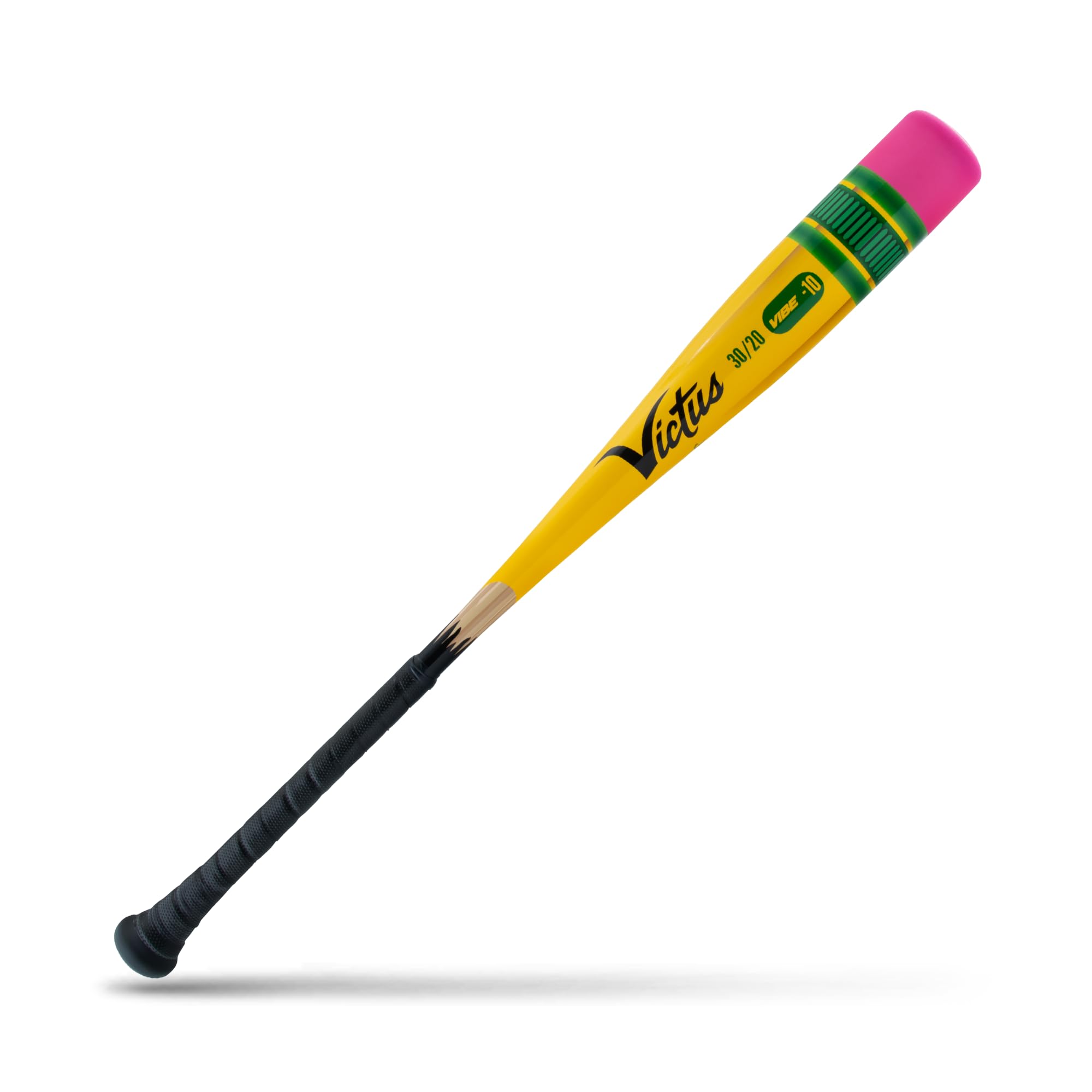
A mid-balanced one-piece with a knob built to kill the sting.
The Vibe Pencil is a one-piece aluminum bat at a 2 5/8-inch barrel, but its standout feature is the knob. Victus built a vibration-reducing taper at the base, which is where the sting from a mishit travels down to your hands. If your kid has ever shaken their hands out after a ball off the handle, that knob is the answer.
The swing weight is mid-balanced, which Victus describes with a medium M.O.I. (a measure of how hard the bat is to rotate). In plain terms, it is neither end-heavy nor feather-light, so a developing hitter can generate power without giving up control. It comes in a -10 drop across sizes from 26/16 all the way to 31/21, so you can size it precisely to your player.
The trade-off is the price at the top tier of this list combined with the one-piece build. You lose the independent vibration control of the Louisville Slugger’s two-piece joint. You gain a direct, clean feel and that purpose-built knob. Reviewers single out the solid one-piece alloy feel, and the finish holds up through a full season.
The number to plan around: the size spread from 26/16 to 31/21 means you can buy the exact length-to-weight match your kid needs instead of compromising on the closest option.
Who this fits: A developing player who has complained about hand sting and wants a clean, direct one-piece feel at a precise size.
Weigh it against: The Select PWR if you want a two-piece joint, or the Rawlings 5150 if the top-tier spend is more than you want to commit.
6. Easton Typhoon USA Baseball Bat | -12 | 1-Piece Aluminum
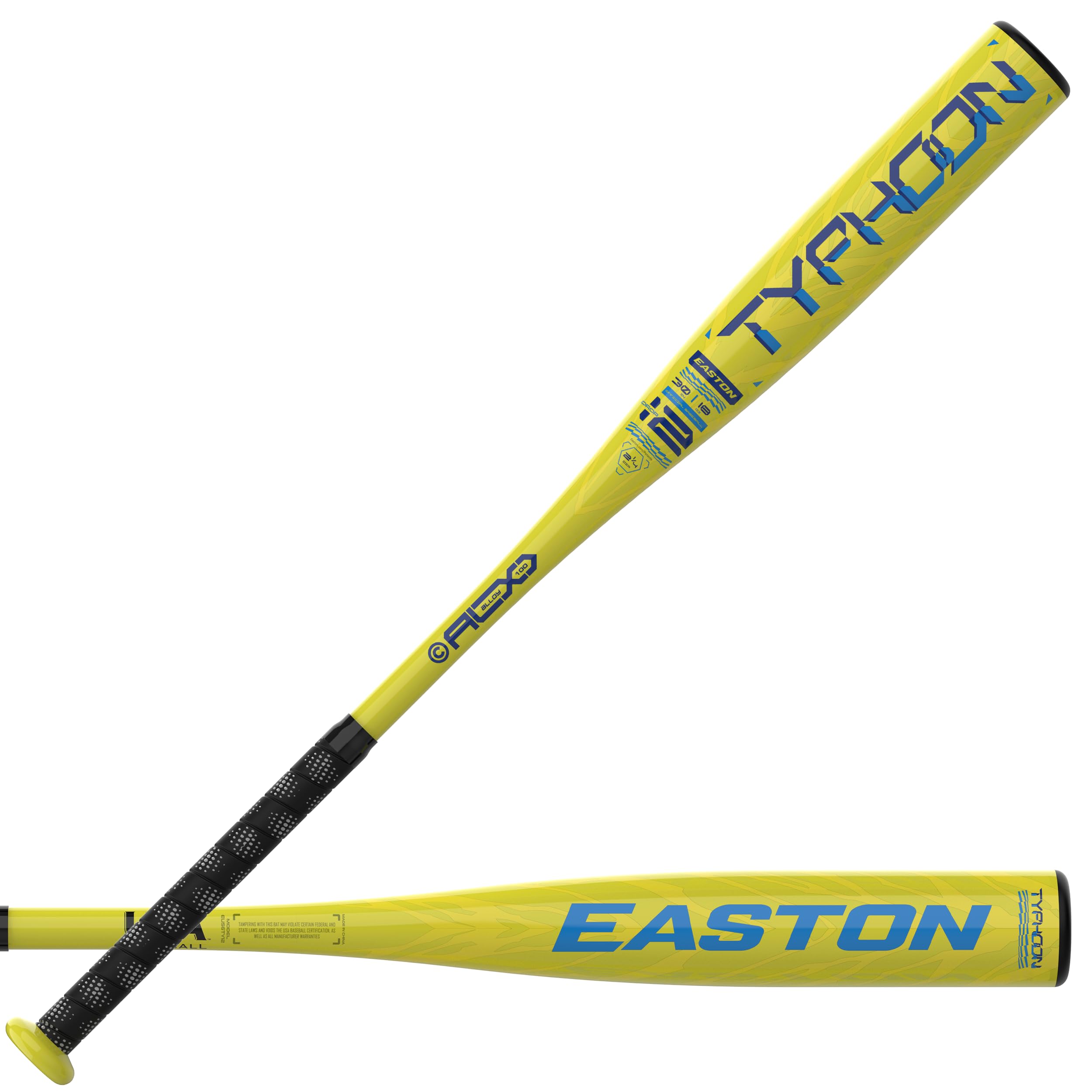
The -12 drop that gets the lightest, easiest swing into small hands.
If you have a very young or small player, this -12 drop is the number that matters. A bigger drop means a lighter bat for the same length, and the Typhoon goes lighter than anything else on this list. The result is that a small kid can get the bat around without dragging it through the zone.
That light swing comes with a 2 1/4-inch barrel, the narrower, more traditional youth size. The build uses ALX100 Military Grade Alloy with a concave endcap (a curved cap at the bat’s end) to keep the bat balanced, and a 2.2mm cushioned flex grip runs down the handle. The enlarged balance is designed to make contact easier for a kid still learning to time a pitch.
The honest note is the narrow 2 1/4-inch barrel. It gives up hitting surface compared with the 2 5/8-inch barrels on the Quantum or the Heist. That is the right trade if swing speed is the problem. It is the wrong trade if the problem is a kid swinging past the ball and needing more forgiveness.
Best fit for: The smallest and youngest hitters who need the lightest bat in the bag to make contact and build confidence.
Think twice if: Your kid already swings fast and would do better with a wider 2 5/8-inch barrel.
7. Easton Havoc USA Baseball Bat | -10 | 1 Pc. Aluminum

A first real bat for the tee-ball graduate who is still learning the game.
Rawlings aims the Remix at ages 10 and under, and it is meant to be the bat a kid carries into their first season of actual pitching. It sits at 26 inches with a -10 drop and a 2 1/4-inch barrel, so it is the shortest and one of the lightest builds here. That lands it right in the hands of a small beginner.
It is 3 inches shorter than the Havoc at 29 inches, which is the whole point. A first bat has to be short enough for a kid to control. The X-Tended sweetspot is designed to promote contact, and the ultra-light drop weight means a young hitter can swing it fast without fighting the bat.
This is an entry-level aluminum bat, so it will not last forever in a hot-hitting 10-year-old’s hands. It is built for a beginner working on fundamentals, and the size and light weight are what people point to most. Treat it as a first bat, not a bat to grow into for years.
Start here if: You have a kid 10 or under stepping up from tee ball and you want a short, light bat to start with.
Plan to upgrade when: They outgrow the 26-inch length — the Raptor at 27 inches is the next step up.
Know the Specs
Drop weight
The drop is the length of the bat in inches minus its weight in ounces, and it is usually written as a negative number like -10. A 28-inch bat at -10 weighs about 18 ounces. A bigger drop means a lighter bat for the same length, which gets a young hitter more swing speed. A smaller drop like -5 means more mass behind the ball for a stronger player.
Barrel diameter
After the drop, the next number to check is barrel diameter, which is the width of the hitting surface. A 2 1/4-inch barrel is the narrower traditional youth size, while a 2 5/8-inch barrel gives a wider hitting zone and a bigger balance. Wider barrels are more forgiving for a kid still learning to square up the ball.
Construction type
A one-piece bat is built as a single solid unit, and it swings stiff and direct through contact. A two-piece bat joins the barrel to the handle through a connector, and that joint absorbs vibration on a mishit. If your kid complains of stinging hands, two-piece is the construction to look at.
USA Baseball certification
A bat certified for USA Baseball is legal in USA Baseball-sanctioned leagues and marked with the USA stamp. USSSA is a different standard. Before you buy, confirm which standard your league plays under, because a bat with the wrong stamp will not be allowed in the box.
Common Questions
Will a USA Baseball bat be legal in my kid’s league?
What drop should I pick for a small 8-year-old?
Is a 2 5/8-inch barrel better than 2 1/4-inch?
Does a two-piece bat really reduce hand sting?
How do I size a youth bat to my child?
Will an aluminum bat dent with regular use?
Can my kid use a BBCOR bat in a USA league?
When should my child move up from a 26-inch bat?
Is a one-piece or two-piece bat better for a beginner?
The Bottom Line
How we choose
We do not accept paid placement. Every pick is matched to a real buyer and a real use-case; we do not hands-on test units.
Sources
Specifications: manufacturer listings and product documentation. Review insights: verified customer reviews, as of November 2026. Pricing: not shown on this page (it changes often); check the current price via the retailer link.
As an Amazon Associate, Tactical Gear Guy earns from qualifying purchases. This does not affect which products we feature.