Specs are compiled from manufacturer listings and verified buyer reviews and can change over time — please confirm the key details on the product page before buying.
You have one microphone output and two places that need it — a mixing console and a backup recorder, or a stage amp and the house PA. An XLR to XLR splitter is the short, cheap cable that sends that single signal down two identical paths without buzzing or dropping level. This guide covers the eight splitters worth wiring into a rig, from short patch adapters to full 6-foot Y-cables, and tells you which one solves your exact setup.
This guide is built by comparing the manufacturers’ published specifications and the patterns across verified customer reviews, so you get each pick’s real strengths and trade-offs instead of marketing spin.
Most buyers get tripped up by one detail: a splitter copies a signal, but it does not mix one, and the direction of the connectors decides which job it does at all. Below you get the real connector directions, cable lengths, wire gauges and shielding spelled out, so you can pick the right one for your board, camera or amplifier without guesswork — starting with the XLR to XLR Splitter that fits the most common rigs.
Top Picks


How To Choose The Best XLR to XLR Splitter
A splitter cable is a wiring decision disguised as a small purchase. Get the connector direction right and the run fits your rig; get it wrong and the cable is dead weight in your bag. Start with direction, then layer in length, gauge and shielding.
Direction first: which way does the signal travel?
The connector count and gender tell you everything. A 1 female to 2 male splitter takes one source — a mic, a console output — and feeds two inputs. A 1 male to 2 female splitter does the reverse: it joins two cables into a single input on your mixer or PA. Buy the wrong direction and the connectors simply will not seat where you need them, no matter how good the cable is.
Length and split point decide whether it fits
Short patch cables suit a rack or pedalboard where everything sits close together. Longer Y-cables give you reach between a stage box and an amp. Watch the split point too: on some cables the Y-junction sits near the male ends, on others roughly one foot from each connector, and that changes how the two legs drape across the back of your gear.
Gauge and shielding for a clean signal
Thicker wire carries signal with less resistance, and a lower gauge number means thicker wire. Shielding wraps the conductors to keep radio and electrical noise out of the run. For short runs in a quiet room the difference is subtle; for long runs next to lighting rigs and power supplies it matters. Look for oxygen-free copper conductors and a foil, spiral or braided shield in the listing.
Balanced wiring: the pin-for-pin check
A balanced connection ties pin 2 to pin 2, pin 3 to pin 3 and pin 1 to pin 1. That pin-for-pin match is what keeps interference low and the signal strong and undistorted. Every splitter on this list is wired that way, so the real differences come down to build, direction and length.
Side-by-Side Comparison
| Model | Best For | Connector Direction | Length | Gauge | Amazon |
|---|---|---|---|---|---|
| Disino XLR Y Splitter Cable★ Best Overall | Feeding two console channels from one mic | 1 Female to 2 Male | 1.5 feet | — | Amazon |
| Kirlin Cable Y-303-06Best for Reach | Stage runs that need extra reach | 1 Female to 2 Male | 6 feet | 24 | Amazon |
| Tisino Balanced XLR SplitterBest Shielding | Studio runs where shielding matters | 1 Female to 2 Male | 5 feet | 20 | Amazon |
| Pig Hog PY-XF2XM | Tour rigs that need a tiny jumper | Female to Dual Male | 6 inches | — | Amazon |
| Hosa YXF-119 | Combining two sources into one input | 2 Female to 1 Male | 6 inches | — | Amazon |
| HUALEU XLR Male to Dual Female (2-Pack) | Pulling two mic lines into one mixer input | 1 Male to 2 Female | 2 feet | 22 | Amazon |
| Seefeful 2-Pack XLR Y Splitter | Stage lighting and instrument patches | 1 Male to 2 Female | 11.8 inches | 20 | Amazon |
| Cable Matters 2-Pack XLR Splitter | Wireless mic splits for studio and home recording | 1 Female to 2 Male | 18 inches | — | Amazon |
Detailed Reviews
1. XLR Splitter Cable 1 Female to 2 Male 1.5 Feet
Our pick — 4.5+★ from 900+ verified ratings; the strongest balance of quality and price.
The short patch splitter that sends one mic to two console channels without a whisper of handling noise.
If you run a shotgun mic into a mixing board and a backup recorder at the same time, this is the cable that makes it a one-plug job. It carries a single XLR female input out to dual XLR male outputs — 1.5 feet end to end, short enough to sit tidily behind the console. The connectors are nickel-plated with metal serviceable ends, so if a sleeve ever works loose you can tighten it back down.
Signal protection comes from OFC spiral shielding — oxygen-free copper wire wound in a spiral to block radio and electrical interference. That is what keeps the run quiet in an old venue with dimmers humming on the same circuit. The balanced wiring ties pin 2 to pin 2, pin 3 to pin 3 and pin 1 to pin 1, so the two outputs see the same clean, undistorted signal. Build quality is the part that wins people over most, and it shows in the metal ends and strain relief.
The honest catch is durability. The plastic connector housings are called heavy-duty in one breath and prone to cracking in the next, so treat the ends gently when you unplug rather than yanking the cable out by the body. And remember what it is: a mono split into two mono lines. It will not turn one mic into a stereo image.
What sold the crowd
- Metal serviceable connector ends you can tighten yourself
- OFC spiral shielding for quiet runs in noisy venues
- Balanced pin-for-pin wiring keeps the signal clean
- 1.5-foot length tames board clutter
Where to baby it
- The plastic connector housings are the wear point — unplug by the body, not the wire
- Splits mono to mono only; no stereo summing
Reach for this if: you need to feed two console inputs from one source and want a short, clean patch with repairable ends.
Think twice if: your rig needs longer reach — the 1.5-foot run will not stretch to a stage box.
2. Kirlin Cable Y-303-06 6 Feet
Six feet of air between your source and your split — the length that actually covers a stage run.
Six feet is the standout here, and it is a big one: compared to the 1.5-foot Disino at the top of this list, you get a 4.0x longer run before the split. That is the difference between a cable that fits a rack and one that reaches across a stage box to an amp on the far side. The 24-gauge oxygen-free copper conductor and spiral shielding keep the signal intact across a full stage run.
Value earns the most goodwill, and it makes sense at this length. You get six feet of shielded Y-cable for less than most rival 5-foot options. The 5.5mm outer diameter jacket is round and black, and the metal housing gives the ends some heft in the hand. Kirlin’s 24-gauge wire is thinner than the 20-gauge Tisino further down, and that gauge choice is where the savings come from.
The trade-off is real. Some buyers find the connectors on the rigid side, and the run is longer than a patch bay needs — a 6-foot Y-cable coiled behind a rack is overkill. If you want a compact jumper, look at the Pig Hog further down instead.
Room to move: 6 feet of reach and 24-gauge OFC for the price of most competitors’ shorter cables. It is the best option for live work where your split lives across the stage.
Gauge versus pitch: the 24-gauge conductor is thinner than the 20-gauge Tisino, but the spiral shielding is what keeps the signal clean at the far end of a 6-foot run.
Best for the stage: anyone splitting a signal over distance where 1.5 feet simply will not cut it.
The snag: the connectors feel rigid, and the length is more than a tight rack needs.
3. Tisino Balanced XLR Splitter Cable 5 feet
The studio-grade build with 24K gold-plated ends and a split point set back toward the male connectors.
Five feet of 20 AWG 4N oxygen-free copper — oxygen-free copper rated at 4N purity — with shielding that targets high-fidelity sound and maximum signal clarity. That is the thickest conductor on this list, and it is why this cable holds its own on a live stage next to power cables. The 24K gold-plated XLR connectors resist corrosion and cut signal loss and static noise.
The split point sits closer to the male ends, about 19.5 inches back, which keeps the two legs consistent as they fan out to your destinations. Polyethylene insulation helps preserve high-frequency response on a bright condenser mic. Quality earns the most praise in buyer feedback, and the whole package is sized for connecting one mixer output to both a power amp and a recording device at once.
One thing to keep straight: it is wired to copy a mono signal, not to combine two sources into stereo. If your goal is merging two lines into one input, you want the Hosa further down instead. That said, the shielding and gold plating make this the studio-first choice for run length and noise rejection.
Why studio hands pick it
- 20 AWG 4N oxygen-free copper — the thickest conductor here
- 24K gold-plated connectors resist corrosion and static
- Polyethylene insulation preserves high-frequency response
- Split point set back approximately 19.5 inches toward the male ends
Keep an eye on
- Copies a mono signal; it will not sum two inputs into stereo
- The 5-foot run is longer than a pedalboard patch needs
Built for the booth: a strong pick for studio recording or a live split where shielding and gold-plated ends earn their place.
Wrong tool for: anyone who needs to combine two signals rather than split one.
4. Pig Hog PY-XF2XM XLR (Female) to Dual XLR (Male) Y-Cable, 6″

Six inches of tour-grade jumper for the tightest spot in your rack, built to be stepped on for life.
The number that matters here is six inches. This is a stubby adapter cable — XLR female in, dual XLR male out — meant to sit in a rack or pedalboard gap where a 5- or 6-footer would just coil into a mess. The pig’s own marketing leans on tour-grade XLR connectors and a proprietary splitter junction, a molded joint where the signal fans out to the two male ends.
The exterior is tough PVC, the kind that takes a scuff in the van and keeps working. It also carries a limited lifetime backing from the manufacturer, which matters for a jumper that lives on a road case lid. If you run a touring rig and want one small jumper that survives the truck, this is the short cable that punches above its length.
The honest limit is reach. Six inches will not stretch to a stage box, so this is a patch-bay and rack tool, not a live run cable. And the buyers who want a strain-relief boot or a longer mini-jumper will need to go farther up this list.
The short-game specialist: six inches, tour-grade connectors and a proprietary splitter junction — a tiny cable that behaves like road gear, not a patch toy.
Length-bound: at 6 inches it solves rack clutter, and nothing else; the 6-foot Kirlin above is the reach pick when the split has to travel.
Reach for this if: your split lives in a rack or on a pedalboard and you want a compact, tour-minded jumper with a limited lifetime backing.
skip it if: you need any real distance — six inches is a patch, not a run.
5. Hosa YXF-119 Y Cable, Dual XLR3F to XLR3M, 6 Inches

The splitter that runs backward: two XLR3F inputs feeding one XLR3M output, built for merging lines.
Every other cable on this list copies one signal into two; this one does the reverse. It takes two XLR3F female inputs and folds them into a single XLR3M male output, which is the cable you want when you have two mono sources and only one channel left on the board. Six inches of run keeps it tight at the back of a rack, and the 3-pin XLR connector at both ends seats cleanly in mixers, preamps and interfaces.
What wins people over is the clean transfer: the cable carries signal with no humming or distortion, and with the dual connectors and short 6-inch length it interconnects a set of devices in one tidy hop. For gigs where you need to pull two mic lines into one input, this is the piece that simplifies it. Construction gets the same nod — it is built for repeatable use, not a one-night patch.
The caveat is direction, again. Because it merges two inputs into one output, it is the wrong tool if you actually need to feed two amps from one mic. Read the connector labels before you plug it in — female in, male out — and it does its single job well.
The merge it makes
- Folds two XLR3F inputs into one XLR3M output
- Clean transfer with no humming or distortion
- 6-inch length is ideal for tight rack interconnects
- Rugged construction for repeat use
Check before you buy
- Merges inputs; it will not split one source into two
- The 6-inch reach limits it to tightly packed gear
Who it beats: any setup that needs to combine two mono lines into a single channel — this does that job cleanly.
Who should look elsewhere: buyers who need one mic feeding two destinations, not the other way around.
6. HUALEU XLR Male to Dual Female Y Splitter 2-Pack
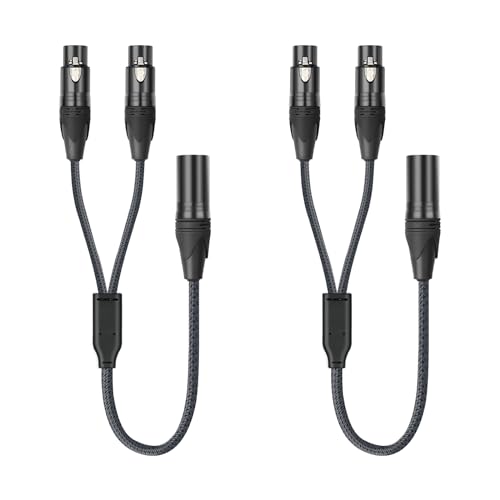
Two cords in the pack, each a 1 male to 2 female combiner with double shielding at 22 AWG.
Here is a splitter that runs the other direction from the Disino up top: it takes one XLR male input and fans it to two XLR female outputs, which is exactly what you need to land two mic cables on a single mixer input. You get two of them in the pack, so a stereo or dual-mic setup is covered in one order. The 2-foot run is short enough to keep a rack tidy and long enough to reach between a mixer and a split point.
The construction is what earns the most praise — 22 AWG 4N oxygen-free copper conductors with aluminum foil and braided copper double shielding, wrapped in a high-density braided fiber outer layer. That two-layer shield is what keeps interference and noise low on a crowded board. Balanced pin-for-pin wiring ties 2 to 2, 3 to 3 and 1 to 1 for a clean, distortion-free signal.
The trade-off: this is a combiner-direction cable, so do not buy it expecting to split one mic into two amps. And the split sits about 1 foot from each end, so the two legs are short and the layout is fixed by that geometry. For a two-pack of well-shielded combiners, though, it is the best value at the top of the range.
Double shield, dual pack: aluminum foil plus braided copper shielding over 22 AWG OFC, two cables in one box — the shielding story is the reason this one sits at the highest rating on the list.
Direction matters: 1 male to 2 female means it combines two mic lines into one input, not the reverse; check your board before ordering.
Go here for: a shielded, two-cable set that pulls two mic lines into a single mixer channel, with the best buyer feedback on this list.
Not your pick if: you need a 1 female to 2 male splitter instead of a combiner.
7. Seefeful XLR Y Splitter 1 Male to 2 Female 11.8 Inches

A two-pack of 20 AWG gold-plated combiners that also handle stage lighting and DMX runs.
This pair of 11.8-inch splitters is built for more than just audio. The 3-pin XLR run is wired 1 male to 2 female to combine two sources into one destination, and the same cable takes stage lighting gear in stride — moving head lights, par lights and spotlights included. The 20 AWG 4N oxygen-free copper with shielding and gold-plated connectors gives you high-fidelity sound plus the conductivity a clean signal needs.
The outer jacket is heavy-duty flexible rubber and soft PVC over a 6.0mm (0.24 inch) diameter, so the two cables take a bend without kinking in the case. The 3-conductor XLR design is the structure that improves noise rejection, and the polyethylene insulation helps the high-frequency end of the signal stay intact. A pair in the pack covers a two-channel setup in one purchase.
Two things to flag. First, the direction: this combines two signals into one, so it is not the cable for splitting one mic into two amps. Second, the 11.8-inch run sits between a patch and a full stage lead — short enough for a pedalboard, but not a long haul. For lighting and instrument work it is genuinely versatile.
Dual-purpose build: 20 AWG OFC and gold-plated connectors, sized for both audio and stage-lighting runs, and sold as a pair.
One direction only: it merges two inputs into one output; the reverse splitter you might be picturing is a different cable.
Fits your bag if: you run XLR for both audio and lighting and want a versatile two-pack short enough to patch.
Leave it if: your job is one source out to two destinations rather than two sources into one.
8. Cable Matters XLR Splitter Cable Female to 2x Male 1.5ft
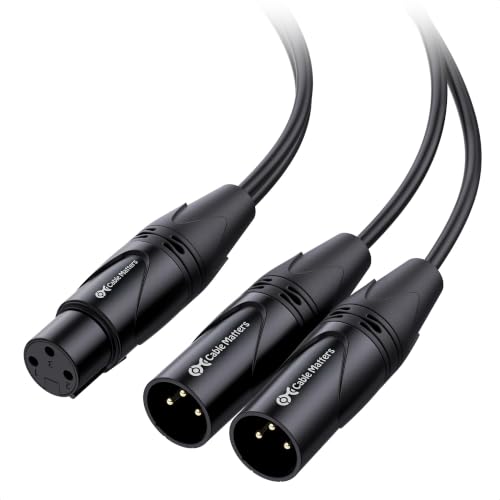
Two 18-inch splitters with 97.5% braided shielding, sized for wireless mics and guitar amps.
This pair of splitters is the pick for a wireless mic that needs to feed an amplifier and a mixer at the same time. Each cable is female-to-2x-male, 18 inches of flexible PVC jacket with molded strain-relief boots, and gold-plated contacts inside durable metal connectors with easy-grip treads. The soft PVC keeps it pliable when you are pushing it into a crowded rack.
The shielding number is concrete: braided shielding provides 97.5% coverage for cancellation of hum and noise, backed by OFC conductors and polyethylene insulation that improve signal clarity and high-frequency response. It fits a DAC, a guitar amplifier, a PA board or a wireless mic receiver — a broad set of 3-pin XLR gear. The flexible 18-inch length makes it easy to reach between a single XLR output and two inputs without a tangle.
The catch is scale. This is a patch-length splitter, so long stage runs are out of its comfort zone, and the molded ends are fixed rather than serviceable. Treat the joints kindly when you unplug. Two cables in the pack do make it a sensible, budget-friendly way to cover two channels at once.
Value in the pair
- 97.5% braided shield coverage fights hum and noise
- Gold-plated contacts in metal connectors with molded boots
- Flexible 18-inch PVC jacket handles a crowded rack
- Two cables in the pack cover a dual channel
Where it stops
- Patch length only — not for long stage runs
- Molded ends are fixed; unplug by the body
Good match for: a home or studio setup routing a wireless mic to two inputs, where a pair of short shielded splitters does the job.
Not the one for: long hauls across a stage or a rig that needs serviceable connector repairs.
Know the Specs
Connector Direction: 1 Female to 2 Male vs 1 Male to 2 Female
A splitter is directional. A 1 female to 2 male cable takes one female source — a mic or a console output — and sends it to two male inputs. A 1 male to 2 female cable works the other way and merges two signals into one. Match the direction to your gear, because the wrong one will not seat where you need it.
Wire Gauge: What the Number Means
Gauge is the thickness of the conductors, and a lower number means thicker wire. A 20-gauge cable carries signal with less resistance than a 24-gauge one, which matters more as the run gets longer. Thicker wire is not automatically better for every patch, but for long runs and noisy venues it helps the signal stay clean.
Shielding: Blocking Interference
Shielding is a layer of foil, spiral wire or braid wrapped around the conductors to keep radio and electrical noise out. It comes in spirals, foil-and-braid combos and full braided coverage. More coverage usually means better cancellation of hum, which is why crowded stages and lighting rigs are where shielding earns its keep.
Cable Length and Split Point
Length decides reach, and the split point decides drape. Short 6-inch jumpers suit a rack; 5- and 6-foot Y-cables suit a stage run. Where the Y-junction sits — near the male ends or about a foot from each connector — changes how the two legs lie across the back of your equipment.
Common Questions
Does a splitter cable send one signal into two, or combine two into one?
Can I split a microphone into two amplifiers with these cables?
What does balanced wiring mean on an XLR splitter?
Will a splitter cable turn my mono microphone into stereo?
Does a thicker wire gauge like 20 AWG sound better than 24 AWG?
How long should an XLR splitter cable be for live use?
Can I use these XLR splitters for DMX lighting control?
Will a cheap XLR splitter cause hum or hiss?
What is the difference between a splitter and a combiner cable?
Do these splitters need power or a battery?
The Bottom Line
For most rigs, the xlr to xlr splitter to reach for is the Disino XLR Y Splitter Cable, because its balanced pin-for-pin wiring, OFC shielding and short 1.5-foot run keep a mic clean when it feeds two console channels. If your split has to travel, grab the Kirlin Y-303-06 for its 6-foot reach and 24-gauge copper. And when you need to combine two lines into one input instead of splitting, the Hosa YXF-119 is the one to reach for.
How we choose
We do not accept paid placement. Every pick is matched to a real buyer and a real use-case; we do not hands-on test units.
Sources
Specifications: manufacturer listings and product documentation. Review insights: verified customer reviews, as of November 2026. Pricing: not shown on this page (it changes often); check the current price via the retailer link.
As an Amazon Associate, Tactical Gear Guy earns from qualifying purchases. This does not affect which products we feature.