Specs are compiled from manufacturer listings and verified buyer reviews and can change over time — please confirm the key details on the product page before buying.
Your cleat, latch, or rail base fails for one reason: the metal was never meant to live in salt, and plain steel or zinc pits and bleeds rust streaks onto gelcoat within a season. Yacht deck hardware is where cheap fittings go to die, and the fix is boring but decisive — buy 316 stainless and buy the right size the first time. Below are nine deck fittings sorted by what they actually do: cleats that tie your lines, rail bases that hold a tube, a drain that clears standing water, a latch that opens a locker, a fender holder that docks in one hand. Each pick lists the exact measurements you need to check against your own boat before you drill.
This guide is built by comparing the manufacturers’ published specifications and the patterns across verified customer reviews, so you get each pick’s real strengths and trade-offs instead of marketing spin.
Fit comes before finish every single time, so measure your hole, your tube, and your rope with calipers before you order. The rest of this guide shows you how to match each measurement to the right yacht deck hardware.
Top Picks

How To Choose The Best Yacht Deck Hardware
Deck hardware is not a style purchase; it is a fitment decision bolted to a hole you cannot easily change. A fitting that is beautiful and one size off will not sit flush, will not hold your line, and will leave you drilling new holes in a deck you just refinished.
Start with 316 stainless steel
Grade decides whether the fitting survives saltwater at all. 316 stainless steel carries molybdenum in the mix, which is what makes it hold up in saltwater while cheaper steel and zinc pit and bleed rust streaks onto gelcoat. Every fitting in this list is 316, so the real sorting happens on measurements and mechanism rather than metal.
Match the hardware to the hole you already have
A flush-mount latch is built for a specific cutout diameter and a specific door thickness. A deck drain is built for a specific hose outside diameter. A rail base is built for a specific tube size. None of these are universal, and none of them forgive a guess. Measure the existing opening with calipers, not a tape, and compare that number to the listing before you buy.
Check mounting hole spacing, not just length
A cleat’s overall length tells you how much rope it takes. The mounting hole spacing tells you whether it drops onto your old bolt holes or forces new ones. Look for that center-to-center figure on the listing — it is the number that decides whether this is a five-minute swap or an afternoon with a drill.
Decide between fixed and folding
A fixed cleat is simpler and takes a line at any angle. A folding cleat lies flat when it is not in use, which keeps a toe-safe deck and lets you mount in a tight spot. The trade is that a folding mechanism is one more moving part to keep clean and free of salt grit.
Side-by-Side Comparison
| Model | Best For | Metal Grade | Key Size Figure | Mounting Holes (center to center) | Amazon |
|---|---|---|---|---|---|
| VEITHI 6″ Open Base Dock Cleats★ Best Overall | Tying up in a slip | 316 stainless steel | 6 inch length, 1-1/8 inch height | 2.25 inch | Amazon |
| keehui 90° Rectangle Rail Base (Pair)Best for Rail Repair | Rebuilding a hand rail | 316 stainless steel | Fits 7/8 inch tube | — | Amazon |
| Racewill 5″ Folding Cleat (2 Pack)Best Flat-Fold Option | Kayak and pontoon decks | 316 stainless steel | 5 inch length, 0.43 inch folded height | 2.75 inch | Amazon |
| NRC&XRC 90° Deck Drain | Clearing standing deck water | 316 stainless steel | 1-1/2 inch hose outside diameter | — | Amazon |
| VEITHI 8″ Flat Top Dock Cleats | Heavy line, short mount span | 316 stainless steel | 8 inch length, 1-1/2 inch height | 2.07 inch | Amazon |
| YUSOVE 2-1/2″ Flush Mount Latch | Hatch and locker doors | 316 stainless steel casting | 2-1/2 inch hole, face plate 3 inch | — | Amazon |
| Salty Reef Marine Stainless Deck Plate | Inspection access and ventilation | 316 stainless steel | Size = inside diameter of the port hole | — | Amazon |
| Laorde 5″ Folding Cleats (4 Pack) | Outfitting a whole deck | 316 stainless steel | 5 inch length, 0.44 inch height | — | Amazon |
| Phender Pro Quick Release Fender Holder | One-hand fender deployment | 316 stainless steel | 1/2 inch quick-release pin | — | Amazon |
Detailed Reviews
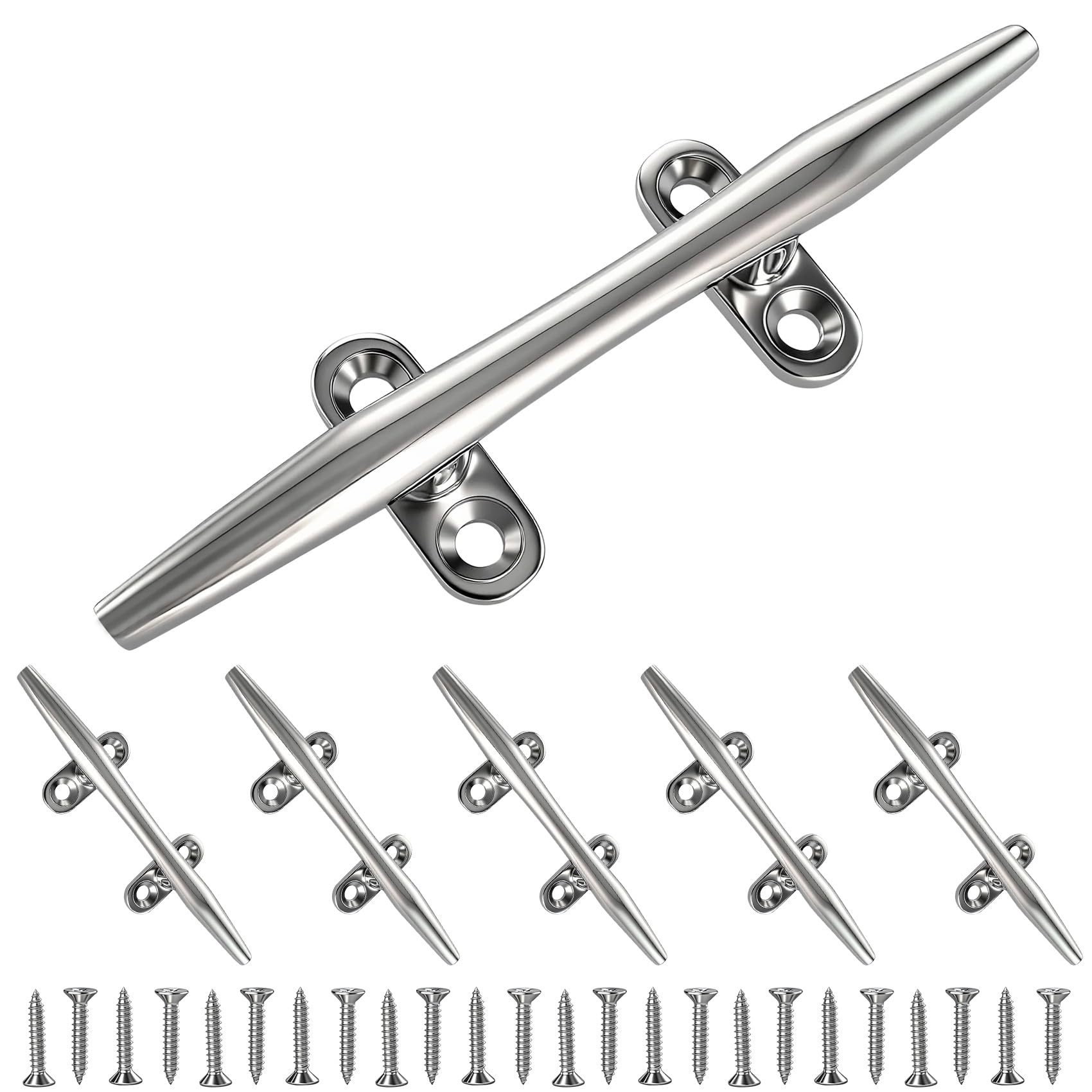
1. VEITHI Open Base Dock Cleats
Our pick — 4.5+★ from 300+ verified ratings; the strongest balance of quality and price.
Six cleats, salt-proof metal, and screw hardware in the box — the simplest mooring fix you can bolt down.
The six-inch model gives you 1-1/8 inch of horn height and 2.25 inch mounting holes center to center, so it drops onto a standard spread and gives your rope room to sit.
What wins people over is the build itself — the finish and the solid feel of that open four-point base are what the review pages keep circling back to. You get the M6 x 30mm stainless screws included, so there is no second trip for fasteners, and the base measures 1.75-inch by 0.6-inch to sit clean on gelcoat or teak.
The catch is honest and physical: at 1 kg for the set, this is not a featherweight package, and an open base leaves a small gap under the horns that collects salt grit over a season. Rinse it and it stays mirror-bright. The listing also markets these as cabinet pulls and towel hooks, so if you want decorative nautical hardware this doubles up.
Where it earns its place
- 316 stainless steel holds up in saltwater instead of pitting like zinc.
- Fasteners included — M6 x 30mm stainless screws arrive with the cleats.
- Open base design takes cleat hitches and clove hitches without crowding the line.
- 6-pack covers a full run of mooring points in one order.
What to weigh first
- At 1 kg the set adds noticeable weight to a light deck fitting order.
- Open base traps salt grit under the horns unless you rinse regularly.
- Six-inch length needs a clear run of deck — not a tight lip.
Buy this if: you are re-cleating a slip, a dock edge, or a run of mooring points and want the hardware in one box.
Measure first if: your existing bolt holes are not 2.25 inch apart — this cleat wants that spread.
2. keehui 90 Degree Rectangle Stanchion Base
A two-piece rail base that turns a wobbling hand rail back into something you trust to grab.
This is one of the lighter fittings on the list — the pair ships at 0.38 kg, against 1 kg for the VEITHI six-pack of cleats. Both are cast 316 stainless, so the weight difference is about how much metal there is, not about a cheaper grade.
The spec that decides everything here is 7/8 inch. That base fits a 7/8 inch pipe or tube and nothing else, so if your rail is a different diameter this is the wrong part no matter how good the polish looks. Each base measures roughly 2.26 inch by 1.78 inch, cast solid with a 90 degree rectangle footprint.
Two things worth knowing before you order. The casting is heavy-wall, which means a couple of these near a stanchion settle a rail fast; the mirror polish is also the part that shows scratches first if you tighten against a bare tool. A half-year warranty backs the pair, and the listing is thin on review detail, so treat this as a measurement-first buy rather than a crowd-validated one.
What this pair really gives you
- Solid cast 316 stainless, built for saltwater rather than painted over.
- Two bases in the pack, so a matching pair of stanchions stays matched.
- 0.38 kg for the pair keeps the rail assembly from getting top-heavy.
Locked-in constraints
- 7/8 inch tube only — there is no adjustment built in.
- Polish shows handling marks if you wrench against the casting.
Right call for: a boat with 7/8 inch railing that needs new feet, not a new rail.
Think twice if: you have not measured your tube with calipers — this part answers to one diameter.
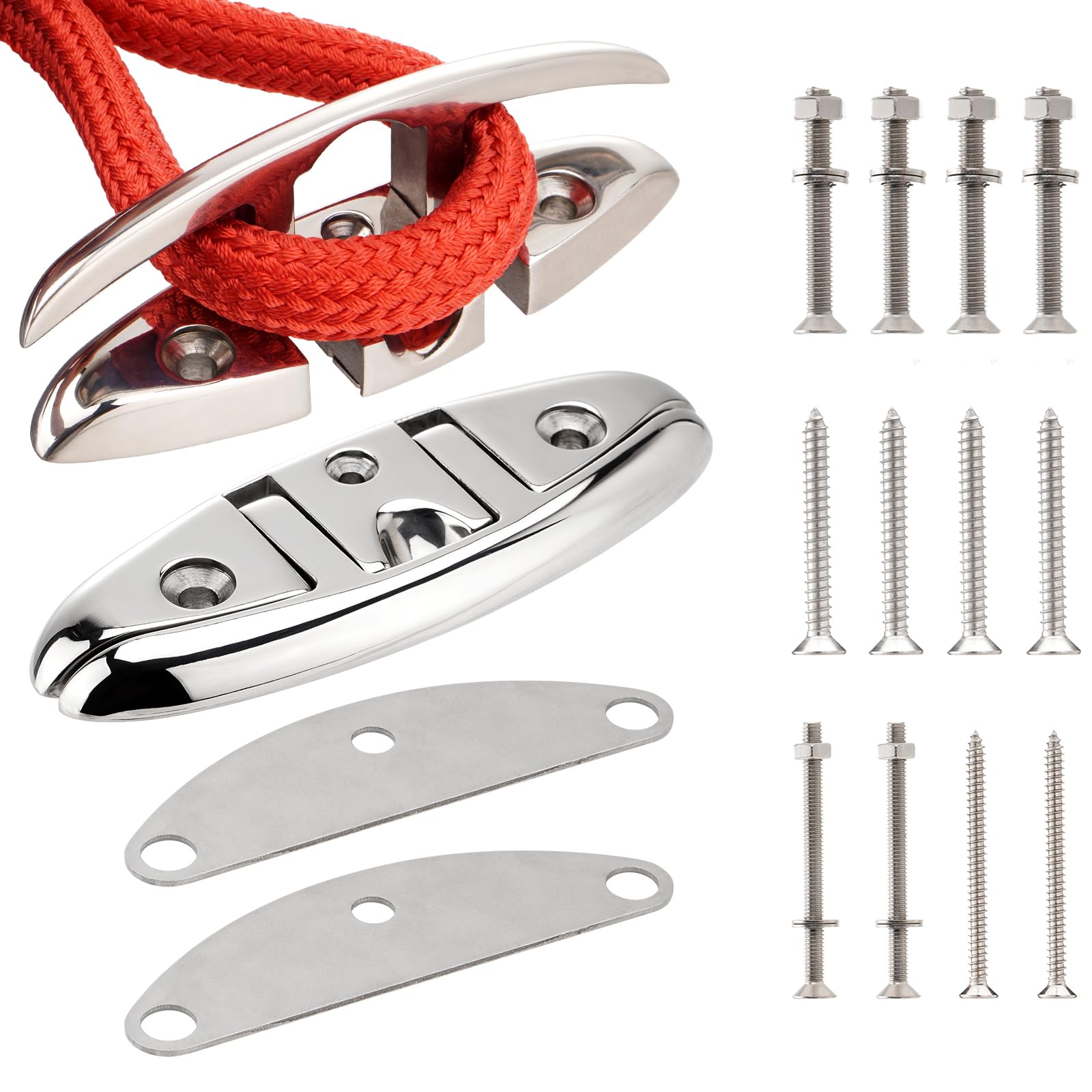
3. Racewill Boat Folding Cleats
Flip it up to tie off, fold it down to kick your shoes off without catching a toe.
The folded height is the number that sells this one: 0.43 inch. Compare that to the VEITHI dock cleat sitting 1.57 inch tall on the deck — the flat-fold cleat preserves a walkable surface where the fixed cleat would be a trip hazard.
Open it and you get 5 inch of total length and 1.5 inch of improve height, with bolt holes 2.75 inch apart center to center. Every part of it, including the screws, is 316 stainless, so the spring mechanism is not the weak link in salt. The chrome finish and the solid feel when deployed are what the review pages focus on, and the fold-flat function is what keeps people recommending it.
The honest trade-off is mechanical: a folding cleat adds a pivot to a part that used to be one piece of metal, so sand and salt need flushing out of the joint now and then. You also get a 2-pack here, plus two backing plates, two types of bolts and screws, fender washers, and lock nuts — a complete install kit rather than a bag of bolts.
The flat-fold win: 0.43 inch folded is genuinely walkable, and the 2.75 inch bolt spacing maps onto a lot of existing deck holes.
The upkeep note: a pivot joint needs rinsing — it is one more moving part than a plain open-base cleat.
Fits best on: kayaks, pontoon decks, and any boat where deck space pulls double duty as walking room.
Pass if: you want zero moving parts and never need the cleat to disappear.
4. NRC&XRC 316 Stainless Steel Marine Deck Drain, 90 Degree
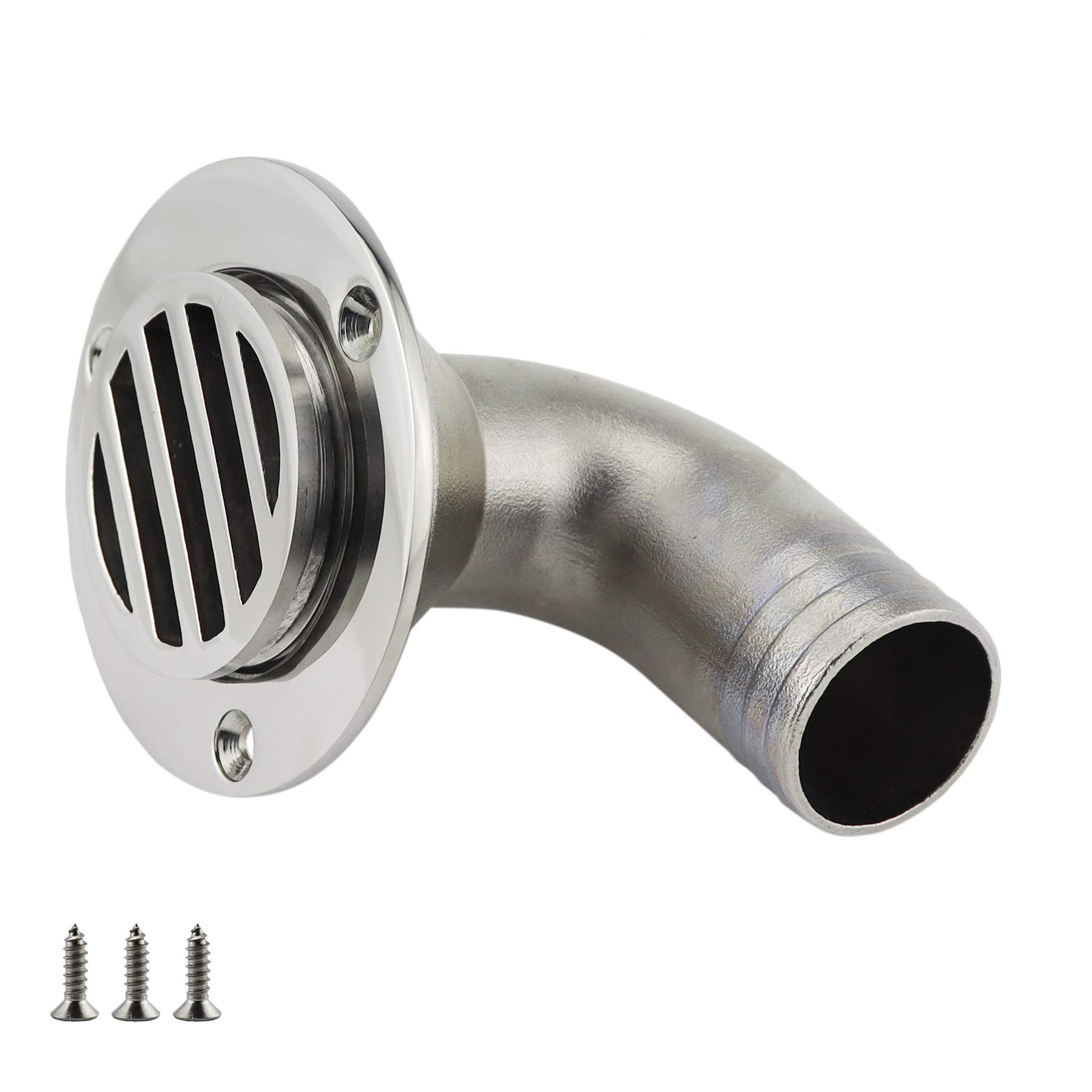
Standing water on a cockpit sole is how gelcoat stains start — this drain is the fix underfoot.
One figure governs this purchase: the hose outside diameter, listed as approximately 38mm, or 1-1/2 inch. Match that to your drain hose and the job is done. Miss it and no amount of polishing helps.
The 90 degree body turns the water sideways, which is what you want where a straight drop would foul a locker or a stringer. Marine grade 316 stainless with a mirror polish means the flange looks like it belongs on a finished deck rather than a bilge part bolted through it. Three fasteners come in the pack, so the only thing you supply is the hose.
This is the smallest-volume fitting in the guide, and that cuts both ways — a single drain in the box means a simple replacement, not a spare for the other side. Fit hole size is listed at 38 millimeters, so your existing cutout has to match that opening before you commit.
Where it shines: the 90 degree exit and the 38mm hose match solve a real drainage routing problem in tight cockpit soles.
Order check: one drain per pack and a fixed 38mm fit hole — confirm your cutout and hose before you buy.
Reach for this if: your cockpit sole pools water and you need a side-exit drain that clears it fast.
Look elsewhere if: your cutout is not 38mm or your hose is a different outside diameter.
5. VEITHI 5/6/8 inch Flat Top Dock Cleats (316 Stainless Steel)
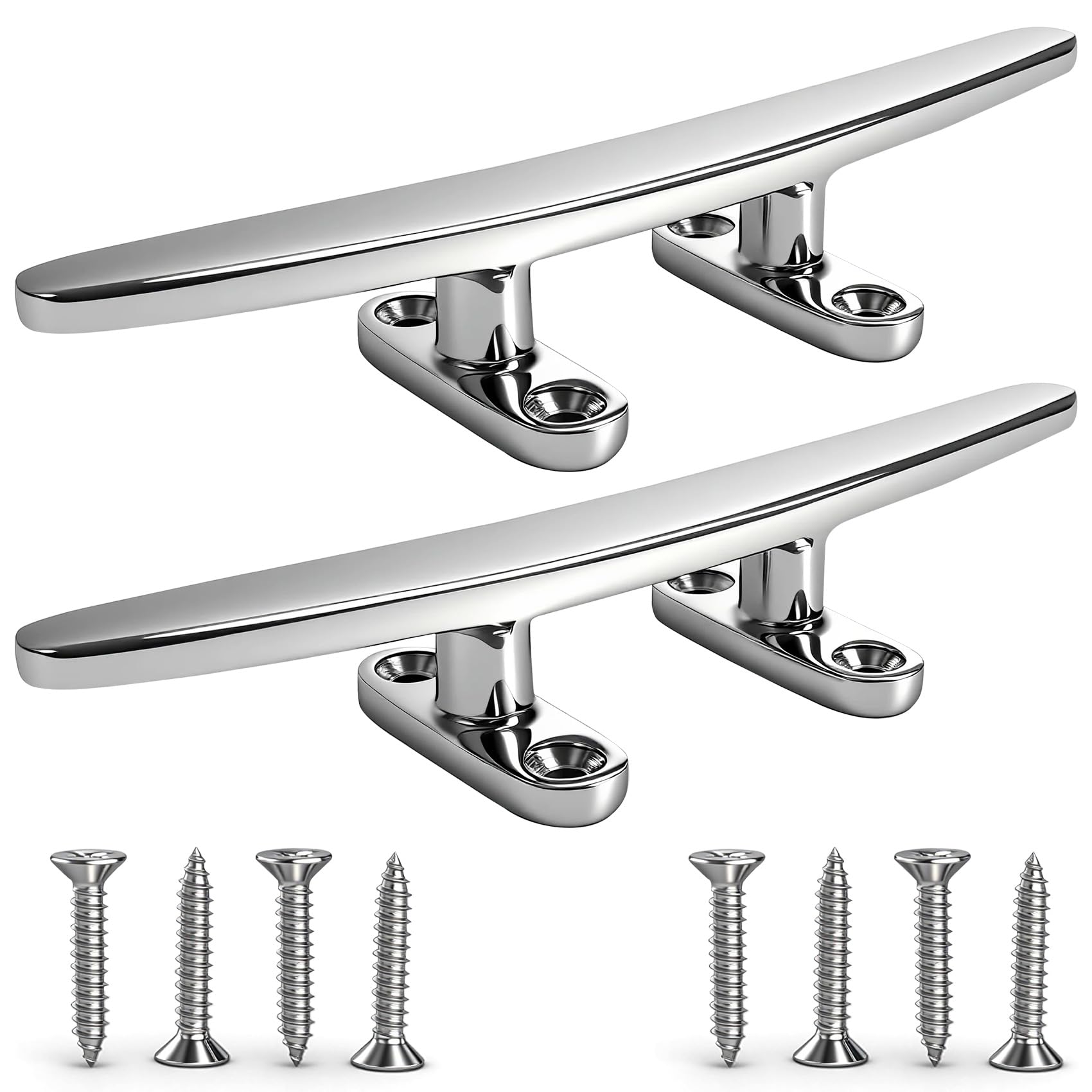
Eight inches of horn on a shorter bolt spread — extra rope room without a longer deck footprint.
The 8 inch model carries 1-1/2 inch of height and a base of 2.4 inch by 3/4 inch, with mounting holes just 2.07 inch apart center to center. That shorter bolt spread is the practical trick: you get a bigger cleat than the mounting span would suggest, which suits a deck where the old fitting was small.
Unlike the six-inch open-base cleat at 1.57 inch tall, this flat-top model sits lower and wider at 2.44 inch, so a fat line lies down flatter across the horns. It is the same 316 stainless with the same high-polish finish, and the M6 x 45mm screws come in the box. The build and the high-polish finish are what reviewers keep coming back to.
One nuance worth catching: the listing describes this as the 8 inch configuration, and the pack sizes include a two-pack, so you are buying a pair, not a full set of mooring points. At 0.8 kg the pair has real presence on deck.
Why it holds the top score
- Bigger cleat on a tight 2.07 inch bolt spread.
- Flat top lies a fat line down cleanly.
- 316 stainless with high polish and included M6 x 45mm screws.
Before you drill
- Two-pack only — plan your count carefully.
- The eight-inch horn needs clear deck around it to take a full wrap.
This is your one if: you want maximum line capacity without a long bolt pattern to drill.
Count your points first: it ships as a pair, so a four-cleat deck means two orders.
6. YUSOVE Flush Mount Latch

A recessed hatch latch that opens with two fingers and no key to lose overboard.
Two numbers make or break this fitting. The hole cutout is 2-1/2 inch, and the door thickness range is 1/8 inch to 3/4 inch. If your locker lid falls in that band and your existing hole is that size, this drops straight in as a replacement; if either number is off, it is the wrong part.
The face plate is 3 inch across on a recessed, mirror-polished body, and the D-handle compression latch pulls with two or three fingers. The solid 316 casting is built to sit in salt and keep working, which suits a deck locker that gets opened wet-handed every single day. Solid 316 stainless casting is the reason. Value is the second thing people keep bringing up.
Here is the practical caution: this is a non-locking latch. That is a deliberate feature for fast access to a compartment, and a real limitation if you want a hatch you can secure. One pcs per package, so a multi-hatch deck needs multiple orders, and the two-year warranty means the maker stands behind the casting.
The fit spec that matters: 2-1/2 inch hole and 1/8 to 3/4 inch door thickness — measure both, not one.
The honest limit: non-locking by design, so security is the trade for instant access.
Ideal for: a wet locker, a bait hatch, or a storage lid you want to pop open without fumbling a key.
Not for: any compartment you need to lock shut.
7. Salty Reef Marine Hardware Boat Deck Plate in 316 Stainless

An inspection port that stays sealed, opens fast, and shows one style of handle where it counts.
The size number on this listing is the inside diameter of the port hole, not the outside of the plate. Get that straight and the install is straightforward; misread it and you will be enlarging a hole you cannot un-enlarge.
What actually keeps water out is the O-ring rubber seal (a rubber ring that blocks water from pushing through the threads) — that is the whole point of an access plate, and it is the detail that separates a deck plate from a hole with a lid on it. AISI 316 stainless (a marine-grade stainless steel that resists rust) handles the finish side, holding a clean look on a deck that sees regular washdowns.
Watch the handle difference: the 5 inch size is the only one that ships with key holes and includes the key, while the 3, 4, and 6 inch sizes use finger holes. Decide which you want before you pick a size, because the opening method changes with it.
Seal and finish
- O-ring rubber seal blocks water through the threads.
- AISI 316 stainless keeps its finish on a washed-down deck.
- Finger-hole sizes give tool-free access.
Size logic to get right
- Listing size means inside diameter — measure the hole, not the plate.
- Only the 5 inch size includes a key; other sizes are finger-hole only.
Choose it when: you need a sealed inspection port over a tank, a sump, or hidden plumbing.
Confirm your handle: pick finger-hole sizes for tool-free access, or the 5 inch key version if you want it keyed.
8. Laorde 5 inch Folding Boat Cleats, 316 Stainless, 4 Pack

Four flip-up cleats in one box — enough to re-cleave a whole kayak or a run of pontoon deck.
The dimensions read 5 inch long by 1.7 inch wide by 0.44 inch folded, which is a compact cleat meant for limited mounting space. That is a genuinely useful spec if your gunwale is narrow, because you can deck-mount it without eating walkway.
Reviewers land on the mirror-polished 316 stainless, which reads as a finished part, and the 0.44 inch folded profile blends into a deck instead of standing up off it. Four heavy-duty cleats come in the pack with fasteners, and the horns are sized to take cleat hitches, clove hitches, bowline knots, and anchor bends.
The trade you are making is mechanism for flatness. A flip-up cleat has a joint that wants rinsing after salt exposure, and unlike a fixed open-base cleat there is nothing to be gained by over-torquing the mount — the assembly does the work. Note the warranty field is listed as none, so the confidence here rests on the 316 steel and the four-in-a-box count rather than any cover.
The multi-pack math: four folding cleats at 0.44 inch folded covers a full small-boat deck in one order.
Worth knowing: the folding joint needs flushing after saltwater use, and the listing carries no warranty.
Go here for: outfitting a kayak, jet ski, or pontoon deck where four tie-off points are the goal.
Skip the folding kind if: you would rather have one solid casting with no pivot to maintain.
9. Phender Pro Quick Release Fender Cleat

Drop a fender on in seconds with one hand while the other stays on the throttle.
This is the pick for anyone who has ever wrestled a bumper over the rail while drifting toward a piling. The quick-release pin is 1/2 inch and the single-hand operation means the fender goes on and comes off without a second pass.
Two design details separate it from a plain cleat. The unique receiver keeps the pin above the mount so your highly polished finish never gets chewed by the line, and the line attachment tabs are CNC machined (computer-controlled cutting) to soften the edges so they do not fray your rope. The receiver is protected by a Delrin tip (a hard plastic cap), cut to keep it dentless, and the whole thing is Type 316 stainless that resists corrosion in fresh and salt alike.
It works with the BSPA-1181 retrofit receiver (a mounting base that lets you add it to an existing setup), so it can slot into an existing setup, and it is rated for 1/2 inch rope. The one thing to be honest about: this is the priciest single fitting in this guide, and the value question is the one buyers raise most. Run it as a dedicated fender point rather than a general-purpose cleat and the reasoning holds. Made in the USA with a lifetime warranty.
The docking case
- 1/2 inch quick-release pin with single-hand operation.
- Pin sits above the receiver so the polished finish stays clean.
- CNC-softened line tabs protect your rope from fraying.
- Lifetime warranty on a made-in-USA fitting.
The honest caveats
- It is a premium single unit, and value is the most-mixed topic in the reviews.
- 1/2 inch pin only — verify your size before ordering.
- Dedicated to fender duty, not a substitute for a mooring cleat.
The right answer if: docking alone with fenders is your everyday reality, and you want the bumper handled with one hand.
Be sure on the pin: this is the 1/2 inch version specifically — check your existing receiver before you click.
Know the Specs
Metal grade: 316 versus everything else
316 stainless steel carries molybdenum, which slows pitting and rust-streaking in saltwater far better than plain steel, zinc, or plastic. Every fitting here is 316, so grade is not your sorting decision — fitment is. When a listing names 316 and shows included stainless screws, you are looking at hardware that will not embarrass you on a white deck after a season of washdowns.
Mounting hole spacing (center to center)
This figure tells you the distance between the bolt holes and therefore whether a part swaps onto your existing holes or forces new ones. A cleat might measure 6 inch or 8 inch overall, but the hole spread is what decides the install. Measure yours with a tape before you order, then match it to the figure on the listing.
Cutout diameter and door thickness
For latches, deck plates, and drains, the cutout is the part of the boat you cannot change easily. A latch built for a 2-1/2 inch hole with a door thickness range of 1/8 inch to 3/4 inch only works if your lid falls inside that band. A deck plate sized by inside diameter only works if the hole matches. Confirm both numbers before you spend.
Folded height versus fixed height
Folding cleats list a folded height — often under half an inch — and a fixed cleat lists a standing height that clears the deck. The flat one protects bare feet and keeps a walkway usable. The fixed one is simpler and easier to clean. Buy the mechanism that matches how you actually use the deck.
Common Questions
Is 316 stainless steel really necessary for deck hardware?
How do I measure my deck for a replacement cleat?
What cutout size do I need for a flush mount hatch latch?
Do folding boat cleats last as long as fixed cleats?
What size rail base fits a 7/8 inch hand rail?
Which deck drain size do I need for my cockpit?
Does a deck plate size refer to the hole or the plate?
Can a quick release fender holder replace a regular mooring cleat?
How often should I rinse stainless deck hardware?
Are included screws and backing plates worth relying on?
The Bottom Line
The right yacht deck hardware is the one that matches the hole you already have, and the VEITHI 6 inch open base cleats earn the top spot because they pair 316 stainless with included screws and a 2.25 inch hole spread you can check in seconds. If your deck needs to stay walkable, the Racewill folding cleat folds to 0.43 inch and ships with backing plates. And if docking alone with fenders is the daily routine, the Phender Pro quick release holder puts the bumper on with one hand — just confirm the 1/2 inch pin size first.
How we choose
We do not accept paid placement. Every pick is matched to a real buyer and a real use-case; we do not hands-on test units.
Sources
Specifications: manufacturer listings and product documentation. Review insights: verified customer reviews, as of November 2026. Pricing: not shown on this page (it changes often); check the current price via the retailer link.
As an Amazon Associate, Tactical Gear Guy earns from qualifying purchases. This does not affect which products we feature.