Specs are compiled from manufacturer listings and verified buyer reviews and can change over time — please confirm the key details on the product page before buying.
Cross-country is run on wet grass, packed dirt, gravel, and the occasional mud pit — so the shoe you pick has to grip loose ground, stay light on your feet, and lock your heel down when you push off a hill. This shortlist covers the three pairs worth putting on your feet, and each one suits a different runner and course.
This guide is built by comparing the manufacturers’ published specifications and the patterns across verified customer reviews, so you get each pick’s real strengths and trade-offs instead of marketing spin.
The choices below split cleanly into a supportive spikeless flat, a proper track-and-cross spike, and a bold fuel-cell trainer — so you can match the shoe to the course and the runner. Read on for the full breakdown of the best xc running shoes for women.
Top Picks
How To Choose XC Running Shoes for Women
Cross-country is not road running and it is not the track. The ground is uneven and often wet, the race distance changes weekly, and a shoe that works on a dry golf course can slide on a muddy hill. The first decision you make is the one most beginners miss: are you buying a spikeless flat or a spike?
Spikeless flat or spike
A spikeless flat, like the Brooks Draft XC, uses rubber lugs (raised rubber teeth on the bottom) to grip packed dirt and gravel. That means you can wear it on concrete paths and warm-up jogs without wrecking the sole. A cross-country spike, like the Saucony Havok XC3, carries metal pins that bite into soft grass and mud, but those pins are meant for the course surface, not the parking lot.
Heel-to-toe drop and cushioning
“Drop” is how much taller the heel sits than the toe. A cross-country flat usually sits low to the ground so your foot can feel the terrain and push off firmly, while cushioning decides how much road-like give you feel under each stride. If you race long courses or train on hardpack, more cushioning saves your legs; if you race short and run on soft grass, a thin, close-to-ground flat responds faster.
Fit and sizing — the makeup-or-break detail
Cross-country shoe sizes often run small, and fit feedback on the Draft XC, Havok XC3, and FuelCell XC7 V5 is genuinely mixed. Order your true running-shoe size, check the return window, and be ready to size up if your toes tap the front on a downhill stride. A snug heel matters most of all — if your heel lifts on a wet hill, you will lose power and grip.
Team colors and heel personalization
High school and club runners often want a shoe that matches the team kit. One of these pairs goes further with a customizable heel piece you can write goal times or a mascot on — handy for the runner who wants her shoe to carry her team identity onto the course.
Side-by-Side Comparison
| Model | Best For | Style | Cushioning | Outsole Grip | Amazon |
|---|---|---|---|---|---|
| Brooks Draft XC Spikeless★ Best Overall | Supportive everyday flat | Spikeless flat | BioMoGo DNA | Durable outsole lugs | Amazon |
| Saucony Havok XC3 | Race-day track and cross country | Spike | — | Cross-country spike pins | Amazon |
| New Balance FuelCell XC7 V5 | Lightweight all-course training | Cross trainer | FuelCell | — | Amazon |
Detailed Reviews
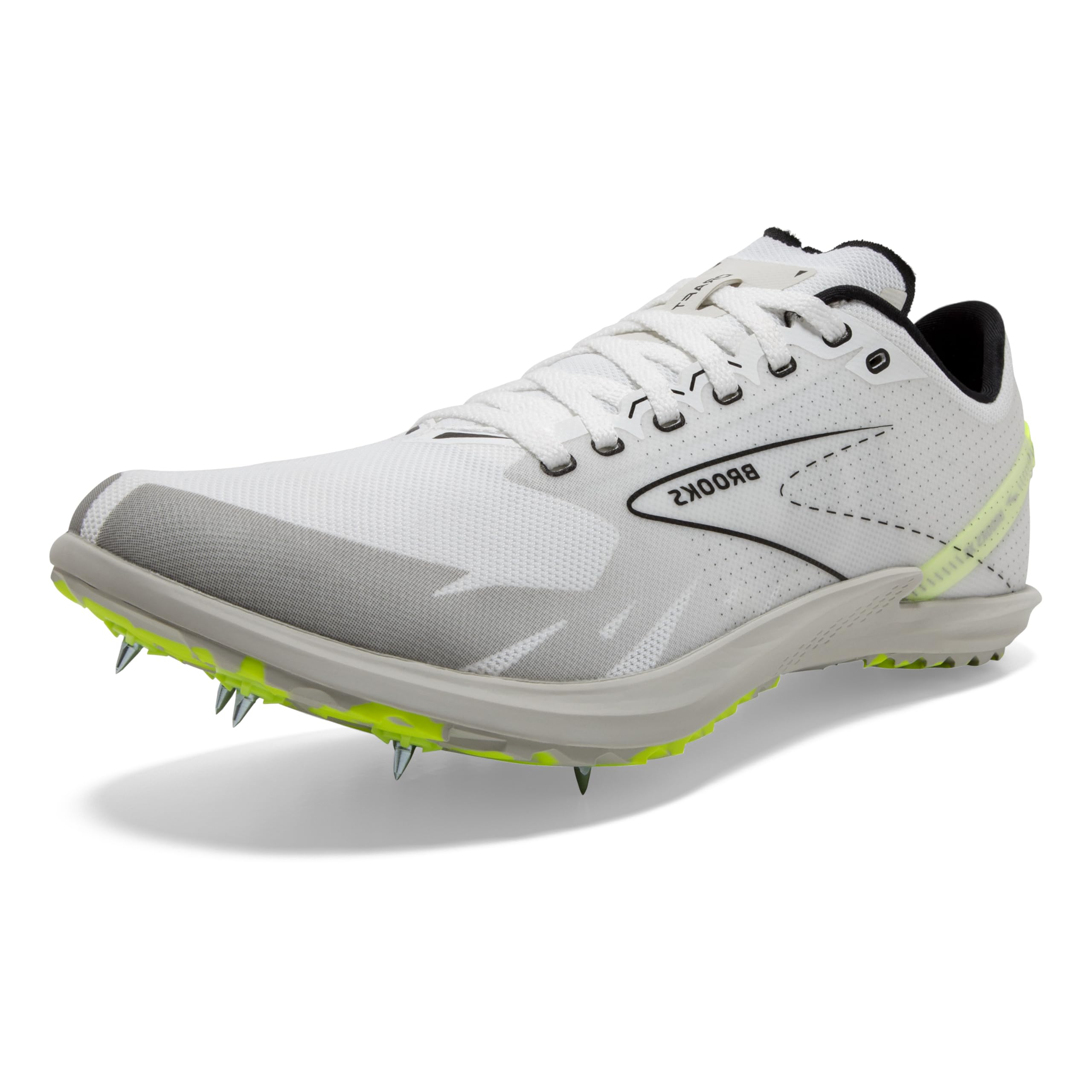
1. Brooks Draft XC Running Shoe
Our pick — 4.5+★ from 200+ verified ratings; the strongest balance of quality and price.
The spikeless flat that keeps its grip from the grass start to the finish chute.
This is the pair to reach for if you want one shoe that handles the whole cross-country season without swapping. The Draft XC is a spikeless flat, which means it uses durable outsole lugs (raised rubber teeth on the bottom) instead of metal pins, so you get traction on uneven ground without pins that come loose on the course. A wide midfoot gives you stable footing when the grass turns to mud and you are pushing off sideways.
Underfoot, Brooks uses its BioMoGo DNA cushioning, which is designed for a responsive feel from the start line to the finishers chute. In plain terms, that means the shoe gives back energy on each stride instead of feeling dead, so long course days do not leave your legs flat. Brooks built this shoe for middle and high school runners competing on varying terrain, and the team angle is real — a customizable heel piece lets you write goal times, draw a mascot, or jot a team cheer right on the heel.
The one fit question buyers keep circling is sizing. The Draft XC runs true to size for many runners but snug at the toe for others, so order your normal running size and check the return window before your first race. On the star score, the Draft XC is the strongest of the three — 4.5+ stars across 200+ ratings — which is why it holds this spot despite the budget pick carrying more reviews.
What wins people over
- Spikeless lugs grip packed dirt, gravel, and grass without metal pins to lose.
- BioMoGo DNA cushioning returns a responsive feel through long course days.
- Wide midfoot adds stable footing on uneven terrain.
- Customizable heel piece lets you add goal times or a team mascot.
What to know before you buy
- Sizing is a coin flip for some buyers — try it before race day.
- Spikeless means no pins for pure soft-mud bite, so it is best on firmer courses.
- Durability is a fair question if you race on hard, abrasive surfaces.
Reach for this if: you want one supportive spikeless flat that handles gravel, grass, and hardpack across a whole season.
Look elsewhere if: your course is pure deep mud and you need metal pins for real bite.
2. Saucony Havok XC3

A women’s-fit spike built for the bite that only pins give you in soft mud.
If your season ends in deep grass and mud, this is the pair that earns its keep. The Havok XC3 is a cross-country spike, meaning its outsole is studded with metal pins that dig into soft ground and hold your push-off when a spikeless flat would slip. The spike profile is what buyers single out as the shoe’s strength — it is the second thing noted as a positive, right behind overall quality.
Saucony lists this in women’s sizing, which matters because cross-country shoes built on a men’s or unisex last can run wide and loose for a narrower foot. The Havok XC3 lands at a lower price than the Brooks Draft XC and is the most budget-friendly of the three, which is a genuine consideration if you are outfitting a whole season or a growing runner. On quality, the overall build is the thing buyers praise first and most often, and comfort ranks just behind it.
Here is the honest catch: sizing is the recurring question. The Havok XC3 fits true to size for many runners, but a real share of buyers find it runs too small, so do not assume your street size will fit straight from the start. Try it on with the socks you race in, and size up if your toe brushes the front on a downhill stride. The Havok XC3 carries a 4.5+ star score across 100+ ratings — slightly behind the Brooks on paper, but at a lower price with a true women’s last.
Where it bites hardest: the metal pins turn soft, wet grass into a surface you can actually push off from, which is exactly the terrain a spikeless flat struggles on.
The bottom line: the Havok XC3 is the pick for race day on soft courses and for runners who want a genuine women’s-fit spike.
Worth knowing: if you race on gravel or hardpack, the pins want a firmer course and careful handling off the grass.
3. New Balance Unisex Adult FuelCell Xc7 V5 Cross Trainer Shoes

The bright, featherweight trainer for the runner who wants color on the start line.
New Balance built the FuelCell XC7 V5 for cross-country athletes who want lightweight performance on any course, and the shoe delivers in the two places buyers look first: quality and comfort. The bright colors are a genuine draw — they show up as a positive aspect in their own right, which is rare for a running shoe where performance usually drowns out looks. If you want your shoe to stand out on the start line, this pair does it.
The FuelCell build is the trainer side of the line — a cross-training shoe rather than a pure race flat, so it suits the runner who trains and races in the same pair. Comfort ranks as the second most-praised thing about it, right behind overall quality, which tells you it holds up across longer efforts and training days rather than just the short sprint of a race. Lightweight design is called out too, so it will not weigh you down through a long course.
Fit is where this one asks you to pay attention. Some runners say the FuelCell XC7 V5 fits perfectly, but others find it runs very narrow — so if you have a wider forefoot, order up or try before you commit. Also note the sizing is unisex rather than a women’s-specific last, which is the biggest difference between this pick and the Havok XC3 above. It sits at 4.0+ stars across 150+ ratings, the lowest of the three, so it is the pick for whoever values color and comfort over the highest score.
The case for it
- FuelCell cross trainer suits both training runs and race day in one pair.
- Comfort is the second most-praised trait after build quality.
- Bright colors make it stand out on the start line.
- Lightweight design keeps the course from feeling long.
The catch
- Runs narrow for some runners — wider feet should size up.
- Unisex sizing, not a women’s-specific last.
- Lowest star score of the three picks.
Pick it for: the runner who wants one bright, lightweight cross trainer that works across training and race day.
Size it up if: you have a wider forefoot, because this one runs narrow for many.
Know the Specs
Spikeless Flat vs Spike
A spikeless flat grips with rubber lugs on the bottom — raised rubber teeth that bite packed dirt, gravel, and dry grass. A cross-country spike uses metal pins that dig into soft mud and wet grass. The spikeless flat is more versatile and can handle warm-up paths; the spike is a race-day tool for soft courses.
Cushioning and Responsiveness
Cushioning is how much give you feel underfoot on each stride. A responsive midsole, like Brooks BioMoGo DNA or New Balance FuelCell, returns energy instead of feeling flat, which saves your legs on longer courses. More cushioning suits long efforts and hardpack; a thin, close-to-ground flat suits short races on soft grass.
Fit and Sizing
Cross-country shoes often run small, and fit feedback on the Draft XC, Havok XC3, and FuelCell XC7 V5 is mixed. Order your true running size, then check the return window. A snug heel stops your foot lifting on a wet hill, and a roomy toe box stops your toes tapping on a downhill stride.
Women’s vs Unisex Sizing
A women’s-specific last is shaped narrower through the heel and midfoot than a unisex shoe. If your foot is narrower, a women’s fit like the Saucony Havok XC3 usually locks down better. A unisex shoe like the New Balance FuelCell XC7 V5 can run narrow for some and roomy for others, so try before you race.
Common Questions
Should I buy spikeless flats or spikes for cross-country?
Do cross-country shoes run true to size for women?
Can I wear spikeless cross-country shoes on the road?
What is the difference between a cross trainer and a spike?
Which of these is best for a narrow foot?
How long do cross-country spikes last?
Are these shoes good for track racing too?
What does the customizable heel on the Brooks Draft XC do?
Can I wear these cross-country shoes for everyday training runs?
Do I need a women’s-specific cross-country shoe?
The Bottom Line
For most runners, the xc running shoes for women winner is the Brooks Draft XC Spikeless because it pairs BioMoGo DNA cushioning with a wide midfoot for stable footing across gravel, grass, and hardpack — and it holds the highest score of the three at 4.5+ stars. If your course ends in mud and you want a genuine women’s-fit spike with real pin bite, grab the Saucony Havok XC3. And for the runner who wants one bright, lightweight cross trainer for both training and race day, the New Balance FuelCell XC7 V5 is the one to reach for.
How we choose
We do not accept paid placement. Every pick is matched to a real buyer and a real use-case; we do not hands-on test units.
Sources
Specifications: manufacturer listings and product documentation. Review insights: verified customer reviews, as of November 2026. Pricing: not shown on this page (it changes often); check the current price via the retailer link.
As an Amazon Associate, Tactical Gear Guy earns from qualifying purchases. This does not affect which products we feature.