Specs are compiled from manufacturer listings and verified buyer reviews and can change over time — please confirm the key details on the product page before buying.
The hardest part of a home gym is not picking exercises — it is picking a machine that stays quiet, stays steady, and stays useful after the novelty wears off. A rack that shakes under a heavy squat, a cable that snags mid-rep, or a weight stack that tops out too soon will quietly ruin your training. This guide sorts through eleven real stations — power cages, cable machines, Smith machines, and one electronic system — and tells you which one fits your space, your strength level, and the way you actually train.
This guide is built by comparing the manufacturers’ published specifications and the patterns across verified customer reviews, so you get each pick’s real strengths and trade-offs instead of marketing spin.
You will see the exact steel thickness, weight-stack size, footprint, and load rating for every option, plus the honest trade-offs owners hit. By the end you will know exactly which of these workout systems for home deserves your floor space.
Top Picks
How To Choose The Best Workout Systems for Home
Start with the room, not the machine. Measure your floor space, measure your ceiling, and measure the distance to the nearest wall before you look at a single cable attachment. Every station here is a large, heavy piece of equipment, and the difference between a great purchase and a frustrating one is usually whether it physically fits and whether it reaches the ceiling without hitting it.
Steel thickness and load rating decide how long it lasts
The frame is the whole machine. Steel wall thickness is listed in millimeters, and thicker walls resist flex when you rack a heavy bar. A rating like 1500 pounds means the frame is built to hold that much static weight — far more than most home lifters will ever rack. Thinner frames at high ratings still work, but they tend to feel livelier under load.
Weight stack versus plate-loaded
A selectorized weight stack is a column of plates built into the machine with a pin you move to change resistance. You never load plates, so switching from a warm-up set to a working set takes a second. Plate-loaded racks use separate weight plates you hang on the bar or cables. Plate-loaded is cheaper and grows as high as your plates go. A stack is faster but tops out at the number printed on it.
Footprint and ceiling clearance
A power cage typically needs a rectangle of floor roughly the size of a small car, and it stands close to seven feet tall. An all-in-one cable station tends to be deeper front-to-back but narrower side-to-side. Check the height spec against your actual ceiling with a tape measure. A machine that fits the floor but not the ceiling is a return shipment waiting to happen.
Pulley quality: the part you feel every rep
Cables and pulleys are where the machine either feels smooth or feels cheap. Bearing pulleys and electroplated telescopic poles glide. Sliding sleeves on rollers work too, as long as they stay aligned. A rough pulley is the single most common source of irritation after assembly, so it is worth reading how owners describe the cable travel before you commit.
Side-by-Side Comparison
| Model | Best For | Max Load Rating | Footprint (D x W x H) | Unit Weight | Amazon |
|---|---|---|---|---|---|
| Mikolo K6 Power Cage★ Best Overall | Full in-cage training in one frame | 1500 lbs | 67.5″D x 56.5″W x 86.4″H | 220 lbs | Amazon |
| SPORTSROYALS Power Rack RK2Best Value | Budget-friendly rack with cables | 1200 lbs | 59.6″D x 59.6″W x 82.6″H | 150 lbs | Amazon |
| SPORTSROYALS Weight Stack StationTop Performer | Fast weight changes with a 150lb stack | 265 lbs | 75″D x 51″W x 81″H | 314 lbs | Amazon |
| Mikolo Home Gym Pro Station | 90+ exercises in a narrow column | 300 lbs | 75″D x 36.3″W x 80″H | 300 lbs | Amazon |
| SunHome Smith Machine SH-999 | Solo lifters training without a spotter | 2000 lbs | 72″D x 60″W x 90″H | 440 lbs | Amazon |
| MAJOR FITNESS Drone3 | Light footprint, 2500lb frame | 2500 lbs | 69.5″W x 45.9″D x 85″H | 232.2 lbs | Amazon |
| Marcy MWM-989 Home Gym | Compact cable station for tight rooms | 300 lbs | 68″D x 42″W x 78″H | — | Amazon |
| MAJOR FITNESS F22 | Two lifters on independent cables | 1600 lbs | 68.9″D x 55.5″W x 82.5″H | 243 lbs | Amazon |
| SunHome Dual-Station 925 | Couples training side by side | 2000 lbs | 96.85″D x 55.12″W x 86.61″H | — | Amazon |
| Marcy SM-4033 Smith Cage | Full cage, bench, and power tower combo | 300 lbs | 67.8″D x 83.5″W x 86.2″H | — | Amazon |
| Speediance Gym Monster 2 | Digital resistance that folds away | 220 lbs digital resistance | 27.16″D x 48.03″W x 72.83″H | — | Amazon |
Detailed Reviews
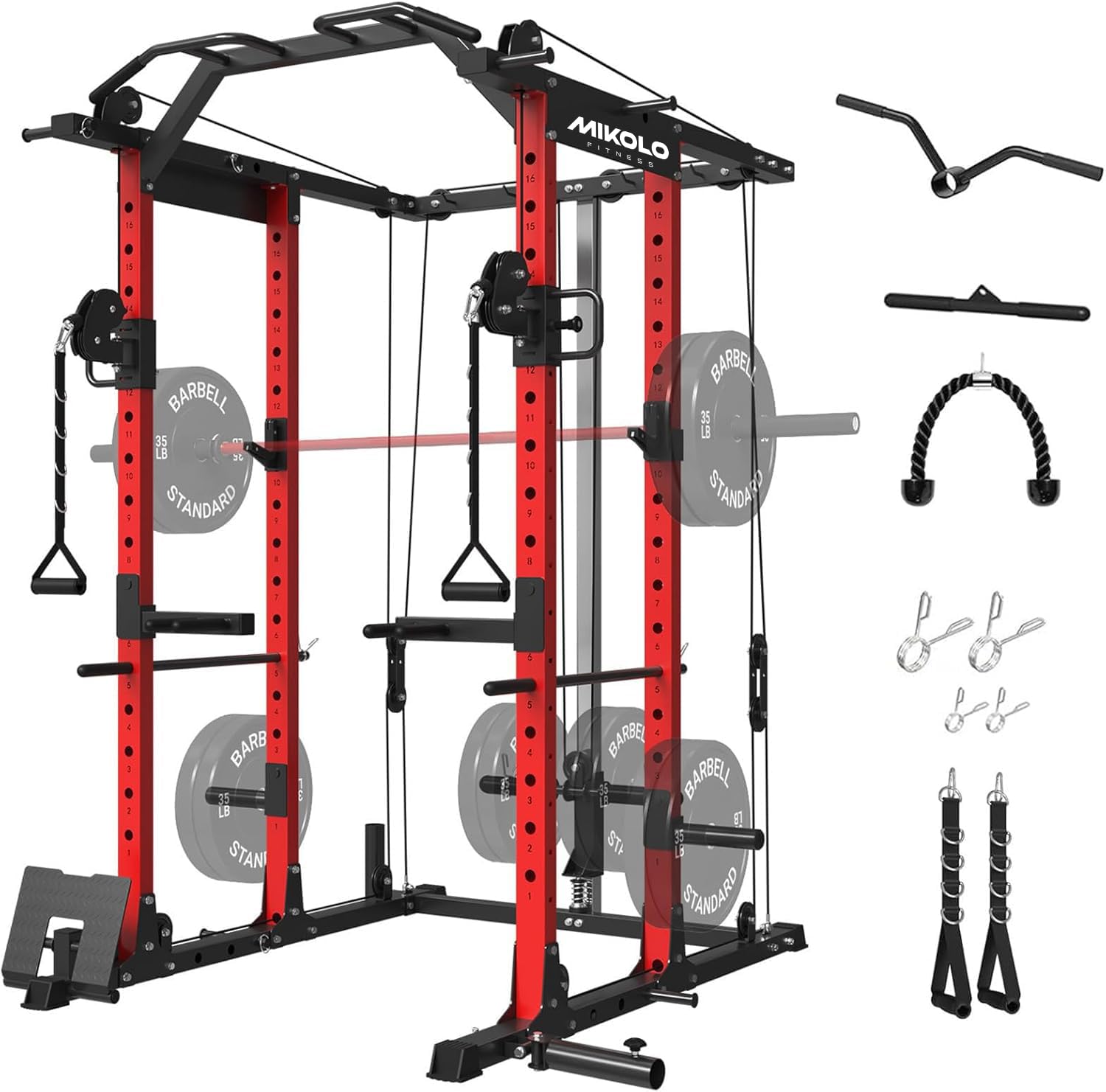
1. Mikolo Power Cage K6 with Cable Crossover
Our pick — 4.5+★ from 200+ verified ratings; the strongest balance of quality and price.
Eight stations, one frame, and a 1500-pound rating — the cage that replaces a whole gym floor.
The number to start with is 1500 pounds — the static load this steel frame is rated to hold. For context, the SPORTSROYALS Power Rack sits at 1200 pounds, and the SPORTSROYALS weight-stack station is rated at 265 pounds. That gap matters if you plan to rack heavy squats and bench presses inside the cage, because the frame is the thing that has to stay still while you push.
The true-cage shape is the reason this one leads. The cage interior measures 41 inches by 60 inches, which is deep enough for almost any weight bench, so you can squat and bench inside the frame rather than beside it. In-frame lifting gives a beginner a safety net that free weights alone do not. The unit weighs 220 pounds and carries eight reinforcing tabs, so it plants itself rather than walking across the floor.
You get the accessories most racks charge extra for: a T-bar, lat pulldown bar, tricep rope, cable bar, two cable handles, two weight storage pins, two J-hooks, two dip bars, a detachable landmine, a footboard, and spring clamps for the bar and safety arms. The pulley sleeves run on four white rollers along the riser, which protects the upright from wear. Owners talk most about the build quality and how straightforward the assembly instructions are — this machine goes together without a fight. A handful of buyers report the moving parts can feel tight at first, so expect a little break-in on the cable.
Where it earns the top spot
- 1500-pound static rating on an alloy steel frame — the highest of the cage-style picks here
- 41″ x 60″ interior clears virtually any bench for in-cage squats and presses
- Full attachment bundle included, so no surprise add-on purchases
- Four-roller pulley sleeves protect the riser and keep cable travel clean
What to weigh before you order
- At 86.4″H it needs real ceiling clearance — measure before you buy
- The 220-pound frame is a permanent install, not something you move for guests
- Cable travel can feel firm from the start until the rollers settle in
Buy this if: you want a single cage that handles squats, presses, pulldowns, rows, dips, and core work without buying five separate machines.
Think twice if: your ceiling is under 87 inches or you need a station you can fold up and store.
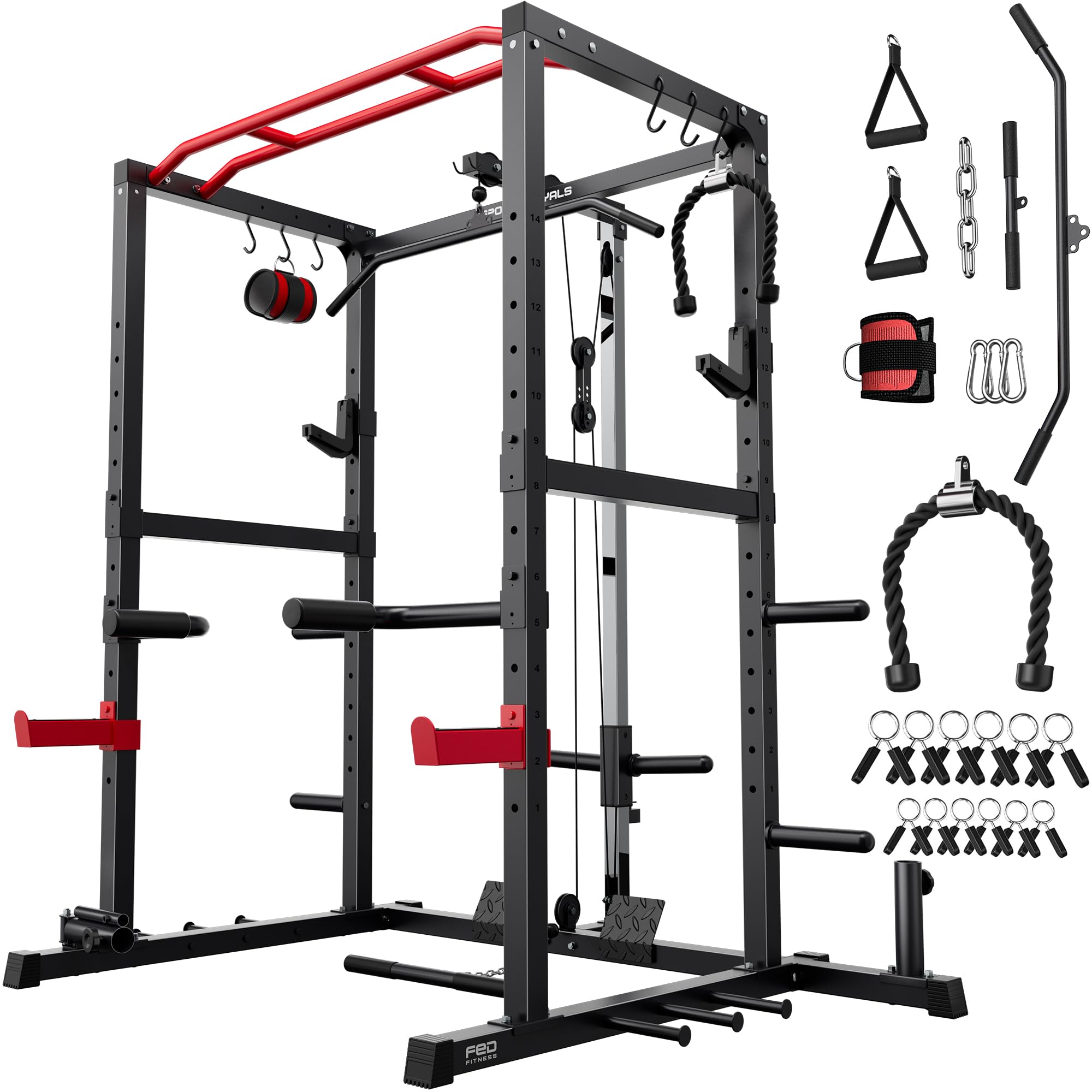
2. SPORTSROYALS Power Rack RK2 with Pulley System
The value pick that undercuts the field without dropping the cable setup.
The frame is 50 x 50mm steel square tubing at 1.5mm thick, rated to 1200 pounds and weighing 150 pounds — that makes it 70 pounds lighter than the Mikolo cage at 220 pounds, so it moves more easily but also feels less planted. Two reinforcing tabs add rigidity, and the 14 adjustable height levels give you plenty of positions for squats, rack pulls, and presses.
Buyers respond most to the value — this pick gets you a rack, cable pulleys, and a genuine attachment set without the mid-range spend. The included bundle is generous: rowing bar, four weight plate storage points, six band pegs, safety arms, a lat pulldown bar, safety bars, J-hooks, dip stands, tricep rope, ankle strap, six barbell clamps, two cable handles, a wide and narrow pull-up frame, a 360-degree landmine, and a foot board. The weight plate storage fits both 2-inch Olympic and 1-inch standard plates.
Here is the honest part. The cables run on precision bearing pulleys with electroplated telescopic poles and a PU-coated steel cable rated to hold 500 pounds, and the cable travel is smooth in daily use. The recurring trade-off is steadiness: the rack can wiggle slightly once it is in place, and a lighter 150-pound frame is less anchored than a 220-pound one. Rubber pads on the safety bar and safety arm do cushion the catch. Also note it ships in two separate boxes that may arrive on different days.
Who it fits: a first home gym where budget matters and the lift loads stay moderate — you get the rack, the pulleys, and the accessories in one purchase.
Worth grabbing if: you are building a starter garage gym and want cables without paying mid-range money.
Look past it if: you plan to push very heavy squats and want zero movement from the frame.
3. SPORTSROYALS Home Gym Station with 150LBS Weight Stack
A selectorized stack that changes weights with a pin — no plate loading, no plate buying.
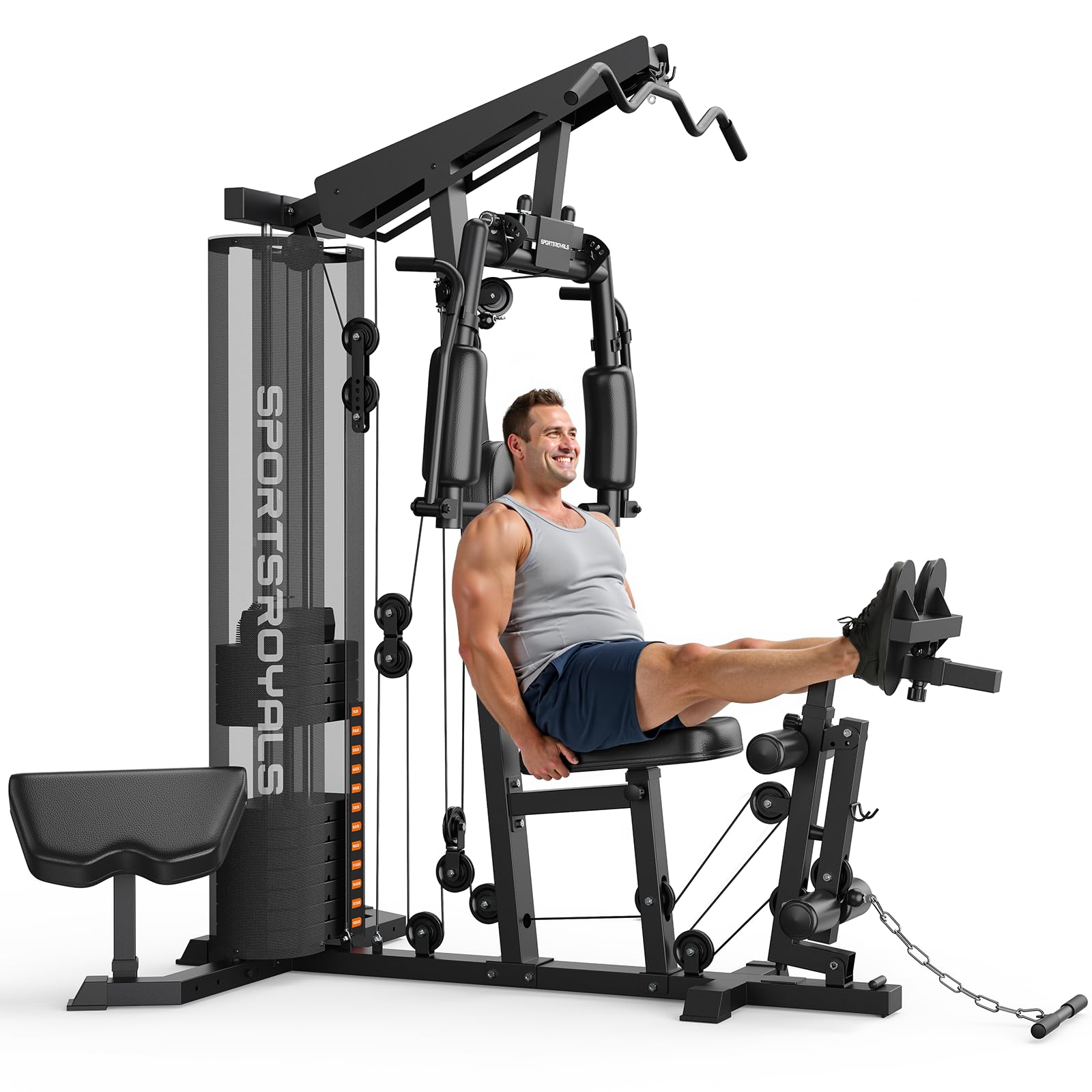
This machine is the answer to a very specific frustration: loading and unloading weight plates between every set. The 150-pound selectorized stack moves in 11+1 levels with a pin, so moving from a light warm-up to a working set takes a second. The steel-shaft pulleys and high-strength cables glide, and the maker describes it as quiet enough for early mornings. That stack tops out at 150 pounds, which is generous for cable rows, pulldowns, curls, and flyes but not a substitute for a barbell on heavy leg work.
The build is 70 x 50mm heavy-duty steel tubing with 2mm thick walls on a wide H-base, and it weighs 314 pounds — exactly the kind of mass that keeps a machine from shifting during a heavy leg press. The non-slip foot pads absorb impact and protect the floor. Six stations plus dedicated chest fly and leg press add up to 35+ exercises, including lat pulldown, shoulder press, preacher curl, and calf training.
Where the design shines is fit. Five-position butterfly arms, a four-position seat cushion, and a height and front-to-back adjustable leg press footplate let you tailor the machine — the maker sizes it for users from 5’2″ to 6’3″. The leg extension and preacher curl pads store away when not in use, which is how a 75″D x 51″W footprint stays workable in a garage or apartment. The honest catch: it ships in four boxes that may not all land at once, and there is a lot of hardware to sort through during assembly. It also weighs 314 pounds, so choose its spot carefully the first time.
Editor’s read: for anyone who wants to walk to a machine, move a pin, and start the set, this delivers a better daily workout flow than any plate-loaded rack at the same tier.
The right call if: you want the convenience of a cable stack in a footprint that still leaves room in a garage.
Not the right call if: your program revolves around heavy barbell squatting and deadlifting.
4. Mikolo Home Gym Pro Station with 152LBS Weight Stack
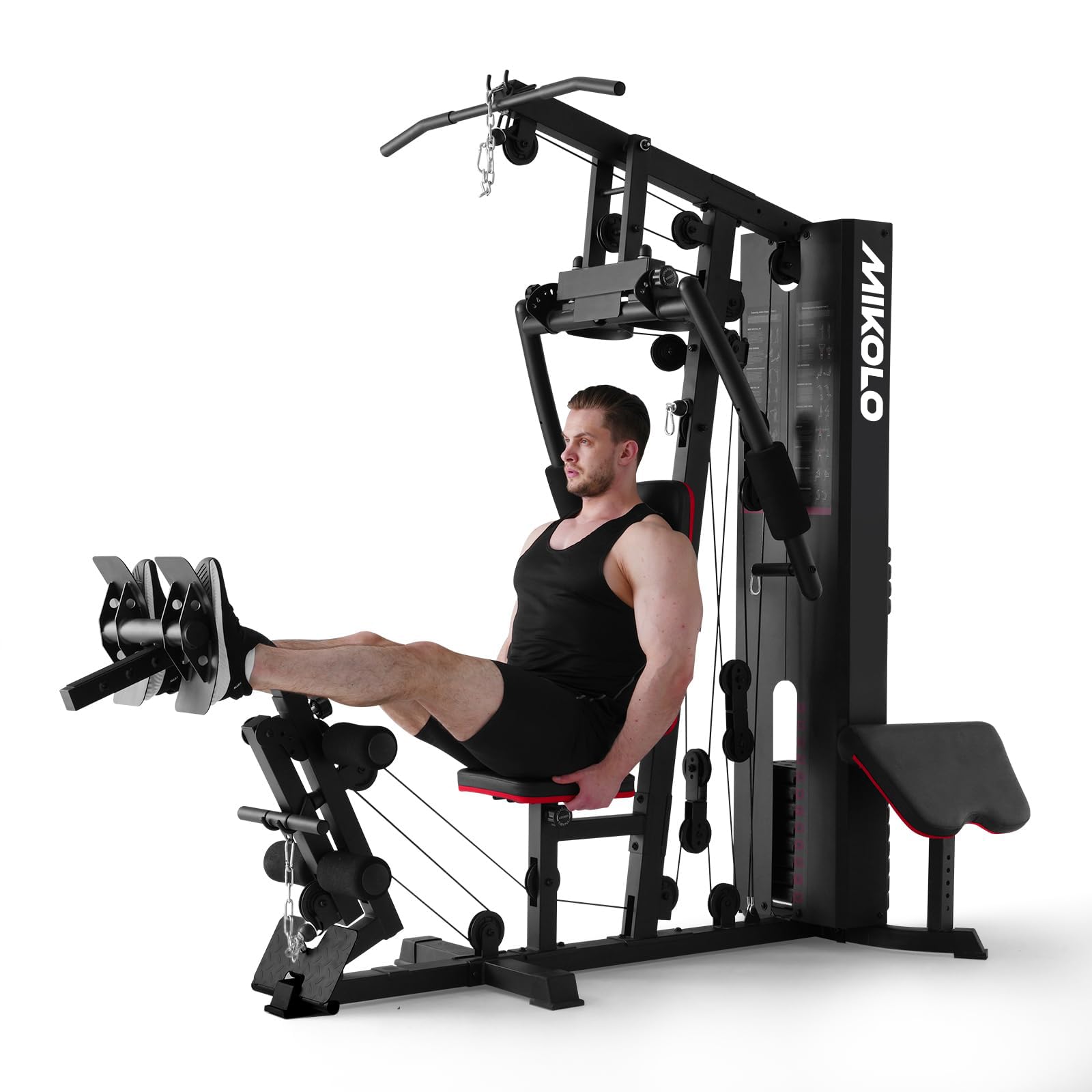
Thirty-six inches wide and eighty inches tall — a full cable gym for a narrow wall.
Width is the spec that sells this one. At 36.3 inches across, it is the narrowest machine in this entire roundup, and it still runs 75 inches deep and 80 inches tall. Compare that to the SunHome Smith Machine at 60 inches wide, and the difference is roughly two feet of wall space you get to keep. For a spare bedroom, a narrow basement strip, or a garage with a car parked beside you, that is the difference between fitting and not fitting.
The 152-pound weight stack is one pound heavier than the SPORTSROYALS stack, and it is built for drop sets and supersets — the point being you never interrupt a set to go find plates. The frame is 14-gauge steel with the counterweight block shielded by a steel sheet. Stations include pec fly, lat pulldown, low row, chest press, leg extension, leg press, preacher curl, core trainer, calf work, and seated and mid rows, and the maker counts over 90 exercises across all of them.
Owners single out the build quality first and second-most, and the consensus fits: a solid machine with an unusually small footprint for what it does. The preach pad and leg press accessories swap out readily, and the professional bearing in the cable bar is designed to take pressure off your wrist. The part to plan around is assembly — some buyers found it easy and others did not, so budget an evening and a helper. Adjustability is the other point of friction worth knowing about before you buy.
Why it stands out here
- 36.3″ width — the tightest side-to-side profile of every machine on this list
- 152-pound stack with pin-select adjustment for fast supersets
- Over 90 exercises with pec fly, leg press, and preacher curl built in
- 14-gauge steel with a shielded counterweight block
Set your expectations around
- Assembly experience splits — plan for a real afternoon with two people
- Positioning adjustments are the area owners find least forgiving
- 75″ depth still requires a genuine wall run, not a corner slot
Reach for this if: wall width is your bottleneck and you refuse to give up a real cable station.
Skip past it if: you want zero-fuss setup — this one rewards patience on assembly day.
5. SunHome Smith Machine SH-999 with Cable Crossover

Fail a heavy bench alone and the bar locks where it sits — that is the whole pitch.
The auto-lock safety hooks are the feature that separates a Smith machine from a free-weight rack, and they exist for one buyer: the person training alone in a garage. The bar locks at any angle, so if a rep stalls you are not trapped under a bar waiting for someone who is not there. The frame runs a 2000-pound static rating on 2mm thickened commercial steel square tubing and weighs 440 pounds, so it does not need to be bolted down to feel anchored.
The second piece worth the money is the butterly chest attachment, which mimics a cable crossover and lets you superset Smith squats with flyes. The pulley system uses a rolling bearing design rather than a sliding one, which the maker says reduces noise and cuts wear on the components. A rowing cable is included, so seated rows are on the menu for back and arm work. Storage is handled too: six weight plate posts, one barbell storage post, and hooks for the included accessories.
What wins people over is value — this is among the most cost-effective ways to get Smith, cable, and butterfly stations in one footprint. The thing to know before you buy is the rerack. Because the bar is fixed to the frame, moving it back into position can feel harder than on a free rack, and that is the most consistent note across owners. If you train alone, that trade is usually worth it.
The real-world trade: you give up the natural arc of a free barbell, and in exchange you never need a spotter. For a solo garage lifter, that is a fair deal at any tier.
Pick it up if: you train solo and want the safety net a Smith bar provides on heavy presses.
Leave it if: you compete in powerlifting and need an unconstrained bar path.
6. MAJOR FITNESS Drone3 Power Rack 2500lbs
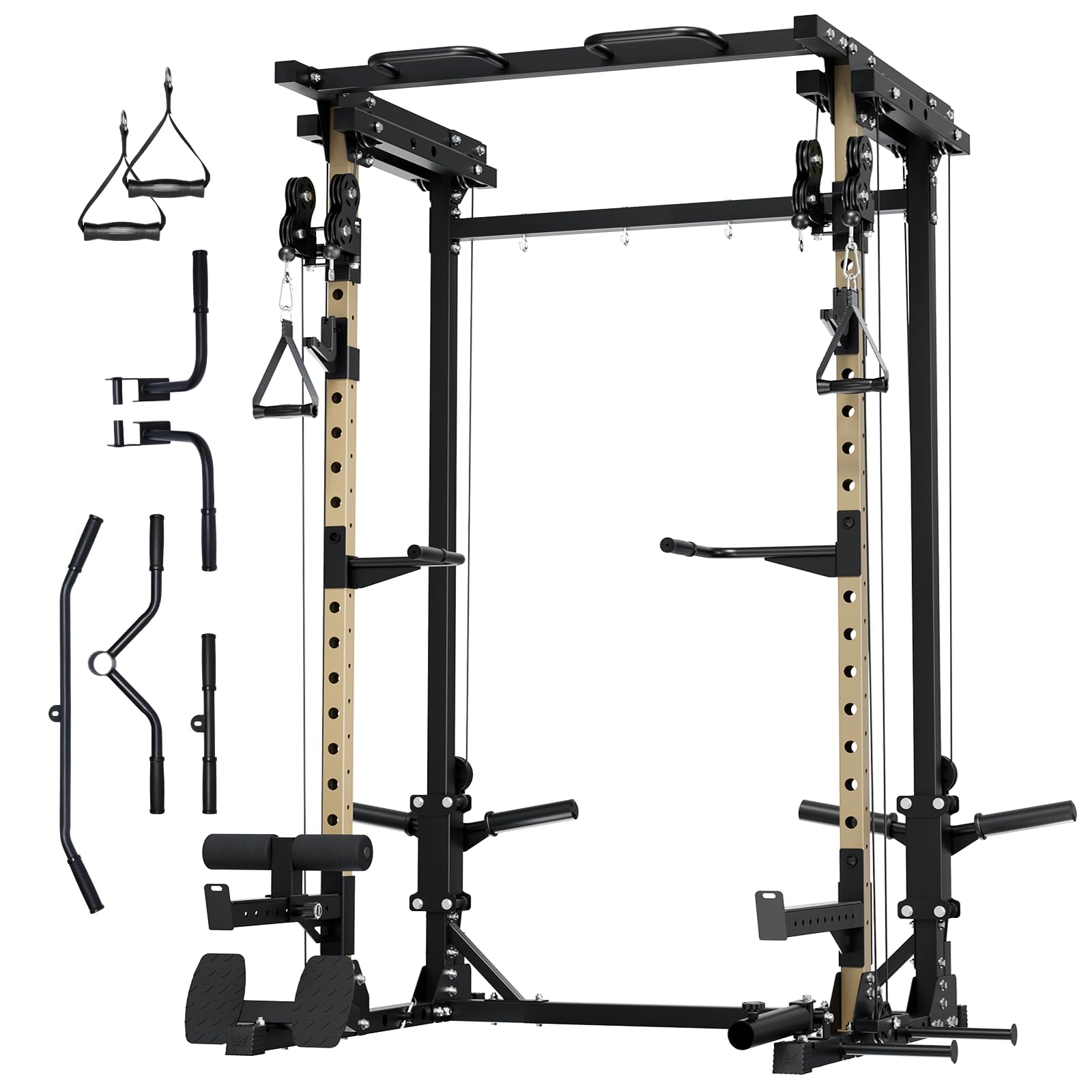
A 2500-pound rating in a frame that takes up less floor than the cage it competes with.
Twenty-five hundred pounds. That is the highest static rating on this entire list, delivered from 2×2-inch commercial-grade steel, and it beats the Mikolo K6’s 1500-pound figure outright. The footprint is where it gets interesting: 69.5 inches wide by 45.9 inches deep by 85 inches tall. All that load capacity sits in a frame with less depth than any of the power cages here, which makes it the pick for a lifter who wants heavy capacity without eating half the room.
The dual-pulley system is the other differentiator. You can run a 2:1 ratio for smooth, high-rep endurance work, or switch to a 1:1 ratio for heavy lifts. That flexibility means one rack covers both a light pump session and a genuinely heavy pull. A linear bearing system keeps the bar traveling with close to no friction, a professional spring system adds safety on the catches, and 19 height settings let you dial in the rack height precisely. A high pull-up bar, T-bar, and chest pull-up bar come with it.
At 232.2 pounds it is lighter than the SunHome Smith Machine’s 440 pounds and still feels substantial once assembled. Owners describe it as well-made and easy to assemble, with quiet operation being a recurring note — a real consideration if you train early while the house is asleep. There is a one-year warranty on components. The honest limit: less weight in the frame means it is a rack you build carefully and place deliberately, not one you drag around.
Strongest spec here: the 2500-pound rating against a 45.9-inch depth is the best capacity-per-floor-space figure in this whole comparison.
Go for it if: you want maximum load rating in a smaller floor footprint and plan to use both cable ratios.
Pass if: you need the heavier 440-pound mass of a commercial Smith machine under you.
7. Marcy Home Gym Station MWM-989 with 150 lb Stack
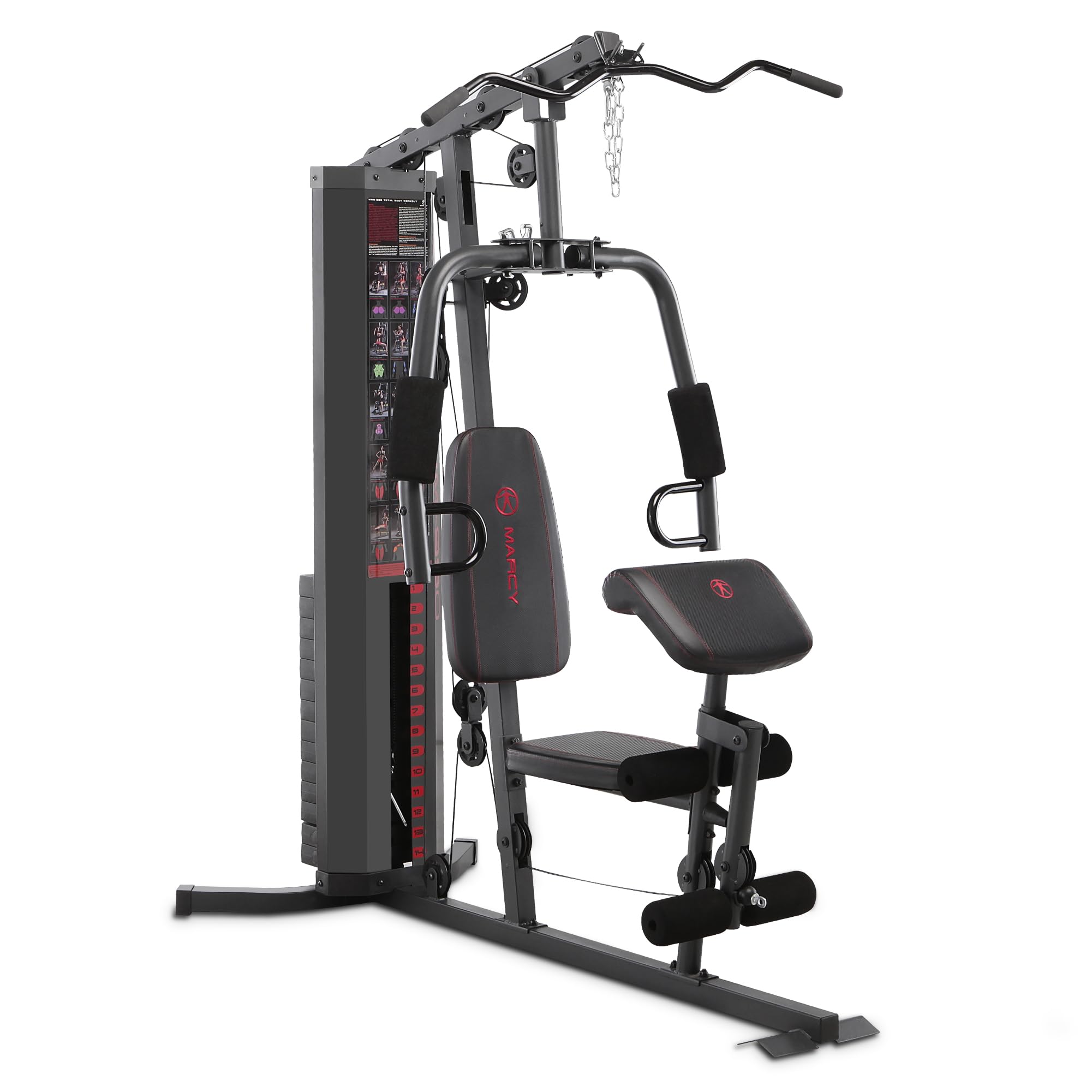
A 42-inch-wide cable station with a weight-stack lock — the tightest full stack here.
Of every weight-stack machine in this guide, this one takes the least wall space at 42 inches wide, 68 inches deep, and 78 inches tall. That 78-inch height is the shortest of the stack stations too, which matters if your basement ceiling is the limiting factor. It is built from heavy-duty steel tubing reinforced with guard rods that hold weight in place mid-set, and it carries a 300-pound maximum weight recommendation.
The 150-pound selectorized stack is pin-adjustable, so you skip the loading and unloading routine entirely. There is also a stack lock that prevents unauthorized use, which is a small but genuinely useful feature in a house with kids. Dual action press arms handle chest press and vertical butterfly work, and you switch between them with a remove/insertion pin rather than a full re-rig. The preacher curl pad is removable and adjustable for isolated bicep work.
Owners describe a steady steel frame with the versatility to handle a variety of exercises, and the consensus is that it is well worth what you pay for it. High-density boxed upholstery on the ergonomically shaped seats is designed to cut pressure and impact across long sessions. The catch to plan for is assembly — the instructions can be thin in spots, so take your time and do not rush the hardware sort. A few long-term owners also note wear over time, which is normal on a cable machine that gets daily use.
Why it earns a slot
- 42″ width and 78″ height — the smallest full-stack profile in this roundup
- 150-pound stack with a safety lock that stops unauthorized use
- Dual action press arms swap between chest press and butterfly with one pin
- Removable, adjustable preacher curl pad for isolated arm work
Things to plan for
- Instructions can be sparse — set aside a full session for assembly
- Long-term cable and frame wear shows up over years of hard use
- 300-pound rating keeps this to cable-focused work, not barbell maxing
The smart pick for: a low-ceiling room where a seven-foot-tall cage simply will not clear.
The wrong pick for: anyone who wants to rack a barbell for heavy squats.
8. MAJOR FITNESS F22 Power Rack 1600lbs
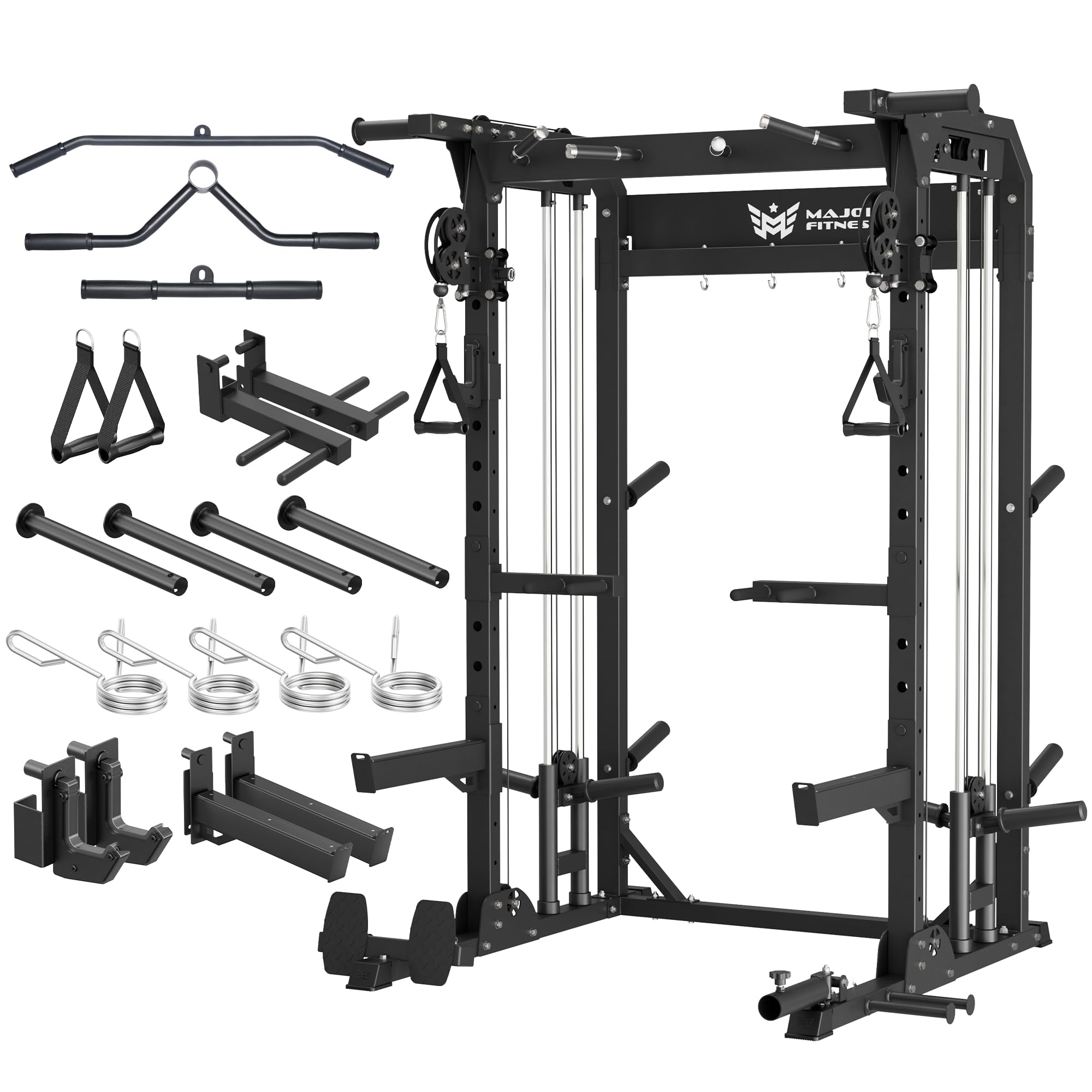
Two people, two cables, one frame — and no interference between the sides.
The dual-triangle base is the quiet hero here. By increasing the contact area with your floor, MAJOR FITNESS says the wider floor contact eliminates the sway lighter racks develop, with no floor bolting needed for standard stability. That is the correct answer for a rented apartment or a garage where you are not drilling holes. The frame itself is 2-inch by 3-inch commercial-grade 14-gauge steel at 0.08 inches thick, rated to 1600 pounds static, and it weighs 243 pounds.
The independent dual-pulley system runs a 2:1 ratio for smoother cable travel and tighter resistance control. The practical benefit is that two people can train at once with no cable crossover between them — partner workouts and fast superset transitions become possible in a single footprint. It replaces three separate machines (weight cage, squat rack, dual-cable crossover) with one 68.9″D x 55.5″W frame.
Owners are unusually enthusiastic — plenty of them call it the best piece of equipment they have owned, pointing at the smooth pulley operation and the straightforward build. The attachment set is complete: J-hooks, safety arms, foot pedals, landmine, T-bar, dip bars, lat pulldown, cable bars, and band pegs, with integrated hooks to keep them out of the way. What you should know: some units arrive with bent components, and the warranty runs one year. Check the boxes at delivery before you sign.
Who it fits: a couple or two training partners sharing one room and one budget — the independent pulleys make simultaneous sessions genuinely practical.
Best for: households where two people train and you refuse to bolt anything into the floor.
Check first: inspect the delivery immediately — some units show up with bent parts, and one-year coverage means you want to file early.
9. SunHome Multifunction Home Gym 925 with 138LB Stack
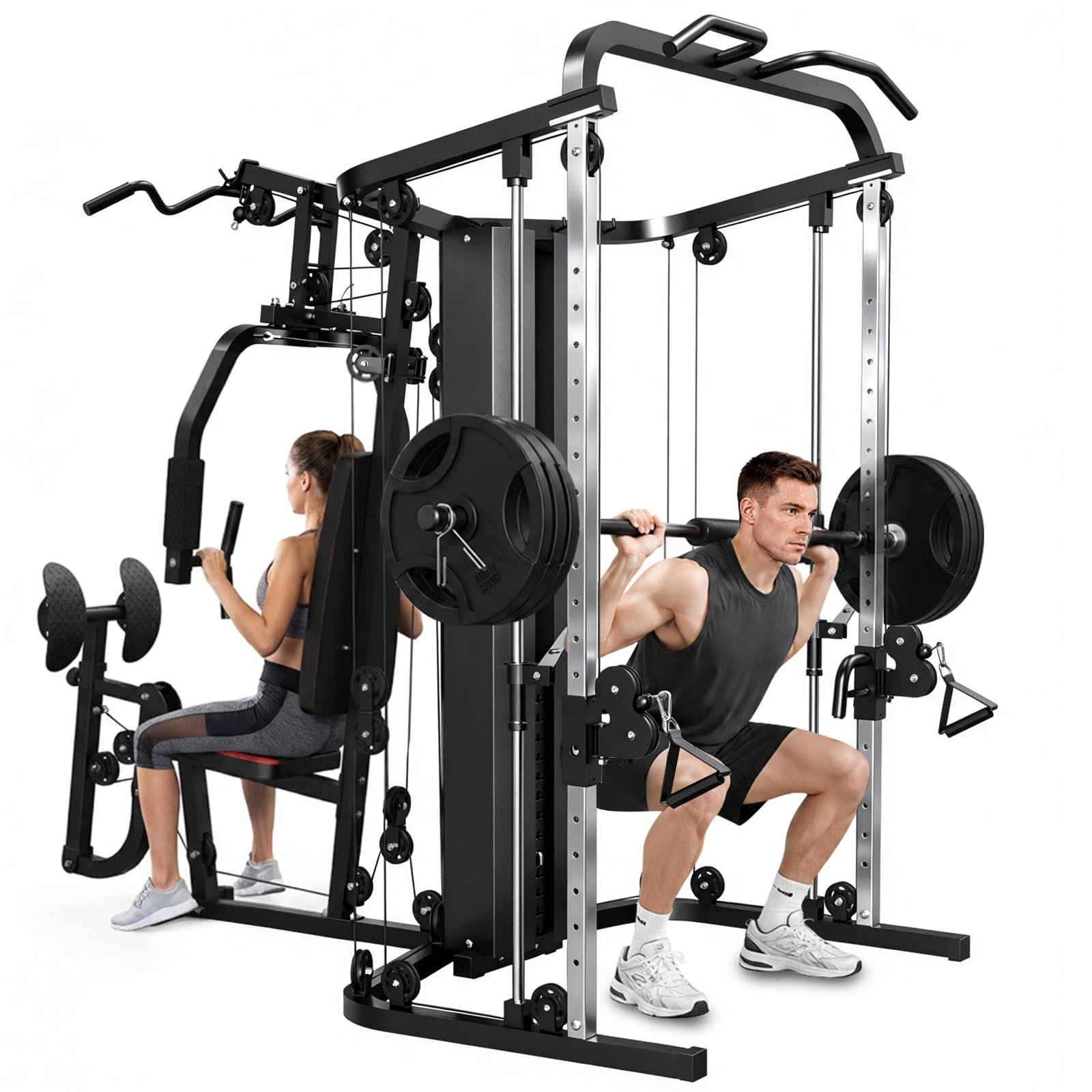
One machine, two people, and a separate stack for each — the shared-gym answer.
Most dual stations technically let two people train, then force them to share one weight selection. This one gives each side its own independent 138-pound selectorized stack, so two partners at different strength levels can adjust separately and keep training. One person can run Smith machine squats while the other does cable crossovers on the opposite side, each on a separate 138-pound stack.
The frame is rated to 2000 pounds in 2-inch by 2-inch commercial-grade steel. The overall footprint is 96.85 inches deep by 55.12 inches wide by 86.61 inches tall, which is the deepest machine in this entire guide — nearly eight feet front to back. It replaces what would otherwise be multiple separate machines, which is how it earns the floor space in a serious garage setup.
Assembly is the strongest point in owner feedback, alongside value and how well the stations function. The maker claims over 100 synchronized exercise combinations, from upper-lower splits to paired muscle groupings. The honest limit worth checking: the pulley system is the most inconsistent area, with some owners describing noticeable slack in the cable. Before you commit, plan your room depth — at over eight feet, this will not fit in a shallow spare bedroom.
Straight talk: the independent dual stacks are the real product here. Everything else is a well-built frame around that one very good idea.
Choose it when: two people with different strength levels will share the same machine daily.
Reconsider if: your room is under eight feet deep, or you want a perfectly taut cable feel on day one.
10. Marcy Smith Machine Cage SM-4033 with Bench

A power tower, a utility bench, and a squat rack in one cage — bench included.
The inclusion of an adjustable weight bench is what makes this the most complete single purchase on the list. You get the Smith machine cage, the bench, and the power tower together, so you are not shopping for a separate bench after the fact. The numbers to know: a 300-pound max user weight, a 300-pound max capacity on the Smith machine bar, a 300-pound max on the safety catches, and a generous 600 pounds on the bench counting both weights and user weight.
There is also a dedicated landmine exercise attachment, which adds rotational and pressing work that a bare Smith machine cannot do. Multi-grip pull-up bars cover pull-ups, chin-ups, and hanging leg raises, and the bar doubles as an anchor point for resistance bands. A durable pulley system enables crossover work, and a rowing cable is included for seated rows targeting the back, forearm, and upper-arm muscles.
Owners are happiest with the construction and the money-to-machine ratio, and the included accessories get called out specifically — dip, pull-up, and T-bar-row attachments being the highlights. The catch is space and setup: the item is 67.8 inches deep by 83.5 inches wide, so at 83.5 inches across it is the widest thing in this guide and needs roughly nine feet of clearance around it. Full assembly is required, and the build time runs long. If you have the floor and the patience, the value is hard to argue with.
What you actually get
- Smith cage, adjustable bench, and power tower in a single purchase
- 600-pound bench capacity counting weights and user weight together
- Dedicated landmine attachment for rotational pressing work
- Multi-grip pull-up bar doubles as a resistance band anchor
What it asks in return
- 83.5″ width makes it the widest frame here — it needs real open floor
- Full assembly required, and it takes a while to finish
- The Smith bar and catches are rated at 300 lbs, so plan accordingly
Worth it for: a dedicated room where you will not need to move the machine and you want everything in one order.
Not for: tight corners — at 83.5 inches wide with a 9-foot clearance recommendation, it wants the whole bay.
11. Speediance Gym Monster 2 Smart Home Gym
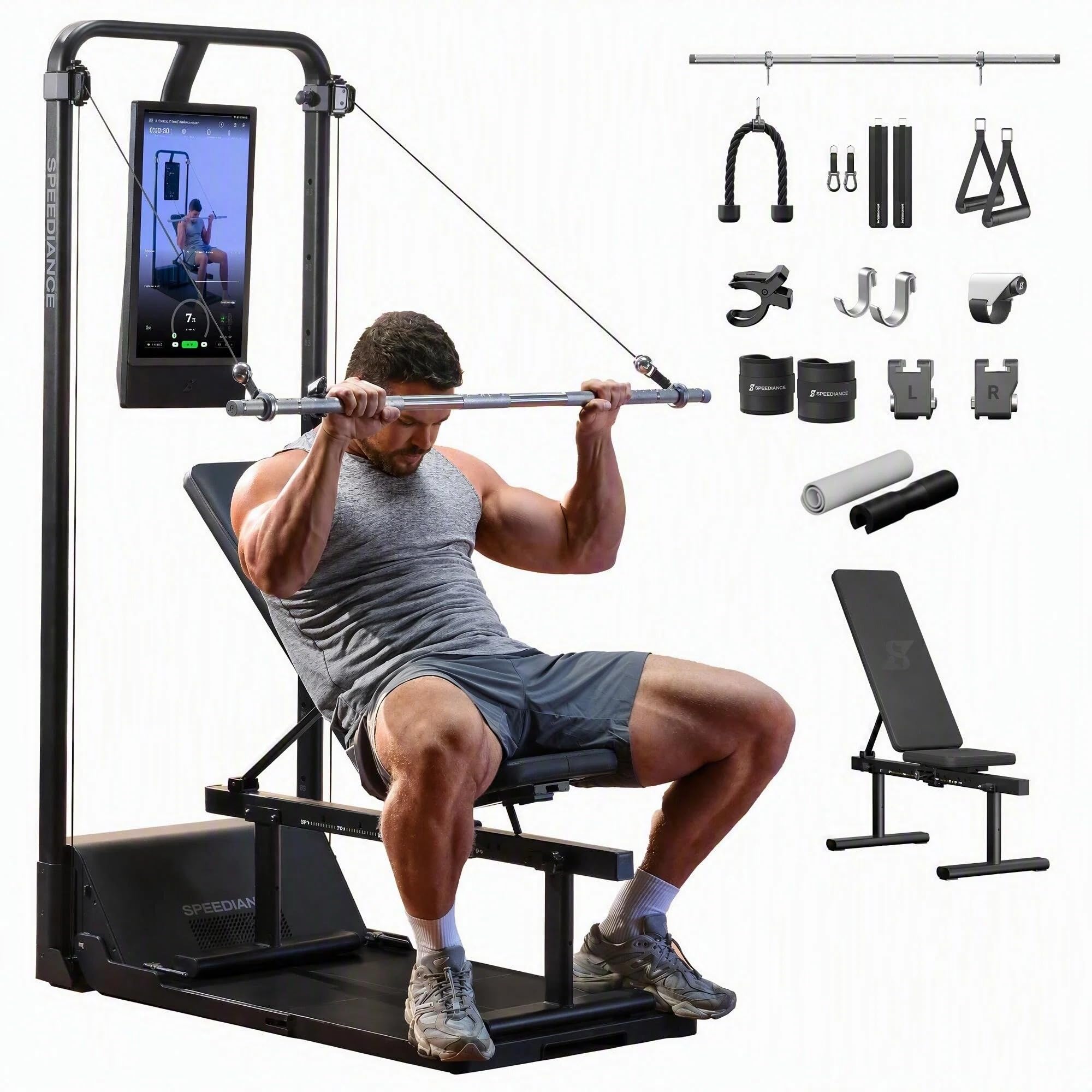
No plates, no stacks — just dialed-in resistance that folds into a quarter of a square meter.
Every other machine here moves physical weight. This one moves electricity. Dual 800W PMSM motors deliver up to 220 pounds of digital resistance, which you adjust by number rather than by loading plates or pulling a pin. Resistance is motor-controlled, so progressive overload means dialing the number up rather than loading a plate. The AI training system tracks performance in real time and recommends weight adjustments after each set — coaching no steel frame here provides.
The space story is why it earns a slot despite being the smallest machine here. It folds down to 0.25 square meters (about 2.69 square feet), which is genuinely apartment-friendly, and at 48.03 inches wide and 72.83 inches tall it clears most ceilings the cages cannot. One frame stands in for a power cage, Smith machine, squat rack, bench rack, cable machine, and pulley system.
Owners call it an amazing piece of equipment that exceeds expectations, and the workout library is the star — a lot of exercise variants and default programs make sessions efficient and easy to follow. What you are giving up is the analog feel: there is no steel bar to rack and no plate to clang. The included Works Plus bundle softens that by adding an adjustable barbell, bench, barbell hooks, handles, Bluetooth ring, ankle straps, and a yoga mat. Coverage runs two years on the main unit and one year on accessories. The honest question: do you want a digital trainer that needs software updates, or steel you can hand down for twenty years?
Your call to make: buy this for flexibility, coaching, and a footprint that vanishes between sessions — not for the tactile feel of iron.
Reach for this if: you live in a small space, travel between homes, or want guided coaching from the machine itself.
Stay with steel if: you want bars, plates, and a station that never needs a software update to keep working.
Know the Specs
Maximum Weight Recommendation
This is the static load the frame is engineered to hold — printed in pounds on the spec sheet. A reading like 1500 pounds means the steel is built to sit still under that much weight, which is far beyond what most home lifters will rack. Read it as a build-quality signal. Frames rated 1200 pounds and up generally feel planted; frames rated around 300 pounds are cable stations meant for pulley work, not barbell squatting.
Weight Stack Size
A selectorized weight stack is a built-in column of plates with a pin you move to change resistance. The number, such as 150 pounds or 152 pounds, is the ceiling on that machine’s cable resistance. It is fast — no plate loading between sets — but it does not grow. If your cable work will outgrow the stack, a plate-loaded rack lets you add weight indefinitely.
Footprint in D x W x H
These three numbers decide whether the machine physically fits. Depth (front to back) is the one buyers forget. Some stations run nearly eight feet deep, which rules out a shallow spare bedroom. Height is the second trap — cages climb toward seven feet, so measure the ceiling before you buy, not after.
Steel Gauge and Pulley Type
Steel wall thickness is listed in millimeters, and thicker walls resist flex. Pulley design decides how the cable feels on every rep. Bearing pulleys and rolling-bearing designs glide smoothly; sliding sleeves work fine when they stay aligned. A rough or slack cable isthe one thing you will notice most in daily use, so check how the cable is described before you commit.
Common Questions
Will a power cage fit in a standard garage with an eight-foot ceiling?
Is a Smith machine better than a free-weight power cage for training alone?
How long does it take to assemble one of these machines?
What is the difference between a 2:1 and a 1:1 pulley ratio?
Do I need to bolt a power rack to the floor?
Is a weight stack or plate-loaded rack better for a small home gym?
Can two people use one home gym station at the same time?
How much floor depth do these machines actually need?
Does digital resistance like the Gym Monster 2 feel the same as real weights?
What ceiling height should I have before buying a tall cage?
The Bottom Line
For most people building a home gym, the winner is the Mikolo Power Cage K6 because it delivers a 1500-pound rated frame, a full in-cage working space of 41 x 60 inches, and eight stations of attachments in one purchase. It is the machine that replaces the most separate equipment while keeping you safe inside the frame. If you want the convenience of a weight stack instead of loading plates, the SPORTSROYALS Home Gym Station is the stronger fit. And for two people training side by side with separate resistance, the SunHome 925 dual-station is the one to reach for.
One last honest nudge: the Mikolo K6 holds 4.5+ stars across 200+ ratings, the kind of long-term feedback worth checking before you commit a garage wall to a cage.
How we choose
We do not accept paid placement. Every pick is matched to a real buyer and a real use-case; we do not hands-on test units.
Sources
Specifications: manufacturer listings and product documentation. Review insights: verified customer reviews, as of November 2026. Pricing: not shown on this page (it changes often); check the current price via the retailer link.
As an Amazon Associate, Tactical Gear Guy earns from qualifying purchases. This does not affect which products we feature.