Specs are compiled from manufacturer listings and verified buyer reviews and can change over time — please confirm the key details on the product page before buying.
A slick, wobbly deck is what makes your knees ache the day after a step session. A wobbly platform with a slick top is the real reason people quit step workouts — not laziness. The nine platforms below all hold a grown adult, but they differ sharply in deck size, height range and how securely the risers lock in. That last detail matters more than any marketing badge.
This guide is built by comparing the manufacturers’ published specifications and the patterns across verified customer reviews, so you get each pick’s real strengths and trade-offs instead of marketing spin.
You will see the big health-club decks, the cheap compact steppers and the multi-angle decks that double as benches. Each one is here because owners keep stepping on it. Ready to pick? Here is the honest breakdown of the best workout step stool.
Top Picks


How To Choose The Best Workout Step Stool
A step platform is a plastic deck on feet. That’s it. But the details of that deck decide whether you can do a full set of knee-ups without the thing skating across your living room floor.
Deck size first, height second
A short, narrow deck forces your feet close together and your knees to overhang the edge. A health-club deck measuring 43 inches long and 16 inches wide gives you room to land a full foot. For anyone chasing step aerobics routines or balance work, that extra length matters more than an extra riser level.
How the risers attach
Risers are the plastic blocks that lift the platform higher. The good ones snap firmly into the deck. On some cheaper steppers they merely sit underneath, which is where wobble starts. If you plan to step up and down at speed, look for a deck whose risers are described as locking or stacking securely.
Weight capacity and what it tells you
Capacity numbers run from 300 pounds to 550 pounds across this group. A higher capacity usually signals a thicker deck shell and sturdier feet. A thicker shell flexes less underfoot during a burpee jump or a quick dip.
Storage and portability
If you train in a small room, a stepper you can stash away matters more than a gym-style deck. Compact steppers weigh as little as 6 pounds, and their risers (the stackable blocks that set the step height) nest underneath, so you can slide one under a sofa or bed. Big health-club decks stay put instead. Decide if you want a fixed piece of furniture or something you carry between rooms.
Side-by-Side Comparison
| Model | Best For | Deck Size | Height Levels | Weight Capacity | Amazon |
|---|---|---|---|---|---|
| The Step Original Aerobic Platform★ Best Overall | All-around home step workouts | 43″L x 16″W | 3 (4″–8″) | 350 lbs | Amazon |
| Goplus 30” Aerobic StepperBest for Travel | Portable, budget-friendly stepping | 28″L x 11″W | 3 (5″–9″) | 330 lbs | Amazon |
| EVERYMILE Aerobic Exercise StepMost Compact | Lightweight convenience | 26.5″L x 10.5″W | 3 (4″–8″) | 400 lbs | Amazon |
| Smartxchoices 16 Inch Adjustable Stepper | High-step and rehab training | 16″L x 16″W | 5 (4″–12″) | 300 lbs | Amazon |
| Yaheetech 43in Aerobic Step | Full-sized deck at a mid price | 43″L x 16.5″W | 3 (4″–8″) | 550 lbs | Amazon |
| Yes4All 2-in-1 Adjustable Stepper | Step and balance training | 42.5″L x 16″W | 3 (4″–8″) | 300 lbs | Amazon |
| Aerobic Step Platform Health Club Size | Crowd-favorite full-size stepper | 42.5″L x 16″W | 3 (4″–8″) | 300 lbs | Amazon |
| leikefitness Exercise Step Platform | Multi-angle home gym deck | 44.09″D x 9.05″W | 2 | 330 lbs | Amazon |
| Power Systems Step Bench | Commercial-grade multi-position deck | — | 8″–14″ | 330 lbs | Amazon |
Detailed Reviews
1. The Step Original Aerobic Platform
Our pick — 4.5+★ from 900+ verified ratings; the strongest balance of quality and price.
A full-size deck that lets your whole foot land without hanging off the edge.
The first thing you notice is room. The platform measures 43 inches long by 16 inches wide, so you can plant both feet flat and step through a routine without your heel catching air. It carries a 350-pound capacity, which leaves plenty of margin, so you won’t feel flex underfoot at 8 inches. The top is a nonslip comfort cushion, and four nonskid feet sit under both the platform and each riser to keep it planted.
You get three levels: 4 inches, 6 inches and 8 inches, set by adding the four included risers. It ships with streaming videos, so you have a routine to follow the day it lands. The deck is high-density polyethylene built in the United States — the kind of plastic that shrugs off a dropped dumbbell and wipes clean.
Here is where it beats its nearest rival. Against the Goplus, which tips the scale at 6 pounds, this one weighs 9.93 kg (about 21.9 pounds) — noticeably heavier to shift room to room. Against the compact 16-inch Smartxchoices, it’s also far more substantial to lug around. At 21.9 pounds, it stays put when you push off it. The crowd backs this up: it’s the top-rated pick in this article at 4.5+ stars across 900+ ratings.
What makes it the pick
- 43″ x 16″ deck gives your full foot room to land
- 350-pound capacity means no give at the highest setting
- Four risers included for 4″, 6″ or 8″ heights
- Nonslip cushion top and nonskid feet on platform and risers
- Streaming videos included to start immediately
Where it asks something of you
- At 9.93 kg it’s a fixed piece — moving it between rooms is a chore
- Takes up floor space when set up
Reach for it if: you want one stable health-club deck for daily step aerobics at home.
Look elsewhere if: you need something to fold away under a bed after every session.
2. Goplus 30” Aerobic Stepper with Risers
Six pounds of plastic stepper you can genuinely carry to the office or a friend’s floor.
Weighing just 6 pounds against The Step’s 9.93 kg, the Goplus is the one you actually want to carry. The deck measures 28 inches long by 11 inches wide and tops out at 9 inches across three levels — 5, 7 and 9 inches. That 9-inch ceiling is higher than The Step’s 8-inch max, so you get one more notch of intensity to grow into. The surface has raised particles to grip your shoes, and the base has a non-slip pad that protects floors from scratches.
The platform is PP plastic, which flexes a bit and stays honest under its 330-pound capacity. It’s the kind of stepper that fits in a corner of a dorm or beside a living room chair and doesn’t demand a permanent spot.
The trade-off worth naming: the adjustments aren’t quite intuitive. Getting the risers seated takes a moment and a couple of tries to feel right, and the platform is narrower than the full-size decks here, so you step more deliberately. The 11-inch width is what lets it tuck into a bag or corner. If you want a deck you can tuck into a bag, that’s the deal you make.
Best for a corner: a small-space routine where you carry the step out, train and slide it away.
The honest catch: the risers take a little fumbling to seat, and the 11-inch width keeps you stepping more carefully than a 16-inch deck.
Pick this one when: portability is your first concern and you don’t want a permanent piece of floor furniture.
Think twice if: you plan to step at speed — the narrower deck asks for deliberate foot placement.
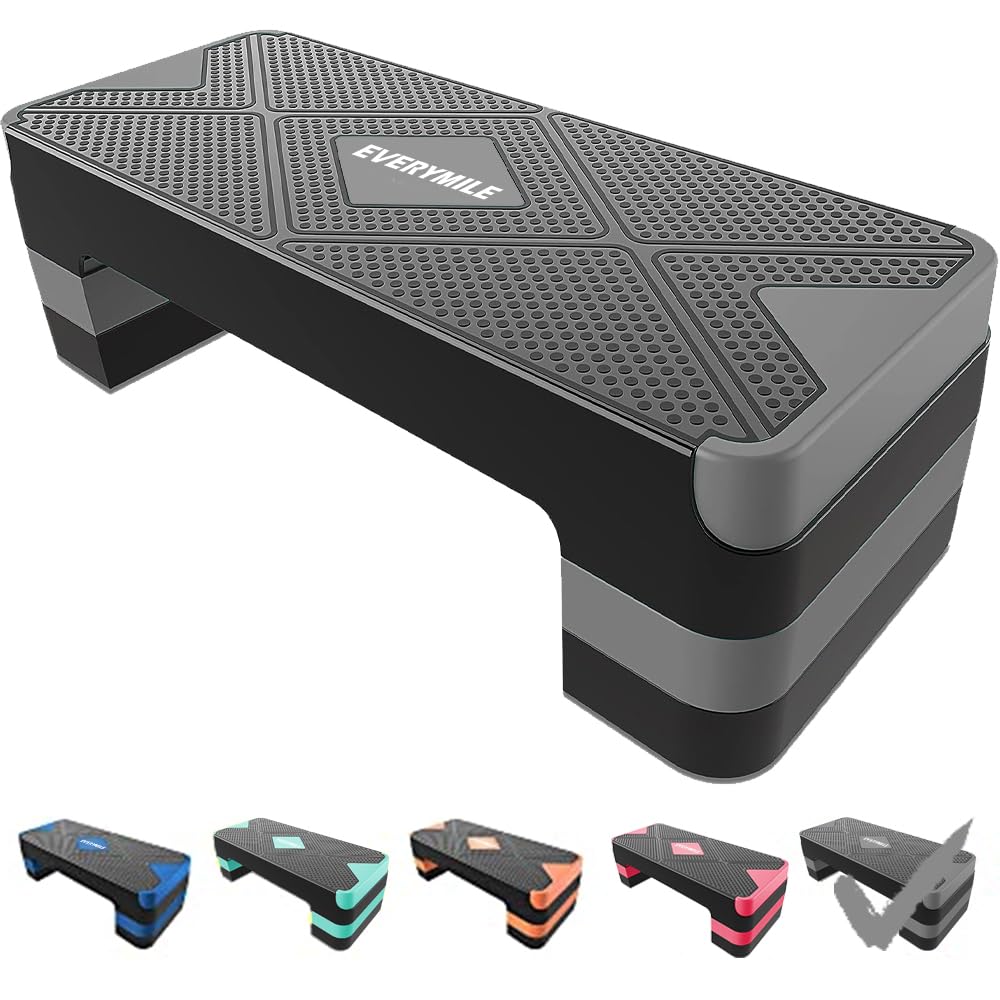
3. EVERYMILE Aerobic Exercise Step
The little ABS deck that punches above its weight on load rating.
Yet it claims a 400-pound capacity, the second-highest figure here behind the Yaheetech’s 550-pound rating. That combination of low mass and high load number tells you the deck is built from dense ABS plastic rather than a thick shell. The 26.5-inch by 10.5-inch deck offers 4-, 6- and 8-inch heights across its included risers, and the top has circular grooves and a textured surface to grip.
No-scratch rubber feet sit under each corner, and the risers stack underneath for storage under a bed or sofa. The platform takes planks, dips, knee-ups and burpee jumps.
One manufacturing note to know: the legs are stiff to add and remove. That’s fine if you set a height and leave it, but a nuisance if you change levels daily. On the build front, it’s a sturdy piece — the deck itself gets more goodwill than most compact steppers here.
Weight and load: light to carry, rated for 400 pounds — unusual for a deck this compact.
Stiff risers: the legs fight you a bit on removal, so pick a height and stick with it for the week.
The right fit: a small-space routine with occasional re-leveling and no heavy machine budget.
Skip it for: frequent height changes — the risers are a wrestle each time.
4. Smartxchoices 16 Inch Adjustable Stepper

Five height levels and a 12-inch ceiling for high-step and rehab work.
If your routine lives at high step, this is the one with range. It adjusts across five levels from 4 to 12 inches — the tallest climb in this article, versus The Step’s 8-inch maximum. The deck is a compact 16-inch by 16-inch square, so it’s a focused step rather than a full health-club platform. HDPE construction holds up to 300 pounds with impact resistance, and the honeycomb surface is textured for grip.
Rubber feet under each step and riser protect floors and keep it from sliding on carpet or hardwood. The risers lock underneath for storage, and the whole deck moves easily if you want to train in the office or a friend’s space.
The one honest caution: the non-slip tread can lift around the edges. It’s a cosmetic-to-minor grip concern rather than a structural failure, but it’s the thing to watch if you train barefoot or in socks and rely on the surface pattern. You’ll notice it most at the corners.
Height range: 4 to 12 inches across five levels — the biggest climb here.
Surface watch: the textured tread can start lifting at the edges over time, so keep an eye on the corners.
Worth it for: high-step training and the taller positions that a 4-to-8-inch deck can’t reach.
Not ideal if: you want a wide deck for full-foot step aerobics — this one is a 16-inch square.
5. Yaheetech 43in Aerobic Step Platform

A full-width health-club deck with the biggest load rating in the group.
This one carries the highest weight rating in the whole article at 550 pounds. The platform is 43 inches long by 16.5 inches wide and adjusts 4, 6 or 8 inches using its four risers. High-density polyethylene construction backs that capacity, and the anti-skid grooved EVA top adds grip under sweaty hands or damp shoes. Non-marking rubber feet sit under the platform and each riser so it sits on hardwood, laminate, tile or carpet without scratching.
At 19.4 pounds it’s a substantial piece. Unlike the Goplus portability pick, this one isn’t designed to be carried around — it’s designed to stay where you put it and support you every time.
The recurring note is size. It fills a serious footprint in a small room, and if your workout space is tight, the length makes itself felt between sets. For anyone with a dedicated corner or spare floor, that width and length are exactly what makes the step aerobics comfortable. The trade-off is real estate, not quality.
Strength story: a 550-pound rating and a 43-inch deck make this the stoutest simple stepper here.
The size question: it’s a large deck, so measure your workout corner before it arrives.
The one to grab if: you want maximum load rating and a full-length deck for step aerobics.
Hold off if: floor space is tight and the step has to share a room with furniture.
6. Yes4All 2-in-1 Adjustable Aerobic Step Platform
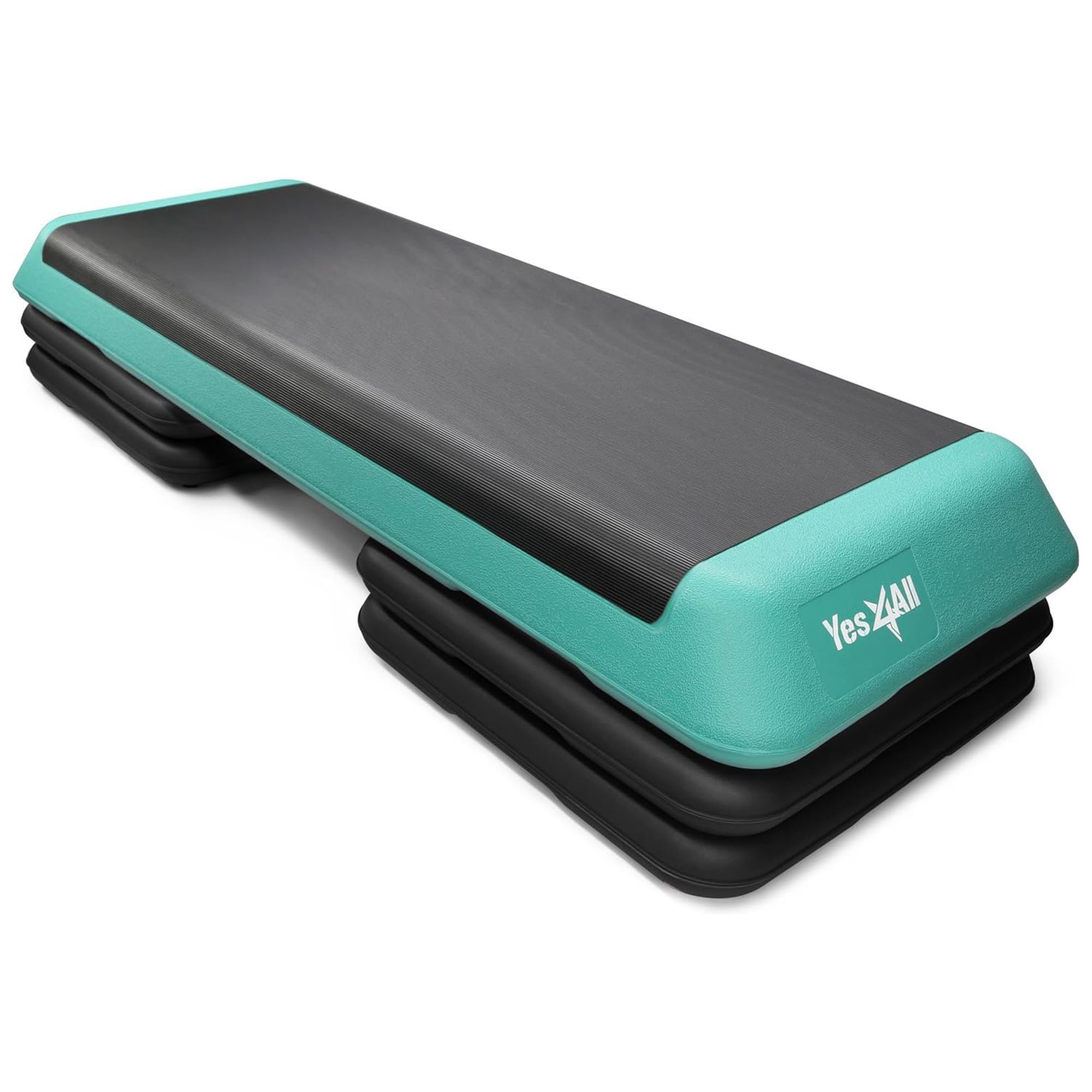
Two products in one: a step deck that converts to a rocker balance board.
The deck spans 42.5 inches long by 16 inches wide, with a slip-resistant, shock-absorbing surface and four removable 16-inch by 16-inch by 2-inch risers. Height goes 4, 6 or 8 inches, and the HDPE shell carries up to 300 pounds — suitable for indoor or outdoor use. Where it splits from the flat steppers is the rocker balance legs, which turn the platform into a balance trainer for stability work.
Risers adjust for more calorie burn and harder cardio, and you can pair the deck with other fitness tools. It’s a solid unit, with the build quality being the thing owners talk about most. The recurring gripe is that the risers don’t snap securely into place — they sit rather than click. That means a slight shift can creep in over time.
It gives you a 42.5-inch step and a rocker balance board in one footprint. If you’re chasing the rock-solid riser seating of The Step, the loose fit is the compromise. You skip buying a separate balance board, but the risers rest in place instead of clicking.
Versatility buy: a 42.5-inch step that doubles as a balance board via the rocker legs.
Loose risers: they don’t click into place, so check the fit before each hard session.
Built for: someone who wants both step and balance training without buying two pieces.
Less suited to: anyone who needs risers that lock firmly and never shift.
7. Aerobic Step Platform Health Club Size — Gray Black

The most-reviewed deck in this article is also one of the steadiest underfoot.
This Yes4All platform is 42.5 inches long by 16 inches wide, adjusts 4, 6 or 8 inches using four removable 16-inch by 16-inch by 2-inch risers, and carries up to 300 pounds. High-density polyethylene handles the shell, and it works indoors or outdoors. What lifts it above the pack is the size — that full length gives you room for a genuine step aerobics routine, and the quality is the thing you feel the moment you step on.
This is the deck with the most feedback in the entire article — 4.5+ stars from 900+ ratings. That’s the broadest sample here, and the consensus lands on the same word: sturdy. Unlike the smaller steppers, it doesn’t feel like a compromise between portability and stability.
The recurring gripe is that the risers don’t lock into place — they sit under the deck rather than click. It’s worth knowing before you buy, especially if you train barefoot and rely on exact footing. But for the money, a full-size deck with this much use behind it is a solid bet.
Full-size draw: 42.5 by 16 inches is the roomy spec most step aerobics routines expect.
Riser fit: no lock-click — the risers rest in place, which asks for a quick check before fast stepping.
Do pick it if: you want a proven full-size deck and can live without a locking riser.
Pause if: you need every riser to snap tight and never shift.
8. leikefitness Exercise Step Platform

One deck that becomes a bench, a step and a ramp with a few angle flips.
The leikefitness is the crossover pick — a multifunctional aerobic deck that plays weight bench, step, plyometric and ramp. It has 2-level height adjustment, 3 angle locations (flat, inclination and decline) and 4 bracket angles at 0°, 25°, 50° and 65°. That’s a lot of adjustment range for a deck that folds into a compact footprint. It carries up to 330 pounds, and 1 resistance band comes in the box.
The surface is anti-slip and textured, with rubber grip feet to hold it steady during a workout. There’s a small storage space inside for bands and tubes, and the whole thing folds small enough to tuck against a wall.
On bulk, it’s a 21-pound piece — heavier than the 20.4-pound Yes4All but far more feature-loaded. The sturdiness and versatility are what sell it, plus the space-saving fold. It covers strength and cardio in one footprint, with the trade-off of slower setup. The catch: with this many positions, you’ll spend a minute dialing in the right setup the first few times.
Where it earns its keep
- Doubles as bench, step, plyo box and ramp
- 330-pound capacity with textured grip and rubber feet
- Folds compact with internal storage for bands
- 1 resistance band included
What to expect
- Multiple positions take repeat sessions to learn
- At 21 pounds, it’s not a carry-around stepper
Right for: a home gym limited to one footprint that has to cover strength and cardio.
Less right for: anyone who just wants to step — the extra angles add setup time.
9. Power Systems Step Bench & Weight Bench
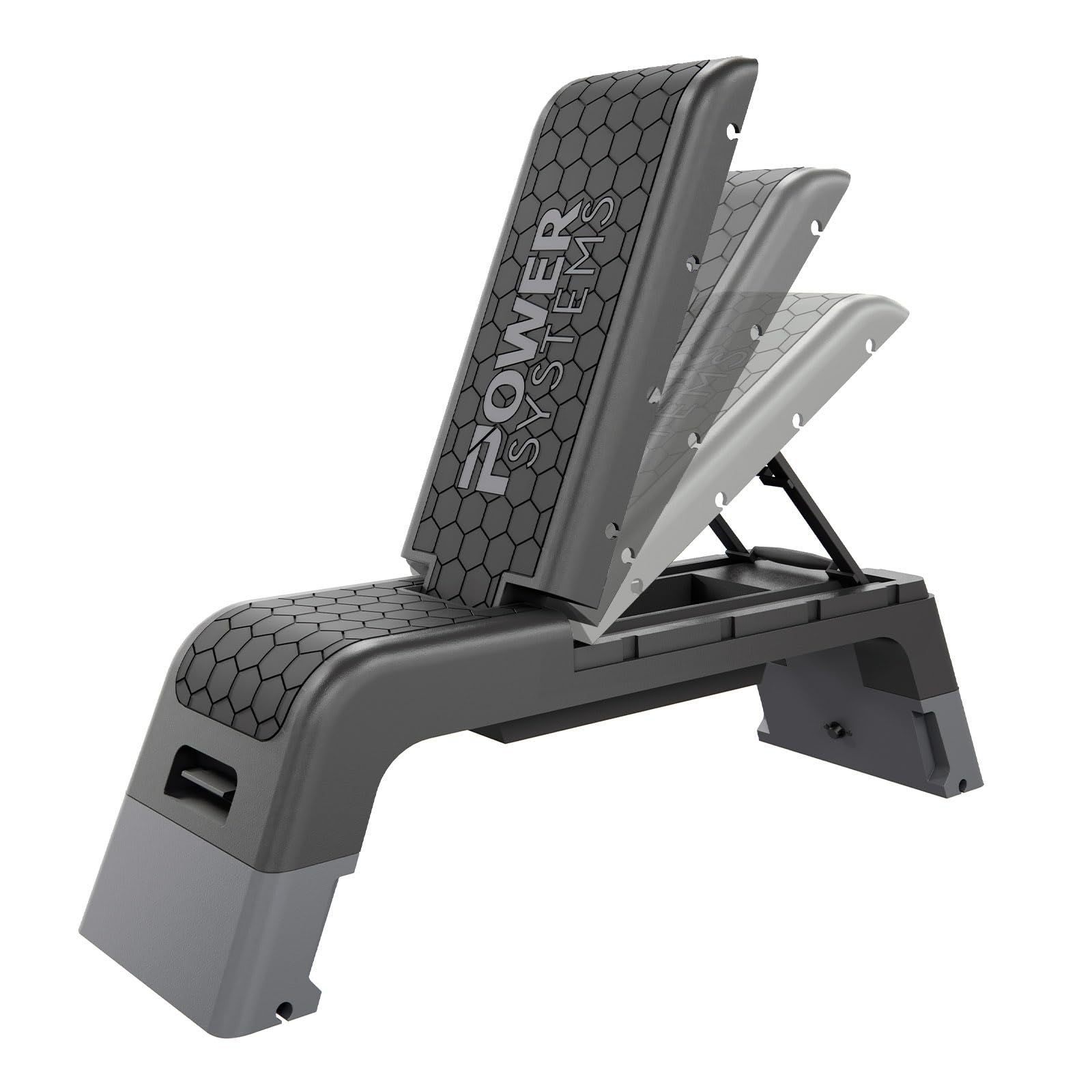
The commercial-grade deck that reconfigures from an 8-inch step to a 14-inch plyo box.
The Power Systems deck is built for the gym floor. As a basic aerobic step it sits at 8 inches; raise it and it becomes a 14-inch plyometric challenge. It also converts to an inclined or declined weight bench for strength training. The dense plastic deck carries up to 330 pounds.
Rubber feet keep the legs planted at the highest configuration, and the surface is non-slip textured rubber. It locks into its lowest position and stacks for storage — low enough to slide under a bed, sofa or into a closet. Internal storage keeps smaller pieces contained and off the floor. The dark gray and black finish disappears into any room.
Folding and reconfiguring all those positions takes practice, and the deck runs narrow at the top — the same dimension that lets it stack so neatly. If you want a commercial-grade bench that steps, this is the heaviest option in this article by build intent, and it rewards someone with a proper gym corner.
Trainer-grade: a 330-pound deck spanning 8 to 14 inches and more than a dozen positions.
Stack-and-store: it locks low and slides under a bed — rare for a commercial-style deck.
Choose it if: you have the room and want one deck that steps, plyos and benches.
Choose again if: you mostly do simple step routines and rarely use the angle settings.
Know the Specs
Deck size
The platform length and width decide how much foot room you get. A 43-inch-by-16-inch deck fits a full step aerobics routine; a 16-inch-square deck is a focused high-step. Wider and longer generally means more stable foot placement and more floor space used.
Riser and height levels
Risers are the blocks you stack under the deck to raise it. Three levels (often 4, 6 and 8 inches) cover most routines; a five-level deck can reach 12 inches, and multi-position decks push to 14 inches. Look for risers that lock or stack securely if you train at speed.
Weight capacity
The rating tells you the load the deck is built to carry — commonly 300 to 550 pounds in this group. A higher number usually pairs with a thicker shell and sturdier feet, which means less flex during jumps and quick step-downs.
Surface grip
Textured, grooved or honeycomb tops add friction under your shoes. Anti-slip pads under the feet keep the deck from sliding on hardwood or carpet. Nonskid feet also protect floors from scratches and marks.
Storage and portability
Compact steppers weigh as little as 6 pounds and stack their risers underneath. Health-club decks weigh closer to 20 pounds and stay where they are. Multi-position decks often fold and lock low enough to slide under a bed.
Material
High-density polyethylene and ABS are the two plastics you’ll see. Both are dense, wipe clean and resist impact. Polyethylene tends to be the heavier-duty shell; ABS is lighter and denser per unit of thickness.
Common Questions
What height should I set my workout step at?
Will a 43-inch step platform fit in my workout space?
Do the risers need to lock into place?
What weight capacity do I need on a step platform?
Can I use a step platform on carpet?
Is a multifunctional deck better than a simple step?
How much does a workout step platform weigh?
Can I do step aerobics in bare feet or socks?
How do I store a step platform between workouts?
Does a higher step burn more calories?
The Bottom Line
Across the board, the workout step stool winner is the The Step Original Aerobic Platform because it pairs a full 43-inch deck with a 350-pound capacity and nonskid feet on every riser. If you want the biggest load rating and a wide deck, grab the Yaheetech 43in Aerobic Step Platform. And for a home gym squeezed for space, the leikefitness Exercise Step Platform folds flat and doubles as a bench. Whichever you pick, start at 4 inches and add risers only when a flat-footed landing feels easy.
How we choose
We do not accept paid placement. Every pick is matched to a real buyer and a real use-case; we do not hands-on test units.
Sources
Specifications: manufacturer listings and product documentation. Review insights: verified customer reviews, as of November 2026. Pricing: not shown on this page (it changes often); check the current price via the retailer link.
As an Amazon Associate, Tactical Gear Guy earns from qualifying purchases. This does not affect which products we feature.