Specs are compiled from manufacturer listings and verified buyer reviews and can change over time — please confirm the key details on the product page before buying.
You do not need a running track to get a lung-burning, arm-heavy workout. A ski machine gives you the same double-pole pulling motion cross-country skiers use, and it does it standing up in a corner of your home. The trick is picking one whose resistance type, footprint, and build suit your room and your training style, which is what this comparison covers.
This guide is built by comparing the manufacturers’ published specifications and the patterns across verified customer reviews, so you get each pick’s real strengths and trade-offs instead of marketing spin.
The three machines here split cleanly into a compact flywheel unit, a wall-bolted steel trainer, and a heavy dual-resistance tower. Below you get the footprint numbers, the resistance systems, and the honest trade-offs that decide which one fits your gym; use this guide to the best Workout Ski Machine as a filter, then match the specs to your own wall and ceiling height.
Top Picks

How To Choose The Best Workout Ski Machine
A ski machine is a standing puller, not a seated rower. You grab two handles and drive them down and back, and the resistance fights you on every stroke. That means three things matter more than any badge on the frame: how the resistance is made, how the machine mounts, and how much room it eats.
Resistance type changes how the workout feels
Air resistance means a fan spins as you pull, so the harder you drive the handles the more resistance you feel — the machine gets harder the faster you go. A damper control (a vent that opens or closes to let more or less air into that fan) lets you set the baseline difficulty. A dual fan-and-magnetic system adds a magnetic brake alongside the fan, so you get a more adjustable, more consistent pull at lower speeds. On the machines here you will see 10 adjustable levels on the Marcy and GMWD units, while the Concept2 relies on its flywheel and damper wheel.
Mounting and ceiling height decide whether it fits
Most ski trainers stand upright and either bolt to a wall or sit on a floor stand. Measure your ceiling and your wall studs before you buy. The Marcy trainer stands 84 inches tall and bolts into the wall with included hardware, while the Concept2 is 83.5 inches tall and can be wall mounted or run free-standing with an optional floor stand. If your ceiling is low or your walls are rented and untouchable, check the mounting option first — it is the most common reason a ski machine gets returned.
Side-by-Side Comparison
| Model | Best For | Resistance | Footprint (D x W x H) | Weight | Amazon |
|---|---|---|---|---|---|
| Concept2 SkiErg★ Best Overall | Compact, low-ceiling-friendly training | Air flywheel with damper | 16″D x 20.5″W x 83.5″H | 46 pounds | Amazon |
| Marcy Indoor Ski Machine Cross Country Trainer | Wall-bolted budget training | Air with 10-level damper | 18″D x 20″W x 84″H | 78.3 pounds | Amazon |
| GMWD Ski Exercise Machine | Heavy-duty dual-resistance home gym | Fan + magnetic, 10 levels | 50.3″D x 23.6″W x 87.4″H | 122 pounds | Amazon |
Detailed Reviews
1. Concept2 SkiErg
Our pick — 4.5+★ from 600+ verified ratings; the strongest balance of quality and price.
The machine that brings Nordic skiing into a corner of your garage without eating the floor.
The SkiErg is the compact benchmark here — 16″D x 20.5″W x 83.5″H with 46 pounds of aluminum. Compare that to the GMWD’s 50.3″D x 23.6″W x 87.4″H and 122 pounds, while still giving you the full standing pull. That slim footprint is the whole point: a nearly wall-flat machine you can leave set up year-round.
Air resistance via a flywheel and damper means the resistance responds to your effort — pull harder and it fights back harder. You can work double pole or classic alternating arm technique, and the included Performance Monitor 5 tracks your session while the smartphone cradle holds your phone for pacing or video. The ergonomic strapless handles let you pull without strapping in, so a quick set between chores is genuinely quick.
What wins people over is the pull itself: smooth through the stroke and hard enough on your upper body and core at any fitness level. Assembly is described as straightforward, and the machine slots into a home gym without dominating it. The honest catch: it sits at the premium end of this group, and a wall mount or floor stand may be needed depending on how you want it set up — the floor stand is optional and separate. It is the highest-rated of the three and the easiest to fit into a small room.
Where it pulls ahead
- 16″D x 20.5″W footprint — the slimmest here
- 46 pounds of aluminum means one person can reposition it
- PM5 monitor with smartphone cradle built in
- Double pole and classic alternating technique both supported
What you should know first
- Premium-tier pricing for this category
- Floor stand is optional and sold separately
- Wall mounting hardware needs a solid wall behind it
Reach for this if: you want the smallest, most proven air-resistance machine for a home gym corner.
Think twice if: you need a floor-stand setup included in the box or want the lowest entry point in this category.
2. Marcy Indoor Ski Machine Cross Country Trainer

A wall-bolted trainer that gets the ski motion into a narrow strip of room.
If you have a spare wall and no floor, the Marcy is built around exactly that. It measures 18″D x 20″W x 84″H and bolts into most walls using the included mounting hardware, so the machine stands in a narrow vertical strip instead of needing a free floor footprint. The 78.3-pound steel frame is heavier than the Concept2’s 46 pounds, which is the trade for that bolted-in feel.
Resistance comes from an air system with 10 levels of adjustable damper control — open the damper for air and it lightens, close it down and the pull firms up. That lets you warm up on a low level and push intensity higher when you want it. The internal drive mechanism delivers a double pull technique that mimics a natural rowing or skiing motion, engaging both your arms and your torso across the stroke. An LCD display feeds back distance, speed, pace, calories, and wattage so you can train with numbers instead of feel.
Here is the part that separates it from the rest: the optional base platform (sold separately) lets you run it free-standing if your wall situation does not allow bolting. That flexibility matters because it is the most affordable machine of the three, and a wall-mounted frame can be a hard sell in a rental. It carries a 3.5+ rating on a small set of reviews, so it sits below the Concept2 on feedback maturity — treat it as a practical budget entry, not a proven workhorse.
The genuine fit: a narrow wall, a tight budget, and a willingness to bolt in the frame make this the cheapest way to get a real ski pull.
The honest limitation: it is a wall-first design, and the optional floor platform is extra — budget for that if bolting is not an option.
Best matched to: a gym with a solid wall and a small floor footprint.
Look elsewhere if: you cannot or will not bolt into a wall and want a self-supporting frame from the start.
3. GMWD Ski Exercise Machine
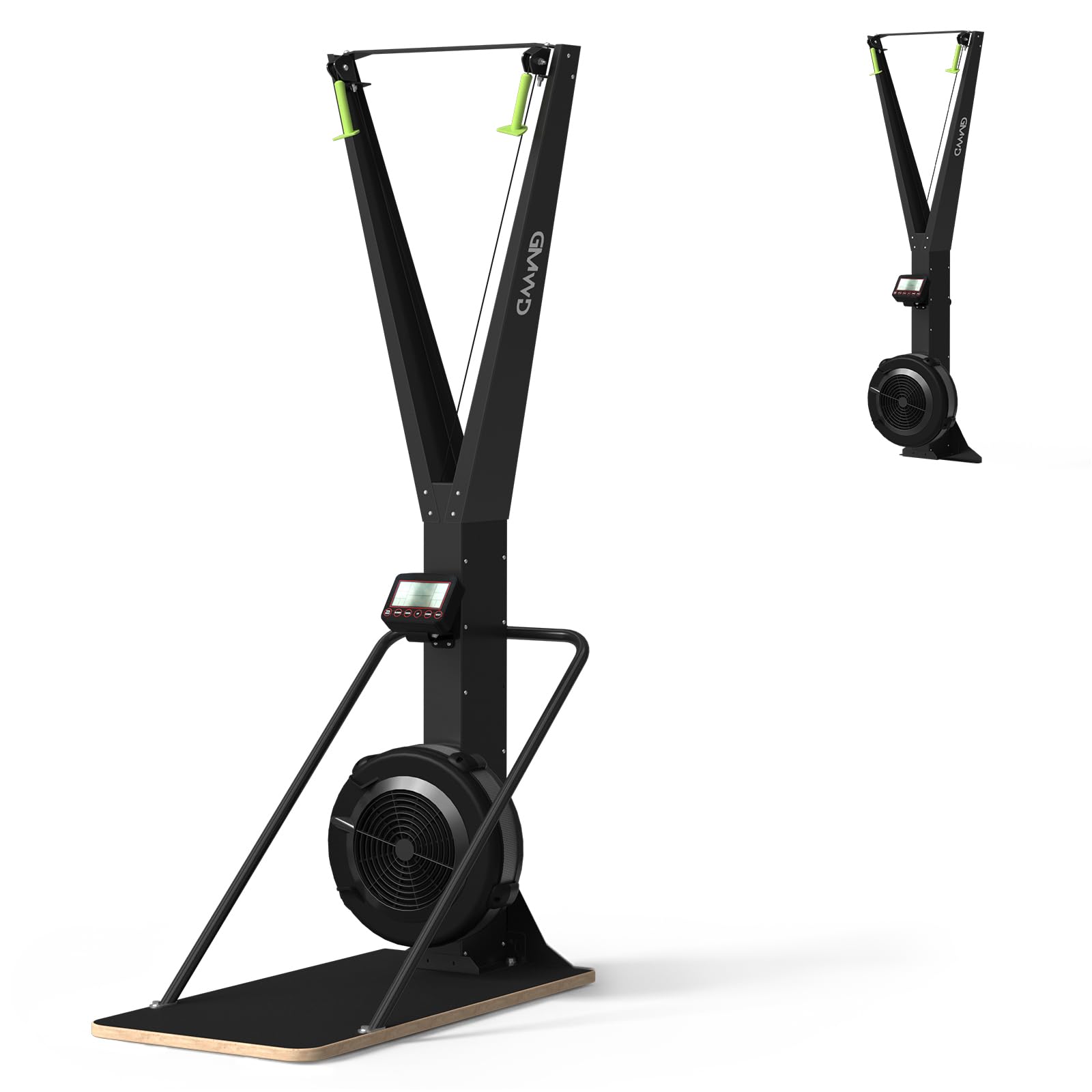
A serious steel tower with dual resistance and a 300-pound weight ceiling.
The GMWD makes its case with mass and resistance options. It is 122 pounds of alloy steel and stands 50.3″D x 23.6″W x 87.4″H — vs the Concept2’s 46-pound, 16-inch-deep frame. That heavier build supports a maximum weight recommendation of 300 pounds and a fan-and-magnetic dual resistance system with 10 adjustable levels. The magnetic brake alongside the fan keeps the pull consistent at low speeds, and the spiral damper lets you change the flywheel airflow quickly to pick a difficulty that suits you.
The stroke works both arms down and out, and the machine targets upper body, lower body, and torso in one motion — GMWD claims that pull engages 84% of your muscles. The LED monitor reads out time, distance, watts, calories, strokes, and total strokes, so you can chase a power number instead of counting reps. It ships with a wall-mounted kit and also has a vertical bracket included, so you can mount it or stand it up your way. The anti-skid deck and pro-grip tap set round out the package.
Owners consistently describe its build quality as performing like machines that cost far more. The recurring honest wrinkle is assembly — some find it straightforward and some find it frustrating, and reports of bolt holes not lining up do exist. Call it a heavy install that rewards patience, not a five-minute setup. At 4.4 ratings with a solid review base, it is the value-heavy option when you want a true gym-feel tower.
Why it earns its floor space
- Fan + magnetic dual resistance gives a smooth pull at all effort levels
- 300-pound weight recommendation for heavier users
- LED monitor tracks watts, strokes, calories, and distance
- Wall kit and vertical bracket both included
The real trade-offs
- 122 pounds and 50.3-inch depth demand real floor space
- Assembly is mixed — some report bolt-hole alignment issues
Pick it if: you want a heavy steel frame, dual resistance, and a 300-pound weight ceiling for a dedicated training area.
skip it if: your room cannot spare the depth or you want a tool-free setup.
Know the Specs
Footprint and Height
The published depth and width tell you how much floor the machine truly needs, and the height tells you whether your ceiling clears it. The Concept2 at 16″D x 20.5″W is the slimmest, the Marcy at 18″D x 20″W is close behind, and the GMWD at 50.3″D x 23.6″W is a deep tower. All three sit around 83 to 87 inches tall, so check your ceiling before buying any of them.
Resistance Systems
Air resistance uses a spinning fan, so effort increases with speed — the harder you pull, the more it resists. Damper levels control how much air the fan gets. A dual fan-and-magnetic setup like the GMWD’s adds a magnetic brake for consistent low-speed resistance. More levels give finer control over the difficulty curve.
Monitor Features
A good monitor turns a pull session into measurable training. Look for distance, speed or pace, calories, watts, and stroke counts. The Concept2 ships a PM5 with a smartphone cradle, the Marcy LCD shows distance, speed, pace, calories, and watts, and the GMWD LED adds stroke and total-stroke tracking.
Build and Weight Limits
Machine weight hints at how stable the frame feels during aggressive pulling. The Marcy’s 78.3-pound and GMWD’s 122-pound steel frames stay planted, while the aluminum Concept2 at 46 pounds is more portable. The GMWD publishes a 300-pound maximum weight recommendation — check that spec if you are a heavier user.
Common Questions
Can a ski machine be used without bolting it to a wall?
How much ceiling height does a ski exercise machine need?
Is air resistance better than magnetic resistance on a ski machine?
What does the damper control actually do?
Can a ski machine work your legs or is it only upper body?
How hard is assembly on these machines?
What weight can a home ski machine support?
Do I need a monitor or can I train without one?
Is a ski machine suitable for beginners?
How much floor space does a ski machine really take?
The Bottom Line
For most buyers, the workout ski machine winner is the Concept2 SkiErg because it pairs the slimmest footprint in the group with a proven air-resistance pull and the highest rating of the three. If you want a heavy steel tower with dual resistance and a 300-pound weight recommendation, grab the GMWD Ski Exercise Machine. And for a wall-bolted budget entry, the Marcy Indoor Ski Machine is the one to reach for. Match the depth and height specs to your room and ceiling, and you get a ski machine you will actually keep using.
How we choose
We do not accept paid placement. Every pick is matched to a real buyer and a real use-case; we do not hands-on test units.
Sources
Specifications: manufacturer listings and product documentation. Review insights: verified customer reviews, as of November 2026. Pricing: not shown on this page (it changes often); check the current price via the retailer link.
As an Amazon Associate, Tactical Gear Guy earns from qualifying purchases. This does not affect which products we feature.