Specs are compiled from manufacturer listings and verified buyer reviews and can change over time — please confirm the key details on the product page before buying.
You want a running shirt that does not turn into a soggy, smelly mess by mile three. A wool running shirt solves exactly that — merino fiber moves sweat off your skin, keeps you warm even when damp, and resists odor so you can wear it for several runs between washes. The catch is that not every merino shirt is knitted the same, and a couple of the picks below have real durability caveats worth knowing before you spend your money. This guide sorts the four strongest options by who each one actually fits.
This guide is built by comparing the manufacturers’ published specifications and the patterns across verified customer reviews, so you get each pick’s real strengths and trade-offs instead of marketing spin.
Below you will find a quick comparison table, plain-English breakdowns of the specs that matter, and honest notes on fit and fabric life. Whether you run trails or roads, here are four merino shirts ranked by fabric weight, fit, and durability.
Top Picks

How To Choose The Best Wool Running Shirt
Wool running shirts vary widely in fiber content, knit weight, and construction. Some are 100% merino, some mix merino with a plant-based fiber to speed drying, and the knit weight swings widely. Fiber content and knit weight together decide whether a shirt runs cool in summer heat or warm on a cold-morning base layer.
Fabric Weight In GSM
GSM stands for grams per square meter — basically how thick and warm the knit is. A lighter knit around 170 GSM feels airy for summer road runs. A heavier knit runs warmer and suits cold-weather base layering. Match the number to your typical running temperature.
Micron Count And Skin Feel
Micron measures the diameter of each wool fiber. The lower the micron number, the finer and softer the fiber feels against skin. Superfine yarn in the 17.5–19.5 micron range is the sort of knit that does not itch on a sweaty run.
Neckline And Seam Construction
A loose neck hole lets cold air pour in and rubs against a hydration pack strap. Offset or flat-lock seams sit flatter so they do not dig in when you swing your arms. On a thin merino knit, a loose collar or raised seam chafes faster than on a cotton tee.
Side-by-Side Comparison
| Model | Best For | Fabric | Weight | Fit | Amazon |
|---|---|---|---|---|---|
| Merino Protect 100% Merino Wool V Neck★ Best Overall | Hot-weather everyday wear | 100% Merino Wool | — | True to size | Amazon |
| SHEEP RUN Men’s Merino Wool Lightweight | High-intensity trail runs | 100% Merino Wool | 170GSM | Regular | Amazon |
| Smartwool Men’s Active Ultralite Short Sleeve | Warm-weather training | 53% Merino Wool, 47% TENCEL™ Lyocell | Lightweight | Athletic Fit | Amazon |
| Minus33 100% Merino Wool Lightweight Crew | Four-season layering | 100% Merino Wool | 170 G/M2 | Regular | Amazon |
Detailed Reviews
1. Merino Protect 100% Merino Wool V Neck T-Shirt
Our pick — 4.0+★ from 800+ verified ratings; the strongest balance of quality and price.
Pure merino that keeps its cool when the thermometer climbs.
The standout here is simple: the whole shirt is 100% merino wool, no synthetic filler. That pure knit is why it does so well in hot weather — merino manages moisture and breathes, so you stay comfortable on a summer run instead of cooking in plastic-feel fabric. It is the crowd favorite of this group, holding 4.0+ stars from a big base of 800+ ratings.
Quality is the thing that wins people over most. The knit feels soft against skin, the V-neck fit lands well for lots of body types, and it holds its size after washing. Odor resistance is the other quiet win: you can do a run, hang it up, and wear it again without a wash. That softness and the color choices round out why owners keep reaching for it.
Now the honest part. Durability is the weak spot, and it is not a rare fluke — holes developing is the recurring gripe, so treat this as a shirt you rotate and wash gently rather than a bombproof workhorse. The value question also splits opinions. It is a genuine merino shirt at a reasonable mid-range tier, but if you want one tee to survive years of hard abuse, know that fabric life is the trade-off you accept for that soft pure-wool feel.
What earns its place
- 100% merino wool with no synthetic filler
- Comfortable in hot weather and resists odor between washes
- Soft texture and a fit that holds true to size after washing
- Best overall pick for everyday wear and summer runs
Where it asks patience
- Holes developing is the recurring durability complaint
- Value-for-money sentiment is split
- Wash gently and rotate it to extend fabric life
Reach for this if: you want a soft, pure-merino shirt that stays fresh through hot runs and repeated wear.
Think twice if: you expect a single tee to shrug off years of rough handling — the wool here rewards gentle care.
2. SHEEP RUN Men’s Merino Wool Lightweight Base Layer

A 170GSM knit built for the sweaty miles you actually run.
The number that does the work here is 170GSM — a light jersey knit that traps just enough warmth without turning into a sauna on a climb. It is spun from 17.5–19.5 micron merino sourced from New Zealand and Australia, the superfine range that keeps the fabric soft against your skin during high-intensity effort. Flat seams cut down on rubbing under a pack strap. Compare that to the Minus33 crew, also a 170 G/M2 knit but at a finer 17.5 micron — two shirts in the same weight class, sized differently for how they wear.
Where owners land again and again is the quality of the wool and the overall comfort. It manages moisture to keep you fresh and dry through hiking, running, and cycling, and the merino structure does the odor work so you are not worrying about smelling at the trailhead. Summer heat is handled by the open, breathable knit that lets sweat vapor escape.
Two things to know before you buy. Some buyers question whether the wool is the real deal and the consensus on fabric quality is genuinely mixed, so buy from a seller with a solid return path. And a few shirts show early holes after several washes, which points to handling — wash cold, air dry, and skip the dryer. The value read splits too, but the 4.0+ star crowd is mostly a comfortable, odor-resistant one.
Why runners bite: the 170GSM knit and superfine micron yarn give you a light, breathable layer that feels gentle on sweaty skin and fights odor without effort.
What to watch: fabric authenticity and durability are both mixed in buyer feedback, so treat gentle washing as part of the deal.
Built for: men logging real miles on trail and road who want a light merino layer that stays fresh.
Less suited to: shoppers who want zero doubt about wool sourcing and long wash-and-wear life out of one shirt.
3. Smartwool Men’s Active Ultralite Short Sleeve
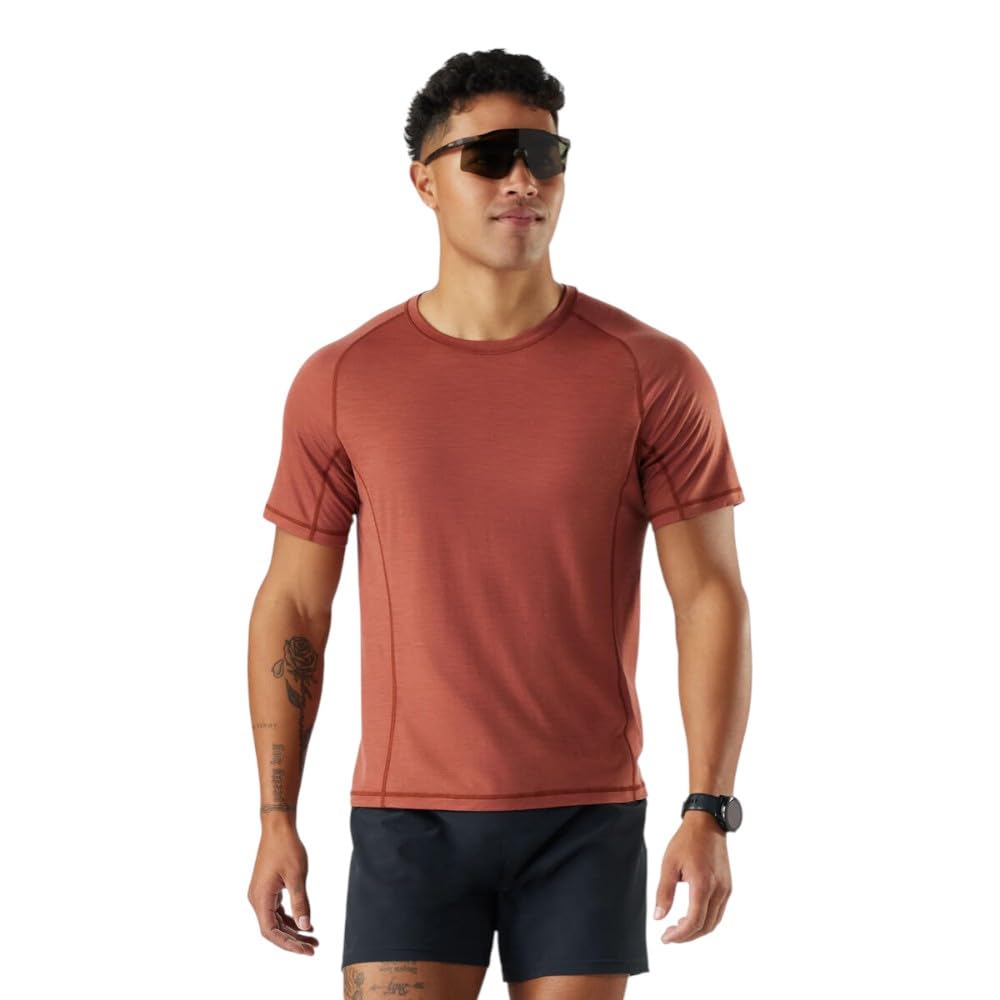
The merino-Tencel blend that dries fast and reads visible after dark.
Smartwool tails this one down into an ultralight mix — 53% merino wool paired with 47% TENCEL™ Lyocell, a plant-based fiber that helps the fabric dry quickly and stretch. That blend is aimed squarely at warm-weather movement and high-intensity training, where you want moisture moved off the skin fast rather than a heavy wool insulation layer. The athletic fit skims the body for free arm swing. Offset seams are shaped to reduce chafing, and reflective elements add visibility on low-light runs.
The material is the star, and it is the reason the shirt scores where it does. Buyers find it soft, comfortable, and warm enough for its ultralight weight. The ZQ-certified merino is reported to fit true to size. If you run at dawn or dusk, the reflective detailing is a real functional plus you will not find on the other pure-merino picks here.
The catch worth flagging up front: the neck hole runs large, and several buyers describe it as absurdly oversized — a loose collar flapping on a run is annoying and lets cold air in. Durability is the other honest concern, with reported short fabric life. This shirt is best understood as a performance layer for warm-weather training runs, not a garment built to last through countless wash cycles.
Strength of the blend: merino plus Tencel dries quickly, breathes, and stretches — the ultralight combo you want for hot-weather training.
The catch to size for: the oversized neck hole is a repeat complaint, and durability runs short of the pure-merino picks.
Fits best: runners doing warm-weather intervals and dawn or dusk sessions who value fast-drying fabric and reflective trim.
Worth a pass if: a snug crew neckline and long fabric life are your two must-haves.
4. Minus33 100% Merino Wool Lightweight Crew

Pure 17.5 micron merino with a UPF 25 rating for sun-exposed runs.
Your skin gets a smooth, non-itchy feel from the Minus33 light crew, because it is knit from 100% merino at 17.5 micron (a fine wool fiber width) in a 170 G/M2 jersey weave (a knit weight of 170 grams per square meter). That is the same weight band as the SHEEP RUN, but at the finer end of the micron scale. Sun protection is where it pulls ahead: a UPF 25 rating (UPF means how much UV sun the fabric blocks) keeps you covered on long exposed summit trails and mid-day road runs. The maker sizes this light layer for high-activity temps from 30°F to 60°F, so it works as a base on cold mornings and a solo tee on mild days.
What people consistently fall for is the knit quality and the material. It feels nice against skin and does the merino temperature trick — warm when it is cold, cool when it is not — while flat-lock seams and a tagless neck keep chafe down. The brand history is deep, running back through generations of wool textile work, and that expertise shows in the weave.
The honest reading is a mixed one on fit and durability. The crew runs a regular fit that some buyers find off, sleeve sizing draws scattered comments, and durability sits in the middle rather than at the top. It is the most premium option in this lineup, so go in expecting a well-made wool tee you care for — not an indestructible one. The warmth, softness, and sun protection still make it the pick for anyone who spends long days outside.
Reasons it stands out
- 100% merino at a fine 17.5 micron for smooth skin feel
- UPF 25 sun protection separates it from the other picks
- 170 G/M2 knit spans 30°F to 60°F high-activity temps
- Flat-lock seams and a tagless neck cut chafing
Points to weigh honestly
- Fit and sleeve sizing draw mixed feedback
- Durability lands mid-pack rather than top
- Premium tier, so it rewards careful washing
Top choice for: long days on exposed trails where the UPF 25 rating and four-season wool earn their keep.
Consider the fit: if you are particular about crew neckline and sleeve length, check the size chart before committing.
Know the Specs
GSM And Fabric Weight
GSM is grams per square meter, a measure of how dense the knit is. A 170GSM or 170 G/M2 shirt is a light layer — airy enough for summer runs and fine as a base under a shell on cold mornings. Heavier knits trap more warmth, which you want for winter base layering but not for a hot road run.
Micron Count
Micron is the diameter of a single wool fiber. The lower the number, the finer and softer the wool feels against skin. Superfine yarn in the 17.5–19.5 micron range is what keeps a merino running shirt from itching when you sweat.
Merino Versus Blends
Pure merino gives you the strongest odor resistance and a soft hand feel. Blending merino with a plant-based fiber like Tencel or Lyocell can speed drying and add stretch, which suits sweaty high-intensity running — though pure wool is often preferred when you want the most natural moisture handling.
Seams, Neckline, And UPF
Flat-lock and offset seams sit flatter against skin to reduce chafing under a pack or swinging arms. A snug crew or V-neck holds warmth better than a loose collar. A UPF rating, like UPF 25, tells you how much sun the fabric blocks on exposed trails.
Common Questions
Does a wool running shirt make you overheat in summer?
What does the micron number mean for skin comfort?
Is 100% merino better than a merino blend for running?
How should I wash a merino wool running shirt so it lasts?
Can I wear a wool running shirt more than once between washes?
Does a wool running shirt itch against the skin?
What is the difference between 170GSM and a heavier wool knit?
Does wool stay warm when it gets wet during a run?
What does a UPF rating on a wool shirt tell me?
The Bottom Line
For most runners, the wool running shirt winner is the Merino Protect 100% Merino Wool V Neck because it pairs pure merino comfort with strong odor resistance and a fit that holds up after washing. If you want sun protection on exposed trails, reach for the Minus33 Lightweight Crew and its UPF 25 rating. And for fast-drying performance on warm-weather intervals, the Smartwool Active Ultralite blend is the one to grab — just size the neckline with care.
How we choose
We do not accept paid placement. Every pick is matched to a real buyer and a real use-case; we do not hands-on test units.
Sources
Specifications: manufacturer listings and product documentation. Review insights: verified customer reviews. Pricing: not shown on this page (it changes often); check the current price via the retailer link.
As an Amazon Associate, Tactical Gear Guy earns from qualifying purchases. This does not affect which products we feature.