Specs are compiled from manufacturer listings and verified buyer reviews and can change over time — please confirm the key details on the product page before buying.
A cut lands where your marked line and your fence put it. That is the whole game with woodworking precision tools — a square or gauge that reads true and repeats exactly is what closes a joint tight instead of a hair proud. Below you get nine picks sorted by what they actually fix on the bench: setup blocks that hold a router bit height, squares that prove a machine is alive to a thousandth of an inch (0.001 inch), and gauges that scratch a repeatable line across the grain.
This guide is built by comparing the manufacturers’ published specifications and the patterns across verified customer reviews, so you get each pick’s real strengths and trade-offs instead of marketing spin.
Most beginners assume a ruler is a ruler, then lose an afternoon to a joint that never closes. The picks below separate the tools that actually repeat from the ones that only look precise — nine woodworking precision tools worth keeping within arm’s reach of the bench.
Top Picks


How To Choose The Best Woodworking Precision Tools
Precision in the shop is a chain, not a single tool. One loose link — a square a degree off, a gauge that slips mid-line — spoils every cut after it. Spend on accuracy where it multiplies through every project, and on convenience only where it speeds up a single step.
Start With the Tolerance, Not the Piece Count
A tolerance is how far off the tool is allowed to be, written as a plus-or-minus figure. The Blockcision blocks are precise to ± 0.001”, which means the error is a thousandth of an inch — invisible to the eye and irrelevant to a glue joint. Sets without a stated tolerance are the ones to question, because the maker never promised you anything.
Watch the graduation range too, which is the smallest step your tool can mark. A 1/16 inch graduation is fine for framing and rough stock breakdown. For joinery and shelf pins you want 1/32 inch or finer.
Match the Tool to the Step It Fixes
Setting a router bit or table saw blade to height is a repeat job, and setup blocks handle it in seconds where a tape measure handles it in minutes with doubt. Marking a dovetail baseline or a dowel center is a different job — that is scribing and layout, where a wheel gauge or an equidistant marker earns its keep. One tool that claims to do all of it usually compromises at every step.
Material Tells You How Long It Stays True
Aluminum alloy resists dents and does not dull a cutting edge, which is why so many setup and layout tools now use it. Hardened steel is the pick for anything that slices wood, like a marking gauge cutter. Brass shows up on gauge heads where a smooth, heavy feel and corrosion resistance matter. Plain stamped metal is the weak link — it flexes, and flex means a line that is not where you thought it was.
Side-by-Side Comparison
| Model | Best For | Stated Accuracy | Material | Graduation / Range | Amazon |
|---|---|---|---|---|---|
| Blockcision Setup Blocks 16 PCS★ Best Overall | Setting blade and bit height fast | ± 0.001” | Aluminum Alloy | 1/16” to 1”, 1/32” increments | Amazon |
| Procision Woodworking Ruler, Set of 3Pocket Layout Kit | Portable scribing and layout | — | Aluminum | 1/16 inches | Amazon |
| Saker 4-in-1 Drilling Positioning RulerCabinet Hardware Pick | Cabinet hardware hole layout | — | Aluminum | 13.78 inches | Amazon |
| ARTYMASTER 8 inch 3D Multi-Angle Square | Angles and three-axis marking | — | Aluminum Alloy | 1/16” to 8.0”, 0-90° | Amazon |
| Klein Tools 935DAF Digital Angle Finder | Miter and blade angle checks | ± 0.2-Degree | ABS Plastic, Stainless Steel | Inside/outside angles and lengths | Amazon |
| Trend Point-2-Point Measuring Tool | Equally spaced dowel and pin marks | — | Metal, Stainless Steel | 3.3in to 28in | Amazon |
| Taytools Solid Brass Wheel Marking Gauge | Slicing a crisp line across grain | — | Brass and Steel | 7″ beam, 3/8” cutter | Amazon |
| Woodpeckers 8 Inch Precision Square | Proving a machine is truly square | 0.001 inch | Aluminum | 1/16 inches | Amazon |
| Woodpeckers 12 Inch T Square | Long-edge marking and shelf pins | 0.004″ | Aluminum | 1/32 inches | Amazon |
Detailed Reviews
1. Blockcision Setup Blocks Woodworking Tools 16 PCS
Our pick — 4.5+★ from 850+ verified ratings; the strongest balance of quality and price.
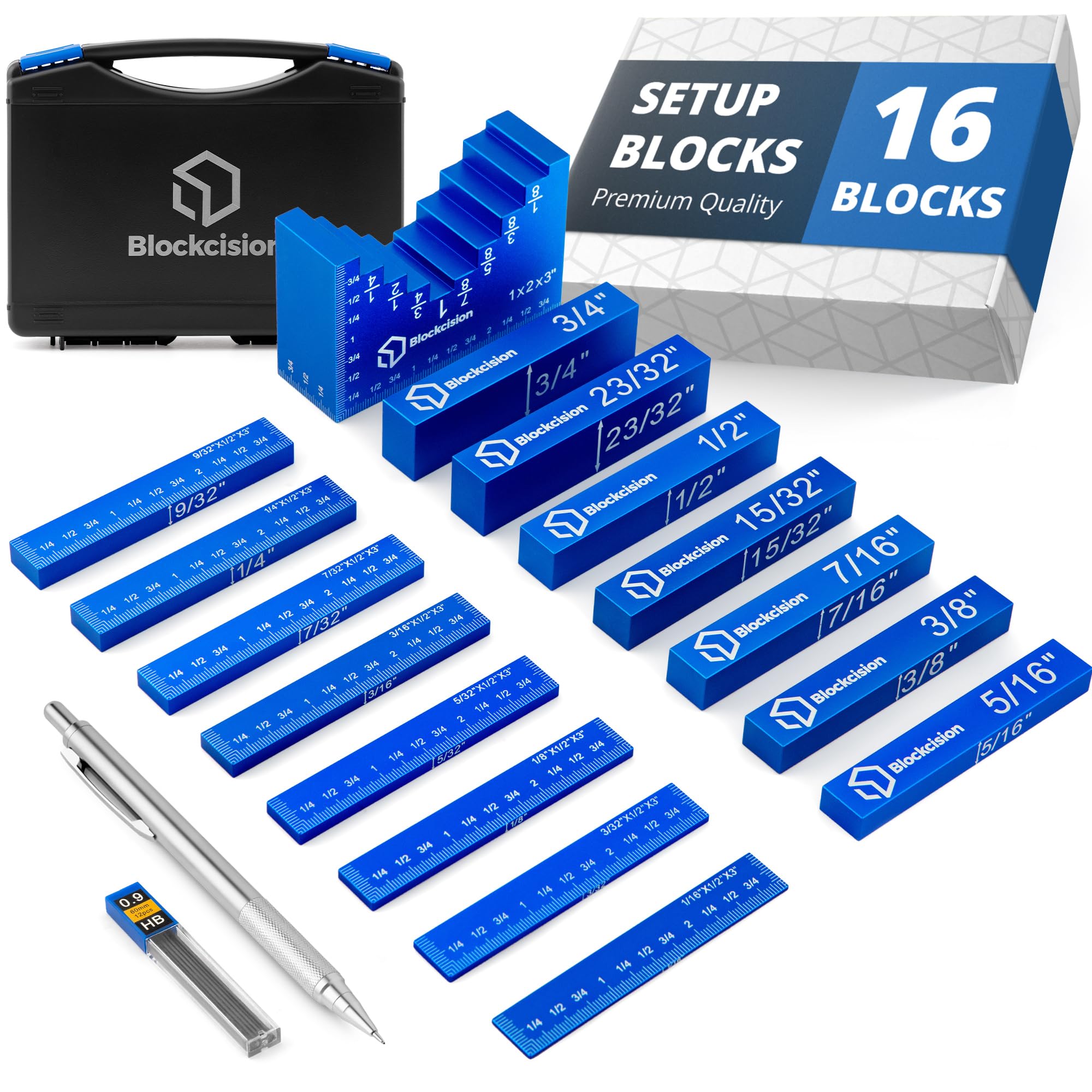
Sixteen aluminum blocks that end the guessing game on blade and bit height.
Setting a table saw blade or router bit against a block is the fastest way to get a repeatable height. This set does it with sixteen bars that are precise to ± 0.001” — a plus-or-minus of one thousandth of an inch, so tight your eye cannot see the error. They cover any measurement from 1/16” to 1” in 1/32” steps, which is the exact band where most joinery lives.
What sets this set apart is that every bar carries its own ruler markings. Other sets only mark the 1-2-3 blocks (the standard reference blocks), but here each bar has its own scale, so you can read a measurement on the fly without hunting for a reference block. The makers call the included piece the SpeedStep Multi Height Block, and it is the one you grab when you want a common height fast. The whole set sits in a polypropylene case (a tough plastic case) that keeps the bars off the bench and ready.
Build is aluminum alloy, which shrugs off dents and will not dull a cutting edge, and the laser-engraved markings are cut into the metal rather than printed on top. Weight comes to 2.09 pounds for the package, and a limited lifetime warranty backs the set.
What earns its bench space
- Tolerance of ± 0.001” makes blade and bit setup repeatable instead of approximate.
- Every block is ruler-marked, so on-the-fly measurement works on all sixteen.
- 1/16” to 1” coverage in 1/32” increments handles most joinery in a single set.
- Engraved markings on aluminum alloy survive the wear a printed scale cannot.
- Polypropylene case keeps the pieces together and off the floor.
Where it asks you to check first
- The set tops out at 1”, so taller blade exposures need a different reference.
- Sixteen loose bars reward a habit of putting each one back in the case.
Made for: the woodworker who resets a router bit or saw blade several times a day and wants the height right on the first try.
Think twice if: your work lives above the 1” ceiling this set covers.
2. Procision Woodworking Ruler, Set of 3 (12, 8, 6 Inch)
Three rulers, one wide slider, and a pencil that all fit in an apron pocket.
Where the Blockcision set is a bench resident, this trio is a pocket kit. You get 12, 8 and 6 inch rulers — three separate items against the Saker’s single ruler — plus a sliding attachment that is 2 inches wide. That extra width is the point: a wider slide sits flatter against the stock, so the line you strike stays steady across the face instead of wobbling off at the end.
The slider doubles as a setup block. It is a 0.5″x1″x2″ piece with its own ruler markings, so you can set a table saw, drill press or router table from the same tool you use to scribe. A curved, shallower cut notch is machined in so the 5 inch reading stays true, and a metal mechanical pencil comes in the box. Holes at both ends let you hang the rulers rather than lose them under a pile of offcuts.
Graduation is 1/16 inch, with the body 0.16 inches thick in aluminum. Owners who put a caliper on theirs came away satisfied, and the slider draws a smooth line without the thumbscrews fighting back. The one honest catch sits in the extras: the included accessories and the readability of the finer markings draw sharper comments than the rulers themselves — worth knowing if you like to read a scale at arm’s length.
The pocket advantage: a 2 inch slide plus three ruler lengths is a full scribing and setup kit in one grab — the kind of thing you keep in the apron, not on the wall. Owner feedback lands hardest on quality and versatility, and the mechanical pencil means you never go hunting for a marking tool mid-layout.
Where it sits in the lineup: lighter on absolute tolerance than the Blockcision set, and without the engraved-every-block feature, but it covers scribing and saw setup across three lengths the blocks cannot match.
Reach for it when: you want scribing, layout and quick machine setup from one tool that travels with you.
Look elsewhere if: you only ever work at the bench and want a single dedicated height reference.
3. Saker 4-in-1 Drilling Positioning Ruler
One long ruler that puts cabinet pulls and drawer fronts on a matching line.
Hanging a run of cabinet doors goes wrong in the same place every time: the second pull lands a hair off the first. This ruler stretches to 13.78 inches in length and width, so it can span a drawer face and reference both holes from one setup.
Three sets of adjustable positioning blocks do the actual locating, and the ABS knobs let you change length and angle without a wrench. A dual-axis bubble level sits in the body to check both horizontal and vertical alignment — useful on a cabinet run where the wall is not quite plumb. The aluminum alloy body carries wear-resistant printing, so the scale holds up to repeated use.
In cabinet work it clearly pulls its weight; buyers describe running through a long stack of faces in short order. The honest trade-off is the alignment feature itself. Getting the blocks dialed in takes patience the first few times, and the setting is the part people find fiddly. Once it is set, though, the repetition is the payoff.
Built for repeat drilling: a 13.78 inch span with three adjustable block sets means you set the spacing once and copy it down a cabinet run. The dual-axis bubble levels keep the reference honest on uneven walls.
Patience up front: the alignment setup rewards the time you spend dialing it in, then pays it back across every face after that.
The right buy for: anyone hanging a full kitchen’s worth of pulls and handles who wants every hole to match.
Not your tool if: you are drilling a single hole and want to skip the setup step entirely.
4. ARTYMASTER 8 inch 3D Multi-Angle Measuring Square
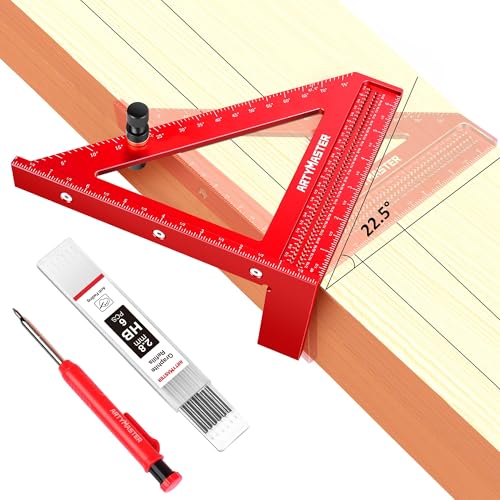
A square that measures in three dimensions and marks angles without a rotation.
Most squares ask you to move the tool to change the angle you are marking. This one is built to skip that step. It reads length, width and vertical height across three separate scales, and it marks any angle from 0 to 90 degrees or draws a horizontal line without spinning the body. The scale runs from 1/16 inch up to 8.0 inches, so it covers small joinery detail and a full 8 inch layout in one tool.
The body is high-strength aluminum alloy with a thickened profile and an anodized finish, which is what gives it the corrosion and rust resistance and the fade-resistant laser engraving. It assembles and disassembles easily, so it packs down rather than taking up wall space. In the box you also get a carpenter pencil with a built-in sharpener and six 2.8mm break-resistant refills, plus a set of stair gauges for repeated step-offs.
What people latch onto is the precision of the marks themselves. It does the job of a three-axis speed square, and it is quick to position on the stock. The shape draws the only split verdict — some find it genuinely square, others do not, so check yours against a known reference when it arrives rather than assuming.
The angle advantage: marking 0-90 degrees without rotating the body saves a re-clamp on every angled cut, and the included pencil and six refills mean the marking tool is already in the box.
First thing to do: verify the square against a trusted reference on day one. The shape is the one point where feedback splits, and a quick check settles it.
Best fit: the woodworker cutting angled joints or stair stringers who wants measurement, calibration and marking from one aluminum body.
Check before you commit: verify squareness on arrival if your work depends on a dead-true 90 degrees.
5. Klein Tools 935DAF Digital Angle Finder

The angle readout that tells you the exact number instead of eyeballing the bubble.
Every other tool on this list asks you to read a scale. This one gives you a number. It measures inside and outside angles, lengths, and calculates miter saw cut angles — a three-in-one job — with a stated precision of ± 0.2 degrees. That figure means the reading can be a fifth of a degree off at most, which is the kind of margin that keeps a mitered corner closed.
The machined ruler edges carry deeply etched markings, so the physical scale stays readable in its own right. A white LED display handles dim corners and shadowed benches, which is where a printed dial gives up. The body mixes ABS plastic with stainless steel, and the finish is brushed. It runs on a single AAA battery, which is included, so it works the day it lands.
What owners trust it for is checking a blade to level and confirming an angle before a cut — the kind of thing you do dozens of times on a trim job. The display reads easily and the numbers land where they should. The one question mark is the value side: some buyers feel the build does not quite match what they paid, which is worth weighing if a digital readout is a nice-to-have rather than a daily need.
Why it earns a slot: ± 0.2-degree precision plus miter calculations means you set a saw to a number rather than a guess, and the LED display works in the low light of a garage at dusk. It checks blade level, angles and lengths without swapping tools.
Worth a thought: a digital tool brings a battery and a price premium over a plain square, so it pays off fastest for trim and miter work that repeats.
Suits: trim carpenters and finish workers who cut miters all day and want the blade angle in digits.
Keep it simple if: you cut mostly square and only need an angle check now and then.
6. Trend Point-2-Point Equidistant Measuring Tool

Set equal spacing across a board once, then walk the marks down the length.
Dividing a board into equal parts is the job that eats a tape measure alive. This tool handles it directly, spanning any board width or length from 3.3in to 28in. It steps off equally spaced points for drilling, dowelling, jointing pins and flat dowelling, and it sets out dovetail and finger joint positions along with dowel centers. For laying out shelf pin holes or a row of dowels, it converts a fiddly math problem into a physical follow-the-tool motion.
It is a compact piece at 4.8 ounces, built from metal and stainless steel with a silver finish. The small footprint means it lives in a drawer until you need it, then takes over the layout. Dowels, screws, biscuits, pins and drilling positions all fall under the same operation — you transfer positions to the workpiece in one pass rather than measuring each one.
Where owners lean on it is multi-hole layout, the kind of repeating pattern where an error compounds if you mark hole by hole. The split feedback centers on accuracy: some find it dead-on, others find it less precise than they want. The locking mechanism draws the same mixed note. Treat it as a layout helper for spacing and a rough reference for the final position, and confirm critical holes individually.
Why it lives in the drawer
- Covers a 3.3in to 28in span, so it handles both a narrow rail and a full shelf.
- Turns equal-spacing layout into a follow-the-tool motion instead of repeated measuring.
- Handles dovetails, finger joints, dowel centers, biscuits and pin positions.
- At 4.8 ounces it stores away without taking bench space.
Where to double-check
- Accuracy feedback splits, so confirm critical holes against a rule.
- The locking mechanism is the part to watch — make sure it seats before you mark.
Worth it for: anyone laying out rows of shelf pins, dowels or biscuits where equal spacing is the whole point.
skip it if: you cut mostly one-off joinery where every mark gets measured anyway.
7. Taytools 464763 Solid Brass Wheel Marking Gauge

A brass wheel gauge whose cutter slices a line instead of tearing one.
A wheel gauge marks joinery differently than a ruler ever can. Instead of a pencil line you get a knife wall — a shallow slice the chisel can register against. This one carries a hardened 3/8 inch diameter round cutter that slices cleanly across the grain, and two additional cutters come in the box so you are not stopped when the first dulls. The head is solid brass at 1.625 inches in diameter, with a knurled adjustment knob and tail for a grip that works in the fingers.
The beam is 7 inches long by 5/16 inch in diameter in hardened steel, and it is grooved on purpose — the groove stops the head from rotating while you adjust, so the setting stays where you put it. The cutter head retracts into a countersink (a recessed hole) in the head to protect it between uses. That is a small touch with real payoff: a protected edge lasts longer and is less likely to catch on the inside of a drawer.
The micro adjust is where the tool divides opinion. Owners call the adjustment extremely precise and the build solid and heavy in the hand, and it is the value that draws the strongest praise. But the threads are the recurring note — some find them coarser than expected, and some report the head slipping under pressure. Set it firmly, check it before each pass, and the brass body does the rest.
The scribing job it owns: a 3/8 inch hardened wheel cutter plus two spares and a grooved steel beam make this the tool for marking dovetail baselines and hinge lines, where a knife wall (a cut line that guides a saw or chisel) beats a pencil every time.
The honest read: the micro adjust is precise but the thread feel and head stability are the two points buyers raise, so lock it down deliberately on each setting.
For the joint cutter: hand-tool woodworkers marking dovetails, tenons and hinge lines who want a crisp knife wall.
Consider an alternative if: you need a gauge that holds a setting through heavy, repeated force without re-checking.
8. Woodpeckers Precision Woodworking Square, 8 Inch

Machined from one solid plate so the 90 degrees cannot drift apart.
Most squares are two pieces pressed or riveted together, and two pieces can move. This one starts as a single piece of cast aluminum tool plate and is machined in multiple high RPM passes on CNC equipment, so the ruler and handle come out as one continuous body. The result is accuracy to within 0.001 inch along the full length of the tool — the same number the Blockcision blocks promise, but here it holds across an 8 inch span rather than a short block.
The handle gets two precision-machined aluminum cheeks, pinned to the body with two stainless steel dowel pins. That is what makes it rigid enough to trust on a machine setup. The thick base stands the rule upright on its own, so you can check a table saw blade, jointer fence or band saw blade hands-free. There is a notch milled at the inside corner to zero out a layout line right to the edge of your work, and a shoulder on the handle lets it lay flat to mark either edge of the rule.
Scales are laser etched in 1/16 inch increments on both sides. It ships 8 inches long by 5 inches wide at 0.25 inches thick, and a Rack-It wall mount keeps it where you can grab it. Accuracy is the thing that carries this tool — bringing machine-shop precision to a woodworking bench is exactly the claim it earns.
Why the price holds up: a single-piece machined body with stainless dowel pins is a different class of tool from a stamped square, and 0.001 inch accuracy across the full 8 inches is the number you are paying for.
The trade-off: this is a layout and checking instrument, not a striking tool — treat it as a reference you protect, not a square you toss in a nail bag.
Right call for: the woodworker who sets up machines and wants a square that proves true rather than approximates it.
Overkill if: you mostly rough-cut framing lumber and a standard carpenter’s square already gets you there.
9. Woodpeckers T Square, 12 Inch

Twelve inches of machined aluminum with a scribing hole every sixteenth.
This is the layout tool you reach for when the line has to run the full length of a case side. The 12 inch blade is machined aluminum fitted to a solid billet handle, and the scales are laser engraved to within 0.004″ — tighter than a 1/32 inch graduation has any right to promise. Against the 8 inch square it covers more length; against the ARTYMASTER it gives you a straight run rather than an angle.
The blade carries 1mm holes drilled every 1/16 inch. Drop a pencil in one, slide the tool along the workpiece, and you get a perfectly spaced line that follows the edge of your stock. That is the feature owners single out for convenience. Built-in 1/4 inch holes on 1 inch centers handle shelf pin layout, and the beveled edges put the scale right down next to the stock so your eye does not travel.
The beam has support lips that stop it tipping and rolling, which is what makes it a stable base rather than a ruler that slides away. It is made in Strongsville, Ohio and comes with a Rack-It wall mount. At 4 pounds it is a bench fixture, not a pocket tool — the weight is part of why it sits dead still while you mark.
The one that earns its wall hook: 1mm scribing holes every 1/16 inch plus 1/4 inch shelf-pin holes on 1 inch centers turn repetitive casework layout into one slide down the edge.
The catch: 4 pounds and 12 inches of aluminum are made to hang on a wall, so plan bench space or the included Rack-It rather than a crowded drawer.
The pick for: cabinet and casework builders laying out shelf pins and long-edge lines who want the tool already mounted and ready.
Not the first buy if: you mostly mark short, small parts where a compact square does the job.
Know the Specs
Tolerance (± figure)
Tolerance is the allowed error, written as a plus-or-minus number. A ± 0.001” rating means the tool can be one thousandth of an inch off, which is invisible in a glue joint. When a maker states no tolerance, you have no promise — that is the single clearest signal to look elsewhere.
Graduation Range
This is the smallest step your tool can mark and the span it covers. A 1/16 inch graduation handles stock breakdown and general layout. Go to 1/32 inch or finer for joinery and shelf pins, where a sixteenth of drift shows up in the finished fit.
Material and Finish
Aluminum alloy resists dents and will not dull a cutting edge. Hardened steel belongs on anything that slices wood, like a marking gauge cutter. Anodized and brushed finishes resist corrosion and rust. Printed scales wear off; laser-engraved ones are cut into the metal and stay readable.
Setup vs. Layout
Setup tools set a machine to a repeatable height or angle in seconds. Layout tools mark positions on the stock. A single tool that claims both usually compromises one. The strongest benches carry a dedicated block set for setup and a dedicated square or gauge for marking.
Common Questions
Is ± 0.001” accuracy actually useful in a wood shop?
Do I need setup blocks if I already own a tape measure?
What is the difference between a wheel marking gauge and a square?
Will the Trend Point-2-Point tool divide a board into equal parts?
How do I check whether a new square is actually square?
Does a digital angle finder replace a physical square?
What is the T-square’s 1mm hole pattern for?
Are aluminum tools durable enough for daily shop use?
How do I keep a marking gauge from slipping mid-line?
Which of these tools should I buy first?
The Bottom Line
For most benches, the woodworking precision tools winner is the Blockcision Setup Blocks 16 PCS because the ± 0.001” bars and ruler marks on every block make blade and bit height a two-second job instead of a guess. If you want a portal scribing and layout kit you can carry, grab the Procision Woodworking Ruler Set of 3. And for proving a machine is truly square, the Woodpeckers 8 Inch Precision Square is the one to reach for.
Start where your work loses the most time. That is the honest way to build a precision kit, one tool at a time.
How we choose
We do not accept paid placement. Every pick is matched to a real buyer and a real use-case; we do not hands-on test units.
Sources
Specifications: manufacturer listings and product documentation. Review insights: verified customer reviews, as of November 2026. Pricing: not shown on this page (it changes often); check the current price via the retailer link.
As an Amazon Associate, Tactical Gear Guy earns from qualifying purchases. This does not affect which products we feature.