Specs are compiled from manufacturer listings and verified buyer reviews and can change over time — please confirm the key details on the product page before buying.
Here is the short answer most joinery buyers want first: if you want one tool that handles dovetails, tenons, and fine trim work with almost no setup fuss, a Japanese pull saw with a thin blade is the safest starting point. If you are building cabinets, tables, or boxes in volume, a doweling jig or pocket-hole jig does the alignment work for you and removes most of the measuring. Everything below is sorted around that one decision: hand-cutting versus guided drilling.
This guide is built by comparing the manufacturers’ published specifications and the patterns across verified customer reviews, so you get each pick’s real strengths and trade-offs instead of marketing spin.
In joinery, a half-millimeter decides whether a drawer sits flush or rattles forever. The picks below split cleanly into pull saws, doweling jigs, pocket-hole systems, and router-based jigs, so you can match the tool to the joint you actually build. These are the woodworking joint tools worth putting on your bench, sorted by the joint each one makes easiest.
Top Picks

How To Choose The Best Woodworking Joint Tools
The first thing to settle is which joint you build most. A dovetail drawer and a face-frame cabinet need completely different tools, and buying for the wrong one is the most common way money gets wasted here. Pick the joint first, then the tool that cuts it.
Match the tool to the joint, not the other way around
Pull saws cut joinery by hand: dovetails, tenons, and trimming a piece to final size. Doweling and pocket-hole jigs drill aligned holes so two boards meet at a fixed angle. Router jigs cut repeating finger patterns like box joints and dovetail tracks. If you build one style of project repeatedly, the jig matched to that joint saves more time than any single hand tool.
Why kerf and blade thickness decide your fit
Kerf is the width of the slot a saw leaves behind. A thin kerf removes less wood, which means less force needed and a cleaner shoulder on a delicate joint. A dovetail saw with a 0.008 in blade and a 0.012 in kerf is cutting a slot roughly the thickness of three sheets of paper. That is what lets you sneak up on a baseline without splitting the pin.
Bushings, stops, and repeatability
On any drilling jig, the hardened steel bushing is the part that keeps your bit travelling straight. Retractable edge stops and ruler markings are what let you drill the second board in the same place as the first. If you plan to build more than one of anything, bushings and stops matter more than the jig body material.
Side-by-Side Comparison
| Model | Best For | Tool Type | Joint / Cut Style | Weight | Amazon |
|---|---|---|---|---|---|
| SUIZAN Dozuki Dovetail Saw 8″★ Best Overall | Fine hand-cut joinery | Japanese pull saw | 30 TPI crosscut | 6 oz / 170 g | Amazon |
| Milescraft 1334 Joint MasterBest Value | Fast dowel joints | Self-clamping doweling jig | Edge, corner, surface | 16 ounces | Amazon |
| Eleon Self Centering Dowel JigWidest Clamp | Wide stock clamping | Self-centering dowel jig | 6 drill bushings | 1.63 kg | Amazon |
| Temple Tool Co. 9.5 Ryoba | General stock sizing | Japanese pull saw | Rip and crosscut | 0.32 kg | Amazon |
| GOINGMAKE Pocket Hole Jig | Beginner-friendly drilling | Pocket hole jig | 3 holes at once | 2 kg | Amazon |
| MICROJIG MatchFit Grid Router Guide | Dovetail track grids | Router guide | 4″ on center indexing | 1.39 pounds | Amazon |
| Milescraft 1311 Joint Pro | Six-hole batch drilling | All-steel doweling jig | 1/4″, 5/16″, 3/8″ dowels | — | Amazon |
| Rockler Router Table Box Joint Jig | Repeat box joints | Router table jig | 1/4″, 3/8″, 1/2″ keys | — | Amazon |
| CMT300 Universal Dovetail Jig | Half-blind dovetails | Router dovetail jig | 1/2″ half-blind template | 6070.01 g | Amazon |
Detailed Reviews
1. SUIZAN Dozuki Dovetail Saw 8″ Cross Cut
Our pick — 4.5+★ from 300+ verified ratings; the strongest balance of quality and price.
A 0.012 in kerf is the whole story here — this saw removes almost nothing, so your dovetail baseline stays where you put it.
The blade measures just 0.008 in thick and cuts a 0.012 in slot, roughly three sheets of printer paper wide. That is why it belongs in the hands of anyone cutting dovetails, tenons, or delicate kumiko lattice work. Cutting by hand here is not slower — it is the only way to shave a few thousandths off a pin without blowing past your line. And at 6 oz, it stays balanced for the light pull strokes this style of saw asks for.
The 30 TPI crosscut teeth leave a fine, clean surface across the grain. That tooth count is high, which means a slower, smoother stroke rather than a fast rip — exactly the trade you want on a visible dovetail shoulder. The steel back adds stiffness so the thin blade tracks straight instead of wandering. The traditional rattan handle gives a secure grip through a long session.
Here is the honest catch. The teeth are fine and they are fragile, so a dropped saw or a sideways yank on a knot can chip them. Treat it as a precision instrument, not a demolition tool, and the 30 TPI teeth stay sharp. For breaking down rough stock all day, a heavier saw with coarser teeth does that better.
Where it earns the top slot
- 0.008 in blade leaves a 0.012 in kerf, so baseline cuts stay tight
- 30 TPI crosscut teeth produce a clean shoulder on show surfaces
- Steel back keeps the ultra-thin blade tracking straight
- Blade swaps out with a Phillips screwdriver
What to keep in mind
- Fine 30 TPI teeth chip if the saw takes a knock
- Replacement blades are sold separately and fit only this model
- Crosscut only — ripping stock with the grain is not its job
Right tool for: cabinetmakers and box builders chasing a clean, tight dovetail by hand.
Look past it if: you need one saw to break down boards and rip stock too.
2. Milescraft 1334 Joint Master Doweling Jig
Edge, corner, and surface joints from one clamp-on body — the dowel jig that turns three setups into one tool.
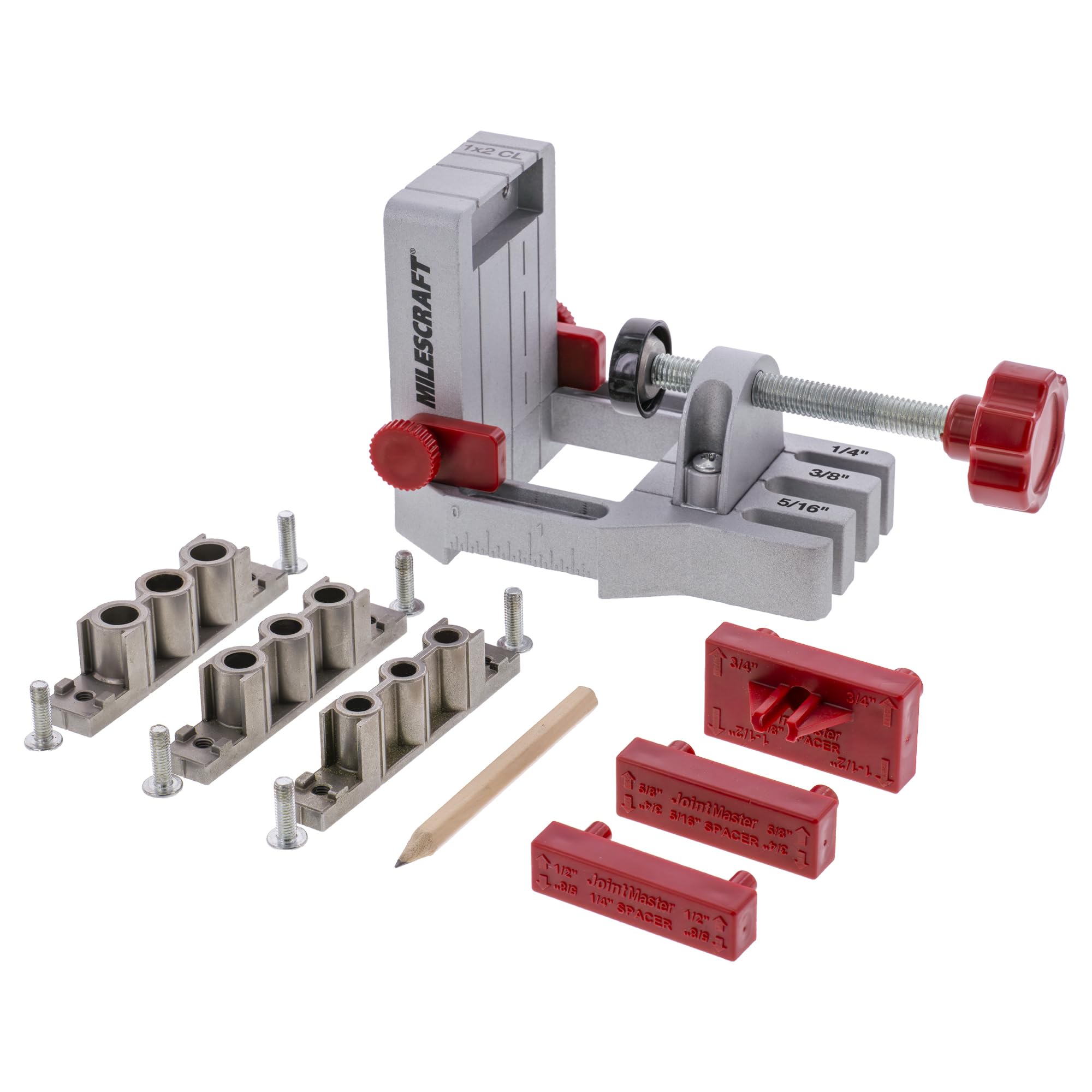
Sixteen ounces of aluminum that clamps itself onto the board and drills dowel holes without flexing. It takes 1/4 in, 5/16 in, and 3/8 in dowel pins, so the same jig covers a chair rail and a table apron. The retractable edge stops are the quiet hero: they align the second board automatically so the holes land in the same spot as the first. Hardened steel bushings then guide the bit straight through hundreds of holes without going oval.
Where this jig earns its keep is repeat work. A whole run of shelf pins or a full face frame comes out consistent because the stops do the measuring for you. Setup is fast enough that a one-off repair is still worth doweling instead of reaching for screws.
Adjustability draws mixed reactions — some find the alignment precise and repeatable, others find dialing it in for the first time takes patience. Read the instructions once before your first cut and that friction mostly disappears. On top of that, Milescraft backs it with a 3 year warranty.
The alignment payoff: retractable edge stops repeat hole placement board after board, which is exactly what dowel joints get wrong when done freehand.
The first-time friction: setting it up for a fresh dowel size takes care, and rushing that step is where alignment complaints start.
Reach for this if: you build cabinets or furniture where matching dowel holes across multiple boards is the whole job.
Think twice if: you want a tool that works from the start with zero setting up.
3. Eleon Self Centering Dowel Jig with Elongated Jaws
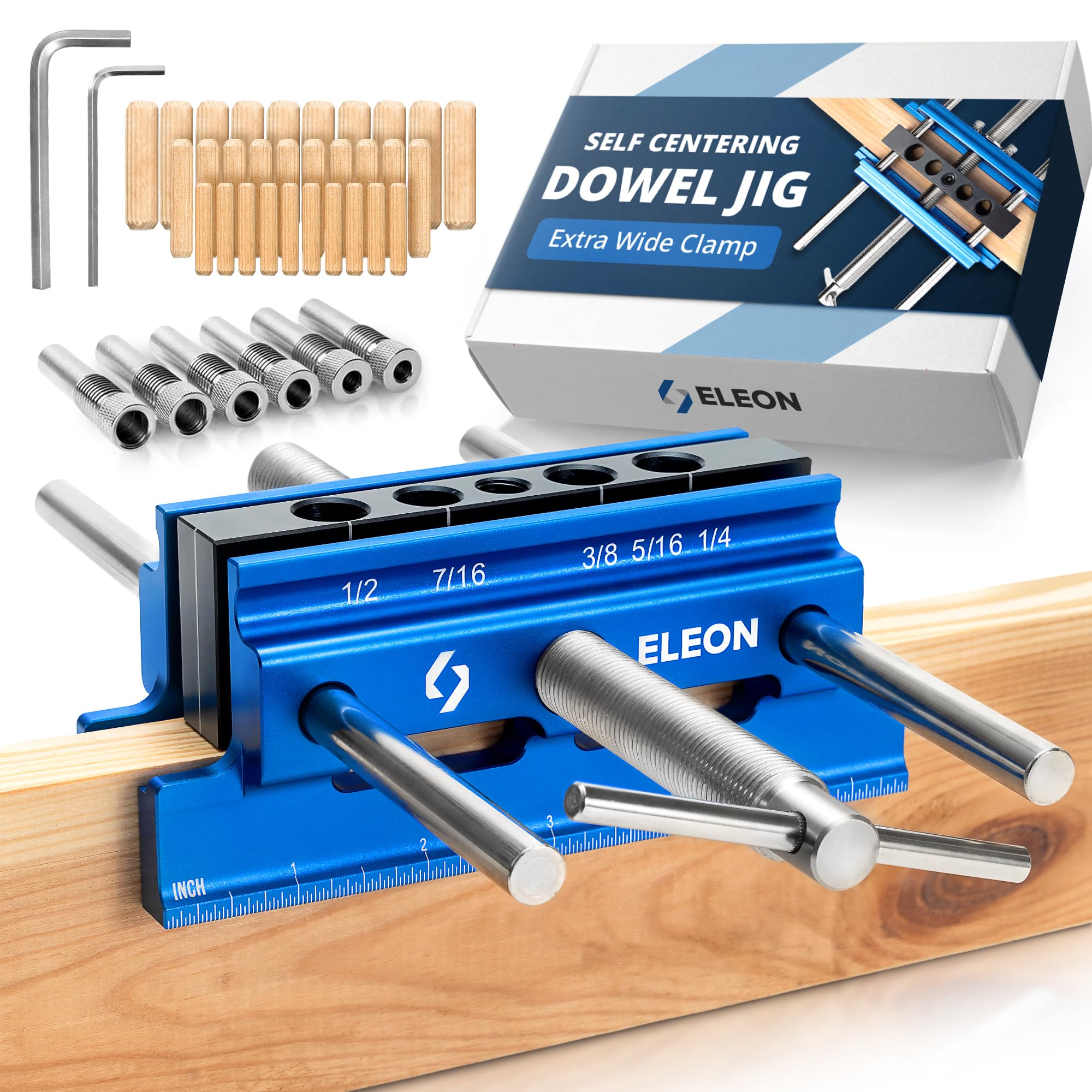
The clamp opens up to 6.7 inches and the jaws are elongated for grip — built for stock the narrow jigs cannot hold.
This is a genuinely heavy jig at 1.63 kg, and that mass is the point. Paired with the elongated jaws and their grip pattern, it sits on wide boards without shifting when you push the drill through. For context, the Temple Tool pull saw on this list weighs 0.32 kg — a big spread in hand-feel, and it tells you which tool is meant to be clamped down and left there. Ruler markings between the bushing positions let you space dowels without reaching for a tape every time. Six drill bushings and 30 dowels come in the box, so you can start a project the day it arrives.
Self-centering is the feature that matters most: the jig finds the middle of the board for you, so paired panels line up from either face. That is a real time saver on thicknesses where eyeballing the centerline goes wrong.
The trade-off is weight and bulk. It is the tool you leave set up on the bench, not the one you toss in a tote bag for a job site. The wide clamp is the reason — you are trading portability for the ability to hold thick stock steady.
Why the jaws matter: elongated clamping faces meet more of the wood than narrow side jaws, which cuts the chance of the jig twisting mid-drill.
Where it stays home: at 1.63 kg it lives on the bench, so site work means a lighter alternative.
Built for: benchtop doweling on wide or thick stock where a narrow jig slips.
Not the pick if: you need a jig that travels to jobs outside the shop.
4. Temple Tool Co. 9.5″ Ryoba Japanese Pull Saw

Two saws in one blade: rip teeth on one edge, crosscut on the other, so stock sizing and joinery share a single tool.
What wins people over on this saw is how it cuts — sharp from the wrapper, tracking straight, and slicing through hardwood rather than fighting it. The double edge is the reason it earns a place on a small bench. Rip teeth on one side cut with the grain, crosscut teeth on the other cut across it, so you can break down a board to length and then cut a tenon without swapping tools. Both edges are high carbon steel, and the saw is made in Japan.
The handle is solid wood in the walnut family with brass hardware, and it feels the way a good hand tool should in the palm. At 0.32 kg it is light enough for long sessions, and the pull stroke lets it use a thin, narrow-kerf blade that needs less force than a Western push saw. Tight spaces are where it shines — cutting a joint flush against an inside corner is far easier when the saw cuts on the pull.
One thing to accept up front: a general-purpose saw does not have the ultra-fine tooth count of a dedicated dovetail saw. If your work is all micro-precision on show dovetails, the SUIZAN above is the better fit. This one is the saw you reach for when the job is a mix of sizing, joinery, and general cutting.
The double-edge dividend: one blade covers ripping stock to width and crosscutting to length, which keeps your bench clear of a second saw.
The generalist limit: a versatile tooth pattern cannot match the 30 TPI finesse of a dedicated dovetail saw on show-grade work.
Take it if: you want one hand saw that handles both stock sizing and medium joinery.
Go finer if: every cut you make is a visible dovetail that has to look perfect.
5. GOINGMAKE All Metal Pocket Hole Jig Kit

Three pocket holes in one push, plus a vacuum port — the jig that keeps your bench clean while you learn the joint.
Pocket-hole joinery is the fastest way for a beginner to build a strong joint, and this kit is set up to make that first build painless. It drills three holes at once through 3/8 inch diameter drill inserts, and it adjusts across 1/2 inch to 1-3/4 inch material using inch and mm scales. The quick clamp holds the workpiece while you drill. A removable vacuum hose pulls chips away as you go, which is the difference between a clean bench and a sawdust shower.
The aluminum alloy body splits into two jobs: mount the whole thing on a workbench for large panels, or pull the drill guide out and use it standalone in a tight corner. Two drill bits, two screwdrivers, and a set of screws and plugs come in the kit.
The parts that draw split opinions are the drill bits and the clamp — plenty of builders find them serviceable, others find them the weak link over time. If you plan heavy daily use, budget for a spare bit as your first upgrade. That said, the dust collection is genuinely the feature people mention most happily, and it is what keeps this jig in rotation.
What it gets right
- Drills three aligned pocket holes in a single pass
- Removable vacuum hose keeps chips off the bench
- Fits material from 1/2 inch to 1-3/4 inch
- Aluminum body splits between bench mount and portable use
Where it asks patience
- Drill bits and clamp draw mixed feedback versus the metal body
- At 2 kg it is a bench fixture, not a pocket tool
Best first buy: a new builder who wants strong joints without years of hand-tool practice.
Hold off if: you already own a pro pocket-hole system and only need spare bits.
6. MICROJIG MatchFit Grid Router Guide

Every groove lands exactly 4 inches apart with no pencil line — a router guide for builders who hate layout work.
If you have ever snapped a chalk line across a 4×8 sheet and then chased it with a router, this guide is aimed straight at you. The self-indexing outer base steps along the panel and drops each dovetail groove at a fixed 4 inch on-center spacing. You set your depth once and route; the base handles the spacing. That means repeatable tracks across a full sheet or a small sled, with the same result each pass, and no marking at all.
It suits people building custom workbenches, jigs, or sleds who want MatchFit dovetail clamps running in clean rows. Most standard routers with 4 inch to 7 inch bases and 1 HP to 3 HP motors will accept it. You will need a 1-3/8 inch Porter-Cable style bushing plate or adapter, plus a 1/2 inch by 14 degree dovetail bit and a 1/4 inch relief bit, all sold separately. The guide itself is high-grade plastic, made in the USA.
The honest note is the price-to-value question. The build is solid and the indexing works, but the bits and bushing are extra purchases, and the value verdict splits between “worth it for a shop fixture” and “more than I expected.” It is also the most niche tool on this list — buy it because you want a dovetail grid, not as a general router accessory.
Zero layout, by design: the indexing base fixes groove spacing at 4 inches, so long panels come out uniform without a single pencil mark.
Count the extras: the dovetail bit, relief bit, and bushing plate are not in the box, so the real cost of entry runs above the guide alone.
Pick it for: building a shop bench or jig sled that needs evenly spaced dovetail tracks.
Skip it for: one-off routing jobs that do not need a repeating grid.
7. Milescraft 1311 Joint Pro All Steel Doweling Jig
Clamp two boards at once and drill six matching holes per setup — the all-steel jig built for production runs.
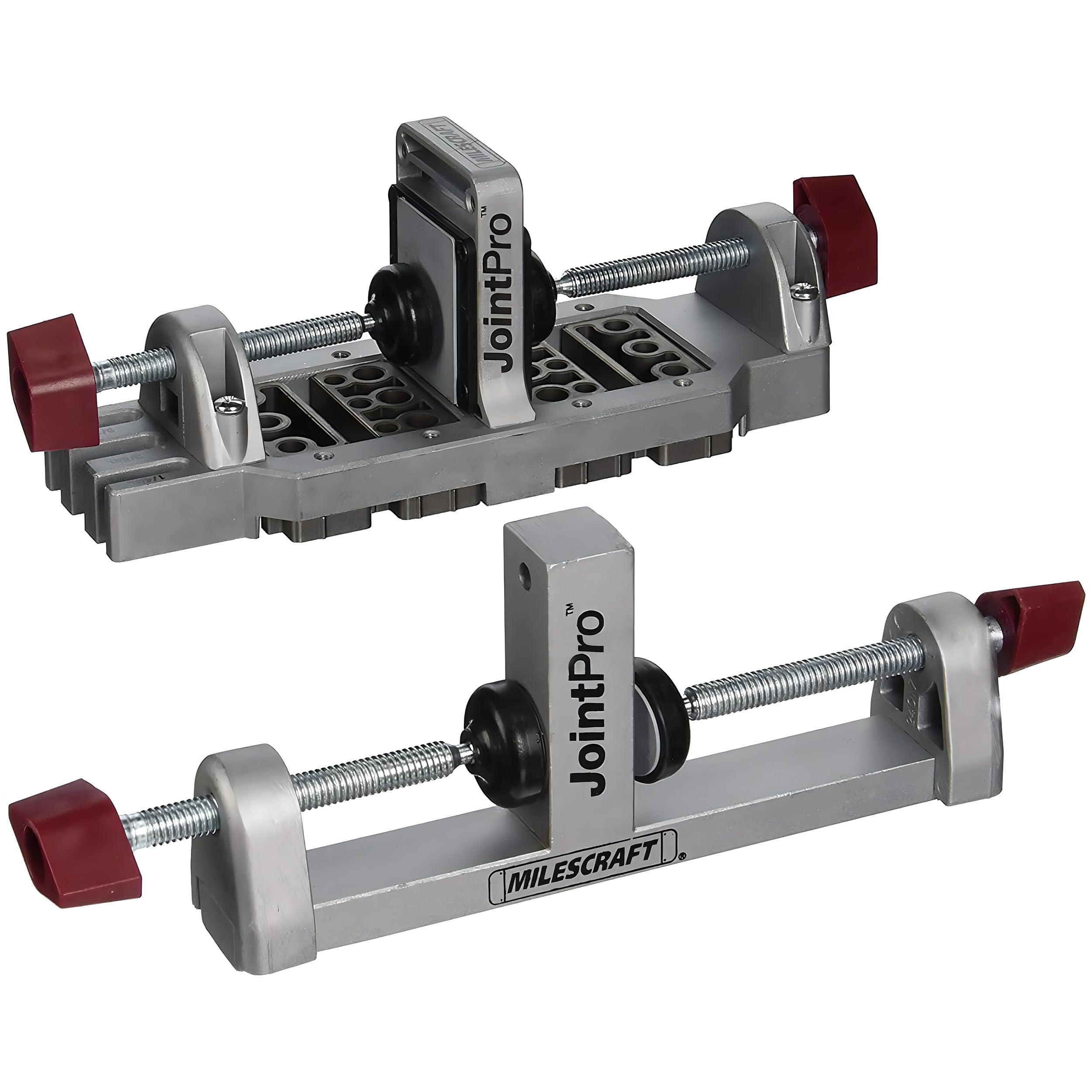
The Joint Pro is the heavier-duty sibling of the Joint Master on this list, and the difference is in how much it does per pass. It clamps both boards at the same time, so the hole in board A and the hole in board B are guaranteed to line up. From that single setup you drill up to six matching holes, which is what makes a stronger, longer-lasting joint. Hardened steel bushing blocks guide the bit for 1/4 in, 5/16 in, and 3/8 in dowels, up to three of any size at a time. Corner, edge, and surface joints all come with detailed instructions.
This one is easier to assess than most because its advantage is concrete: fewer setups means fewer chances to drift out of alignment. If you are running a batch of cabinet parts or building a set of chairs, the two-board clamping alone saves real time.
Do double-check your board dimensions before you buy — Milescraft asks you to verify imperial or metric sizing against your project, and a jig that is right for one stock thickness can be wrong for another. That one check avoids most of the frustration.
Straight from the spec sheet
- Clamps both boards together for guaranteed hole alignment
- Drills up to six matching holes per setup
- Hardened steel bushings in three dowel sizes
- Covers corner, edge, and surface joints
The fine print
- You must confirm your stock dimensions match the jig before buying
- Heavier and pricier than the basic Joint Master
For the production bench: anyone drilling repeated dowel joints who wants two boards aligned in one clamp.
Not the fit if: you only ever need a single hole and want the smallest possible jig.
8. Rockler Router Table Box Joint Jig
Solid brass indexing keys in three widths keep every finger on a box joint the same size — the router table route to tight drawers.
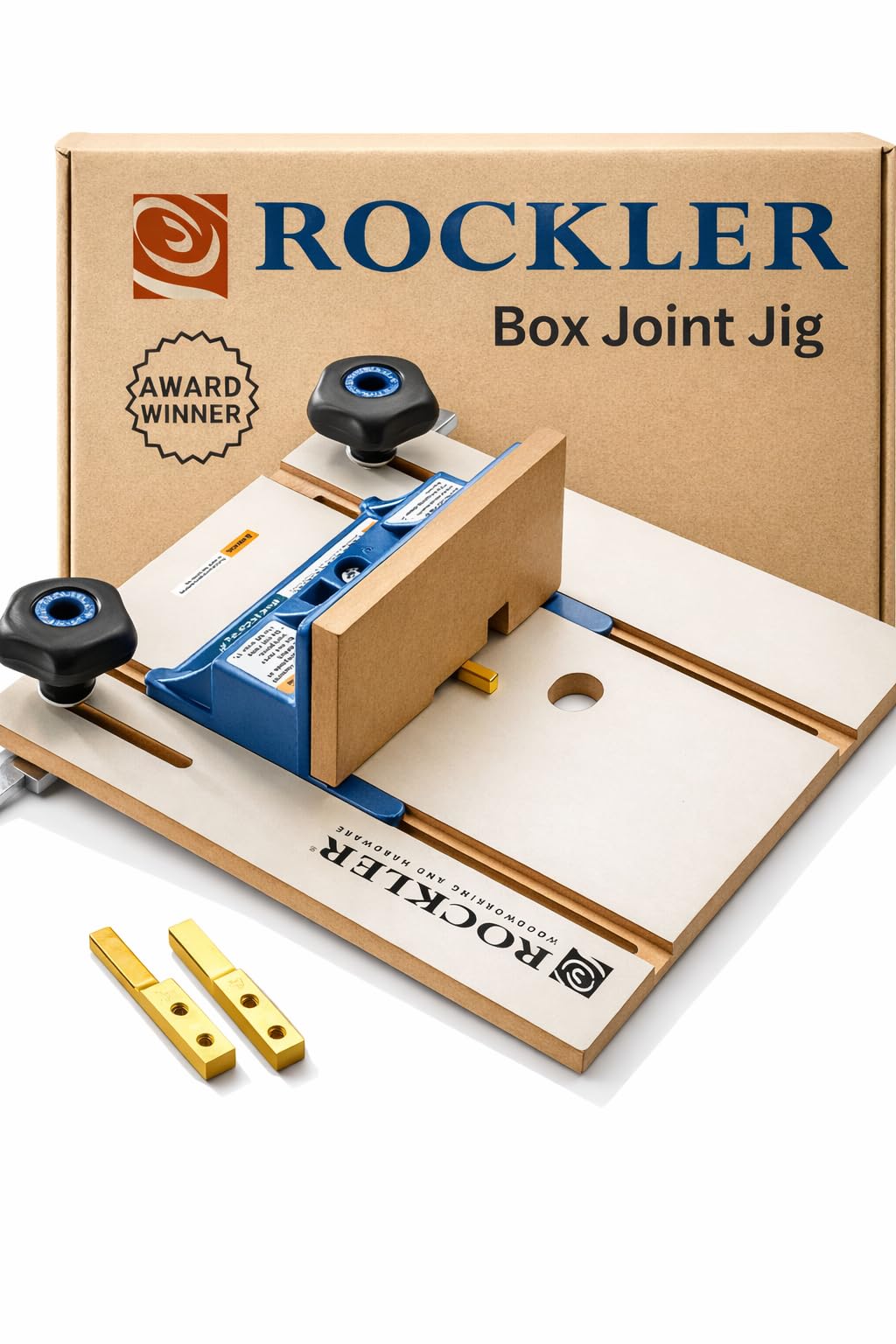
Box joints are the workhorse joint for small to medium boxes, and precision-machined brass keys are what make them repeat. You get three key widths — 1/4 in, 3/8 in, and 1/2 in — and the design lets you swap them and store them right on the sled. The sled rides in a 3/4 inch miter slot on long skis that keep it square to the router bit, with tabs that stop the cut at the right depth. Soft-grip knobs lock the platform down.
The platform is melamine-coated MDF, which keeps the sled sliding easily and takes router bit lubricant to extend its life. A sacrificial fence face controls tear-out on the back edge. What wins people over is simply that it makes good, tight box joints without a lot of fiddling — the jig does the spacing, you do the routing.
Here is where it needs care. The sled can wobble by around 1/16 inch, and some buyers find it does not seat cleanly in certain router tables, Craftsman among them. Softer build quality than expected is the other recurring note. Measure your miter slot before you commit, and a few swipes of masking tape on the skis will tighten a loose fit. Buy it for what it does well and check the fit to your table first.
The spacing engine: machined brass keys in 1/4 in, 3/8 in, and 1/2 in widths give you uniform finger spacing in each size without recalculating anything.
The fit check first: the sled can shift a little and does not seat perfectly in every router table, so confirm your miter slot before you rely on it for a full run.
Choose it if: you build boxes and drawers on a router table and want fast, repeatable finger spacing.
Reconsider if: your router table has an unusual miter slot you cannot confirm against the sled.
9. CMT300 Universal Dovetail Jig
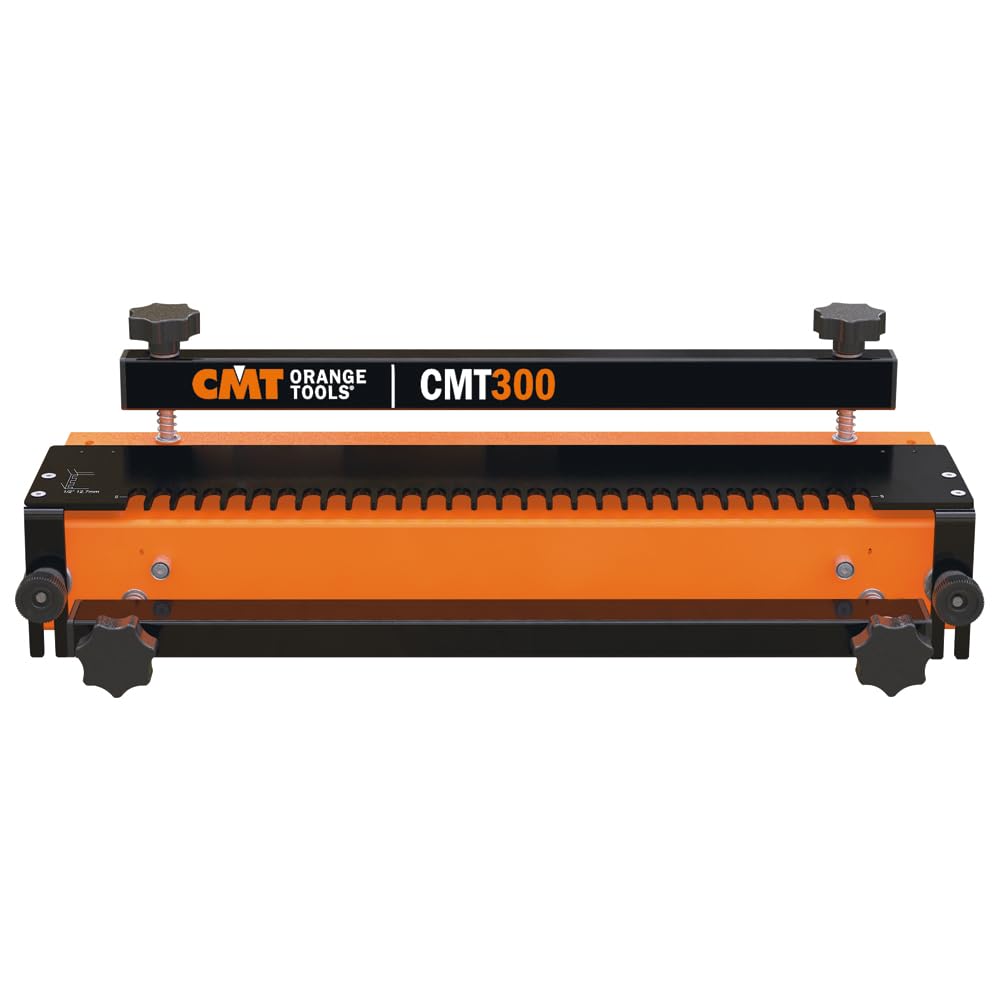
A steel-bodied dovetail jig that takes stock from 7/16 inch to 1 inch and clamps it against factory-set stops.
This is the heaviest tool on the list and built like it — a steel body with templates, stops, and clamping bars that come dead square. Setup is deliberately short: clamp the workpiece with its edges against the factory-set stops, set the bit depth, and rout. The standard jig includes a template for 1/2 inch half-blind joints plus a template guide, which covers the dovetail drawer front most cabinet builders start with. It accepts stock from 7/16 inch up to 1 inch thick, so the same jig spans drawer sides and thicker carcass parts.
Where it makes the most sense is for anyone routing repeated half-blind dovetails who wants a rigid platform that will not flex under the router’s weight. Steel does not move the way plastic and MDF can. That solidity is the reason to pay for a premium jig.
Two things to weigh. First, the templates and setup are set for specific joints — additional template styles for other joints are bought separately, so plan your projects around the 1/2 inch half-blind template or budget for more. Second, its bulk means it lives bolted to a bench; this is not a knocked-down-and-stored tool.
Rigidity as the reason to buy: the steel body, templates, and clamping bars hold square without deflecting, which is exactly what a router weighing on a jig needs.
Templates beyond the box: the included 1/2 inch half-blind template covers drawer dovetails, but other joint styles need extra templates bought separately.
Made for: cabinet builders routing repeated half-blind dovetails who want a rigid, factory-set jig.
Think ahead if: you want finger joints or through dovetails from the same jig with no add-ons.
Know the Specs
Kerf and blade thickness
Kerf is the width of the slot a saw removes. The SUIZAN dovetail saw cuts a 0.012 in kerf with a 0.008 in blade, which is about the thickness of three sheets of paper. Thin kerf means less wood removed and less force needed, so you can shave a joint to final fit without splitting the pin.
Teeth per inch (TPI)
TPI counts the teeth in one inch of blade. Higher TPI cuts slower but leaves a smoother surface. The SUIZAN’s 30 TPI crosscut pattern suits fine joinery and visible shoulders, while a general-purpose pull saw uses a coarser pattern that cuts faster on stock sizing.
Drill bushings and indexing stops
On a doweling jig, the hardened steel bushing keeps the bit travelling straight, and edge stops or indexing keys repeat the hole placement. That repetition is what makes the second board line up with the first — the single most important spec on a drill-alignment jig.
Router jig indexing
Router jigs use indexing to set spacing automatically. The MICROJIG guide spaces dovetail grooves exactly 4 inches on center; the Rockler box joint jig spaces fingers with 1/4 in, 3/8 in, and 1/2 in brass keys. Both remove the tape measure from the job.
Common Questions
What is a kerf and why does it matter for a dovetail joint?
Can a doweling jig replace a domino or loose-tenon machine?
Is a Japanese pull saw better than a Western push saw for joinery?
What router do I need for the MICROJIG MatchFit router guide?
Will the Rockler box joint jig fit my router table?
What stock thickness does the CMT300 dovetail jig accept?
How long do the teeth last on a thin-kerf dovetail saw?
Do pocket hole joints leave a visible mark on the finished piece?
Do I need a router table to make box joints?
Which of these tools is best for a complete beginner?
The Bottom Line
The woodworking joint tools winner is the SUIZAN Dozuki Dovetail Saw, because its 0.008 in blade and 0.012 in kerf let you hand-cut dovetails and tenons with a level of fit that is hard to match any other way — and it stays fuss-free. If you build in volume and want the jig to do the alignment, grab the Milescraft 1334 Joint Master for its self-clamping edge stops, or the Milescraft 1311 Joint Pro when you need six holes per setup across two boards. And for cabinet runs, the CMT300 is the one to reach for when rigid, factory-set half-blind dovetails matter more than portability.
How we choose
We do not accept paid placement. Every pick is matched to a real buyer and a real use-case; we do not hands-on test units.
Sources
Specifications: manufacturer listings and product documentation. Review insights: verified customer reviews, as of November 2026. Pricing: not shown on this page (it changes often); check the current price via the retailer link.
As an Amazon Associate, Tactical Gear Guy earns from qualifying purchases. This does not affect which products we feature.