Specs are compiled from manufacturer listings and verified buyer reviews and can change over time — please confirm the key details on the product page before buying.
You want a saw that will not throw your board off line halfway through a rip cut. This guide ranks the serious woodworkers table saw choices by what actually saves your cuts — a fence that locks where you set it, a table heavy enough not to chatter, and enough rip capacity to handle a full sheet of plywood without a wrestling match.
This guide is built by comparing the manufacturers’ published specifications and the patterns across verified customer reviews, so you get each pick’s real strengths and trade-offs instead of marketing spin.
A table saw is the one tool where a bad fence turns good lumber into scrap. Below you’ll find the fence systems, rip capacities, motor sizes, and voltage realities broken down in plain English — including which saws run on household current and which need a dedicated shop line. Every pick here earns its place through measurable specs — rip capacity, fence lock, motor draw — not brand noise.
Top Picks


How To Choose The Best Woodworkers Table Saw
Start with the fence, not the motor. On a table saw the fence is the part you touch every single cut. If it shifts a hair when you lock it down, your boards come out tapered and your square cuts go out the window. The best woodworkers table saw for you is the one whose fence holds its setting and whose table stays flat, because those two things decide whether your rips repeat.
Rip capacity above the blade
Rip capacity is how far the fence slides from the blade — the number that decides whether you can break down a four-foot panel or only trim narrow stock. A 30-inch fence handles most furniture work. Push past 36 inches and full sheets and cabinet sides stop fighting you. Check the left-side capacity too, since some saws only give you a few inches on that side.
Motor size, amperage, and what your shop can feed it
Horsepower tells you how hard the saw can push through thick hardwood without bogging. But amperage and voltage decide whether it runs at all. A 115V saw can plug into a dedicated household circuit. A 240V cabinet saw needs a different line run to your shop first. Match the motor to your wiring before you fall for the spec.
Cast iron versus stamped steel
A cast iron top and wings add mass, and mass is what keeps the saw from vibrating mid-cut. Stamped steel wings save weight and cost but can buzz under load. If your work is precision joinery, the heavier table tends to be worth the extra effort to move it into place.
Fence styles and safety hardware
Rack and pinion fences move smoothly along toothed rails. T-square fences lock onto a steel tube with a lever. Both can be accurate — what matters is that the lock is firm and the cursor reads true. Look for a riving knife and an independent blade guard, because those are the pieces that keep kickback and exposed blade away from your hands.
Side-by-Side Comparison
| Model | Best For | Rip Capacity | Motor / Current | Weight | Amazon |
|---|---|---|---|---|---|
| Bosch Professional GTS 10 XC★ Best Overall | Accurate rips on a smaller footprint | 635 mm right / 250 mm left | 2100 W | 35 kg | Amazon |
| Delta 36-6023Folds and Rolls | Folding portability on a budget | 32.5 inches | 15 A | 77 pounds | Amazon |
| SKIL SPT99-11 Worm DriveWorm Drive Torque | Cutting thick stock with one person | 30-1/2 inches | Worm drive | 94.3 pounds | Amazon |
| Makita MLT100N/2 | Wide cuts with extension tables | Extension tables both sides | 1500 W, 240V | 34.1 kg | Amazon |
| Shop Fox W1837 | Hybrid build with rolling mobility | — | 2 HP, 20 A | 260 pounds | Amazon |
| Laguna F2 Fusion | Serious shop accuracy and dust control | 36 inches | 1.75 HP, 110V | 359 pounds | Amazon |
| Grizzly G1023RLX | Long rails for big panels | 7 ft rails | 3 HP, 240V, 14A | 402 pounds | Amazon |
| Grizzly G0651 | Big cabinet saw with left tilt | Wide extension table | 3 HP, 220V, 13A | 435 pounds | Amazon |
| Powermatic PM1000 | Cabinet accuracy on household power | 52 inches right / 12 inches left | 1-3/4 HP, 20 A | 393.8 pounds | Amazon |
| Delta UNISAW 36-L352 | Heavy production ripping | 52 inches | 3 HP, 220V | 674 pounds | Amazon |
| JET Deluxe XACTA | Quiet, smooth cabinet cuts | 30 inches right / 12 inches left | 3 HP, 230V | 330 lb net | Amazon |
Detailed Reviews
1. Bosch Professional table saw GTS 10 XC
Our pick — 4.5+★ from 4,000+ verified ratings; the strongest balance of quality and price.
The precision-first saw that puts 635 mm of cutting reach on your right side.
Here is the number that wins work: 635 mm of cutting capacity to the right of the blade. That is roughly 25 inches of rip, which means cabinet sides, shelf stock, and most furniture panels clear the fence without you flipping the board around. Add 250 mm to the left and you get decent room on both sides of the blade for a saw this size.
The motor spins the 254 mm blade at 3,200 rpm — a no-load speed that keeps a clean, fast entry into hardwood. A 254 mm blade is your standard 10-inch size, so blades are easy to source when you want a finer-tooth rip or a crosscut. The 30 mm bore is note, because blades must match that arbor hole or they will not sit true.
The trade-off is weight and the fence setup. At 35 kg this is a saw you move with a helper, not one you tuck under a bench. Assembly also asks you to dial in the parallel stop and angle stop yourself — the maker ships them as loose components, so budget a session to square everything before your first real cut. Owners who take that time describe the results as dead-on.
What Earns It First Place
- 635 mm rip capacity right of the blade clears wide panels
- 3,200 rpm no-load speed keeps cuts fast and clean
- 254 mm blade size is easy to replace and upgrade
- On-tool storage for a spare saw blade keeps you working
Where It Asks More Of You
- 35 kg means two people to reposition it
- Parallel stop and angle stop need squaring on setup
Built for: the woodworker who values repeatable, accurate rips over portability and works in a fixed shop spot.
Know first: that 35 kg body and the setup dialing are real — this is a stay-put saw.
2. Delta 36-6023 10 Inch Table Saw with 32.5 Inch Rip Capacity
A 77-pound contractor saw that folds up and disappears when the shop gets small.
Compare this to the Laguna in the same lineup and the gap is dramatic — 77 pounds against 359 pounds. That is the whole pitch for the Delta: it folds, it stores, and one person can wheel it out of the way. In a garage shop that doubles as parking, that flexibility is not a nicety. It is the reason the saw gets used.
A 15 A contractor-grade motor runs on standard household power, so there is no new circuit to run before your first cut. The 32.5-inch rip capacity is enough for most home furniture work and shelf stock. The rack and pinion fence glides along toothed rails — the mechanism buyers single out for being accurate right from the start once you set it.
The honest caveat is assembly. Reports split between a straightforward build and a job that takes real effort to get square. Give yourself an afternoon and a decent square, and the saw rewards the patience. Some owners also note the light build flexes slightly under heavy load, which is the price you pay for that 77-pound frame.
The value read: for a first serious saw in a shared or temporary space, the fold-up portability and the 15 A household-friendly motor make the Delta an easy entry point. Durability comments tilt mixed, so treat it as a care-for-it tool rather than a production workhorse.
Reach for this if: your shop is a garage that needs to be a garage again by evening.
Look elsewhere if: you plan to rip thick hardwoods all day — the light frame wants lighter duty.
3. SKIL SPT99-11 Worm Drive Table Saw
Worm drive gearing that eats through thick oak without a second person helping.
Depth of cut is what separates this saw from the pack. A 3-5/8 inch capacity means you can slice through stock that leaves contractor saws stalling. Worm drive gearing trades speed for torque, and the result is a motor that keeps pulling when a thick board loads it down. As the review pages sum it up: “Customers find this table saw performs exceptionally well, with a powerful worm drive motor and easy assembly that takes about 20 minutes.”
The 30-1/2 inch rip capacity and rack and pinion fence handle wide cuts, while the outfeed and left support let one person manage a bigger board alone. That support system is the quiet feature that makes this saw work solo. Dust collection routes debris to one spot through the port elbow, which keeps cleanup simple.
What wins people over is raw performance — buyers talk about it more than anything else, and power comes second. The 16-inch wheels and easy-load handles on the rolling stand make the 94.3-pound saw far easier to move than the number suggests. The mixed notes come on adjustability and blade durability, so expect to fine-tune the settings and plan on replacing the stock blade sooner than a premium one.
Who it suits: the builder cutting thick hardwoods alone. The depth of cut and torque carry cuts a lighter saw cannot, and the support arms turn one-person panel work into a real option.
Pick it for: thick-stock ripping with no helper on hand.
Factor in: the stock blade and the dialing-in — both want attention early.
4. Makita MLT100N/2 240V 260mm Table Saw

Slide-out extension tables turn a compact saw into a big-panel ripper.
The design hook here is the extension tables. A left extension with smooth sliding action and a right and rear extension add cutting capacity without making the base itself enormous. If you break down full sheets regularly, that built-out surface changes how much of a board you can support on the table.
Cutting depth is a useful 93 mm at 90 degrees and 64 mm at 45 degrees, so bevel and square cuts on thick stock stay within reach. The 260 mm blade is slightly larger than a standard 10-inch size, and it is tungsten carbide tipped. The 1500 W motor runs on 240V, so confirm your shop line before committing.
Everyday usability shows in the small choices. The safety guard installs and removes without a tool, and a see-through guard keeps the blade and cutting line visible while you work. On-tool storage holds the accessories you reach for most. The 34.1 kg weight sits close to the Bosch at 35 kg, so both ask for a fixed spot or a helper to move.
Why It Works For Panel Work
- Left, right, and rear extensions add surface for wide cuts
- 93 mm depth at 90° handles thick stock
- Tool-free guard removal speeds changeovers
- See-through guard keeps the cut line visible
Before You Commit
- 240V motor needs the right shop circuit
- 34.1 kg is heavy to reposition alone
Its strength: extension-table surface for wide panel cuts on a saw that still fits a mid-size shop.
Check first: that 240V feed — it will not run on a standard household outlet.
5. Shop Fox 10 in. 2 HP Open-Stand Hybrid Table Saw W1837

A hybrid cabinet-style saw with wheels that make a 260-pound machine liftable.
Hybrid saws split the difference between contractor and cabinet classes, and the Shop Fox leans into that middle ground. A 2 HP motor draws 20 A, so it needs a dedicated circuit, but it gives you more push than a 15 A contractor saw. The 260-pound body is heavy enough to sit stable yet built with mobility in mind.
That mobility is a real highlight. Steel wings and wheels let you lift and move the saw short distances, which matters in a shop where the saw does not have a permanent home. The riving knife and blade guard are easy to install and remove, a detail that keeps safe cutting quick rather than a chore.
What earns it trust is the build and the assembly — buyers praise both most, with build quality and accuracy close behind. The mixed notes land on adjustability and on whether the value holds up, so set expectations: this is a good saw for the money, not a top-tier cabinet machine. Owners who want a heavy, movable hybrid will be happy. Those chasing machine-shop precision should keep reading.
A fair summary: the hybrid build and the wheels make the Shop Fox a sensible step up from contractor saws for a shop that still needs to move things around. Adjustability is where you may spend extra tuning time.
Right for: a woodworker upgrading to a heavier saw without giving up the ability to roll it around.
Set expectations on: heavier motor means a dedicated 20 A circuit, and the fence may need fine-tuning.
6. Laguna 10″ Table Saw, 36″ Rip, 1.75 HP, 110V 1Ph (F2 Fusion)
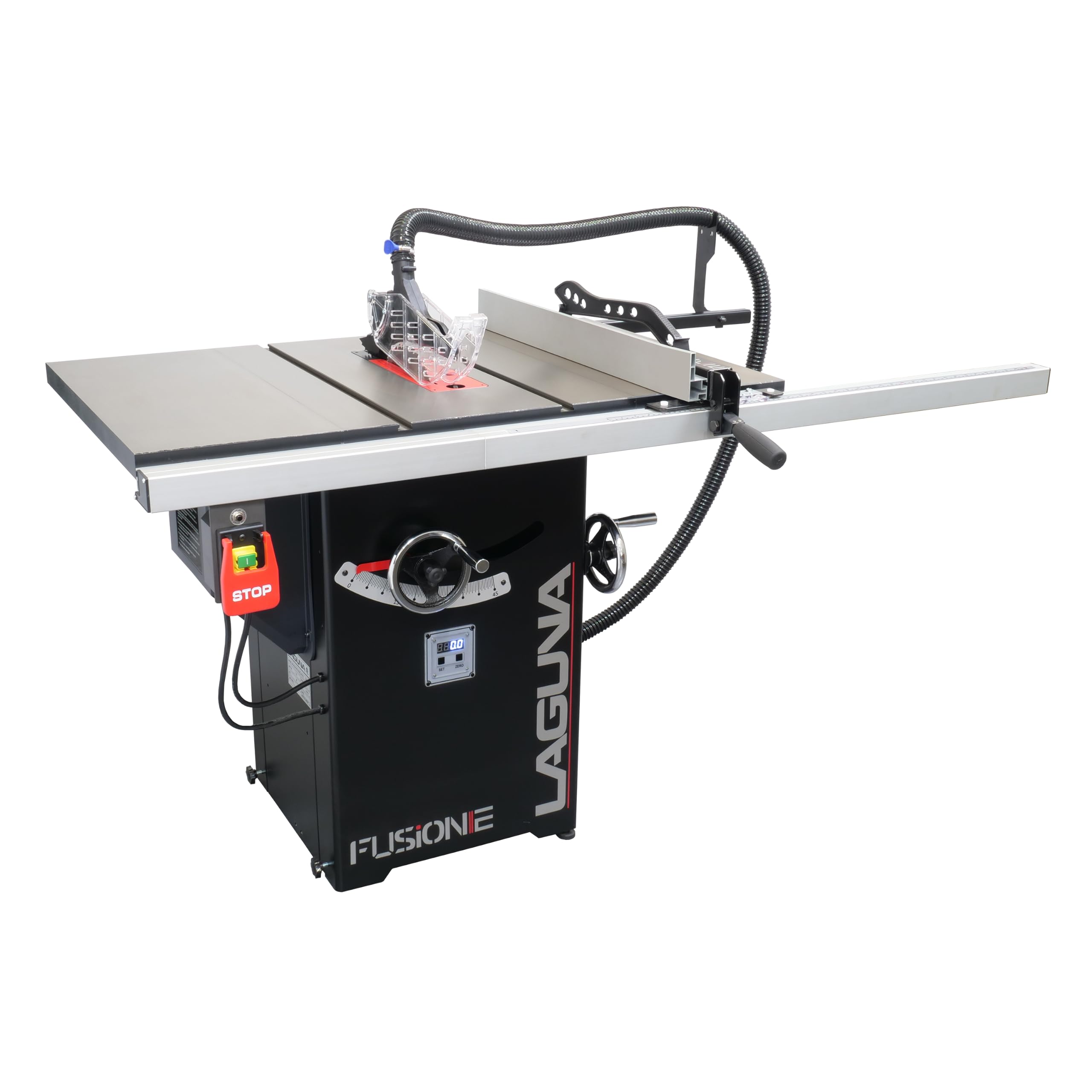
A cast iron hybrid that runs on 110V and pulls 36 inches of rip capacity.
Here is the spec that matters for a home shop: a 1.75 HP TEFC motor that runs on 110V. You get cabinet-style cutting on household power, with no new 240V line to install. The enclosed TEFC motor is built to shrug off sawdust, which is exactly the environment it lives in. Rip capacity reaches 36 inches through a Hi-Lo hybrid fence on extended steel rails.
Compare that 36-inch rip to the Delta’s 32.5 inches and the Laguna gives you more fence travel for wide boards. Cast iron table and wings, premium arbor and motor bearings, and a body-mounted trunnion combine for a stable, vibration-resistant cut. The 10-inch carbide blade cuts up to 3-1/8 inch deep at 90 degrees and 2-1/8 inch at 45 degrees.
Dust collection is where it quietly wins. A sealed cabinet bottom, a 4-inch dust port, and over- and under-blade collection pull sawdust from two directions, so the shop stays cleaner and the blade runs truer. The catch is mass: at 359 pounds it absolutely dominates a floor and will not be moved casually. It also dwarfs the Delta’s 77-pound frame — which is the point if you are settling in for good. Setup earns praise, with the riving knife called simple to square.
The Case For The Laguna
- 36-inch rip capacity tops the Delta’s 32.5 inches
- Runs on 110V — no 240V line needed
- Sealed cabinet and 4-inch dust port for cleaner air
- Cast iron table and trunnion steady every cut
The Reality Check
- 359 pounds is a permanent-floor machine
- Footprint is huge, at 66.81″L x 65.75″W
Choose it when: you want cast iron accuracy and good dust control while staying on 110V household power.
Plan for: a dedicated footprint — that 359-pound body and 66.81-inch length are not going anywhere.
7. Grizzly Industrial G1023RLX Cabinet Table Saw

Seven-foot rails and a 3 HP motor built to rip full sheets without a second cut.
The defining feature is the rail length — seven feet of fence travel means full-sheet panel breakdown becomes routine. A 3 HP, 240V, single-phase motor drawing 14 A drives the blade at 3450 RPM, so thick stock meets plenty of torque. Note the amperage against the Shop Fox’s 20 A: the Grizzly runs a lower current for more horsepower, thanks to its 240V feed.
The table is built to stay flat under load. A solid cast iron top is first heat treated for strength, then milled flat and ground to a mirror-like finish. That is a table you can trust for a straight edge across a wide panel. T-slots keep your miter gauge from sliding off when retracted, and a generous 44″ x 27″ extension table adds support.
A 5/8-inch diameter arbor is long enough to accept dado blades up to 13/16 inch wide, so cutting grooves and dados is on the table. The honest note here is that this is a 240V cabinet saw for a dedicated shop — it asks for a real circuit and a permanent floor spot, and its 402 pounds confirm it.
Bottom line: for panel breakdown and groove cutting on thick material, the 7-foot rails and 3 HP motor do the heavy lifting. Plan the 240V circuit and floor space before it arrives.
Suited to: a dedicated shop that rips full sheets and cuts dadoes regularly.
Worth knowing: the 240V feed and 402-pound frame mean it stays where you put it.
8. Grizzly Industrial G0651 Cabinet Table Saw
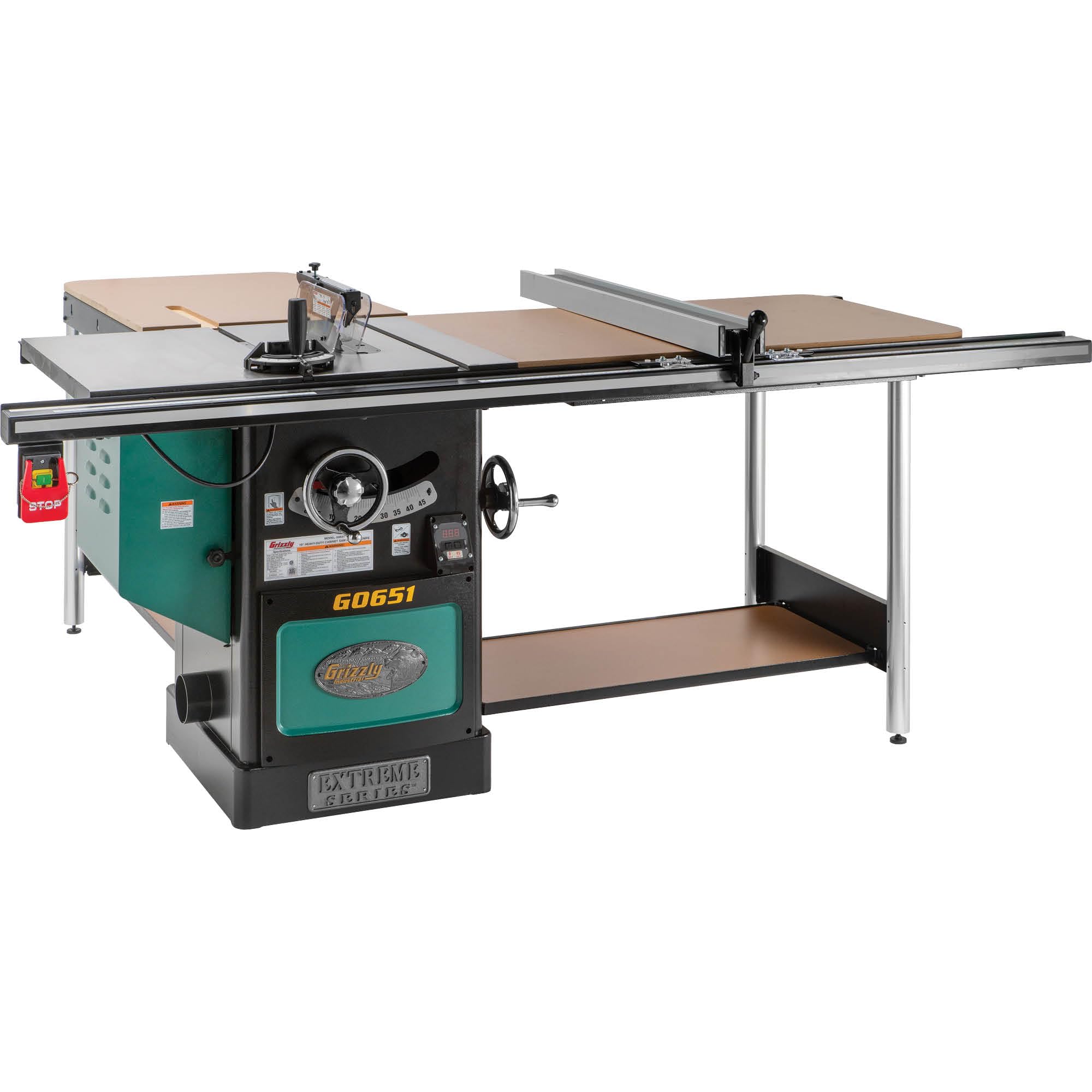
A left-tilt cabinet saw with a 27″ x 75-3/4″ table built for production-size work.
Table size is the headline. With the extension in place the surface measures 27″ x 75-3/4″, giving you a long, wide run-up for long boards and panels. The 3 HP, 220V, single-phase motor draws 13 A, and the blade tilts left up to 45 degrees — handy for bevel cuts where you want the material to stay against the fence.
A 435-pound body anchors the saw firmly, which helps the cut stay smooth when you feed heavy stock. The table height from the floor is 34-7/8 inches, a comfortable working height for most benches. The saw arrives as a bare tool, so expect to add your own blade before the first cut.
The real caution is the power and the footprint. This is a 220V cabinet saw that needs proper wiring and a large dedicated space — the 91.5″ x 75″ footprint is not a garage corner. If you have the shop for it, the left-tilt design and long table make it a capable machine. If your feed is a standard household line, look at the 110V Laguna instead.
Where It Shines
- 27″ x 75-3/4″ table suits long boards and panels
- Left tilt to 45° keeps material against the fence on bevels
- 3 HP, 220V motor holds up under heavy stock
- 435-pound body steadies the cut
What It Requires
- 220V circuit and a large dedicated shop space
- Bare tool — blade sold separately
Made for: a large shop that needs a long table and left-tilt bevels on thick stock.
Sort out first: the 220V line and the 91.5-inch footprint before it ships.
9. Powermatic PM1000 Cabinet Table Saw
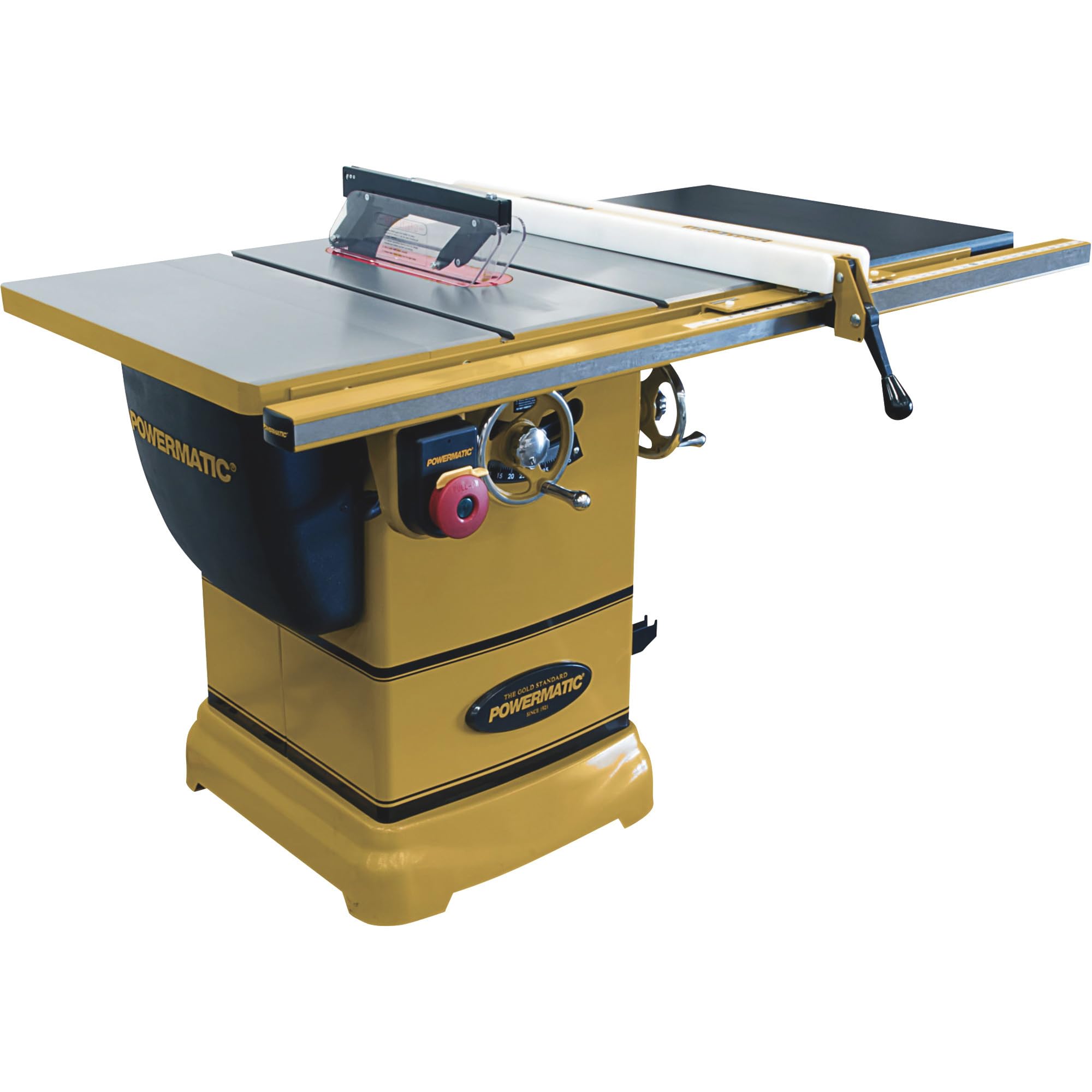
A cast iron cabinet saw with 52 inches of rip that plugs into a household circuit.
This is the saw for the woodworker who wants cabinet-class accuracy but cannot run a 230V line yet. The 1-3/4 HP TEFC motor comes prewired for 115V and plugs into a dedicated 20 A circuit, and it can be rewired for 230V later if you upgrade the shop. Rip capacity reaches 52 inches to the right of the blade and 12 inches to the left with the Accu-Fence.
The Accu-Fence rides a steel guide tube on a 2″ x 2″ front rail with a three-position lock lever — up to lift the fence off, middle to slide, down to lock. Clamping pressure adjusts, and a cursor reads the scale on the tube. The ground cast iron table and two cast iron wings make a 40″ x 27″ top with two 3/4-inch miter slots, and a cast iron trunnion sits inside an enclosed steel cabinet.
What buyers praise most is the build — well-made, easy to assemble, and clear to follow. The 1-3/4 HP motor cuts 3-1/8 inch deep at 90 degrees and 2-1/8 inch at 45 degrees, and it handles 10/4 hardwoods smoothly. The catch is that this is a cabinet saw built for home and small-pro shops, not continuous heavy production. For all-day ripping on thick stock, a 3-5 HP cabinet saw on 230V is the better fit.
My honest read: the 52-inch Accu-Fence and cast iron top give serious accuracy on 115V, which is rare pairing. A 4-inch dust port and a 350 CFM collector requirement mean you should plan your dust setup alongside the saw.
Go for it if: you want a real cabinet saw without running 230V to the workshop.
Consider the step up if: big production ripping is your daily work — that wants a 3-5 HP, 230V machine.
10. Delta UNISAW 36-L352

A 674-pound Unisaw with a 3 HP motor and the Biesemeyer fence at 52 inches.
The centerpiece is the Biesemeyer fence system, a design that lets you make precision cuts every time and even has a feature for cutting small pieces of stock. A 3 HP, 220V Marathon motor is built to handle demanding production work. A single-cast trunnion system delivers strong vibration control, which keeps the 674-pound machine running smoothly through heavy stock.
The bevel dial tunes the blade angle to within 1/4 degree, giving you fine control on angled cuts. This is a serious machine for someone running volume, and the 52-inch rip capacity handles wide panels. The 674-pound weight is the highest in this lineup — it does not move once placed.
One thing to know before ordering: this ships in four boxes — the saw body, the fence rails, the fence and legs, and the extension table. If a component is missing, the guidance is to accept the shipment and contact the seller rather than return the whole unit, and the missing part gets expedited to you. That is worth understanding so a partial delivery does not throw your build day.
What It Delivers
- Biesemeyer fence for precision, repetitive cuts
- 3 HP, 220V motor for demanding production work
- Single-cast trunnion controls vibration
- Bevel dial accurate to within 1/4°
Set Your Plans For
- 674 pounds — a fixed, permanent installation
- Ships in four boxes; check each one on arrival
For the volume shop: the 3 HP Unisaw and Biesemeyer fence are built for repetitive production cuts.
Weigh it against: the 220V line, the 674-pound footprint, and the four-box delivery.
11. JET Deluxe XACTA Cabinet Table Saw

Poly-V belt drive and chrome handwheels on a 3 HP cabinet saw that runs quiet.
A 3 HP, 230V single-phase motor drives a 5/8-inch arbor at 4,300 RPM through a Poly-V belt, which the maker describes as a smooth, quiet power transfer. The commercial-grade XACTA Fence II uses a T-square design that glides easily and locks down firmly, ripping up to 30 inches right of the blade and 12 inches left. Reviewers describe the saw as one that “purrs when running,” and accuracy is a consistent theme.
The cast iron top is precision-ground with a beveled front edge, and two 11-inch cast iron extension wings bring the surface to 29″ deep x 42″ wide at a 34-inch working height. A wide-stance trunnion and chrome-plated handwheels give smooth blade height and left-tilt (0-45°) adjustment with 90° and 45° positive stops.
Safety is well sorted: a quick-release riving knife comes off without tools, and an independent-leaf blade guard with anti-kickback pawl protects you even at a 45° tilt. A rail-mounted magnetic switch provides overload protection, and a push-button arbor lock speeds blade changes. Note the 330 lb net weight and the 230V, 20 A requirement — this is a serious home or small-shop saw, not a jobsite tool, and it comes without a blade or plug.
Why it earns a spot: smooth Poly-V belt power, a fence that locks firmly, and left-tilt precision with positive stops. The 4-inch dust port sets up cleanly with a 350 CFM collector, and it accepts dado stacks up to 13/16 inch wide.
Best matched to: a dedicated home or small pro shop wanting quiet, smooth cabinet cuts.
Budget for: a 230V, 20 A circuit, a blade, and a power plug — none of those ship with the saw.
Know the Specs
Rip Capacity
Rip capacity is the distance your fence travels from the blade, which tells you how wide a board you can cut. A 30-inch fence handles furniture and shelf stock. A 36-inch or 52-inch fence lets you break down full panels and cabinet sides without flipping the board. The Laguna reaches 36 inches, the Powermatic 52 inches, so the wider your stock, the more this number matters.
Motor Horsepower and Voltage
Horsepower is the saw’s push through hardwood; voltage and amperage decide whether it runs in your shop. A 110V motor plugs into household power. A 220V or 240V cabinet saw needs a dedicated line run first. Match the motor to your wiring — a 3 HP machine is wasted if you cannot feed it the current it wants.
Table and Trunnion
A cast iron table and trunnion add mass, which reduces vibration and keeps cuts straight. Stamped steel parts are lighter and cheaper but can buzz under load. A heat-treated, ground cast iron top like the Grizzly’s holds flatness across a wide panel, which is why serious saws lean toward the heavier material.
Fence Type and Cut Depth
Rack and pinion fences move along toothed rails; T-square fences lock on a steel tube. What matters is a firm lock and an accurate cursor. Cut depth tells you the thickest stock you can slice — the SKIL reaches 3-5/8 inches, the Powermatic 3-1/8 inches at 90°. For thick hardwoods, depth and torque together decide what clears the blade.
Common Questions
Can a 240V table saw run on a normal household outlet?
What rip capacity do I need to cut a full sheet of plywood?
Is a worm drive table saw better than a belt drive saw?
How much does a cabinet table saw weigh and do I need help moving it?
What is a riving knife and why does it matter on a table saw?
How much dust collection does a cabinet table saw need?
Should I buy a folding contractor saw or a fixed cabinet saw?
Do these table saws come with a blade and a power plug?
What blade size and arbor bore do these saws use?
Can I cut dadoes and grooves on these table saws?
Is a left-tilt or right-tilt blade better on a cabinet saw?
The Bottom Line
For most woodworkers, the woodworkers table saw winner is the Bosch Professional GTS 10 XC because its 635 mm right-side rip capacity and 3,200 rpm motor deliver repeatable, accurate cuts in a fixed shop spot. If you want cast iron precision plus good dust control on 110V household power, grab the Laguna F2 Fusion. And for a garage shop that has to fold away by evening, the Delta 36-6023 is the one to reach for. One last nudge: if your wiring allows a 240V line and you rip full sheets, the long-rail Grizzly G1023RLX and the left-tilt JET Deluxe XACTA are where cabinet-saw accuracy lives, so sort your shop power before the saw arrives.
How we choose
We do not accept paid placement. Every pick is matched to a real buyer and a real use-case; we do not hands-on test units.
Sources
Specifications: manufacturer listings and product documentation. Review insights: verified customer reviews, as of November 2026. Pricing: not shown on this page (it changes often); check the current price via the retailer link.
As an Amazon Associate, Tactical Gear Guy earns from qualifying purchases. This does not affect which products we feature.