Specs are compiled from manufacturer listings and verified buyer reviews and can change over time — please confirm the key details on the product page before buying.
If your fingers peel off the wall before your arms give out, the fix is a wooden board over a doorway — not more chalk and not another gym session. Wooden climbing holds give you a repeatable finger-strength session at home, in short bursts, on a surface that treats your skin far more kindly than resin. The catch most buyers hit is that a cheap board with the wrong depth range either feels useless after a month or tears your fingertips up. This shortlist filters for boards with real depth variety, honest mounting hardware, and wood that has been sanded properly — so you train fingers, not blisters.
This guide is built by comparing the manufacturers’ published specifications and the patterns across verified customer reviews, so you get each pick’s real strengths and trade-offs instead of marketing spin.
You want depth increments you can actually progress through, edges that do not chew your skin, and hardware that holds up. Below is what to buy for your level and your wall.
Here is the shortlist of wooden climbing holds that earn their place above your door frame.
Top Picks

How To Choose The Best Wooden Climbing Holds
The single decision that shapes everything else is edge depth — the measurement of how much fingertip sits on the wood when you hang. A deep edge (around 40mm) is forgiving and good for warm-ups and pull-ups. A shallow edge (10-20mm) is where real finger strength gets built. If you buy a board with only one depth, you will outgrow it fast.
Depth Range Beats Depth Count
A board listing 30mm down to 10mm gives you a real training ladder you can climb over months. A board that only offers 30mm edges is a warm-up tool and nothing more. Check the smallest depth on the spec sheet first, because that number caps how hard you can ever train at home.
Skin Is Your Real Limiter
Wood is gentler than resin, but only if the edges have been rounded and polished. Look for language about fillets, rounded pocket edges, or polished surfaces — these describe the sanding work that keeps you from shredding calluses in a single session. Sharp corners on a hangboard will end your training week early.
What Ships In The Box
Mounting hardware is where budget boards cut corners. Screws sized in M4 or M8, expansion tubes for masonry, and clear guidance about stud walls all matter. If a board ships with a handful of screws and no expansion hardware, budget for a trip to the hardware store. Boards that want 16-inch stud spacing should say so before you drill your wall.
Side-by-Side Comparison
| Model | Best For | Material | Weight | Grip Range | Amazon |
|---|---|---|---|---|---|
| YY Vertical Hang Holds (PENTA)★ Best Overall | Progressive finger training | Birch and poplar laminate | 220 g per unit | 30mm to 10mm plus mono and duo | Amazon |
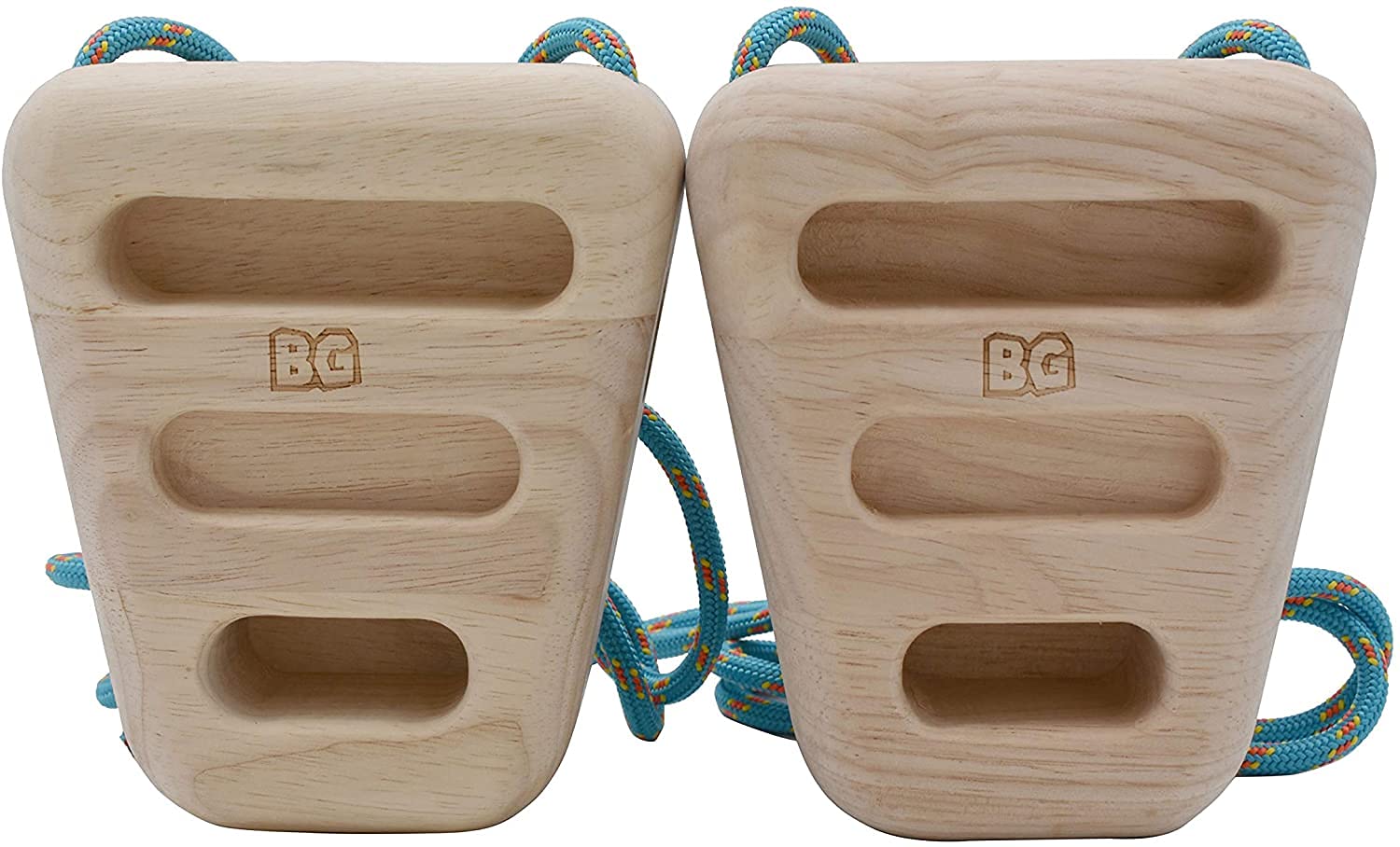
| BG Climbing Wood HangboardBest Value | Portable warm-up board | Wood | — | — | Amazon |
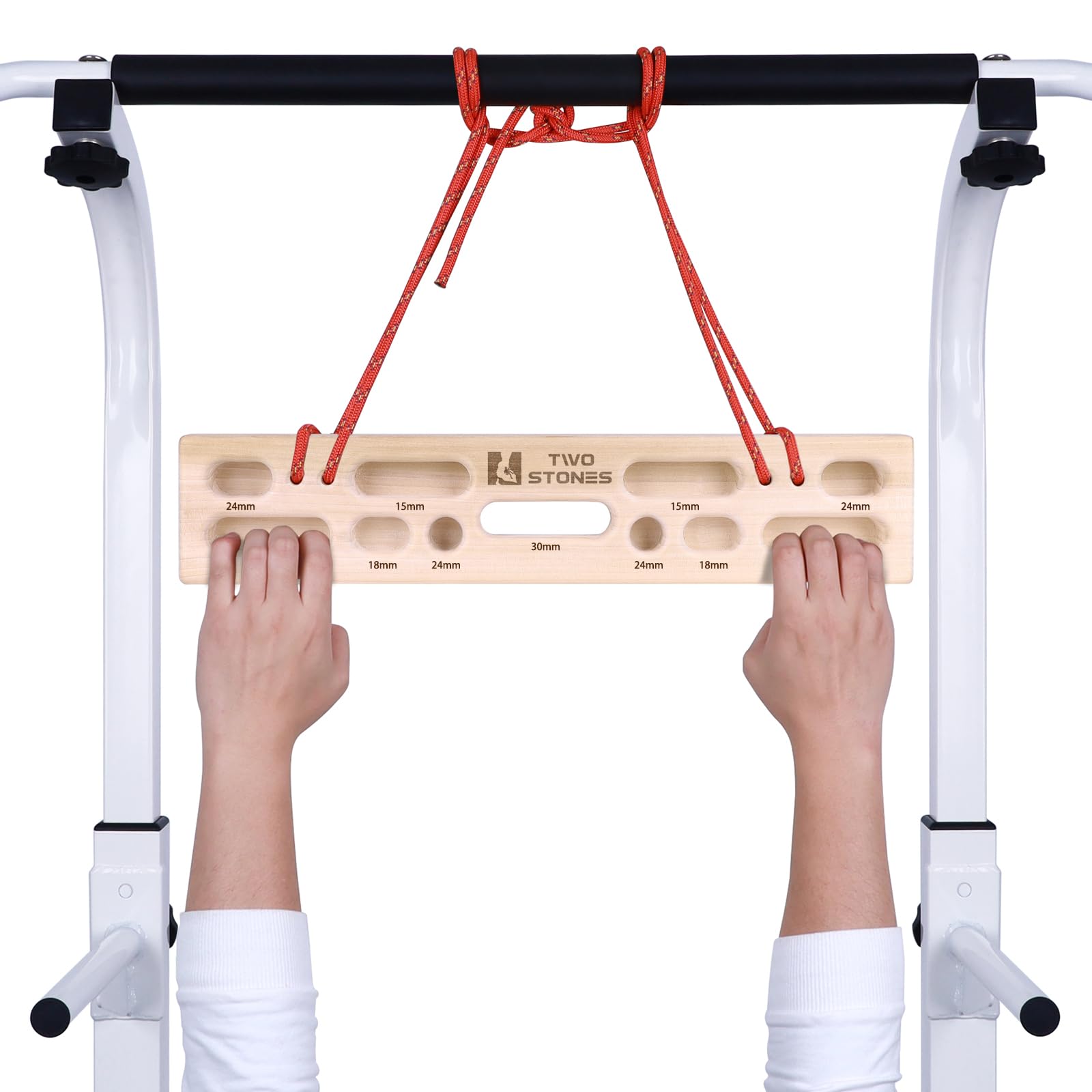
| Two Stones Portable HangboardBest for Travel | Travel and outdoor sessions | Boxwood | 0.75 kg | 1/2/3/4-finger pockets, 4 depths | Amazon |
| POWER GUIDANCE Hangboard | Full-scale home workouts | Wood | 1.43 kg | 1 inch, 1.4 inch and 0.6 inch deep rows | Amazon |
| Yes4All Wooden Hang Board | Doorway mounting with phone holder | Wood | 2.05 kg | Jugs, slopers, mini crimps, pinch | Amazon |
| Two Stones Climbing Hangboard | All-round training station | Boxwood | — | Outer jugs, 2 slope angles, 2/3/4-finger pockets | Amazon |
| YY Vertical Verticalboard Light | Beginners and upgraders | Poplar wood | 0.9 kg | 20mm, 25mm, 45mm plus 40mm center | Amazon |
| Metolius Wood Grips Compact II | Tight wall space | Wood | 4.7 pounds | — | Amazon |
| GRIPNATIC FingerPeg 1.0 | Combined hang and calisthenics | Beech hardwood | 3.5 kg | 0.6 to 1.6 inch, 6 depth levels | Amazon |
Detailed Reviews
1. YY Vertical – Hang Holds
Our pick — 4.5+★ from 250+ verified ratings; the strongest balance of quality and price.
Seven grip depths on a pair of boards you can spin with one twist.
The PENTA pair solves the problem every home trainer hits: you get strong on one edge depth and then have nothing harder to move to. Each unit carries seven grip options — 30mm, 25mm, 20mm, 15mm, 10mm, plus a mono and a duo pocket — so your training ladder goes from warm-up hangs down to the shallow edges that actually build finger strength. The 360° system means you rotate the board to change grips instead of repositioning your hands on a fixed face.
At 220g per unit, the laminated birch and poplar build is light enough to carry to the gym or crag and hang from a portable setup. Reviewers praise the build quality most, and the soft laminated surface stays comfortable against your skin through long suspension hangs. You also get use beyond hanging: they work as unstable supports for push-ups, which turns one purchase into a finger session and a pressing session.
The catch is that these are sold as a pair of two boards rather than a single wide face, so you need to think about where and how you will hang them rather than assuming a doorway fit. The upside is portability that a full-width board cannot match.
Where the PENTA Pair Wins
- Seven depths on each unit, from 30mm down to 10mm, so you can progress at home
- 360° rotation lets you swap grips with a twist instead of re-gripping a fixed board
- 220g per unit in laminated birch and poplar — light enough to travel with
- Doubles as an unstable support for push-ups
What To Plan Around
- Sold as two separate units, so your hanging setup needs to suit a pair rather than one wide board
- No mounting hardware details listed, so confirm your fixings before you drill
Pick this if: you want a board that keeps up with you from warm-up hangs to shallow crimp work, and you value being able to move it around.
Think again if: you want one wide face bolted permanently above a door frame — a single-board design suits that better.
2. Wood Hangboard Rock Climbing Holds
A single wooden board, two screws, and a straightforward route to stronger fingers.
This is the no-complications option. It ships as one wooden board with two screws included, is rated for indoor use, and does one job: give you an edge to hang from so you can train suspension and pulling strength in your fingers, arms, and back. If you are buying your first wooden climbing hold and do not want to think about depth ladders or calisthenics bars, this gets you hanging.
Owners call out the sturdy wood construction and grip strength, and the strings hold body weight without complaint. That is the core promise of any hangboard, and this one delivers it for a budget-tier spend.
What you trade for that simplicity is depth variety. The listing does not itemize the edge sizes, so you are not buying a board you can carefully progress through in millimeters. Treat it as a warm-up and general-conditioning board rather than a measured training tool.
Honest read: the wood and the fixing screws are the whole product, and that is fine — it hangs, it holds, and it does not pretend to be a training lab.
Who it suits: a first board for someone who wants to start hanging this week without studying edge increments first.
Reach for this if: budget is tight and you want a wooden board over your door today.
Look elsewhere if: you already know you want to train specific edge depths in millimeters.
3. Two Stones Portable Hangboard
Milled from one solid block of boxwood, and light enough to disappear into a pack.
Portability here is not a marketing word. This board is 0.75 kg; the Yes4All doorway board is 2.05 kg. It is cut from a complete natural rail wood block with no chips or splicing, so you get one continuous piece of wood rather than a glued-up assembly.
The pocket layout is what separates it from a plain edge board: 1, 2, 3, and 4-finger pockets across four different depths, plus edges designed to mimic holds you meet on real rock. All pocket edges get an R5 fillet and the whole surface is polished, so the wood is soft against skin with no burrs or sharp corners. Reviewers praise the pocket functionality most, with durability close behind.
The one thing to weigh honestly is mounting. The hardware side draws mixed response, so plan your fixing method before the board arrives rather than after. It is a training tool that happens to be portable, not a bolt-it-and-forget-it doorway station.
This one is for: climbers who train on the road, at the gym, or off a portable rig and want real pocket depth in a pack-sized board.
Worth knowing: the mounting setup is the weak link, so budget a little time to sort your own fixings.
4. POWER GUIDANCE Rock Climbing Hangboard
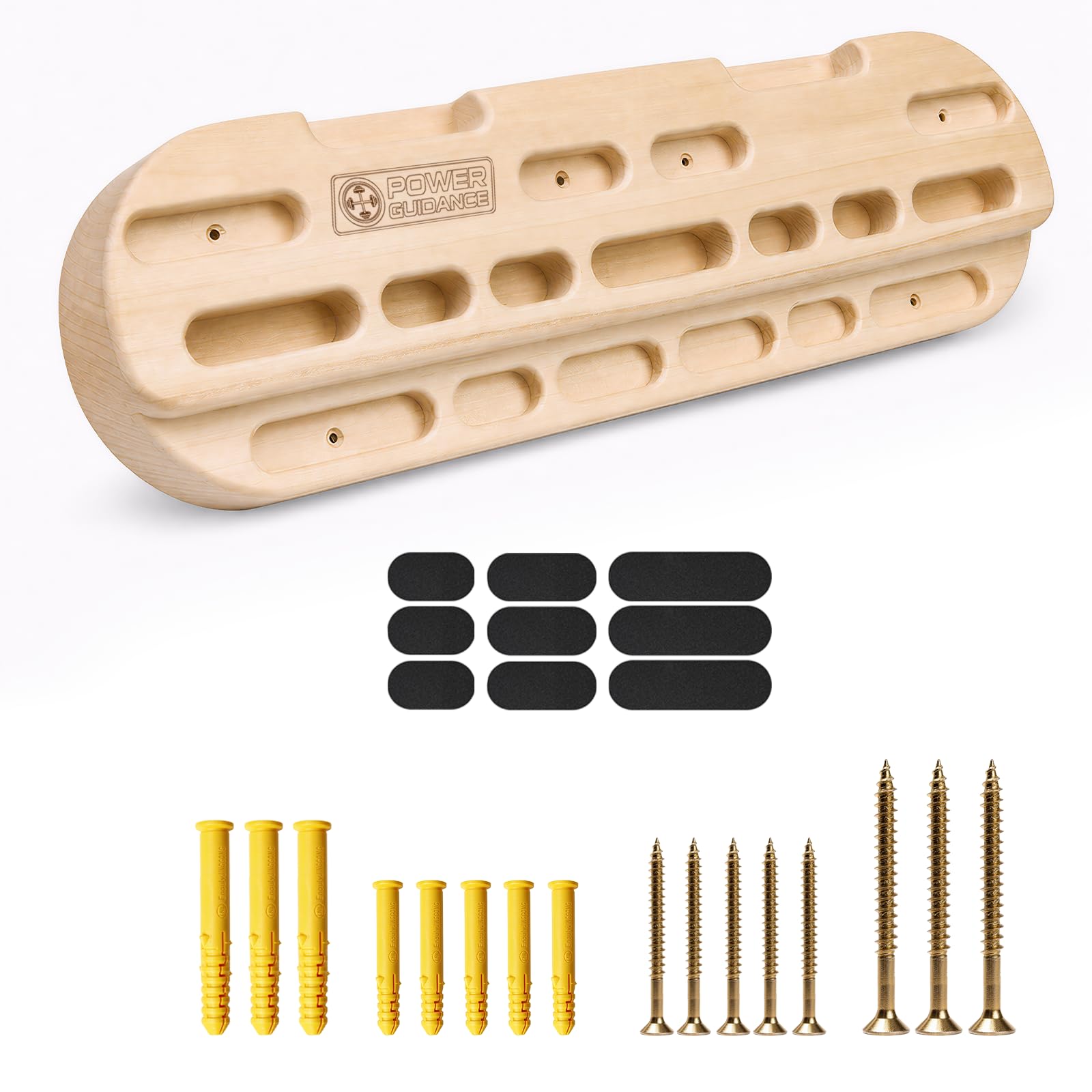
Three rows of jugs at three depths, plus a full mounting kit in the box.
The depth ladder here is laid out in rows you can read at a glance. The top row carries four jugs that are 1 inch deep, the middle row mixes 1.4-inch-deep pockets and edges, and the bottom row drops to 0.6 inches. That bottom row is where the work happens — a shallow hold that forces your fingers to earn it. Across the face you get 4 sets of 4-finger pockets, 3 sets of 3-finger pockets, and 2 sets of 2-finger pockets, which covers a full-scale workout without needing a second board.
Reviewers single out the build quality and the smooth natural wood texture, which feels easy on fingers. The board is made from crude wood that is ground and polished, and the slight unevenness is deliberate — it mimics the varied surface of real rock. Six M8 by 70mm screws, two 80mm expansion tubes, four 60mm expansion tubes, and a sheet of sandpaper all come in the box.
The honest caveat is the hardware. The screws are the recurring gripe in the feedback, so check your wall and your drill before relying on the included fixings. If you are going into a wall without studs, the maker recommends a backing plate, which is not included.
The real draw: 1 inch, 1.4 inch and 0.6 inch rows turn a single board into a progression you can actually follow, and the sanded finish is kind to skin over long hangs.
The trade-off: the included fixings are the weak point — plan on upgrading the screws or adding a backing plate for a studless wall.
Best for: a home wall where you want depth variety and a full pocket selection on one board.
Skip the included hardware if: your wall is anything other than solid studs — buy better fixings before you drill.
5. Yes4All Wooden Hang Board for Doorway
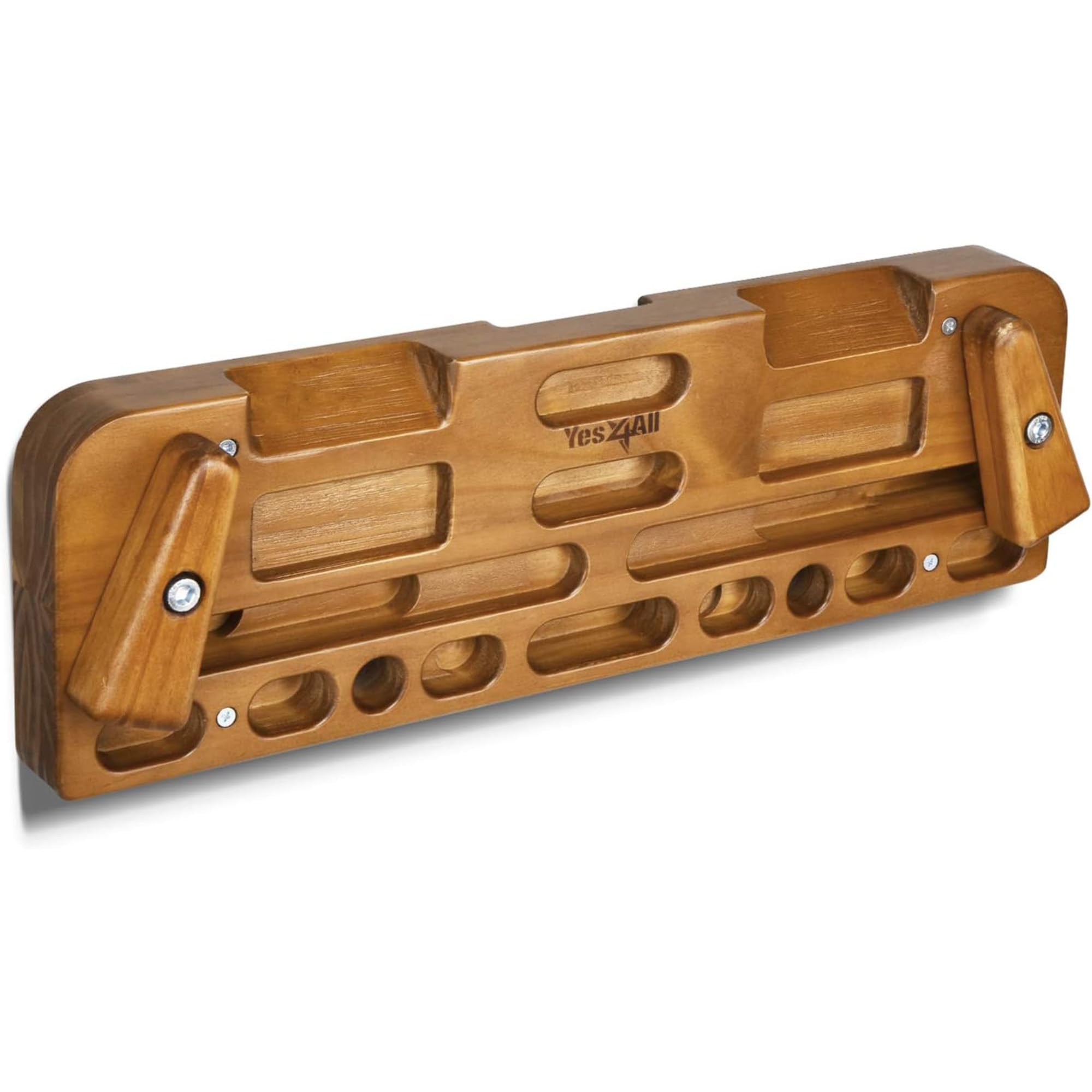
A doorway board with a phone holder, adjustable pinch holds, and stud-wall fixings included.
Two features here do real work that most boards skip. There is a phone holder at the top so you can track exercise time without picking up your phone between hangs, and the two pinch holds detach so you can set the angle you prefer before securing them. Below the jugs, the edges are rounded for comfort during extended holds, and the inside of the jugs and slopers carries an anti-slip surface for better control.
The grip menu itself is broad: jugs, slopers, mini crimps, and pinch holds, with the mini crimps sitting at the shallowest depth for the hardest work. Widths span 1 to 4 fingers. It is built for 16-inch wood stud walls and ships with four wood screws, two hex bolts, and a manual, and the maximum weight recommendation is 300 pounds.
The part you should weigh honestly is consistency. It is a feature-rich board at a mid-range price, but check your fixings and expect a slicker surface than the wood boards above.
What It Brings
- Phone holder up top for timing sets without touching your phone
- Two detachable pinch holds you angle before locking down
- Jugs, slopers, mini crimps and pinch holds across 1 to 4 fingers
- 300-pound maximum weight recommendation and stud-wall screws included
Where It Can Fall Short
- Build and durability feedback is mixed rather than uniformly strong
- The surface is described as slippery, which changes how much you trust a hold
Go with it if: the phone holder and adjustable pinch holds are features you will genuinely use, and your wall has 16-inch studs.
Be cautious if: you want a board whose surface grabs without question — the slipperiness is the recurring note.
6. TWO STONES Climbing Hangboard
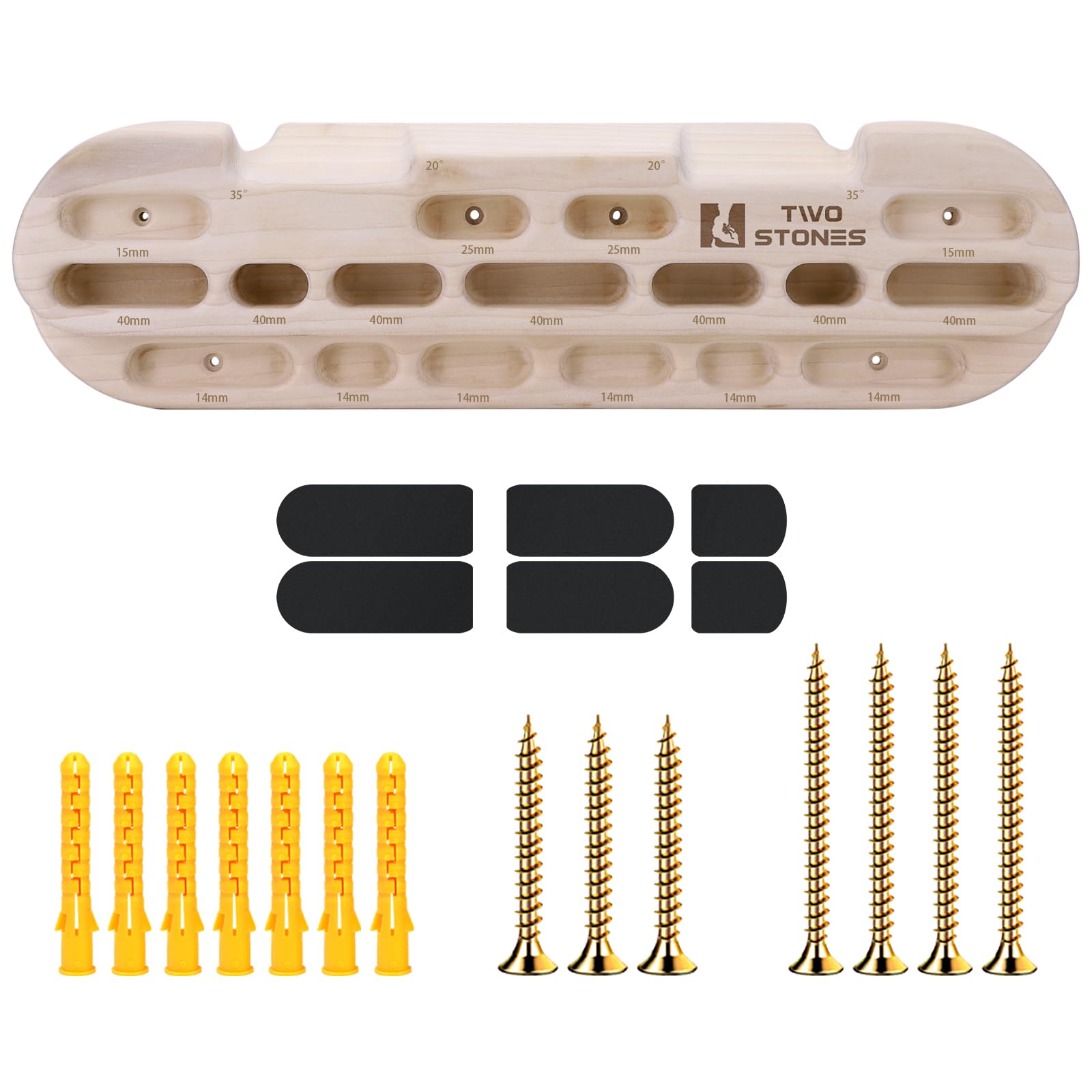
Jugs, two slope angles, pockets in four depths, all milled from a single block.
This board covers the widest spread of grip types on the list. Outer jugs handle warm-ups and pull-ups, slopes come in two different angles for open-hand strength, and 2, 3, and 4-finger pockets sit across four different depths so you can find the work level that matches your grade. Every pocket edge gets the same R5 fillet treatment and the whole face is polished, which is what lets you hang for long sets without your fingers complaining.
It is CNC milled from one complete solid wood block with no chips and splicing, and the wood is natural with no burrs or sharp edges. The training applications are spelled out rather than vague — dead hangs, bent-arm hangs, offset hangs, standard and offset pull-ups, one-arm pull-ups, L-hangs, and front levers — so there is a session for whatever you are working on. Installation is described as super easy, and seven screws plus seven expansion tubes come in the box.
The honest trade-off is comfort on the smaller holds and edge coverage. Some buyers find it not super comfortable and note the absence of 18 to 22mm edges, so if those mid depths are your bread and butter, look at a board that fills that gap.
Why it earns the spot: a single milled block with two slope angles and four pocket depths gives you enough variety to run a whole training week off one board.
The gap to know: no 18 to 22mm edges, so if that range is your training zone, this board leaves you hunting.
Fits you if: you want one board that handles warm-ups, open-hand work, and finger-specific progressions without adding second and third units.
Look past it if: mid-range edges in the 18 to 22mm window are central to your plan.
7. YY Vertical Hangboards for Rock Climbing

Poplar wood, seven grip options, and a magnetic upgrade path when it gets easy.
The learning curve is the design brief here. Poplar wood gives the board a grip that respects your skin, and the rounded sockets are shaped to be comfortable and ergonomic rather than purely functional. There is an elastic holder that makes pull-ups more accessible for beginners, so you can start training gently instead of jumping straight into dead hangs.
Seven grip options cover the board: 20mm, 25mm and 45mm holds, a 40mm central hold, flat holds at 30° and 20°, and 2 jugs. The 40mm center grip is the one that gets singled out for practicing single-arm pull-ups. Reviewers praise the build quality most, with the smooth wood surface close behind for how it feels across a full session.
The upgrade path is the clever bit. Magnetic inserts are compatible, so when the current depths feel too easy you can add VerticalBoard inserts to reduce each depth by 10mm, sold separately. That turns an entry-level board into a progression tool rather than something you outgrow in a season. It is designed in the Alps by climbers and tested in climbing gyms.
The beginner’s route: start with the elastic holder and generous depths, then reduce each grip by 10mm with magnetic inserts when you are ready.
Know before you buy: the magnetic inserts that deepen the challenge are a separate purchase, and the board is 0.9 kg so it wants proper fixings.
8. Metolius Wood Grips Compact II Training Board

A short wooden board for the wall space you actually have.
Space is the constraint this board answers. The compact face measures 24 inches by 6.2 inches, so it fits over a narrow doorway or into a garage corner where a longer board would not go. At 4.7 pounds it feels substantial in the hand, which is what you want from something you will hang your body weight off.
Metolius builds it in wood and backs it with a limited warranty, and this is a premium-tier pick aimed at climbers who already know what they want from a training board. The wood material and the traditional hangboard format are the whole proposition — no calisthenics holes and no modular inserts.
What you give up is variety and volume of feedback. The listing does not itemize edge depths or pocket sizes, so you are buying on the compact footprint and the wood build rather than on a published depth ladder. Measure your space first and confirm the hold layout suits your training before committing.
The case for it: 24 inches of wooden training face for a wall that cannot take a longer board.
Check first: the listing does not spell out depth increments, so ask or look at the board in person if depth precision matters to you.
Worth your attention if: your available wall is short and a full-width board simply will not fit.
Hold off if: you need a documented set of edge depths to plan a progression.
9. GRIPNATIC FingerPeg 1.0 Hangboard

A fingerboard and a calisthenics station in the same piece of beech.
Six depth levels is the densest progression on this list. The FingerPeg 1.0 runs 2, 3, and 4-finger pockets across depths from 0.6 to 1.6 inches, with warm-up jugs and slopers at 20° and 35°. That spread means you can find the exact edge that matches where you are and move down it in small steps rather than jumping in big gaps.
The second function is what makes it different from every other board here. Six calisthenics bar holes let you run pull-up and bodyweight work off the same piece of wood, so a finger session and a pulling session do not need separate installations. It is cut from class A beech hardwood with a 265 lbs load capacity, has rounded edges and a finely sanded finish, and mounts above door frames or on wooden beams in under 15 minutes with room for natural leg movement.
The trade-off is weight and permanence. At 3.5 kg this is a heavy, top-tier board that wants a properly anchored mount, and the maker notes it should be stored in dry areas to keep performing. It is not the piece you move between rooms.
Why It Stands Out
- Six depth levels from 0.6 to 1.6 inches across 2, 3, and 4-finger pockets
- Slopers at 20° and 35° plus warm-up jugs for a full session on one board
- Six calisthenics bar holes for pull-up and bodyweight work
- Class A beech hardwood with a 265 lbs load capacity and sanded, rounded edges
The Practical Limits
- 3.5 kg means it needs a well-anchored mount, not a quick hook
- Keep it in dry areas — damp rooms are not what the beech is built for
Choose it when: you want finger training and pull-up work from one anchored station with the finest depth steps on this list.
Weigh this: a 3.5 kg board is a commitment — anchor it properly and keep it out of damp air.
Know the Specs
Edge Depth in Millimeters
Edge depth is how much fingertip rests on the wood. A 30mm edge is generous and suits warm-ups and pull-ups. A 10mm edge is a serious training hold that loads your finger tendons hard. Boards that list a range — say 30mm down to 10mm — let you progress over months, while a board with a single depth caps how far you can go at home.
Wood Type and Surface Finish
The wood matters less than the finish. Poplar, birch, boxwood, and beech all appear on this list, and what separates a good board from a painful one is the sanding. Rounded pocket edges and polished faces keep your skin intact over long hangs. Burrs and sharp corners will end a session early, which is why fillet and polished-surface language on a listing is worth more than the species name.
Mounting Hardware and Wall Type
Screws and expansion tubes are where boards differ most behind the scenes. Stud walls with 16-inch spacing are the simplest target, and boards that specify that spacing tell you what your wall needs. Masonry needs expansion tubes, and studless walls often need a backing plate that is not included. Check the included components list before you plan the install.
Pocket Count and Finger Sets
A 4-finger pocket trains your whole hand, a 2-finger pocket isolates a pair of fingers, and a mono isolates one. Boards that offer 1, 2, 3, and 4-finger pockets across several depths give you more training angles than a board with only jugs. If finger-specific strength is your goal, the pocket layout matters as much as the edge depths.
Common Questions
Will a wooden hangboard damage my fingers if I am new to climbing?
How deep should the edges be on a beginner hangboard?
Can I mount a wooden hangboard above a doorway without studs?
Is poplar or beech better for a climbing hangboard?
How long should I hang on a wooden fingerboard?
What is the difference between 2-finger and 4-finger pockets?
Do I need a doorway board or a portable hangboard?
Can a wooden climbing hold double as a pull-up training tool?
Does the surface of a hangboard really affect my skin that much?
Where should I store a wooden hangboard between sessions?
The Bottom Line
The winner in this lineup of wooden climbing holds is the YY Vertical Hang Holds, because seven depths on a rotating pair — 30mm down to 10mm plus a mono and duo — give you a real training ladder you can carry anywhere. It holds a 4.5+ star rating across 290+ reviews. If you want one wide board with two slope angles and four pocket depths, the TWO STONES Climbing Hangboard covers the most grip types on a single milled block. And for finger work plus pull-ups off one anchored station, the GRIPNATIC FingerPeg 1.0 packs six depth levels and six calisthenics bar holes into class A beech.
How we choose
We do not accept paid placement. Every pick is matched to a real buyer and a real use-case; we do not hands-on test units.
Sources
Specifications: manufacturer listings and product documentation. Review insights: verified customer reviews, as of November 2026. Pricing: not shown on this page (it changes often); check the current price via the retailer link.
As an Amazon Associate, Tactical Gear Guy earns from qualifying purchases. This does not affect which products we feature.