Specs are compiled from manufacturer listings and verified buyer reviews and can change over time — please confirm the key details on the product page before buying.
Here is the short answer most buyers need before anything else: the right wood dust collector for your shop matches its airflow and filter micron rating to the machines you actually run, not the biggest CFM number on the box. A 4-inch port collector paired with a 5-micron bag will keep a table saw’s coarse chips off your floor. It will not pull the fine sanding dust that hangs in the air for hours and settles on everything after you leave. That gap between “chips gone” and “air clean” is where most workshop owners end up buying twice.
This guide is built by comparing the manufacturers’ published specifications and the patterns across verified customer reviews, so you get each pick’s real strengths and trade-offs instead of marketing spin.
The picks below range from a compact HEPA extractor you can carry to a jobsite to a 1,300 CFM stationary unit with a 50-gallon bag. Each one is matched to a real shop size and dust type, so you can compare airflow, filtration, and bag capacity side by side. This breakdown of wood vacuum systems is ordered by the buyer each model genuinely fits, not by marketing claims.
Top Picks

How To Choose The Best Wood Vacuum Systems
Buying a dust collector for a woodshop is a different job than buying a shop vac. A shop vac moves a small volume of air through a narrow hose. A wood dust collector moves a large volume through a wide port, which is what a table saw or planer needs to keep chips from piling up under the blade or coming back at you. Get that distinction locked in first and the rest of the decision gets simpler.
Match airflow to the tool, not the shop
CFM stands for cubic feet per minute — the volume of air the unit pulls through in one minute. A collector rated at 560 CFM is moving a serious stream of air. A model rated at 1,300 CFM is moving more than twice that volume, which matters once you hook up a planer or run two machines off a Y-fitting. For a benchtop router table you can get away with far less. For a 14-inch planer you want real volume and a short hose run.
Read the micron rating as your air-quality score
A micron is one millionth of a meter, and it is the unit used to describe how small a particle has to be before your filter lets it pass. A 5-micron bag catches the visible chips and most coarse sawdust. A 2-micron filter catches finer particles, and a HEPA-rated filter is built to capture 99.97% of particles at 0.3 microns or larger, which is the range that stays airborne longest. The tighter the filter, the cleaner your shop air and the less often you will find a film on every flat surface.
Decide between rolling bag, wall mount, and extractor
Rolling bag collectors are the classic shop staple: a large bag on casters you wheel to the machine. Wall-mount units hang out of the way and free up floor space in a one-car garage. Extractor-style units work more like a high-end vacuum, with a hose that attaches directly to a hand tool, and are often paired with sanders and routers. Each fits a different workflow, so pick by how you move around the shop rather than by spec sheet alone.
Check the port size before you commit
A 4-inch port and a 6-inch port are not interchangeable in practice. The larger the port, the more air can move, so a unit with a 4-inch inlet will always be airflow-limited by that opening even if the motor is strong. Note whether the collector has one 4-inch inlet, dual 4-inch inlets so you can run two tools, or a single 6-inch port. Buy the port that matches your machines and your hose, or you will spend your first weekend hunting adapters.
Side-by-Side Comparison
| Model | Best For | Airflow (CFM) | Bag/Drum Capacity | Filter Rating | Amazon |
|---|---|---|---|---|---|
| Festool 575280 CLEANTEC CT SYS★ Best Overall | Trim work and sanding on site | — | 0.92 gallons | HEPA cartridge | Amazon |
| WEN DC3401Best Value | Small shop, table and miter saws | 660 | 12 gallons | 5-micron bag | Amazon |
| VEVOR Wall Mount 1 HPSpace Saver | Garage shops short on floor space | 560 | 21 gallons (80L) | 2.5-micron bag | Amazon |
| BUCKTOOL 750 CFM | Auto-start tool pairing | 750 | 13 gallons | 2-micron upper bag | Amazon |
| POWERTEC DC5371 | Quiet wall-mount in a small shop | 560 | 1-micron bag | 1-micron bag | Amazon |
| WEN DC1300 | Big bags, two-tool draws | 1,300 | 50 gallons | 5-micron | Amazon |
| Festool 578441 CT 15 | Finish sanding with HEPA air | — | 15 liters (3.96 gallons) | HEPA | Amazon |
| Jet Vortex Cone 708659K | Dense chip volume, less filter clogging | 1,100 | 39.6 gallons | 2-micron canister | Amazon |
| Bosch VAC140AH | OSHA silica compliance and tool pairing | 150 | 14 gallons | HEPA at 0.3 microns | Amazon |
| Jet JCDC-1.5 Cyclone | Two-stage separation in a full shop | 763 | 20 gallons | 2-micron, MERV 13 | Amazon |
Detailed Reviews
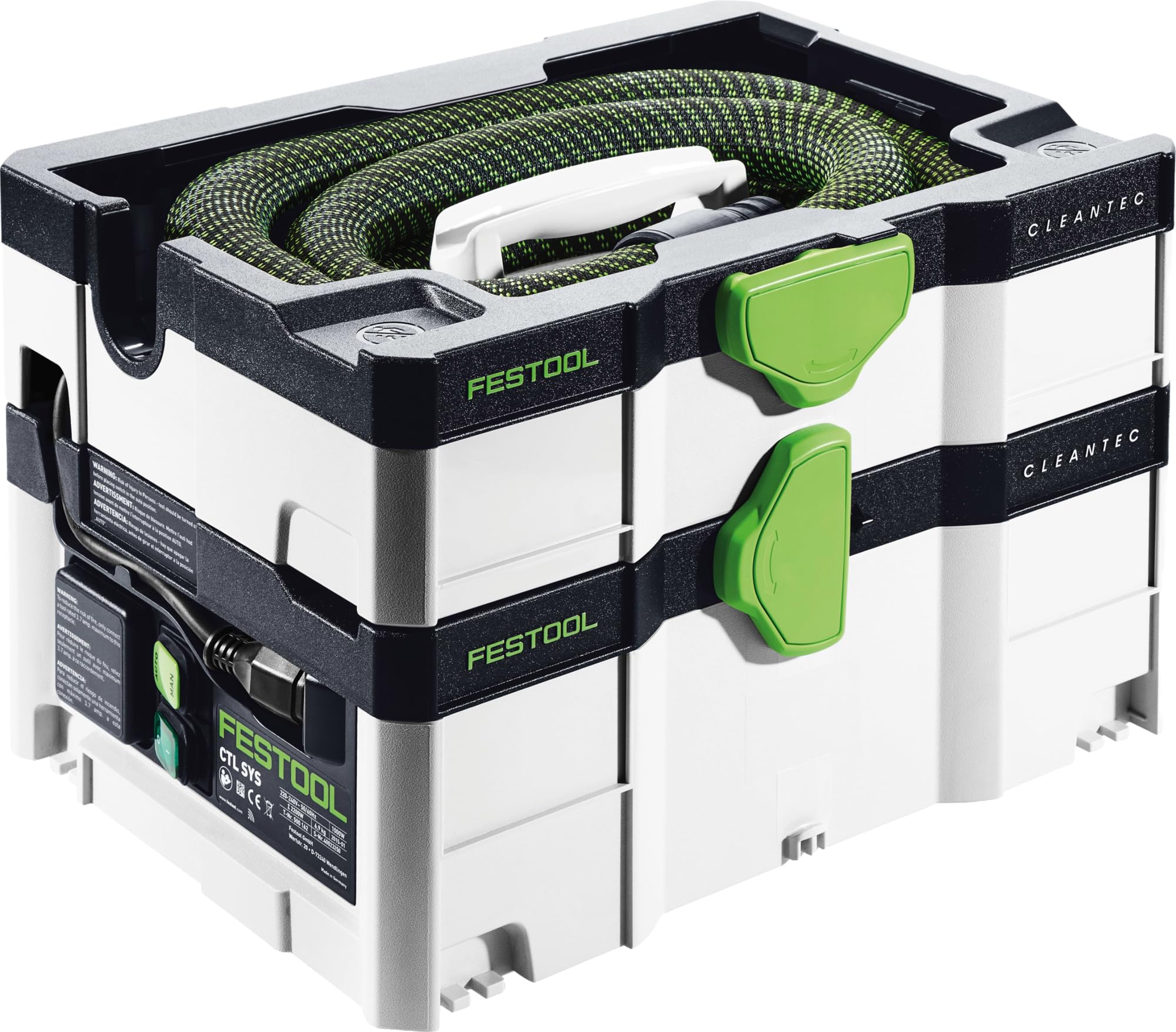
1. Festool 575280 CLEANTEC CT SYS HEPA Dust Extractor
Our pick — 4.5+★ from 100+ verified ratings; the strongest balance of quality and price.
The trim-work extractor that rides in a Systainer and starts itself when your tool fires.
If you finish sanding in other people’s houses, this is the shape of vacuum you want. The CT SYS is a canister extractor built around HEPA filtration and a 1000W turbine, and it lives inside a Systainer box — the stackable case system Festool uses — so it carries to the truck like a toolbox rather than a shop machine. The auto-start outlet powers the extractor on and off with a connected Festool power tool, which means you pull a sander’s trigger and the extraction begins with it.
What wins people over is the quality of the build — it is the assessment buyers keep returning to when they describe it, and suction power runs a close second. The 0.92-gallon capacity sounds small next to a 50-gallon rolling bag, and it is: this is a 22.8-times-smaller bag than the VEVOR wall mount’s 21 gallons. The trade is that you are not hauling a drum around. It runs at a quoted 67 dB, quiet enough to hold a conversation beside it, and the shoulder strap, integrated hose storage, and removable hose holder make setup on a jobsite quick. Onboard accessory storage holds the crevice and upholstery nozzles.
The honest tension is value. Some buyers feel the price sits high for what is, ultimately, under a gallon of dust capacity, and bag fill-up time draws the same mixed read — you will empty it more often on a long sanding session. The HEPA filter is also what you are paying the premium for, so if your work is rough framing and you do not need clean air in a client’s living room, an ordinary bag collector above will do the same job for much less.
Why it earns top billing
- HEPA cartridge filtration plus a 1000W turbine keeps fine sanding dust contained
- Auto-start outlet turns extraction on with the connected tool, no separate switch
- Quoted 67 dB operation and Systainer format make it genuinely site-friendly
- Shoulder strap, integrated hose storage, and onboard nozzles travel with the unit
Where it asks for patience
- 0.92-gallon capacity means frequent empties on long finish sessions
- Premium-tier spend for a compact extractor that runs one tool at a time
- Best auto-start behavior is tied to Festool tools
Go this way if you install and finish on site: its HEPA filtration and auto-start outlet make it the natural companion to a sander in a finished room.
Wait if you run stock through a planer all day: a rolling bag collector will hold far more chips for far less outlay.
2. WEN DC3401 Dust Collector
An entry-priced roller that pulls 660 CFM through a 4-inch port and still has a wall-mount option.
For a first shop or a one-car garage, the DC3401 is the sensible starting point. A 5.7-amp brushed motor driving a 6-inch impeller moves up to 660 cubic feet of air per minute — enough volume to pull chips off a table saw or miter saw and keep them off the floor. That 660 CFM actually beats the VEVOR wall mount’s 560 CFM and the WEN DC3474’s 600 CFM on paper, which is a curious result for the least expensive unit on this list.
The practical package is what sells it. You get a 12-gallon 5-micron zippered collection bag, lockable swivel casters so it rolls to a machine and stays put, an onboard carrying handle, and an optional wall mount if you want it off the floor. A 4-inch dust port connects to the common woodworking tools without hunting for adapters, and a two-year warranty backs it. It handles miter saws and table saws well in daily use, and its compact size fits where a bigger drum would not.
Set expectations on air quality. The 5-micron bag is the loose spec here — it holds the visible dust but lets the finest particles pass, so this is a chip collector, not an air cleaner. Cleaning performance splits the room too, with some buyers finding it clearly better than a shop vac and others less convinced. If your goal is a cleaner shop floor at a modest outlay, it delivers. If you want HEPA-grade air, look at the Festool or Bosch extractors below.
The value read: 660 CFM, a 12-gallon bag, casters, and a wall-mount option in one entry-level package is a lot of working collector for the money. The 4-inch port caps its ceiling, so run it close to the tool.
Know before you buy: the 5-micron bag is the loose end — fine sanding dust will recirculate unless you upgrade the bag or run a separate air filter.
Right for the first-time woodworker: a small-to-mid shop running a table saw and miter saw will get real chip control from the DC3401.
Not for the finisher: if airborne fine dust is your concern, the micron rating here is too generous.
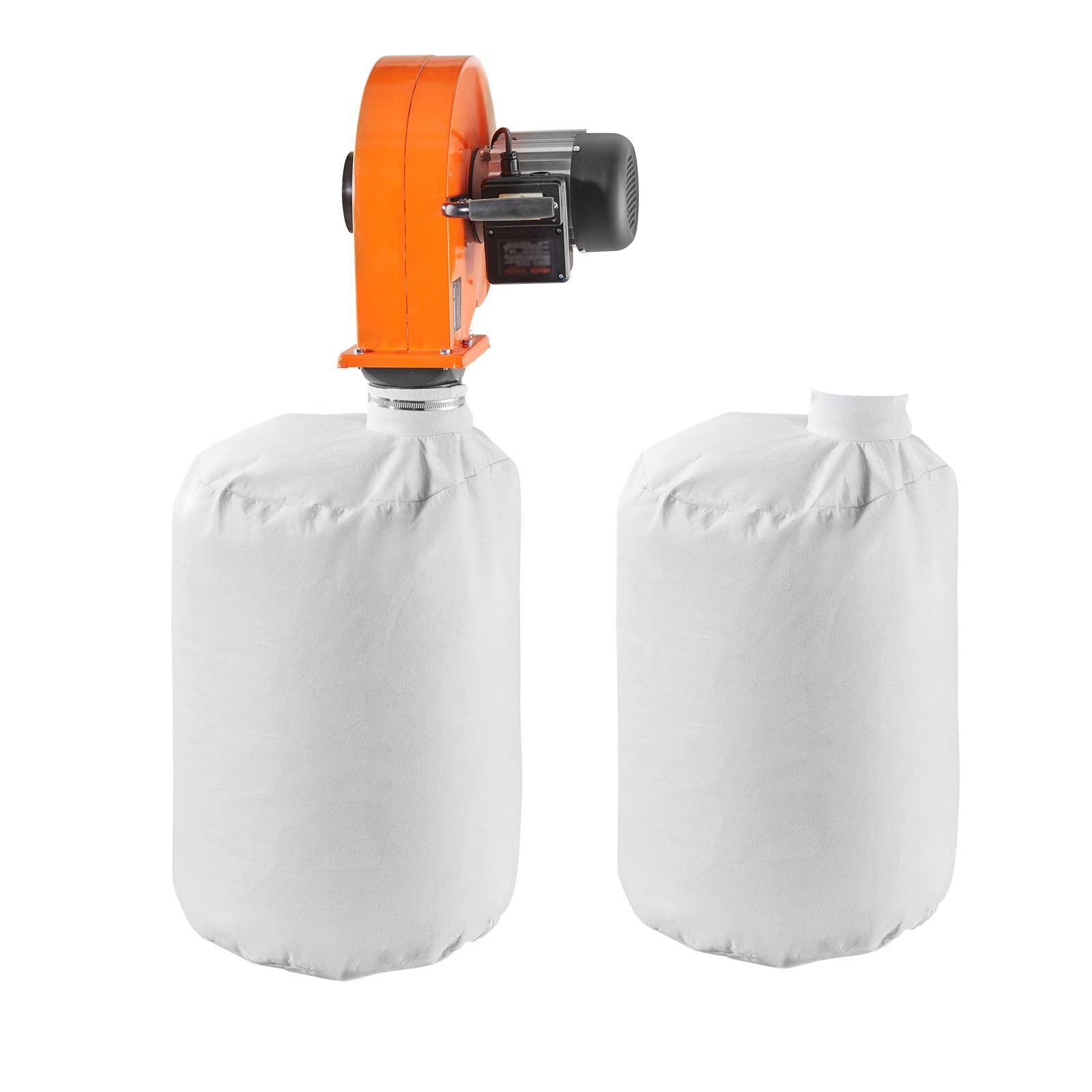
3. VEVOR Wall Mount Dust Collector 1 HP
Hang it on the wall, feed it 21 gallons of capacity, and keep the floor clear.
The floor space is the feature here. Mounted on a wall, this 1 HP collector gets the motor, the bag, and the footprint out of the way of your bench and your path to the saw — a real benefit in a single-bay garage where every square foot is spoken for. It is 24 pounds, which is light enough to bracket to a stud without a helper, and the induction motor is rated to run at 90 dB or less.
Capacity is the standout number. The 21-gallon (80L) non-woven bag is a big-can commitment, and it stands far above the BUCKTOOL’s 13 gallons and the WEN DC3474’s 15 gallons — you empty it far less often on medium projects. The 2.5-micron filtration catches fine wood dust and shavings, a tighter spec than a 5-micron bag, and the bottom zipper means you unzip to dump without detaching anything. It runs 560 CFM off a 1 HP induction motor, the same airflow figure the POWERTEC wall mount quotes, so the two are direct rivals on paper.
One thing to plan around: this is a newer listing with a light track record of owner feedback compared to the established names on this page. That is a fair caveat, not a knock on the machine — the specs are competitive and the design is sound. Buy it as a compact wall-mount chip collector for a small-to-medium shop and it fits its brief cleanly.
What earns the wall bracket: 21 gallons of capacity plus 2.5-micron filtration plus a 24-pound body is a clean fit for a space-tight shop.
The caveat: it is a newer model with less accumulated owner history than the WEN or POWERTEC units, so you are an early adopter on a proven design type.
Pick it if your shop is also your garage: wall mounting gets a 21-gallon bag out of your way without giving up airflow.
Look elsewhere if you want a long track record: the established WEN and POWERTEC wall units above carry more owner mileage.
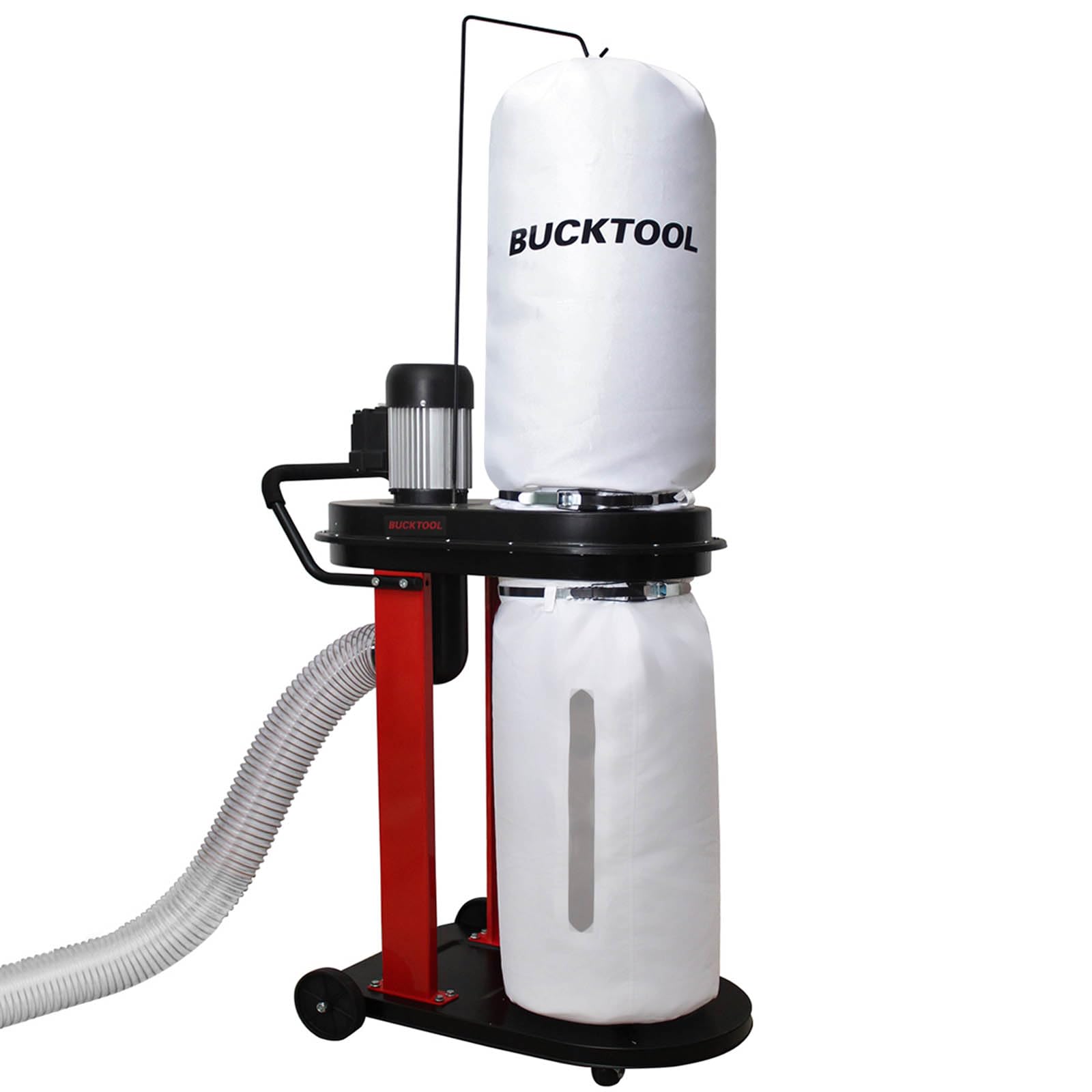
4. BUCKTOOL 750 CFM Auto-Start Dust Collector, 1.2HP, 13-Gallon
A 1.2 HP collector that switches on with your tool and moves 750 CFM doing it.
The feature that separates this one from every other bag collector here is the auto-start outlet. Plug a power tool into it, up to 7A max, and the collector fires up when the tool does — you stop hunting for a second outlet or flipping a separate switch. A 1.2 HP, 120V motor turning at 3450 RPM moves 750 CFM, and the unit is CSA listed. It carries three bags: a 2-micron cloth upper filter bag, plus a plastic and a cloth lower collection bag.
The 750 CFM figure beats the WEN DC3474’s 600 and the VEVOR’s 560, and the 2-micron upper bag filters finer than the 5-micron bags on both WEN rolling units. A package of five reducers plus a 5-foot, 4-inch flexible hose means most machines connect without a trip to the hardware store. The bag clamp is a soft PET design that will not bite your hand on install, and the 16-1/2 x 26-3/8 inch base with casters lets it roll or sit as a stationary compact unit.
Two honest friction points. It is 56 pounds, notably heavier than the 24-pound VEVOR wall mount, so moving it around the shop is a two-hand job on the casters. And assembly draws mixed feedback, with some finding it easy and others irritated by the instructions — budget an afternoon for the build and you will avoid the frustration. Buyers report it handles a 14-inch planer and a 16-inch horizontal drum sander effectively, so the airflow is real where it counts.
What the motor buys you
- 750 CFM from a 1.2 HP, 3450 RPM motor — strong airflow for the tier
- Auto-start outlet (7A max) turns the collector on and off with your tool
- 2-micron upper filter bag plus three bags total included
- Five reducers and a 5-foot flexible hose cover most tool connections
What to budget for
- 56 pounds makes it the heaviest roller of the WEN/VEVOR group
- Assembly instructions split opinion — allow time and patience
- 13-gallon capacity empties sooner than the 21-gallon wall mount
Pair it with powered tools: the auto-start outlet makes this the natural fit when your sander or saw should trigger the extraction.
Think twice if you reposition often: at 56 pounds it is not the go-anywhere unit a lighter wall mount is.
5. POWERTEC Wall Mount Dust Collector 1HP

A wall hanger with the tightest bag on the list and a motor that runs on 120V or 240V.
For a small pro shop or a serious hobby setup, the POWERTEC wall mount earns its bracket with two things the competition does not always offer: a 1-micron filter bag and dual-voltage operation. The 1 HP induction motor runs at 12 amp on 120V or 6 amp on 240V, turning at 3450 RPM and delivering 560 CFM through a 4-inch inlet. The 1-micron bag has a window to check the dust level and a zippered bottom for emptying — and at 1 micron it stops finer particles than the 2.5-micron and 5-micron bags on several rivals.
How it behaves in a shop is the reason it climbs the list. Performance and effectiveness are what owners talk about most, and the noise level runs a close third — it is listed at 80 dB and widely described as quiet for a machine this size. Setup and installation go smoothly, and the 4-inch port attaches directly to a hose. POWERTEC’s Vortex Base guides airflow to cut turbulence, which the maker claims yields up to 10% more efficiency than a comparable model. What left an impression is a report that virtually no sawdust makes it to the filter bag.
Pull the hose regularly and clear the port. Suction scores mixed in owner feedback and size draws the same mixed read — the compact body is the appeal, but it also limits how big a job it will take on. The 35.5-pound unit handles table saws, sanders, and routers with ease.
The air-quality edge: a 1-micron bag at 560 CFM is the finest filtration among the bagged wall mounts here, and dual voltage lets you wire it to 240V for lower amp draw.
Upkeep is real: the grated 4-inch port needs clearing or the impeller loses efficiency — it is the one routine task this unit asks of you.
A strong call for the small pro shop: 1-micron filtration, dual voltage, and quiet running make it a smart wall-mounted permanent.
Skip if you collect bags slowly: the compact body suits frequent, close-up cuts more than marathon stock runs.
6. WEN DC1300 Dust Collector

The volume monster: 1,300 CFM, two tool connections, and a 50-gallon bag that rarely needs emptying.
When the question is pure air volume, this is the answer on this page. A 14-amp motor turns a 10-inch steel impeller up to 3450 RPM and the unit circulates up to 1,300 cubic feet of air per minute — the highest airflow figure here, well above the DC3474’s 600 and the Jet cyclone’s 763. Two 4-inch inlets let you attach two tools at once, so you can leave a table saw and a jointer hooked up and just move the blast gate.
The vertical collection bag holds 50 gallons, easily the largest capacity on this list and far beyond the BUCKTOOL’s 13 or the DC3474’s 15. That is a shop tool that empties on a monthly rhythm rather than a weekly one. A mobile base with four swivel casters rolls the whole drum to whatever machine needs it, and quality tops what owners talk about most, with noise level a strong second. It fills a small-shop role so well that one buyer notes it cannot be heard when the garage door is closed.
Two things temper the enthusiasm. Durability feedback is mixed, so treat it as a durable hobby-shop machine and go easy on the bag and housing. The instructions split opinion as well — some find the directions straightforward and some find them lacking, so plan on a careful evening with the manual. At this airflow level a dedicated circuit is worth confirming with an electrician before you commit.
The airflow story: 1,300 CFM through two 4-inch inlets and a 50-gallon vertical bag is built for continuous chip volume in a compact shop.
The caveats worth weighing: mixed durability feedback and thin instructions mean assembly and setup ask for a careful hand.
Right for a small shop with big draws: the dual inlets and 50-gallon bag suit someone who leaves two machines plumbed up.
Not for the finish-obsessed: the 5-micron rating collects chips far better than it cleans air.
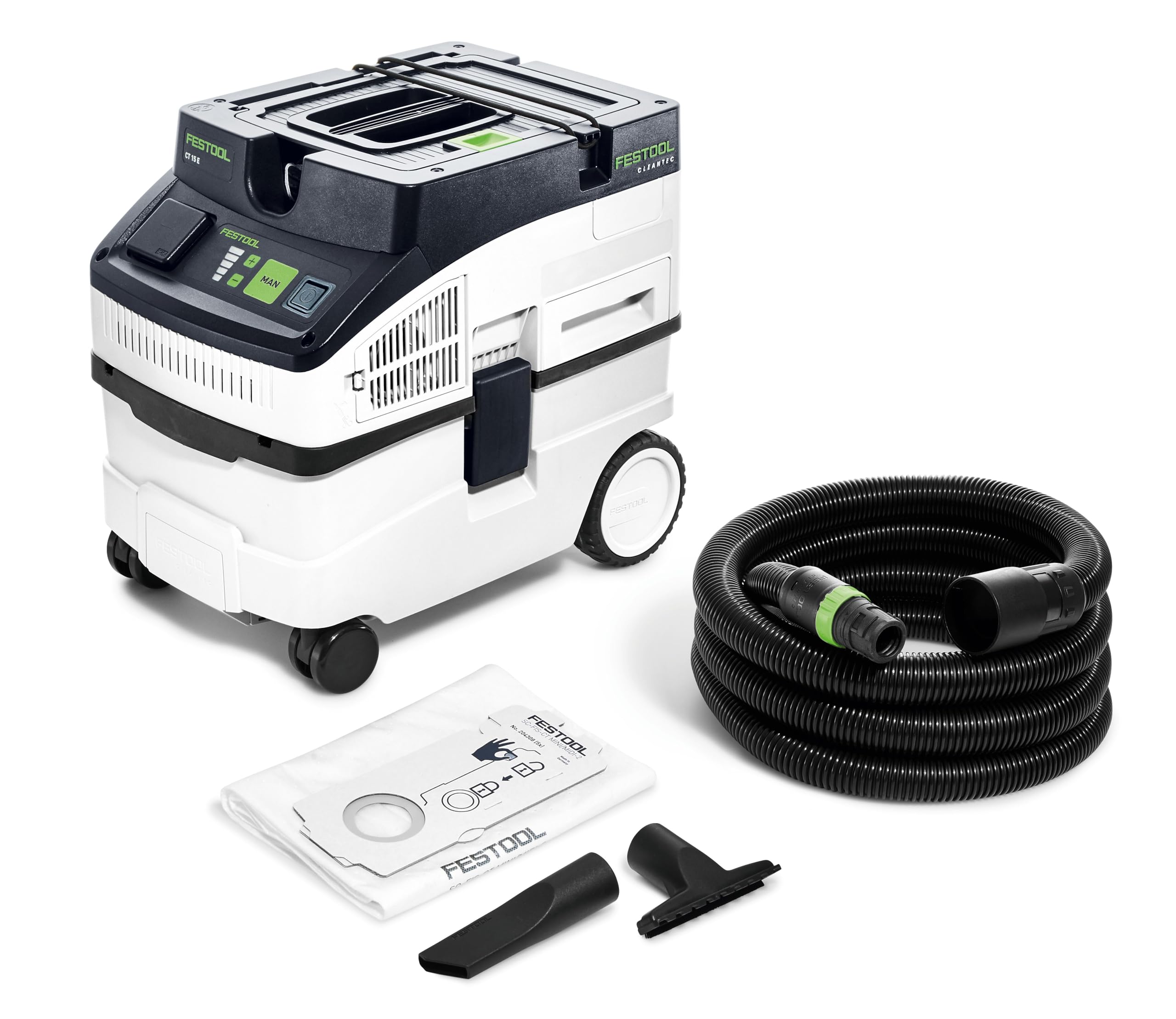
7. Festool 578441 CT 15 Dust Extractor
The premium extractor that pairs HEPA air with a bigger can and steel-axle chassis.
Step up from the compact CT SYS and you get room to breathe — literally and in bag terms. The CT 15 holds 3.96 gallons (15 liters) in a canister that will not force constant emptying the way the sub-gallon CT SYS does, while still delivering HEPA-certified filtration and an adjustable high-performance turbine. Automatic tool start ties the extractor to your tool, and touch operation makes the controls a simple tap.
The build is where the premium lands. The chassis runs on steel axles, the design is compact and stable, and Festool backs it with a three-year comprehensive warranty that includes wear and tear. It travels well for on-the-go work, and the flat top doubles as a shelf for work materials. Crevice and upholstery nozzles store onboard. Getting suction and performance out of it is never in question — owners mention it pulls as well as the CT26 model, which is a serious compliment from the Festool stable.
The honest limit is capacity against price. If your work is hand-tool sanding and finish carpentry, that is the right trade. If you are pushing a planer all afternoon, the WEN DC1300’s 50-gallon bag above is the far more practical machine, even without HEPA air.
Where the premium goes: HEPA certification, automatic tool start, steel axles, and a three-year wear-and-tear warranty add up to a long-lived site extractor.
The capacity question: 3.96 gallons is generous for finish work but modest against any big shop drum collector.
Reach for it if finish quality rules your work: HEPA air and auto-start make it a fine partner for site sanding and trim.
It is not your bulk chip machine: leave the planer to a large-bag collector and keep this for fine dust.
8. Jet Vortex Cone Dust Collector
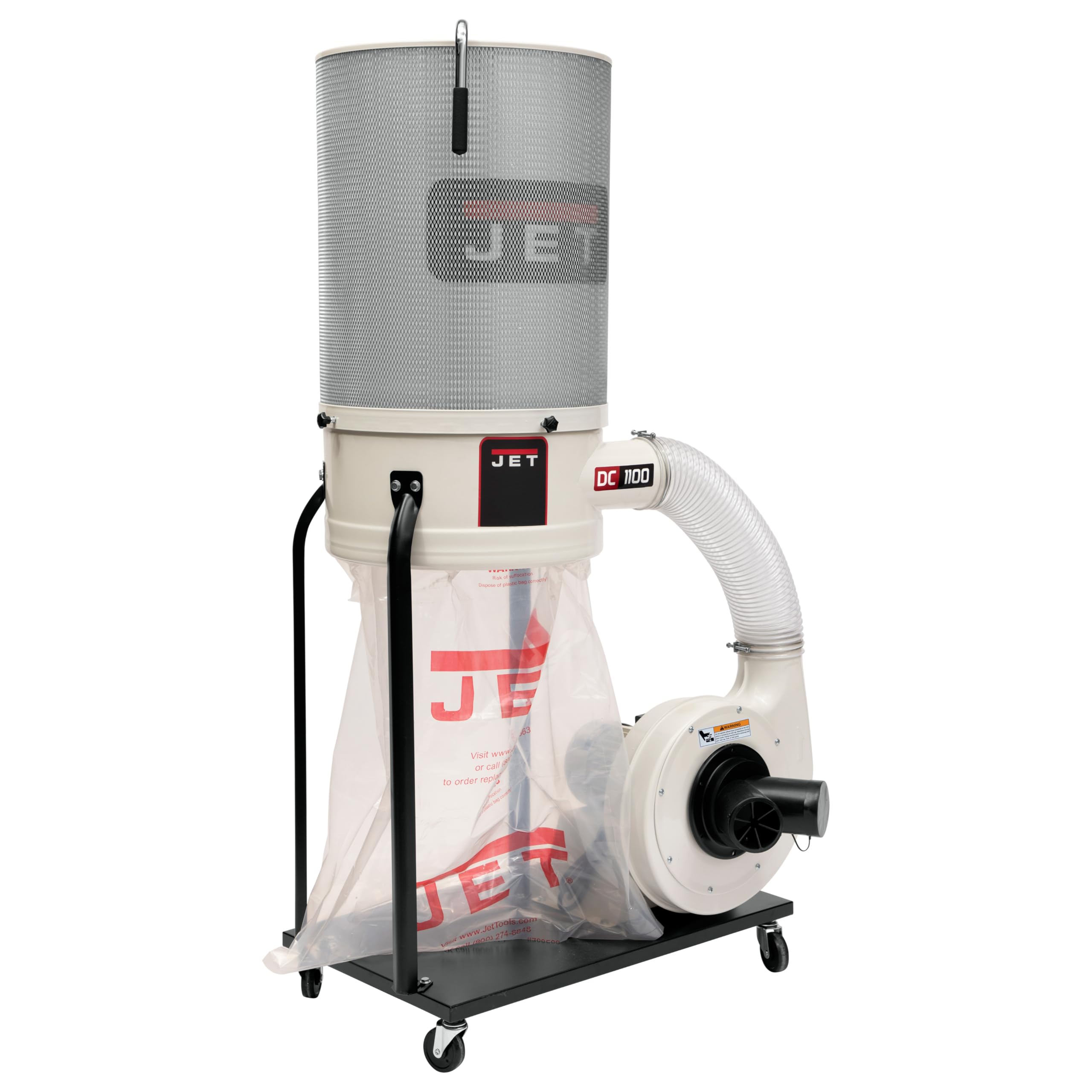
Pre-separation before the filter, and a handle you spin to knock dust clean.
The Vortex Cone is the feature that justifies the Jet name here. Mounted below the filter chamber, the cone drops 98% of wood chips into the collector bag before they reach the canister, so mainly fine dust hits the filter. That means sustained airflow between cleanings and a more densely packed bag — fewer bag changes over a season. It is a smart bit of shop engineering, and it is why this unit holds suction longer than a straight bag collector the same size.
The motor is a continuous-duty 1-1/2 HP turning an 11-inch steel impeller, rated at 1,100 CFM, 10-1/2 in. static pressure, and 8,464 FPM at 4 inches. It runs 11A at 115V or 5.5A at 230V, ships prewired for 115V, and wants a 20A circuit. The 2-micron pleated canister captures 98% of 2-micron and 86% of 1-micron particles, and a turn of the top handle sends internal scrapers across the pleats, dropping dust into the bag without removing the filter. The 39.6-gallon capacity dwarfs the 13- and 15-gallon rollers above. It runs 70-80 dB at 3 feet and comes backed by a five-year warranty.
The limitation is scope. This is built for wood dust and chips indoors only — no metal shavings, no liquids, no glass or plastic. One 6-inch inlet or two 4-inch inlets connect stationary machines, and remote control is sold separately. At 1,100 CFM it is a big-shop machine, and durability draws mixed feedback, so it is a durable hobby-to-pro collector rather than an industrial lifer.
Why the cone matters
- Vortex Cone keeps 98% of chips off the filter, sustaining airflow between cleanings
- 2-micron canister with a crank-to-clean handle and a clear bag window
- 1,100 CFM from a continuous-duty 1-1/2 HP motor over a 39.6-gallon capacity
- Five-year warranty and a four-caster base that rolls where you need it
Where it stops
- Wood dust indoors only — no metal, liquids, glass, or plastic
- Needs a 20A circuit and 115V prewiring checked before you run it
- Remote control is an added purchase, not included
The fit for a stationary shop: if your machines never move and chip volume is steady, the Vortex Cone and 39.6-gallon bag are built for you.
Mind the power and the limits: a 20A circuit is required and this collector is wood-only, so mixed-material work needs a different machine.
9. BOSCH VAC140AH Dust Extractor
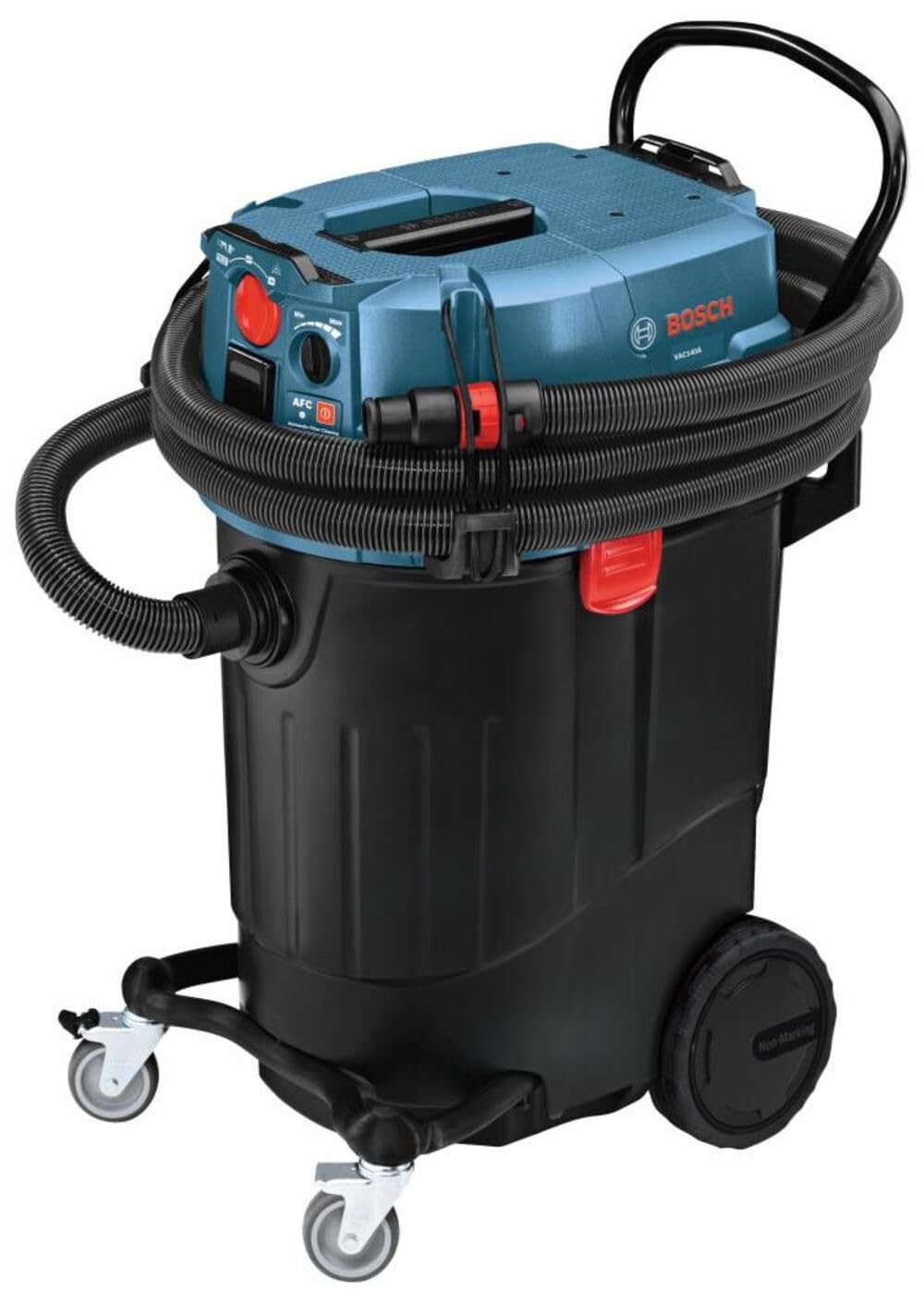
The compliance-minded extractor that clears its own filter every fifteen seconds.
For anyone chasing silica dust compliance, the VAC140AH is the machine that does the housekeeping for you. Automatic filter cleaning runs every 15 seconds to keep suction strong without you stopping to knock the filter, and the included HEPA filter captures 99.97% of particles at 0.3 microns or larger. Bosch’s PRO+GUARD system pairs this extractor with its shrouds and hoses to help users work toward OSHA Silica Table 1 compliance. That is the headline here, and it is why this extractor commands its tier.
Performance is aimed at tools, not drums. It delivers a maximum 150 CFM with a sustainable maximum 97 in. static water lift — a far lower airflow figure than the 1,100 or 1,300 CFM drum collectors above, because its job is high-pressure suction through a hose at a tool, not volume through a 4-inch duct. Power tool activation lets the tool’s own switch turn the vacuum on and off, and the Power Broker dial matches suction force to the application. A 14-gallon capacity plus an included fleece filter bag protects the filter and contains dry debris. Owners find it effective at containing sawdust and praise its dust filtration and versatility.
Noise is the split opinion — some find it considerably quieter than expected and some describe it as annoyingly loud, so it is not a machine for a shared living space. Value draws a mixed read too, since this sits at the premium end. Buy it for compliance and clean-air performance at the tool, and it earns its keep. Buy it hoping to vacuum up planer chips by the drum and the 150 CFM will disappoint.
The compliance case: automatic filter cleaning every 15 seconds, 99.97% capture at 0.3 microns, and PRO+GUARD make this a serious silica-management tool.
The trade-off: 150 CFM is hose-and-tool suction, not duct volume, so it is not a chip-drum replacement.
Built for the compliance-minded pro: if OSHA silica dust rules drive your purchase, the auto-clean and HEPA specs are exactly on point.
Not your bulk collector: at 150 CFM it is a tool extractor, so pair it with a drum unit for volume work.
10. Jet JCDC-1.5 Cyclone Dust Collector

Why pros choose a cyclone
- True two-stage separation drops heavy chips into a steel drum before they hit the filter
- MERV 13-rated canister captures 99% of 2-micron particles
- RF remote control and quick-release drum levers keep operation and emptying simple
- Direct-mounted steel canister with a double-paddle cleaning handle, no flex hose
What you accept
- 763 CFM trails the big bag collectors on raw volume
- Needs a dedicated 115V/20A circuit
- Wood dust indoors only — no metal, liquids, or outdoor use
The fit for a full shop that hates bag changes: the 20-gallon steel drum and cyclone separation keep suction strong as it fills, so you empty rarely and clean the filter less.
Think twice if volume is everything: at 763 CFM it gives up airflow to the 1,100 and 1,300 CFM units, so it makes its case on separation and convenience, not raw pull.
Know the Specs
CFM and port size
CFM (cubic feet per minute) is the volume of air a collector moves. A larger port lets more air through, so a 4-inch inlet caps airflow regardless of a strong motor. A 6-inch port or dual 4-inch inlets let a bigger motor actually work — which is why the high-CFM drum units above use wide ports while the extractors use narrow hoses at high pressure.
Micron rating and HEPA
A micron is one millionth of a meter. A 5-micron bag catches visible chips and coarse dust; a 2-micron filter catches finer particles; a HEPA filter is built to capture 99.97% of particles at 0.3 microns or larger. The tighter the filter, the cleaner your shop air and the less film you find on surfaces later.
Bag vs canister vs cyclone
A bag collector is a large cloth or plastic bag, the simplest and roomiest option. A canister is a pleated filter you usually clean with a handle or a crank. A cyclone adds two-stage separation, dropping heavy chips into a drum before air reaches the filter, which keeps suction strong as the drum fills.
Static lift and tool pairing
Static water lift describes how hard a unit pulls through a narrow hose, which is why extractors quote high lift but modest CFM. Auto-start and power-tool activation let the tool’s own switch run the extractor, so fine sanding dust is captured the instant the tool spins up.
Common Questions
Do I need a dust collector or just a shop vac for my woodshop?
What is the difference between a 5-micron bag and a HEPA filter?
Will a 4-inch collector port fit my table saw?
How often will I need to empty the dust bag?
Is a cyclone dust collector better than a bag collector?
Can I run a dust collector and my tool on the same outlet?
Will a dust collector work for both wood dust and metal shavings?
Do I need a HEPA extractor for sanding and finish work?
Can a wood dust collector be mounted on the wall to save floor space?
What size collector do I need for a small home shop?
The Bottom Line
For most buyers, the wood vacuum systems winner is the Festool 575280 CLEAN
How we choose
We do not accept paid placement. Every pick is matched to a real buyer and a real use-case; we do not hands-on test units.
Sources
Specifications: manufacturer listings and product documentation. Review insights: verified customer reviews, as of November 2026. Pricing: not shown on this page (it changes often); check the current price via the retailer link.
As an Amazon Associate, Tactical Gear Guy earns from qualifying purchases. This does not affect which products we feature.