Specs are compiled from manufacturer listings and verified buyer reviews and can change over time — please confirm the key details on the product page before buying.
If your joints keep closing up with a hairline gap, the problem is usually not your saw — it is the way you set the blade height or marked the line in the first place. A good wood measuring tool takes the guesswork out of that step, so the cut you planned is the cut you get. Below are nine tools that each solve a different part of that problem: setting blade and bit heights, checking square, finding angles, marking equal spacing, and even reading moisture before you commit a board to a project.
This guide is built by comparing the manufacturers’ published specifications and the patterns across verified customer reviews, so you get each pick’s real strengths and trade-offs instead of marketing spin.
You will see setup blocks, squares, slide rulers and calipers side by side, with the exact tolerances and ranges that separate them. My aim is simple: help you pick the wood measuring tools that match how you actually work, not the flashiest box on the shelf.
Top Picks


How To Choose The Best Wood Measuring Tools
Start with the job you repeat most. If you set a router bit or a table saw blade dozens of times a week, a setup block set saves you the most time. If you lay out angles and bevels, you want a square or an angle finder. If you mark equal spacing for dowels and pins, an equidistant tool does in one pass what a tape measure makes you do five times.
Tolerance is the number that decides quality
Tolerance is how far off a measurement can be. A setup block rated to ± 0.001″ is accurate to one-thousandth of an inch, which is finer than most woodworkers can cut. A caliper at ±0.001″/0.02mm gives you the same order of accuracy in a hand tool you can check a board with. When two tools look alike, the tighter stated tolerance is usually the better buy.
Match the tool to the machine you own
Setup blocks and slide rulers are built for table saws, routers, drill presses and planers. A combination T-square covers layout and angle work on flat stock. A digital angle finder is for setting blade tilt and checking miter saw cuts. Buying one tool that tries to do all three usually means it does none of them well.
Case, markings and material decide how long it lasts
Laser-engraved markings on aluminum alloy hold up far better than printed scales that rub off after a few months in a shop. A storage case keeps a 16-piece block set from scattering across the bench. And on any measuring tool with moving parts, the locking screws or nuts are the first thing to wear — check how they feel before you commit.
Side-by-Side Comparison
| Model | Best For | Measuring Range | Stated Accuracy | Material | Amazon |
|---|---|---|---|---|---|
| Blockcision 16 PCS Setup Blocks★ Best Overall | Fast blade and bit setup | 1/16″ to 1″ in 1/32″ steps | ± 0.001″ | Aluminum alloy | Amazon |
| WT103B 3D Multi-Angle SquareMost Versatile | Angles and three-plane marking | 1/16″ to 8.0″, 0-90° | 0.06 inch graduation | Anodized aluminum | Amazon |
| Procision Ruler Set of 3Best for Repeat Lines | Repeat line marking with a slider | 6″, 8″, 12″ rulers | 1/16″ graduations | Aluminum | Amazon |
| GRENPRO Speed Combination T-Square | Straight lines and angle marking | Up to 18 inches (48 cm) | — | Aluminum alloy | Amazon |
| Trend Point-2-Point | Equally spaced dowel and pin marks | 3.3 in to 28 in | — | Metal, stainless steel | Amazon |
| 14Pcs Setup Blocks | Stacked height combinations | 1/16″ to 3/4″ | 0.001 inch | Aluminum alloy, CNC machined | Amazon |
| HARDELL Digital Caliper 6 Inch | Checking stock and part thickness | 6 inches | ±0.001″/0.02mm | Metal body | Amazon |
| Klein Tools 935DAF | Blade tilt and miter angles | Inside/outside angles and lengths | +/- 0.2-Degree | ABS plastic, stainless steel | Amazon |
| Bosch UniversalHumid | Checking moisture before cutting | Measuring pins in wood | — | — | Amazon |
Detailed Reviews
1. Blockcision Setup Blocks Woodworking Tools 16 PCS
Our pick — 4.5+★ from 850+ verified ratings; the strongest balance of quality and price.
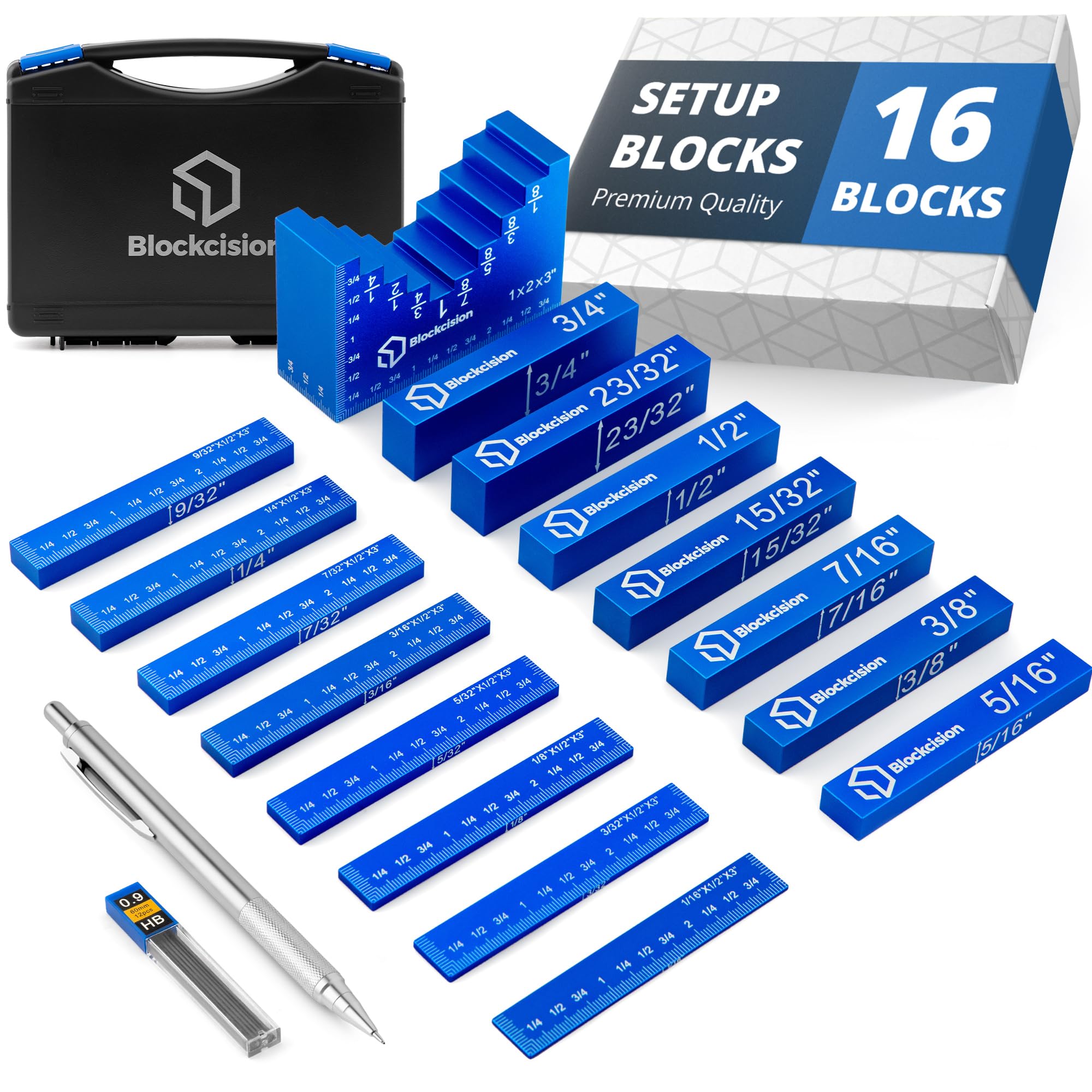
Sixteen bars, every one graduated — this set ends the second trip to the fence to check a height.
The job these do is dead simple: you drop a stack of blocks under your router bit or beside your table saw blade, and the height is set. This set covers any measurement from 1/16″ to 1″ in 1/32″ increments, so you are not guessing between two sizes. The bars are aluminum alloy, dent-resistant, and rated precise to ± 0.001″ — one-thousandth of an inch, which is far tighter than any cut you will make in wood.
What wins people over is the graduation. Every single bar in the 16-piece set carries ruler markings, not just the classic 1-2-3 blocks, which means you can read a measurement straight off the block in your hand instead of setting it down to go find a rule. That one detail is the difference between setting a stop block in seconds and walking back to the bench for a rule. A sturdy polypropylene case holds the whole set, and the laser-engraved markings are there for the long haul rather than wearing off after a season.
The honest catch is that this is a single-purpose tool — it excels at blade, bit and fence heights, and it will not replace a square or an angle finder for layout work. At 2.09 pounds in the case, it is also too heavy to carry in a shop apron pocket. But for the setup step you repeat every session, the tight tolerance and the marked bars make it the pick I would hand most woodworkers first.
What earns it the top spot
- Ruler markings on all 16 bars, not just the 1-2-3 blocks, so you can measure on the fly
- ± 0.001″ precision across a 1/16″ to 1″ range in 1/32″ steps
- Aluminum alloy bars with laser-engraved scales that resist scratching off
- Dedicated polypropylene case keeps the set together and ready
Where it asks for care
- Setup-only tool — it will not cover square, angle or layout jobs
- 2.09 pounds in the case is heavier than a pocket rule
- Limited lifetime warranty is worth registering for
Built for: the woodworker who resets a blade or bit height several times in a session and wants it right the first time.
Think twice if: your setup work is mostly angles and bevels — a combination square covers that better.
2. WT103B 8 Inch 3D Multi-Angle Measuring Square Ruler
Three planes of scale on one square — length, width and height, without flipping the board.
Most squares make you rotate the workpiece to mark a second face. This one carries scales in three dimensions, so you can read length, width, vertical height and any angle from 0 to 90 degrees without moving the stock. The measuring range runs from 1/16 inch up to 8.0 inches, and the graduations step at 0.06 inches. The body is high-strength aluminum alloy, thickened for stability, with laser-engraved scales that resist fading.
Where it pulls ahead of the plain ruler sets is the marking side. The 0-90 degree scale lets you lay out a bevel or draw a true horizontal line without rotating the square body at all. It ships with a carpenter pencil that has a built-in sharpener plus 6 refills at 2.8mm, which are described as break-resistant, and an Allen wrench for assembly. The anodized finish resists wear, corrosion and rust, so it can live in a toolbox without turning rough.
The trade-off here is the same one that comes with any multi-function layout tool — with more scales and moving parts to manage, there is more to keep square and check, and the assembly means it arrives in pieces. Treat it as a layout and marking square rather than a precision measuring instrument, and it earns its keep.
The layout argument: if you regularly cut bevels or work on stock where you cannot spin the board, three-dimensional scales save you a step on every piece.
Reach for this if: your projects involve angle work and multi-face marking more than raw height setting.
Look elsewhere if: you want a single solid piece from the start — this one assembles before first use.
3. Procision Woodworking Ruler, Set of 3 (12, 8, 6 Inch)
The wide slide is the whole idea — its 2-inch face holds a line steady where a thin rule wanders.
Three rulers at 12, 8 and 6 inches, each with a 2-inch sliding attachment that sits wider on the board than the usual narrow rule. That extra width is what stops the line from drifting when you draw across a long face. The slides are graduated at 1/16 inch, and the set also includes a dual-purpose setup block — a 0.5″ x 1″ x 2″ slide with its own markings — that you can use to set a table saw, drill press or router table height.
The accuracy story is the part worth repeating. Buyers report these rulers measuring within +/- 0.003 inches of a digital caliper, which is fine enough for any furniture or cabinet joint. The curved, shallower cut notch at the 5-inch mark is there to keep that reading true. Once you lock the slider with the thumbscrews, you can draw several identical lines without readjusting, and both ends carry hang holes so the rulers stay together in the shop.
Two honest notes. The included accessories and the readability of the smaller scales drew mixed feelings — the 6-inch rule in particular is tight on marking space. And the body is only 0.16 inches thick, so it flexes slightly if you press hard on an overhang. Neither is a reason to pass, but a heavy-handed user may prefer a solid machined square for rough stock.
Why the set works: one wide slide, three lengths, and a line you do not have to redraw. It is a marking tool first and a measuring tool second, and that split is exactly right for cabinet work.
Suits you if: you mark multiple identical lines per board and want the slider to carry the repetition.
Not your tool if: you need a rigid straightedge for heavy stock — 0.16 inches of aluminum will flex under pressure.
4. GRENPRO Speed Combination T-Square
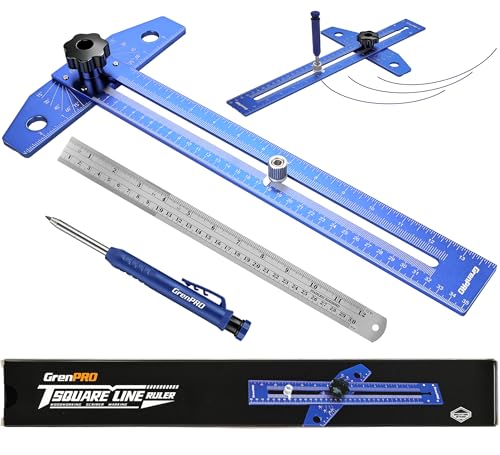
A ruler and a protractor bolted together, with a nut you loosen to set any angle.
This aluminum sliding T-square reaches up to 18 inches (48 cm) in length and adds a full protractor scale to the ruler. Loosen the nut, set the angle, tighten, and you can mark a bevel or draw a radial line without reaching for a separate angle tool. The body is premium aluminum alloy — light enough to hold one-handed and stiff enough that it does not deform in a workshop.
The scales are laser-engraved, so the ruler and protractor markings stay sharp and readable after repeated use rather than rubbing away. It ships with a carpenter pencil and a steel ruler, which extends the measuring range in one kit. For small projects especially, the combination is handy — you get straight lines, angle marks and a short measurement without swapping tools.
Worth knowing: the angle adjustment mechanism is the one area that has drawn mixed feedback, so set your angle and check it against a known reference before you commit a cut. This tool is best treated as a layout aid for marking, not a certified angle instrument. For the price of one tool covering straight lines and bevels, that is a reasonable exchange.
The value read: an 18-inch ruler and a protractor in one hand, plus a pencil and steel rule in the box. What it does not do is hold an angle to a measured tolerance like a digital finder.
Pick it for: layout work where you mark angles and straight lines on flat stock and want one tool to do both.
Skip it for: critical miter setups where a digital readout matters more than a protractor scale.
5. Trend Point-2-Point Equidistant Measuring Tool

Set it once across the board, then mark every dowel and pin at one pass.
Spacing is the job most tape measures do badly. This tool marks equally spaced points across the width or length of any board from 3.3 inches to 28 inches, so a run of dowels, biscuits or joint pins lines up from the first mark to the last. It is built for dovetail and finger joint layout, dowel centres and drilling positions, and it will also transfer a spacing from one workpiece to another.
The body is metal and stainless steel at 4.8 ounces, compact enough to keep in a bench drawer. Where it proves its worth is multi-hole layouts — the mechanism handles a whole row where a rule and pencil would need a separate calculation at each point. For anyone cutting repeat joinery, that is the whole reason to own one.
The honest picture is more mixed than the price suggests. The locking mechanism and the accuracy of the spacing have both drawn split feedback — some get clean results, some find it drifts. The highest-volume conversation around this tool is about consistency, so check the lock holds before each layout run. Used within that limit, it still beats doing the math by hand.
Straight talk on the lock: verify the setting on a test board before you mark the good stock. Do that, and this is the fastest way to a row of evenly spaced holes.
Best for: joinery layout where the same spacing repeats across many boards.
Weigh the risk if: your work needs a guaranteed lock every single time — this is not the most sure-footed tool in the list.
6. 14Pcs Setup Blocks for Woodworking
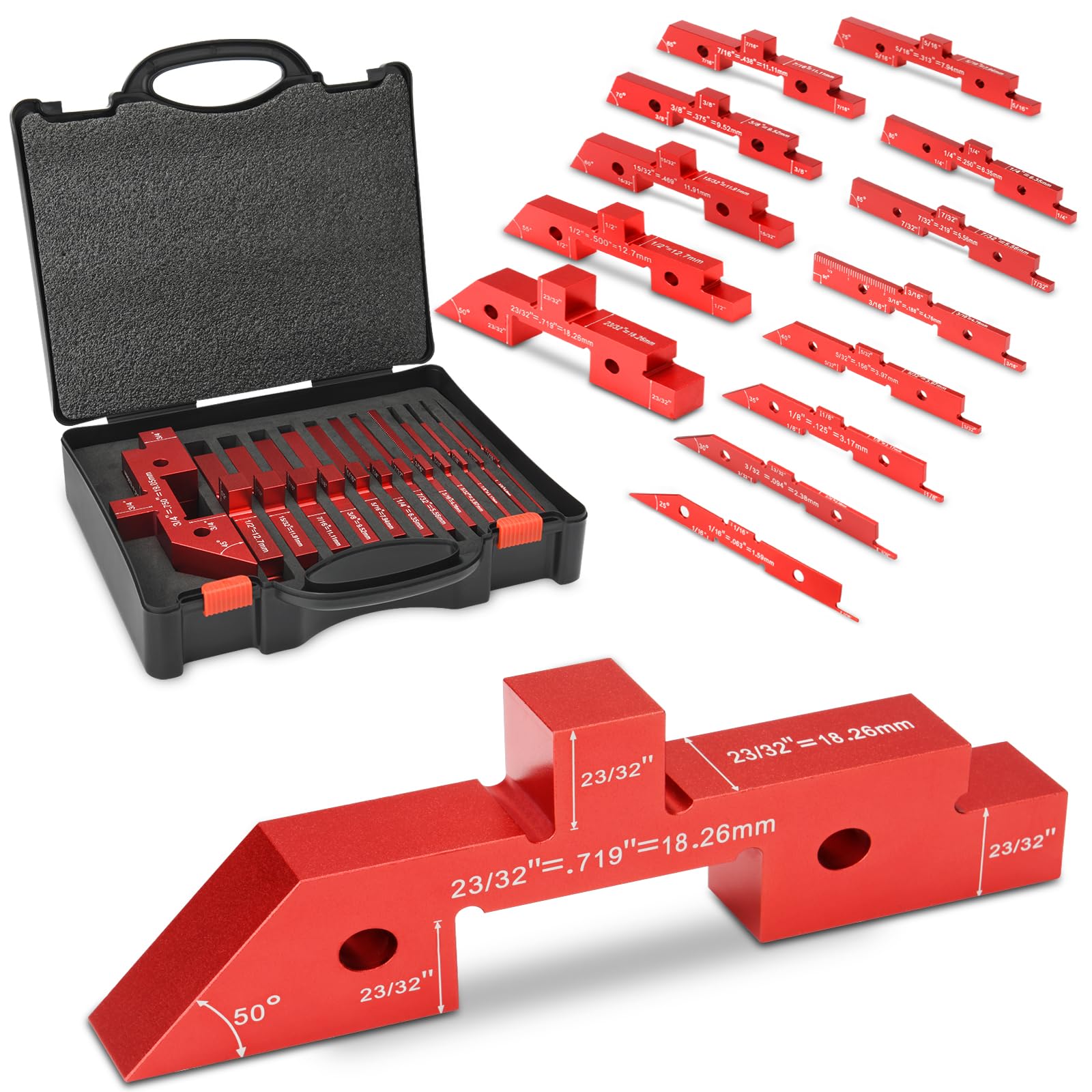
Fourteen thin bars that stack into hundreds of combinations — every height you need, no caliper in sight.
Where the Blockcision set above covers 1/16″ to 1″, this one takes a different angle: fourteen individual bars with varying thicknesses that you stack to reach any target. The sizes are 1/16″, 3/32″, 1/8″, 5/32″, 3/16″, 7/32″, 1/4″, 5/16″, 3/8″, 7/16″, 15/32″, 1/2″, 23/32″ and 3/4″, each precise to 0.001 inch. That is what lets one set sit under a router bit, set a milling thickness, test a workpiece depth and angle a table saw blade without adding another gadget to the bench.
The build is CNC-machined aluminum alloy with an anodized finish and laser-engraved markings, at 2.35 pounds for the full set. It comes in a dedicated storage case so the loose bars do not migrate. Owners mention the accuracy landing within 0.002-0.003 inch, which is plenty for wood. The 4-in-1 framing — angle, step, depth and fence — is the reason one kit covers table saws, routers, band saws and planers.
The recurring gripe is the case latches, which can work loose. Do not rely on the case as a travel container; treat it as bench storage and the rest of the tool holds up fine.
Why the stacking wins
- 14 graduated thicknesses that combine into hundreds of heights
- 0.001 inch precision from CNC-machined aluminum alloy
- Covers angle, step, depth and fence setup in one kit
- Anodized finish and laser-engraved markings for long service
Small thing to plan for
- Case latches can come loose, so keep the box on the bench
- Stacking takes a moment longer than grabbing a single fixed bar
Buy this when: you want maximum height coverage from one compact set and do not mind stacking two bars to get there.
Go fixed instead if: you want the fastest possible one-piece height changes and the latch issue would bother you.
7. HARDELL Digital Caliper 6 Inch, Rechargeable All Metal
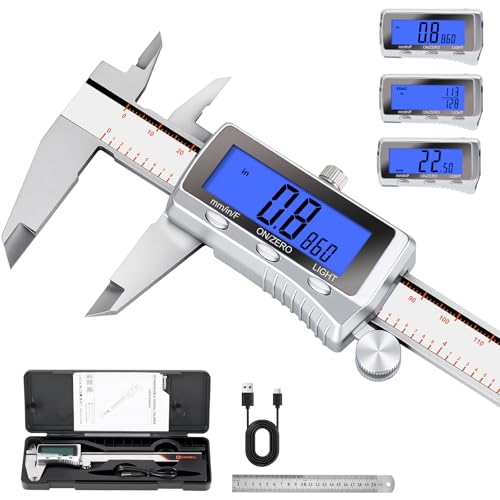
A caliper you recharge over USB-C, not one that dies mid-project while you hunt for a coin cell.
The spec that carries this tool is the power side. The maker rates the rechargeable battery at 4 months of use, with a 20-minute full charge or 2 minutes for enough power to keep measuring. Anyone who has opened a dead caliper mid-project will see the point. The measuring accuracy is ±0.001″/0.02mm across a 6-inch range, with a resolution of 0.0005″, so it reads to the same fine scale as a quality shop caliper.
The readout is the other reason to pick it. A backlight button lights the LCD so you can read the numbers in a dim garage or a bright site, and the screen auto-shuts the light after 5 seconds and the caliper after 5 minutes idle. Three units — inch, mm and fraction — switch instantly, and four measurement modes cover internal, external, depth and step. The all-metal body shields the electronics, which the maker says keeps readings steady near electric drills and other magnetic interference.
The catch is the charging protocol. It needs a 5V adapter and a USB-C cable, and the maker warns against adapters over 7V or dual USB-C (Type-C to Type-C) cables, which may not charge at all. Follow that spec and the tool is a set-and-forget bench companion.
Standout spec: +/- 0.001 inches with a 0.0005-inch resolution on a rechargeable body. That combination is why it sits at the premium end of this list rather than with the block sets.
Choose it for: verifying stock thickness, thread sizes and 3D-print layers with a readout you can trust in poor light.
Check first: you have a 5V adapter and a standard USB-A-to-C cable — a C-to-C cable may leave it refusing to charge.
8. Klein Tools 935DAF Digital Angle Finder

Inside angles, outside angles and a miter saw figure — three readings from one hinged arm.
Klein rates this finder to +/- 0.2-Degree precision with machined ruler edges. That is the number to hold onto, because it is the difference between a miter joint that closes and one that shows a sliver of daylight. The hinged design measures inside and outside angles, reads lengths, and works out the miter saw cut angle so you can dial the blade in by number rather than by eye.
The display is a white LED, which stays readable in a dim shop or under harsh overhead light. The ruler is metallic with deeply etched markings, so the scale does not blur or rub away, and the body — ABS plastic with stainless steel arm — resists rust. It runs on one AAA battery, which is included, so it works on arrival. Owners find it especially useful for blade leveling and angle checks, where an eyeball estimate tends to drift.
Be aware the value conversation around this tool is split — some find it a fair buy, some less so. If you set up miters weekly, the 0.2-degree precision justifies it. If you cut an occasional bevel, a manual protractor square will do.
The miter argument: a digital readout removes the arithmetic from compound cuts. You angle the arms, read the number, set the saw.
Worth it if: you cut miters and bevels often and want the blade angle to be a number, not a guess.
Pass if: your angle work is occasional enough that a protractor square covers it.
9. Bosch UniversalHumid Wood Moisture Meter

The check that happens before cutting — push the pins into the board and read the traffic-light LEDs.
Moisture is the hidden reason a finished board cups, shrinks or splits weeks after the glue dries. This meter checks wood moisture content by pushing its measuring pins into the stock, and it lets you pick between two wood groups for more precise results. A sticker with examples of each group ships in 12 languages and can be stuck onto the tool, so you are not guessing which setting your board belongs to.
Reading the result takes no skill at all, which is the point. The LED traffic-light system shows red when use is not recommended, yellow when you should be concerned, and green when the wood is suitable for use. It runs on 3 AAA batteries, which are included, and comes with a hand strap and a printed manual. At 0.12 kg, it fits in a tool bag alongside the rest of your layout gear.
The catch is that this is a go/no-go tool rather than a lab-grade moisture reader — it tells you whether a board is ready, not a detailed profile of how it will move. And the manual is English-language-not-guaranteed as packaged, so plan to work from the light system rather than the paperwork.
The prevention play: one pin push tells you more about a board’s future than any measurement you take after the cut. That is why it belongs in the same kit as your squares and rules.
Get it when: you buy rough or air-dried stock and want a fast read on whether it is ready to work.
Think bigger if: you need precise percentage readings for a log or kiln record — this tool answers ready-or-not, not exact figures.
Know the Specs
Stated accuracy and tolerance
Tolerance is how far a reading can be from the truth. A setup block rated to ± 0.001″ is accurate to one-thousandth of an inch, and a caliper at ±0.001″/0.02mm is in the same range. An angle finder at +/- 0.2-Degree is accurate to a fifth of a degree, which is enough for a clean miter. When two tools look alike, the one with the tighter stated tolerance usually gives you the more reliable cut.
Measuring range and graduation
Range is the span the tool covers, and graduation is the smallest step it marks. A block set that runs 1/16″ to 1″ in 1/32″ steps lets you reach any height within that band. A caliper with a 6-inch range and 0.0005″ resolution covers board thickness and part checks. A layout square that reads from 1/16 inch to 8.0 inches handles most cabinet and furniture marking. Match the range to the stock you actually cut.
Material and marking durability
Aluminum alloy with laser-engraved scales keeps its readings readable far longer than printed markings that wear away. An anodized finish adds resistance to wear and rust. On stainless steel arms with etched markings, the scale is cut into the metal, so it survives the shop. Materials decide how long the number you rely on stays the number you can read.
Power, display and ease of reading
Digital tools need a power plan. A rechargeable body removes the coin-cell hunt, while an LED or backlit LCD keeps the number readable in dim light. Auto-off, in seconds for the backlight and minutes for the tool, protects the battery. If you work in poor light, a bright display and a simple traffic-light readout are worth more than extra functions.
Common Questions
Are setup blocks accurate enough for furniture work?
Should I buy stackable setup blocks or a fixed bar set?
How is a digital caliper different from a steel rule?
Why does my miter joint show a gap even with a good square?
Do I really need a moisture meter for woodworking?
Will a rechargeable caliper run out mid-project?
What does an equidistant measuring tool do that a tape measure cannot?
Can these measuring tools work with a router as well as a table saw?
How should I store a block set so the bars stay accurate?
What is the difference between a 3D square and a combination T-square?
The Bottom Line
For most woodworkers, the wood measuring tools winner is the Blockcision 16-piece setup block set because every bar is graduated and the ± 0.001″ tolerance covers any measurement from 1/16″ to 1″. If you want the most reach and three-plane marking from one square, grab the WT103B 3D square. And for the check that happens before any cut, the Bosch UniversalHumid is the one to reach for.
One honest nudge: if you are building out a bench from scratch, start with the setup blocks and a caliper, then add the square or angle finder when a specific job calls for it. That order puts the measurement that affects every cut at the front of your kit.
How we choose
We do not accept paid placement. Every pick is matched to a real buyer and a real use-case; we do not hands-on test units.
Sources
Specifications: manufacturer listings and product documentation. Review insights: verified customer reviews, as of November 2026. Pricing: not shown on this page (it changes often); check the current price via the retailer link.
As an Amazon Associate, Tactical Gear Guy earns from qualifying purchases. This does not affect which products we feature.