Specs are compiled from manufacturer listings and verified buyer reviews and can change over time — please confirm the key details on the product page before buying.
If you want the short answer: buy a pull saw for clean joinery and a chisel set for hogging out material, and skip anything vague labelled a multi-tool. The nine woodworking cutters below cover sawing, chopping and carving, and each one is a real hand tool with real steel and real buyer mileage behind it. What separates a good wood cutter tool from a frustrating one depends on three things: how many teeth per inch (TPI — the number of cutting teeth in one inch of blade) it carries, what the blade is made of, and how it feels in your hand after twenty minutes of cutting.
This guide is built by comparing the manufacturers’ published specifications and the patterns across verified customer reviews, so you get each pick’s real strengths and trade-offs instead of marketing spin.
Some cut fast and leave a rough edge, some leave glass-smooth lines but punish sloppy technique. Here is what actually matters when you are shopping for the best wood cutter tool.
Top Picks


How To Choose The Best Wood Cutter Tool
The biggest mistake buyers make is treating every cutter as the same job. A flush saw, a ryoba and a chisel set solve completely different problems, and buying the wrong one means fighting your material instead of shaping it. Decide the job first, then match the tool.
Teeth per inch sets the speed-versus-fineness trade
A saw’s TPI (teeth per inch — how many cutting points sit in one inch of blade) decides everything about the cut. Low numbers like 8 TPI bite hard and clear chips fast, which is why they suit framing and rough sizing. High numbers like 18 TPI take smaller bites and leave a burnished edge, which is what you want on joinery and dowels.
Pull-stroke versus push-stroke blades
Japanese-style saws cut as you pull the handle toward you, which lets the blade be thin and the kerf (the slot the saw leaves behind) narrow. That means less material removed and less effort per stroke. Western hand saws cut on the push and tend to be stiffer, so they handle rougher stock without wandering.
Chisel steel and bevel angle
Look for Cr-V (chrome-vanadium — a steel alloy that holds an edge longer than basic carbon steel) and a stated bevel angle. A 25° edge is the common woodworking grind, while a 28° edge spends a little sharpness to survive harder knocks. A honing guide and a sharpening stone in the box saves you buying them separately.
Side-by-Side Comparison
| Model | Best For | Blade / Edge | Teeth or Sizes | Type | Amazon |
|---|---|---|---|---|---|
| JORGENSEN RYOBA 7 Inch★ Best Overall | Fine joinery in tight spots | SK5 steel, replaceable | 125 teeth | Double-edge pull saw | Amazon |
| Temple Tool Co. 6 Inch Flush CutBest For Flush Work | Flush-cutting pegs and dowels | Japanese high carbon steel | 6-inch blade | Flush cut pull saw | Amazon |
| WORKPRO 10-Piece Chisel SetBest Starter Kit | Beginners building a kit | Cr-V steel, 28° edge | 1/4″ to 1-1/2″ | Chisel set | Amazon |
| JORGENSEN 15-Inch Hand Saw | Fast general cutting | SK5 steel, Teflon coated | 8 TPI | Western hand saw | Amazon |
| O’Shine Miter Shears | Angled trim and molding | SK5 steel, chrome plated | 4-inch blade | Miter shear | Amazon |
| ENERTWIST 13-Piece Chisel Set | Full chisel range plus sharpening | Drop-forged CR-V, bevel edge | 1/4″ to 1-1/2″ | Chisel set | Amazon |
| EZARC Wood Chisel Set | Sharp from the start | CR-V steel, HRC60, 25° bevel | 1/4″ to 1″ | Chisel set | Amazon |
| Temple Tool Co. 9.5 Ryoba | General-purpose stock sizing | Japanese high carbon steel | Rip and crosscut sides | Double-edge pull saw | Amazon |
| BeaverCraft S14 Carving Kit | Spoon and bowl carving | 1066 high carbon steel | 3-piece kit | Carving knife set | Amazon |
Detailed Reviews
1. JORGENSEN RYOBA 7 Inch Double Edge Japanese Pull Saw
Our pick — 4.5+★ from 950+ verified ratings; the strongest balance of quality and price.
Two cutting edges in one short blade, so you stop reaching for a second saw.
The figure that earns this saw the top spot is 125 — the total tooth count packed into a 7-inch SK5 steel blade. Two edges do two jobs: one side runs 18 TPI for hardwoods and clean finish cuts, the other runs 7-12 TPI gradual teeth for fast rip cuts along the grain. You are getting a fine saw and a coarse saw in one handle, which is why it tops this list as the best wood cutter tool for anyone working at a bench rather than on a building site.
That 7-inch blade is 8 inches shorter than the JORGENSEN 15-Inch Hand Saw, and that gap is the whole point. Short blades track straight into dovetails, model parts and small trim, where a long saw wanders and overshoots your line. And the 125 teeth versus that 15-inch saw’s 8 teeth is a 15.6x gap — coarser teeth bite faster, finer teeth leave the cleaner shoulder you want on a visible joint.
The blade is replaceable, so when the SK5 steel dulls you loosen the screw and swap it instead of replacing the whole saw. The handle is European beech with a soft grip and it works one-handed or two — a real help when your other hand is holding the workpiece steady. Owners describe smooth, precise cuts in softer woods, and several use it for model building where a full-size saw will not fit.
Where the ryoba earns its keep
- One saw covers finish cuts (18 TPI) and fast rip work (7-12 TPI) in the same blade.
- Replaceable SK5 blade means a dull edge costs you a blade, not a whole saw.
- 7-inch length handles fine joinery and model work without wandering off the line.
- Beech handle with a soft grip works one-handed or two-handed.
What to know before you commit
- Pull-stroke technique is a habit change if you learned on Western push saws.
- 7 inches is short for breaking down full stock — the 15-inch saw handles that.
- The thin blade needs a steady hand; force it and it will kink rather than cut.
Go with it for: bench work where clean shoulders matter more than speed — joinery, dowels, model parts and small trim.
Choose longer instead if: your cutting tray is full of framing stock, because 7 inches will feel cramped on anything oversized.
2. Temple Tool Co. Japanese Flush Cut Saw
A 6-inch flush cutter that trims a dowel flat without scarring the surface next to it.
At 0.09 kg, this is the featherweight of the saw group. Compare that with the 0.61 kg JORGENSEN 15-Inch Hand Saw and the difference is a 6.8x weight gap — a lightness you feel immediately when you are working at eye level or reaching into a joint. The job it owns is flush cutting: trimming a dowel, tenon, wedge or trim piece level with an adjacent face, which is a cut that punishes any saw that wanders.
Because it cuts on the pull stroke, the blade can be thin and the kerf narrow, so it removes less material and leaves a cleaner finish. Owners describe a smooth clean cut that does not mar the surrounding wood, which is exactly the requirement here. It handles guitar work, repair jobs and furniture touch-ups where surrounding finish matters as much as the cut itself.
Two details explain the price of admission. The trade-off is a 6-inch blade with no replaceable edge — this is a precision tool for smaller components, not a saw you hand to someone breaking down a sheet of plywood. A case comes in the box, which keeps those fine narrow-kerf teeth protected between jobs.
The unglamorous strength: this saw does one thing — flush cutting — and does it without leaving a scar. If your work involves visible dowel joints, inlay or guitar building, that single strength justifies it.
It clicks when: your joins are meant to be seen, so a wandering blade would show up in the finished piece.
Not the one for: bigger cutting jobs — a short, thin blade is the wrong tool for stock sizing.
3. WORKPRO 10-Piece Wood Chisel Set
Ten pieces, six chisel sizes, and the sharpening gear you would otherwise buy twice.
Walk into a shop as a beginner and the hardest part is knowing which widths you actually need. WORKPRO solves that by shipping six bevel-edge chisels in 1/4″, 1/2″, 3/4″, 1″, 1-1/4″ and 1-1/2″ — the range that covers mortising, pairing and general clean-up. The blades are Cr-V steel ground at a 28° edge, which trades a sliver of sharpness for edge strength that survives a knock.
The other four pieces are what make this a complete start: a double-sided sharpening stone in 120/240 grit, an adjustable honing guide, and two carpenter pencils, all in a storage case. The grit numbers tell you the job — 120 shapes a dull edge, 240 refines it. With a honing guide you hold a consistent angle instead of guessing it freehand, which is the single biggest reason beginner chisels go blunt fast.
You can hit these handles with a mallet or hammer without splitting the grip, because they are PP+TPR (polypropylene and rubber — a hard plastic core with a rubberised skin) with a nickel-plated strike cap. The rubberised TPR grip absorbs mallet shock and reduces hand fatigue in long sessions. Quality is what owners praise most here, closely followed by sharpness, and the case keeps the set tidy between projects.
Built for the toolbox, not the museum: rubberised handles and protective guards mean this set tolerates real jobsite handling — the exact opposite of a display-only collection.
Fair warning: the 28° edge is strong rather than razor-thin, so expect to hone these soon after first use rather than right out of the case.
Reach for this if: you are kitting out a first workshop and want every common width plus sharpening covered in one box.
Look elsewhere if: you already own a honing guide and only need one or two specific widths.
4. JORGENSEN 15-Inch Hand Saw, 8 TPI Coarse Blade
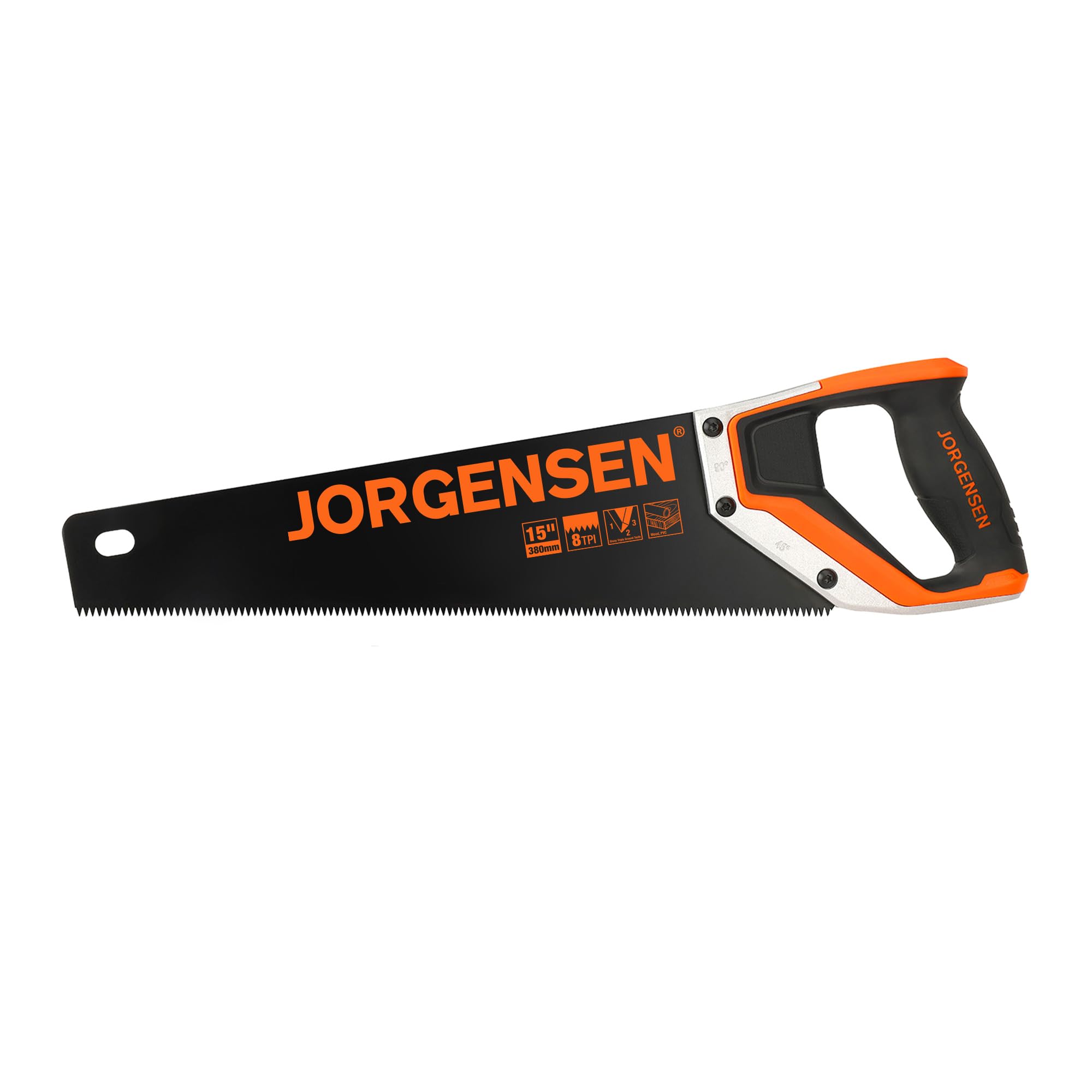
Eight aggressive teeth and a 15-inch blade that eats lumber without ceremony.
This is the saw you grab when the job is to shorten something, not to make it beautiful. The 8 TPI triple-ground teeth are built to chew, and Jorgensen rates these 8 TPI teeth at 50% faster cutting than a standard blade. Pair those coarse teeth with a 15-inch SK5 steel blade and you have a saw that clears chips and keeps going through lumber, pruning cuts and PVC.
For the scale of the thing: the blade runs 15 inches against the 7-inch RYOBA pull saw up top, a 2.1x length gap that translates directly into reach and stroke length. Long strokes plus coarse teeth equals speed, and owners compare the feel to a hot knife through butter on softwood. The Teflon coating reduces friction so sawdust does not cling to the steel, and it resists rust when the saw lives in a garage or truck bed.
The aluminum frame ties securely to the blade, and the TPE and ABS grip has 45° and 90° angle guides built into the handle for quick marking. That is a small feature that saves a job-site reach for your square. At 0.61 kg it carries real weight, so plan on two hands for long sessions, but that mass is what drives the cut. A plastic edge protector comes in the box to keep the teeth safe in transit.
Where this saw shines
- 8 TPI coarse teeth clear chips fast for quicker cuts through lumber.
- 15-inch SK5 blade gives long, powerful strokes on framing and pruning stock.
- Teflon coating cuts friction build-up and resists rust.
- 45° and 90° guides built into the handle save a square reach.
Honest limits
- Coarse teeth leave a rougher edge — not the saw for a visible joint line.
- 0.61 kg of saw wants two hands over long sessions.
The one for you if: speed matters more than finish — framing, pruning, PVC and quick sizing jobs.
Pass on it if: the cut edge will stay in view, where 8 teeth per inch leave too much tear-out.
5. O’Shine Miter Shears, 45-135 Degree Multi Angle Trim Cutter

Snips molding at seven preset angles without dragging out a saw or a miter box.
The O’Shine’s party piece is the anvil. It carries incised markings for 45°, 60°, 75°, 90°, 105°, 120° and 135°, and the holes beside each marking let you click the fence into position — a spring and iron ball hold it there, so your angle stays put through the cut. That is a miter box’s job done by a hand tool you can hold in one palm. An extra SK5 blade (a high-carbon steel blade) with a polypropylene sheath ships in the box, so a dull edge is a swap rather than a replacement purchase.
The blade itself is Japan-made SK5 steel, hard chrome plated and heat treated to HRC52 (a hardness scale reading — higher numbers resist wear longer). It slices soft wood parts like dowel and rod up to 3/4″ in size, plus PVC strips, quarter round, weather stripping and shoe molding. The handle is PVC with an anti-slip grip and comes ambidextrous, so left-handed users are not fighting the tool.
What wins people over is the time saved on trim: click the fence to an angle and squeeze, with no miter box to set up or clamp. Cutting performance is the honest split point: precision trim work earns praise, while thicker quarter round molding and angle accuracy attract gripes, so treat this as a soft-material trim shear rather than a saw replacement. It is built in Taiwan, and the aluminum alloy head keeps it light enough for repeated cuts without arm fatigue.
Straight talk on the cutting edge: feed it soft wood and thin trim and it clips clean; push it into thick quarter round and the cut quality slides, so match the material to the tool.
Ideal owner: anyone fitting shoe molding, weather stripping or PVC trim who wants angled cuts without setting up a miter saw.
Think twice if: your molding is thick and hardwood — reach for a saw and a miter box instead.
6. ENERTWIST 13pcs Wood Chisel Set

Eight widths instead of six, plus a sharpener that also handles plane irons.
Where most chisel kits stop at six sizes, this one runs to eight: 1/4″, 3/8″, 1/2″, 5/8″, 3/4″, 1″, 1-1/4″ and 1-1/2″. The two extra widths — 3/8″ and 5/8″ — are the ones you reach for on hinge mortises and small pairing work, and having them in the box saves a separate purchase. The blades are drop-forged CR-V with a bevel edge, which is why they take an edge and hold it across softwood, hardwood and laminated stock.
What makes this the more serious kit is the honing guide and stone combination. The guide sharpens at a 25 or 30 degree angle, and unlike the WORKPRO below it can handle plane irons as well as chisels — one jig for the whole bench. The hardened steel strike cap has an anti-impact curved surface, which is shaped to shrug off glancing blows and keep your hand clear of a missed hit.
Each chisel carries its own protection cap, and the black hard case holds the set rigid with tools held in place rather than rattling loose. On sharpness the picture is split: plenty of buyers find these arrive very sharp, while a few run into burrs on the cutting edge that a pass on the stone sorts out.
The two-angle advantage: a 25 or 30 degree honing guide that also fits plane irons is the upgrade that carries this kit above a plain chisel box — you sharpen your whole bench on one setup.
Count the burrs: the edges sometimes need a quick honing pass before first use, so budget a few minutes at the stone when the box arrives.
Pick this one when: you want the widest size range and a guide that also covers plane irons, and you are happy to touch up an edge now and then.
Not for you if: you want a chisel that only ever gets used on softwood and never sees a mallet.
7. EZARC Wood Chisel Set 6PCS

Six chisels sharpened to 25 degrees and living in a proper wooden box.
The first thing you will notice is the box. A wooden case is a different proposition from a plastic tray: it does not crack when it falls off a shelf, and it turns a working tool into something you would actually hand to someone as a gift. Inside sit six chisels in 1/4″, 3/8″, 1/2″, 5/8″, 13/16″ and 1″ — the widths that cover the vast majority of mortising, paring and glue-scraping on a bench.
Steel is the EZARC’s strongest card. It is chrome-vanadium, finely grained and tempered to HRC60 (a hardness reading that speaks to how well the edge resists wear). The bevels are ground at 25 degrees — the woodworking standard — and the maker states they cut straight from the box, so you can sharpen a door hinge or shave a rough face without a first session at the stone.
The handles are beech, a dense hardwood that wears well and resists the knocks a chisel takes when you are paring down to a line. Beeswax-free plain beech also means no slippery lacquer finish to fight. The honest note is on the edge life: some buyers report the edges holding for a reasonable stretch, others find them not sharp or prone to breaking with heavy use, so this is a set to treat as a good bench tool rather than an heirloom. Quality scores highest among owners, with value close behind.
Why the wooden box matters: six chisels rattling in a drawer is how edges die — the fitted wooden case keeps them posed and protected, which stretches the time between honings.
An honest word on durability: this is a value-priced set, so heavy levering or mallet abuse is where it will show wear fastest.
The right call for: a woodworker who wants a sharp-from-the-box set in a case that outlasts the tool and doubles as a proper gift.
skip it if: you plan to hammer these through knots all day — go up a tier for that workload.
8. Temple Tool Co. 9.5 Ryoba Japanese Pull Saw

A two-sided ryoba that rips with the grain and crosscuts across it in the same tool.
This is the saw to own if you only want to own one. One edge carries rip teeth for cutting with the grain, the other carries crosscut teeth for cutting across it, so sizing raw stock and cutting joinery both happen without a blade change. At 9.5 inches it sits between the 7-inch RYOBA and the 15-inch hand saw — long enough for medium joinery and stock sizing, short enough to control.
It cuts on the pull stroke, which is what lets the blade be thin and the kerf narrow. At 0.32 kg it is noticeably lighter in the hand than the 0.61 kg JORGENSEN 15-Inch Hand Saw, and the difference tells over a long session. Owners describe it as sharp from the wrapper and cutting like a hot knife through butter, with particular praise for tight spaces where a longer Western saw will not fit the stroke.
Deep quality and sharpness are what the review pages keep coming back to. The one thing to respect is the blade: it is thin by design, so let the teeth do the work and it will keep that edge for a long stretch.
Why it earns a place
- Rip teeth and crosscut teeth on one blade — one saw covers two jobs.
- 0.32 kg keeps long sessions comfortable and cuts in tight spaces manageable.
- Thin narrow-kerf blade removes less wood per stroke.
- Solid wood handle with brass fittings and Japanese handcraft behind it.
Where it needs care
- 9.5 inches is mid-length — not the pick for breaking down long framing stock.
- The thin blade rewards patience; forcing the stroke bends rather than cuts.
One-saw solution for: the woodworker who wants general stock sizing plus joinery from a single pull saw without a blade swap.
Pair it with: the longer 15-inch saw if your work regularly starts with full-length stock.
9. BeaverCraft Wood Carving Knives Kit S14

Three curved blades shaped for hollowing a spoon, a kuksa or a bowl.
This is the set you buy when your project is a shape rather than a straight line. Three tools do the work: a spoon knife, a whittling knife and a long-bent bowl gouge. Between them they cover the hollow of a spoon, the outside whittling and the deep bowl scoop — and the blades are 1066 high carbon steel, chosen because it takes a keen edge and keeps it through soft green wood.
The handles are oak, treated with linseed oil, and the maker designs them to be worked without fatigue during long carving sessions — which matters, because hollowing a bowl is repetitive hand work. The set is handcrafted in Ukraine and the maker pitches it at adult beginners as much as pros, so it suits a first spoon project as well as someone replacing a worn knife.
Owners call it a solid starting set that works and offers good value, with performance rated close behind quality. Be honest about the edges: sharpness is the split point, because some blades arrive ready to cut and others need a pass on a strop before their first spoon. Handle quality is also a matter of taste rather than a fault — the oiled oak suits some hands and not others. Treat these as carving tools to be maintained and they will do what the job asks.
Why three beats one: the hooked spoon knife and the long-bent bowl gouge reach into curves that a straight benchtop chisel simply cannot follow, which is the whole reason to own a carving kit rather than a chisel set.
Best for: anyone carving a spoon, kuksa or small bowl who wants the three curved tools in one purchase.
Check your expectation if: you want blades that cut perfectly straight from the box — some arrive needing a strop first.
Know the Specs
TPI and Tooth Count
TPI stands for teeth per inch — how many cutting teeth sit in one inch of blade. A low number like 8 TPI bites deep and cuts fast, which suits rough sizing and framing. A high number like 18 TPI takes smaller bites and leaves a cleaner surface, which suits joinery and flush trimming. The two numbers work together: a saw can have a modest TPI and a big total tooth count if the blade is long enough. Match the TPI to the finish you need rather than chasing the biggest number.
Blade Steel and Hardness
Blade steel decides how long an edge lasts. SK5 and high carbon steel hold a fine edge and take a polish, which is why pull saws use them for thin, sharp blades. Chisel steel is often Cr-V (chrome-vanadium), chosen for durability under mallet blows. Hardness readings like HRC60 measure how well a steel resists wear, and a higher number generally means the edge stays keener for longer — at the cost of being harder to sharpen on a rough stone.
Bevel Angle and Honing
A bevel angle is the shape of the cutting edge measured in degrees. A 25° bevel is the standard woodworking grind and gives a keen edge for paring. A 28° bevel gives up a little sharpness for a stronger edge that survives knocks. A honing guide holds the blade at a fixed angle while you work the stone, which is what keeps an edge consistent from one sharpening to the next. Stones come in grits — a lower grit shapes a dull edge, a higher grit refines it.
Pull-Stroke and Kerf
Japanese-style saws cut as you pull the handle toward you. That pulling motion lets the blade be thinner, and a thinner blade cuts a narrower kerf — the slot of removed wood left behind. A narrow kerf means less material to remove and less effort per stroke, plus a cleaner finish. The trade is that pull saws need a steady, unhurried hand; forcing the stroke kinks a thin blade rather than cutting faster.
Common Questions
Is a pull saw better than a Western push saw for woodworking?
What does 18 TPI mean on a flush cut saw?
Can I use miter shears to cut hardwood molding?
How do I keep a wood chisel sharp between projects?
What is the difference between rip and crosscut saw teeth?
Should a beginner buy a chisel set or a single chisel?
Where are these wood cutter tools made?
Can I replace a worn saw blade instead of buying a new saw?
What hardness should wood chisel steel be?
Are Japanese flush cut saws safe for cutting dowels in finished furniture?
The Bottom Line
The strongest all-rounder on this list is the JORGENSEN RYOBA 7 Inch Double Edge Pull Saw, and the reason is simple: 125 teeth split across an 18 TPI hardwood edge and a 7-12 TPI rip edge, with a replaceable SK5 blade to keep it going. If you want the crowd favourite, the JORGENSEN 15-Inch Hand Saw carries the highest score of the group with plenty of owner backing behind its 8 TPI cut speed. For chopping rather than sawing, the ENERTWIST 13-Piece Chisel Set gives you the widest size range plus a honing guide that also handles plane irons — a genuinely useful pair of extras, and the sort of detail worth acting on while the kit is readily available.
How we choose
We do not accept paid placement. Every pick is matched to a real buyer and a real use-case; we do not hands-on test units.
Sources
Specifications: manufacturer listings and product documentation. Review insights: verified customer reviews, as of November 2026. Pricing: not shown on this page (it changes often); check the current price via the retailer link.
As an Amazon Associate, Tactical Gear Guy earns from qualifying purchases. This does not affect which products we feature.