Specs are compiled from manufacturer listings and verified buyer reviews and can change over time — please confirm the key details on the product page before buying.
You want your voice to sound like it belongs on camera, not like it’s coming through a phone three rooms away. The honest answer: a wireless phone microphone fixes that in under a minute — you plug a small receiver into your USB-C port, clip a tiny transmitter to your collar, and record. This guide covers eight systems that actually work on a phone, ranked so you can see which one suits interviews, vlogging, or teaching before you spend anything.
This guide is built by comparing the manufacturers’ published specifications and the patterns across verified customer reviews, so you get each pick’s real strengths and trade-offs instead of marketing spin.
One thing to sort out before you read: these are wireless mics matched by purpose rather than one exact model number, so check the connector on your phone first. Every pick below is a genuine plug-in wireless setup, and each one earns its spot on a different strength — the DJI Mic Mini’s 4.5+ stars across 27,000+ owners proves that much. Here’s what actually matters when you’re shopping for a wireless phone microphone.
Quick Picks
- DJI Mic Mini (2 TX + 1 Mobile RX)
- Mini 2 Wireless Lavalier Microphones — Budget Champion
- BOYA V30 Wireless Lavalier Microphone — Longest Reach
- Wireless Microphone for iPhone Android Phone — Best Battery Readout
- FIFINE M9 2 Pack Wireless Lavalier Microphone — Most Flexible Rig
- Insta360 Mic Air (1 TX + 1 RX) — Smallest Build
- Hollyland Lark M2 Wireless Microphone — Top Performer
- MAONO Wave T5 Wireless Lavalier Microphone — Most Versatile
How To Choose The Best Wireless Phone Microphone
Your phone’s built-in mic picks up the whole room instead of one voice, and that is why most people buy a wireless phone mic. The fix is a separate transmitter you clip near your mouth, sending audio wirelessly to a receiver plugged into your phone. Four things separate a good one from a frustrating one — and none of them are the brand name.
Start with the connector, not the mic
A wireless phone microphone reaches your phone through a small receiver that plugs into the phone’s own port. If your phone has a USB-C port, you want a USB-C receiver. If it has a Lightning port, you need either a Lightning receiver or a USB-C receiver plus an adapter. Get this wrong and nothing else about the mic matters — it simply will not connect. All eight picks here are USB-C based, and several bundle an adapter for older iPhones.
Range in feet, and what actually eats it
Every listing quotes a transmission range — 70 feet on the short end, 328 feet on the long end. That figure assumes a clear open space with nothing between you and the phone. Put your body between the transmitter and receiver and the usable distance shrinks fast. If you plan to set the phone down and walk away, buy range generously. If you’ll always be within a few paces, a short-range unit saves you nothing but is perfectly fine.
Battery per charge versus battery with the case
Two numbers get quoted and they mean different things. Per-charge runtime is how long one transmitter runs on its own battery — that’s your single take. Total runtime with the charging case is how much you get when you keep topping the mics up between takes. For a quick shoot either number is plenty. For a full day of interviews, the case figure is the one that keeps you rolling.
Noise cancellation, signal-to-noise, and sound pressure
Noise cancellation removes steady background sound — traffic, air conditioning, crowd hum — before it reaches the recording. Signal-to-noise ratio, quoted in dB, describes how far your voice sits above the mic’s own electronic hiss, so a higher dB figure means a cleaner floor. Maximum sound pressure level is the loudest peak the mic handles before the sound distorts. If you record near loud machinery or sing close to the mic, that ceiling matters.
Side-by-Side Comparison
| Model | Best For | Transmission Range | Battery | Connector | Amazon |
|---|---|---|---|---|---|
| DJI Mic Mini (2 TX + 1 Mobile RX) | Overall phone recording | 300 m | 11.5 hours | USB Type-C | Amazon |
| Mini 2 Wireless Lavalier (KUKIHO) | Budget dual-mic shoots | 100 ft | 36 hours with case | USB Type-C | Amazon |
| BOYA V30 | Long-range run-and-gun | 328 ft | 36 hours with case | USB Type-C | Amazon |
| TXTUNE USB C Mini Clip On Mic | Entry-level outdoor work | 70 ft | 24 hours with case | USB Type-C | Amazon |
| FIFINE M9 2 Pack | Mixed phone and camera rigs | 164 ft | 30 hours with case | 3.5 mm Jack | Amazon |
| Insta360 Mic Air (1 TX + 1 RX) | Discreet on-camera presence | 300 m | 10 hours | USB Type-C | Amazon |
| Hollyland Lark M2 | Pro-level two-person audio | 1,000 ft | 30 hours with case | USB Type-C | Amazon |
| MAONO Wave T5 | Multi-device creators | 300 m | 40 hours with case | USB Type-C / Lightning | Amazon |
Detailed Reviews
1. DJI Mic Mini
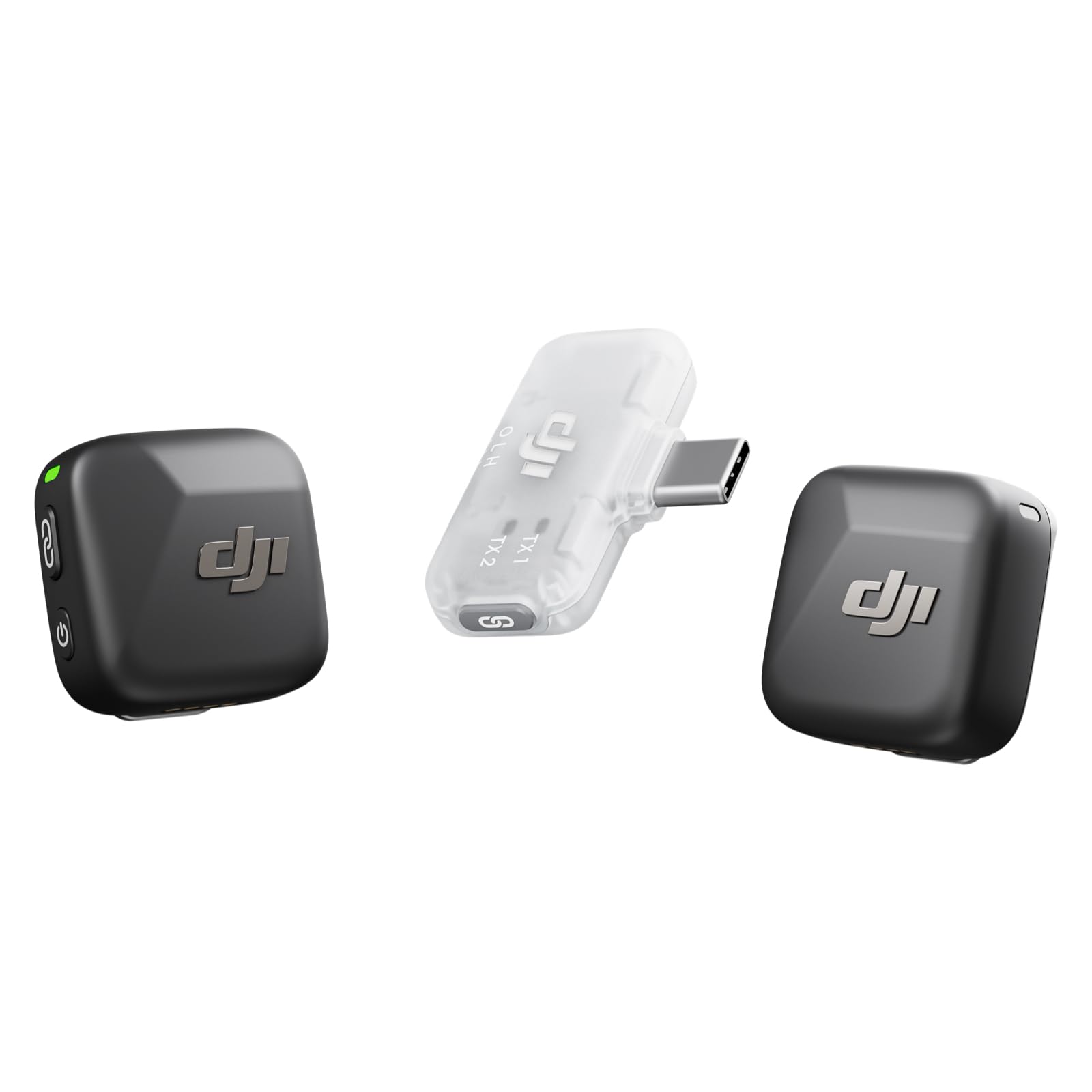
Two transmitters, one receiver, and a 300 m wireless leash you will never outrun.
The DJI Mic Mini hands you two transmitters and a USB-C mobile receiver in one box, so a two-person interview is covered without buying a second kit. Its wireless reach is 300 m (about 984 feet of clear open space), and that number is the reason it sits at the top — the TXTUNE, the shortest-range pick here, tops out at 70 ft. You can leave the phone on a tripod, walk to the far side of a park, and your voice still arrives.
You barely feel it on a collar: each transmitter weighs 10 g according to DJI’s own spec sheet, and the 26 g figure on the listing covers the receiver side of the package. It is also small enough to stay out of frame. Two noise cancellation levels let you match the room — Basic for a quiet room, Strong for a busy street. Automatic limiting pulls the volume down when you suddenly get loud instead of letting the recording clip. Runtime is 11.5 hours across the two transmitters and receiver, so a full shoot day runs without reaching for a cable.
Buyers report that the build and audio quality win them over, with reliability and connectivity close behind — the recurring theme is that it works the moment you take it out of the pouch. The honest catch is compatibility, which draws mixed notes. This is a USB-C system built around Android, iPhone 15 and newer, PC and tablet, so an older Lightning iPhone needs a workaround rather than a straight plug-in. The DJI-only extras are also gated: connecting the transmitter straight to OsmoAudio gear like Osmo Pocket 3 or Osmo Action 5 Pro skips the receiver entirely at 48 kHz, 24-bit (a high-resolution audio format), but that convenience only exists if you already own that hardware.
What earns it first place
- 300 m wireless range leaves every short-range rival in this guide standing still
- Two transmitters included — a two-person interview needs no extra purchase
- 11.5 hours of combined runtime matches a full shooting day
- Automatic limiting stops clipping the moment your voice jumps in volume
- Two noise-cancelling strengths, so a quiet studio and a loud street both get a setting
What to weigh before buying
- Compatibility draws mixed owner feedback, so confirm your port type before ordering
- The receiver-free OsmoAudio link only helps if you own DJI camera gear
- No charging case in this bundle — runtime relies on each unit’s own battery
Go for it if: you shoot interviews or two-person content on a USB-C phone and want a range figure you will never outgrow.
Check your port first: older Lightning iPhones need an adapter, and this bundle ships no charging case.
2. Mini 2 Wireless Lavalier Microphones

Two mics, a charging case that refills them twice, and no app to learn.
If your budget is tight and your videos are short, this KUKIHO kit gets you recording without a single menu. There is no Bluetooth pairing and no app — you plug the USB-C receiver into the phone, switch the mic on, and it pairs itself. A DSP noise reduction chip (a small processor that strips background hiss) offers three adjustable levels, so you can dial the cleanup up on a windy street and back off in a quiet room.
You never have to aim it: capture is 360° omnidirectional, which means the mic picks up sound from every direction around it rather than pointing at your mouth. Two transmitters are in the box for dual recording, which makes it useful for an interview or a two-host video. The charging case holds a 300 mAh battery (a small built-in power cell) and takes 1.5 hours to top up a mic. It delivers up to 6 hours per charge, and the case recharges the mic twice over, for 36 hours of total recording time. It can even charge your phone while you record, which helps when your phone battery is the thing about to give out.
Transmission is rated for 100 ft in open areas, so this is a stay-near-the-phone mic rather than a wander-off one — the BOYA V30 further down reaches 328 feet. The 4.72 x 3.23 x 1.52 inch case is compact enough to live in a jacket pocket. Owner feedback centers on how well it handles TikTok-style video and on-the-go interviews, with clear, natural sound and instant connection to iPhones coming up again and again. Treat the 100 ft claim as the open-air figure it is; put a wall between you and the phone and you’ll want to stay closer.
Where the money goes: almost everything here is aimed at convenience — self-pairing, three noise levels, a case that also charges your phone, and two mics in one box at the entry tier.
The fit: new creators shooting short-form video who want a two-mic setup and a case that handles recharging for them.
The ceiling: 100 ft of open-air range means you stay near the phone — no walking off across a field.
3. BOYA V30 Wireless Lavalier Microphone
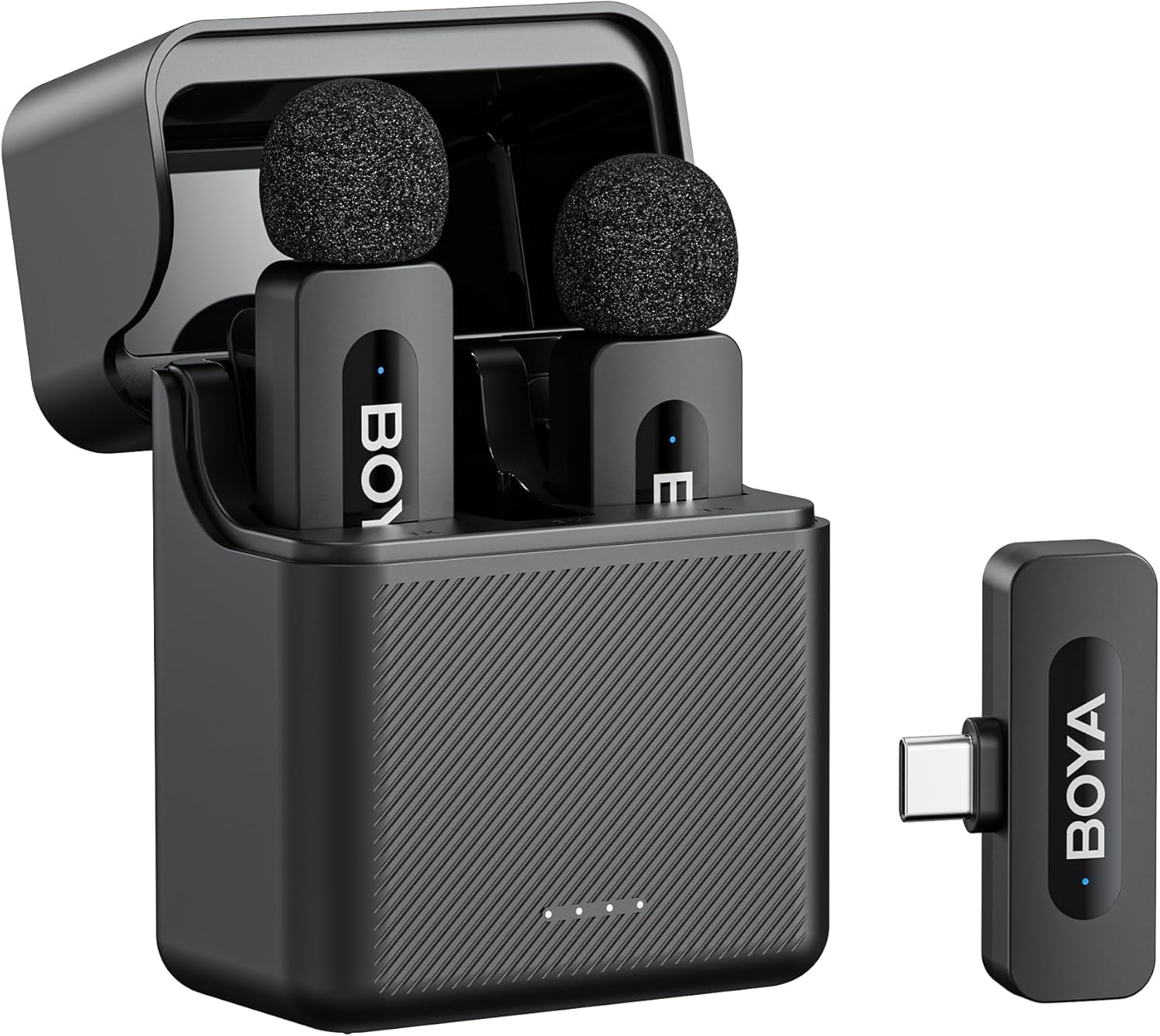
A 328-foot wireless leash on a 10.5 g clip — that is the whole pitch.
You can walk away from your phone with the BOYA V30, which is built for the creator who does not want to stay near it. Its 2.4GHz wireless link (a common cord-free radio band) reaches 328 feet, the longest range among this guide’s budget picks — the TXTUNE below stops at 70 ft, a gap of 258 feet of walking room. Set the phone on a tripod at one end of a room and you can still be working at the other.
The transmitter weighs 10.5 g, so it disappears on a collar. Inside is a 95 mAh rechargeable battery that runs 9 hours per charge, and the charging case takes the total to 36 hours. Audio is captured at 48 kHz/16-bit with an 80 dB signal-to-noise ratio and a 120 dB maximum sound pressure level, which means it handles a loud voice or a close-mic’d shout without the sound breaking up. A one-click noise cancellation button plus a dense windproof foam cover deals with wind and background rumble, and the 360° rotatable clip means you can angle the mic toward your mouth rather than accept however your shirt sits.
The detail that saves you repeated fiddling: you can play back a recording through the phone’s own speaker without unplugging the receiver. Owners describe it working well in virtual meetings and note the automatic connection takes the guesswork out of setup. Two things to know. It is USB-C only — Android, iPhone 17/16/15 and laptops — so an older Lightning iPhone needs an adapter. And the receiver’s USB-C port is there to charge your phone, not to serve as a headphone jack.
The distance play: 328 ft of range is not a marketing number you’ll never use — it’s the difference between a locked-down tripod shot and free movement.
The practical snag: USB-C only, with no Lightning option in the box.
Made for this: run-and-gun shooters who leave the phone planted and roam while talking.
Not your pick if: your phone still uses a Lightning port and you don’t want to add an adapter to the chain.
4. Wireless Microphone USB C Mini Clip on Mic
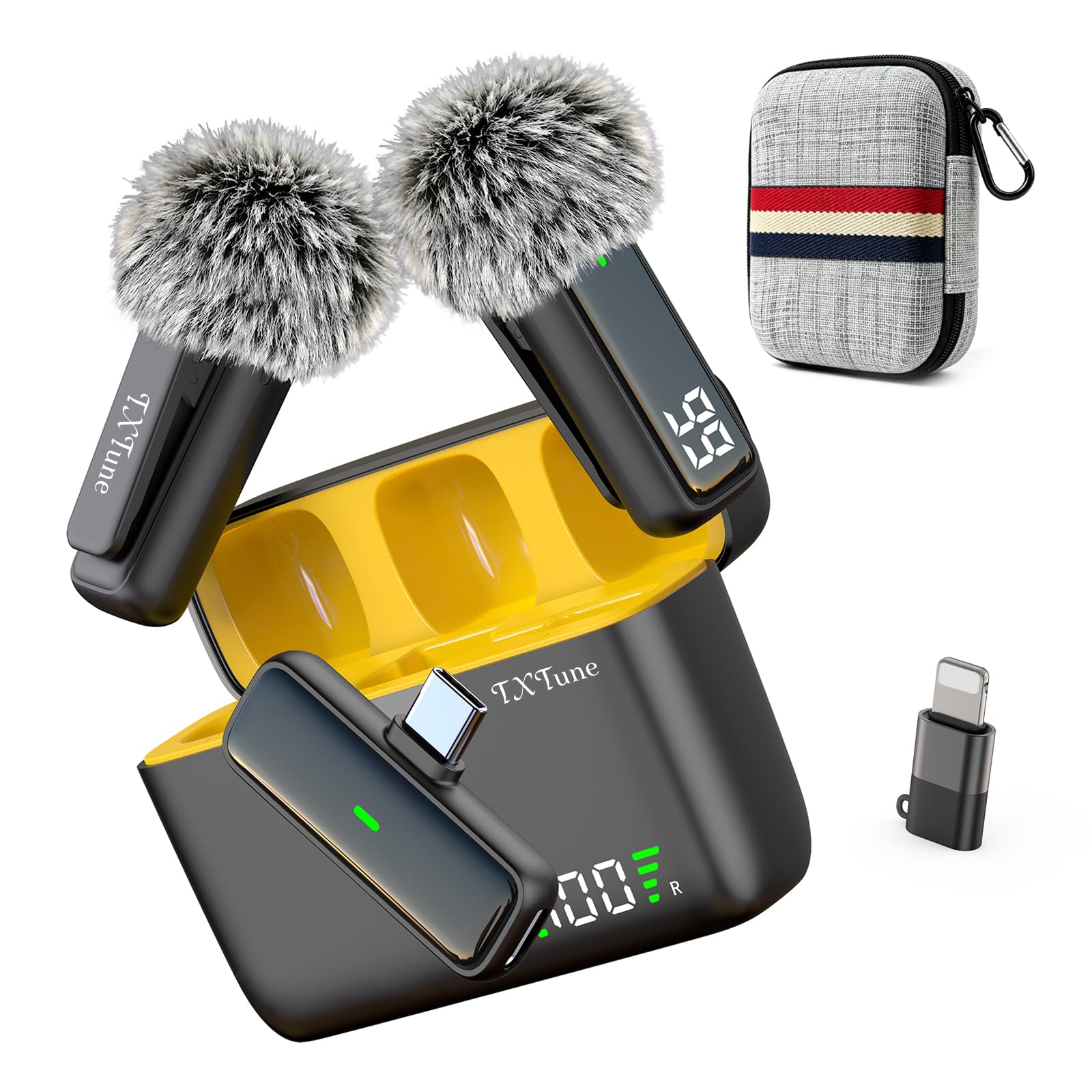
A little screen on each mic tells you the battery level before you start rolling.
The detail that makes this TXTUNE stand out is boring but genuinely useful: a digital power indicator on each mic, so you can see how much charge is left instead of discovering it mid-interview. Each transmitter runs up to 6 hours on a full charge, and the charging case stretches total use to 24 hours. The receiver passes charge through to your phone while you record, which keeps the phone alive during a long session.
Noise handling comes from a built-in DSP chip paired with furry windshields in the box — the fuzzy covers that break up wind before it hits the mic capsule. That combination is aimed squarely at outdoor recording and street interviews. Transmission holds stable up to 70 feet with low latency, which is enough for a vlog or a podcast where you stay within sight of the phone, but it is the shortest range in this article. Each mic weighs 9 grams and attaches by clip.
Owners find the sound clear and easy to set up, and the value read is consistently that it holds its own against pricier units — one buyer reports clear pickup at 25 feet. The mixed feedback lands on connectivity and noise cancellation, which tracks with the 70 ft ceiling: stay in range and the link holds, push past it and you’ll notice. Worth knowing that a Lightning adapter is included for iPhone 14/13/12, iPad and other iOS devices, so older iPhones are covered here where several rivals in this list leave you to buy one.
What owners value: clarity and value — the quality and sound-quality columns carry the most weight in feedback, and setup takes minutes.
Pick it when: you record outdoors near the phone and want to see battery status at a glance rather than guess.
Know the limit: 70 ft is the shortest reach here — fine for a street interview, thin for roaming a venue.
5. FIFINE M9 2 Pack Wireless Lavalier Microphone

The one kit that talks to your phone and your camera without a second purchase.
The FIFINE M9 is the pick for creators who switch devices mid-week — phone one day, DSLR the next. It ships with a 3.5 mm TRS cable and a 3.5 mm TRRS cable, so the receiver reaches a camera through the headphone-style jack and a phone through USB-C where the device supports it. A Lightning iPhone or iPad slots in via the included 3.5 mm cable plus a Lightning adapter. It covers Android tablets, USB-C iPhones, iPads with USB-C, laptops and DSLR cameras from one set.
The receiver carries a display screen showing which mic is connected and the audio level across three volume settings — you can see what’s happening instead of hoping. Sensitivity is -38dB and the maximum sound pressure level reaches 90dB, with a frequency response of 20Hz to 20kHz (the audible span of human hearing) so voices and detail survive the recording chain. Runtime is up to 30 hours through the charging case, which fully recharges the kit roughly three times, and you can charge while recording in dual-channel mode so a key moment never gets cut short. Range is 164 feet.
Owner feedback reads this as a budget kit that works and is quick to set up, with value as the second-strongest theme. The audio quality note is genuinely mixed — some find it surprisingly good, while others describe a boxy quality. Expect a plain, clear voice rather than a studio gloss, and stick to the wired-Camera or USB-C phone path since iPhone compatibility is where variation appears. This is a phone mic that moonlights as a camera mic, not a camera mic that tolerates a phone.
Why it earns a place
- Two mics plus cables that reach phone, tablet, laptop and DSLR cameras
- Receiver display shows connection status and three volume settings at a glance
- 30 hours through the charging case, with charge-while-recording in dual mode
- On-camera keys for volume, mute and noise cancellation
The trade-off
- Audio quality splits opinion — some describe a boxy, roomy tone
- iPhone compatibility is the shakiest part of the setup
- 164 ft of range sits well below the long-reach picks here
Reach for this if: you record on a camera as often as a phone and want one kit to serve both.
Look elsewhere if: you need consistent iPhone plug-in without adapters, or studio-grade tone.
6. Insta360 Mic Air (1 TX + 1 RX), Noise Cancelling, 300m Range

A coin-sized transmitter you can hide under a shirt or hang from a pendant.
Insta360 built the Mic Air around being unseen. The transmitter is 7.9 grams, roughly the weight of a AA battery cut in half, and it mounts three ways — magnetic, clip-on, or as a pendant. That flexibility is the point: on camera you can hide it entirely rather than clip a black brick to a collar. The package includes a magnet pendant and a clip magnet to make all three work.
Audio is sampled at 48kHz for true-to-life voice capture, with advanced noise cancelling and a windshield to clean things up outdoors. Transmission reaches 300 m (about 984 feet) and battery runs 10 hours with the receiver, with noise cancelling off. There is a remote control built into the transmitter — you can start and stop video, toggle noise cancelling, or mute without walking back to the phone. That saves a lot of trips across a room.
Owner feedback highlights sound quality, voice clarity and value most, plus the freedom to start and stop recording from a distance. The magnet mounting is the part that splits opinion — it holds fine for a seated interview or a walk-and-talk, but it is not built for active sports where a body gets thrown around. One structural limit worth knowing: the Mic Air works in Mono mode only, so audio from two transmitters lands on a single channel. If you want discrete left-and-right tracks per speaker, look at the Lark M2 below.
The discreet choice: 7.9 g with three mount styles means it stays out of frame in ways a clipped mic can’t manage.
The honest caveat: Mono-only recording puts both speakers on one channel.
Choose this when: staying invisible on camera matters more than separate stereo tracks per speaker.
Pass if: you shoot active sport footage or need two independent channels in post.
7. Hollyland Lark M2 Wireless Microphone

A quarter-mile wireless link and studio-grade 24-bit sound in a 9 g mic.
Hollyland’s Lark M2 puts the longest range figure in this entire guide on the table: 1,000 ft of line-of-sight range. No other mic here comes close, and it’s the reason filmmakers and event shooters reach for it. The transmitter weighs 9 g, and the receiver plugs straight into USB-C with no cable between it and the phone — you plug in, the pair talks, and you record.
Audio is captured at 48kHz/24-bit, the higher-depth format that keeps more of a voice intact, with a 70dB signal-to-noise ratio and up to 115dB maximum sound pressure level for loud peaks. Continuous runtime is 10 hours with ENC (environmental noise cancellation) off, and the charging case adds two full recharges per cycle in under 1.5 hours each, for 30 hours total. A yellow button toggles noise cancelling on the transmitter and receiver, and the HollyAudio app opens up Strong and Low levels for finer control.
Owners consistently describe clear sound, instant pairing and reliable links at long distances, which matches the spec sheet’s ambition. There’s a shortcut hidden in the button too: double-press the noise-cancellation button on the transmitter and your phone starts or stops video, or fires the shutter — a hands-free way to capture a moment you’re already inside. Just confirm your phone accepts a single volume-button press for that trick, because not every handset does. This is the pick where the audio ceiling, the range and the control scheme all point the same direction.
Standout strengths
- 1,000 ft line-of-sight range is the longest here by a wide margin
- 48kHz/24-bit capture with a 70dB signal-to-noise ratio
- 30 hours total through the charging case, 10 hours continuous
- Double-press control shoots video or photos from the mic
Worth slow-reading
- Remote shutter control depends on your phone accepting a volume-button press
- The premium tier asks more of your budget than the value picks
Built for: serious video work where a dropped link ruins a take and 1,000 ft of range buys real freedom.
Check before you commit: your phone model’s volume-button behavior decides whether the remote shutter works.
8. MAONO Wave T5 Wireless Lavalier Microphone

Three receivers in the box — USB-C, Lightning and camera — so no device gets left behind.
The Wave T5 solves the connector problem most kits leave you to fix yourself. MAONO includes three receivers: USB-C, Lightning, and a camera receiver. That one detail means an iPhone with Lightning, an Android phone, and a DSLR are all covered without buying an adapter. If your household records across mixed devices, this eliminates a whole category of frustration.
Loud moments stay clean: sound is captured at 48kHz/24-bit (a high-resolution audio format) with an 80dB signal-to-noise ratio (how far the signal sits above background hiss) and a 120dB maximum sound pressure level (the loudest peak it handles), so sudden shouts come through without distortion. The transmitter weighs 9 g. what separates it practically is the tone shaping: four one-tap voice presets — Vocal Enhancer, Brightness, Warmth and Magnetic Radio — let you change how your voice reads without touching an editor. Noise cancellation runs three modes and 14 levels through the Maono Link App, and there are independent noise-reduction and mute buttons on the mic.
Runtime is 9 hours per transmitter and 40 hours total through the charging case, the longest case-included runtime in this article. The receiver’s USB-C port passes charge to your phone while you record. Range reaches 300 m in open areas and 100 m when the transmitter is behind your back or in a pocket — a real figure, since body-blocking is what actually kills most wireless links. The reliability and connectivity columns draw mixed notes, which points at the pairing routine: if the blue light flashes slowly the pair failed, and you need to long-press the pairing button on both until the lights flash fast. Learn that once and it’s a non-issue. Owners mostly praise the sound for voiceovers and interview-style video.
The device-flexibility win: three receivers in one box beats buying adapters and hoping they work.
Learn this early: pairing takes a deliberate long-press on both ends, not a single tap.
Best fit for: creators juggling a Lightning iPhone, an Android phone and a camera who want one kit for all three.
Be ready to: master the pairing button routine, and accept a premium-tier price for four tone presets.
Know the Specs
Transmission Range in Feet and Metres
Range is the maximum distance the transmitter can talk to the receiver before the audio drops. It is always quoted for open space with a clear line of sight. Your body, a wall, or a pocket between the two eats into that figure, which is why some makers quote two numbers — one for open air and one for when the mic is behind you. Buy more range than you think you need if you plan to walk around; buy less if the phone sits within a few paces.
Battery Hours and the Charging Case
Per-charge runtime tells you how long one transmitter runs alone. Total runtime with the case tells you how long you can keep shooting while topping the mics up between takes. A mic quoting 6 hours per charge with a case that recharges it twice gives you a long session without an outlet. None of these figures account for heavy noise-cancellation use, so treat them as a best case.
Signal-to-Noise Ratio and Sound Pressure Level
Signal-to-noise ratio, in dB, measures how far your voice sits above the mic’s own electronic hiss — a higher figure means a cleaner recording floor. Maximum sound pressure level, also in dB, is the loudest peak the mic can take before the sound breaks up. If you record near traffic, machinery, or sing close to the capsule, both figures decide whether your audio stays clean.
What Plug-and-Play Really Means
A plug-and-play wireless mic pairs itself with the receiver the moment you power it on, with no Bluetooth menu and no companion app. That matters because a Bluetooth microphone routes through your phone’s Bluetooth stack, which can add delay and compress the audio. A dedicated receiver on the USB-C or Lightning port sidesteps all of that and gives you a direct, low-latency signal.
Common Questions
Will a USB-C wireless mic work on my iPhone if it has a Lightning port?
How far can I actually walk from my phone before the audio drops?
Do I need an app to use a wireless phone microphone?
Can a wireless lavalier mic record two people at once?
Does noise cancellation remove wind noise outdoors?
How long does a wireless mic run on one charge?
Will my phone charge while the mic is plugged in?
Is a dedicated wireless mic better than recording with phone Bluetooth earbuds?
What does 48kHz/24-bit audio mean for a phone recording?
Can I use one of these mics with a DSLR camera as well as my phone?
The Bottom Line
The wireless phone microphone that earns the top spot is the DJI Mic Mini, because its 300 m range and 11.5 hours of runtime cover both a two-person interview and a full day of shooting without a cable in sight. If range is what you’re chasing on a tighter budget, the BOYA V30 reaches 328 ft with 36 hours through its case. And for creators who record on a phone one day and a camera the next, the MAONO Wave T5 bundles USB-C, Lightning and camera receivers so no device gets left out. Whichever you pick, plug the receiver in and test the pairing before the shoot starts — that five-minute check is the one thing that separates a clean take from a re-shoot.
How we choose
We do not accept paid placement. Every pick is matched to a real buyer and a real use-case; we do not hands-on test units.
Sources
Specifications: manufacturer listings and product documentation. Review insights: verified customer reviews, as of November 2026. Pricing: not shown on this page (it changes often); check the current price via the retailer link.
As an Amazon Associate, Tactical Gear Guy earns from qualifying purchases. This does not affect which products we feature.