Specs are compiled from manufacturer listings and verified buyer reviews and can change over time — please confirm the key details on the product page before buying.
If your local channels keep dropping out during the fourth quarter, the antenna is usually the problem — not your TV. A roof-mounted outdoor unit pulls free broadcast signal straight out of the air, and the right one holds that picture steady through rain, wind, and distance. Below you’ll find the nine outdoor antennas worth considering, sorted by who each one actually suits.
This guide is built by comparing the manufacturers’ published specifications and the patterns across verified customer reviews, so you get each pick’s real strengths and trade-offs instead of marketing spin.
You’ll see how range, gain, and aiming separate a fussy install from a set-and-watch one, plus which units genuinely survive a rooftop winter. Read on for the clearest path to a wireless outdoor tv antenna that actually holds its channels.
Top Picks

How To Choose The Best Wireless Outdoor TV Antenna
Buying an outdoor antenna is really a distance-and-obstacle problem. Your broadcast towers sit somewhere out there, and the antenna has to grab their signal and hand it down a coax cable to your TV without letting noise creep in. Everything else — the remote, the app, the paint finish — is secondary.
Match the range figure to your real distance
A “150-mile” rating is the manufacturer’s best-case number, measured over open, flat ground with nothing between you and the tower. Trees, hills, and even your own roof cut into that. Pick an antenna whose published range comfortably exceeds the actual miles to your towers — that extra headroom is what keeps a channel locked in on a stormy night.
Directional or multi-directional, depending on your towers
A directional antenna (one that aims at a single point) delivers more focused gain, which matters when all your stations cluster in one direction. A multi-directional or rotating model lets you swing toward a second tower cluster without climbing back up. If your locals are scattered, rotation or a wide-pull design saves you a second antenna.
Look at the amplifier and the filtering
A built-in amplifier boosts a weak signal before it travels down the cable, so distant stations survive the trip. Just as important is filtering — circuitry that blocks nearby cell and FM interference from drowning out your channels. An amplified antenna without filtering can actually make a strong local station worse by overloading the tuner.
Check what mounting hardware ships with it
Some units arrive with a J-mount, mast clamps, and a full install kit; others give you the antenna and expect you to source the pole. Read the box contents before you buy, because a mast you have to buy separately adds a trip to the hardware store before you ever see a picture.
Side-by-Side Comparison
| Model | Best For | Max Range | Channels | Aiming | Amazon |
|---|---|---|---|---|---|
| Winegard Sensar IV RVW-395★ Best Overall | RV and travel-trailer installs | 55 miles | — | Crank-up rotation | Amazon |
| CEKAY Outdoor YagiBudget Champion | Budget rooftop on a mast | 70 miles | 100 | Fixed directional | Amazon |
| CEKAY 150-Mile MotorizedMost Versatile | Rural homes with scattered towers | 150 miles | 69 | Motorized 360° remote | Amazon |
| GE Outdoor HD Digital | Attic or roof, many channels | 80 miles | 200 | Fixed Yagi | Amazon |
| Five Star 150-Mile Kit | Feeding several TVs at once | 150 miles | 5 | Motorized 360° remote | Amazon |
| Antennas Direct Element | Clustered towers, one direction | 60 miles | — | Uni-directional | Amazon |
| Five Star 200-Mile Outdoor | Long-distance fringe reception | 200 miles | 100 | Fixed multi-directional | Amazon |
| Winegard Elite WE7550A | Low-noise rural reception | 70+ miles | 36 | Fixed directional | Amazon |
| Televes DAT BOSS Mix LR | Fringe reception with heavy interference | 100 miles | 29 | Directional, triple-boom | Amazon |
Detailed Reviews
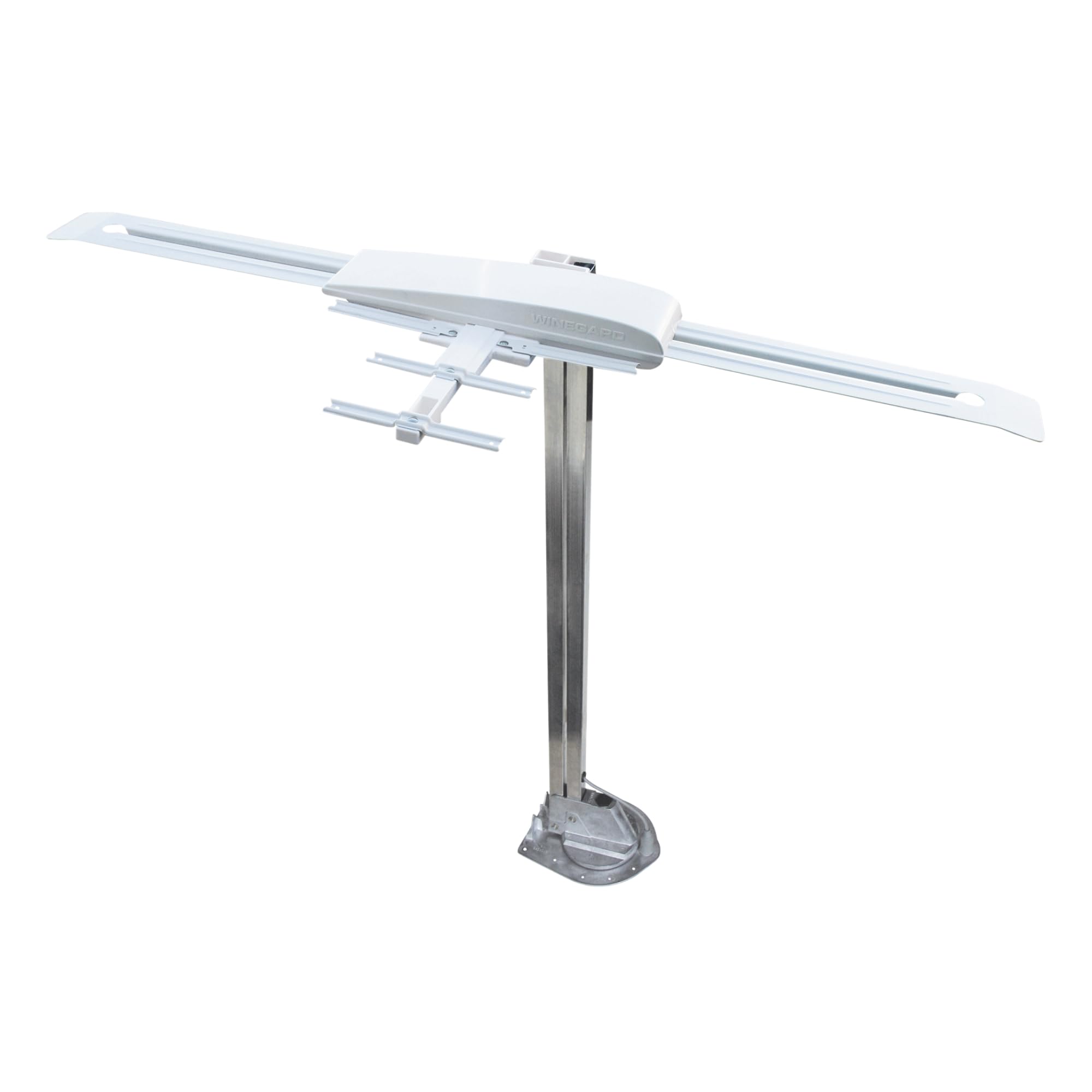
1. Winegard Sensar IV RVW-395 RV TV Antenna
Our pick — 4.5+★ from 950+ verified ratings; the strongest balance of quality and price.
The crank-up batwing that turns a campground into a living room.
For anyone who lives out of a travel trailer or motorhome, this is the antenna the crowd has settled on — 4.5+ stars across 900+ ratings — and the reason is simple. It raises to 48 inches, rotates by hand crank to aim at the towers, and drops back down flat when you roll out. The built-in amplifier carries a 65-mile range figure, and the published spec tops out at 55 miles, so it pulls weak stations most travel antennas miss.
What wins people over is plainly the build. It’s a powder-coated exterior that Winegard says passed environmental testing, and it’s swappable — the head unit replaces without tearing out the whole roof assembly. UHF reception gets a lift from the integrated Wingman design. Winegard’s RV Halo app adds an AR channel finder that helps you point the thing before you crank it up. Reception clears from over 60 miles out, and cord-cutters moving off satellite find the switch worth it.
The catch worth knowing up front: this is a directional antenna, so you aim it every time you relocate, and the crank lives inside the RV. It’s also the largest single item on this list dimensionally — 46.25″L x 15.25″W x 4″H and 10.2 pounds — which is fine on a roof but not something you’ll stash in a drawer. Against the GE Outdoor HD, it’s a tighter reach play but built for a moving home rather than a fixed one.
Where it earns its keep
- Crank-up rotation aims without a roof climb
- Built-in amplifier reaches the 65-mile published range
- Swappable head unit keeps the install serviceable
- NextGen TV and 4K Ultra-HD compatible
What to weigh first
- Directional, so re-aim after every move
- Large footprint at 46.25″L x 15.25″W x 4″H
Reach for it if: your home has wheels and you want free HD at every stop.
Think again if: you want a fixed roof antenna you aim once and forget.
2. CEKAY Outdoor Yagi TV Antenna
An all-metal Yagi that asks for almost no money and no tools.
If you’re on a fixed roof and your towers sit in one direction, this is the value play. It’s a directional Yagi — a long boom with stacked elements that focus the signal hard at one point — rated to 70 miles and tuned for both VHF and UHF, at 170~860MHz. The published channel count is 100, and the 40-foot RG6 coax and J-pole come in the box, so the mast is handled.
Performance is the thing buyers rate highest on this one, closely followed by overall quality and channel count. Buyers report it pulls more than 90 channels with a clean picture and assembles in minutes with printed instructions and no tools required. Owners mention it holds signal through heat, rain, wind, and snow, and it’s ATSC 3.0 compatible for the coming broadcast standard.
One point to size honestly: durability draws a split reaction, so a coastal or high-wind roof is worth a second look before you commit. For a sheltered install with clear line of sight, it’s a hard-to-argue starting point. It also skips the motorized aiming you get on the CEKAY 150-Mile model above — you point it once and leave it.
The tool-free draw: it arrives mostly pre-assembled, and you don’t need a wrench to get it up — that’s rare at this tier and saves an afternoon.
The honest limit: it’s a fixed directional design, so scattered towers mean picking which cluster you sacrifice.
Great match for: a budget-minded cord-cutter with towers lined up in one direction.
Pause if: you need remote aiming or live somewhere the wind tests everything.
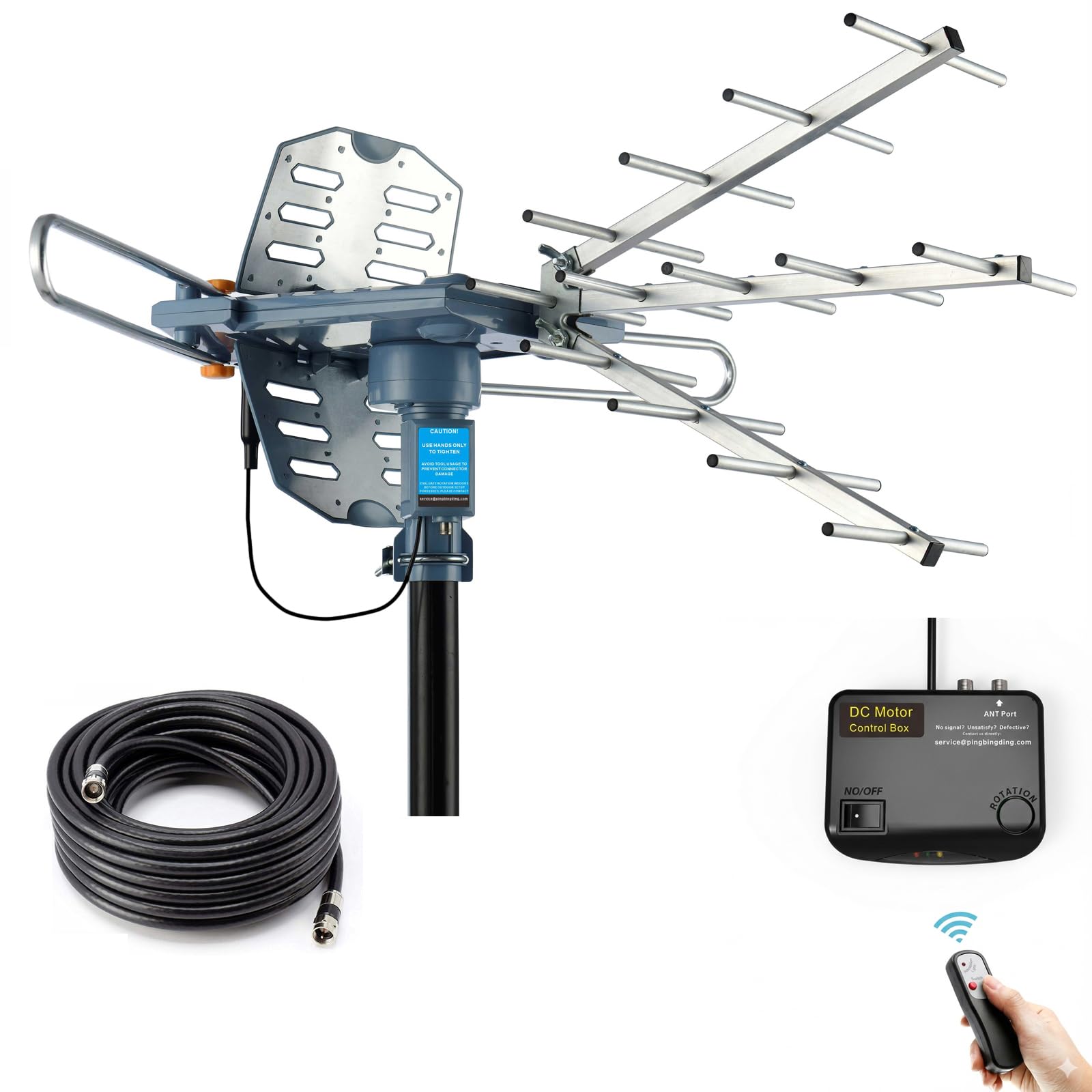
3. CEKAY 150-Mile Motorized Outdoor TV Antenna
Aim it from the couch instead of the roof.
Rural homes with towers in two or three directions are exactly the case this was built for. The headline number is a 150-mile maximum range, and it carries a 69-channel count — against the GE Outdoor HD’s 200, that’s a narrower channel list but a much longer reach spec. A DC motor rotates the whole unit clockwise or counter-clockwise from a wireless remote, so you can hunt the strongest signal without ever climbing up.
The reception side is handled by a high-gain, low-noise amplifier that pulls VHF (170–230 MHz) and UHF (470–860 MHz) and holds 720p, 1080i, 1080p, and 4K. The construction is corrosion-resistant with lightning protection, and a 40-foot RG6 cable comes with it. In genuinely remote spots, customers note it locking onto roughly 25 channels with a clean, pixelation-free picture.
This is the pick when the towers are scattered, and the trade-off is that you’re managing an aim rather than a fixed install. Fine-tune it once and note which direction your favorites sit. Also know that a 150-mile spec is a best case over flat ground — hills and trees will trim what you actually catch.
Why the remote matters: a rotating antenna that adjusts by remote means storm season doesn’t mean a ladder.
The real-world caveat: you’ll likely re-aim it a few times before settling on the best angle for your locals.
Suit yourself to it if: you’re out past the suburbs and your stations aren’t in one tidy line.
Look past it if: all your towers sit in a single direction — you’d pay for a motor you never use.
4. GE Outdoor HD Digital TV Antenna

The channel monster that brings in more stations per dollar than anything here.
Two hundred is the number to remember: this GE carries a 200-channel count, and that’s nearly three times the CEKAY 150-Mile Motorized’s 69. It’s rated to 80 miles, works with every brand of TV and converter box, and handles VHF and UHF in full 1080p with 4K Ultra-HD readiness. If you want maximum stations from a fixed, no-motor install, this is the spec sheet you want.
Buyers rate channel reception highest on this one, and the count backs it up — it pulls in more than 100 channels with a pixelation-free picture. Setup stays simple because the weather-resistant bracket, mast clamp, and J-mount all come in the box. You can mount it to a wall, a roof, or a standard mast, or hide it away in the attic. It also supports NEXTGEN TV (ATSC 3.0, the next broadcast standard), so it is ready for that signal.
The recurring gripe is the instruction sheet, which some find thin for a first-time install — watch a mounting video before you start. And while the majority love the compact design, size draws a mixed reaction, so check the 37″L x 26.5″W x 19″H footprint against your mount point. Wiring a second TV is straightforward with the multiple-TV support.
The headline win: 200 channels on the spec — the widest channel count of the whole group.
Worth planning for: the included J-mount means no hardware-store run, but bring your patience for the instructions.
Pick it if: raw station count is what you’re chasing and your roof or attic has room for it.
Bypass if: you need to steer the antenna toward far-off towers.
5. Five Star HDTV Antenna 150 Miles

One antenna, five screens, and a remote that spares you the ladder.
Households running several TVs are the whole point of this kit. A splitter in the box takes the feed from two outputs up to five TVs, so every room gets the signal from one install. The reception spec is 150 miles over a 45-860MHz band, with 4K, 1080i, 1080p, and 720p support, and a 360-degree motor turns the antenna from a wireless remote.
The amplifier side is where it gets clever for crowded areas — a high-gain, low-noise boost plus a LET filter that cuts interference from nearby 4G phone signal. An upgraded smart chip handles automatic gain control, so the signal stays clean once you run a channel scan. The 40-foot coaxial cable lets you put the antenna where reception is best, not where the TV happens to sit. Buyers consistently rate setup as easy, the picture as crisp, and the build as solid.
Two practical notes. The remote takes AAA batteries that don’t come with it, so grab a pair before install day. And the antenna itself measures 24″ x 29″ x 10″, which is a modest enough footprint for a roof or eave. Assembly is a matter of extending five reflector elements into the main unit.
What stands out
- Splitter feeds up to five TVs from one antenna
- LET filter blocks nearby 4G phone interference
- 360-degree motor with wireless remote aiming
- Full install kit with J-pole and 40-foot cable
Small things to know
- Remote’s AAA batteries are not included
- Reception still depends on where your towers sit
Best for: a family wiring the whole house off one antenna.
Less ideal for: a single-TV setup where the splitter just adds clutter.
6. Antennas Direct Element Outdoor TV Antenna

Featherweight and focused — for towers that line up in one direction.
If your broadcast towers all cluster one way, a uni-directional design concentrates the pull instead of spreading it thin. That’s what the Element does, with a peak gain spec of 6.7 dBi on Hi-VHF and 9.2 dBi on UHF across 174 to 216 MHz and 470 to 608 MHz. At 2.6 pounds, it’s a fraction of the weight of the Winegard Sensar IV’s 10.2 pounds, so a single mast holds it comfortably.
Channel reception is what it’s loved for, and the build earns near-equal praise. Reviewers point out it lifts VHF reception off a baseline, and its clean design and fold-out elements make it simpler to hang than more complex designs. It’s NextGen TV, 4K, 8K UHD, and 1080p compatible, and it works indoors in an attic or on an outdoor mast without an internet connection.
The reception literature is honest that distance and obstacles like trees and building materials will affect what you pull, since an antenna can’t match a cable bundle. Picture quality draws a mixed reaction from buyers — worth knowing if you’re chasing a weak station. At 44.5″L x 35.5″W x 2.5″H, it’s thin but wide, so plan the mounting space.
Light-touch install: 2.6 pounds on a mast is an easy one-person lift, and the fold-out elements keep setup quick.
Narrow aim: uni-directional means it’s brilliant for clustered towers and a poor fit for scattered ones.
A clean fit for: a lightweight attic or roofline install with towers in one cluster.
skip it if: your stations sit in opposite directions — the focused aim will cost you one of them.
7. Five Star Outdoor HDTV Antenna 200 Mile

Two hundred miles on the spec sheet, for the house at the edge of the map.
If your broadcast towers sit genuinely far off, this is the range pick. Five Star rates it up to 200 miles, and it catches both VHF and UHF (the two main broadcast bands), with a 100-channel count and full 1080p and 4K reception. Its receiving elements (the metal arms that grab the signal) run longer and larger than its other models to pull in weak signal. That length is the whole reason it holds up at distance, and the published reach sits well past the GE Outdoor HD’s 80 miles.
Setup is where this pick keeps winning people over — assemble, mount on the roof, attic, chimney, eave, or mast, then run a channel scan on the TV. Shoppers say channel pulls in the high sixties and low eighties, with a clean picture and no cable bill at the end of it. ATSC 3.0 readiness means it carries you into the next broadcast standard, and the kit includes the mounting bracket, J-pole, and a TV splitter for multiple sets.
A note on honesty about range figures: 200 miles is a best-case over open terrain, and Five Star itself points out that reception depends on local towers, trees, and obstacles. Plan a monthly channel scan too, since it keeps your lineup current.
Range-first thinking: the extended length is aimed squarely at fringe homes where shorter antennas fall short.
Size is the companion cost: 46″L x 28″W x 25″H wants real mounting space and a solid attachment point.
Made for: a rural home willing to trade size for the farthest reach on the list.
Not the match if: you’re close to your towers and want something low-profile.
8. Winegard Elite WE7550A Outdoor TV Antenna
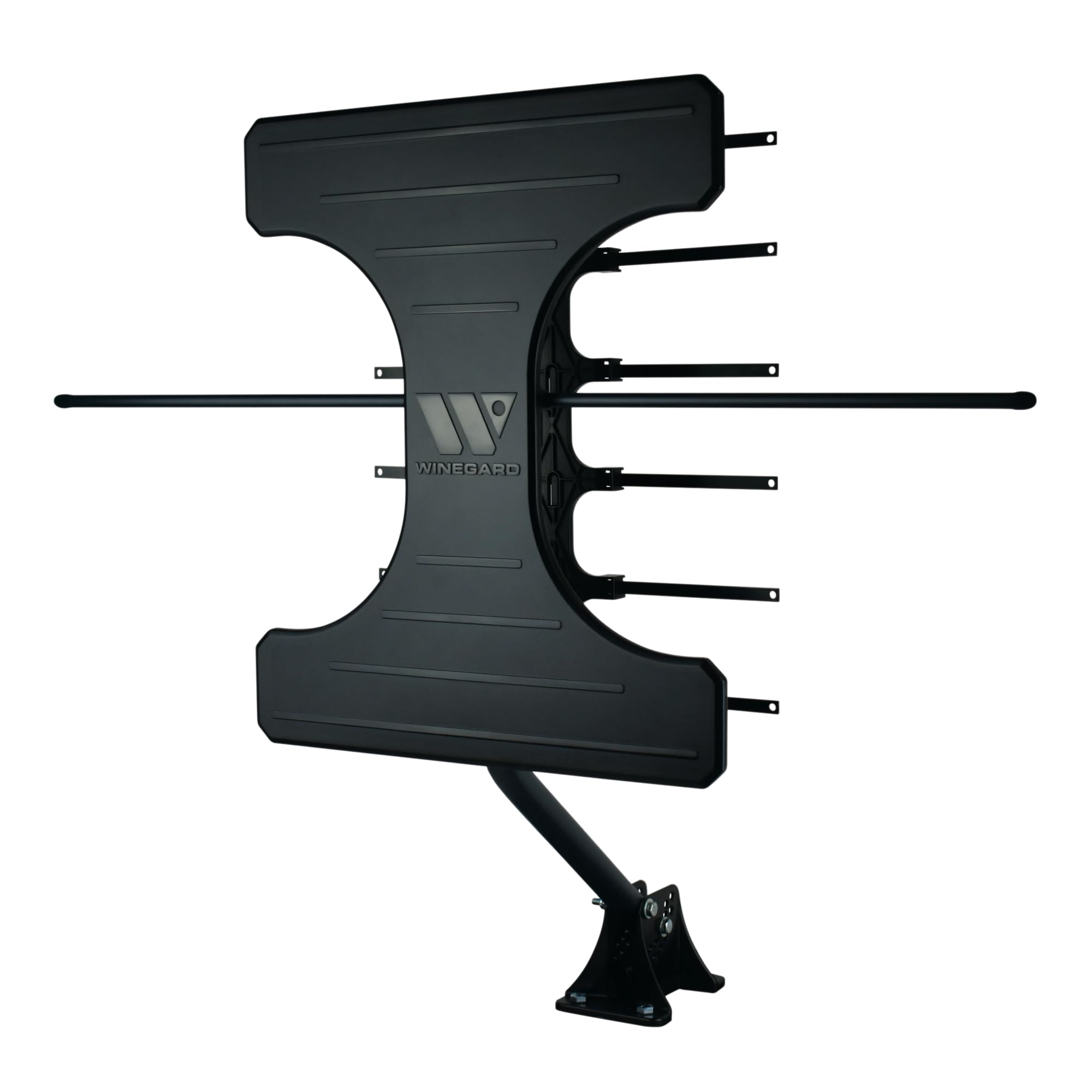
Built around a 1.0 dB noise floor for crowded rural airwaves.
The defining figure here is noise. The integrated boost amplifier runs Clear Circuit Technology at a 1.0 dB noise level, and the lower that number, the less hiss rides on top of a weak distant station. It’s rated to 70+ miles for VHF and UHF, with 10x TwinAmp amplification and NextGen TV compatibility. At 16 ounces, this is a compact, low-profile housing — a slim shape compared to the Winegard Sensar IV’s 46.25″L body.
Buyers rate quality highest, with channel count close behind — 40+ stations turning up reliably, with perfect 1080p clarity reported. Assemble and install are consistently called easy, and the field-ready mount flexes to fit a rooftop, attic, or mast. A 3-foot USB power cable and 110V adapter come along, so the amplifier has its power source sorted.
One thing to weigh seriously before you buy: the signal pages are mixed on this one, with excellent UHF reception but VHF stations proving a weaker spot. If your most-watched locals push out on VHF, this may not be the unit. And durability gets a harsher read than the rest of the pack, so think about how exposed your mounting spot will be.
The engineer’s detail: a 1.0 dB noise spec is the quietest amplifier number on this list, and that matters for far-off stations.
Where it stumbles: VHF-heavy markets and long-term durability are the two things to check against your situation.
A strong call if: your far stations are mostly UHF and you value a clean, low-noise feed.
Hold off if: your biggest local channels broadcast on VHF — this leans UHF.
9. Televes DAT BOSS Mix LR 149884 HDTV Antenna
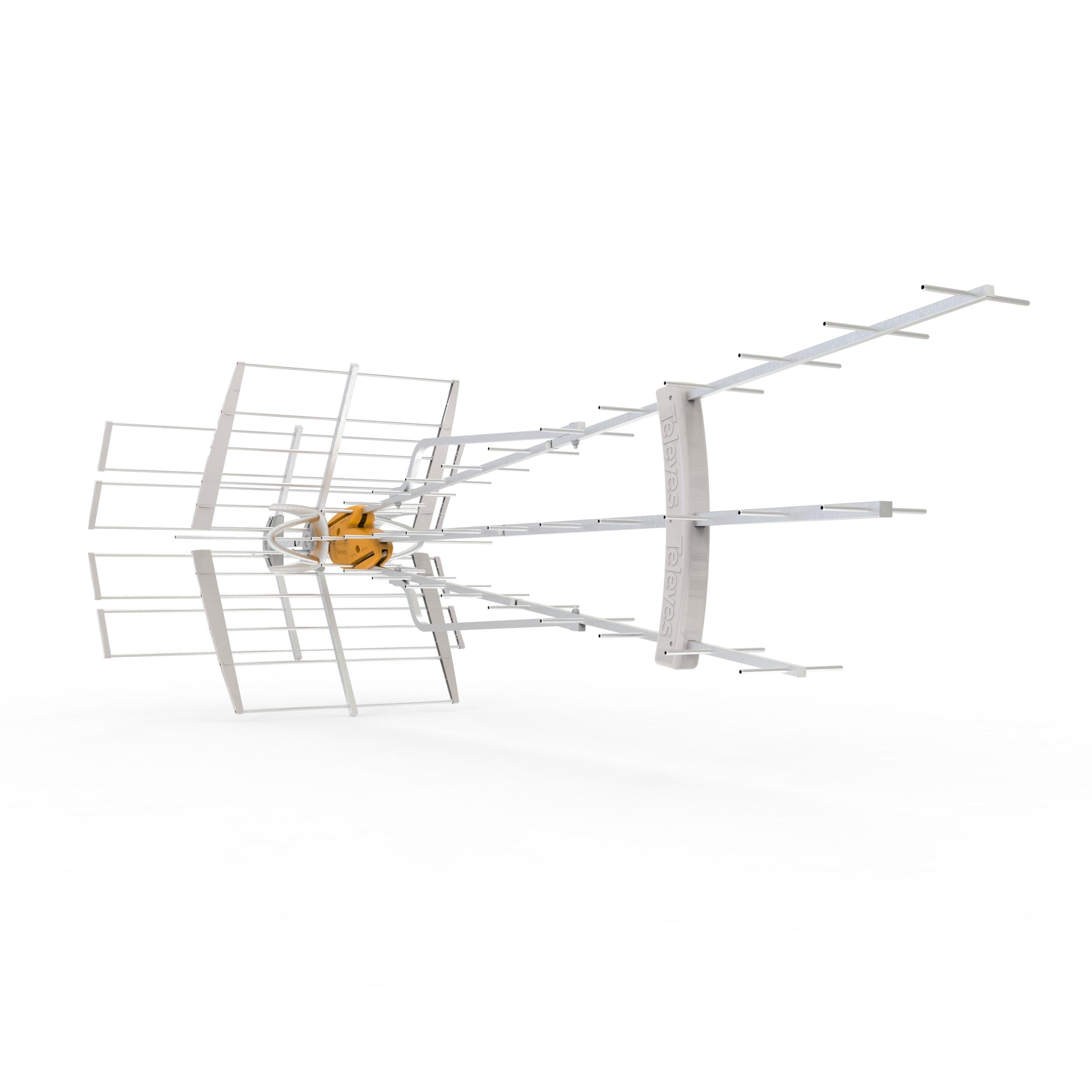
Professional-grade engineering for the fringe-reception corner of the map.
This is the antenna you buy when cutting the cord has to work on the first try. It’s rated to 100 miles, and the built-in TForce preamp adjusts gain independently by band — 38 dBi on High VHF and 46 dBi on UHF — so it stabilizes a fluctuating signal instead of blasting it. Integrated FM, LTE, 4G, and 5G filtering pushes nearby cell and radio towers out of your TV’s way, and it runs amplified when powered and still passes signal passively if the power goes.
Quality earns the loudest praise from buyers, with channel count and performance right behind. Buyers report it doubles signal strength on hard-to-reach stations, pulls about 25 channels in tricky spots, and reaches 30+ channels from 70 miles even with Starlink internet running in the same house. Front-to-back is specified at 12 dB on High VHF and 25 dB on UHF, which is what trims multipath ghosting. It arrives with a UL-listed 12V power inserter, mast clamps, wrench, and weather boot, and it fits masts from 0.78″ to 2.4″.
Call this one for the toughest environment, and know what that costs you in effort — assembly draws a mixed reaction, so budget patience for the build. It’s also the largest unit dimensionally at 84.13″L, which needs real roof span. It is the most expensive pick here, but it’s the only one with dual European patents on its amplifier and design, and it’s built in Spain with 60+ years of antenna experience behind it.
What makes it premium
- Per-band gain control maintains stable output as signals shift
- FM / LTE / 4G / 5G filtering blocks interference
- Passive mode keeps signal flowing if power drops
- Full install kit with UL-listed power inserter
The trade-offs
- Assembly takes patience before it’s up
- 84.13″L needs a serious roof span
Engineered for: rural and fringe homes where weaker stations and cell-tower interference make lesser antennas give up.
Not for: a quick, low-effort install close to town.
Know the Specs
Maximum range (miles)
This is the manufacturer’s best-case distance figure, measured over open ground. Real-world reception depends on trees, hills, and building materials between you and the tower, so a distant rooftop will see less than the printed number. Pick an antenna whose range comfortably beats your real distance for headroom.
Amplifier and gain (dBi)
An amplifier boosts a weak signal before it travels down the coax, and gain — measured in dBi — is how hard it pushes. Higher gain can rescue a distant station, but too much on a very close tower can overload the tuner. That’s why per-band gain control and filtering help on fringe installs.
Directional vs. multi-directional
A directional antenna focuses its pull on one point, which delivers more gain toward clustered towers. A multi-directional or motorized model trades some focus for the ability to catch stations from more than one direction. Match this to how your local towers are spread out.
ATSC 3.0 and 4K support
ATSC 3.0 is the newer broadcast standard, sometimes called NextGen TV, and it can carry 4K picture and better audio where your local stations offer it. An antenna that lists ATSC 3.0 or NextGen TV compatibility is built to receive it once your market switches over.
Common Questions
Do I need power at the antenna for the amplifier to work?
Will a 150-mile antenna actually pull stations from 150 miles away?
Can one outdoor antenna feed more than one TV?
What’s the difference between a directional and a motorized antenna?
Does 4K or ATSC 3.0 support mean I’ll see 4K channels right away?
How high should I mount an outdoor TV antenna?
What if some channels come in clear and others don’t?
Why do nearby cell towers interfere with my TV signal?
Do these outdoor antennas come with the mounting pole?
How often should I rescan for channels?
The Bottom Line
For the pick most people will be happiest with, the Winegard Sensar IV RVW-395 wins — 4.5+ stars and a crank-up design that aims and folds down, which is why it sits at the top of this list. For a fixed rooftop feeding one TV on a budget, the CEKAY Outdoor Yagi gets you pulling channels with no tools and no fuss. And if your towers are scattered and you want to steer from the couch, reach for the CEKAY 150-Mile Motorized.
How we choose
We do not accept paid placement. Every pick is matched to a real buyer and a real use-case; we do not hands-on test units.
Sources
Specifications: manufacturer listings and product documentation. Review insights: verified customer reviews, as of November 2026. Pricing: not shown on this page (it changes often); check the current price via the retailer link.
As an Amazon Associate, Tactical Gear Guy earns from qualifying purchases. This does not affect which products we feature.