Specs are compiled from manufacturer listings and verified buyer reviews and can change over time — please confirm the key details on the product page before buying.
Wired ceiling speakers fail for the same boring reason most of the time: the cutout was sized wrong or the tweeter was aimed straight down at the floor. Below are the in-ceiling pairs worth cutting holes for, ranked by what actually matters once the drywall dust settles.
This guide is built by comparing the manufacturers’ published specifications and the patterns across verified customer reviews, so you get each pick’s real strengths and trade-offs instead of marketing spin.
You will see driver size, cutout diameter, impedance and power handling spelled out for each pick, plus which rooms and ceilings they suit. The picks below cover the best wired ceiling speakers for kitchens, patios, surround rooms and whole-house audio, with the honest fit note attached to every one.
Top Picks


How To Choose The Best Wired Ceiling Speakers
Start with the hole, not the sound. A wired ceiling speaker only goes in where the cutout matches your ceiling, so the cutout diameter is the first number to write down. Get it wrong and you are patching drywall.
Measure the cutout before you fall for the driver size
A bigger woofer moves more air — an 8-inch driver pushes more low end than a 6.5-inch one. But an 8-inch speaker needs a bigger hole. The Micca R-8C wants a 9.5-inch cutout, while the Pyle PDIC68FG drops into a 7.9-inch hole. Check the space between joists and any ductwork before you commit.
Match impedance to your amplifier
Most of these speakers run at 8 ohms, which is a safe, easy load for a standard home amplifier. The Micca 4-pack is rated at 6 ohms, a slightly harder load — confirm your amp handles it. If you are wiring several pairs off one amplifier, impedance adds up, so check the amp’s minimum rating first.
Decide whether aiming matters in your room
In a low ceiling or a room where you sit off to one side, an aimable tweeter (the small high-frequency driver you can tilt) is worth more than extra watts. The Klipsch and Yamaha pairs let you point the tweeter at your seat. In a big open kitchen, dispersion matters more than pinpoint aim.
Plan for moisture and paint
Kitchens, bathrooms and covered porches get humid. A rubber seal on the Polk RC80i helps keep moisture out. Paintable grilles on most of these let the speaker vanish into the ceiling once installed.
Side-by-Side Comparison
| Model | Best For | Driver Size | Impedance | Power Handling | Amazon |
|---|---|---|---|---|---|
| Polk Audio RC80i★ Best Overall | Best overall / patios and kitchens | 8 inches | — | — | Amazon |
| Acoustic Audio CSic83 (Pair)Best Value | Full 3-way sound on a budget | 8 inches | 8 ohm | 20–350W per speaker | Amazon |
| Micca R-8C ReferenceBest for Detail | Demanding listeners / refined look | 8 inches | 8 Ohms | 120 Watts (each) | Amazon |
| Pyle PDIC68FG | Smaller cutouts / tight ceilings | 6.5 inches | 8-ohm | 300W max | Amazon |
| Acoustic Audio CS-IC83 (4-Pack) | Whole-house coverage on a budget | 8 inches | 8ohm | 20–350W per speaker | Amazon |
| Yamaha NS-IW280CWH | Directional sound / Atmos and surrounds | 6.5 inches | — | 100-Watt max | Amazon |
| Klipsch CDT-5650-C II | Precision aim / home theater | 6.5 inches | — | — | Amazon |
| Yamaha NS-IC800 | Big-room sound / large spaces | 8 inches | 8 Ohm | 140W max / 50W nominal | Amazon |
| Micca 4-Pack | Multi-room on a modest amp | 8 inches | 6 Ohms | 80 Watts (each) | Amazon |
Detailed Reviews
1. Polk Audio RC80i In Ceiling Speakers
Our pick — 4.5+★ from 2,000+ verified ratings; the strongest balance of quality and price.
The patio-and-kitchen pair that stays damp-proof and disappears into the ceiling.
The Polk RC80i takes the top spot for two reasons: a rubber-sealed 8″ driver that tolerates humid rooms, and a 1″ aimable tweeter you can point at your seat. Inside sits an 8″ Dynamic Balance woofer (the main driver that moves air for bass and mids) paired with a 1″ aimable tweeter (the small high-frequency driver you can point at your seat). Angle that tweeter toward the sofa and vocals stop smearing across the ceiling.
Owners single out sound quality above all, and the mineral-filled polymer cone adds damping so music and movies both stay composed. There’s a rubber seal around the driver that keeps moisture from creeping in, which is exactly why this pair fits bathrooms, kitchens and covered porches. Setup is genuinely simple: three steps, paintable aluminum grilles, and a pair of cardboard templates with paint masks so you can match your ceiling color and make them vanish.
The catch is the grilles. They come off for painting, but they’re the fiddliest part of the whole job — handle them gently and re-seat them square, or they can rattle. That said, most of the 2,000+ owners here are happy, and no other pick balances price, build and room-versatility as well.
What makes it the top pick
- 8″ woofer plus aimable 1″ tweeter for full, steerable sound
- Rubber seal suited to bathrooms, kitchens and covered porches
- Paintable aluminum grilles and included paint masks
- Consistently the most-praised sound quality of any pick here
Where it needs care
- Grille removal is the fussiest step — seat them gently
- Sold as a pair, so measure a 2-speaker layout first
Made for: humid rooms, covered patios and anyone who wants one pair to sound good everywhere and stay put.
Think twice if: your ceiling can’t take an 8″ driver and you need a tiny footprint — a 6.5″ model fits tighter spaces.
2. Acoustic Audio CSic83 Speaker Pair
A three-way pair that punches far above what its price tag suggests.
The CSic83 is the value benchmark of this list: a true three-way pair for well under what most two-way ceiling speakers cost. A three-way design splits the work between three drivers — a woofer for bass, a mid for vocals, and a tweeter for highs — where most cheap ceiling speakers run just two. That extra midrange driver is why voices come through clearer on this pair.
The 8″ woofer uses a rigid polypropylene cone and a butyl rubber surround, and a set of passive crossovers keeps each driver in its own lane. Efficiency is rated at 95dB, which is high — it means a modest amplifier gets these loud. It’s also why the CSic83 edges the Pyle 6.5″ pair on efficiency, 95dB versus 91dB. Recommended power is 20–350 watts per speaker, with an 8-ohm impedance, and the cutout is 9.45″.
Reviewers single out the sound-to-price ratio above everything else on the CSic83. Installation is straightforward too, spring-loaded terminals and a cutout template included. It fills bedrooms, dens and secondary rooms beautifully without a boutique price.
Why it’s the smart buy: a true three-way crossover, 95dB efficiency and 20–350W handling for a modest outlay is a lot of speaker for the money.
The honest note: it’s a value-leaning build, so treat the spring terminals with care and don’t expect flagship refinement at the top end.
Reach for it: on a budget where clear three-way sound in a spare room matters more than prestige badges.
Look elsewhere: if you want aimable drivers for a tricky theater layout — the Klipsch or Yamaha handle that better.
3. Micca R-8C In-Ceiling Speaker
The audiophile-leaning single speaker that hides almost flush and lets you tune the treble.
The R-8C is the detail pick, and it makes the case with parts. A vented carbon/glass fiber woofer with a concave cap handles the lows and mids; a fluid-cooled 1″ aluminum dome tweeter sits on a swivel bridge you can point at the listening spot. Separate woofer and tweeter tone switches let you nudge the response +3dB, 0 or -3dB to suit the room. Rated at 8 Ohms, 120 watts each, 40Hz–22kHz, with a 90dB sensitivity.
Measure carefully, because its 8″ driver needs a 9.5″ cutout and a 10.75″ outer diameter — noticeably bigger than the Pyle’s 7.9″ cutout. In exchange you get a rimless, micro-fine-mesh grille that sits nearly flush. Owners love the sound quality first and the build and look right after; it holds up in humid climates like Florida, per the reviews.
The one thing to plan for: this listing is a single speaker, not a pair. Buy two for a stereo room. For the clarity and the flush look, it’s a fair ask — this is a speaker that rewards a careful install.
Sharpest fit for: a listener who wants a low-profile, tunable speaker and doesn’t mind buying each unit individually.
The trade-off to know: sold as one speaker, so a stereo pair means buying two and budget accordingly.
4. Pyle PDIC68FG Speakers Pair

The smaller-cutout pair for ceilings where a full 8-inch hole won’t fit.
Ceiling space is often the deciding factor, and this Pyle pair wins there. Its 6.5″ drivers need only a 7.9″ cutout — the smallest hole of any speaker here, versus the Micca R-8C’s 9.5″. If you’re squeezing between joists or working a shallow ceiling, that difference is the whole ballgame.
Sound-wise it’s a two-way with a woven glass fiber cone woofer and a 1″ silk dome tweeter, covering 70Hz–22kHz at 8-ohm impedance with 91dB sensitivity and 300W max power. The magnetic grills snap on and off with no tools, and the clamp-type brackets lock with a screwdriver — no extra hardware. Each box includes two speakers, two grills, three 9.8-foot speaker wires and a cutout template.
Clear, clean sound is the headline in the reviews, and buyers put them to work on both TV and streamed movies. It’s an honest, capable install speaker with no pretense. If your ceiling is the limiting factor, this is the pair that simply fits.
The fit-first argument: a 7.9″ cutout plus magnetic tool-free grills makes this the easiest pair to drop into a cramped ceiling.
Worth knowing: the 6.5″ driver won’t dig as deep in the bass as the 8″ models, and each box ships with three 9.8-foot wires to route.
Grab this if: your ceiling is tight or shallow and you need the smallest footprint on the list.
Skip the squeeze regret: if you want maximum low end and have the room, an 8″ driver moves more air.
5. Acoustic Audio CS-IC83 Speaker 2 Pair Pack

Four three-way speakers for the price of a couple of ordinary pairs.
This is the whole-house play. The pack contains two pairs — four speakers total — so you can cover a living room and a kitchen off one order. Each speaker is the same three-way formula as the single pair above: an 8″ polypropylene woofer, poly mica midrange, 13mm soft dome tweeter, and passive crossovers, rated 20–350W per speaker at 8ohm with 95dB efficiency.
Specs that matter for a multi-room job: 9.45″ cutout, 10.83″ overall, 3.78″ mounting depth, so measure your joist spacing before you cut four holes. Spring-loaded terminals and paintable grilles make the wiring and finishing straightforward across rooms.
Owners praise the rich, room-filling sound of all four speakers, and the per-speaker price stays well below premium pairs. If you want surround in one room plus background music in another without buying two premium pairs, this is the cost-effective route.
Built for: covering multiple rooms in one go without buying two premium pairs.
Plan around: four 9.45″ holes to cut and route — wire the runs before you close anything up.
6. Yamaha NS-IW280CWH In-Ceiling Speaker System

The pair that keeps sound so directional you forget it’s in the ceiling.
Yamaha’s trick here is aim. The 6.5″ polypropylene mica cone woofer teams up with dual 3/4″ dome tweeters using SoundMax technology, and each swivel tweeter can be pointed toward the seats. That directionality is the defining trait: the swivel tweeters focus sound so tightly that listeners struggle to locate the speakers, which is exactly what surrounds and Atmos overhead channels need.
It’s rated at 100 watts maximum input with a 10.2″ frame size, and the two-per-package count means one order covers a stereo pair. The paintable aluminum grille has a protective cover, and owners call the build solid — heavy-duty spring-loaded banana sockets are the kind of detail that survives repeated installs. Sound quality dominates the feedback by a wide margin, with appearance close behind.
The trade-off to know up front: the 6.5″ driver trades some low-end weight for precision aim and a tighter footprint. If you want thump, a bigger 8″ pair delivers more. If you want spot-on placement for a surround system, this is the one.
Why it suits surround rooms
- Dual swivel dome tweeters aim precisely at the seats
- 100W max input, 10.2″ frame, two speakers per pack
- Heavy-duty spring-loaded banana sockets
- Paintable aluminum grille with protective cover
What to weigh
- 6.5″ driver gives up some bass depth to the 8″ models
- The tight aim means optimal placement matters more
Ideal when: you’re wiring surrounds or Atmos overheads and want sound you can steer at the seating area.
Consider the alternative: if pounding bass matters more than precise aim, an 8″ pair will hit harder.
7. Klipsch CDT-5650-C II In-Ceiling Speaker – White (Each)
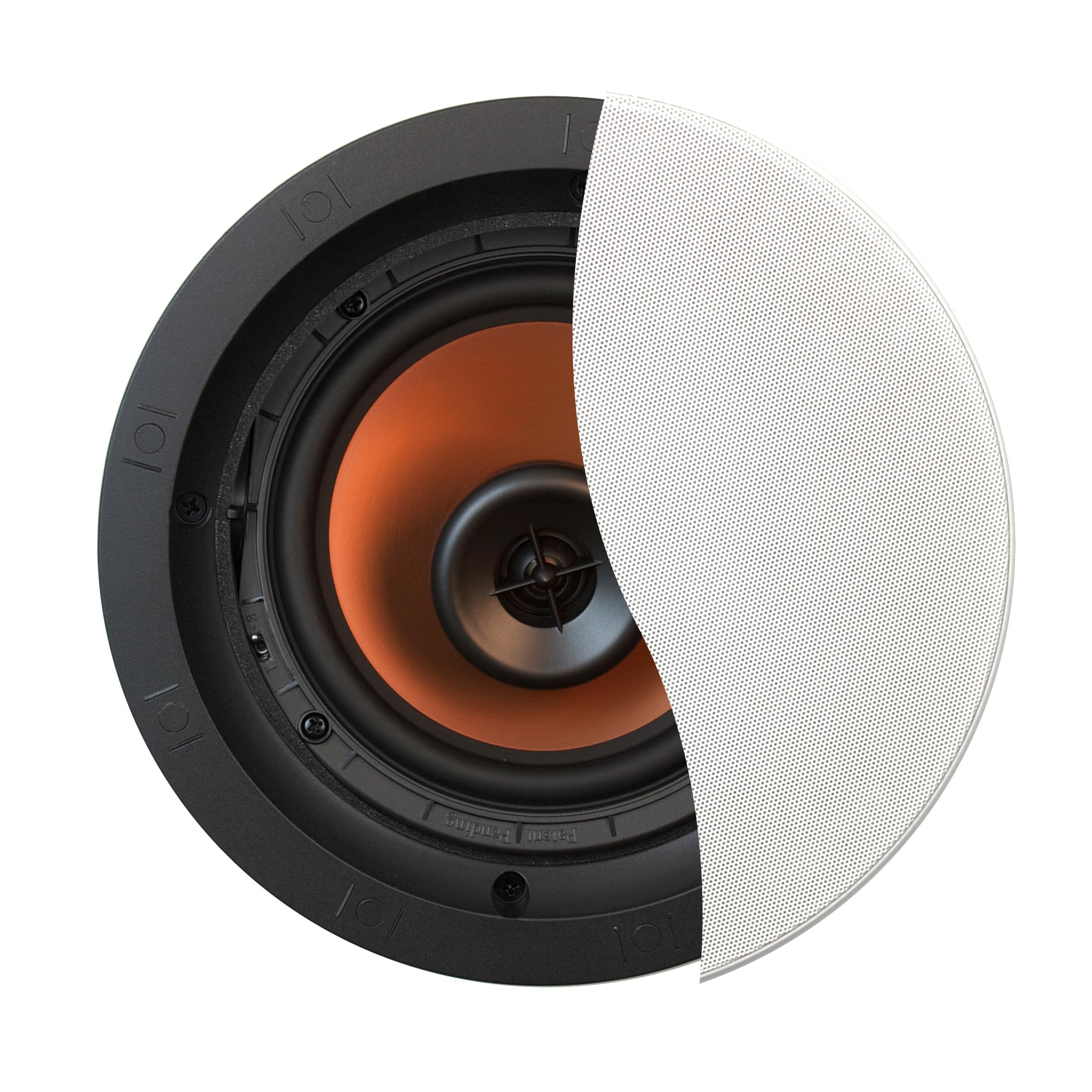
The theater-grade single whose horn tweeter and aimable drivers bring the drama.
Klipsch brings its horn-loaded design to a ceiling speaker, and the point is control. A 100° Tractrix horn sits over the 1″ titanium tweeter, and the Controlled Dispersion Technology lets you aim the tweeter and the woofer independently at your seat. Treble and midbass attenuation switches let you balance the room without external EQ. It’s a 6.5″ driver, sold as a single speaker, built for a serious home theater.
Buyers report that sound quality leads by a stretch, installation is easy, and the adjustable 15° tilt is the star. Angling both drivers toward your seat “makes a world of difference,” as owners describe it. It’s a favorite for Atmos setups (overhead sound formats) and pairs flexibly with streaming gear and modest amps.
The obvious catch: each is one speaker, so a stereo or Atmos layout means buying several, and that adds up fast. Precision this good is worth it in a dedicated theater. In a casual kitchen, it’s overkill.
The reason it leads the premium tier: independently aimable horn tweeter and woofer plus attenuation switches put real control in your hands.
Budget reality: it’s priced and sold per speaker, so a full surround array is a serious commitment.
For the theater crowd: if you’re building an Atmos room or a critical listening space and want to aim each driver at your seat, this is for you.
Not for: quick kitchen background music, where per-speaker pricing and precision aim are more than the job needs.
8. Yamaha NS-IC800 In-Ceiling Speakers

A full-size pair built to fill a large room without straining.
The NS-IC800 is the volume-and-presence pick. A big 8″ driver with 140W max and 50W nominal input drives a two-way crossover at 3.50kHz, running to a maximum frequency of 28kHz at 8-ohm impedance. The 10.9″ diameter and 4.3″ depth mean it wants a serious hole and clearance — measure before ordering.
Owners describe it as sounding larger than its size suggests, and installation is easy to follow with the included instructions. The magnetic grills and secure mounting system are appreciated for a clean finish. If you’re covering an open living area or a media room, this pair carries the load.
The honest note: this is more speaker than a small bedroom needs, and the deep 4.3″ mounting depth rules out shallow ceilings. In the right big room, though, it’s a confident, generous performer.
Right call for: open-plan living rooms and media rooms that need real headroom and a big driver.
Rule it out if: your ceiling cavity is shallow or your room is small — the 4.3″ depth and huge output are more than you need.
9. Micca 8-Inch Speakers 4-Pack

Four flush, paintable 8-inch speakers for a clean whole-house look.
This four-pack fills a home with quiet, even sound. Each speaker has an 8″ polypropylene cone woofer (the main driver that moves air for bass and mids) with a rubber surround, plus a 1/2″ PEI dome tweeter (the small high-frequency driver). They’re tuned for wide dispersion (sound spread) and a broad balance, so you don’t have to sit dead center. Specs: 50Hz–20kHz frequency response (the range of low to high notes you hear), 6-ohm impedance (electrical load the amp sees), 87dB sensitivity (how loud it plays per watt), 80 watts per speaker, a 9¾” cutout (hole size for mounting), and 4″ mounting depth (space needed behind the ceiling).
What earns it a spot is the finish and the fit. The rimless grille protrudes less than 3/16th of an inch and paints to match the wall, so installed speakers nearly vanish. Built-in mounting tabs grab drywall without extra brackets, and the instructions even cover wire selection. Owners find the sound very clear, and they work well even on a small amount of power.
One spec to flag: the 6-ohm rating is a slightly harder load than the 8-ohm speakers here, so confirm your amplifier’s minimum impedance, especially if you’re running several off one amp. Keep it within spec and this four-pack delivers a tidy, professional whole-house result.
What it nails: a near-flush rimless grille, four speakers in one box, and paintable faces for a whole-house look that disappears.
The spec to check: 6-ohm impedance and a 9¾” cutout — clear both with your amp and ceiling before you cut.
Go for it: when you want four matching in-ceilings for one clean run through the house.
Double-check first: your amp’s 6-ohm handling and your joist spacing before cutting four 9¾” holes.
Know the Specs
Cutout diameter and mounting depth
The cutout is the round hole you saw in the ceiling; the mounting depth is how far the speaker reaches up into the cavity. These two numbers decide whether a speaker fits at all — the Pyle needs a 7.9″ cutout, while a full 8″ driver like the Micca R-8C wants 9.5″. Measure both before buying so you don’t patch drywall.
Impedance and power handling
Impedance (measured in ohms) is the electrical load the speaker places on your amplifier. Most here run at 8 ohms, an easy load for standard amps; the Micca 4-pack runs at 6 ohms, a bit harder — check your amp’s minimum. Power handling tells you how many watts it can take, such as the Yamaha NS-IC800’s 140W max and 50W nominal.
Sensitivity in decibels
Sensitivity is how loud a speaker gets per watt, measured in dB. Higher means louder on less power — the Acoustic Audio pairs hit 95dB versus the Pyle’s 91dB, so they’ll play louder from the same amplifier. That’s useful if your amp is modest or you’re driving several pairs.
Tweeter aiming and dispersion
The tweeter handles the high frequencies, and whether you can aim it matters. Swivel or pivoting tweeters on the Klipsch, Yamaha and Micca let you point the highs at your seat, which sharpens vocals in an off-center room. In a wide open kitchen, dispersion across the space matters more than pinpoint aim.
Common Questions
What impedance ceiling speakers can my amplifier drive?
How do I measure the cutout for an in-ceiling speaker?
Do wired ceiling speakers need power in the ceiling?
Can I use in-ceiling speakers in a bathroom or covered porch?
Is an 8-inch driver better than a 6.5-inch one?
What does 3-way mean on a ceiling speaker?
Do more watts mean louder ceiling speakers?
Can I paint the grilles to match my ceiling?
How much amplifier power do I need for a pair of these?
Can I aim the tweeter toward my seat?
The Bottom Line
For most rooms, the wired ceiling speakers that balance sound, build and price best are the Polk Audio RC80i — an aimable tweeter, a moisture-friendly rubber seal, and sound that most owners single out as the standout. If value and three-way clarity top your list, the Acoustic Audio CSic83 pair is the smart spend. And for a dedicated theater or Atmos layout, the Klipsch CDT-5650-C II gives you the independent aim that brings a room to life. One last nudge: the Polk sits at the top of the sound-quality praise here, so if you’re unsure where to start, cut your holes for it and you won’t be second-guessing.
How we choose
We do not accept paid placement. Every pick is matched to a real buyer and a real use-case; we do not hands-on test units.
Sources
Specifications: manufacturer listings and product documentation. Review insights: verified customer reviews, as of November 2026. Pricing: not shown on this page (it changes often); check the current price via the retailer link.
As an Amazon Associate, Tactical Gear Guy earns from qualifying purchases. This does not affect which products we feature.