Specs are compiled from manufacturer listings and verified buyer reviews and can change over time — please confirm the key details on the product page before buying.
Most white desktop speakers look like a coffee mug got a driver glued to it. The picks below don’t. Every one of them has a white housing, and every one earns its slot on what it does at your desk — how it handles vocals, whether it hums when idle, whether Bluetooth drops mid-call. If you want the short answer: the Edifier R1280T is the safest buy for a first proper pair, and the Sanyun SW203 is the one to stretch for if you actually care how music is staged in front of you.
This guide is built by comparing the manufacturers’ published specifications and the patterns across verified customer reviews, so you get each pick’s real strengths and trade-offs instead of marketing spin.
White speakers are harder to hide dust and easier to mismatch with your desk, so the finish and the footprint matter as much as the wattage. Here is how I’d narrow the field among the best white computer speakers.
Top Picks


How To Choose The Best White Computer Speakers
The regret story with desk speakers almost always starts with the same two mistakes. One is buying a pair tuned for a living room and discovering the bass rattles your keyboard at low volume. The other is buying on peak watts while ignoring the cabinet. Both are fixable once you know the four things that actually decide whether a pair works on a desk.
Watts: continuous, not peak
Look for RMS watts — the continuous power the amp can hold, rather than a peak figure printed for the box. A 36W RMS pair like the MEVOSTO DS19 is a completely different animal from a 60W RMS set like the Sanyun SW203, and neither is the same as a 100W peak rating. RMS is the number that tells you how loud it stays clean at arm’s length.
Driver size and the desk reality
A 3-inch woofer (the driver handling mids and lows) suits near-field listening — you sitting a foot or two from the screen. A 5-inch woofer moves more air, so it can sound fuller without the cabinet being pushed, but it takes up real desk space. Bigger isn’t automatically better here; it’s about how far away you sit.
Cabinet material changes the bass
An MDF wood cabinet (medium-density fibreboard, a dense engineered wood) damps resonance far better than a thin plastic shell. That’s why the wood-bodied Edifiers and the Sanyun SW203 can hold bass together at moderate volume. If you plan to listen at low levels all day, cabinet material matters more than the wattage figure.
Inputs and what your machine already has
USB-C carries clean digital audio and takes the load off your PC’s own sound chip. RCA and 3.5mm AUX are the universal fallbacks for turntables, older laptops, and mixers. Bluetooth 5.x is for phones and quick streaming — check the version, since 5.0 and 5.4 behave differently with pairing stability. If you own a turntable without a phono stage, confirm the speaker has RCA in and not just a headphone jack.
Side-by-Side Comparison
| Model | Best For | Power (RMS) | Drivers | Inputs | Amazon |
|---|---|---|---|---|---|
| Edifier R1280T (White)★ Best Overall | First proper pair | 42W RMS | 13mm silk dome tweeter + 4-inch full range | Dual AUX (3.5mm / RCA) | Amazon |
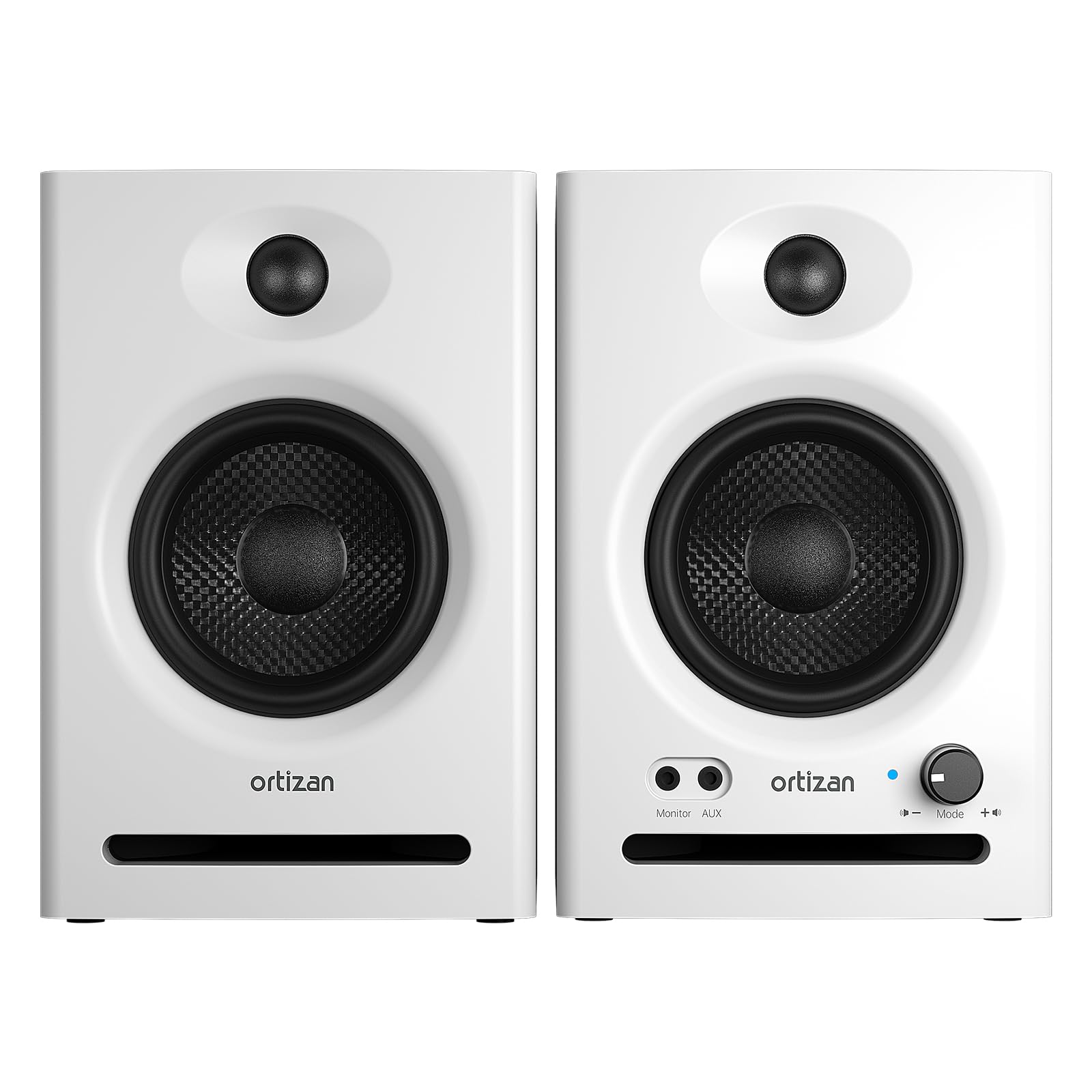
| Ortizan C7Best Value | Studio-style mixing on a budget | — | 0.75-inch silk dome tweeter + 3.5-inch carbon fiber | RCA, 3.5mm AUX, TRS, USB, Bluetooth 5.3 | Amazon |
| Sanyun SW203Soundstage Pick | Wide stereo stage at a desk | 60W RMS | 20mm silk dome tweeter + 3-inch carbon fiber woofer | USB-C, Bluetooth 5.4, 3.5mm AUX | Amazon |
| MEVOSTO DS19 | Big woofers for the money | 36W RMS | Dual 1-inch silk dome tweeters + dual 5-inch woofers | USB, RCA, 3.5mm AUX, Bluetooth 5.4 | Amazon |
| Edifier MR3 | Monitoring and app EQ | 18W × 2 | 1-inch tweeters + 3.5-inch mid-low drivers | Balanced TRS, RCA, AUX, Bluetooth 5.4 | Amazon |
| Pioneer DJ DM-40D | DJ controller setups | — | 4-inch drivers | RCA, mini jack, TRS | Amazon |
| Audio-Technica AT-SP3XWH | Turntable and minimal decor | — | — | Dual RCA, Bluetooth | Amazon |
| Kanto ORA (White) | Reference-quality desktop audio | 100W peak | 3/4-inch silk dome tweeters + 3-inch paper cone drivers | USB-C, RCA, Bluetooth 5.0 | Amazon |
Detailed Reviews
1. Edifier R1280T Powered Bookshelf Speakers (White)
Our pick — 4.5+★ from 500+ verified ratings; the strongest balance of quality and price.
A 42W RMS wood-cabinet pair with two AUX inputs, so a PC and a turntable stay plugged in at once.
Two 3.5mm headphone jacks. Wait — two AUX ins, which is the clever bit. You can leave your PC wired to one and a turntable or streamer on the other, and neither needs unplugging when you switch. For anyone who has spent years crouching behind a monitor to swap a cable, that alone is worth the shelf space.
The speaker itself is 42W RMS driving a 13mm silk dome tweeter (a soft fabric dome that smooths out harsh highs) and a 4-inch full-range unit. Translation for your desk: vocals sit forward and cymbals do not slice. The MDF wood cabinet with a white wood-effect vinyl finish keeps bass steady rather than boomy, which is exactly what you want at arm’s length rather than across a room.
What wins buyers over is the sound itself, which is what almost every long review circles back to. A small-to-medium room fills straight from the start with no receiver and no setup ritual — plug in and play, as the review pages put it. Bass and treble live on the side of the main speaker, and the bundled remote handles volume from across the room, which is genuinely handy when the speakers are tucked behind a monitor arm.
What earns it the top spot
- Two AUX inputs let a PC and a turntable stay connected at the same time
- 42W RMS with a 13mm silk dome tweeter — smooth highs, not fizzy
- MDF wood cabinet holds bass together at low volume
- Remote control handles volume without reaching behind the desk
Where it asks for patience
- No Bluetooth — this pair is wired only, so phone streaming needs a dongle or a different pick
- No USB-C or digital input, so your PC’s own sound chip stays in the chain
- A few reports of reliability hiccups sit alongside far more praise
Straight answer: Buy this if you want one honest wired pair for a PC, turntable, or both, and you value sound over wireless convenience.
Different route: If Bluetooth streaming from your phone is non-negotiable, the Ortizan C7 or Sanyun SW203 below covers that without giving up the white finish.
2. Ortizan C7 Powered Studio Monitors Pair
A studio-style pair with TRS, USB, dual AUX, and Bluetooth 5.3 — the most inputs here.
Here is the spec that decides it: a 6.35mm TRS balanced input, the same connector a mixing desk or an electric guitar rig expects. That means this pair can sit at the center of a small home studio — mixer, keyboard, or instrument direct in — without a separate interface. Add USB with a built-in 24-bit DAC (a converter that turns digital audio into the analog signal the drivers read, keeping the signal cleaner), and your PC feeds it directly rather than through your motherboard’s onboard chip.
The cabinet pairs a 0.75-inch silk dome tweeter with a 3.5-inch carbon fiber mid-bass driver. Compared with the Edifier R1280T’s 13mm tweeter, this one is a touch smaller, but the carbon fiber cone holds its shape under power, which keeps mid-low frequencies clean when you push volume. The Bluetooth 5.3 radio reaches a stated 18 meters — enough to walk to the kitchen without the stream stuttering. ABS, metal, and wood in the enclosure keep the cabinet rigid.
The one caveat worth knowing before you buy: the volume control draws mixed feelings. Bass and treble knobs on the back are easy to work, but the volume itself is the recurring gripe — factor that in if you plan to ride the dial constantly. Everything else, from the crisp highs to the build, reads solid across the long tail of feedback.
Why producers like it: A 6.35mm TRS balanced input, two AUX ins, a front headphone jack, USB, and Bluetooth 5.3 in one pair — the most connection options here for the tier.
Plan around this: The volume control is the weak link; set bass and treble on the rear knobs once and control volume from your source instead.
Reach for this if: You want a white monitor-style pair that can take a mixer, a guitar, a PC, and a phone without rewiring between them.
Look elsewhere if: A precise, satisfying volume knob is a deal for you — the rear-panel dial here is the one thing that keeps it from easy perfection.
3. Sanyun SW203 3″ 60W Computer Speakers
Two 3-inch cabinets with per-driver DSP that push vocals forward and drums behind them.
Most 2.0 desk speakers flatten music into a left-right line. This one aims past that with a specific trick: three independent DSPs — a master processor plus one per cabinet — each driver getting its own signal, its own EQ, and its own timing. The practical result is a front stage where vocals sit in front, drums sit behind, and the image holds steady when you lean in or back in your chair.
The hardware backs it up. A 20mm silk dome tweeter sits in a horn waveguide that widens high-frequency spread, and a 3-inch carbon fiber woofer handles mids and bass from a high-density MDF cabinet — wood, not plastic. Total output is 60W RMS, 30W per cabinet. That is emphatically above the MEVOSTO DS19’s 36W RMS, and paired with the waveguide the desk-filling difference is audible before you get near the top of the dial.
The input set is the quiet luxury: USB-C, Bluetooth 5.4, and 3.5mm AUX, all fed through the same 24-bit DSP chain, so even an old CD player or turntable via the AUX gets cleaned up by the onboard converter. Setup once, then just listen — the rear knob is the daily control, and a noise gate keeps pauses hiss-free. The honest note is that the stage-focus tuning rewards a near-field desk position; sit far across a room and you are not getting what you paid for.
The engineering you can hear
- Triple-DSP per-driver processing builds a wide, stable stereo image
- 60W RMS across a 3-inch carbon fiber woofer and 20mm silk dome tweeter
- USB-C, Bluetooth 5.4, and AUX all pass through the same 24-bit signal chain
- Horn-loaded waveguide keeps highs even when you sit off-center
The trade you make
- The rear-panel volume knob is your only daily control — no remote
- Bass and treble are calibration knobs, not everyday dials
- Tuned for near-field listening, so it gives less across a big room
My read: The Sanyun SW203 is the pick for anyone who listens critically at a desk and wants the sound to exist in front of them, not just left and right.
Not for you if: You want a remote in hand or plan to fill a living room — this is a desk instrument.
4. MEVOSTO DS19 White Powered Bookshelf Speakers, 5-Inch
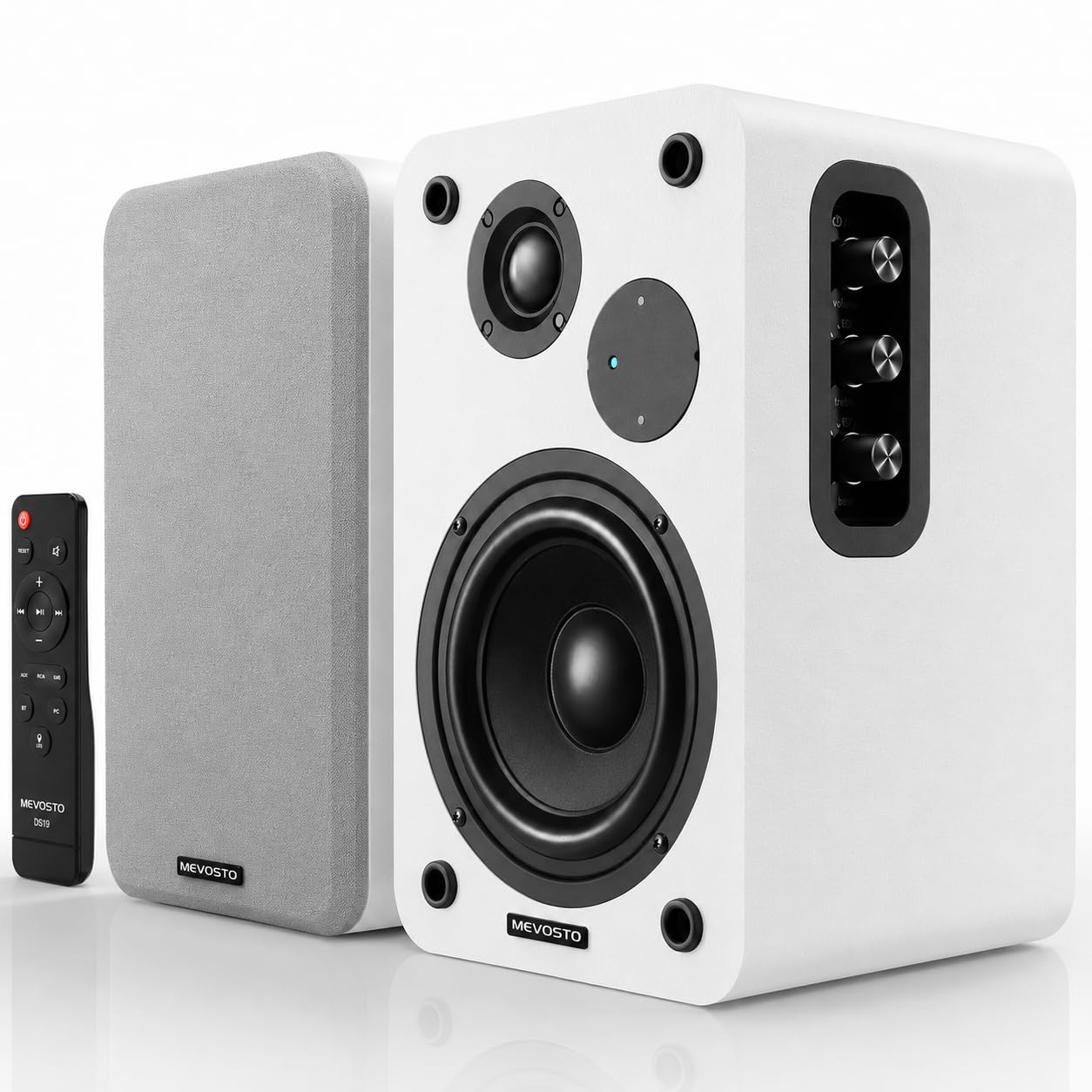
The only pair here with 5-inch woofers, which means fuller bass and 9.7-inch-tall cabinets.
Those dual 5-inch woofers and dual 1-inch silk-dome tweeters move serious air for the tier, and the 36W RMS amp holds them together. Set against the Sanyun SW203’s 3-inch woofer, this is a materially bigger driver — the physics of that matters if you want a fuller low end without pushing the amp hard. A textured, leather-look white finish makes it look more considered than a plastic box, and the wood enclosure keeps resonance in check.
The input list is unusually broad for the money: USB audio (which works with a PC and compatible consoles including the PS5), RCA, 3.5mm AUX, and Bluetooth 5.4. Bass and treble knobs plus a bundled remote cover daily use. If you run a turntable with its own phono preamp, the RCA input handles it. There’s also support for compatible 12V/15V/18V DC sources, which matters if this ever moves to a camper or boat. An 18V/2A adapter ships with it.
Two things to know up front. The maker is clear that it does not decode Dolby Audio, so do not expect surround processing from a film soundtrack. And with two drivers this size, each cabinet measures 5.9 x 6.1 x 9.7 inches — real estate you should measure before committing a small desk to it. The payoff for that footprint is the biggest woofer on this list.
The honest pitch: 5-inch woofers are the reason to choose this over smaller white pairs — more low-end air movement for a fuller sound at the same volume.
Measure first: Two 9.7-inch-tall cabinets are not subtle on a compact desk, and there is no Dolby Audio decoding on board.
Best fit: A roomier desk or a small media shelf where you want fuller bass from white cabinets and use a PC, turntable, or console.
Skip the size: If your desk is already crowded, the smaller Sanyun or Edifier MR3 fits the same footprint far more gracefully.
5. Edifier MR3 Powered Studio Monitors, Hi-Res Certified, White

A Hi-Res certified monitor rated 52Hz–40kHz, so mixes translate without added warmth.
Hi-Res Audio certification usually means one thing at a desk: the speaker stays flat across a wide range rather than boosting treble or bass to impress in a showroom. This one is rated from 52Hz to 40kHz — that frequency span covers everything from a bass guitar’s low notes up past what your ears register, so nothing gets artificially sweetened. The reward is accurate playback for video editing, guitar practice, or just hearing a recording the way it was mixed.
Power is 18W × 2 RMS with a peak SPL of 92.5dB, driving 3.5-inch mid-low drivers and 1-inch tweeters from an MDF cabinet. The input spread is the practical part: balanced TRS, RCA, and AUX, plus Bluetooth 5.4 with multi-point. RCA and AUX can stay connected at once, so your PC and a second source coexist. There is also a headphone output on board, which saves you pulling the cable when you want to listen late.
Three modes — Music, Monitor, and Custom — shift the tuning, and the EDIFIER ConneX app lets you fine-tune EQ from your phone. Owners love the sound and the look in person, though adjustability and volume behaviour draw a more mixed reaction, so treat the app EQ as a helper rather than a fix-all. The flat profile is also the honest catch: if you wanted thump-first party sound, this is precise rather than plump.
Where it delivers
- Hi-Res Audio certified with a 52Hz–40kHz range for accurate playback
- Balanced TRS, RCA, and AUX plus Bluetooth 5.4 multi-point
- Onboard headphone output for quiet late-night sessions
- Music, Monitor, and Custom modes plus app EQ control
Where to temper expectations
- 18W × 2 RMS is modest — enough for a desk, not a party
- App-based adjustment and volume behaviour split opinion
- Flat tuning prioritizes accuracy over bass warmth
Who it suits: Editors, guitarists, and podcasters who need an honest, flat reference in a small room and want Bluetooth convenience on the side.
Who should pass: Anyone chasing warm bass for film or gaming — this pair reports what is on the track rather than flattering it.
6. Pioneer DJ DM-40D Active Desktop Monitor Speakers

The only pair here with a front DJ Mode / Production Mode switch and a headphone socket for cueing.
The defining feature is the switch on the front: DJ Mode or Production Mode, each with its own DSP tuning. Flip to DJ and the bass is shaped for beat matching through headphones; flip to Production and the response flattens out for mixing. RCA, mini-jack, and TRS terminals cover controllers, mixers, laptops, and soundcards, and a front headphone socket handles cueing without a separate box.
The cabinet details are built for tight spaces. Grooves on the bass ducts (the vents that let air move in and out behind the driver) reduce air friction, so the bass stays tight even with the speakers pushed against a wall — a real advantage on a crowded desk. Curved front edges add rigidity, cutting resonance at any volume. The drivers are 4-inch units, a size up from the 3-inch class, which gives a little more body without dominating the desk.
Where this one needs an honest look: sound quality and long-term reliability both split opinion in the feedback, which is a different read than the sound-first praise the Edifiers gather. That does not rule it out — it rules it in for the specific buyer who wants DJ-mode DSP and has a controller to plug in. If your priority is the cleanest possible playback for the tier, the Edifier R1280T is the safer bet.
Why a DJ picks it: DJ Mode and Production Mode are a real switch, not a label — plus TRS, RCA, and mini-jack for controllers and mixers.
The honest caveat: Some buyers report units that stop working over time, and sound impressions vary; this is a fit-based choice, not a safe-default one.
Go here for: A beginner DJ or producer plugging a controller straight in and needing cue monitoring on the front panel.
Think twice if: You want a pair you can set up once and forget — the mixed reliability feedback makes a warranty-backed purchase wise.
7. Audio-Technica AT-SP3XWH Powered Bookshelf Speaker, White
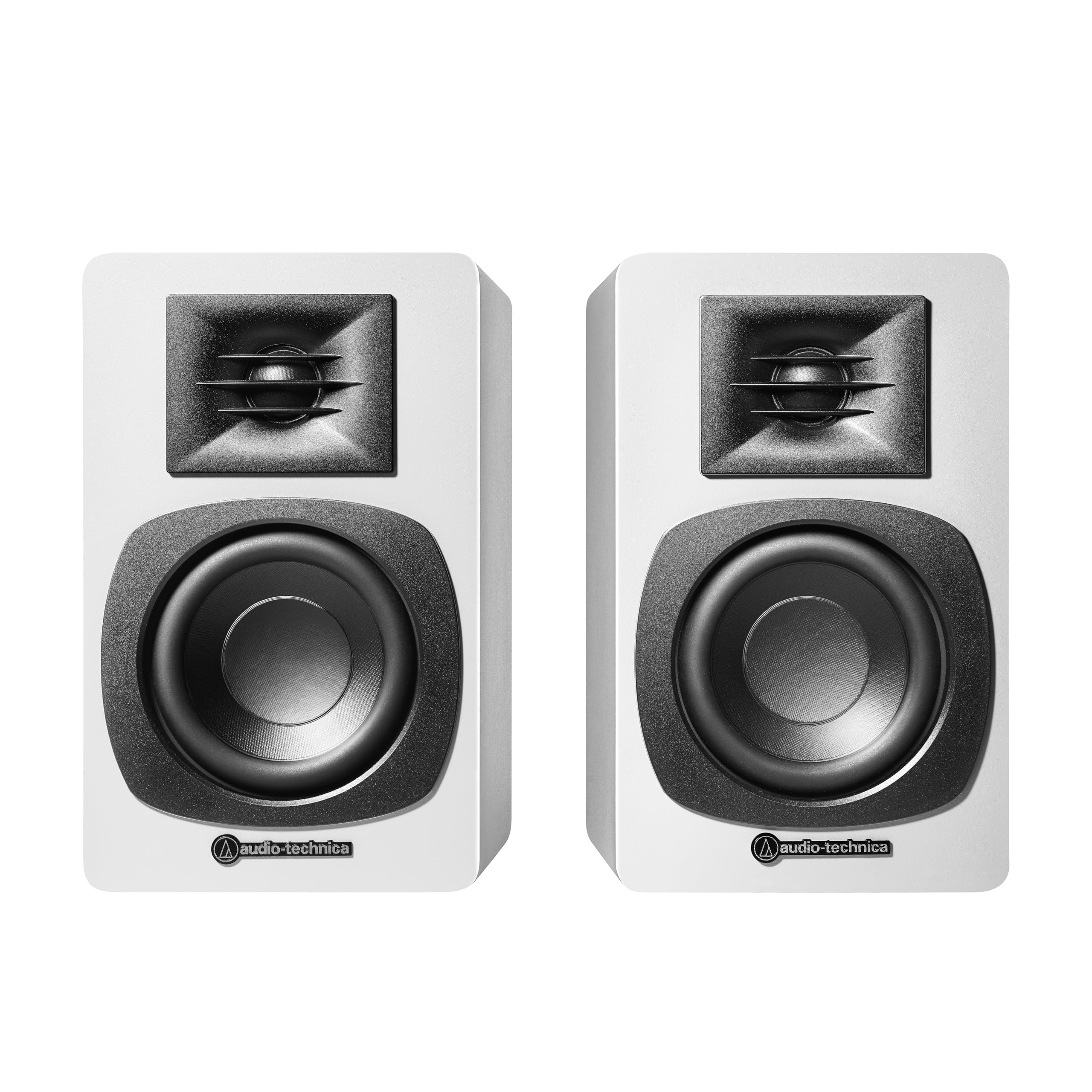
A minimalist white pair with multipoint Bluetooth and dual RCA for a turntable.
Audio-Technica built this one for people who want a simple powered setup with no receiver in the chain. Dual RCA jacks take a wired source — turntable, DAC, or PC — while Bluetooth covers your phone. The multipoint pairing function keeps two Bluetooth devices connected at once, so you can switch between a laptop and a phone without re-pairing each time. A volume dial and a power button with an LED indicator sit on the cabinet.
What owners describe is a pair that stays clear and goes loud — the “full-range” tuning is not a marketing line here so much as a description of how it handles everyday music without needing to be pushed. Setup is a plug-in affair: an AC adapter with three international plug adapters and a 6.6-foot (2.0 m) speaker cable come in the box, which helps if this travels or lives on a desk where the wall socket is on the far side.
The plastic enclosure is the honest trade — where the Edifiers use MDF wood, this one leans on a clean look over dense cabinet damping. That is a reasonable swap for a minimal white shelf setup. The one thing it lacks is a digital input, so your PC stays analog through its own sound chip unless you add a DAC.
What makes it appealing: Multipoint Bluetooth, dual RCA, and international plug adapters — a travel-friendly white pair that works with a turntable and a phone.
What to weigh: A plastic cabinet and no USB-C or digital input, so it asks more of your source than the wood-bodied picks.
Choose it for: A clean desk or shelf where Bluetooth multipoint and vinyl-ready RCA matter more than a digital input.
Alternative path: If you want wood cabinet damping and a digital connection, the Edifier MR3 is the closer match.
8. Kanto ORA 100W Powered Reference Desktop Computer Speakers

A 3-inch speaker with a 100W amp and a sub crossover that both surprise you.
The number most buyers trip over is 100W — this is a bi-amplified, DSP-tuned Class-D amplifier feeding 3-inch paper cone drivers and 3/4-inch silk dome tweeters. That is not a peak figure used as a headline; it is power on tap, and the effect at a desk is a pair that plays loud without getting harsh. The rated frequency response runs 70Hz to 22kHz, and Kanto claims deep bass for a 3-inch woofer, which is worth taking as a claim rather than a promise.
The clever bit is the sub integration. A crossover network starts automatically at 100Hz when a subwoofer is connected, letting ORA focus on vocals and upper detail while the sub handles bass duties. Relieving a small driver of the lowest notes means you can play louder with less distortion. Three inputs cover both camps: USB-C for the cleanest signal from a PC or Mac, Bluetooth 5.0 for phones, and RCA for analog gear.
Compact enough to slip under a monitor or into a backpack, and a 1/4″-20 threaded insert at the rear allows wall or ceiling mounting. Investors in sound detail tend to love this one for how much it does from such a small box. The warning is value — a share of buyers think it is priced beyond its merit, so weigh that against the sub crossover and USB-C you are also paying for.
What the premium buys
- 100W bi-amplified Class-D power from 3-inch paper cone drivers and 3/4-inch silk dome tweeters
- Automatic 100 Hz crossover when a subwoofer connects
- USB-C, Bluetooth 5.0, and RCA across digital and analog
- Rear 1/4″-20 insert for wall or ceiling mounting
What you should know
- Value is the sticking point — some consider it expensive for its size
- No onboard headphone output or TRS balanced input, unlike cheaper monitor pairs here
- A 3-inch driver relies on a sub for true low-end extension
Worth it if: You want one compact white pair for reference-quality listening, USB-C from a Mac, and a clean path to adding a subwoofer.
Alternatively: If value is the priority, the Ortizan C7 brings TRS, USB, and Bluetooth for a fraction of the commitment — you trade the 100W amp for more connection options.
Know the Specs
RMS watts vs peak watts
RMS (root-mean-square) is the continuous power a speaker can sustain; peak is a momentary spike. A 60W RMS pair like the Sanyun SW203 is built to hold that level cleanly, while a 100W peak rating on the Kanto ORA describes a burst, not a sustained output. On a desk, RMS is the number that tells you how loud it stays undistorted at arm’s length.
Silk dome tweeters and driver size
The tweeter handles highs, and a silk dome (a soft fabric dome rather than hard metal) tends to smooth harshness in vocals and cymbals. The woofer handles mids and lows, and its size dictates how much air it moves: a 5-inch woofer pushes more than a 3-inch, but a bigger driver also wants more space. Match the size to how far you sit, not to the biggest number on the spec sheet.
DAC, DSP, and digital inputs
A DAC (digital-to-analog converter) turns USB or Bluetooth audio into the analog signal a driver can use. A DSP is a digital signal processor that shapes and times that signal — the Sanyun SW203 goes further with one per driver. Cleaner conversion and smarter processing generally mean less hiss, tighter timing, and a more stable stereo image, which is why USB-C inputs tend to beat a PC’s own headphone jack.
Cabinet material and resonance
Resonance is a cabinet’s own vibration coloring the sound. MDF wood (dense engineered wood) damps it better than plastic, which is why wood-bodied pairs can sound fuller without booming. If you listen at low volume all day, cabinet material often matters more than a small wattage difference — a tightly damped 36W wood cabinet can sound cleaner than a loose plastic one rated higher.
Common Questions
Will white computer speakers stay white or yellow over time?
Can I connect a turntable directly to these white speakers?
Is Bluetooth good enough for desktop listening or should I use USB-C?
How much desk space do the 5-inch speakers take up?
Do I need a subwoofer with 3-inch desktop speakers?
What is the difference between near-field monitors and regular bookshelf speakers?
Will these speakers work with a PS5 or gaming console?
Can I add a second pair or a subwoofer later?
Do these speakers need a separate amplifier?
The Bottom Line
For most people building a white desk setup, the white computer speakers that gets the balance right is the Edifier R1280T — two AUX inputs, a 42W RMS wood cabinet, and a sound that fills a small room with no fuss. If you want a wider stereo stage at your desk, the Sanyun SW203 with its triple-DSP processing and 60W RMS is the step up. And for the cleanest single-cabinet solution with room to add a subwoofer, the Edifier D12 is the one to reach for.
How we choose
We do not accept paid placement. Every pick is matched to a real buyer and a real use-case; we do not hands-on test units.
Sources
Specifications: manufacturer listings and product documentation. Review insights: verified customer reviews, as of November 2026. Pricing: not shown on this page (it changes often); check the current price via the retailer link.
As an Amazon Associate, Tactical Gear Guy earns from qualifying purchases. This does not affect which products we feature.