Specs are compiled from manufacturer listings and verified buyer reviews and can change over time — please confirm the key details on the product page before buying.
If you are heading out on a wildland line, the pack you choose decides how much water, shelter, and hand tool weight you haul mile after mile. The short answer: the FS-1 Spotter Wildland Firefighter Backpack is the pack most crew members should start with, and the FS-1 Ranger is the upgrade for anyone digging with a full shelter load on uneven ground. Both are on this list for one reason — the Spotter is built for search-and-rescue work, and the Ranger is built for wildland fire line work, not weekend trails.
This guide is built by comparing the manufacturers’ published specifications and the patterns across verified customer reviews, so you get each pick’s real strengths and trade-offs instead of marketing spin.
A duty pack has to keep your shelter, water, and hand tools reachable without unpacking mid-shift. That is exactly what separates a real duty pack from a hiking bag, and this shortlist of wildland fire packs keeps the choice focused on the two packs that actually fit the job.
Quick Picks
- FS-1 Spotter Wildland Firefighter Backpack — Best Overall
- FS-1 Ranger Wildland Firefighter Backpack — Best For Digging Line
How To Choose The Best Wildland Fire Packs
A wildland fire pack is not a hiking daypack with a different label. It has to carry a fire shelter, a water bladder, hand tools, and personal gear while you hike in and dig line. Buy for the load you actually carry on the line, not the look of the bag.
Buy a modular system, not a fixed bag
Your load changes hour to hour. A modular pack lets you add or pull a medical kit case, a water reservoir case, or a tool module without swapping the whole bag. The FS-1 Spotter uses a 700 cubic inch main pack module with removable modules, so you carry what the shift needs. Check that the modules click on and off securely before you commit.
Look for shelter and tool access built in
On a hot shift you want the shelter case and tools reachable without unpacking. The FS-1 Ranger adds a fire shelter case drop-down feature that counterbalances weight while digging. A generic daypack has no shelter case at all, let alone one that drops down to shift weight.
Check the frame, harness, and hardware
Long hikes in and long hikes out punish a bad harness. Look for a custom torso curve fit frame, adjustable waist and shoulder lengths, and an ergonomic harness. For durability, look for DuPont 1000 Denier Cordura, ITW Nexus buckles, and YKK zipper pulls and tape. These materials tell you how the pack handles brush, ash, and daily abuse.
Side-by-Side Comparison
| Model | Best For | Load System | Harness / Frame | Build Materials | Amazon |
|---|---|---|---|---|---|
| FS-1 Spotter Wildland Firefighter Backpack | Everyday crew shifts with a changing tool load | 700 cu in main module plus removable modules | Custom torso curve fit frame, adjustable waist and shoulder lengths | 1000 Denier Cordura, ITW Nexus buckles, YKK zippers | Amazon |
| FS-1 Ranger Wildland Firefighter Backpack | Digging line with a full fire shelter load | Modular pack system with multiple set-up options | Aluminum stay harness structuring, D.A.S. Dual Action Stabilizer | Nylon lining, framed backpack design, buckle closure | Amazon |
Detailed Reviews
1. FS-1 Spotter Wildland Firefighter Backpack

The crew pack that lets your load change shape as the shift does
The FS-1 Spotter earns the top spot because of one number: a 700 cubic inch main pack module. That is the core bag you build your fire line load around. From there you click removable modules onto it — a medical kit case, a water reservoir case, a dual flagging tape dispenser — so you carry exactly the tools the shift needs. The water reservoir case is designed for a CamelBak water bladder, which is sold separately. That modular thinking is the whole point of a duty pack, and it is what makes this one the easiest to live with across a season.
Weight is the second reason. The Spotter is built to weigh under four pounds. That matters most when your load is mid to lightweight and you still need your tools easy to reach. It is also a serious comfort build for long missions: a custom torso curve fit frame, adjustable waist and shoulder lengths, and an ergonomically designed harness system. If a fixed-fit bag has left your shoulders aching after a hike-in, the adjustable waist and shoulder lengths are the first thing you will notice.
The Spotter is built to survive scrapes against brush and rock, because its body is DuPont 1000 Denier Cordura (a heavy, abrasion-resistant fabric). The buckles and hardware are ITW Nexus, and the zipper pulls and tape are YKK. Reinforced stress points protect the spots that wear first, so the pack holds up where it rubs. Coaxsher backs all its fire and SAR gear with a 100% guarantee. One honest limit: this is a mid-to-light load modular pack with a 700 cubic inch main module (about the size of a small daypack’s main compartment). It is not meant to be overloaded like a full external-frame freight hauler. Keep the load inside that mid-to-light range and the Spotter carries it well.
What earns it first place
- 700 cubic inch main pack module plus click-on modules for medical, water, and flagging tape
- Weighs under four pounds, so a mid-to-light load stays easy on your shoulders
- Custom torso curve fit frame with adjustable waist and shoulder lengths
- 1000 Denier Cordura, ITW Nexus hardware, and YKK zippers with reinforced stress points
What to weigh before buying
- The water reservoir case needs a CamelBak water bladder, which is sold separately
- It is built for mid and lightweight loads, so plan your shelter and tool weight around that
The right fit: Crew members who want one pack that adapts as the tool list changes, with a mid-to-light load.
Before you commit: Budget for the CamelBak bladder separately, since the reservoir case does not include one.
2. FS-1 Ranger Wildland Firefighter Backpack (Black)
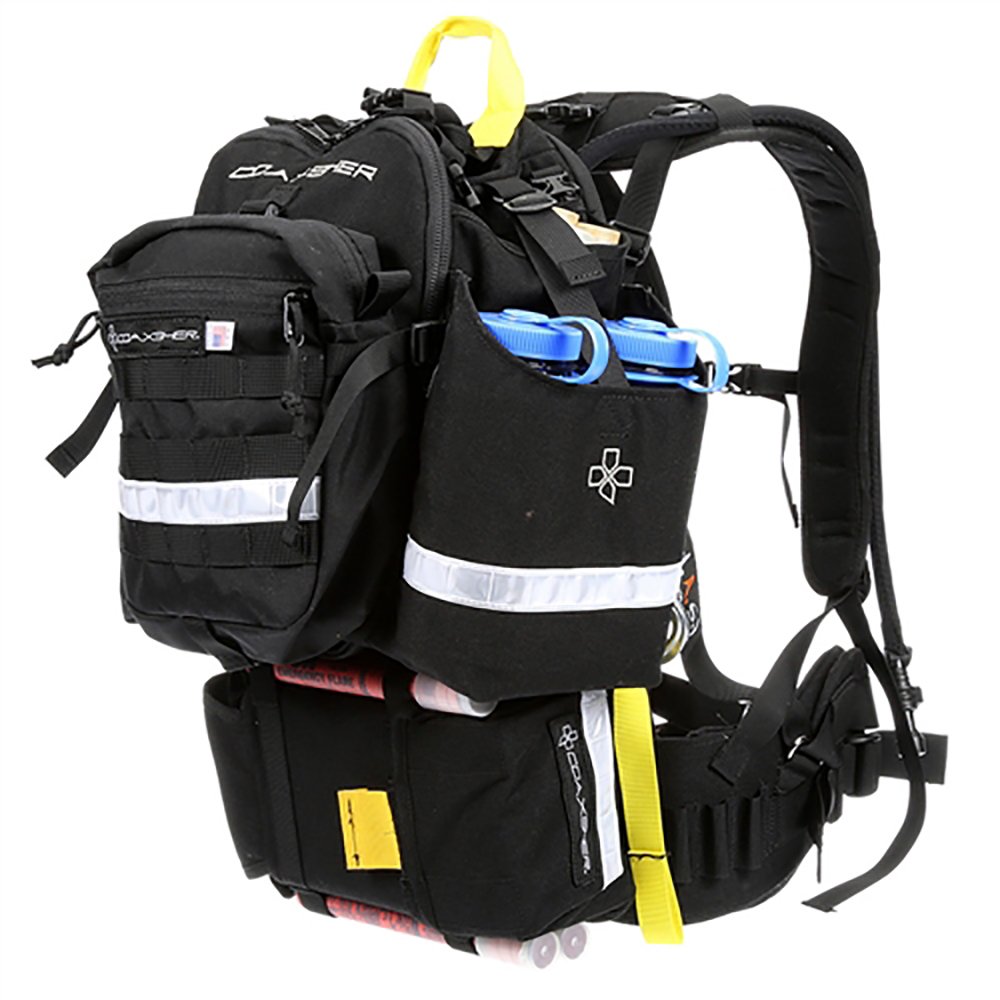
A black framed pack built to balance a fire shelter while you cut line
The FS-1 Ranger earns its spot with one feature the Spotter does not have: a fire shelter case that drops down to counterbalance weight while you dig. That keeps the shelter from pulling the pack forward when you are bent over a tool. This is the single feature that separates it from the Spotter above. If your shift is mostly digging with a shelter on your back, this is the balance-focused pack. If you mostly hike with a light load and rarely dig, the Spotter suits you better.
Underneath, the Ranger uses aluminum stay harness structuring for hiking comfort across long distances. A patent pending D.A.S. Dual Action Stabilizer helps settle the load, and compression straps keep the shelter and tools tight against the frame. The modular pack system offers multiple set-up options, so you can configure it to the load. The framed backpack design and nylon lining sit behind a buckle closure, and the black colorway keeps it low-profile on the line.
The trade-off is straightforward. The Ranger gives you dedicated shelter balance and an aluminum stay harness, but it is the heavier, more fixed build compared with the Spotter’s click-on modular cases. On short shifts with a light load, the Spotter’s 700 cubic inch module and under-four-pound frame are easier to move in. On a long dig with the shelter on your back, the Ranger’s drop-down counterbalance keeps the pack from pulling forward when you bend over a tool. Both are Coaxsher fire packs, so you can match the set-up to the shift rather than replacing the brand.
The balance feature: The fire shelter case drop-down counterbalances weight while digging, so the pack stays settled when you are working on the line rather than hiking.
Carry structure: Aluminum stay harness structuring, a patent pending D.A.S. Dual Action Stabilizer, and compression straps keep the load tight against your back. The modular pack system offers multiple set-up options.
Go with this if the shelter is your main load: The Ranger’s drop-down case and aluminum stay harness are built for digging shifts.
The catch to know: If your shifts are mostly light-load hiking, the Spotter’s modular click-on cases will feel more flexible.
Know the Specs
Load System and Modules
A load system is how the pack holds and changes your gear. The FS-1 Spotter uses a 700 cubic inch main pack module with removable modules for a medical kit case, a water reservoir case, and a dual flagging tape dispenser. The FS-1 Ranger uses a modular pack system with multiple set-up options and compression straps. More modules mean you can shift the pack to fit the shift’s tool list.
Harness and Frame
The harness and frame carry the weight. A custom torso curve fit frame with adjustable waist and shoulder lengths helps the FS-1 Spotter settle on your back for long missions. The FS-1 Ranger uses aluminum stay harness structuring, a patent pending D.A.S. Dual Action Stabilizer, and a framed backpack design. A good frame keeps the load from shifting while you hike and dig.
Shelter Drop-Down and Balance
Fire shelter placement affects how the pack carries. The FS-1 Ranger’s fire shelter case drop-down feature counterbalances weight while digging. That placement keeps the shelter from pulling the pack forward when you bend. If you carry a shelter on digging shifts, this feature is worth studying.
Build Materials and Hardware
Fire gear sees brush, ash, and daily abuse, so the materials matter. The FS-1 Spotter uses DuPont 1000 Denier Cordura, ITW Nexus buckles and hardware, YKK zipper pulls and tape, and reinforced stress points. The FS-1 Ranger has a nylon lining and a buckle closure. Look at the stress points and zippers first — they are what fail on a cheaper pack.
Common Questions
Will the FS-1 Spotter hold a fire shelter?
Does the FS-1 Spotter come with a water bladder?
What is the difference between the Spotter and the Ranger packs?
How much does the FS-1 Spotter weigh?
What materials are in the FS-1 Spotter pack?
Is the FS-1 Ranger a framed pack?
Can I configure the FS-1 Ranger for different loads?
Which pack should a new crew member start with?
Are these packs made by the same brand?
The Bottom Line
For most crew members whose fire line load changes shift to shift, the FS-1 Spotter is the pack to start with. It gives you a 700 cubic inch main module, click-on tool modules, and a build that weighs under four pounds, so you can reconfigure gear without unpacking. If your shifts are mostly digging with a fire shelter on your back, reach for the FS-1 Ranger instead. Its fire shelter case drop-down counterbalances weight while you work, and its aluminum stay harness (a metal frame strip that stiffens the back) keeps the load settled. Both are Coaxsher fire packs, so you can pick the Spotter or the Ranger for the shift without changing brands.
How we choose
We do not accept paid placement. Every pick is matched to a real buyer and a real use-case; we do not hands-on test units.
Sources
Specifications: manufacturer listings and product documentation. Review insights: verified customer reviews, as of November 2026. Pricing: not shown on this page (it changes often); check the current price via the retailer link.
As an Amazon Associate, Tactical Gear Guy earns from qualifying purchases. This does not affect which products we feature.