Specs are compiled from manufacturer listings and verified buyer reviews and can change over time — please confirm the key details on the product page before buying.
Most people who buy a WiFi switch with a timer hit the same wall: they get the switch on the wall, open the app, and discover the schedule they wanted is buried three menus deep. The second wall is the neutral wire. Every switch below needs one in the box, and if your wall box lacks it, no amount of app polish will save the install. So the real question is not which switch has the most features — it is which one lets you set a countdown, a daily routine, and an away pattern without a manual. That is what this guide sorts out.
This guide is built by comparing the manufacturers’ published specifications and the patterns across verified customer reviews, so you get each pick’s real strengths and trade-offs instead of marketing spin.
You will see which switches handle 3-way and 4-way wiring, which ones speak Matter so they work across Apple Home and Alexa at once, and which ones keep a schedule running when the internet drops. Every pick below is a real WiFi switch with timer and schedule control built in, so you can compare them on the things that actually decide a purchase.
Top Picks


How To Choose The Best WiFi Switch with Timer
Start with your wall box, not the product page. A WiFi switch with a timer needs constant power to keep its radio and its clock alive, and that means a neutral wire (the white return wire) has to be present alongside your hot and load wires. Open the plate and look before you order anything. If you only see two wires and a bare ground, most of this list will not work in that box without an electrician.
Countdown timer versus schedule — they solve different problems
A countdown timer turns the light off after a set period, which suits a bathroom fan, a closet light, or a garage light you keep forgetting. A schedule is a repeating rule tied to clock times, which suits a porch light at sunset or a bedroom lamp at 11pm. The switches here handle both, but the app layout matters — a timer buried under three submenus gets abandoned within a week. Away Mode is the third piece: it randomizes on and off times so the house looks lived in while you travel.
Check the current rating against what you are switching
The current rating, measured in amps (A), tells you how much load the switch can safely carry. A 15 A switch is built for a standard lighting circuit. A 10 A switch handles lights and a ceiling fan but leaves less headroom. Match the rating to the circuit, not to the size of the room. If you are switching a motor load like a fan, a lower-rated dimmer or a switch not rated for motors can shorten its life, so read the listing carefully.
Match the circuit type to your wiring
Single-pole means one switch controls one light — the common case. Three-way means two switches control the same light, typical of a hallway or staircase. Four-way adds a third control point. Not every WiFi switch on this list supports 3-way or 4-way, and a few explicitly say they do not. Verify that line before you buy, because a single-pole-only switch will not drop into a hallway circuit no matter how you wire it.
Side-by-Side Comparison
| Model | Best For | Current Rating | Circuit Type | Connectivity | Amazon |
|---|---|---|---|---|---|
| Tapo S500 (4-Pack)★ Best Overall | Outfitting several rooms at once | 15 A | 1-way | Wi-Fi | Amazon |
| GHome Smart Light Switch SW5Budget Champion | Cheapest single-switch start | 15 A | 1-way | Wi-Fi | Amazon |
| Tapo S515Most Versatile | Hallways and staircases | 15 A | 1-way, 3-way, 4-way | Matter, Wi-Fi | Amazon |
| TREATLIFE Smart Light Switch | Simple Alexa and Google setup | 10 A | 1-way | Wi-Fi | Amazon |
| Kasa Smart Dimmer HS220-BL | Dimming plus timers | 2.5 A | 1-way | Wi-Fi | Amazon |
| MOES Smart Touch Switch | Glass-panel look, RF remote option | 10 A | 3-way | Bluetooth, Wi-Fi | Amazon |
| TP-Link Tapo S505 (2-Pack) | Mixed Apple and Alexa homes | 15 A | 1-way | Matter, Wi-Fi | Amazon |
| ELEGRP Smart Light Switch | Quiet rocker in black | 3.75 A | 3-way | Bluetooth, Wi-Fi | Amazon |
| Lesim 2-Gang Smart Switch | Two lights on one panel | 15 A | 1-way | Wi-Fi | Amazon |
Detailed Reviews
1. Tapo Smart Light Switch S500 (4-Pack)
Our pick — 4.5+★ from 850+ verified ratings; the strongest balance of quality and price.
Four switches in one box, so the hallway, kitchen and bedroom all get the same timer routine.
The number that decides this pick is 15 A — the current rating (how much electrical load the switch can carry), which covers a standard lighting circuit with room to spare. You get four S500 switches, four wall plates, sixteen wire nuts and eight screws in the box. That is enough to replace the switches in four rooms in one afternoon instead of ordering again after the first install.
Where this Tapo pulls away from the single-switch names below is consistency: four identical units means one app, one pairing routine, and one set of schedules repeated across the house. The Tapo app walks you through wiring step by step, and the countdown plus schedule combination lets a bathroom fan run on a timer while a porch light follows a daily rule. Voice control runs through Alexa, Google Assistant and Samsung Bixby.
Away Mode is what justifies the four-pack: it randomizes on and off times so the house reads as occupied while you travel. The catch is honest and it is the same catch every switch here shares — you need a neutral wire and 2.4GHz WiFi, and the listing itself recommends an electrician if wiring is unfamiliar territory. Buyers rate it 4.5+ stars across 1,000+ reviews, and the recurring note is that the Tapo app’s step-by-step wiring guide makes a first install manageable.
What earns the top spot
- 15 A rating handles a standard lighting circuit without pinching
- Four switches, four plates and sixteen wire nuts in a single box
- Countdown timer, schedules and Away Mode all live in the Tapo app
- Works with Alexa, Google Assistant and Samsung Bixby by voice
Where it asks something of you
- Neutral wire required in every wall box you replace
- 2.4GHz WiFi only — a 5GHz-only network will not pair
- Single-pole wiring only, so no hallway 3-way circuits
The four-room answer: Buy this if you are replacing several single-pole switches and want matching timer routines across the whole house.
Where it stops: A hallway light run from two switches needs a 3-way model instead, because this one is single-pole only.
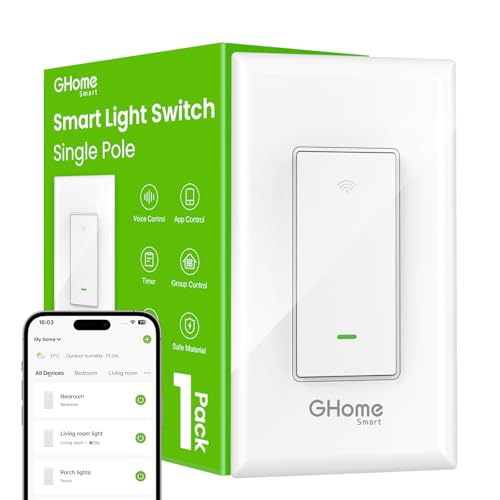
2. GHome Smart Light Switch SW5
The entry-level switch that still carries a full 1800W load rating and a real schedule.
For one switch in one room, this GHome is the sensible starting point. Its 15 A rating works out to a 1800W load capability at 120V/60Hz, which covers ordinary lighting plus a ceiling fan. It fits a standard wall box and reuses your existing fixtures, so there is no bulb shopping involved. GHome lists UL and FCC certification, flame-retardant construction and overload protection.
The scheduling side does what a timer switch should. You can set a porch light to come on at sunset, a bedroom light to go off at a set hour, or flip on Away Mode while you are traveling. Because there is no hub in the chain, the switch talks straight to your router — and only on 2.4GHz, so a 5GHz network will not see it during pairing. Group controls let you kill every switch in the house from one command once you have more than one installed.
Worth knowing before you commit: GHome ships newer firmware, and the listing asks you to accept the in-app upgrade prompt to V1.1.3 for steadier behavior. Do that on day one rather than after the schedule starts acting up. At 4.0+ stars it trails the top of this list, but reviewers consistently call the GHome install clear and quick.
The wiring read: Step-by-step instructions in the GHome app cover the wiring and pairing in one pass, which is why this one suits a first-timer who wants a single switch running tonight.
Set your expectation: Single-pole only, neutral wire required, and no 5GHz support — three limits to confirm against your wall box before ordering.
Go here if: You need one switch on a timer and want the simplest possible app path.
Pass if: Your wall box has no neutral wire or your home runs a 5GHz-only network.
3. Tapo S515 Single-Pole/3-Way/4-Way
One switch that handles a hallway run from three separate wall points.
Here is the wiring gap that matters most: the S515 supports 1-way, 3-way and 4-way circuits in a single unit, so the same switch drops into a simple bedroom light or a staircase light controlled from three points. The single-pole names on this list cannot do that. Its 15 A rating also edges past the TREATLIFE switch’s 10 A, which leaves visibly more headroom on a heavier lighting circuit.
Matter certification is the second reason this one stands apart. Matter is a shared smart-home language, so the switch works with Apple HomeKit, Amazon Alexa, Google Home and Samsung SmartThings at once, plus other Matter-certified devices regardless of brand. You are not locked into one ecosystem if your household is split between an iPhone and an Echo speaker.
The app adds energy monitoring, which tracks the power draw of whatever lights are connected so you can spot a lamp left running. Schedules and Away Mode are both present, and you can group the switch with a smart bulb or smart plug for one-tap control. The trade-off is that the physical button is a toggle rather than a flat paddle, which some hands adapt to faster than others. At 4.0+ stars, reviewers consistently land on easy install, solid build and good value.
The multi-point case: If your hallway or staircase light already has two or three wall switches feeding it, this is the shortest path — no rewiring to a single point required.
One thing to budget: Matter pairing is a different flow from plain WiFi pairing, so give yourself a quiet ten minutes for the first setup rather than rushing it.
Reach for this if: You need 3-way or 4-way control or you run a mixed Apple-and-Alexa household.
Look elsewhere if: You just want the cheapest single-pole switch, since the extra circuit flexibility adds complexity you will never touch.
4. Kasa Smart Dimmer Switch HS220-BL

A timer switch that also dials brightness from 1% to 100% on a schedule.
Most switches on this list only do on and off. This Kasa changes the picture because it dims, and the range runs from 1% brightness up to 100%. That means a scheduled evening wind-down — dim the living room lamp to a low level at 9pm, then off at 11pm — happens automatically without touching a button. The fade on and off feature removes the abrupt click to full brightness.
What buyers latch onto first is functionality, and the smooth dimming plus LED recessed light compatibility are the two things this model earns consistent credit for. Scheduling works the same way as the on/off switches: set times, attach a brightness level, and let it ride. Away Mode randomizes your lights while you travel, and there is also a one-tap sound mode bonus the listing mentions.
Two honest notes. First, this is a dimmer, not a dimmer-and-speed controller — do not expect ceiling fan speed changes from it. Second, it is a single-pole unit and it needs a neutral wire and 2.4GHz WiFi, same as the rest. Connectivity does draw mixed feedback in the review pool, so if your WiFi signal is weak at that wall, expect to fuss with the router position. The black finish is a deliberate choice too — it reads as a design statement, not a neutral white plate.
what separates it: You can schedule brightness, not just on and off — the feature you will actually use every night. Set it once and the room dims itself on a routine.
The honest limit: A dimmer handles lighting circuits only, and this one is rated 2.5 A, so a heavy load circuit belongs on a 15 A switch instead.
Best for: Anyone who wants scheduled dimming in a living room or bedroom and prefers a black plate.
Skip if: You need to switch a ceiling fan or a circuit carrying more than a lighting load.
5. TP-Link Tapo S505 Matter Switch (2-Pack)

Schedules that keep firing even when the internet goes down.
Once set up, Matter devices on your local network talk directly to each other, so a schedule or a switch-to-bulb link still works without a cloud connection. When the internet drops, your timer does not. A plain WiFi switch loses its cloud link and its remote control at the same moment.
Multi-Admin is the other premium trick. You can control the same switch from the SmartThings app on a Samsung phone, dim it by asking Alexa, and switch it off in Apple Home — all at once, no extra hardware. Both switches in the pack carry a 15 A rating, and both need neutral wiring plus 2.4GHz WiFi for setup. Timer and schedule control runs through the Tapo app, with Siri, Alexa and Google Home all in the voice lineup.
The place this one asks for patience is reliability, which reads mixed in the review pool — some units behave flawlessly while others need a firmware nudge. Keep the Tapo app updated and pair the switches close to the router the first time. If Matter multi-admin and local schedules are what you want, this is the most future-proof pick here.
Why the premium is real
- Matter LAN control keeps schedules running without the internet
- Multi-Admin works across Apple Home, Alexa, Google and SmartThings simultaneously
- Two switches in the pack, both rated 15 A
What you are trading for it
- Reliability draws mixed feedback across the review pool
- Single-pole only, so hallways still need the S515
- Matter setup takes a slower first pairing than plain WiFi
Worth it when: Your home mixes Apple and Alexa gear and you cannot afford a timer that dies with the WiFi.
Not for you if: You only need one switch and a plain WiFi timer covers the job.
6. TREATLIFE Smart Light Switch

The screwless wall plate and a straightforward scheduling app in one low-cost switch.
Start with the number that separates it from the Tapo S515: this TREATLIFE carries a 10 A current rating and a 1250W maximum power figure, while the S515 is rated 15 A. That gap matters if your circuit runs close to its limit — the higher-rated switch leaves more margin. For a normal light or a ceiling fan, the 10 A rating is plenty.
What wins people over is the build quality, and the screwless snap-on wall plate is a big part of that — no visible screws, a clean finish that sits flush. The signal light is subtle enough not to glare at night. Scheduling and countdown functions live in the Smart Life app, and you can share devices with family or group lights for one-tap control. Voice control runs through Alexa, Google Assistant and SmartThings.
Suitable for lighting up Christmas decoration lights is a small line in the listing that turns out to be genuinely useful for seasonal setups — a countdown keeps the tree lights on for an hour, then off. The wiring notes are the usual trio: neutral wire required, 2.4GHz only, and single-pole only. It is the right pick if the plate finish and the app simplicity matter more to you than 3-way support.
The finish angle: A screwless plate hides the mounting hardware entirely, which is the detail that makes a smart switch look like it belongs in a finished room rather than a retrofit.
The trade-off: That tidy plate comes with a 10 A ceiling, so a heavy circuit or a 3-way hallway run belongs on a different model.
The right buy for: A clean single-pole install where the finished look on the wall matters as much as the schedule.
Think twice if: You need 3-way wiring or a circuit closer to the top of a 15 A rating.
7. MOES WiFi Smart Touch Wall Switch

An anti-scratch tempered glass panel you tap, plus a 3-way circuit in one unit.
If you like the flat black-glass look on a wall plate, this MOES delivers it without a separate dimmer. The panel is anti-scratch tempered glass and responds to a touch rather than a press. Its 10 A rating covers lights and fans, and it supports multi-control association for a 3-way setup — two switches controlling one light — or a plain single-pole install.
The unusual extra here is the built-in RF433 radio (a separate low-frequency remote-control signal). It works alongside the Smart Life app, touch control and voice control, and each method runs independently, so a failed WiFi connection does not knock out the app. An RF remote with 1527 encoding pairs with it, though the remote is not in the box.
One design limit to know going in: this is not a dimmer. It switches on and off, full stop. The IP54 rating (protection against dust and splashing water) makes it slightly more forgiving in a utility area than a bare plastic plate. It pairs over both WiFi and Bluetooth, so a slightly awkward wall position gets a second pairing route.
Where it shines: The glass touch panel and the independent RF433 control give you two backup ways to switch the light when the app will not respond.
Go in knowing: The countdown timer uses fixed intervals rather than a custom duration, and there is no dimming at all.
Reach for this if: You want a glass touch panel and a 3-way circuit with a remote-control fallback.
Look elsewhere if: Dimming or an exact custom-length countdown is what you need.
8. ELEGRP Smart Light Switch
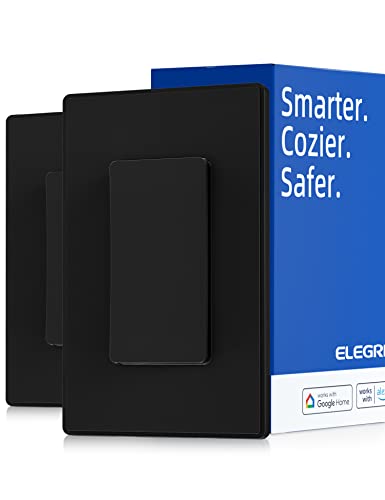
A quiet rocker with a matte finish and a slim body that leaves room in the box.
You get a quiet press instead of a click: the ELEGRP uses a smooth rocker with a skin-like matte surface, a detail that matters in a hallway right outside a bedroom door. The body is ultra-slim, so a crowded electrical box has more room for the wiring. Its 3-way circuit support (a circuit where two switches control the same light) means it can replace a hallway switch that shares control with a second switch.
Scheduling is the practical reason to pick it. You get schedules and a countdown timer, and you can sync on and off times to sunrise and sunset — a porch light that turns itself on as it gets dark and greets you when you arrive late. Voice control runs through Alexa and Google Assistant, and app control works from anywhere, so a light left on while you travel is a one-tap fix.
The relay uses Bluetooth plus WiFi for pairing, and the blue 3-way wire simply stays unconnected when you use it as a single-pole switch. Reliability is the mixed note in the review pool — some units run clean, others switch on or off on their own, so keep it away from a flaky WiFi signal and update firmware. Appearance and build quality are the bright spots. Its 3.75 A rating is the lowest here, so it is a light-switch unit, not a circuit for heavier loads.
The quiet factor: A matte rocker with no sharp click is a real difference in a home where a hallway switch sits near a sleeping room.
The honest limit: At 3.75 A this is a lighting-only switch, and the random on/off reports mean it is best paired with a strong WiFi signal.
Suits you if: You want a 3-way rocker with a matte finish and sunrise/sunset scheduling.
Not the one if: You need a switch for a heavier circuit or you want top-level reliability above all else.
9. Lesim 2-Gang Smart Light Switch

Two lights on one rose-metal panel, with schedule and sharing built in.
Two-gang means two separate lights controlled from a single panel, which is the reason to look at this one: a kitchen or living room with a pair of lights gets both on one smart plate. Its 15 A rating matches the Tapo S500 and the Tapo S515, so it carries a standard lighting circuit at the same headroom. The finish is a rose metal, which is a look you either want or do not.
Schedules and timers run through the Smart Life app, and Smart Sharing lets you split control with family members so everyone can flip the lights without passing one phone around. Voice control works through Alexa and Google Assistant. Remote control from the app works from anywhere, and grouping the switch lets one command switch several lights at once.
Check your wiring first, because the limits are strict: it replaces a single-pole switch only (one switch controls the light) and is not compatible with 3-way or multi-switch circuits. It needs a neutral wire (the white return wire in the box), and it supports 2.4GHz WiFi only, not 5GHz. Buyers report easy installation and the practical ability to control lights from another room. At 4.0+ stars it sits at the low end of this list — a solid budget 2-gang panel rather than a premium one.
The two-gang case: A single panel for two lights saves replacing two separate switches, and sharing keeps the schedule in one place.
What narrows it: Single-pole only with no 3-way support, so check your wiring before you commit.
The match for: A two-light room where you want one smart panel and shared family control.
The mismatch: A 3-way circuit or a 5GHz-only network will block this install entirely.
Know the Specs
Current Rating (Amps)
Amps (A) measure how much electrical load a switch can safely carry. A 15 A switch handles a standard lighting circuit with margin; a 10 A switch covers lights and a small fan. Read the rating on the switch and compare it to what you intend to switch — a switch rated below the circuit’s draw runs hot and wears out faster. Dimmers often carry a lower amp rating than on/off switches because they throttle power rather than just passing it.
Timer vs Schedule vs Away Mode
A countdown timer runs the light for a fixed period and then off — useful for a fan or a closet. A schedule repeats based on clock time, which suits a porch light at sunset or a bedroom lamp at a set hour. Away Mode randomizes the on and off pattern so the house looks occupied while you travel. The best switch puts all three in one app, and the brand difference is mostly how many taps each one takes to reach.
Neutral Wire and 2.4GHz WiFi
A smart switch needs constant power to keep its radio and clock alive, so a neutral wire has to be present in the wall box. Check for the white return wire before ordering. The switch also needs a 2.4GHz WiFi signal — the older, longer-range band — because 5GHz is not supported by any switch on this list. If your wall is far from the router, pairing can fail even when the network is fine elsewhere.
Matter, Voice Control and 3-Way
Matter is a shared smart-home standard, so a Matter-certified switch works across Apple Home, Alexa, Google Home and SmartThings without a separate hub per platform. Voice control across Alexa or Google removes the need to reach for the app. Three-way and four-way refer to circuits where multiple switches control the same light — a hallway or staircase. Not every switch supports these, and the listing says so plainly when you look for it.
Common Questions
Do I really need a neutral wire for a WiFi switch with a timer?
What is the difference between a countdown timer and a schedule on a smart switch?
Can a WiFi switch with a timer work if my internet goes down?
Will these switches work with a ceiling fan?
What is the difference between single-pole and 3-way smart switches?
Why does my switch only see 2.4GHz WiFi?
Do I need a hub or smart-home bridge to use these switches?
Can these smart switches dim lights as well as turn them on and off?
Is a WiFi switch with a timer safe to install myself?
What is Matter and does it matter for a timer switch?
The Bottom Line
For most homes, the four-pack of Tapo S500 switches is the smartest starting point — one order covers four rooms, one app runs every timer and schedule, and the 15 A rating fits a standard lighting circuit. If your hallway light already runs from two wall switches, the Tapo S515 is the only unit here that handles 3-way and 4-way wiring in one piece, and it adds Matter and energy monitoring. And if dimming on a schedule is the goal, the Kasa HS220-BL is the pick, since it dials brightness from 1% to 100% rather than just switching power.
Before you order anything, open the plate on the wall and confirm two things: a neutral wire in the box and a 2.4GHz WiFi signal at that spot. Those two checks decide whether a smart switch takes ten minutes or turns into a project. Pick a model that matches your circuit, not the one with the longest feature list — a single-pole switch in a 3-way hallway will never work no matter how good the app is.
How we choose
We do not accept paid placement. Every pick is matched to a real buyer and a real use-case; we do not hands-on test units.
Sources
Specifications: manufacturer listings and product documentation. Review insights: verified customer reviews, as of November 2026. Pricing: not shown on this page (it changes often); check the current price via the retailer link.
As an Amazon Associate, Tactical Gear Guy earns from qualifying purchases. This does not affect which products we feature.