Specs are compiled from manufacturer listings and verified buyer reviews and can change over time — please confirm the key details on the product page before buying.
A white projector screen is the cheapest upgrade in a movie setup and the easiest part to get wrong. Buy one that curls at the edges or lets light bleed through the back, and every dark scene in your film turns grey and washed out. Get gain, black backing and mounting right and a mid-range projector looks like it cost twice as much. This guide separates the nine screens worth shortlisting from the ones that will fight you every movie night.
This guide is built by comparing the manufacturers’ published specifications and the patterns across verified customer reviews, so you get each pick’s real strengths and trade-offs instead of marketing spin.
You will see how gain, viewing angle and black backing change what your projector actually throws on the wall. We also cover which screens survive a backyard and which belong on a ceiling. By the end you will know which white projector screen fits your room, your projector and your tolerance for installation.
Top Picks
How To Choose The Best White Projector Screen
Start with your room, not the spec sheet. A screen only performs as well as the light around it and the projector throwing at it. Answer three questions before you buy anything: how bright is the room, how far back will the projector sit, and do you want the screen gone when the movie ends?
Gain: how much light bounces back at you
Gain (how strongly a screen bounces projector light back at your seats) decides how bright the picture looks. A 1.1 gain screen sends back a little more than a plain white wall would, so the picture reads brighter in a room with some ambient light. A 1.2 gain pushes a touch further. Higher gain narrows the balance, so viewers sitting far off to the side see a dimmer image. If your projector is dim, gain helps. If you always watch with the lights down, a matte white surface at modest gain is easier on the eyes.
Viewing angle: where the picture stays bright
The viewing angle is the cone in front of the screen where the image stays evenly lit. A 160° screen covers a wide fan of seats, so people on the sofa ends still get a clean picture. A 178° surface is even more forgiving for a packed room. If you watch from directly in front with two or three people, a narrower angle is fine and often gives a punchier centre image.
Black backing and borders
A black backing layer stops projector light passing straight through the fabric. Without it, a bright scene glows through the back of the screen and washes out the picture from the front. Black masking borders around the edge do the same job at the frame — they sharpen contrast because your eye compares the bright image against true black. If the screen sits in front of a window or a lit wall, backing is not optional.
Mounting: pull-down, tripod, fixed or motorized
A manual pull-down screen hangs from the wall or ceiling and rolls away when you are done. A tripod or floor-standing screen sets up anywhere flat and packs into a bag for the backyard. A motorized screen drops and retracts on a remote, which matters if the screen lives permanently over a living-room wall. Match the mount to how often you deploy the screen: a pull-down for weekly use, a tripod for occasional outdoor nights, a motorized drop for a permanent wall.
Side-by-Side Comparison
| Model | Best For | Screen Size | Aspect Ratio | Mount Type | Amazon |
|---|---|---|---|---|---|
| 120″ HD Manual Pull Down (1:1)★ Best Overall | Big square-format wall or ceiling screen | 120 inches | 1:1 | Wall / ceiling pull-down | Amazon |
| Iolieo 120″ Foldable 16:9Best Value | Washable portable screen for indoor and outdoor | 120 inches | 16:9 | Wall / frame / tie-down | Amazon |
| ZUVMITG 120″ with StandBest Outdoor Pick | Backyard and camping movie nights | 120 inches | 16:9 | Floor stand | Amazon |
| Saicool 100″ Pull Down | Home theater on a wall or ceiling | 100 inches | 16:9 | Wall / ceiling pull-down | Amazon |
| Pyle 50″ Tripod PRJTP53 | Desktop and classroom presentations | 50 inches | — | Floor / tripod | Amazon |
| Kshioe 84″ Motorized | Remote-controlled home theater | 84 inches | 16:9 | Wall / ceiling motorized | Amazon |
| WASJOYE 84″ Pull Down | Anti-crease PVC with wide viewing | 84 inches | 16:9 | Wall / ceiling pull-down | Amazon |
| Pyle 72″ Manual Pull Down | Small rooms and apartments | 72 inches | — | Wall / ceiling pull-down | Amazon |
| VIVOHOME 84″ Motorized | Long-range remote in a living room | 84 inches | 16:9 | Wall / ceiling motorized | Amazon |
Detailed Reviews
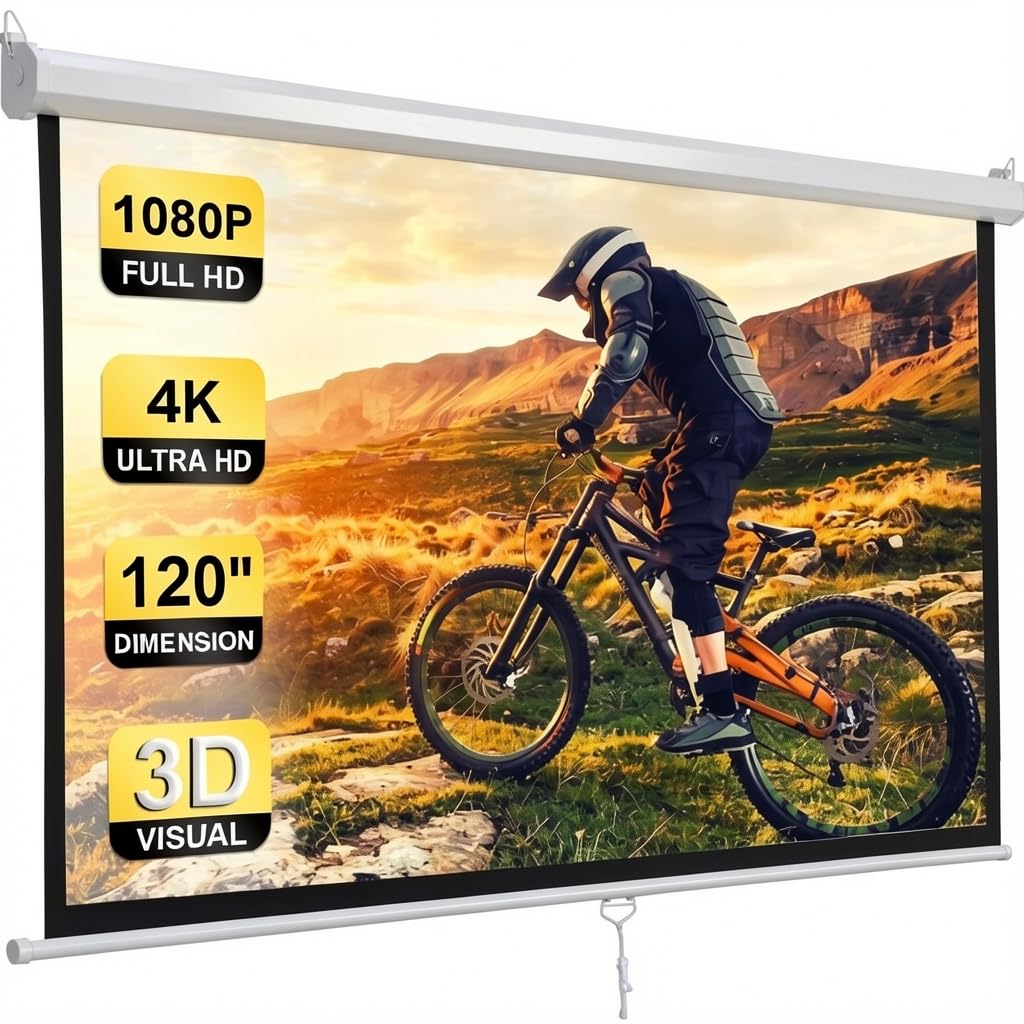
1. 120″ HD Manual Projector Screen 1:1
Our pick — 4.5+★ from 350+ verified ratings; the strongest balance of quality and price.
A 120-inch square that hangs from wall or ceiling and locks exactly where you leave it.
One big white surface that serves double duty is what this pick delivers. The 1:1 format gives you a 120-inch diagonal spread over an 89.7 x 86.6-inch screen area — a true square that swallows a widescreen 16:9 image in the middle and still has room for tall presentation slides or video games. A standard 16:9 widescreen stretches the picture edge to edge with nothing left over, so the blank square is a deliberate oddball choice, not a mistake. It is a 1.1 gain matte white surface, meaning it bounces back a bit more light than a plain white wall.
The build and the value win people over here, not a single showy number. The matte white surface spreads light across a 160° viewing angle, so the whole sofa gets a settled picture instead of one bright balance. A standard black backing sits behind the fabric to stop light punching through, and four black borders frame the image to sharpen contrast. The heavy-duty metal casing installs on either a wall or a ceiling, and a shelf lock lets you set the drop height and even the aspect ratio you want to use.
The recurring inconsistency is the retraction — some units roll back up cleanly and some resist, so pull it down gently and let the spring do the work rather than yanking it. The surface itself wipes clean with mild soap and water if you ever mark it. At 15.7 pounds it is noticeably heavier than the 12.5-pound ZUVMITG stand screen in this list, which tells you the casing is the real thing. For a wall-mounted setup that stays put, that weight is reassurance rather than a burden.
Why It Earns The Top Slot
- 1:1 square format handles both widescreen movies and tall content on one surface.
- 1.1 gain matte white with black backing keeps the picture bright and stops light bleed.
- 160° viewing angle spreads the image across a full row of seats.
- Dual wall or ceiling mounting with a height locking shelf set.
- Solid 15.7-pound metal-cased build that feels built to stay hung.
Where It Needs Care
- The retraction mechanism is the weak link — roll it up slowly and deliberately.
- The square format wastes top and bottom space on a 16:9 movie.
Reach for this if: you want a permanent, big-format wall or ceiling screen that covers movies, slides and games on one white surface.
Think twice if: your only content is widescreen film and you want every inch of the screen filled.
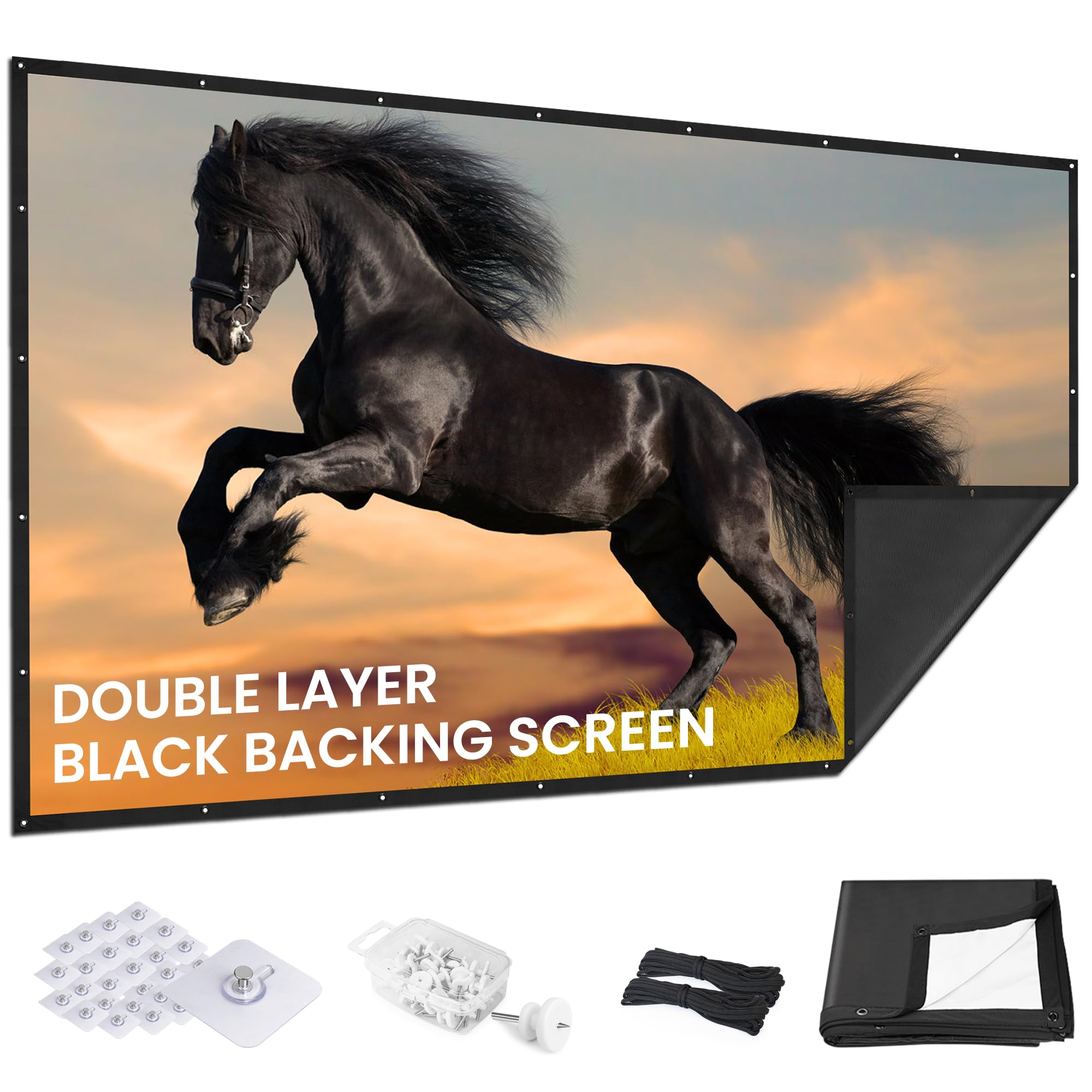
2. Iolieo 120 Inch Projector Screen
The foldable fabric screen you can wash, tie to a tree and roll up in a bag.
If your movie night moves between the living room and the backyard, this is the one to grab. It is a 120-inch 16:9 sheet of black-backed polyester with a 102 x 58-inch viewing area — big enough for a proper backyard crowd but light enough at 1.38 kg to carry one-handed. The black backing layer kills light bleed through the fabric, which is exactly what separates a crisp image from the washed-out grey you get from a plain sheet.
The versatility is the real story. Tailored accessories let you hang it on a wall with transparent sticky hooks or invisible nail hooks, tie it to trees or tents with ropes, or build a DIY frame from PVC pipes or lumber. It is machine washable and wrinkle-resistant, so a crease from the bag flattens out far easier than it would on a rigid pull-down surface. Contrast and colour read noticeably better here than a bare white wall, and the thicker material keeps the borders straighter than softer fabric screens in its class.
What wins people over is the picture quality the black backing open up — dark scenes hold their depth rather than glowing with pass-through light. Installation is a bolt-together affair with clear instructions, and the US-based support team offers live help if a part is missing or you get stuck. The trade-off is fit rather than fault: this is a fabric screen with no rigid frame or casing, so it depends on a flat wall or a taut DIY frame to look its best. Expect to spend a little care getting the corners even the first time.
Straight read: a fabric screen that turns almost any wall, fence or tent into a 120-inch cinema surface, then folds away into nothing.
Fair caveat: no rigid casing means a slightly uneven wall shows through the fabric’s pull.
Who it beats: every rigid screen here for people who watch outside and inside week to week.
Who it does not: anyone who wants a permanent, taut, motorized drop in a dedicated theater room.
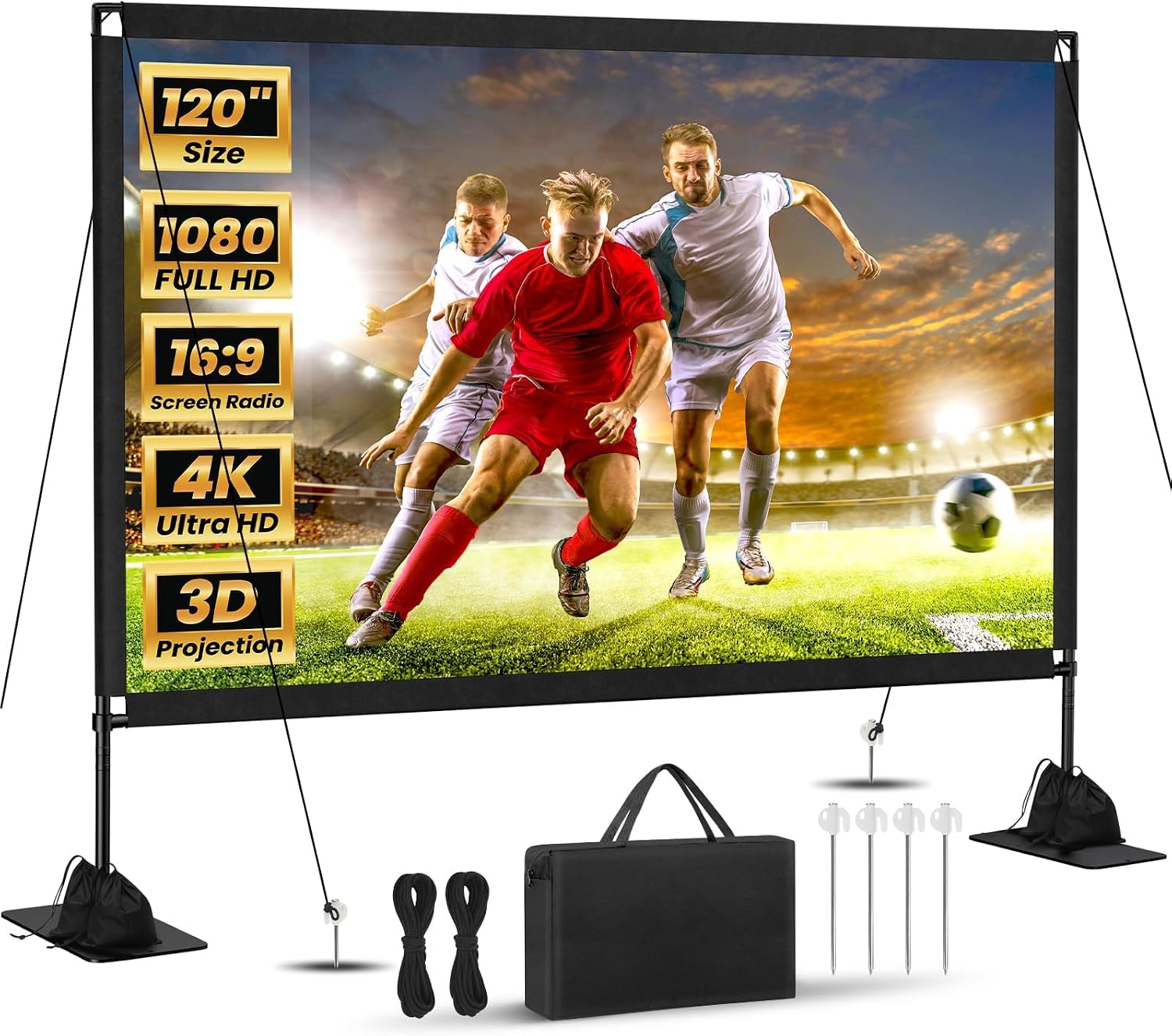
3. ZUVMITG 120inch Projector Screen with Stand
A freestanding 120-inch 4K screen built to stand up to a gust of wind in the backyard.
Most stand screens wobble the moment the wind picks up. This one attacks that problem head-on with four ground stakes, four ropes and four sandbags to hold it down, plus an extended reinforced steel base. The screen itself is a 120-inch 16:9 surface in washable milk silk fabric, stretched into a frame so the edges stay flat rather than waving in the breeze. It folds flat into a dedicated carry bag, and at 12.5 pounds it is a full 3.2 pounds lighter than the 15.7-pound 1:1 pull-down at the top of this list — a real difference when you are hauling it to a campsite.
Setup is the part people rave about most, right alongside the build. The component design slots together in a few steps with clear instructions, which is why it is one of the easier screens here to get standing straight. It projects from both sides thanks to the integrated frame fit, and a 160° viewing angle means your whole crowd sees a bright, even picture from wherever they sit. Bright 4K visuals come through as a crisp, punchy image outdoors where a dimmer surface would wash straight out.
The honest limit is stability in strong wind — the sandbags and stakes do serious work, but this is still a freestanding frame, not a bolted-down fixture. On a still evening it is rock solid; in a real blow, use every anchor in the box and position it out of the wind path. For camping, tailgates and backyard movie nights, it is the pick that lets you take a proper 120-inch screen almost anywhere.
Clear winner for: camping and backyard nights where you need a 120-inch screen standing up without a wall.
The catch to know: in strong wind it still wants all four sandbags and stakes working together.
4. Saicool Projector Screen 100 Inch

A tidy 100-inch pull-down that keeps a widescreen picture crisp and wrinkle-free on any wall.
Here is the sensible middle of the road for a living-room setup. You get a 100-inch 16:9 diagonal with an 88 x 56-inch viewing area, so big-budget films fill the frame edge to edge with no wasted space. The matte white fabric is chosen to keep image clarity clean, and a black border runs the perimeter to boost contrast and block stray light. A 160° viewing angle means the ends of the sofa get the same bright picture as the centre seat.
The mounting story is what sells this one for a permanent install. It clips onto a wall, a ceiling or a freestanding frame, and it works with universal standard projectors, so you are not locked to one brand. The black frame keeps the surface pulled taut so it stays smooth and free of the sag that creases cheaper screens. Fire up a film or a sports broadcast and the taut matte white surface holds a sharp, even image with no hot spots.
Tension is where you need to stay honest with yourself: over time some units gradually lose their pull, so treat the drop and retract gently and it stays tidy far longer. This is the screen to buy if you want a clean 100-inch wall picture most nights and are happy to mount it once and leave it. Order this one over the 120-inch 1:1 above if widescreen film is your main event and every inch of frame should be filled.
The pull toward it: a straightforward 100-inch 16:9 surface, black-framed and wrinkle-free, that sets up on wall or ceiling and simply works.
Keep in mind: long-term tension can slacken, so avoid snapping the screen back up hard.
Best fit for: a dedicated movie wall where 100 inches in 16:9 is the right size.
Pass if: you need one screen to also handle tall slide decks or a backyard move.
5. Pyle 50 Inches Tripod Projector Screen PRJTP53

A tiny 50-inch tripod screen that pops up in seconds for a desktop or classroom.
Do not buy this expecting a movie-theater wall. This is a 50-inch fold-out tripod screen built for presentations, and it is the smallest surface on the list — the ZUVMITG outdoor screen above is 120 inches, well over twice the diagonal. What you trade in size you get back in portability: it stands on any flat floor or table, folds up for travel, and the retractable design slips into a bag for on-the-go presentations.
The fabric is a premium matte white that produces an even viewing surface, wrapped by a black masking border that sharpens focus and alignment. Pyle rates it stain-resistant and made of flame retardant fabric, which suits a classroom or office where a screen gets knocked around. Stand it on a table for a quick pitch, drop it on the floor for a small-group movie, or pack it for a wedding or event — the placement options are the whole point of a tripod build.
Stability is the trade-off to size up honestly: a lightweight tripod screen is nimble but it is not a heavy freestanding frame, so keep it away from doorways and wobbly tables where it could get nudged. The ease of use is class-leading for the price — from box to ready in a handful of seconds, which is why it lives in offices and classrooms rather than dedicated theaters. If your world is 50-inch desktop presentations, this is the travel-ready pick. If you want a film wall, go bigger.
What Makes It Click
- From box to ready in seconds thanks to the fold-out tripod design.
- Stands on any flat floor or table for flexible placement.
- Premium matte white surface with a black masking border for focus.
- Flame retardant fabric suits classroom and office use.
Where It Concedes
- 50 inches is a small surface — no match for the 120-inch screens for a movie crowd.
- A light tripod is easy to nudge, so placement needs a little thought.
Go grab it if: you need a grab-and-go 50-inch surface for presentations or classroom use.
Look elsewhere if: a big-screen movie night is the goal rather than a desktop pitch.
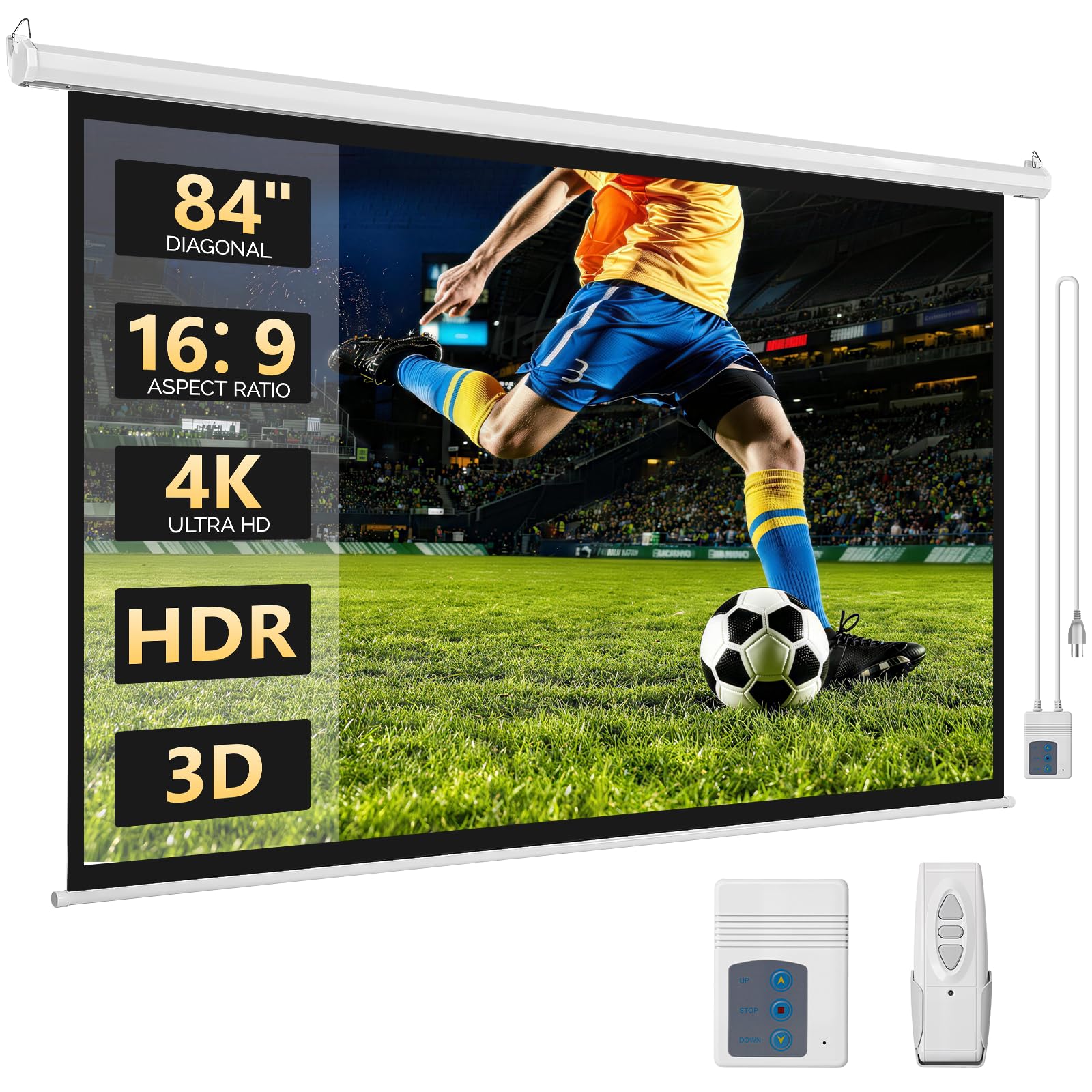
6. Kshioe Motorized Projector Screen 84in
Drop the screen from your seat with a remote — no reaching up, no yanking cords.
A motorized screen is about one comfort you never want to give back: pressing a button instead of climbing to pull a tab. This one is an 84-inch 16:9 surface with a 73.2 x 41.3-inch viewing area, and the motor drops it with a steady, jerk-free motion so it does not swing or rattle as it settles. Mount it on wall or ceiling with the dual installation design, and from then on, a film night is one remote press away.
The wireless remote is the small luxury that makes it worth the step up — you can operate it from anywhere in the room. A 160° viewing angle handles a residential or commercial crowd, so it works equally in a home theater, a classroom training room or a conference setup. The screen is 84 inches, a good compromise when a full 120-inch wall is too much for the space you have. The matte white surface keeps fine detail intact instead of flattening bright scenes into a washed-out blob.
The one thing to plan around is the rubbery smell that some motorized screens carry when new — air it out before the first movie night and it fades. Setup is otherwise simple, and the steady motorised motion is the feature that quietly distinguishes it from cheaper manual pulls. Think of this as the pick for a room where you want the screen hanging permanently, out of the way and ready, without a drop-cord ritual every time.
Short verdict: a remote-controlled 84-inch drop that turns a spare wall into a home theater with a single button press.
Plan for this: air the screen out before its first use, since new motorized screens can hold a faint smell.
Ideal owner: someone who wants the screen mounted for good and lowered from the sofa with the remote.
Not the one if: you need a portable screen you can carry outside for the evening.
7. WASJOYE 84” Projector Screen Manual Pull Down

A four-layer PVC pull-down that hits 1.2 gain and a 178° spread for a bright, even picture.
On paper, this screen leads this whole list on the two numbers that set picture quality. The 1.2 gain is the highest named gain here — more reflective than the 1.1 gain on the 120-inch 1:1 pull-down above — so it throws a brighter image back at the seats. And its 178° viewing angle reaches wider than the 160° screens all around it, drying up almost every dead spot in the room. Both numbers apply to the same matte white PVC surface, so the image stays bright even from the far corner of the sofa.
The surface is built to stay flat. A four-layer composite structure resists the expansion and contraction caused by temperature and humidity swings, so it holds its shape instead of wrinkling when the room warms up or cools down. The self-locking torsion spring lets you pull it down and it locks where you stop, and the rotating mechanism is sealed against dust to keep the drop smooth over years of use. It handles 3D, 1080p, 4K and Full HD, and the maker recommends pairing it with a medium-to-long focal length projector.
The practical note is a two-person install — this is a wall and ceiling pull-down that needs a helper on the bracket the first time. The PVC scrubs clean with water if it ever picks up a mark, and it will not curl or bend over time according to the maker. For anyone chasing the brightest, most evenly spread image in a room of any size, this is the display-first choice on the list.
Led by the spec: 1.2 gain and 178° make this the brightest, widest-spreading screen here — the pick for picture quality first.
Budget two pairs of hands: the first wall or ceiling mount needs a helper to line up the bracket.
8. Pyle 72-Inch Manual Pull Down Projector Screen PRJSM7206.5

The 72-inch matte white pull-down for a small room that still wants a real wall picture.
When your room will not take 100 inches without overwhelming it, 72 inches is a sensible landing spot. The viewing area measures 42.5 x 56.6 inches, sized for a small office, apartment or classroom rather than a full theater wall. The matte white surface keeps colours vibrant and video crisp, and a black masking border runs around the edge for focus and contrast in low or ambient lighting. A thick 4.0mm fabric resists sagging and warping, and the maker says it arrives without the chemical smell other screens carry on first opening.
The auto-lock pull-down adjusts to your preferred height and retracts smoothly without curling up at the edges. Hang it on a wall or a ceiling using the top loops — dual mounting gives you flexibility indoors. In a room with a little daylight, a matte white surface like this still reads clearly rather than washing out into a pale blur. If a film night outside is on the cards now and then, it can handle that too, though it is happiest as a permanent indoor pull-down.
Here is the realistic trade-off: 72 inches is the second-smallest surface here, so this is not the pick for a big crowd or a cavernous room. It is the pick for someone who wants a crisp, properly framed picture in a compact space with a simple manual drop. Set it, mount it and enjoy it, all without the premium tier hitting your wallet.
Straight read: a well-built 72-inch matte white pull-down that fits small rooms without making a movie night feel like a compromise.
Honest limit: at 72 inches, a large room or a full household of viewers will want a bigger canvas.
balance for: apartments, small offices and classrooms that need a real screen without the wall being swallowed.
Go bigger if: your viewing space comfortably fits 100 inches or more.
9. VIVOHOME 84 Inch 16:9 Motorized Projector Screen, White

A motorized 84-inch screen whose pre-paired remote works from 82 feet away.
Dropping the screen from across the room is the stand-out number here. The pre-paired remote holds a stable connection up to 82 ft, so you can drop the screen from the back row, the kitchen or anywhere in a large living room — and it clips to the wall if you would rather keep it fixed in one spot. The display area is 84 inches in 16:9, a 73.2 x 41.1-inch viewing surface sized for best viewing around 8.2 ft back. The whole casing measures 82.1 x 50.4 inches, so it is worth checking your wall coverage before you commit.
The surface is a matte white with a 160° viewing angle that spreads a bright, even image while cutting glare and ambient light. It handles 3D, 1080p, 4K and Full HD content, and a 3-layer water-proof PVC fabric resists creases and temperature swings so it wipes clean and stays flat. An 8mm metal casing protects the roll in transit, and the double-box packaging is designed to get it to you undented. The 3.28 ft power cord gives you some slack when placing it near an outlet.
The realistic watch-outs are a slight new-screen smell that fades once aired, and the need for a properly sized wall — 84 inches is generous, so in a tight room it feels big. Buy the 23A 12V battery for the remote separately, since it is not included. Mounting is flexible across wall or ceiling, horizontal or vertical, so it adapts to an awkward room far better than a fixed frame. That makes it the most adaptable motorized pick here for a living room that has to work around furniture.
Why It Adapts So Well
- Remote works up to 82 ft away and can be wall-fixed for easy access.
- Wall or ceiling, horizontal or vertical mounting suits awkward rooms.
- 3-layer water-proof PVC resists creases and wipes clean.
- 8mm metal casing and double-box packaging protect it in transit.
The Small Print
- The remote needs a 23A 12V battery that is not included.
- A faint new-screen smell needs airing out before first use.
Reach for it when: the room is large and you want to fire the screen from the far end without leaving your seat.
Check first: the 82.1 x 50.4-inch casing needs a generous clear wall to mount.
Know the Specs
Gain: how much light bounces back
Gain is how strongly a screen reflects projector light back toward the seats. A 1.0 gain matches a plain white wall; 1.1 and 1.2 push a little brighter, which helps a dim projector or a room with some ambient light. More gain narrows the bright seat zone, so a packed room with viewers off to the side may prefer a lower-gain matte surface. Higher gain is not automatically better: a dim projector benefits, but a bright one in a dark room can look harsh, and off-axis seats dim faster.
Viewing angle: the bright seat zone
The viewing angle is the spread of seats where the image stays evenly lit. A 160° screen covers a wide row of viewers; 178° is wider still, keeping the far edges of the sofa bright. If you watch alone or dead-centre with a couple of people, a moderate angle is fine and often gives a punchier centre. Larger rooms and full crowds are where the wider angles earn their keep.
Aspect ratio: 16:9 vs 1:1
16:9 is widescreen — the shape of films, most streaming and HD TV, so a 16:9 screen fills edge to edge with movie content. 1:1 is a square, which leaves black bars above and below a widescreen film but gives full height for tall slides or games. Pick 16:9 for pure movie watching and 1:1 only if you also present tall content and want one surface for both.
Black backing and borders
A black backing layer sits behind the fabric so projector light cannot pass straight through and wash out the image. Black borders around the frame do a related job: your eye reads the bright picture against true black, which lifts perceived contrast. In a room with a window or a lit wall behind the screen, backing makes the biggest difference to how deep the dark scenes look.
Common Questions
Should I buy a 16:9 or a 1:1 white projector screen?
What does 1.1 gain or 1.2 gain actually mean on a screen?
Is a black backing really necessary on a white screen?
How far back should my projector sit from an 84-inch screen?
Will a manual pull-down screen stay flat over time?
Can I use a white projector screen outdoors?
Does a motorized screen need special wiring?
What size screen fits a small apartment or classroom?
Do these screens work with any projector brand?
How do I clean a white projector screen without damaging it?
The Bottom Line
For the best all-round white projector screen, the 120″ HD Manual Pull Down 1:1 is the pick — its 1.1 gain matte white surface, 160° viewing angle and dual wall or ceiling mount cover movies, slides and games on one big square, and its solid 15.7-pound build is made to stay hung. If portability and a washable surface matter more, the Iolieo 120-inch foldable with black backing turns almost any wall or tree into a cinema. And for a permanent, remotely lowered home theater screen, the Kshioe 84-inch motorized drops with a single remote press.
Match the screen to the room and the job — a 1:1 square for mixed content, a 120-inch 16:9 for a backyard, a 72-inch pull-down for a small space — and your projector will look far better than its price suggests.
How we choose
We do not accept paid placement. Every pick is matched to a real buyer and a real use-case; we do not hands-on test units.
Sources
Specifications: manufacturer listings and product documentation. Review insights: verified customer reviews, as of November 2026. Pricing: not shown on this page (it changes often); check the current price via the retailer link.
As an Amazon Associate, Tactical Gear Guy earns from qualifying purchases. This does not affect which products we feature.