Specs are compiled from manufacturer listings and verified buyer reviews and can change over time — please confirm the key details on the product page before buying.
Buying wire for a well pump is less about picking a brand and more about matching the cable to how you are going to run it. If the run goes underground, you want a direct-burial feeder cable that can sit in wet soil without a conduit. If the run goes through conduit or into a panel, you want a flexible stranded wire that pulls easily around bends. The 12 AWG THHN set is the pick for most first-time installers: 19-strand copper for conduit pulls and panel terminations, flexible enough to pull by hand.
This guide is built by comparing the manufacturers’ published specifications and the patterns across verified customer reviews, so you get each pick’s real strengths and trade-offs instead of marketing spin.
Below you will find the pick that balances flexibility, protection, and price for most residential well pump wiring jobs. My breakdown of the best well pump wire covers gauge, strand count, and burial rating so your pump run stays safe.
Top Picks
How To Choose The Best Well Pump Wire
Most pump wiring mistakes happen before anyone touches a breaker. They happen at the supply shelf, when a buyer grabs the wrong jacket type or the wrong strand construction for the route the cable has to travel. Get the jacket type and the strand construction right and the rest of the job follows.
Match the jacket to the route, not the price tag
Wire that runs inside conduit needs a slick outer jacket so it slides rather than snags. A nylon-jacketed THHN wire (Thermoplastic High Heat-resistant Nylon-coated — the standard building wire used inside conduit and panels) is built for exactly that. Wire that goes straight into soil needs a direct-burial rating, which means the cable is constructed to sit underground without a protective pipe around it. Running conduit-rated THHN in a buried trench, or burial UF cable through a conduit pull, is the single most common mismatch.
Stranded copper versus solid copper
A stranded conductor is made of many thin copper wires twisted together, and a solid conductor is one stiff copper core. Stranded wire bends around corners and pulls through long conduit runs without kinking. Solid wire is stiffer and holds its shape, which suits straight underground feeder runs where flexibility is not the priority. For a pump drop that has to navigate a well casing and a few bends, stranded is the friendlier choice.
Why 12 AWG keeps showing up
Gauge is the thickness of the copper, and a lower number means thicker wire. 12 AWG sits in the middle of the residential range and is what most of these cables use. Thicker wire carries more current with less voltage drop over distance, which matters on a long pump run. If your run is unusually long or your pump draws heavily, a licensed electrician is the right person to confirm the gauge — the cable listing alone will not tell you that.
The ratings you should actually read
Voltage rating tells you the maximum the insulation is built to handle, and 600V shows up across this whole group. The wet/dry location rating matters just as much for a well pump, because the inside of a well casing is a wet environment. Look for a cable explicitly rated for wet locations, and for a temperature rating if the wire will sit near a pump motor that runs warm.
Side-by-Side Comparison
| Model | Best For | Gauge | Length | Conductor | Amazon |
|---|---|---|---|---|---|
| 12 AWG THHN Wire 35FT 3-Color Set★ Best Overall | Conduit pulls and panel work | 12 AWG | 35 ft | 19-strand stranded copper | Amazon |
| 12/2 UF-B Wire Gray Solid Underground Feeder CableBest for Short Buried Runs | Short direct-burial runs | 12 AWG | 50 ft | Solid copper | Amazon |
| THHN Wire 12 Gauge 3 Conductor 50FT | Longer conduit and grounding runs | 12 AWG | 50 ft | OFC stranded copper | Amazon |
| 12/2 UF Wire Outdoor Direct Burial Stranded Copper Cable | Buried pump lines and outdoor outlets | 12 AWG | 100 ft | 10-strand stranded copper | Amazon |
| 500 ft 12/2 w/G Submersible Well Pump Wire Cable | Deep well pump drops | 12 AWG | 500 ft | 3-strand copper, 2 wires plus ground | Amazon |
Detailed Reviews
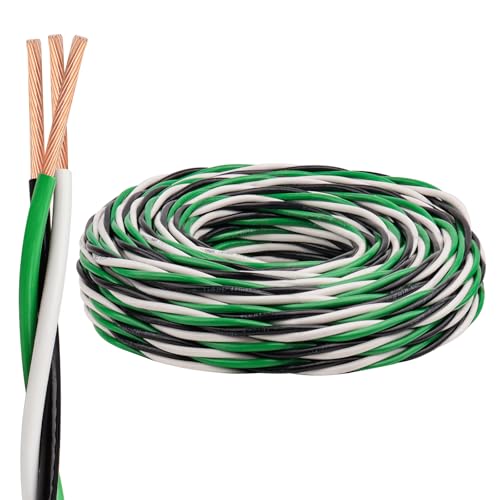
1. 12 AWG THHN Wire 35FT 3-Color Set (Black/White/Green)
Our pick — 4.5+★ from 200+ verified ratings; the strongest balance of quality and price.
Nineteen strands of copper that thread a tight bend instead of fighting it.
Your first pump job usually dies at the third bend in the conduit, where a stiff cable jams and you end up pushing instead of pulling. This 35-foot set of 12 AWG THHN wire sidesteps that by building each conductor from 19 thin copper strands instead of one solid core. Nineteen strands is the number to remember here — and it is a far cry from the single solid strand inside the 12/2 UF-B feeder cable in this list. More strands means more give, and more give means the wire follows the pipe instead of arguing with it.
You get three conductors in one bundle — black, white, and green — already twisted together and individually insulated. The colour coding does real work on installation day: hot, neutral, and ground are obvious at a glance, which cuts down on crossed connections inside a panel or junction box. The nylon outer jacket over PVC insulation resists abrasion, gasoline, oil, sunlight, and common chemicals. It is rated for 600V and cleared for both wet and dry locations, so a damp well house or a humid crawl space is not a problem.
Buyers rate this set on build quality first and ease of pulling second. The pull-through reputation is earned: buyers report it handled a 40-foot run with three bends without complaint, and it plays nicely with Wago connectors when you are terminating. Where it asks for a little patience is length planning. At 35 feet you have to measure your route before you order, because a long panel-to-pump-house run will leave you short and splicing is not something you want on a buried line. If your run is longer, the 50-foot three-conductor THHN below is the direct step up.
What earns its place
- 19 copper strands per conductor give it the flexibility to pull through bends without kinking.
- Three pre-twisted colour-coded conductors simplify routing and cut miswiring risk.
- Nylon jacket over PVC insulation resists abrasion, oil, gasoline, and sunlight.
- Rated 600V and cleared for wet or dry locations, including damp well houses.
Where it asks for care
- 35 feet runs out fast on a long panel-to-well route — measure before ordering.
- Conduit-rated wire, so it is not the right call for a direct-burial trench.
Reach for this if: you are pulling through conduit or wiring a panel and want the easiest-feeding stranded wire in the group.
Look elsewhere if: your cable goes straight into soil — that job belongs to a direct-burial UF cable, not this one.
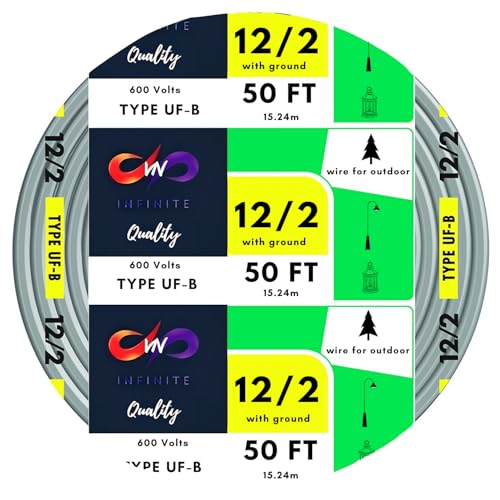
2. 12/2 UF-B Wire Gray Solid Underground Feeder Cable (50 Ft)
The trench-and-cover option — no conduit, no fuss, straight into the ground.
When the pump line leaves the house and dives into soil, the rules change. This is a UF-B cable (Underground Feeder, Branch circuit — a cable built to be buried directly without a protective pipe), and that rating is the whole reason to buy it. You trench, you lay the cable, you backfill. There is no conduit to cut, glue, or thread, which is the difference between a weekend job and a two-weekend job. In this group it is a compact option at 50 feet, which suits a short run from a well head to a pressure tank or an outdoor pump house.
The conductor here is 12 AWG solid copper rather than stranded, and that is a deliberate trade. Solid copper is stiff, but it holds its shape in a straight trench and delivers steady conductivity. The PVC jacket resists sunlight, moisture, and corrosion, so the cable survives the wet, gritty environment it is buried in. It also carries a flame-retardant rating and is UL listed, which matters when an inspector looks at the run. Rated for 600V and 90°C in both dry and wet conditions, it is cleared for precisely the damp, corrosive spots a pump installation tends to sit in.
Here is the honest catch, and it is a physical one rather than a defect. Solid copper does not like tight bends. If your route needs to curve sharply around a foundation or into a cramped pit, you will feel the stiffness, and forcing a bend risks stressing the conductor. The quality reputation on this cable is solid, and its price-to-length value holds up for shorter runs. But compare the 50 feet here against the 500-foot Kalas reel further down and the difference in scope is obvious — this is a short-run cable, not a feeder for a deep well.
Fit check: a 50-foot solid-copper burial cable with a UL listing and a 600V, 90°C wet/dry rating — sized for a well head close to the house, not a distant pump.
Temper the plan: solid conductors resist tight radius bends, so map a gentle path before you backfill.
Go with it when: the run is short, underground, and you want to skip conduit entirely.
Step up if: you need a long feeder or a route full of curves — the stranded UF cable below covers both better.
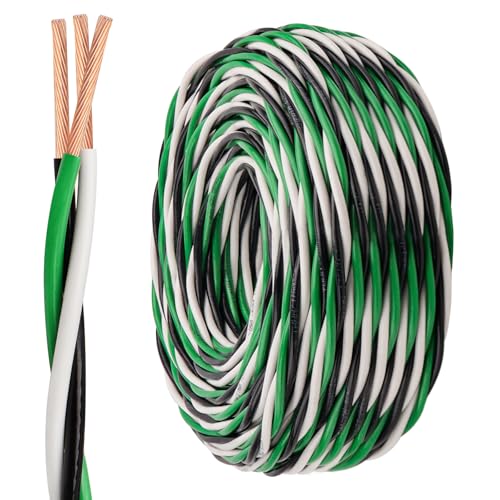
3. THHN Wire 12 Gauge 3 Conductor (Black/White/Green) 50FT
The oxygen-free copper reel for runs that outgrow a 35-foot bundle.
If the Best Overall set is too short for your route, this is the natural next stop. The jump is meaningful: 50 feet here versus 35 feet on the XRDS set, so you get a longer single pull without adding a splice. The conductor is oxygen-free copper (OFC — copper refined to remove oxygen, which keeps resistance low and fights corrosion), and it is stranded rather than solid, so it still bends through tight spaces and complex layouts.
The working temperature range is the spec that sets this one apart. It is rated from -14°F to +194°F (-10°C to +90°C), so a cold well house in January and a hot pump motor in July both sit inside its window. It carries a UL 83 listing and RoHS compliance, is flame-retardant, and is rated to 600V. The nylon (PA6) jacket and PVC insulation shrug off moisture, oil, gasoline, and chemicals. Three colour-coded conductors keep hot, neutral, and ground straight during termination, which is exactly where most DIY wiring errors happen.
Where this one asks you to think is in strand count versus the other THHN wire here. Its specification lists 3 strands, against the 19 strands of the Best Overall set, so it is the stiffer of the two three-conductor THHN options even though both are officially stranded. On a mostly straight conduit run that difference will not bother you. On a route with several tight 90s, the higher-strand cable feeds more smoothly. Buy this one for the extra length and the wider temperature window, not for maximum flexibility.
Where it wins: 50 feet of OFC stranded copper rated across a -14°F to +194°F window, UL 83 listed and 600V rated — a longer single pull with a broad temperature margin.
The trade-off: fewer strands than the higher-strand THHN means it pulls a tight, bend-heavy route less easily.
Pick this when: your conduit run needs more than 35 feet of three-conductor wire and you want an OFC conductor with a wide temperature rating.
Stay with the top pick if: your route is bend-heavy and pull effort is your biggest worry.
4. 12/2 UF Wire 100ft

Direct burial without the stiffness — stranded copper that still bends.
Most buried feeder cable is solid copper, which means the trade for going underground is a stiff, stubborn reel. This FIRMERST cable refuses that trade. It carries the same direct-burial rating, so it can go into a trench without conduit, but the copper inside is stranded — 10 strands per conductor — so it flexes instead of fighting you. Set it beside the 12/2 UF-B solid cable above and the gap is easy to feel: 10 strands against 1 solid core. On a curved trench line around a foundation that difference shows up immediately.
The length is the other half of the argument. 100 feet here versus 50 feet on the solid UF-B cable is a longer reach, and that covers a well head set further out in the yard or a run that has to loop around a deck. The cable is ETL listed (tested to a published electrical safety standard by an independent lab), uses two conductors plus a ground wire, and is rated for 600 volts. The PVC jacket resists corrosion and UV exposure, so sun on the exposed section and wet soil on the buried section are both handled. Landscape lighting, outdoor outlets, and pump wiring are all listed applications.
At 100 feet of 10-strand stranded copper, the length-to-price ratio is what tips this toward a buried well line that needs slack. What you give up is the third colour-coded conductor you get on the THHN sets — this is a 2-wire-plus-ground cable, so terminations follow the UF colour scheme rather than the three-colour one. That is normal for feeder cable, not a shortfall, but first-timers should read the jacket markings before they cut.
Why it earns a slot
- Stranded copper inside a direct-burial jacket — buried without conduit, but still flexible.
- 100 feet of reach covers well heads set well away from the house.
- ETL listed and rated for 600 volts, with a PVC jacket that resists UV and corrosion.
- 10-strand construction beats the solid-core feeder cable on bendability.
Before you order
- Two conductors plus ground, so it uses the UF colour scheme rather than the three-colour THHN layout.
- Burial cable is the wrong choice for a conduit pull, where jacket slickness matters more.
The right tool for: a buried pump line that curves, needs 100 feet of reach, and skips conduit.
Not the fit for: a conduit pull, where a nylon-jacketed THHN wire feeds far smoother.
5. 500 ft 12/2 w/G Submersible Well Pump Wire Cable

Five hundred feet on one reel, because a deep pump has nowhere to splice.
A well pump drop is the one job where running short is not an inconvenience — it is a redo. This Kalas cable answers that with a 500-foot reel, and the scale is the story. Put it next to the 12/2 UF-B 50-foot cable — 500 feet here versus 50 feet there — and that is the difference between a shallow run and a deep-set submersible pump. It is 12 AWG copper rated for 600 volts, with two current-carrying wires plus a ground, and it is made in the USA.
The size also solves a problem the shorter cables create. Every extra splice down a well casing is another point of failure sitting in water, so a single continuous 500-foot pull is the cleaner install. That one-reel reach is why this belongs on a list of well pump wire even though it costs the most of the group — you are buying length and continuity, not a feature list. The 3-strand conductor keeps it manageable on the reel, and at 0.08 inches wire diameter it threads a pump drop without bulk.
Buyers consistently report this 500-foot reel arrives as described, with the copper quality holding up. The catch is planning. A 500-foot reel is heavy and expensive, and if your well is shallow you are paying for cable that will sit as waste on the spool. There is also the part that has nothing to do with the cable: submersible pump wire termination at the motor end is a job for a qualified installer, because a bad splice in a wet well is the failure that costs the most to fix. Buy the reach if you truly need it — otherwise a shorter reel does the job with less money tied up in copper.
Decision-maker: 500 feet of 12 AWG submersible cable rated for 600 volts with two wires plus ground — enough continuous length to drop a submersible pump with no splice in the wet section.
Honest limit: on a shallow well this reel is more copper than the job needs, and the motor-end splice still belongs to a qualified installer.
Buy it for: a deep well pump drop where one continuous 500-foot run beats splicing.
Hold off if: your well is shallow — a shorter cable gets you there without paying for copper you will never unspool.
Know the Specs
Gauge (AWG) and why 12 keeps appearing
AWG stands for American Wire Gauge, and it measures how thick the copper conductor is. A lower number means thicker wire, so 12 AWG is thicker than 14 AWG. Thicker copper carries more current with less voltage loss across a long run, which is why it shows up on nearly every cable here. For pump wiring the gauge has to carry the pump motor’s draw over the full length of the run. That is a calculation, not a guess — have a licensed electrician confirm the gauge for your pump and your distance.
Stranded versus solid conductors
A stranded conductor is many thin copper wires twisted into one, while a solid conductor is a single stiff core. Strand count is the number you compare: 19 strands bends more easily than 3, and 1 strand is fully solid. Stranded wire pulls through conduit and around bends with less kinking, which makes it the friendlier pick for a well casing with a few curves. Solid wire stays stiff, holds its shape in a straight trench, and suits direct-burial feeder runs where you are not wrestling it around corners.
Direct burial and wet-location ratings
A direct-burial rating means the cable is built to be laid in soil without a conduit around it — the jacket is the protection. A wet-location rating means the insulation is cleared for environments with standing or condensing moisture, which is exactly what the inside of a well casing is. A 600V rating tells you the maximum voltage the insulation handles. Read all three when you buy: a cable rated for wet locations and direct burial can go underground without extra protection, while a conduit-only wire needs its pipe.
Jackets, insulation, and temperature range
THHN wire typically pairs a PVC insulation layer with a nylon outer jacket, and that outer jacket is what resists abrasion, oil, gasoline, and sunlight. UF feeder cable leans on a PVC jacket rated to handle moisture, corrosion, and UV. Temperature ratings matter near a pump motor that runs warm: a -14°F to +194°F window, for instance, covers both a cold well house and a hot motor housing. Match the temperature and jacket rating to where the cable actually lives, and you avoid a jacket that ages too fast.
Common Questions
Can I use THHN wire for a submersible well pump drop?
Is solid or stranded wire better for a well pump?
Do I need conduit if the cable is direct burial rated?
What does 600V rating mean on well pump wire?
How many wires does a well pump cable need?
Can I splice well pump wire underground?
What is the difference between UF-B and THHN wire?
Is 12 gauge wire thick enough for a well pump?
Does well pump wire need to be rated for wet locations?
How do I know how much cable length to buy?
The Bottom Line
For most residential well pump wiring, the well pump wire winner is the 12 AWG THHN Wire 35FT 3-Color Set — the 19-strand copper and the pre-twisted three-colour layout make it the easiest cable in this group to pull and terminate. If your pump line is going underground without conduit, reach for the 12/2 UF Wire 100ft cable, which pairs a direct-burial jacket with 10-strand stranded copper and a full 100 feet of reach. And for a deep submersible drop where a splice in the wet section is not an option, the 500 ft Kalas submersible cable gives you the continuous run. Splices are the first thing to fail on a pump job, so buy the full continuous length up front.
How we choose
We do not accept paid placement. Every pick is matched to a real buyer and a real use-case; we do not hands-on test units.
Sources
Specifications: manufacturer listings and product documentation. Review insights: verified customer reviews, as of November 2026. Pricing: not shown on this page (it changes often); check the current price via the retailer link.
As an Amazon Associate, Tactical Gear Guy earns from qualifying purchases. This does not affect which products we feature.