Specs are compiled from manufacturer listings and verified buyer reviews and can change over time — please confirm the key details on the product page before buying.
You want a dash cam that actually proves what happened — the plate of the car that clipped you, the face of a passenger, the knock on your bumper while you were parked. The picks below do exactly that, and the specs that matter are resolution, channel count, and whether night footage stays readable instead of turning into gray mush.
This guide is built by comparing the manufacturers’ published specifications and the patterns across verified customer reviews, so you get each pick’s real strengths and trade-offs instead of marketing spin.
Most cars only have one camera pointing forward, which leaves the cabin and the rear uncovered. Below you get nine models ranked so the strongest all-rounder sits first, with honest notes on where each one falls short — the full picture of every webcam for car worth mounting this year.
Top Picks

How To Choose The Best Webcam for Car
The first thing to settle is how many angles you need to cover. A front-only camera proves what happened ahead of you. It does nothing for a rear-end bump, a taxi passenger dispute, or a parking-lot scrape along your door. Count your angles first, then shop.
Decide your channel count before anything else
Two-channel cars cover the road and the cabin or the road and the rear. Three-channel rigs add the cabin on top of front and rear. Four-channel setups watch front, rear, left and right for near-360° coverage. More angles means more footage to store, so pair extra channels with a larger memory card — 512GB support shows up on several picks here.
Resolution: 4K, 2.5K, and what each buys you
Resolution (the pixel count in the video) is what lets you zoom into a plate and still read it. A 4K front camera gives you the most crop room, while 2.5K and 1440P sit just below and stay sharp enough for most claims. Rear and cabin cameras often step down to 1080P, which is normal and usually fine for faces and vehicle shapes.
Night footage separates the good from the average
A large aperture — the lens opening, written as a low F-number like F1.5 — pulls in more light when the street is dim. Infrared (IR) LEDs light up the cabin in total darkness and give you black-and-white interior footage instead of a black frame. WDR (wide dynamic range) keeps headlights and dark shadows from blowing out the same clip.
Storage, heat, and the battery question
Loop recording overwrites the oldest open up clip when the card fills, so the card size caps your history. A G-sensor (a motion sensor that detects a bump) locks the clip on impact so it survives the overwrite. Cars get seriously hot, so a supercapacitor — which stores power without a lithium cell — survives temperature swings a battery struggles with.
Side-by-Side Comparison
Every row uses the same three specs so you can scan trade-offs straight across: how many camera channels you get, the top front resolution, and the largest memory card the unit accepts.
| Model | Best For | Channels | Front Resolution | Max Card | Amazon |
|---|---|---|---|---|---|
| TERUNSOUL 3-Channel★ Best Overall | Full front, rear and cabin cover | 3 | 4K | 512 GB | Amazon |
| E-YEEGER Front and InsideBest for Rideshare | Rideshare cabin recording | 2 | 2.5K | 256 GB | Amazon |
| Avylet 2K MiniMost Discreet | Discreet front-only mount | 1 | 1440P | 128 GB | Amazon |
| Milerong Dual | Budget front plus cabin | 2 | 1080P | 64 GB | Amazon |
| DDPAI Z60 | Dual storage safety net | 2 | 4K | 512 GB | Amazon |
| 70mai A810 Lite | Remote 4G monitoring | 2 | 4K | 512 GB | Amazon |
| 70mai T800E | Three-angle rideshare duty | 3 | 4K | 512 GB | Amazon |
| Icesky S03 | Four-angle 360° coverage | 4 | 4K | 512 GB | Amazon |
| ROVE R2-4K Dual | Night clarity from a proven sensor | 2 | Upscaled 4K | 1 TB | Amazon |
Detailed Reviews
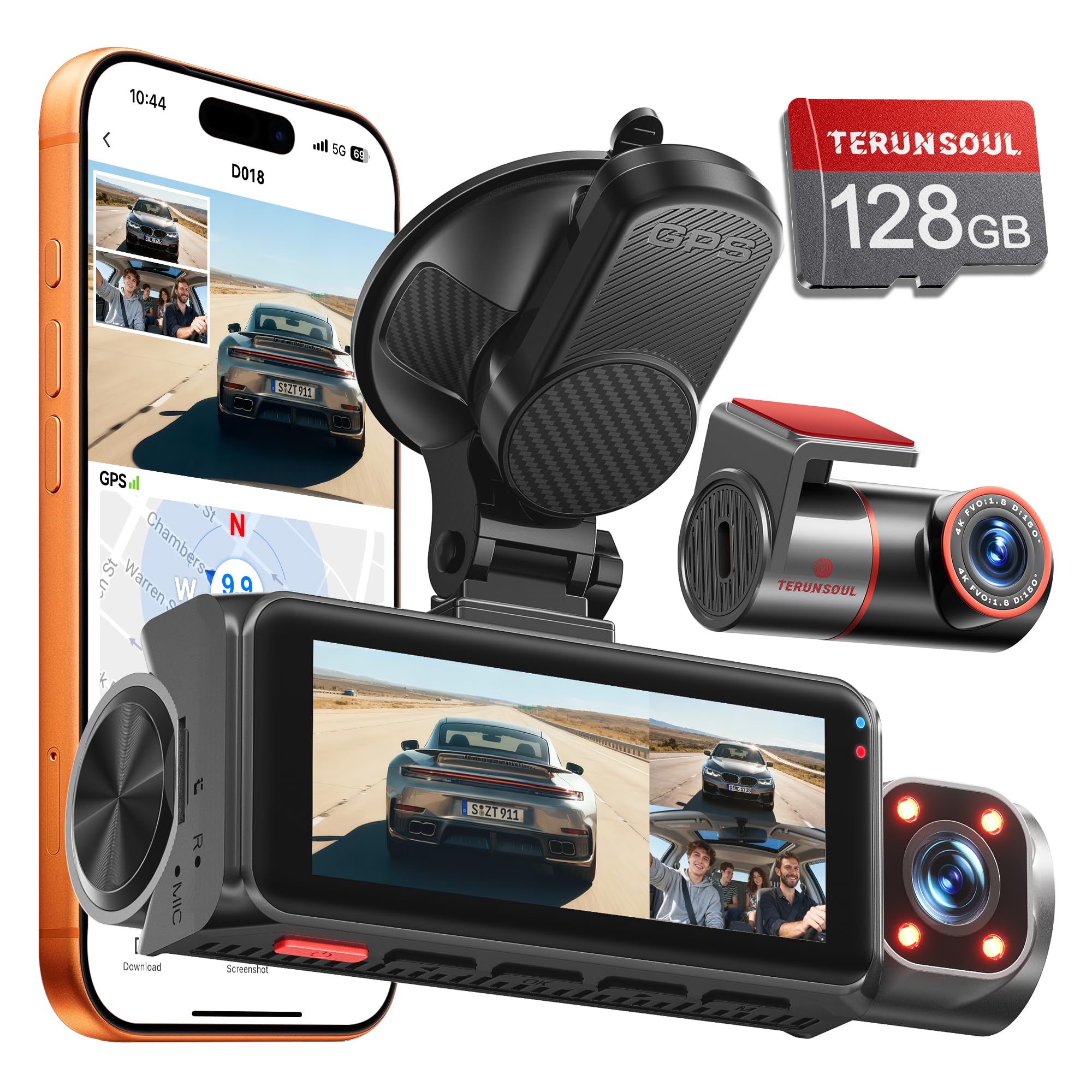
1. TERUNSOUL 4K+4K+1080P 3 Channel Dash Cam
Our pick — 4.5+★ from 400+ verified ratings; the strongest balance of quality and price.
Three cameras, all recording at once, with a free 128GB card in the box — the complete-coverage answer.
Three angles is the whole story here. The front lens records in 4K UHD, the rear lens also captures 4K, and the cabin lens adds 1080P on top. That means a plate ahead, a plate behind, and the face in your passenger seat all land on the same timeline. The viewing angles are listed at 170° front, 150° rear and 150° cabin, and those wide sweeps are what keep a blind spot from hiding a vehicle.
Night driving gets real hardware rather than a software filter. The AProX HD night vision works alongside WDR, and the cabin camera carries 4 IR lights that record the interior even in complete darkness — the exact scenario a rideshare shift runs into at 1 a.m. The 3.18″ full-laminated screen cuts reflections back at you, and a screen saver keeps the glow out of your eyes on a long drive. Wireless runs on WiFi 6 dual-band at 5.8GHz and 2.4GHz, with transfers stated up to 20MB/s, so pulling a clip to your phone through the TERUNSOUL app is quick.
Buyers consistently report that all three cameras deliver crisp, clear footage, and the included 128GB card removes a day-one purchase. The card ceiling is where this separates from cheaper duals: it takes up to 512GB, while the Avylet 2K Mini caps out at 128GB. Loop recording and a G-sensor emergency lock keep the important clip safe when the card cycles, and the built-in GPS stamps speed and location onto the footage itself.
Parking surveillance uses time-lapse recording to stretch storage while you are away, and collision detection locks the clip on impact. One thing to plan for: that parking mode needs a hardwire kit, which is not in the box. The same goes for the 24H monitoring only working once it is wired to constant power.
What earns this the top spot
- Front, rear and cabin all record together — 4K, 4K and 1080P
- Free 128GB card included, and support up to 512GB
- 4 IR lights keep the cabin visible in total darkness
- WiFi 6 dual-band transfer with in-app OTA firmware updates
What to plan around
- Parking mode needs a hardwire kit, sold separately
- Three channels fill a card faster than a single-lens setup
Reach for this if: you want the road, the rear and the cabin on one recording without buying extra storage on day one.
Factor in first: budget the hardwire kit if you want that time-lapse parking watch to run while the car sits.
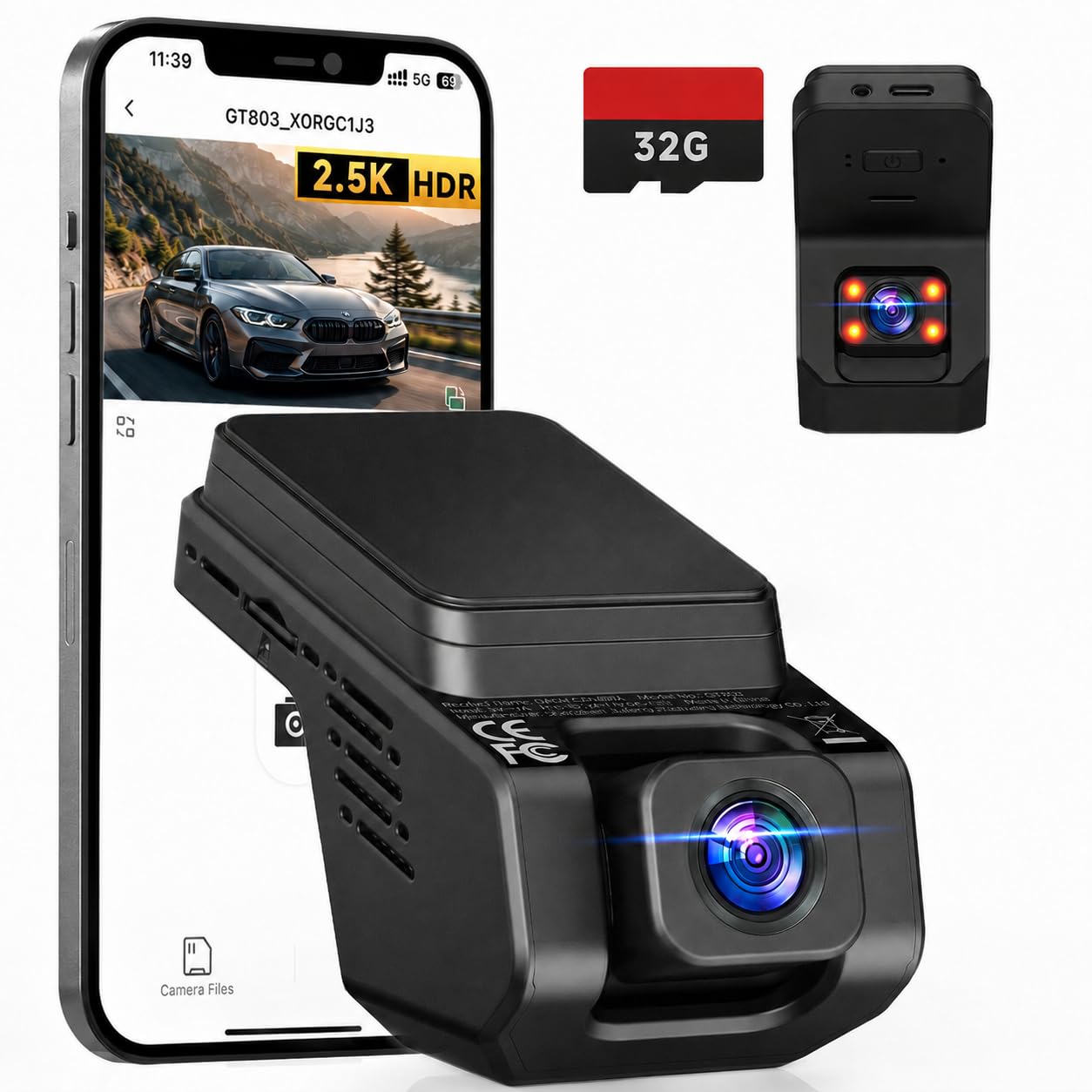
2. E-YEEGER Dash Cam Front and Inside
A 2.5K front lens and a night-vision cabin lens that disappears behind your mirror.
A 2.5K front camera paired with a 1080P cabin camera covers the two views most drivers actually need. The front sweeps 170° to catch more lanes, and the interior takes in 150° of passenger area — the angle a carpool argument or a late-night rideshare fare can happen inside. It is the same road-plus-cabin idea as the top pick, just with the rear lens traded away for a much smaller footprint.
Dark cabins are handled by 4 IR LEDs that keep recording in black and white once the inside of the car goes black. You can set IR off, on, or auto depending on your shift, and WDR balances the bright and dark zones of a parking garage or a dim street. There is no screen at all — the unit mounts near the rearview mirror with an electrostatic sticker and 3M adhesive, so nothing glows in your line of sight.
Getting a clip off the camera happens over built-in 2.4GHz WiFi through the VeeCar app, which gives you live preview, playback and downloads without pulling the card. The 32GB card comes pre-installed and the unit accepts cards up to 256GB. Reviewers praise the build and picture quality most, with ease of installation right behind it. The compact body draws steady praise too, with enough room to tuck it behind the mirror without blocking the view. Setup is genuinely a one-person job: buyers report getting it running in about 20 minutes.
The honest limit is scope. There is no rear camera, so a bump from behind is not on your footage. The adjustable G-sensor locks collision clips and loop recording runs in 1, 2 or 3-minute chunks, while impact-triggered parking monitoring and time-lapse need a compatible hardwire kit that is sold separately.
Where it shines: the screenless mirror-mount plus IR cabin vision is the pairing that makes this a natural fit for taxi and rideshare drivers who want the interior on record without a glowing display.
The trade-off: two channels only, so pair it with a separate rear camera if you want the bumper covered.
Pick it when: the cabin matters more than the rear bumper and you want the windshield kept clean.
Choose another if: you need rear footage — this one stops at the front and the inside.
3. Avylet Dash Cam 2K Mini
A tiny front-only camera for drivers who want proof without a screen crowding the glass.
Front-only is the design choice here, and the payoff is size. The body measures 1.96×1.37×1.81 inches — small enough to tuck behind a rearview mirror and forget about. The single lens records 1440P (2560×1440 at 30fps), versus 1296P on older dash cams. A 170° wide angle keeps more lanes in frame, which helps when the car that cut you in came from the side.
Low light is where the lens hardware does the work. A large F1.6 aperture pulls in more light and cuts motion blur, and 6 glass lens elements add scratch resistance and heat tolerance. WDR auto-adjusts exposure so a dark tunnel and a bright exit do not blow out the same clip. Instead of a lithium battery, this uses supercapacitors, rated for -4°F to 158°F, which is the sensible build for a car that freezes overnight and bakes in a summer lot.
The 1.5″ IPS screen lets you check recording status and play back footage on the spot, with physical buttons rather than a touch layer. Video comes to your phone over WiFi through the Avylet app. GPS is optional through an external module that is not included, but when fitted it stamps speed, location, time stamps and route onto the video, viewable in the app or a desktop player. Reviewers praise footage quality most, with ease of setup close behind.
Budget accordingly: no memory card is included, and the unit takes cards up to 128GB — a tighter ceiling than the 512GB the top three-channel pick accepts. Reliability draws mixed notes in the feedback, so treat the 2-year warranty as your backup and keep the card formatted.
The right fit: a driver after a single clean front view who hates clutter on the windshield.
Worth knowing: you supply the card and the GPS module yourself, and the front lens is all you get.
4. Milerong Dual Dash Cam Front and Inside

A simple front-and-cabin dual recorder with no app, no WiFi, and a card already inside.
Two 1080P cameras record at 30fps here — one aimed 170° down the road and one taking in 140° of cabin. A 2-inch IPS screen shows both feeds, and a 64GB card ships in the box so you are recording the moment you plug in. There is no wireless, no app, no GPS and no Bluetooth. That sounds like a list of missing features, but for plenty of drivers it is the point: nothing to pair, nothing to update, nothing to lock you out.
Dark cabins get 4 IR lights plus F1.8 aperture and WDR, so passengers stay visible in black and white even with no light inside. One quirk to remember: turning the night-vision function on turns the interior view gray, and off restores normal color. The G-sensor locks clips on a sudden shock, loop recording runs in 1, 2 or 3-minute chunks, and a 24-hour parking monitor wakes the camera to shoot 31 seconds when it senses a knock — though that needs a hardwire kit you buy separately.
Reviewers rank value just behind footage quality, and the front-and-cabin dual setup is what they call out. The practical ceiling is the 64GB card limit, which is modest next to the 512GB several rivals take. Video quality and reliability both carry mixed notes, so judge it as a solid everyday dual that suits rideshare and taxi work rather than a premium evidence rig. Suction-mount installs also draw a few grumbles, so clean the glass properly before you stick it.
The case for it: no app to wrestle with and no card to buy — a plug-in-and-record dual for drivers who want simple.
Fair warning: 64GB is the ceiling, so plan on frequent loop cycles.
Best suited to: a driver who wants both views without touching a smartphone app.
Think twice if: you need GPS stamps or storage beyond 64GB.
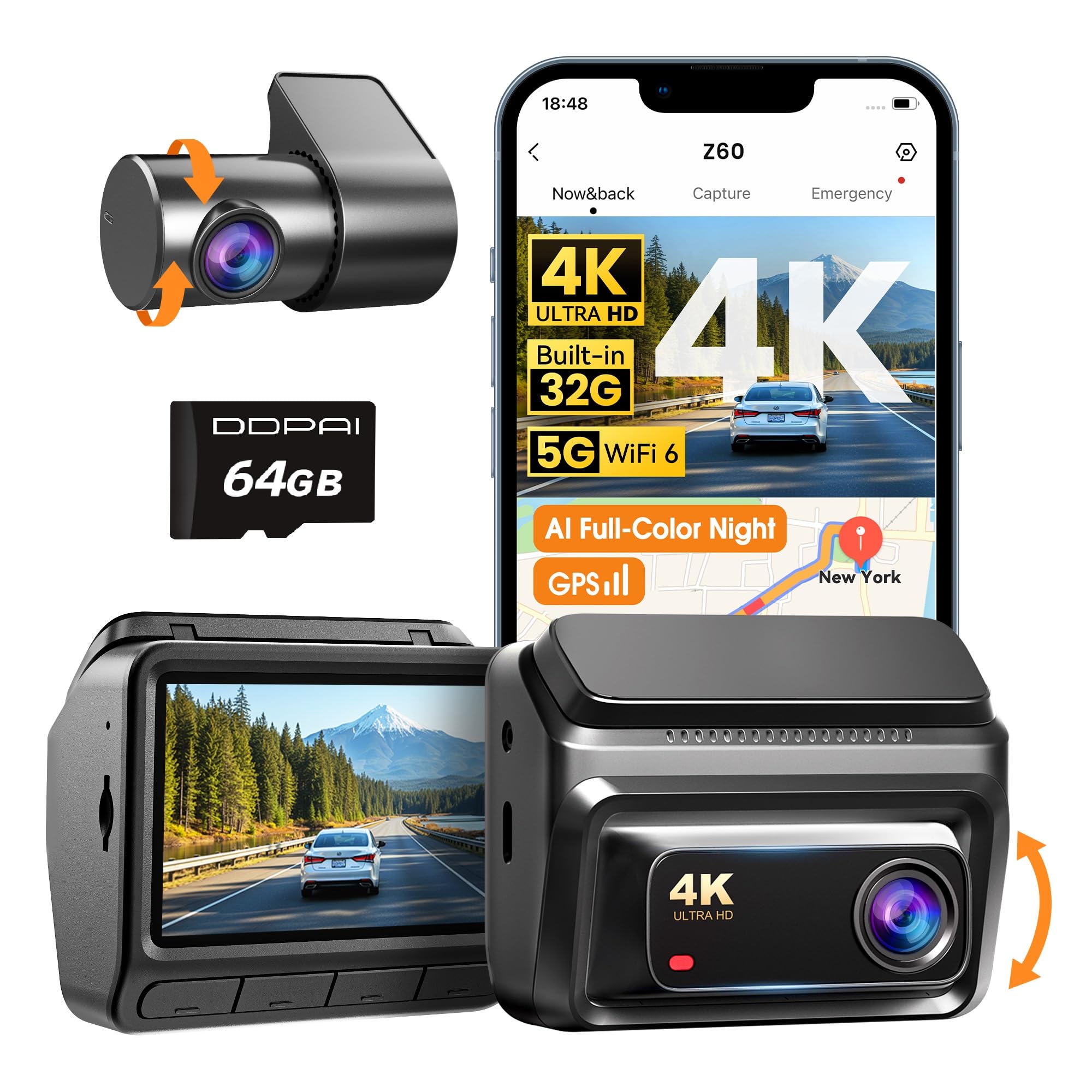
5. DDPAI Z60 4K+1080P Dual Dash Cam
Two places to save the footage — a memory card and internal storage that takes over if the card fails.
This is the pick for anyone who has ever lost a clip to a corrupted card. DDPAI’s D²Save 2.0 moves recordings onto built-in 32GB eMMC storage the moment the microSD becomes damaged or unreadable. Alongside that internal memory, a free 64GB card is included, so you start with two layers of protection instead of one. The front lens records 4K and the rear handles 1080P, giving you plates and road signs from both ends of the car.
Night footage runs through AI ISP and Realcube imaging with a large F1.8 aperture and a 6-layer optical lens system, aimed at cutting glare, motion blur and noise. Traffic-light glare and tunnel darkness are the exact conditions that expose a weak sensor. Wireless transfers go through WiFi Turbo at stated speeds up to 18MB/s on 5GHz, and built-in GPS logs route, speed and driving history. ADAS voice alerts flag front-vehicle movement and fatigue driving.
Reviewers praise footage quality most, with installation right behind it — the 18.0 ft rear camera cable gives you real reach to the back window. Power comes from an automotive-grade supercapacitor, which holds up in temperature swings and keeps recordings intact through a sudden power cut. Parking mode uses Always-On Video technology with up to 7 days of surveillance on low power, waking on impact.
Two things to weigh. That 7-day parking watch needs a hardwire kit, which is not in the box. And while connectivity works well for plenty, app downloads over WiFi are slower for some, so a card reader is a handy backup on a big file. The 140° front field of view versus the 170° lenses on the two-channel picks above.
Why the dual storage matters
- 32GB internal eMMC backs up the card automatically
- Free 64GB microSD plus support up to 512GB
- 4K front, 1080P rear, GPS and 5GHz WiFi
- Supercapacitor instead of a lithium battery
Set expectations on
- Parking mode requires a separate hardwire kit
- 140° front view versus 170° rivals
Go for it if: never losing a critical clip matters more to you than the widest possible lens.
Look elsewhere if: you want maximum side coverage from the front camera.
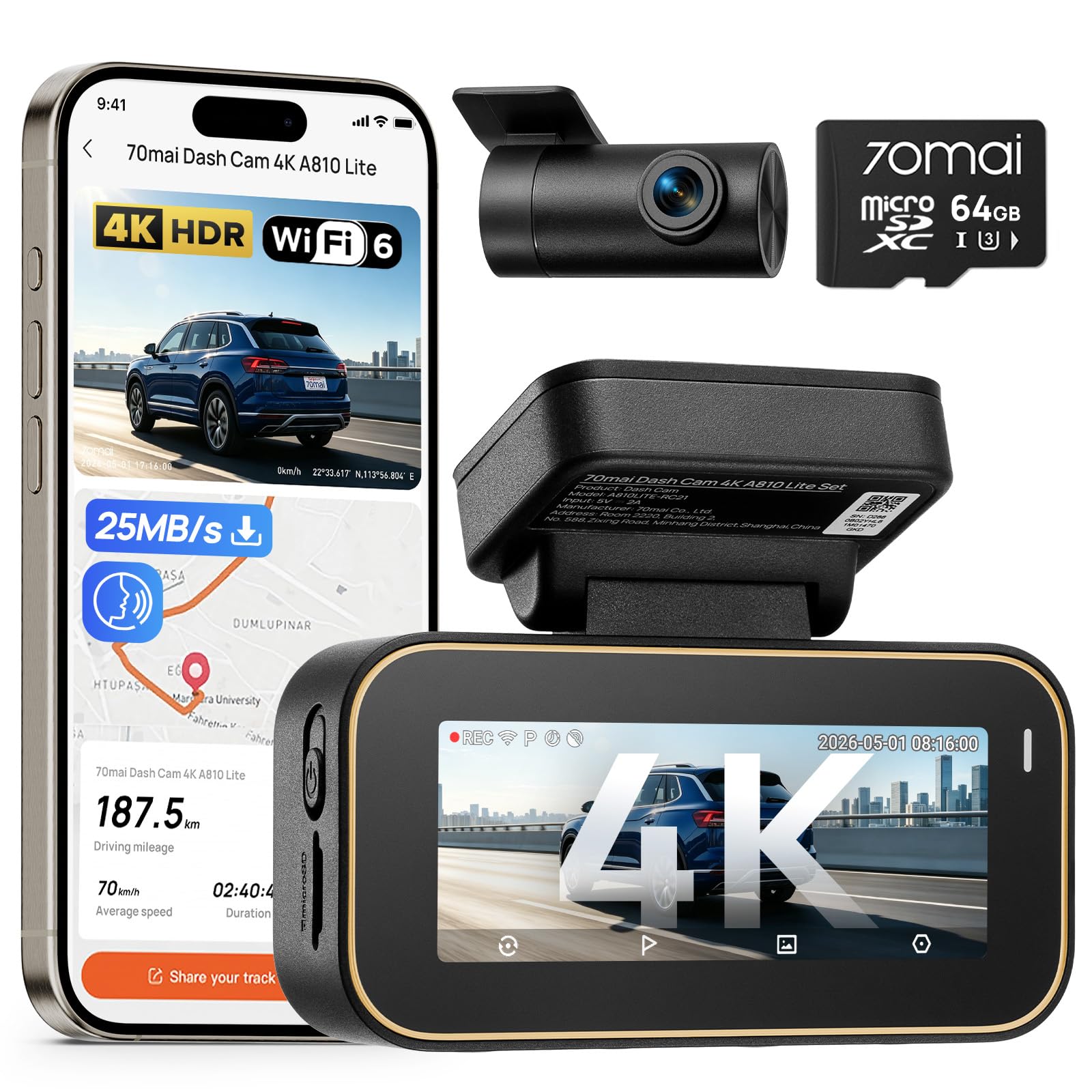
6. 70mai A810 Lite 4K Dash Cam
Check on your parked car from your phone, from anywhere, with a live 4K view.
Remote access is the standout here. With 4G LTE support you can pull live footage, track the vehicle’s location, and get real-time alerts through the app while you are at work or the airport. That is a genuinely different capability from the WiFi-only picks elsewhere on this list. The front camera records 3840×2160P and the rear adds 1080P, with wide lenses to cut blind spots.
Low-light recording pairs HDR with a large F1.55 aperture, which reduces headlight glare and lifts detail in dark areas for tunnels, rain and night. Transfers run on 5GHz WiFi 6 at stated speeds up to 25MB/s, faster than older WiFi duals, and the app handles playback, settings, GPS data and OTA firmware. The camera itself is compact — under an inch deep at 0.96″ and about 4 ounces — so it hides behind the mirror without eating your view.
Quality carries the most weight in the feedback by a clear margin, with functionality next, and the front 4K footage is what people point to first. Cable length splits opinion: the main camera cable is too short for some installs, while others find the supplied runs sufficient. Three-mode GPS (GPS, GLONASS and BDS) logs speed and route, voice control keeps your hands free, and a supercapacitor replaces the battery for heat resistance.
Two costs hide in the feature list. The 4G remote function needs the UP05 4G hardwire kit, and the 24H parking modes need a hardwire kit from the UP03, UP05 or UP06 range — neither is included. A 64GB card is in the box and the unit takes cards up to 512GB.
Made for: the owner who wants eyes on a parked car from a phone, not just a recording after the fact.
Before you buy: both the 4G link and parking mode depend on hardwire kits sold separately.
7. 70mai T800E 4K 3-Channel Dash Cam
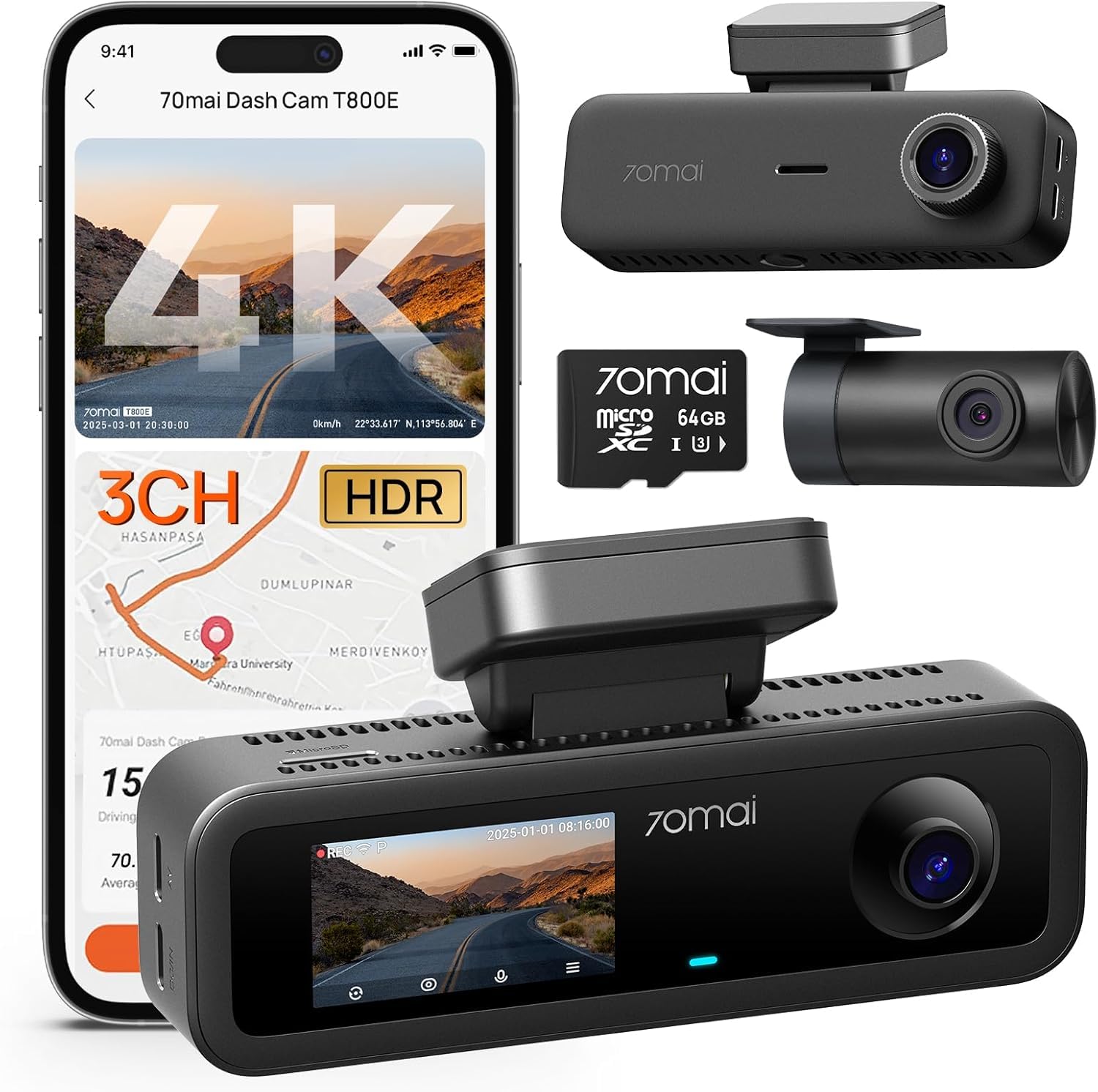
A 4K front, a 1080P cabin and a 1080P rear — three cameras for a rideshare shift.
Three channels is the reason this sits high on the list. The 4K front records the road, a 1080P interior lens takes the cabin, and a 1080P rear camera covers the bumper behind you. Ultra-wide lenses and an F1.55 aperture keep visibility strong day and night. If you drive for Uber or Lyft, that trio is the coverage most disputes actually need.
The interior camera has switchable infrared recording — flip IR on for clear night footage inside the car, or off when you do not need it. HDR imaging and 3D noise reduction fight the low-light grain that ruins a night plate. Storage starts with the included 64GB SD card and tops out at 512GB, and the RC21 rear camera uses a Type-C connection. There is no 4G support on this model, so remote live viewing is not part of the package.
Wireless runs on Wi-Fi 6, with file transfer through the 70mai App reaching speeds up to 10 MB/s. Built-in 5-mode GPS records location, speed and route, and voice control handles photos, recording and locking clips hands-free. The camera is built around a supercapacitor rather than a lithium battery, rated from 14°F to 140°F. Clean, sharp 4K front footage is the takeaway that travels furthest in the feedback, and the low-profile mount keeps your field of vision clear.
Parking surveillance works with the G-sensor to record and lock incidents, and it needs a UP06 or UP03 hardwire kit to run continuously — sold separately. The adhesive mount is a strong hold, but it is a permanent choice rather than a quick-release suction setup.
Standout strength: three simultaneous views with a proper 4K front and a switchable IR cabin lens — the complete rideshare kit.
Know this going in: no 4G on this model, so live remote viewing belongs to the A810 Lite above.
Choose it for: front, cabin and rear coverage in one install that suits rideshare and family cars alike.
Pass it over if: you specifically want remote 4G monitoring from your phone.
8. Icesky S03 4K 4-Channel Dash Cam
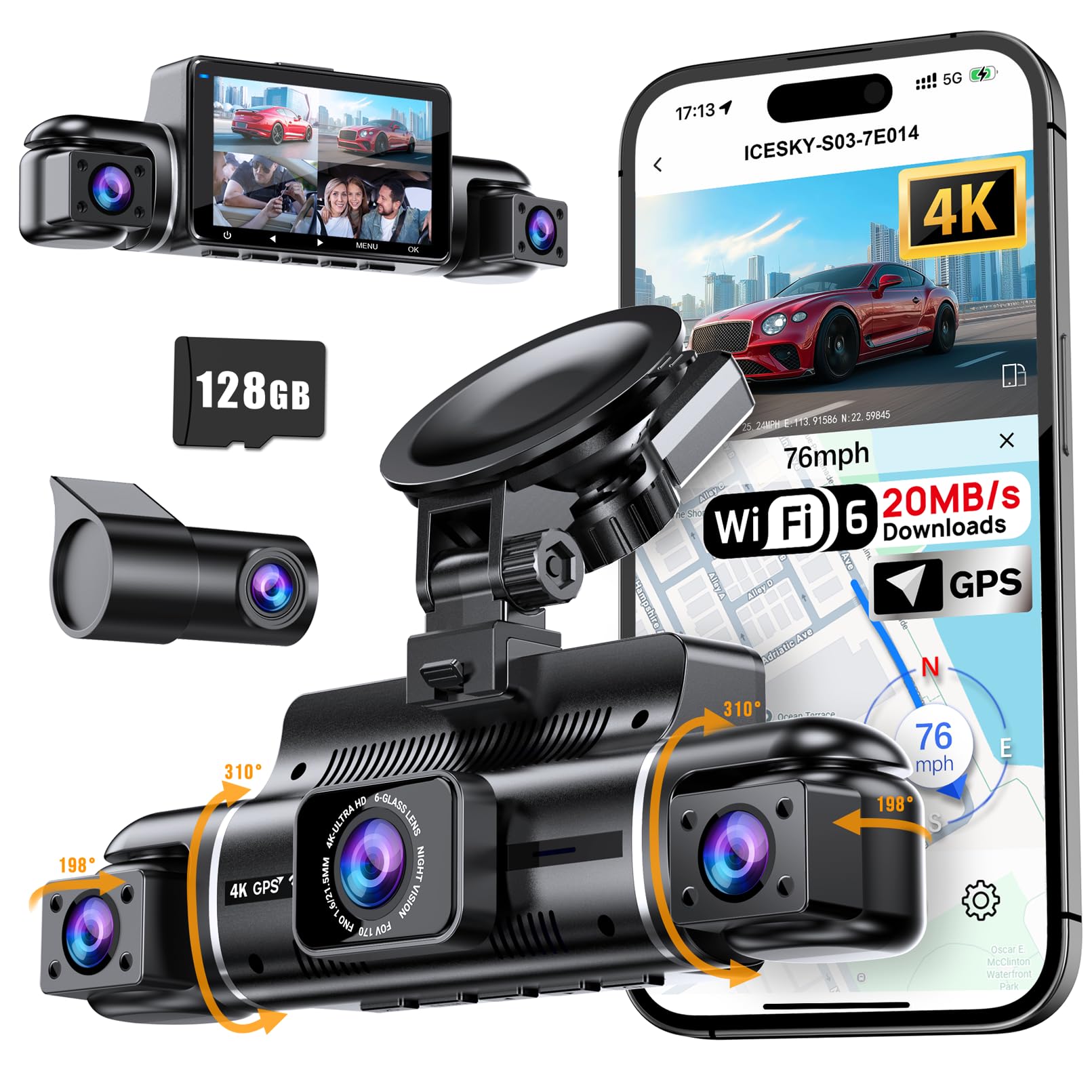
Four camera heads pointing front, rear, left and right — nothing on the car goes unseen.
This is the widest net in the group. A 4K front lens plus 1080P from the rear, inside, left and right cameras run at once, adding up to full 360° coverage. A built-in 3-inch screen can show the front, rear, left and right feeds at the same time, so you can confirm each angle is live before you drive. That layout catches the door scrape and the side-swipe a two-channel rig never sees.
Night side vision is where the extra hardware shows up. Eight IR lights illuminate the left and right cameras, and those infrared modes switch independently, so improving one side does not wash out the others. Built-in GPS logs speed, route, location and time for review in the app or a desktop GPS player. WiFi 6 on 5.8GHz supports downloads stated up to 20MB/s without pulling the card.
A 128GB card is included, and the unit accepts up to 512GB. The verdict across the feedback is that the daytime 4K footage is clear and the all-angle coverage does what it promises, with loop recording and the G-sensor holding up over time. A lithium polymer battery sits inside, a different power design from the supercapacitor units above. Voice alerts and a screen saver help you keep your eyes forward instead of fiddling with buttons.
The 24H parking mode needs a hardwire kit, which is not included. And four channels recording at once means more storage churn, so the included 128GB card is a starting point rather than a long archive.
What you are buying: the only four-channel design here, with independent IR control for each side camera.
Set your expectation: more angles means the card fills faster, and the parking watch needs the hardwire kit.
For you if: a full surround view is the reason you are shopping, side scrapes included.
Not needed if: front and cabin alone already cover how you park and drive.
9. ROVE R2-4K Dual Dash Cam with STARVIS 2
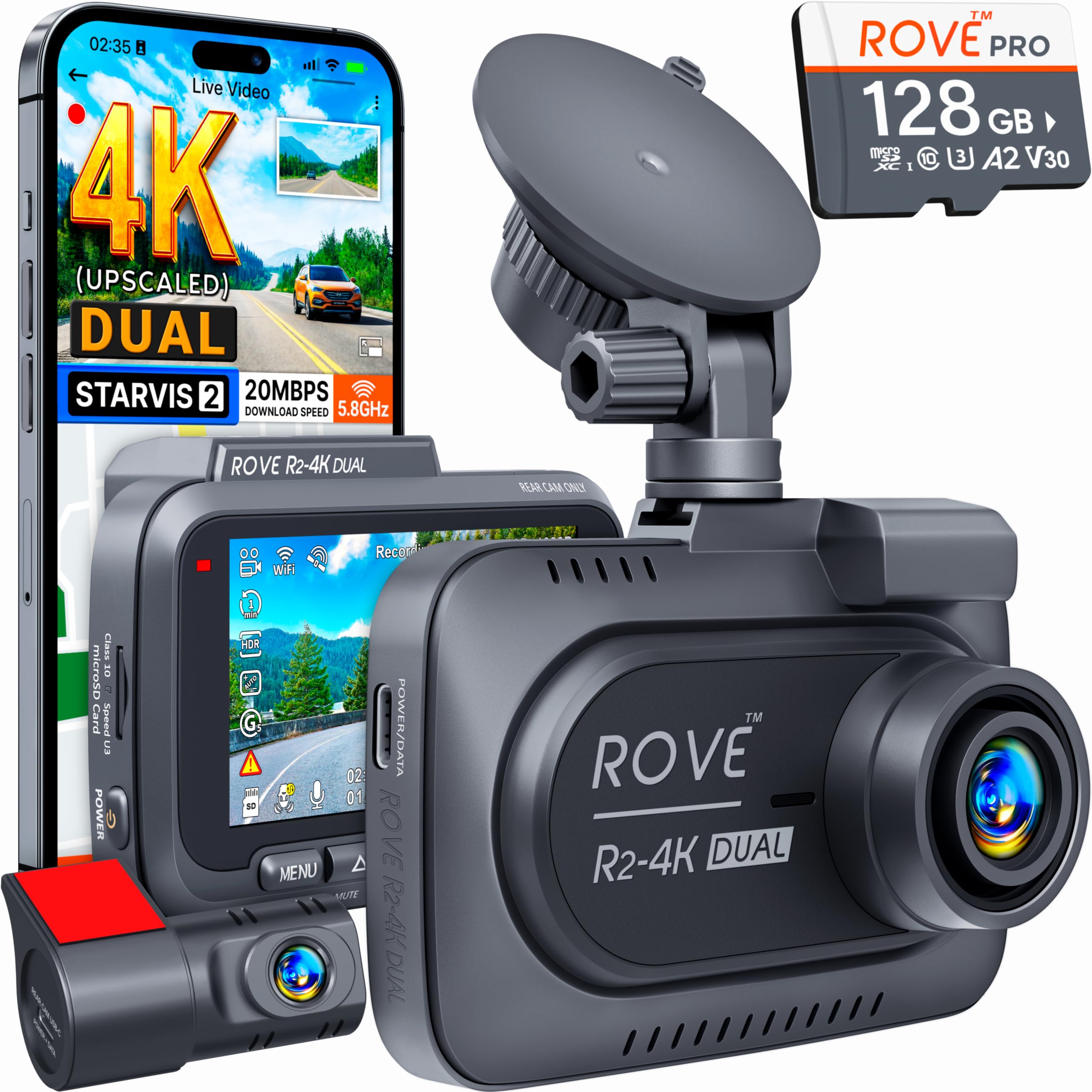
A Sony night sensor, a 3-inch screen, and the largest card ceiling in this lineup.
The centerpiece is a Sony STARVIS 2 IMX675 5MP image sensor behind an F1.5 aperture, with F1.8 on the rear lens and HDR on top. That hardware is aimed straight at the hardest job a dash cam has: reading a plate after dark, through a tunnel, or at dusk. The front records at 2.5K and intelligently upscales to 4K (2160P) for playback, while the rear records at 1080P. ROVE is explicit that this is upscaled 4K, not native 4K.
Storage is the widest here by a distance. The unit accepts microSDXC cards up to 1 TB, and a ROVE PRO 128GB card ships in the box. Sit that next to the Milerong dual, capped at 64GB, and the difference in how far back your footage reaches is stark. GPS appears on the 3-inch IPS screen as live speed and compass, and stamps routes, locations and speed onto the video for a desktop player.
Transfers run on dual-band 5.8GHz and 2.4GHz WiFi, with downloads through the ROVE app stated up to 20 MB/sec. The parking mode is a three-part setup — 1 fps time-lapse, motion detection and collision detection — and on an event the camera records a full 1-minute clip into an event folder, then gives a voice alert on your next start. Built-in thermal protection guards the unit in high heat.
Two catches. Parking mode needs a hardwire kit that is not in the box, and the 150° front field of view versus the 170° lenses on several picks above. Mount it with the included suction or 3M sticky option and keep it running on the supplied power cable.
The evidence case
- Sony STARVIS 2 IMX675 sensor with F1.5 front aperture
- Accepts cards up to 1 TB; 128GB card included
- Dual-band WiFi with up to 20 MB/sec downloads
- Three-part parking mode with voice event alerts
Where it asks for more
- 4K is upscaled from 2.5K, not native 4K
- 150° front view versus 170° rivals
Worth it for: night driving where reading the plate is the whole point, plus long recording history on a 1TB card.
Weigh this: if you want the widest side sweep or true native 4K, other picks on this list deliver those instead.
Know the Specs
Channels: how many eyes on the car
A channel is one camera feed. One channel covers the road ahead. Two channels usually mean front plus either the cabin or the rear. Three channels add a third angle, and four channels can cover front, rear, left and right for a surround view. More channels catch more evidence but fill the memory card faster.
Aperture and IR lights
Aperture is the lens opening, written as an F-number. A lower number like F1.5 lets in more light than F1.8, which matters most after dark. IR (infrared) lights are small LEDs that illuminate the cabin when there is no visible light. They record the interior in black and white, which is why a night cabin clip looks gray instead of color.
Memory card size and loop recording
Loop recording overwrites the oldest open up clip once the card fills, so card size sets how far back your archive goes. Several picks here accept cards up to 512GB, while the Milerong dual tops out at 64GB and the ROVE R2-4K Dual takes cards up to 1 TB. A bigger card means fewer overwrites and more history.
Supercapacitor versus battery
A supercapacitor stores power without a lithium cell, so it handles temperature swings better and avoids the swelling a battery can develop. Several picks here use one, while the Icesky S03 lists a lithium polymer battery instead. In a car that freezes overnight and bakes in summer, that difference matters over time.
Common Questions
Will a dash cam fit behind my rearview mirror without blocking my view?
Do I need a hardwire kit for parking mode to work?
How many angles do I need for rideshare driving?
What kind of memory card do these dash cams take?
Is upscaled 4K worse than native 4K on a dash cam?
Will a supercapacitor dash cam survive a hot summer dashboard?
Can I check footage on my phone without removing the card?
Does the cabin camera record in color at night?
What happens to old footage when the card fills up?
Can I view live footage of my parked car from far away?
The Bottom Line
For most drivers, the webcam for car winner is the TERUNSOUL 3-Channel because front, rear and cabin record together in 4K, 4K and 1080P, and the 128GB card is already in the box. If you want remote eyes on a parked car from your phone, grab the 70mai A810 Lite for its 4G LTE live view. And for the widest coverage without a second install, the Icesky S03 adds left and right cameras for a full 360° view. Whichever you mount, match the channel count to the angles you actually need on record, then budget the hardwire kit for parking watch — the cameras that earn their keep are the ones still running when the car is off.
How we choose
We do not accept paid placement. Every pick is matched to a real buyer and a real use-case; we do not hands-on test units.
Sources
Specifications: manufacturer listings and product documentation. Review insights: verified customer reviews, as of November 2026. Pricing: not shown on this page (it changes often); check the current price via the retailer link.
As an Amazon Associate, Tactical Gear Guy earns from qualifying purchases. This does not affect which products we feature.