Specs are compiled from manufacturer listings and verified buyer reviews and can change over time — please confirm the key details on the product page before buying.
If your coffee tastes flat, your showers leave a film, or your white laundry slowly goes grey, the culprit is usually your incoming water. A whole house water system filter treats every drop entering the building instead of just one tap, so showers, laundry, the dishwasher and the kitchen sink all benefit. This guide sorts the eight strongest picks by what you actually need: sediment-only protection for well water, chlorine removal for city water, or full reverse osmosis for drinking-grade purity at the sink.
This guide is built by comparing the manufacturers’ published specifications and the patterns across verified customer reviews, so you get each pick’s real strengths and trade-offs instead of marketing spin.
You will see the difference between stages, micron ratings, flow rates and gallon capacities, and which one actually fits your plumbing. The picks below cover the full range of the best water system filter options for homes on city water and private wells alike.
Top Picks

How To Choose The Best Water System Filter
The first decision is not brand or budget — it is where the filter sits. A whole house system filter installs at the main supply line and treats everything that enters the house. An under sink system treats only the cold line feeding one faucet, but it can go much finer on contaminant removal. Pick the wrong one and you either pay for purity you never drink or you keep buying bottled water because your tap still tastes off.
Whole house versus under sink: pick the job first
Go whole house if your problem is visible — rust stains in the toilet tank, sediment grit in the washing machine, or a chlorine smell that hits you in the shower. A two-stage system with a sediment cartridge in front and a carbon block behind it is the standard build here. It protects plumbing and appliances from grit while knocking down chlorine taste and odor across every tap. Go under sink if your water looks fine but you want drinking water that measures close to zero on a TDS meter (a handheld pen that counts dissolved solids in parts per million). That is reverse osmosis territory.
Read the micron number before the brand name
A micron is one thousandth of a millimeter, and the number on a filter tells you the size of the particle it stops. A 5-micron sediment cartridge catches rust, sand and grit. A 0.0001-micron RO membrane (about a hundred-thousandth of a millimeter) is fine enough to strip dissolved salts and heavy metals from the water, which is why RO systems reduce TDS and carbon systems do not. If a listing just says “filters sediment” with no micron figure, you are guessing at what gets through.
Match flow rate to how many taps run at once
Flow rate in gallons per minute (gpm) is the spec that quietly decides whether your morning shower still feels normal. A whole house unit with a low gpm figure can starve two showers and a dishwasher running together. Under sink systems quote a much smaller number because they serve one faucet, so a figure like 0.72 gpm is genuinely fast for filling a bottle or a pot. Check the gpm against your household’s simultaneous demand, not against the biggest number on the page.
Count the gallons and the months between cartridge changes
Capacity in gallons and filter life cycle in months are two views of the same cost question: how often do you buy replacements? A 100,000-gallon rating with a one-year life cycle suits a family that wants one maintenance day a year. A three-month life cycle means four cartridge swaps annually, so check what the replacements cost and whether they are standard sizes or proprietary. Standard 10-inch and 20-inch cartridges are sold widely; proprietary ones lock you into one seller.
Certifications are your shortcut past the marketing
NSF/ANSI 42 covers chlorine, taste and odor reduction. NSF/ANSI 58 covers reverse osmosis systems and the contaminants they remove. NSF/ANSI 372 is a lead-free plumbing certification for the housing and fittings, not a water-treatment claim. WQA certification is a separate third-party stamp. A system that lists these standards has been tested against a defined contaminant list; one that only says “premium filtration” has not shown you anything.
Side-by-Side Comparison
| Model | Best For | Install Type | Max Flow Rate | Capacity | Amazon |
|---|---|---|---|---|---|
| iSpring WGB22B★ Best Overall | Whole house chlorine removal | Whole House | 15 gpm | 100,000 gallons | Amazon |
| GE GXWH40LBest Value | Sediment-only budget install | Whole House | 4 gpm | 40 liters | Amazon |
| PUREPLUS WFM10BB2Gauge Equipped | Gauge-monitored two-stage | Whole-House System | — | 30,000 gallons | Amazon |
| SimPure DB10C-2 | Clear-housing well water | Wall Mount | 15 gpm | 60,000 gallons | Amazon |
| Aquasana AQ-6300M-BN | Fast under-sink drinking water | Under Sink | 0.72 gpm | 800 gallons | Amazon |
| Waterdrop T3-C | Tankless RO on a budget | Under Sink | — | 450 gallons | Amazon |
| Waterdrop G5P500A | Alkaline RO for a busy kitchen | Under Sink | 1.31 liters per minute | 500 gallons | Amazon |
| APEC ROES-PH75X | Remineralized RO with a tank | Under Sink | 0.05 gpm | 75 gallons per day | Amazon |
Detailed Reviews
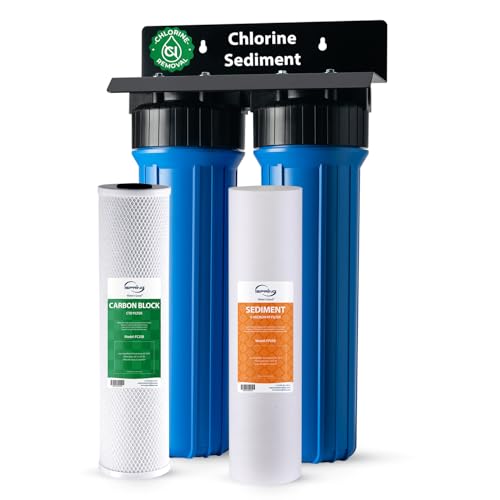
1. iSpring WGB22B 2-Stage Whole House Water Filtration System
Our pick — 4.5+★ from 800+ verified ratings; the strongest balance of quality and price.
A two-stage whole house filter that moves 15 gallons a minute without choking your shower
The WGB22B is the pick for a household that wants the chlorine smell gone from every tap without losing water pressure. Its 15 gpm maximum flow rate is the number that earns it the top spot — that is how much water the unit can pass per minute, so it keeps up with multiple fixtures running at once. Compare that to the GE GXWH40L at 4 gpm and you can see why a busy family feels the difference straight away.
Inside, a first-stage sediment cartridge catches particles down to 5 microns (five thousandths of a millimeter) before a coconut-shell carbon block takes on chlorine, odors and bad taste. iSpring rates the pair of 20″ x 4.5″ cartridges for up to 100,000 gallons — roughly a year for a typical home. Those cartridges are industry-standard sizes, so you are not locked into one seller when replacement time comes. Compare that capacity to the PUREPLUS 2-Stage at 30,000 gallons and the iSpring runs far longer between changes.
What wins people over is build quality, and it shows in the 36-pound assembled weight — this is a substantial bracket-mounted unit, not a light plastic box. The trade-off is honest and worth stating plainly: the plastic housings can leak. Some long-term buyers report seepage developing over years of service, and a few have had a canister split. Mount it where a drip can drain safely, use the supplied wrench and double O-ring seals properly, and check the housings once a season. The 1″ FNPT connections and included mounting bracket make the plumbing side straightforward for a confident DIYer.
Where the WGB22B earns its keep
- 15 gpm flow keeps pressure up when several taps run at once
- 100,000-gallon capacity and a one-year filter life cycle cut maintenance to once a year
- Standard 20″ x 4.5″ cartridges are sold widely and cost less to replace than proprietary ones
- 20″ x 4.5″ sediment plus coconut-shell carbon block covers rust, sediment, odor and chlorine in one pass
- Preserves naturally occurring minerals rather than stripping the water down like an RO system
The honest caveats
- Plastic housings have a history of developing leaks after several years
- At 36 pounds it needs solid mounting and a second pair of hands during install
- Will not reduce TDS — for that you need an RO system instead
Reach for this if: you want chlorine and sediment handled across the whole house with one yearly cartridge change.
Look elsewhere if: you need dissolved-solids reduction at the tap — this cartridge pair is not designed for it.
2. GE Whole House Water Filtration System GXWH40L
The light, cheap entry point that lets you see the grit piling up
If your water problem is visible sediment rather than a chlorine smell, the GXWH40L does the job for the least outlay. It weighs 8.2 pounds against the iSpring’s 36 pounds, so one person can hang it on a basement wall without a struggle. The clear sump is the feature that sells it: you can watch the cartridge turn brown and know exactly when a swap is due, instead of guessing from a calendar.
Understand what you are and are not getting. This is a single-stage housing that takes FXHTC or FXHSC cartridges, neither included, and GE specifies a three-month replacement cycle for best results. Its 4 gpm maximum flow rate is modest — noticeably behind the 15 gpm of the iSpring above — so in a large house with two bathrooms running simultaneously you may feel the drop. Owners of smaller homes find it sized right; anyone with a bigger household should read that flow figure carefully before committing.
The plumbing hardware is genuinely useful: a 1″ connection, pressure relief valve, bypass option, mounting bracket and a remote filter reminder light all come in the box. That bypass valve is the detail that wins people over — you can swap a cartridge without shutting water off to the whole house. Note that GE specifies horizontal pipe connections only, so check your layout before you buy. Expect to replace the unit itself eventually rather than repair it; several long-term users simply swapped in a new one when theirs started weeping after a handful of years.
Cheap to run, but plan the swaps: the filter lasts three months — the most frequent change in this guide — so budget for four cartridges a year rather than one.
Where it fits best: a cabin, a small home, or a first-line sediment trap ahead of a finer system.
Right call for: a small household that wants visible proof of what the filter is catching.
Think twice if: your house runs several fixtures at once — the 4 gpm ceiling is the limiting factor.
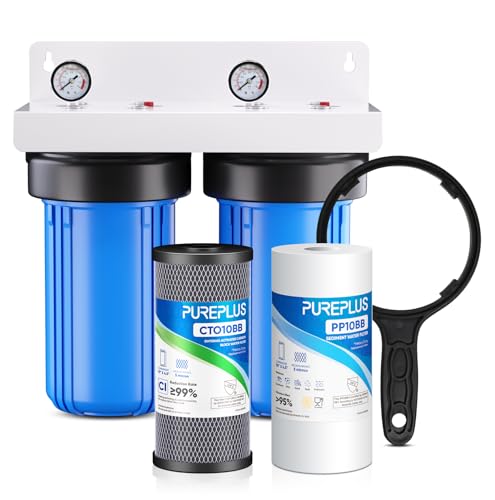
3. PUREPLUS 2-Stage Whole House Water Filter WFM10BB2
Two dials on the housing tell you when the cartridges are spent instead of a calendar telling you
The feature that sets the PUREPLUS apart is the pair of external pressure gauges — one reads the pressure before each stage so you can see the drop as a cartridge loads up. When the gauge falls, you know it is time to change filters, not when a sticker on the housing says so. That is a smarter way to run a whole house filter, and it is unusual at this price tier.
The cartridge pair itself is standard: a polypropylene sediment filter traps rust, sand and debris, and a carbon block filter behind it reduces chlorine, foul taste, odors and discoloration. PUREPLUS states the filters are NSF/ANSI 42 certified, which is the standard covering chlorine, taste and odor. The capacity is rated at 30,000 gallons — honest but the shortest full-system figure in this comparison. Replacement refills are one search code away and use the universal 10″ x 4.5″ size that most housings accept.
Installation is where opinions divide. The mounting plate takes a fair number of screws to attach to the filter head, and some owners find that the fiddliest part of the job while others breeze through it. Plan an afternoon and a helper and it goes smoothly. The gauges even ship with thread tape already fitted, a small touch that saves a trip to the hardware store. As for the water itself, expect clear, smell-free output once you have flushed the new cartridges through.
Gauge-driven maintenance: pressure readings take the guesswork out of replacement timing — a real advantage over blind calendar swaps.
One honest limit: at 30,000 gallons the capacity is the shortest here, so a large family will change cartridges more often than with the iSpring.
Good match for: a hands-on owner who would rather read a gauge than remember a date.
Less ideal if: you want the longest possible stretch between cartridge changes.
4. SimPure Whole House Water Filter System DB10C-2
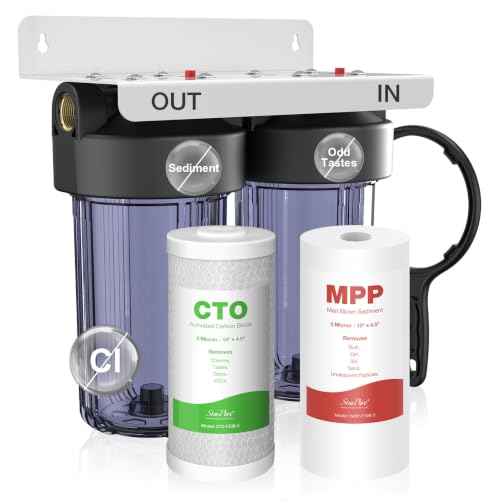
Clear housings and brass fittings built for the muck that comes out of a well
Two clear filter housings tell you at a glance how fast a cartridge is loading, which matters most on well water where sediment and iron arrive fast and heavy. The DB10C-2 pairs them with 2×2 O-ring seals and brass fittings, and owners mention it handling ferric iron well. The spec sheet lists a 15 gpm maximum flow rate, matching the iSpring at the top of this guide, so pressure stays healthy through the unit.
Inside the two housings sit an MPP sediment cartridge for sand, rust and larger particles, plus a CTO carbon block for residual chlorine, discoloration and odors. SimPure rates the system for 60,000 gallons. The carbon filter is listed with a 3-to-6-month lifespan and the sediment filter a 6-to-12-month one, so the two cartridges do not change on the same day. Operating range is 25-90 psi (pounds per square inch, the measure of water pressure at the pipe) and 40-100°F water temperature. Note the capacity figure and the annual 80,000-gallon claim in the listing do not match — treat the 60,000-gallon spec as the conservative number.
Quality is what owners praise most, and the water result backs it up: clear output, no chlorine smell, no pressure drop. The caution worth flagging is durability at the metal inlet — some owners have reported the housing cracking and a gauge flooding the surrounding area. That is the reason to buy a bypass valve and mount the unit where a spill can drain. Reviewers who installed a bypass also like the maintenance win: you can service the cartridges without shutting off the whole house.
Why well owners single out the DB10C-2
- Clear housings let you see cartridge loading without undoing anything
- 15 gpm flow keeps pressure strong across the household
- Brass fittings and double O-ring seals on each housing
- Standard 10″ x 4.5″ cartridges fit widely available replacements
What to watch
- Metal inlet housing has cracked for some owners — add a bypass and a drain-safe mount
- Carbon and sediment cartridges run on different change intervals
- The 60,000-gallon spec and the listing’s 80,000-gallon claim disagree
Built for: a well-water household that needs to see sediment loading and keep flow up.
Weigh the risk if: you cannot mount it somewhere a drip would be harmless.
5. Aquasana Under Sink Water Filter AQ-6300M-BN
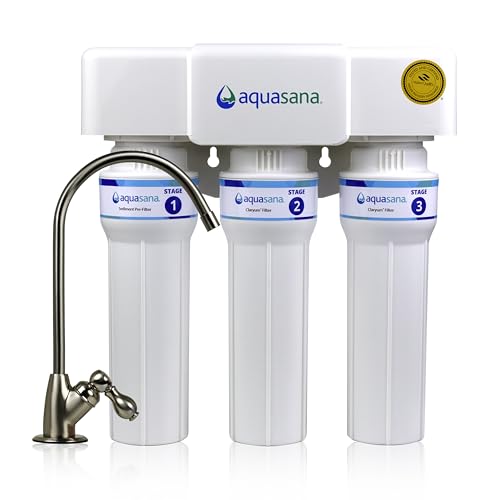
Filters for the kitchen tap only, but fills a bottle faster than any drip system
Most under-sink filters make you wait. The AQ-6300M-BN pushes filtered water at 0.72 gallons per minute, which the maker describes as 7X faster than a leading pitcher filter — enough that filling a bottle or a pasta pot does not turn into a chore. That flow is the reason to pick this over a slower carbon system, and it is why it lands above the tank-fed RO units for everyday kitchen use.
The Claryum three-stage cartridge is WQA certified to NSF 42, 53 and 401, covering a stated list of 78 contaminants including lead, PFAS and microplastics. It retains minerals rather than stripping them out, so the water keeps its taste character. The important limit: this system will not reduce TDS the way an RO membrane does. If your goal is lower dissolved solids, jump to the Waterdrop or APEC systems instead.
Each filter lasts up to 6 months or 800 gallons, whichever comes first, and swaps by twisting off the housing — no wrench parade. The install kit includes the first set of filters, a brushed nickel faucet, and the parts for under-counter fitting, with 15.85 inches of clearance needed beneath the sink. Installation wins people over here far more than any spec line: owners with an existing countertop hole report a quick swap, and one replaced an older Aquasana unit without changing the original faucet. Value is the split opinion — a few find the install components lighter-duty than they would like, while plenty call the filtration strong for the tier.
Speed and certification together: 0.72 gpm plus the NSF 42/53/401 coverage is an uncommon pairing at this level.
Know before you buy: it leaves TDS alone, so it is not a substitute for an RO system if dissolved solids are your concern.
A natural fit for: a renter or homeowner who wants fast, certified drinking water at one sink with minimal plumbing.
Different tool needed if: you are chasing a lower TDS reading.
6. Waterdrop T3-C RO Water Filtration System
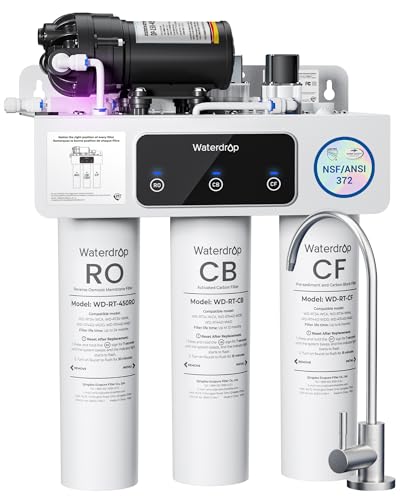
A tankless reverse osmosis unit that tucks under the sink without the storage tank bulk
For people who want RO purity but have no room for a pressure tank, the T3-C is the answer. It runs eight filtration stages through a 0.0001-micron RO membrane that strips heavy metals, chlorine, PFOA and PFOS, rated at a steady 450 gallons per day. That daily figure is far beyond what the tank-based APEC delivers, so a busy household never runs dry waiting for the tank to refill.
Two practical notes before you commit. This system requires an electrical connection to operate its pump and auto-flush cycle, so you need a free outlet under the sink. And the faucet install means drilling a hole in the countertop — this is not a renter-friendly install. The tankless body saves space compared with a tanked RO system, and the all-in-one cartridge swaps in seconds with smart filter alerts telling you when.
Owners consistently report easy install, quiet running and a water taste noticeably cleaner than city tap. The 2:1 pure-to-drain ratio means two cups of clean water per cup sent to drain, which is a reasonable efficiency figure. The honest caveat is that a few owners needed an extra inlet adapter because their plumbing did not match the supplied fittings — grab one before you start and the job goes smoother. Also check your electrical layout first: without a socket close by, the install stalls.
The space win: no tank means the unit slips into a compact cabinet that a tanked RO system would fill.
Plan around this: drilling a countertop hole and needing a power outlet are non-negotiables for this install.
Worth a look if: you want RO performance and a tankless footprint at a modest tier.
skip it if: you cannot drill the countertop or reach an outlet under the sink.
7. Waterdrop G5P500A Reverse Osmosis System
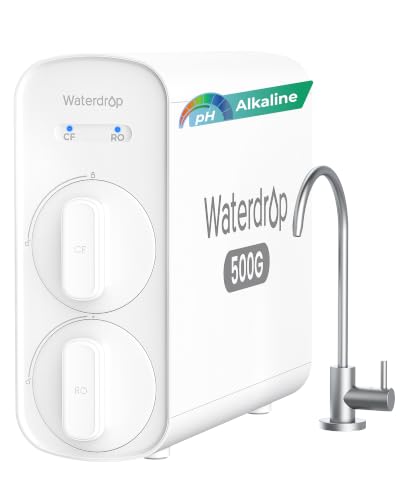
Reverse osmosis that puts minerals back in and fills a cup in eight seconds
Two numbers separate the G5P500A from the RO pack. First, a steady 500 gallons per day, enough to fill a 6-ounce cup in about 8 seconds according to the maker. Second, an alkaline mineralization stage that adds calcium, magnesium, sodium and potassium back after the 0.0001-micron RO membrane has done its stripping work. That second stage is why many buyers pick this over a straight RO system: they want pure water that does not taste flat.
Under the counter, the tankless design claims to free up much of the cabinet space a tanked system would occupy, and it can mount under the sink or on the wall. NSF/ANSI 58 and 372 certifications cover the RO performance and lead-free plumbing. Inside are an 8-stage process that reduces PFOA, PFOS, chlorine, lead, fluoride and heavy metals, running on a 2:1 pure-to-drain ratio. Replacement intervals are staggered across the CF, CB and RO filters, so you are not swapping everything at once.
Owners measure the result in TDS: one tap-water reading dropped from about 230 to about 20 after install. Most report a 30-minute setup with a plumber, quiet running, and a strong taste upgrade over a pitcher filter. Note the mix of opinions on the pump itself — the great majority run fine, but a handful report a failure and some replacement filters that did not seat correctly. Buy from a solid seller and keep the receipt for warranty.
Reasons the G5P500A leads the RO group
- 500 GPD flow fills a cup in about 8 seconds
- Alkaline stage adds calcium, magnesium, sodium and potassium back into the water
- Tankless design frees under-sink space versus a tank system
- NSF/ANSI 58 and 372 certified RO performance and lead-free fittings
- Staggered filter intervals spread the replacement cost
The fair concerns
- A minority of customers note pump failures and replacement filters that do not fit
- Requires drilling the countertop for the faucet
- Like any RO system, it sends some water to drain during operation
Suits the buyer who: wants RO purity with minerals restored and the fastest flow in the RO class.
Budget for: a countertop hole and enough clearance under the sink for a wall or floor mount.
8. APEC Water ROES-PH75X 6-Stage Under Sink RO System
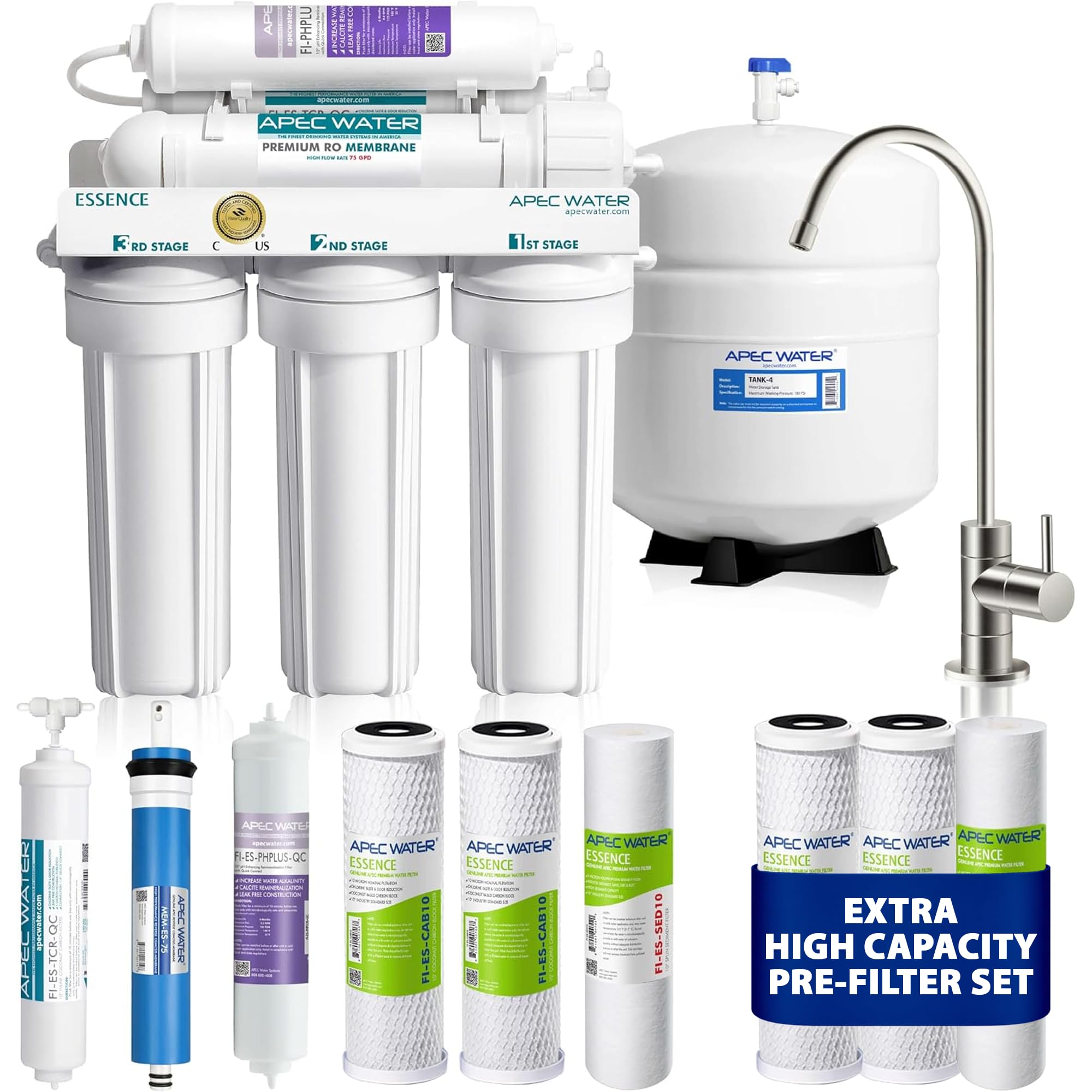
A tanked RO system that raises the pH and keeps a reservoir ready at the tap
The ROES-PH75X takes a different approach to the Waterdrop units above: it keeps a storage tank, so filtered water sits ready the moment you open the faucet. Flow at the tap is quoted at just 0.05 gpm, which sounds slow but reflects the pressure-fed tank rather than a slow membrane — the tank does the fast delivery. Its 75 GPD membrane throughput is modest, but the tank buffers that so you rarely notice.
You get cleaner-tasting water through six stages of filtration, run through an NSF-certified 372 and 58 system (NSF is an independent safety-certification body). The stated removal list covers chlorine, taste, odor, VOCs, fluoride, arsenic, lead and heavy metals. It handles a max TDS feed of 2000 ppm (TDS means total dissolved solids — the mineral and salt content in your water) and 40-85 psi feed pressure (psi is pounds per square inch, the standard measure of water pressure). The sixth-stage cartridge uses premium-grade calcium to raise pH and add minerals back after the membrane strips the water, so your glass tastes less flat. It ships with an extra high-capacity pre-filter set, plus tank, faucet, tubing, drain saddle, feed adapter and wrenches — a complete kit in the box, so you are not hunting for parts on install day.
Owners single out build quality above all. The water comes out clear and tastes full-bodied after the calcium stage; a TDS drop from 275 to about 50 and a pH from 7.5 to about 9.7 shows the mineralization working. The caution is leaks: some reviewers point out slow seeps at a fixture, and a few have had a line connection fail. Take your time with the fittings and check them a week after install, and the reliability holds. One owner found the promised extra filter set was short of the full bundle, so open the box and count before you start.
The pH angle: a dedicated calcium stage lifts alkalinity, which is why this appeals to buyers who dislike flat-tasting RO water.
The one watch-out: tighten and re-check every fitting after the first week — leaks are the recurring issue with any tanked RO setup.
Best for: a homeowner who wants instant tank-fed RO water with minerals added back.
Not the pick for: anyone who cannot spare cabinet room for a tank.
Know the Specs
Micron rating and filtration stages
A micron (one thousandth of a millimeter) sets the smallest particle a filter can stop. A 5-micron sediment cartridge catches visible grit; a 0.0001-micron RO membrane strips dissolved salts and heavy metals. Two stages (sediment plus carbon) is the standard whole house build for chlorine and sediment; six to eight stages adds RO and often a mineral stage for drinking water.
Maximum flow rate in gpm and GPD
Flow rate tells you how much water the system moves per minute (gpm) or per day (GPD). Whole house units need a high gpm figure to feed several taps at once — the iSpring runs 15 gpm while the GE runs 4 gpm. Under sink systems quote much lower gpm because they serve one faucet; RO systems quote GPD for the membrane’s daily output, often buffered by a tank.
Capacity in gallons and filter life cycle
Capacity is how many gallons a cartridge processes before replacement; the life cycle is the same thing in time. A 100,000-gallon system with a one-year cycle means one maintenance day a year. A 3-month cycle means four swaps a year, so check that the replacement cartridges are standard sizes (10-inch or 20-inch) rather than proprietary.
Certifications: NSF 42, 58, 372 and WQA
NSF/ANSI 42 covers chlorine, taste and odor reduction. NSF/ANSI 58 covers the contaminants an RO system removes. NSF/ANSI 372 certifies lead-free plumbing in the housing and fittings, not water treatment. WQA is a separate third-party endorsement. A certified system has been tested against a defined contaminant list; an uncertified one has shown you nothing concrete.
Common Questions
What is the difference between a whole house filter and an under sink RO system?
Do I need a whole house water filter on city water or just well water?
Will a whole house filter reduce TDS like a reverse osmosis system?
How often do I change the cartridges in a two-stage whole house filter?
What micron rating do I need for well water sediment?
Can I install a whole house water filter without a plumber?
Does an under sink RO system need electricity and a drilled countertop?
What does the NSF 42 certification mean on a water filter?
Is a whole house filter worth it if my water looks clear?
How much cabinet space does an under sink water filter need?
The Bottom Line
For most homes, the strongest water system filter pick is the iSpring WGB22B — its 15 gpm flow (gallons per minute — how much water moves through at once) keeps shower pressure strong, while the 100,000-gallon cartridge pair and standard 20″ x 4.5″ sizes make year-one ownership simple. It also carries the higher rating of the two biggest whole-house systems here, 4.6 against the GE’s 4.5. If you want gauge-driven maintenance, grab the PUREPLUS WFM10BB2 with its pressure dials, so you can see when a cartridge is spent. And for drinking water with dissolved solids stripped and minerals put back, the Waterdrop G5P500A is the RO (reverse osmosis — a membrane that pushes water through a fine filter to strip dissolved solids) pick to reach for.
How we choose
We do not accept paid placement. Every pick is matched to a real buyer and a real use-case; we do not hands-on test units.
Sources
Specifications: manufacturer listings and product documentation. Review insights: verified customer reviews, as of November 2026. Pricing: not shown on this page (it changes often); check the current price via the retailer link.
As an Amazon Associate, Tactical Gear Guy earns from qualifying purchases. This does not affect which products we feature.