Specs are compiled from manufacturer listings and verified buyer reviews and can change over time — please confirm the key details on the product page before buying.
Most people buy a storage tank water heater by the wrong number. They look at the wattage on the box and ignore the gallons inside the tank — then wonder why the shower runs cold halfway through. The gallon figure decides how long your shower lasts, so that is the number this guide leads with on every pick.
This guide is built by comparing the manufacturers’ published specifications and the patterns across verified customer reviews, so you get each pick’s real strengths and trade-offs instead of marketing spin.
Below you’ll find ten tank-style heaters sorted by what they actually do well, from tiny under-sink units to whole-home tanks. Every entry explains the real trade-off so you can match one to your space and water demand, and this breakdown of the water heater storage tank market keeps every figure pulled straight from the spec sheet.
Top Picks
How To Choose The Best Water Heater Storage Tank
A storage tank water heater holds a set amount of hot water ready in a tank, then refills and reheats it. That is different from a tankless unit, which heats water only as it flows. For a sink, an RV, or a small apartment, a tank model gives you hot water the instant you open the tap — no waiting for a burner to fire.
Start with gallons, not watts
Capacity is the number that sets how much hot water you have on hand. A 6-gallon tank suits a quick RV shower or a single sink. A 30-gallon tank can feed several outlets at once. Match the gallon figure to how many taps run at the same time, then look at wattage for how fast it recovers.
Check your power before you buy
Many compact units run on a standard 120-volt household outlet, which means no special wiring. Larger, faster-recovery tanks often need 240-volt service. Confirm your outlet and breaker match the unit’s requirements before ordering, because a 5000-watt tank will not run on a 120-volt circuit.
Look at what protects the tank from rust
A glass-lined or porcelain-enamel interior plus a magnesium or aluminum anode rod is the standard defense against corrosion. The anode rod sacrifices itself so the steel tank does not rust through. A tank with no anode, like a lightweight aluminum model, relies on the metal itself to resist corrosion.
Side-by-Side Comparison
| Model | Best For | Capacity | Heat Output | Power Source | Amazon |
|---|---|---|---|---|---|
| Ariston 12 Gallon 120V★ Best Overall | RV and under-sink hot water | 12 gallons | 1500 watts | 120V AC | Amazon |
| Westinghouse 8 Gal Under SinkBest Value | Kitchen or bath sink upgrade | 8 gallons | 1440 watts | 120V AC | Amazon |
| ThermoMate ES900 8 GallonCompact Pick | Small-space point of use | 8 gallons | 5120 BTU | 120V hardwired | Amazon |
| GE 18 Gallon Plug and Play | Small home or condo supply | 18 gallons | 140 °F max | 120V AC | Amazon |
| FVSTR Dual Power 15L | Off-grid camper hot water | 15 liters | 1500 watts | 12V DC / AC | Amazon |
| GE 18 Gallon Lowboy | Low-clearance installs | 18 gallons | 3800 watts | Electric | Amazon |
| KINGRVER 6 Gallon RV | RV replacement with fast recovery | 6 gallons | 12000 BTU | Propane / 120V AC | Amazon |
| VEVOR 30 Gal 5000W | Large family or small business | 30 gallons | 5000 watts | 240V AC | Amazon |
| Dometic WH-10GEA | RV with room for a bigger tank | 10 gallons | 10000 BTU | LP gas / 12V | Amazon |
| Suburban 12 Gallon Combo | RV gas and electric combo | 12 gallons | 12000 BTU | Gas / Electric | Amazon |
Detailed Reviews
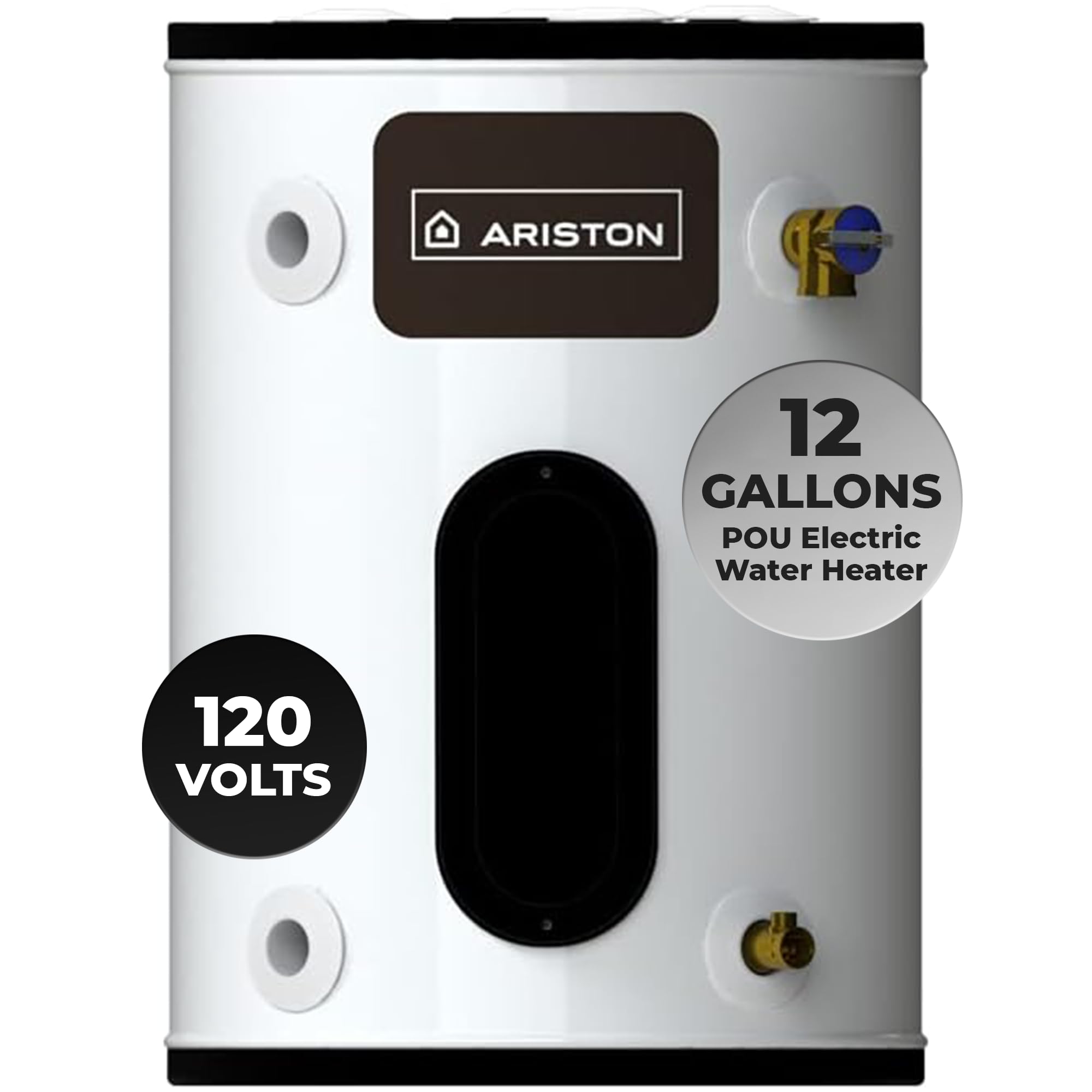
1. Ariston 12 Gallon 120V Electric Water Heater
Our pick — 4.5+★ from 100+ verified ratings; the strongest balance of quality and price.
Twelve gallons that heat to 160 °F and plug into a normal wall outlet
The Ariston earns the top spot because it solves the exact problem most compact heaters create: not enough hot water before the tank runs out. Its 12-gallon capacity feeds an RV shower or a small bathroom without the refill wait you get from a tiny unit. The 1500-watt heating element brings that water up to a 160 °F maximum (the hottest setting allowed on the dial), so you can blend it down for a comfortable shower.
Best of all, it runs on 120 volts — meaning a standard household outlet powers it, with no special circuit or hardwiring. That single fact is why campers and in-law suites are the natural home for it. Owners consistently praise its RV performance and the side or top mounting that lets it tuck into odd corners. A 0.5 gpm flow rate (gallons per minute — how fast water moves through the unit) suits a point-of-use tap rather than a whole house.
The trade-off is scale. A 12-gallon tank covers a shower or two, not a family of four showering back to back. It measures 15.8 inches wide by 22.5 inches high (its footprint), so you need a spot with real clearance, not just a slot under a narrow cabinet. For RV, camper, and small-space duty, though, the combination of 160 °F heat, 120V simplicity, and a screw-in element that transfers heat straight to the water is hard to match at this tier.
Where it shines
- 12-gallon tank and 160 °F max heat give a real shower, not a splash
- 120V plug-in power means no special wiring or breaker work
- Side or top mounting fits tight RV and bathroom spaces
- Screw-in heating element sends heat directly into the water
Where it stops
- 12 gallons won’t keep pace with back-to-back family showers
- Its 15.8″ wide, 22.5″ tall footprint needs real clearance
Reach for this if: you need reliable hot water in an RV, camper, or small suite and want to plug into a normal outlet.
Pass it by if: you’re heating for a full household running several showers at once.
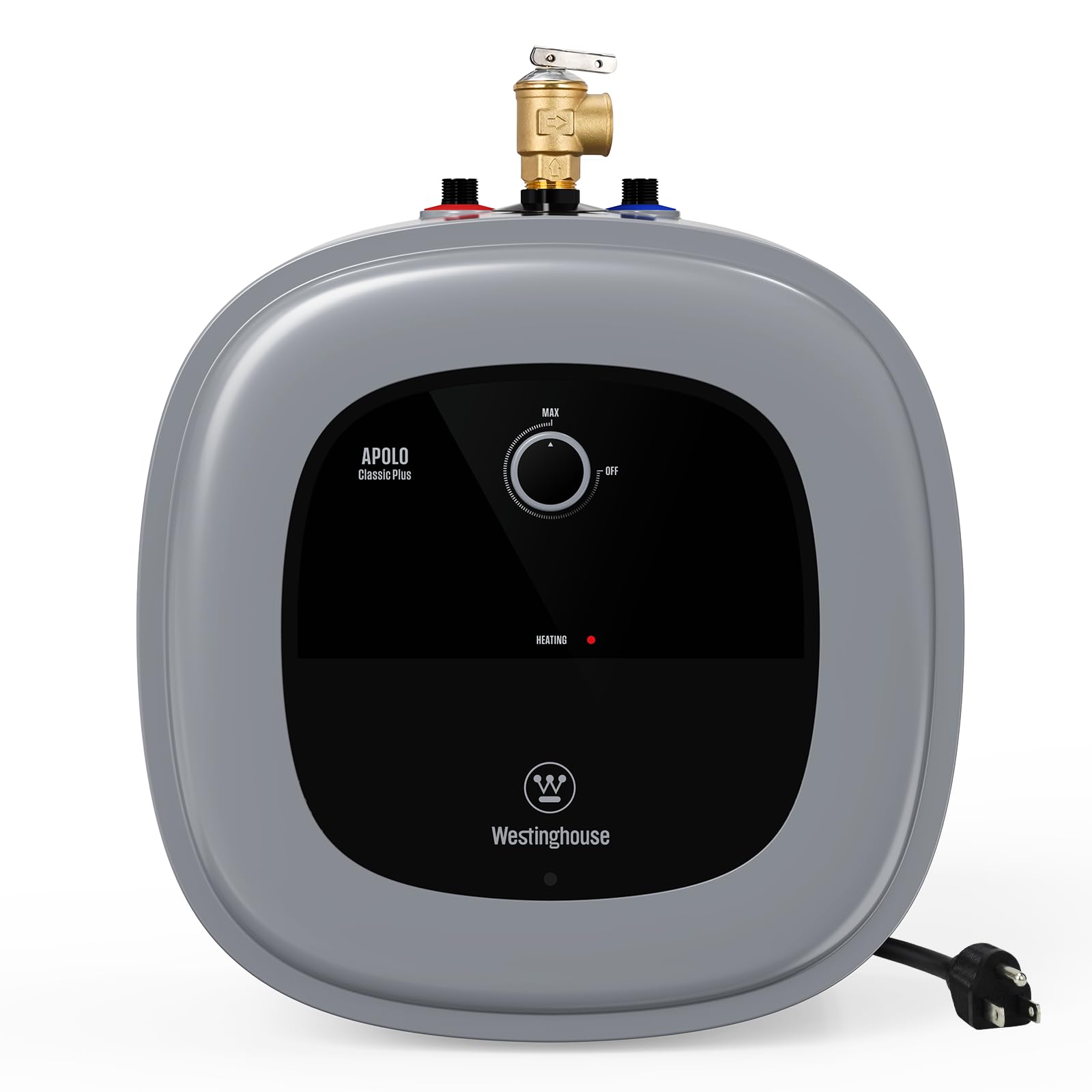
2. Westinghouse 8 Gal 120V Mini Tank Under Sink
The under-sink tank that keeps eight gallons hot and ready on a plug
If the cold-water wait at the kitchen tap is your daily annoyance, this 8-gallon Westinghouse is built for exactly that fix. It stores hot water right at the point of use, so the tap runs warm the moment you turn it. That’s the whole appeal of a point-of-use tank, and it does it without a special circuit — you connect the cold line and plug into a standard 120V outlet.
What wins people over is the tank construction: a triple-layer glass-lined interior, a magnesium anode rod, and a 1440-watt stainless steel heating element, all pressure tested to 150 PSI (pounds per square inch — the water pressure it can safely hold). That package is why it carries a 6-year tank warranty. It’s also CSA listed with dry-fire, over-temperature, and pressure-relief protection, plus an IPX4 rating (resists splashing water from any direction).
Compared with the larger GE 18-gallon pick, this holds 8 gallons to that unit’s 18 — but it also weighs 28.2 pounds against the GE’s 54, so one person can hang it. The honest limit: at 8 gallons it handles handwashing, dishes, and a quick shower, and the maker itself recommends the 4-gallon for larger sinks and the 1.5 to 2.5-gallon for light handwashing. Fit the gallon size to your tap, not the other way around.
Built to last: A glass-lined tank, anode rod, and 6-year warranty outclass most mini tanks in this bracket.
The honest ceiling: Eight gallons is a shower-and-sink supply, not a whole-home tank — plan your outlets accordingly.
The smart buy for: a kitchen, bath, or office sink that’s tired of waiting for hot water.
Look elsewhere for: heating multiple bathrooms or a full family at once.
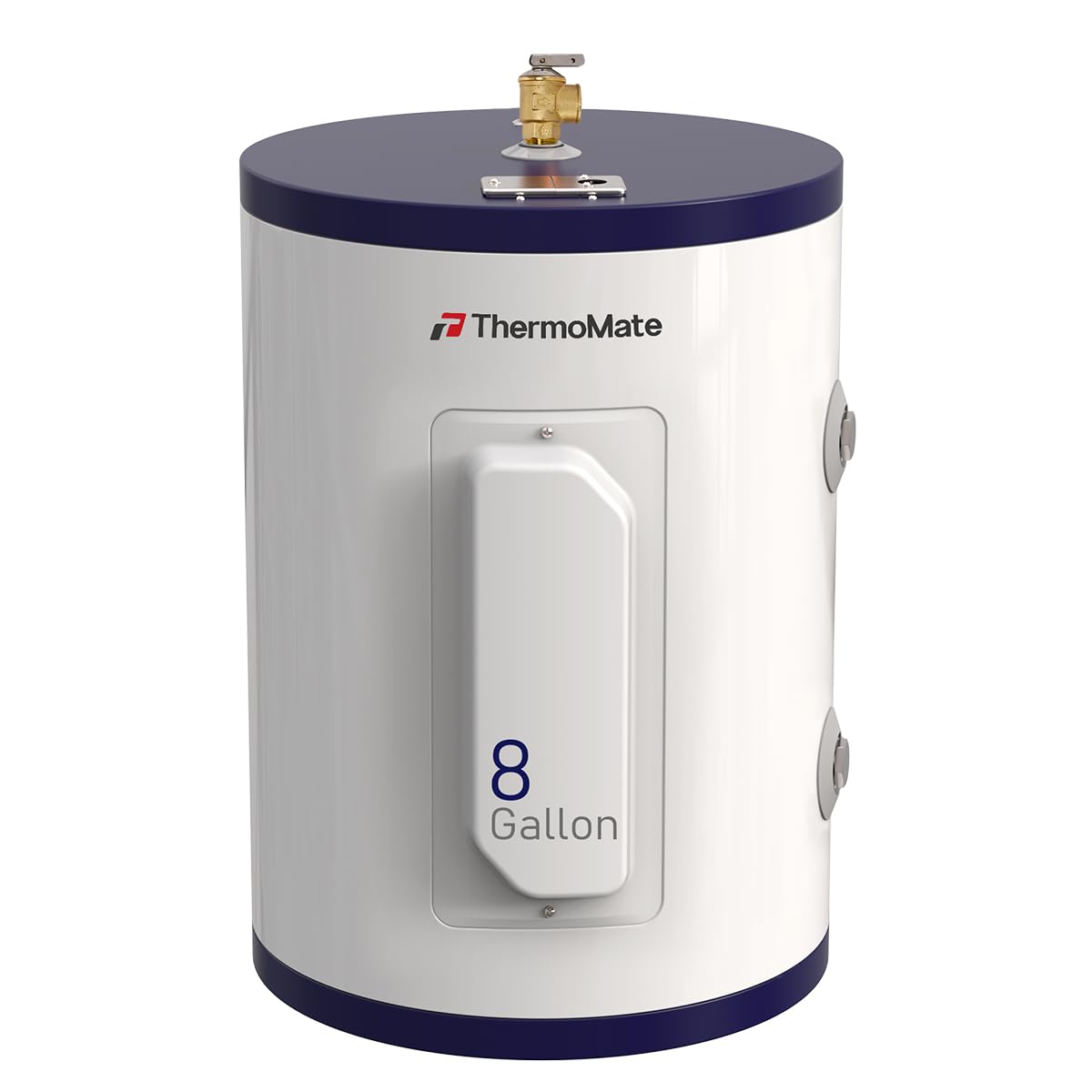
3. ThermoMate ES900 8 Gallon Point of Use
A 20.75-inch low-profile tank that slides under a sink or into an RV bay
Height is where most small heaters get rejected, so ThermoMate built this one to clear tight spots. At 20.75 inches in depth and 14 inches wide, it’s shaped to tuck under a kitchen or bath sink, into an RV, or a garage shop where headroom is short. You can run it solo or inline as a booster behind a bigger heater.
The internals lean on durability: a porcelain enamel glass-coated inner tank to resist high heat and rust, plus an INCOLOY-800 heating element that the maker says fights corrosion better than copper at high temperatures. The thermostat adjusts between 90 °F and 150 °F, so you can dial the whole tank down for safety or up for a hot shower. It’s UL listed with an ASME, ANSI, and CSA-approved T&P relief valve and a high-temperature limit cutout.
The catch shows up in how much hot water you actually get. The tank stays warm a long time, but the recovery math works out to roughly 2 gallons of hot water and 2 gallons of warm — enough for a quick shower or a couple of sinks, not a linger. It’s also a 120-volt unit that needs hardwiring, with a cord included only as an optional route. If you want a low, stealthy install, this is your shape; if you want long showers, size up.
The reasons it earns a slot
- 20.75″ depth and 14″ width fit under sinks and into RV bays
- Adjustable thermostat from 90 °F to 150 °F
- Porcelain enamel tank and INCOLOY-800 element resist corrosion
- UL listed with full pressure and temperature protection
Before you commit
- Real usable hot water runs about 2 gallons before you notice a drop
- Hardwired 120V install — the cord is only an optional extra
Matches your setup if: you have a tight sink or RV space and can hardwire 120V.
Think twice if: you expect long, multiple showers from one fill.
4. GE Appliances 18 Gallon Plug and Play

Whole-home gallons that install in minutes on standard plumbing
For a small house, condo, or apartment that wants real hot water without a full plumbing project, this GE is the most capable 120-volt unit on the list. Its 18-gallon tank is more than double the capacity of the 8-gallon under-sink Westinghouse — 18 gallons against 8 — so it can feed a single hookup or a whole small home. It uses standard 3/4-inch NPT water connections and plugs into any 120-volt supply.
It can stand alone or work inline with another heater to boost a long pipe run or a washing machine, which makes it a fix for the far bathroom that never warms up. A stainless steel heating element resists rust and an anode rod adds long-term corrosion protection. GE backs it with an 8-year tank-and-parts warranty. The adjustable thermostat lets you set the temperature you want.
Expect heft: at 54 pounds it weighs about twice the Westinghouse, and at 19.25 inches wide it needs a wider footprint than a mini tank. Heating experience is mixed — some find it heats the water well, others that it barely warms — so match it to a modest draw (one hookup or a small home) rather than multiple showers at once. Buyers describe installation as quick with existing plumbing.
The whole-home angle: 18 gallons on plain 120V and standard 3/4-in NPT fittings is a lot of hot water for a plug-in tank.
Honest caveat: Heating results vary by draw, so keep the load to a single hookup or small home to stay happy.
Built for you if: you’re supplying a small home, condo, or a booster for a long pipe run.
Not your pick if: you need it tucked under a sink — it’s 54 pounds and doesn’t fit there.
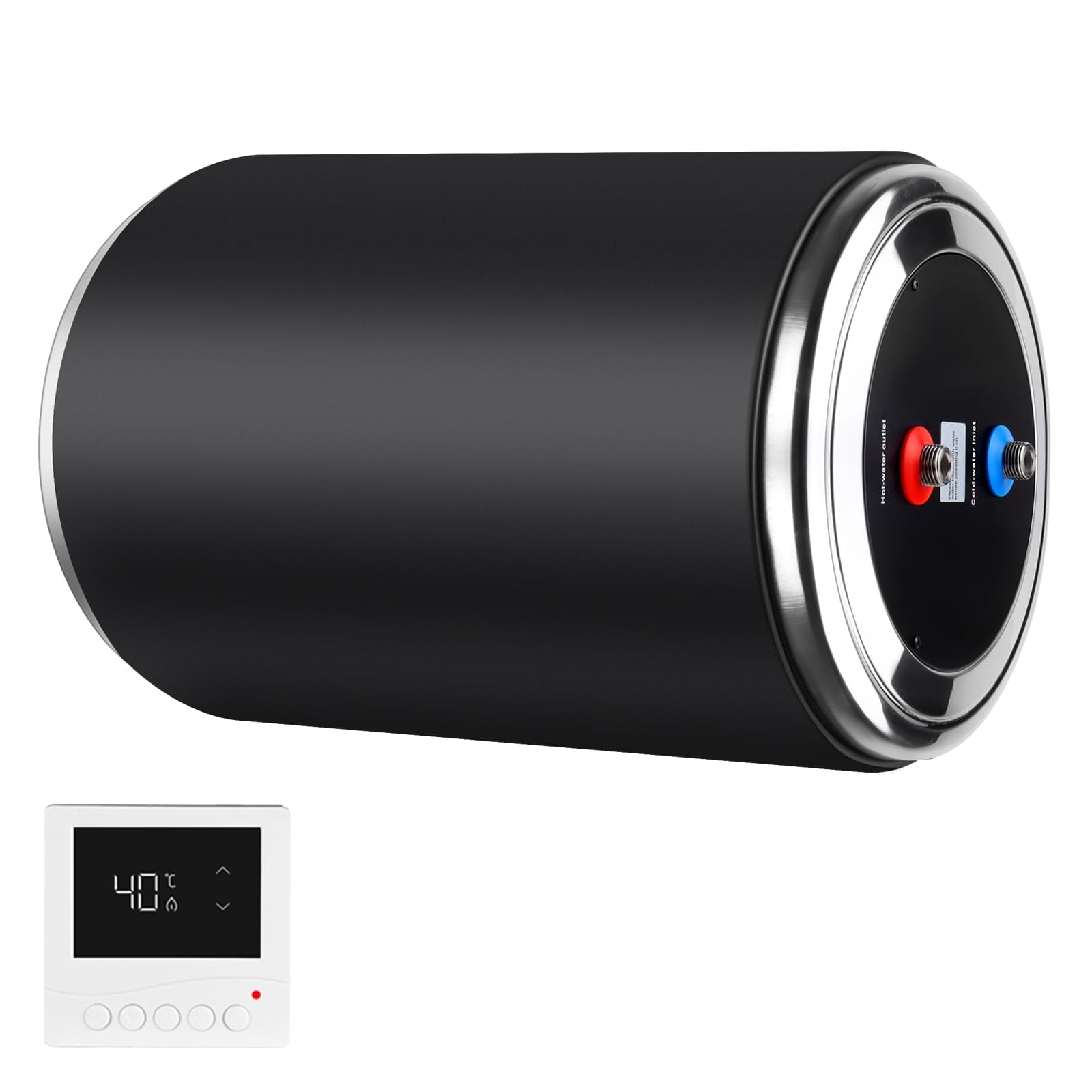
5. FVSTR Dual Power 15L RV Tank Water Heater
Run it on a 12V battery in the wild or shore power at camp
This is the heater for the camper that goes places with no outlet. It’s built to run on two power sources: 12V DC at 200 watts off your battery, or AC at 1500 watts when you’re plugged in. That dual feed is the point — you get hot water off-grid without draining the battery fast, and fast recovery when shore power is available.
The 15-liter tank pushes water at up to 8 liters per minute, which suits a shower or a sink at a campsite. It weighs 3.5 kilograms, light enough to mount without a lot of reinforcement, and it’s built for caravans, campsites, and even solar setups. A remote controller lets you set it from inside rather than climbing into the bay.
Read the voltage rules closely: this is strictly a 12V DC unit and is not compatible with 24V systems. Wiring it into a 24V rig will not work, so confirm your battery bank before you buy. It’s also a smaller 15-liter tank, so it suits one or two people rather than a crowd. For the traveler whose power comes from a battery, though, the dual-source design is the reason to pick it.
Off-grid flexibility: 12V DC at 200W for battery use, AC at 1500W for shore power — two ways to heat the same 15-liter tank.
Voltage watch: 12V only, not compatible with 24V systems — verify your rig’s wiring first.
Made for: the boondocker whose rig runs on a 12V battery bank and shore power.
Wrong fit if: your camper runs a 24V system — this won’t work with it.
6. GE 18 Gallon Side Port Lowboy

Eighteen gallons built low so it fits where height is the enemy
Some closets and crawlspaces simply won’t take a tall heater, and that’s the gap this GE Lowboy fills. It holds 18 gallons but is shaped low to slide under a stairwell, into a low cabinet, or anywhere a standard-height tank won’t clear. It’s sized for a household of 1 to 2 people, and it replaces an old heater using standard water and electrical connections.
A 3.8kW (3800-watt) element drives quick recovery, so hot water is back fast after each use. An inlet tube refills from the bottom of the tank to boost how much hot water you actually get out of it, and an anode rod guards the steel against corrosion. The rust-proof drain valve is built for long service. Its Uniform Energy Factor — a rating of how efficiently it turns electricity into hot water — is 0.93.
This is the fastest-recovering electric unit here, at 3800 watts versus the 1500-watt Ariston — but that speed requires the 240-volt-class wiring a 3.8kW element implies, not a plug-in outlet. So if your space is low but your power is limited, check the circuit before committing. What owners praise most here is straightforward: it heats reliably, and the thermostat brings the tank up to temperature fast.
Why it earns the slot
- 18 gallons in a low profile for tight-height installs
- 3800W element for fast recovery between uses
- Bottom inlet tube boost hot water delivery
- Anode rod and rust-proof drain valve fight corrosion
Keep in mind
- Sized for 1 to 2 people, not a large family
- The 3.8kW element needs heavier wiring than a 120V plug-in
Your answer if: a low closet or crawlspace is blocking a standard-height tank.
Keep shopping if: you’re feeding a big family or only have 120V service.
7. KINGRVER 6 Gallon RV Propane and Electric Hybrid
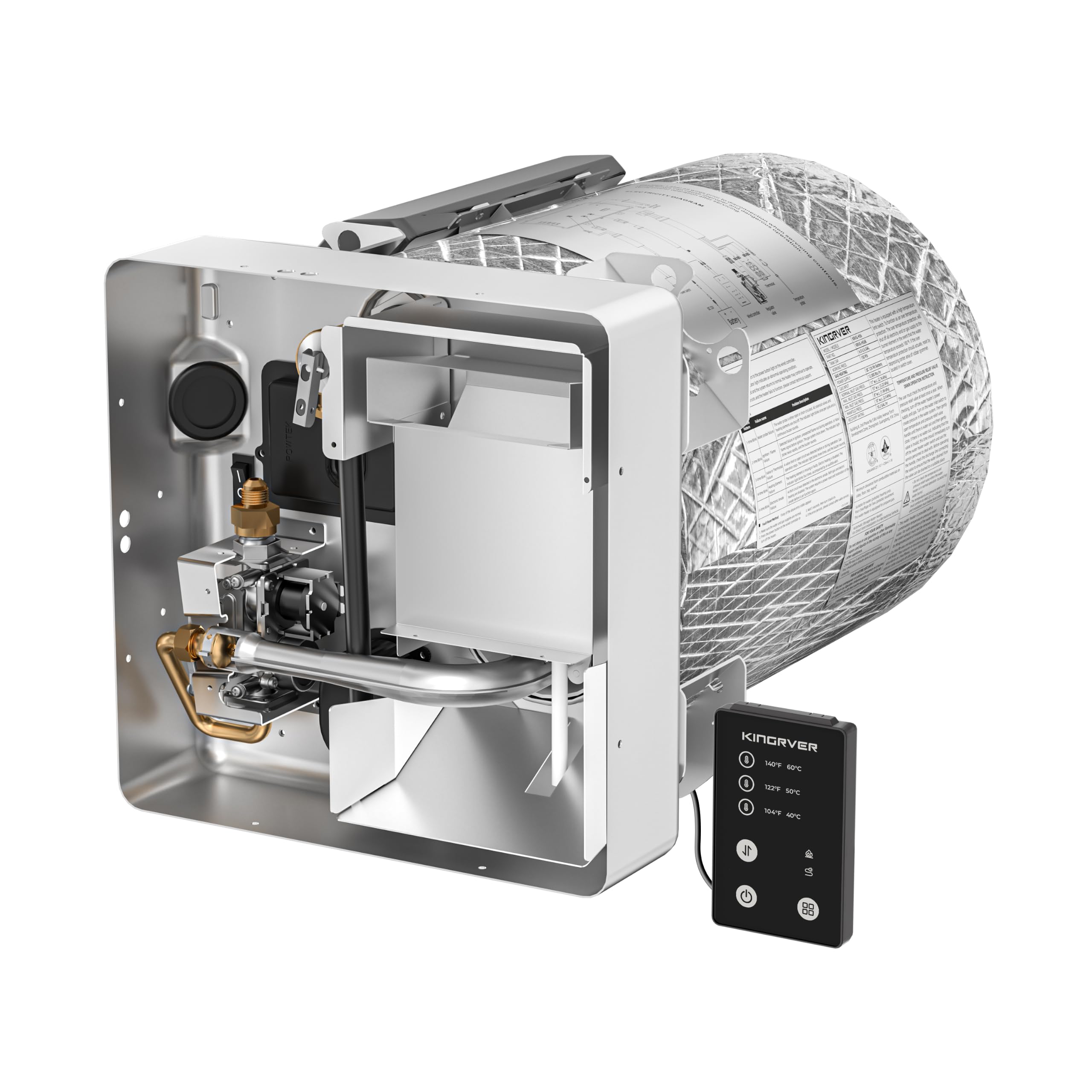
Gas, electric, or both at once — with a remote for the temperature
For an RV owner who wants hot water without waiting long, this KINGRVER gives you three ways to make it: gas, electric, or hybrid mode that runs both at once for faster recovery. The 6-gallon tank uses four-layer construction to hold heat, and a wired remote lets you set the temperature from 104 °F to 140 °F and switch heating modes without leaving the cabin.
It’s a direct replacement made to fit most 4 to 6-gallon RV water heater cutouts, and the maker notes compatibility with common Suburban, Atwood, and Dometic setups. Its dimensions are 21 inches deep, 12.7 inches wide, and 12.7 inches high, with at least 3 inches of extra depth needed for pipe connections. It uses standard 1/2-inch NPT fittings, and a quick-install guide comes in the box.
Performance is where this one wins over the pack — owners rave that it delivers hot water in around 7 seconds, and that custom temperature is a real comfort upgrade. The honest trade-off is temperature retention, which is a mixed point: it keeps water consistently warm, but the tank’s hold isn’t its strongest card. It’s also gas-ignition based, using 12V DC for the burner and 120V AC for electric mode — so it fits RV power, not a house outlet alone.
Speed you’ll notice: Hot water in around 7 seconds, with a remote that dials 104 °F to 140 °F to your taste.
The trade: Temperature retention is mixed — expect steady warmth, not the longest hold, between draws.
Fits your rig if: you want a 4-to-6-gallon RV replacement with hybrid fast recovery.
Overkill if: you need a whole-home tank — this is propane-dependent and RV-shaped.
8. VEVOR 30 Gal 5000W Electric Tank Water Heater
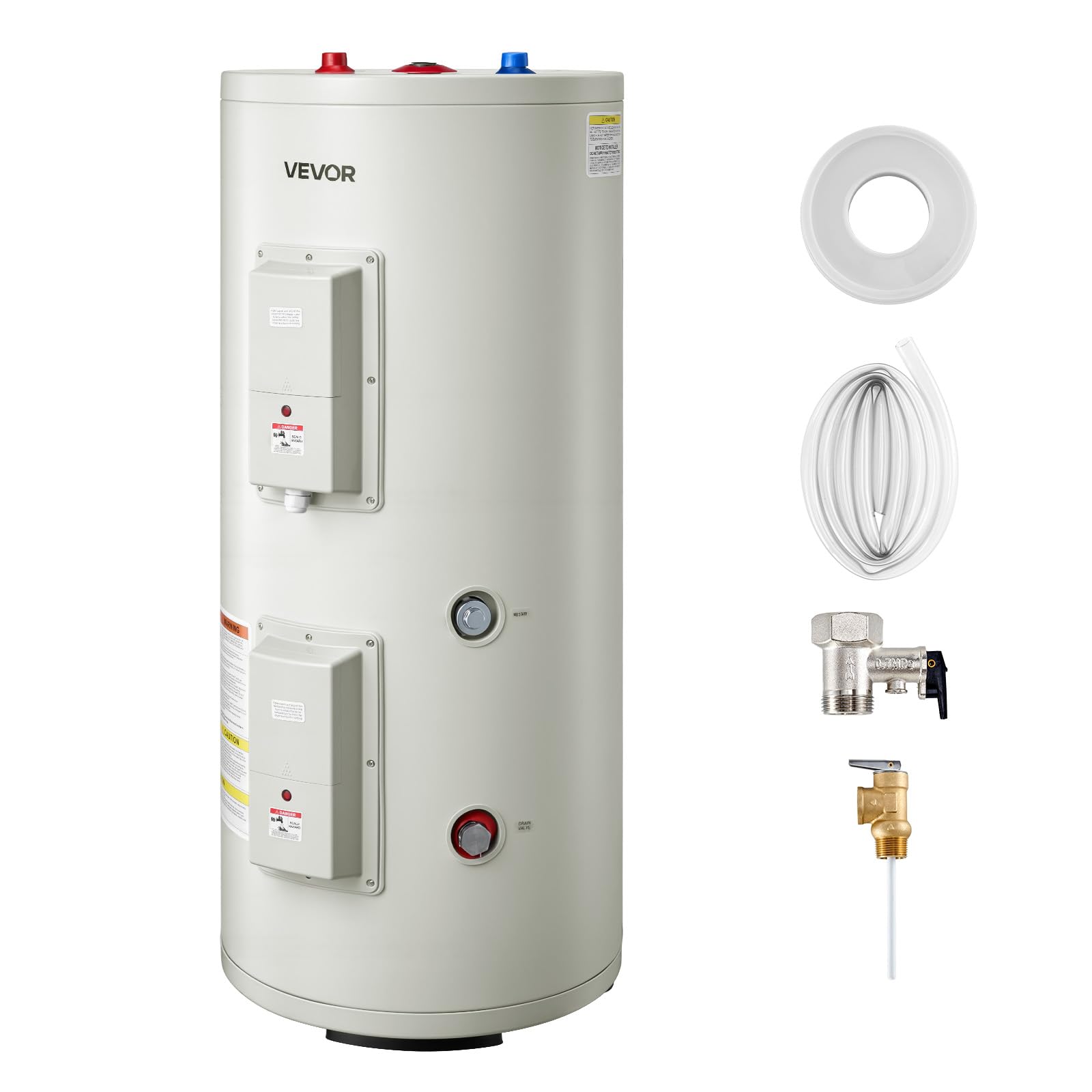
Thirty gallons and 5000 watts for a house that keeps the taps busy
This is the biggest tank on the list, and it’s sized for volume. The 30-gallon capacity is made for a family of 3 to 5 people or small commercial use, feeding 3 to 4 water outlets at once so showers, sinks, and washbasins can run together without running cold. Where the compact units top out at 12 gallons, this one triples that for a busy household.
The 5000-watt element drives fast, uniform heating, and a 20 mm thick foam insulation layer keeps the heat in so the water stays constant and the energy bills stay down. The enamel interior resists both heat and corrosion, and it carries dry-heating, overheating, and overpressure protections with an IPX4 water-splash rating. A simple rotary knob sets the temperature, with an LED indicator showing when it’s heating.
Two things to plan for: it needs 240-volt service to feed the 5000-watt element, and it stands 40.16 inches tall, so it wants floor space and a dedicated circuit, not a plug-in outlet. Owners rate its heating performance highly and say the install is genuinely easy for a 30-gallon, 40-inch-tall tank. Match it to a house with real demand — it’s overkill for a single sink.
Volume leader: 30 gallons and 5000W for simultaneous showers, sinks, and basins in a 3-to-5-person home.
Install reality: Needs 240V service and 40.16 inches of height — plan circuit and floor space up front.
Worth it for: a large family or small business that runs several hot taps at once.
Too much if: you have a single sink and only 120V power available.
9. Dometic WH-10GEA 10-Gallon Gas/Electric

A ten-gallon RV tank that skips the anode and skips winterizing fuss
Dometic’s pitch here is a 10-gallon tank that its maker calls 66% larger than standard RV tank size — so you get noticeably more hot water than the common 6-gallon units. It heats with a 10,000 BTU electronic-ignition burner that fires on LP gas, with the electric side running on 12V. In a camper where a standard tank runs out mid-shower, that extra volume is the whole reason to choose it.
The aluminum tank is a genuine convenience: it requires no anode rod, so there’s one less part to change each year. A pre-installed winterization bypass kit means closing up for the season is a single valve job rather than a draining project. It weighs 22 pounds, lighter than most steel-tank rivals, and it’s a 21-inch-deep unit built to drop into the standard bay.
Buyers report it heats water fast and drops into a standard RV bay as a direct replacement, with the electric heating element serviceable from outside without pulling the tank. The aluminum tank is the trade: no-anode means the metal itself resists corrosion, which is why some owners accept the shorter 2-year limited warranty.
Owners’ verdict: Fast heating and a clean fit, with an outside-serviceable element that saves pulling the tank.
Take note: The aluminum tank skips the anode and carries a 2-year limited warranty — factor that into the value.
Choose this for: an RV upgrade where no-anode maintenance and easy winterizing matter.
Consider the trade: the shorter 2-year warranty if you prefer a long tank guarantee.
10. Suburban 12 Gallon Gas and Electric Combo
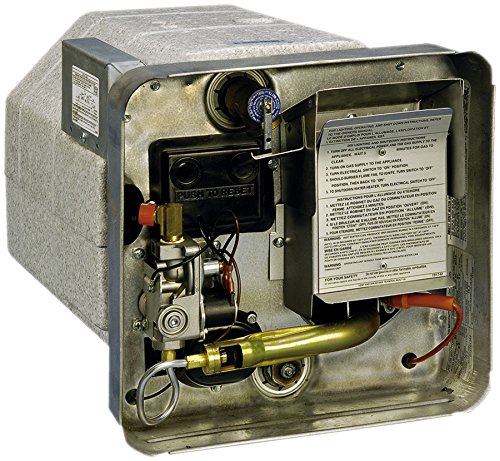
Twelve gallons that heat on gas or electric — a true RV combo tank
Suburban builds this for the RV owner who wants both fuel options in one 12-gallon tank. It’s a combination gas-and-electric model — a 12,000 BTU burner or electric heating — so you can run it on propane when you’re off the grid or on electric when you’re plugged in. A porcelain-lined steel tank and an anode rod protect against electrolysis and rust, and it carries a 3-year limited warranty on the tank.
It’s a 24-inch-wide, 16.7-inch-tall unit weighing 47.6 pounds, sized to drop in as a replacement with a 150 PSI maximum pressure rating. The electronic ignition fires without a standing pilot. Installation is where it earns its keep — it’s the most-discussed strength here, with easy install and a clean fit called out again and again, and it keeps water nice and hot once it’s going.
The honest caveat is durability: the recurring gripe is that some units start leaking after only a few months, and that’s why a portion of buyers disagree on its value. Most buyers are happy with the fit and the heat, but read the warranty terms and check the tank on arrival. Sourced as a budget-friendly combo, it’s the sensible entry point if you want gas-plus-electric without paying top tier — just keep an eye on that first season.
What buyers like
- Gas-and-electric combo gives two heating routes in one tank
- Porcelain-lined steel tank with an anode rod for corrosion protection
- Drops in as a replacement with a clean fit
What to weigh
- Durability and leakage are the recurring concerns — some report leaks within months
- Value splits buyers, so check the 3-year tank warranty terms
Best for: the RV owner who wants gas or electric in one replacement tank.
Weigh first if: you want the longest-lived tank and read durability as the deciding factor.
Know the Specs
Capacity in Gallons
The gallon figure is how much hot water is ready in the tank at once. A 6-gallon tank suits an RV or a single sink; a 30-gallon tank can feed several outlets. Match capacity to how many taps run together, not to the wattage on the label.
Wattage and Voltage
Wattage sets how fast the tank reheats water after a draw. Voltage decides whether it plugs into a standard outlet or needs heavier service. Small 120-volt units plug in; a 5000-watt tank needs 240-volt service. Check the circuit before ordering.
Glass-Lined Tank and Anode Rod
A glass or porcelain enamel coating on the inside of the steel tank slows rust. An anode rod adds a second layer, sacrificing itself to protect the steel. Aluminum tanks skip the anode and rely on the metal itself to resist corrosion.
BTU and Recovery Rate
BTU (British thermal units) measures the heating power of gas and some electric elements. A high recovery rate means the tank refills with hot water quickly after a shower, which lets a smaller tank stretch its usable supply over several draws.
Common Questions
How many gallons of hot water do I need for a shower and a sink?
Can I run a 30-gallon tank on a normal household outlet?
What is the difference between a storage tank and a tankless water heater?
Do I need an anode rod in a water heater tank?
Will an under-sink tank heat water fast enough for dishes?
Can I install a storage tank water heater under a low space?
What does 12V DC versus 120V AC mean for an RV heater?
Does a higher wattage always mean more hot water?
How long does a storage tank water heater typically last?
Can a storage tank heater work as a booster for my main heater?
The Bottom Line
For most people, the water heater storage tank winner is the Ariston 12 Gallon — 12 gallons, a 160 °F ceiling, and 120V plug-in power cover RV and small-space duty without wiring work. If you want a compact tank that tucks under a sink on a plug, reach for the Westinghouse 8 Gal. And for a family that runs several taps at once, the VEVOR 30 Gal is the one to install. Whatever you choose, confirm the gallons against your daily draw and the voltage against your supply — those two numbers decide how much hot water you actually get.
How we choose
We do not accept paid placement. Every pick is matched to a real buyer and a real use-case; we do not hands-on test units.
Sources
Specifications: manufacturer listings and product documentation. Review insights: verified customer reviews, as of November 2026. Pricing: not shown on this page (it changes often); check the current price via the retailer link.
As an Amazon Associate, Tactical Gear Guy earns from qualifying purchases. This does not affect which products we feature.