Specs are compiled from manufacturer listings and verified buyer reviews and can change over time — please confirm the key details on the product page before buying.
You want a lamp that throws that soft amber pool of light across a room — not harsh white office lighting. The catch is that “Edison bulb” gets slapped on everything from genuine carbon-filament throwbacks to modern LED bulbs dressed up in amber glass, and the difference changes your electricity bill, your dimmer behavior, and how often you climb a ladder. This guide separates true tungsten-filament bulbs from amber-glass LED lookalikes and narrows the field to the nine worth buying.
This guide is built by comparing the manufacturers’ published specifications and the patterns across verified customer reviews, so you get each pick’s real strengths and trade-offs instead of marketing spin.
You’ll see which bulbs run hot and hungry, which sip power for years, and which shapes actually fit a tight sconce. By the end you’ll know exactly which vintage edison light bulbs deserve a socket in your home.
Top Picks


How To Choose The Best Vintage Edison Light Bulbs
Start with the color of light, not the shape of the glass. A bulb rated 2200K to 2300K glows deep amber-gold and makes wood, brick and leather look richer. A bulb rated 4000K is neutral white — it throws a clean, cooler light that reads modern rather than nostalgic, so decide which mood you actually want before you shop.
Incandescent or LED filament
Incandescent Edison bulbs (the ones with a real tungsten wire inside) draw full wattage and burn hot — a 60-watt version uses 60 watts of power and is rated around 2,500 hours. LED filament bulbs mimic the same visible curly wire but sip power and are often rated 15,000 to 25,000 hours. If the fixture runs all evening, the LED version saves you repeated replacements; if you want the genuinely warm, slightly orange glow of a true filament, incandescent delivers it.
Match the glass shape to your fixture
The shape code on the box tells you how the bulb will sit in the socket. ST64 and ST58 are the fat teardrop globes; ST19 is a slightly longer teardrop; A19 is the classic household pear shape; T45 is a slim tubular stick. A wide ST64 globe can crowd a tight wall sconce, while a slim T45 slips into narrow spots. Measure the clearance inside the shade before you buy a globe.
Check the base and dimmer before checkout
Nearly every bulb here uses an E26 medium screw base — the standard US socket — so fit is rarely the problem. Dimming is where buyers get caught. LED filament bulbs need a dimmer rated for LED loads, and some bulbs in this roundup are explicitly not for use with a dimmer switch at all. If your switch has a slider, confirm the bulb is labeled dimmable and LED-dimmer compatible.
Side-by-Side Comparison
| Model | Best For | Wattage | Color Temp | Rated Life | Amazon |
|---|---|---|---|---|---|
| CTKcom 2-Pack ST58 Squirrel Cage★ Best Overall | True incandescent amber glow | 40W | 2300K | 3000+ hours | Amazon |
| Brightever 60W ST64 4-PackBrightest Amber Incandescent | Bright amber incandescent | 60W | 2200K | 2500+ hours | Amazon |
| Sigalux ST19 Dimmable LEDFan And Fixture Retrofit | Fan and fixture retrofit | 40W equivalent | 2700K | — | Amazon |
| Decoaui ST19 Dual Helix LED | Long-life decorative glow | 4W (40W equivalent) | 2500K | 25,000 hours | Amazon |
| Qingmiao ST58 6-Pack LED | Whole-house value pack | 4W (40W equivalent) | 3000K | 15,000+ hours | Amazon |
| CTKcom T45 25W 4-Pack | Slim tubular fixtures | 25W | 2300K | 3000 hours | Amazon |
| DiCUNO E26 60W Amber 6-Pack | Brightest amber LED | 6W (60W equivalent) | 2200K | 25,000 hours | Amazon |
| DAYBETTER 12-Pack ST58 | Bulk neutral-white installs | 8W (60W equivalent) | 4000K | 15,000+ hours | Amazon |
| BLINGCOLOR A19 2200K | Classic pear-shape warm LED | 4W (40W equivalent) | 2200K | — | Amazon |
Detailed Reviews
1. CTKcom 2-Pack 40W ST58
Our pick — 4.5+★ from 550+ verified ratings; the strongest balance of quality and price.
The amber-glass teardrop that nails the antique look without the LED impersonation.
This is the bulb for the person who wants their Edison fixtures to actually look like the ones in the coffee-shop photos. The squirrel cage filament — a spiral of wire that loops around itself inside the glass — creates that visible warm spiral you can see glowing from across the room. The 2300K color temperature sits at the deep amber end of the warm scale, so the light reads golden rather than yellow-white. And the amber clear glass with a brass base is what gives it the period-correct feel that frosted LED imitations miss.
What wins people over is the build — the quality of the glass and base is the most-praised thing about this bulb, with the look of the light close behind. It threads onto an E26 base and runs on 110-130V, so it drops straight into standard chandeliers, wall sconces, pendant lighting and showroom fixtures without an adapter. It is also dimmable, which means you can dial it down for dinner and up when you need to actually see. The downside is the honest physics of incandescent: this bulb draws the full 40 watts and is rated around 3000+ hours, so it burns through electricity and will need replacing far sooner than an LED would. A few units reportedly arrive dead or fail early — treat that as a quality-control lottery rather than the norm, and buy from a seller with easy returns.
Why it earns the top spot
- Genuine incandescent squirrel-cage filament for that unmistakable amber spiral
- 2300K color temperature lands right in the golden-hour range
- Dimmable on a standard dimmer circuit
- E26 brass base fits chandeliers, sconces and pendants without adapters
What you give up
- Runs on 40 watts — incandescent, so it costs more to burn than an LED
- Rated around 3000+ hours, far short of the 25,000-hour LED options here
- Occasional dead-on-arrival units reported
Reach for this if: you want the real incandescent glow and don’t mind replacing a bulb every so often.
Look elsewhere if: you’re lighting a fixture that runs all night — the LED options below will outlast it many times over.
2. Brightever 60 Watt ST64 4-Pack
A four-pack of fat amber globes that throws more light than the 40W crowd.
If your complaint about vintage bulbs is that they look lovely but leave the room dim, this is the step up. It pushes 260 lumens through a 2200K amber shell — and that lumen figure is the real difference here. Against the 40W CTKcom pick above, you get 260 lumens versus the lower output of the 40-watt bulb, which is a meaningful lift when you’re trying to read by the light rather than just decorate with it. The 60-watt draw is the trade: more warmth and more brightness, and more electricity eaten per hour.
Brightness is the thing buyers praise most here by a wide margin, with the appearance of the light a clear second. The ST64 globe is the classic wide teardrop at 2.51 inches wide and 5.63 inches tall, so check clearance inside a closed shade before you commit. It’s fully dimmable — the maker notes the dimmer switch isn’t included — and the 360-degree beam spreads light evenly rather than throwing a hot spot forward. Rated around 2500+ hours, this one is about the short-lived end of the incandescent class, so it’s best in fixtures you don’t run for hours nightly. Some buyers find the color shifts more amber than expected and a few questioned the value versus LED, but the core reaction is that these deliver a genuine, easy-on-the-eyes window. For a dining-room chandelier lit a few hours a night, that’s exactly the job.
The honest read: brightest true-incandescent amber glow in this roundup, and the 260-lumen output is the reason to pick it over the 40W options.
Know before you buy: 60 watts and roughly 2500+ rated hours means it is the least efficient bulb here — great for ambience, not for all-evening use.
Suits: dining rooms, sconces and pendant clusters that need visible warmth plus usable light.
Not for: a porch light or hallway that stays on for long stretches — the LED picks will cost you far less to run.
3. Sigalux Edison LED Light Bulbs, ST19 Dimmable, 400LM, 4-Pack
Bright enough to justify the retrofit, dim enough to keep the mood.
Here is a genuinely useful number: 400 lumens. That’s what makes this 4-pack the practical choice for someone swapping bulbs in a fixture they actually use — a ceiling fan, a vanity, a dining pendant. It’s listed as a 40-watt equivalent, but buyer after buyer says it reads closer to a 60-watt in perceived brightness, which is exactly what you want when you move from a dim incandescent to LED. The 2700K warm-white tint leans slightly less amber than a 2200K bulb, so it’s a good bridge if you want warmth without a heavy orange cast.
Smooth dimming from 10% to 100% without flicker or buzz is the headline, and it pairs with the CRI 90 — a color rendering index that measures how faithfully a bulb shows true colors, with 100 being perfect daylight. That high score is why wood tones and fabrics still look natural under this light. It drops into an E26 base and is UL listed. The recurring gripe is durability: some units have been reported to break in use or separate where the glass meets the metal base, so handle them carefully when installing and don’t overtighten. Set against the CTKcom incandescent’s 3000+ rated hours above, this LED is the longer-term investment.
Where it shines: 400 lumens and CRI 90 make it the best all-round retrofit for fixtures you rely on daily, not just for show.
The caution: glass-to-base durability is a known weak point, so install gently and keep the packaging in case of breakage.
My call: the best pick if you’re replacing bulbs in a ceiling fan or vanity and want brighter output than the amber incandescents deliver.
Think twice if: your heart is set on a deep-orange 2200K glow — this runs a cleaner 2700K.
4. Decoaui ST19 Dual Helix Edison LED Bulbs, 3-Pack

The dual-helix glass that looks hand-blown and sips power for years.
Most filament bulbs use straight wire; this one runs two spiral helices inside the glass, and the maker points out that’s a costlier manufacturing process. You see the payoff the moment it’s lit — a softer, more intricate glow than a plain filament throws. It’s a 4-watt LED doing the work of a 40-watt incandescent, so the running cost is a fraction of the true-incandescent picks, and at 25,000 hours it will outlast the CTKcom 40-watt incandescent’s 3000+ rating many times over. Steady, flicker-free light at 300 lumens with a CRI of 85+ keeps colors looking natural under it.
Brightness and the look of the filament are what owners respond to — the amber tinted glass dodges the harsh blue cast some cheap LEDs throw, and the 2500K warmth sits in a cozy middle ground. Dimming runs smooth from 0% to 100% and it’s compatible with most LED dimmers, which makes it easy to set the room’s mood. One practical note the maker flags itself: the size. At 5.4 inches long and 2.5 inches in diameter, it’s worth checking that it clears the inside of a table lamp or a tight pendant before you order.
Standouts worth knowing
- Dual helix filament gives a richer, more crafted look than straight wire
- 4 watts replacing 40 watts, so running cost is minimal
- 25,000-hour rating means years between replacements
- Dims smoothly 0%–100% with most LED dimmers
Caveats to weigh
- 5.4″ length and 2.5″ diameter need clearance-checking in enclosed shades
- 2500K reads warmer-amber than a standard household bulb — intentional, but not for everyone
Pick it when: you want decorative bulbs that stay lit for years and look genuinely crafted rather than mass-produced.
Skip it when: the glove-tight shade you’re fitting needs a smaller globe — measure first.
5. Qingmiao Vintage LED Edison Bulbs, ST58 4W, 6-Pack
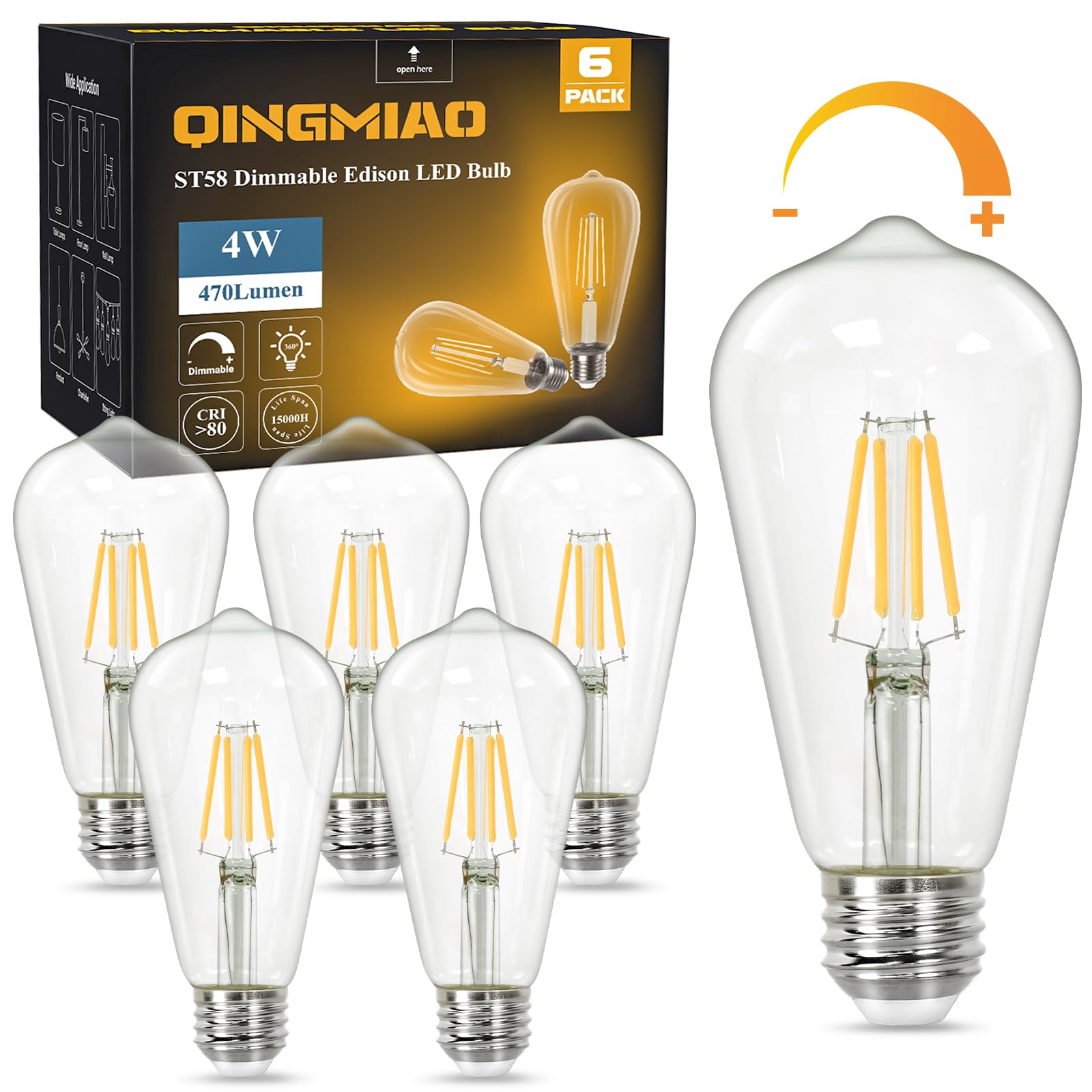
Six bulbs, one order, a whole fixture run sorted in a single click.
When you’ve got a six-globe chandelier or a row of wall sconces, buying pairs gets old fast. This pack gives you exactly six, so you can fill a multi-bulb fixture in one go — and that alone makes it the practical pick for a big install. Each bulb is a 4-watt LED standing in for a 40-watt incandescent, rated over 15,000 hours, at a 3000K soft white. Compared with the 2-pack CTKcom incandescent at 3000+ hours, you’re getting roughly five times the rated life per bulb and three times the pack count for the same kind of money.
The 360-degree beam spreads light evenly and the dimming steps smoothly from 100% down to 10% without flicker, so it adapts to a bright kitchen task or a dim evening. Flicker-free and no-glare performance plus a CRI of 80+ keep things comfortable on the eyes. Where the story gets mixed is lifespan — most owners get long service, but some have reported failures within a couple of months, so keep the return window in mind. The maker backs it with a replacement option within 24 months, which softens that risk.
The case for it: six bulbs rated over 15,000 hours for a multi-globe fixture is the simplest way to retrofit a whole room at once.
The trade-off: lifespan is mixed in real use, so check every bulb on arrival and lean on the maker’s replacement policy if one quits early.
Best for: filling a six-light chandelier or a sconce row without ordering twice.
Consider the alternatives if: you want the very deepest amber tint — this one leans warm-white at 3000K rather than orange.
6. CTKcom T45 25 Watt Vintage Antique Bulbs, 4-Pack

The slim stick that slides into narrow sconces and old reading lamps.
Not every fixture wants a fat teardrop globe. The T45 is a tubular stick-style bulb, and at 4.4 inches long by 1.78 inches in diameter it slips into places a wide ST64 never would — narrow wall sconces, tight reading lamps, vintage desk lights. The spiral tubular filament keeps the antique character, and the yellow amber glass at 2300K delivers a deep, warm, honeyed glow rather than a bright white wash. It’s dimmable and runs on 110-130V through an E26 base, with CE and RoHS certification noted by the maker.
What buyers come back to is the quality and the brightness in that shaped glass — this is a bulb people buy specifically to put warm, cozy light into a classic old lamp or a reading corner, and it does that well. At 25 watts it’s the lowest-power true-incandescent here, so it sips less electricity than the 60-watt Brightever while still producing enough light to read by. Rated around 3000 hours, it’s a typical incandescent lifespan, so plan on replacing it eventually rather than once a decade.
Why it has a home here: the slim T45 shape fills a gap the wide globes can’t — literally — and the 2300K amber keeps the period look intact in tight fixtures.
The honest limit: 25 watts of incandescent means genuine warmth but a bulb you’ll eventually replace, not a decade-long LED.
Reach for this if: your sconce or reading lamp is too narrow for a wide globe and you want a true honey-amber glow.
Pass if: you need maximum brightness from a slim socket — 25 watts is cozy, not room-filling.
7. DiCUNO E26 Edison Bulbs 60W Equivalent, 2200K, 6-Pack

The rare amber bulb that’s actually bright — 600 lumens of deep-warm LED.
Most amber bulbs force a choice: warm color or usable brightness. This one sidesteps it. The DiCUNO pushes 600 lumens — the brightest amber-glass option in this roundup — through a 2200K amber shell, so you get genuine golden warmth without squinting. It’s a 6-watt LED standing in for a 60-watt incandescent and is rated 25,000 hours, which means it keeps that look burning for years. The teardrop ST19 glass with squirrel-cage filaments inside keeps the vintage impression intact. If you liked the 60-watt brightness idea of the Brightever but want LED efficiency, this is the equivalent trade.
Quality and brightness are what win people over — the 2200K warmth reads as a soft glow that isn’t harsh or over-bright, and owners note a convincing vintage incandescent look. The 360-degree beam spreads it evenly and low heat output keeps the bulb from getting too hot to handle. One important quirk: the maker explicitly says do not use this bulb with a dimmer switch for best performance, so this is a straight on/off bulb despite the LED pedigree. Buy it for a fixture you don’t dim.
What buyers like
- 600 lumens is the brightest amber output in this lineup
- 2200K deep-warm tint with a convincing vintage look
- 6 watts replacing a 60-watt incandescent
- 25,000-hour rated life
What to know
- Not meant for use with a dimmer switch — on/off fixtures only
- Comes only as a 6-pack, so a single-lamp buyer has spares whether they want them or not
Choose it for: a bright-but-golden look in a non-dimmable fixture like a pendant or a hallway lamp.
Don’t choose it for: a dimmer-controlled setup — the maker advises against dimming this one.
8. DAYBETTER 12-Pack Vintage LED Edison Bulbs, ST58, 4000K

Twelve bulbs, plenty bright, and a color that flips the Edison rulebook.
Twelve bulbs in one box is a head-turner if you’re wiring a big space — a restaurant feel, a long hallway, a row of porch lanterns. This is an 8-watt LED replacing a 60-watt incandescent, pushing 800 lumens on full, and rated over 15,000 hours. The filament and clear glass keep the classic Edison skeleton, so it looks the part. But here’s the honest catch that separates this from most of the list: it’s 4000K neutral white, not amber. That reads crisp and clean rather than nostalgic — a deliberate departure from the golden glow you’ll find on the 2200K and 2300K bulbs above.
Owners like the quality and brightness, with the crisp white light reading sharp in porch fixtures and outdoor lanterns, and many call it good value for the pack size. Dimming runs smooth from 100% down to 10% without flicker, and the CRI of 80+ keeps colors natural. The wide E26 base fits pendant lights, chandeliers, vanity fixtures, wall lanterns and table lamps. If you want golden ambience, look at the DiCUNO or CTKcom picks; if you want 800 lumens of neutral-white light in a 12-pack for a whole property, this is the workhorse.
Where it fits: bulk coverage with 800 lumens per bulb and a 12-pack that outfits an entire property in modern-clean styling.
Who should look past it: anyone chasing the deep amber originals — 4000K is a cool, near-white light that reads modern, not vintage.
Best for: whole-house or commercial installs where you need many bulbs and prefer crisp neutral light.
Not the one if: the golden Edison glow is the whole point for you.
9. BLINGCOLOR A19 Vintage Edison LED Bulbs, 2200K, 4-Pack

A normal pear-shaped bulb with a hidden vintage heart inside.
Some shades and lampshades want the ordinary A19 pear silhouette, not a fat globe — and this is the bulb for those. It’s the classic household shape at 2.36 inches wide and 4.25 inches tall, so it drops into conventional table and floor lamps, yet the ultra-thin spiral LED filament inside gives it the vintage character when it’s lit. The 2200K amber glass burns deep-warm, and the strong CRI of 90+ is the standout — that’s near the top of the color-fidelity scale, so woods, paint and skin tones stay true instead of going muddy under the warm tint.
Light quality and appearance are what people respond to — the amber glow reads close to a genuine incandescent and creates an easy, cozy ambience in living rooms. It sips just 4 watts doing the work of 40 watts and stays cool enough to touch, which matters in a lamp with a fabric shade. The smooth dimming is compatible with most LED dimmers, and it also runs fine in non-dimmable fixtures if you just want the look. No flicker, no hum, no glare — and it won’t turn black in use the way incandescent bulbs do over time.
Standout spec: CRI 90+ is the highest color-rendering figure among the classic-shape picks here, so colors look genuinely accurate under the warm light.
Fit note: A19 sizing is forgiving in lamps, but if your fixture is designed around a wide teardrop globe, this slim pear shape will leave more empty glass showing.
My pick if: you want vintage warmth in an ordinary lamp shape and care about colors looking true.
Wrong fit if: your fixture was built to frame a big globe silhouette — this one is deliberately discreet.
Know the Specs
Color temperature (Kelvin)
Kelvin measures the color of the light, not the heat. A lower number is warmer and more amber; a higher number is cooler and whiter. The classic Edison glow sits around 2200K to 2300K — a deep golden amber. A bulb at 2700K to 3000K reads warm but less orange, and one at 4000K is neutral white. Pick your Kelvin first, because it sets the entire mood of the room and no other spec overrides it.
Wattage vs. equivalent
With LED bulbs, the wattage is what the bulb actually draws from the wall, and the “equivalent” is the incandescent it replaces. A 4-watt LED claiming a 40-watt equivalent uses a fraction of the power for similar brightness. A true incandescent Edison bulb draws its full rated wattage — a 60-watt incandescent uses 60 watts. Lower draw means a lower electricity bill, but the LED number and the incandescent number are not the same thing.
Rated hours and lifespan
Rated hours is the maker’s estimate of how long the bulb will run before it fades or fails. Incandescent Edison bulbs here are rated roughly 2,500 to 3,000 hours, while the LED filament options run from 15,000 to 25,000 hours. A bulb you’ll keep lit for hours each night rewards the longer rating; a decorative bulb used for a couple of evening hours might last years even at the shorter rating.
Lumens and CRI
Lumens is brightness — how much visible light the bulb throws. More lumens means a brighter room. CRI (color rendering index) says how faithfully the bulb shows true colors, on a scale to 100. A CRI of 80+ is good; 90+ is excellent. Amber-tinted glass shifts the color slightly regardless, but a higher CRI keeps wood, fabric and faces looking natural instead of washed out.
Common Questions
Will these bulbs fit a standard US light socket?
Can I use a vintage Edison bulb with a dimmer switch?
What is the difference between 2200K and 4000K in an Edison bulb?
Do incandescent Edison bulbs use more electricity than LED ones?
How long do these bulbs actually last?
Why do some Edison bulbs look dimmer than a normal bulb?
What does the ST64 or ST58 shape code mean?
Can I use an Edison bulb outdoors?
Is a higher CRI worth paying attention to in an amber bulb?
Why do incandescent Edison bulbs get so hot?
The Bottom Line
The crowd favorite here is the CTKcom 2-Pack ST58 Squirrel Cage — 4.5+ stars, a 2300K amber glow, and a real squirrel-cage filament for anyone who wants incandescent character rather than an LED imitation. If you’d rather buy once and forget it, the Decoaui ST19 Dual Helix pairs that crafted look with a 25,000-hour rated life. And when you’re filling a whole six-light fixture in one order with a warm-white LED, the Qingmiao 6-Pack is the practical call. Pick your Kelvin, match the glass shape to your fixture, and confirm your dimmer’s LED rating —
How we choose
We do not accept paid placement. Every pick is matched to a real buyer and a real use-case; we do not hands-on test units.
Sources
Specifications: manufacturer listings and product documentation. Review insights: verified customer reviews, as of November 2026. Pricing: not shown on this page (it changes often); check the current price via the retailer link.
As an Amazon Associate, Tactical Gear Guy earns from qualifying purchases. This does not affect which products we feature.