Specs are compiled from manufacturer listings and verified buyer reviews and can change over time — please confirm the key details on the product page before buying.
You want to see who is at your door without paying a company every month for the privilege. That is the whole promise of a video doorbell with local storage — the footage lives on a microSD card or hub you own, not on a server you rent. The short answer: the eufy E340 is the pick most people should start with, because its second downward camera watches the floor where parcels sit and its clips land on a eufy HomeBase indoors. Below you will find nine doorbells that all keep your video on hardware you control, sorted by what each one does best.
This guide is built by comparing the manufacturers’ published specifications and the patterns across verified customer reviews, so you get each pick’s real strengths and trade-offs instead of marketing spin.
One note on this list, said plainly: matching here is flexible and human, so not every pick is the exact model you typed into the search bar. Where a near-equivalent same-type unit serves the same job, it earns a place. Read on for a straight walk through the video doorbell with local storage options worth your door.
Top Picks


How To Choose The Best Video Doorbell with Local Storage
The single decision that matters most is whether the microSD card sits in the outdoor camera or in an indoor hub or monitor. A card inside the outdoor camera travels with a thief if the unit is pried off the wall. A card inside an indoor hub or monitor stays on your shelf no matter what happens at the door. Resolution, field of view and battery life are secondary tuning decisions next to that.
Find your storage host before anything else
Three main shapes exist in this category. Some doorbells store on a microSD card in the camera itself. Some pair with a small indoor base that holds the card and doubles as a Wi‑Fi extender and chime. Others ship with a dedicated touchscreen monitor that carries the memory card indoors. Pick the storage host first, and your shortlist shrinks fast.
Match the power route to your doorway
Battery models install in minutes without an electrician but send you out to recharge. Wired models reuse existing 8–24V doorbell transformer wiring and never need a swap. Power over Ethernet (PoE) runs power and data down one cable — great if you can fish a cable, impractical if you cannot. Two-way models let you start wireless and hardwire later.
Check the card ceiling before you buy
A low capacity maximum means you are overwriting old clips sooner than you expect. A generous ceiling buys more history. Do not assume every doorbell accepts a big card — some cap at 128GB, some at 256GB, several accept 512GB. Buy the card separately unless the listing says it ships in the box.
Side-by-Side Comparison
| Model | Best For | Max Local Storage | Video Resolution | Field of View | Amazon |
|---|---|---|---|---|---|
| eufy Security Video Doorbell E340★ Best Overall | Dual-camera parcel watching | HomeBase compatible | 2K Full HD | — | Amazon |
| Aqara Doorbell Camera G400HomeKit Ready | HomeKit and NVR users | 512 GB microSD | 2K HD | 165 degrees | Amazon |
| aosu 2K Wireless Doorbell CameraCrowd Favorite | Big review base, easy setup | 256 GB microSD | 2K | 166 degrees | Amazon |
| WUUK 2K Doorbell Camera | Multi-camera homes | 32GB local EMMC | 2K | — | Amazon |
| Wyze Wireless Video Doorbell Pro | Screw-free installs | microSD card | 1440 HD | 1:1 head to toe | Amazon |
| Anona 3K Dual Cam Doorbell | Dual-cam on a budget | 512 GB microSD | 3K 5MP | — | Amazon |
| REOLINK Battery Video Doorbell (2nd Gen) | Long battery, NVR setups | 512 GB | 2K 4MP | 180 degrees | Amazon |
| PHILIPS Security Video Doorbell | Long battery, no fees | 8GB motion videos | 2K QHD | — | Amazon |
| 8″ Wireless Video Doorbell (SIMBAILAI) | No-phone monitor viewing | 32GB, 128GB max | 1080P | 160 degrees | Amazon |
Detailed Reviews
1. eufy Security Video Doorbell E340
Our pick — 4.0+★ from 300+ verified ratings; the strongest balance of quality and price.
Two cameras on one doorbell — one for faces, one for the parcel on your step.
The E340’s defining trick is a pair of cameras working together. The front-facing lens focuses on people at eye level, and a second downward-facing camera fills in the floor right in front of your door. That floor view is the one that matters if packages go missing — you see the hand, the box and whether it actually left.
Recording lands on eufy’s HomeBase S380 or S280, an indoor box that holds your clips on a card stored inside your house. No subscription rides along with the footage; the storage is yours once the hub is set up. That said, the doorbell itself requires one of those hubs to record locally, and the HomeBase is a separate purchase — plan for that before you order. Night footage gets a boost from a dual-light system, and eufy claims a clear nighttime viewing distance of up to 16ft (5m).
Power gives you real flexibility. Run it on the battery and swap a spare quick-release pack to avoid downtime. Or hardwire it to an existing doorbell line — 16 to 24V and above 10VA — and the wired source keeps the battery topped up. Note that wired mode still needs the battery physically installed.
What earns the top slot
- Dual cameras give a package-and-face view most single-lens doorbells miss
- Local recording on a eufy HomeBase with no monthly fee
- 2K Full HD clarity with color night vision
- Battery or wired power, plus HomeBase and Alexa/Google chime pairing
Where it asks a little back
- Local storage depends on a HomeBase hub, sold separately
- Notifications and Wi-Fi connectivity draw mixed reports from owners
- Battery life is not a strength for everyone who buys it
Reach for this if: you want two views at once — a face at the door and the parcel below — and you are willing to add eufy’s HomeBase for the storage.
Think again if: you want a card slot in the box and nothing more to buy — the Aqara G400 below has one built in.
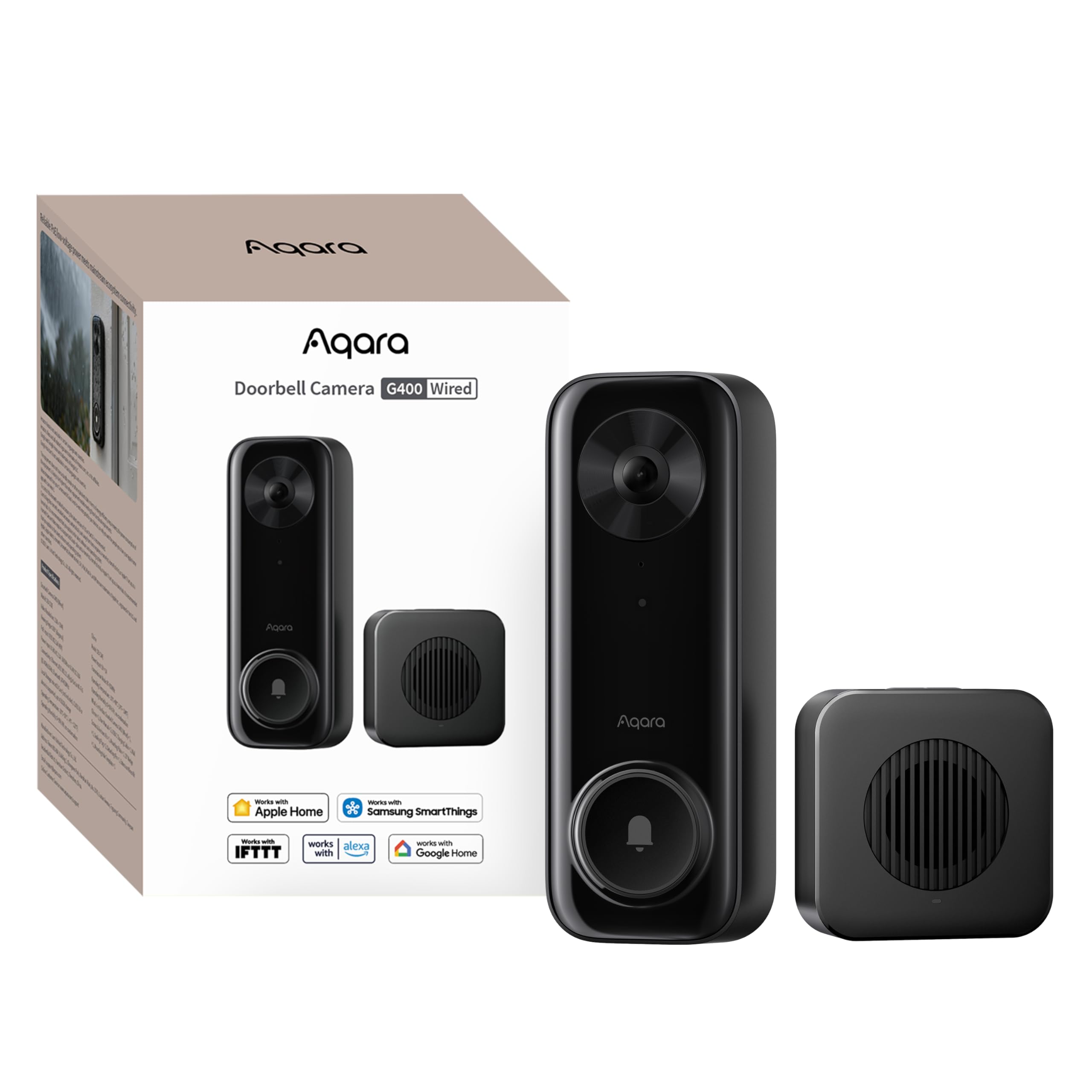
2. Aqara Doorbell Camera G400 with Chime
The widest card ceiling in this lineup, plus a head-to-toe view worth its own paragraph.
If 512GB of local footage sounds like more than you will ever need, that is the point — you never want to think about your card again. That is the Aqara G400’s biggest number: storage climbs to 512GB on a microSD card (card not included). Compare that to the aosu’s 256GB cap and you are looking at twice the space for the same class of card. More headroom means you can rewind further back when a package or a visitor goes missing.
Its second stand-out is the view shape. Aqara’s 165-degree lens uses a 3:4 aspect ratio, taller than the 16:9 shape most doorbell cameras chase — you see packages at your feet and faces at the door in the same frame. The aosu’s 166-degree lens is a fraction wider on paper, but the tall frame is the part you feel day-to-day.
Power is hardwired only — PoE or reuse 8–24V AC/DC wiring. Wi-Fi 6 across 2.4GHz and 5GHz meets WPA3 security standards, and the outdoor enclosure carries an IP65 dust-and-water rating. One limit worth flagging: HomeKit Secure Video require an iCloud+ plan and an Apple home hub, and the resolution drops to 1200p on HomeKit. The bright sun is the other known soft spot; overexposed frames wash out on some installs.
What makes it tick
- 512GB microSD support — the largest card capability on this list
- 165-degree tall 3:4 view for packages and faces together
- PoE or existing wiring — no battery changes ever
- HomeKit Secure Video, Alexa, Google, SmartThings plus RTSP/ONVIF and NVR input
The fine print to read first
- Hardwired only — not a battery option
- HomeKit Secure Video needs iCloud+ and an Apple hub
- Bright daylight can wash out the frame on some installs
The one to beat for Apple homes: if you already live in HomeKit and want a wired doorbell with 512GB of local room, this is the pick.
Not for you if: you have no doorbell wiring at the door and want to run on battery.
3. aosu 2K Wireless Doorbell Camera with aosuBase
The doorbell the widest crowd already trusts, with a hub that tucks the card indoors.
The aosu has the most owner ratings in this guide — 4.0+ stars across thousands of reviews — and it earns that trust with a simple setup. Its 166-degree field of view (how wide the camera sees) in a squarer 4:3 frame (the shape of the video) captures more of your porch than the taller 165-degree Aqara on paper. You see visitors head to toe, with packages near the door.
The aosuBase Mini is the part that makes local storage smart. It doubles as a Wi-Fi extender on your 2.4GHz network (5GHz is not supported), an indoor chime, and a card slot. That means the microSD card — up to 256GB, sold separately — lives indoors, not on the front door where a thief can grab it. At 256GB you are storing half the footage ceiling the Aqara G400 offers, but on the safer side of the wall.
The battery shows 5200mAh, and battery life is the one aspect where owner experience splits — some report good runtime, others say it drains fast after a few months of heavy motion. Connectivity also draws its share of gripes, and the 2.4GHz-only requirement locks out a 5GHz-only network. AI person detection helps keep false alarms down, and two-way talk includes preset quick replies and a voice changer.
What wins people over: 2K sharpness, a low price, and a hub that puts your card indoors where a stolen doorbell does not take the footage with it.
The honest trade-off: 256GB is half the storage ceiling of the Aqara, and 2.4GHz-only Wi-Fi is a hard limit if your home runs on a 5GHz-only router.
Best for: a renter or homeowner who wants local recording on a hub with the largest owner base behind it.
Look elsewhere if: you need more than 256GB of storage or your network will not hand out a 2.4GHz signal.
4. WUUK 2K Doorbell Camera

A doorbell that quietly anchors a whole home camera network.
The WUUK’s homebase is not just a chime — it is a mini recorder. It packs 32GB of local EMMC memory that the maker says holds up to 365 days of video, and it can support up to 8 WUUK wireless cameras total. If you plan to add more cameras to your porch or side yard, this base grows with you instead of becoming redundant.
All footage is encrypted and saved locally, so no cloud tier is required. Detection uses radar plus PIR (a motion sensor that detects heat) alongside intelligent human detection, so the camera tries to tell a visitor’s path apart from a passing car. Alerts arrive as real-time pushes when someone approaches.
A 5200mAh battery (a measure of charge capacity) powers it, and the maker estimates 6 months per charge based on actual usage — though the spec sheet also lists a 3-month average, so plan for somewhere in that range depending on foot traffic. It is rated to work in -4°F weather and can be hardwired to 8–24VAC (standard doorbell wiring) if you want to stop charging. Setup uses 2.4/5GHz Wi-Fi (two common Wi-Fi bands), and the hub boots in about 30 seconds. Buyers report battery life as the recurring weak spot, with some noting the pack needs attention more often than expected over time.
The argument for it: one hub, 32GB of onboard memory, and room for 8 cameras makes this the pick for someone building out, not just one door.
Keep in mind: the 32GB lives in the hub, so adding a bigger card is not the path — you are capped at what ships in the box unless you expand the system, not the storage.
Pick this one if: a multi-camera WUUK setup is in your future — the homebase earns its keep across the system.
Go another route if: you want a single doorbell with a removable card and expandable storage.
5. Wyze Wireless Video Doorbell Pro with Chime
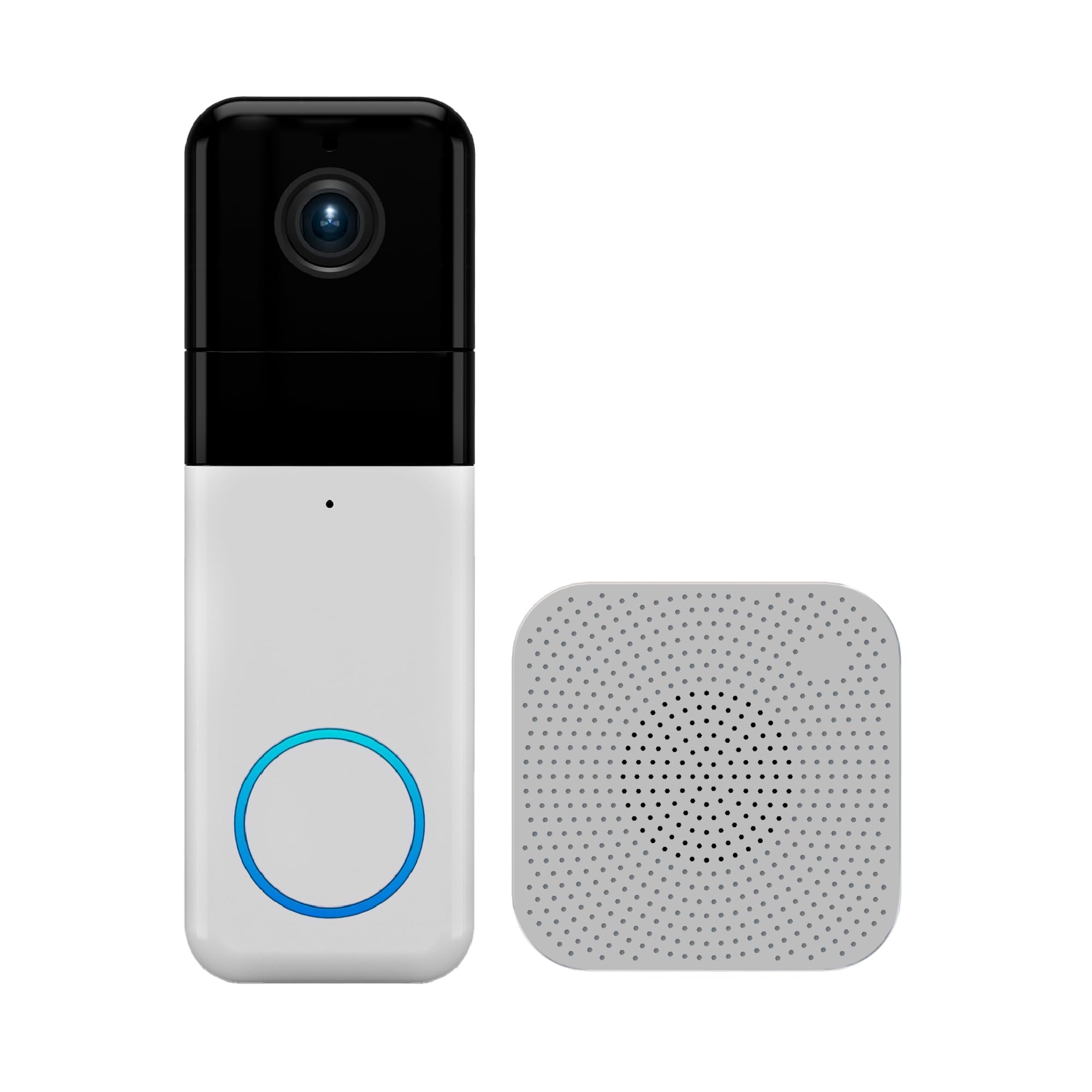
Thirty seconds, no screwdriver, and a chime that barks at strangers.
For a rental or a door you cannot drill, the Wyze Pro’s setup is the story. Screw-free mounting uses 3M tape and gets you running in roughly 30 seconds; screws and wiring are included if you later want a permanent hardwired install. That flexibility — temporary now, permanent later — is the split most doorbells make you choose up front.
Picture is 1440 HD, which Wyze positions as clearer than traditional HD, and the 1:1 aspect ratio shows the full person plus whatever is on the ground. The included chime carries 20 tunes and 8 volume levels, with a dog-bark tone you can play to deter intruders.
The honest catch is storage. The Wyze Pro records locally on a microSD card if you skip the subscription, but the flashiest detection features — real-time human detection and 14-day cloud storage — need the Cam Plus plan. The card also lives in the camera outdoors, which is worth knowing if theft is a concern. Battery life draws mixed notes, with a handful reporting it stops holding a charge as it ages.
Why buyers reach for it
- 30-second screw-free install, with screws and wiring in the box for later
- 1440 HD with a 1:1 head-to-toe view
- Chime included with 20 tunes, 8 volume levels, and a dog-bark tone
- Optional microSD storage for local recording without a subscription
What to weigh
- Human detection sits behind the optional Cam Plus plan
- The microSD card lives inside the outdoor camera
- Some owners mention the battery stops taking a charge over time
Made for: renters and first-time doorbell buyers who want the fastest possible path from box to doorstep.
Not the one if: you want your card indoors and the best detection features without an add-on plan.
6. Anona 3K Dual Cam Video Doorbell Camera
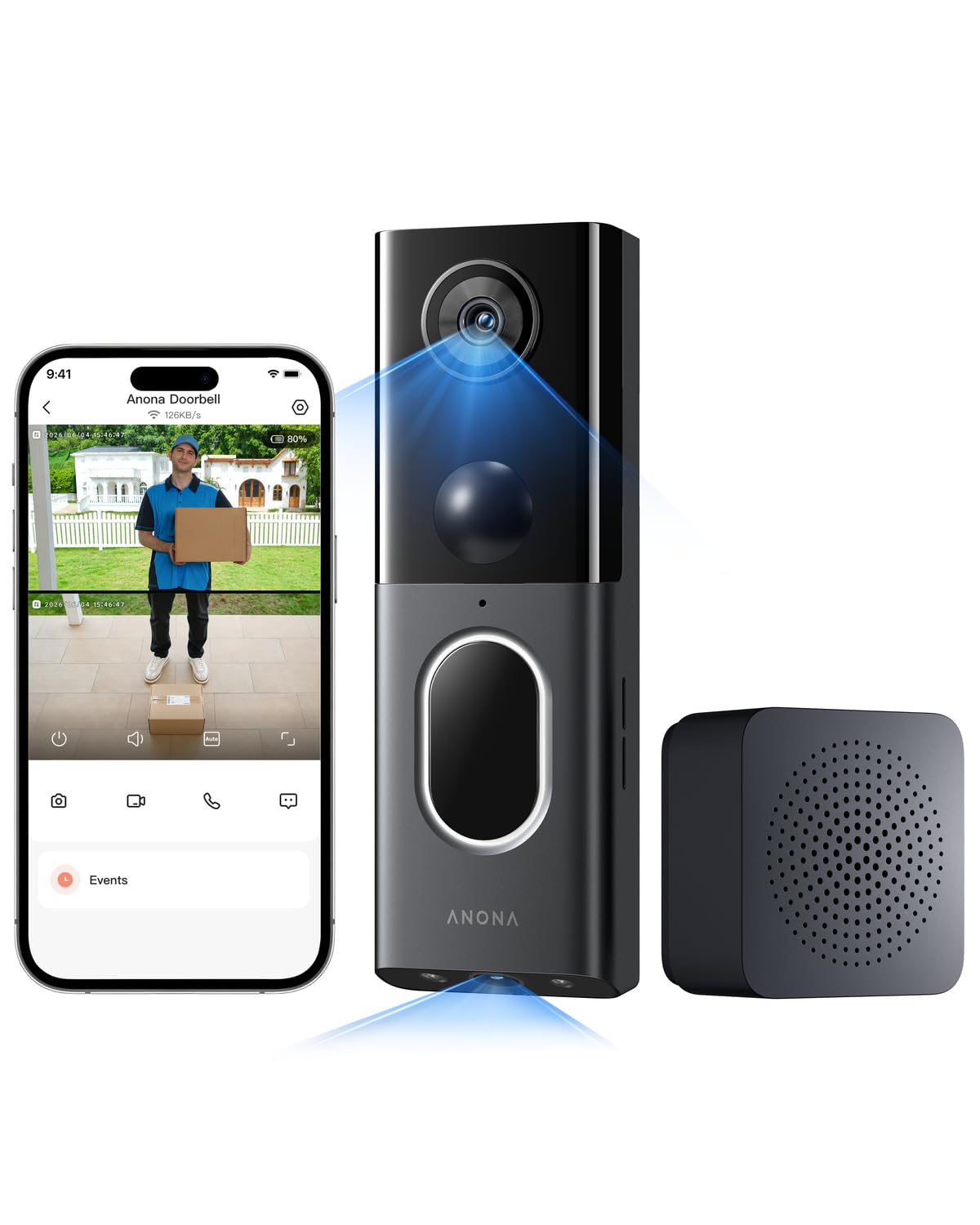
Two cameras and 3K resolution — the sharpest dual-cam on this list.
Anona’s 3K 5MP main camera captures visitors at eye level while the secondary camera watches packages, pets and activity near the doorstep, giving you two views at once. Resolution here is the ceiling of this list: 3K 5MP outranks the eufy E340’s 2K Full HD and the Aqara G400’s 2K HD on raw pixel count. Color night vision keeps low-light frames usable, and the lower camera’s night vision is the specific piece owners single out for praise.
Storage is generous — a microSD card up to 512GB (not included), matching the Aqara G400’s ceiling and double the aosu’s 256GB maximum. The 5200mAh battery provides up to 100 days of use wirelessly; hardwired to existing wiring, it runs 24/7 continuous recording. IP65 weather resistance, Wi-Fi 6 on 2.4GHz, an included indoor chime and mechanical chime compatibility round out the hardware.
Where the Anona asks you to trust it is reliability, and that is where owner experience splits. The picture quality, install and head-to-toe view land as real wins; battery life and reliability draw a fair share of mixed notes, with some reporting the unit stopping after six weeks. The 150+ ratings reflect that smaller track record compared to the aosu’s much larger base.
The standout spec: 3K 5MP dual-camera video is the sharpest resolution on this entire list, and 512GB of card capacity matches the top of the field.
The honest read: reliability reports are split and the review base is smaller, so this is a pick for someone drawn to dual-cam clarity who accepts a slightly less-proven track record.
Choose it for: the dual-camera view combined with the highest resolution in this lineup, backed by 512GB of expandable storage.
Go safer if: a deep owner track record matters more to you than the pixel count jump.
7. REOLINK Battery Video Doorbell (2nd Gen)
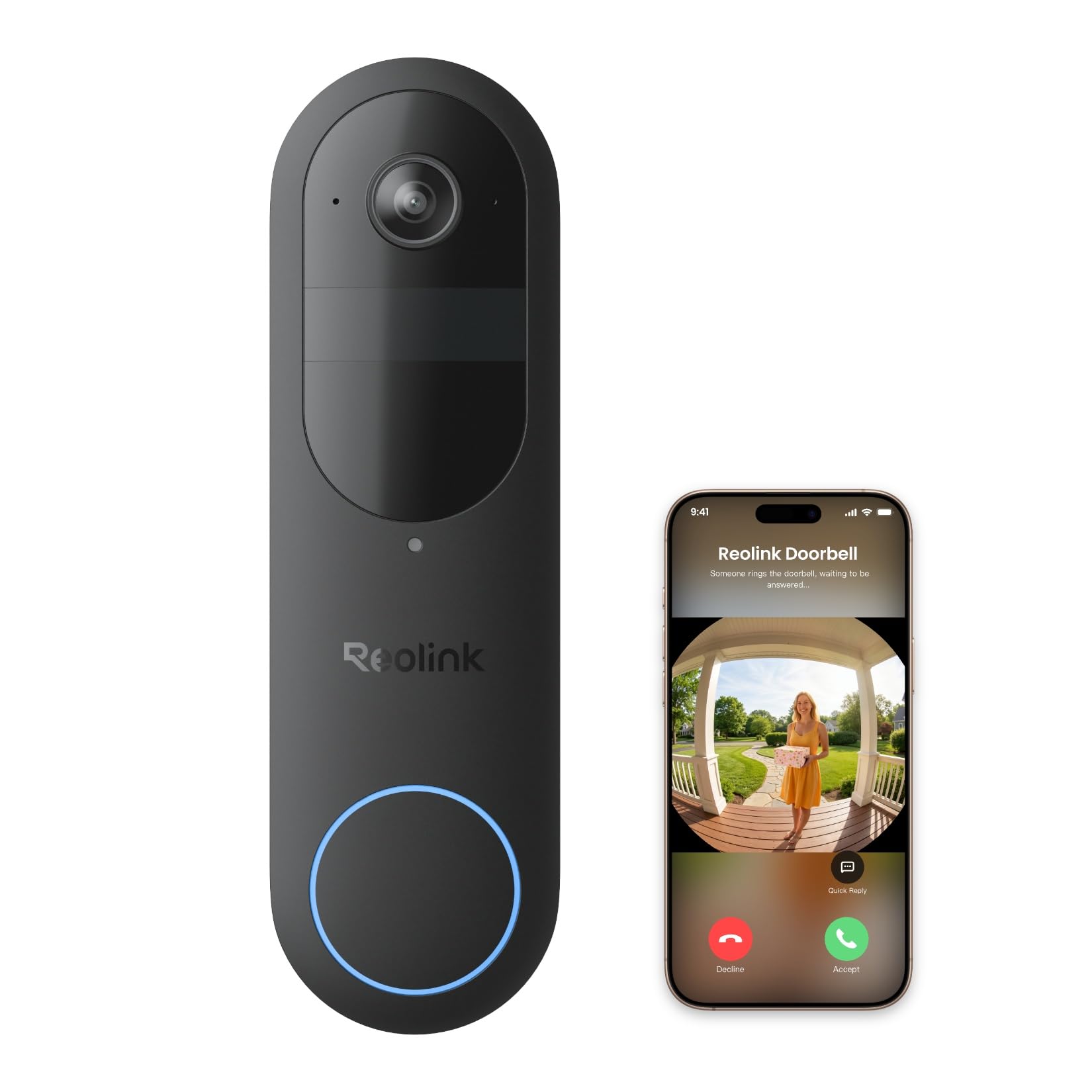
For the tinkerer who wants the card, the NVR and the FTP server all at once.
The Reolink’s strength is where you can store footage. It can write to an SD card up to 512GB (a memory card that holds video), a Reolink Home Hub, an NVR (a network video recorder that stores camera footage), or an FTP server (a computer that stores files) — every route local, and all encrypted. That is the widest menu of local options in this guide, and it matters if you already run a Reolink NVR system at home.
The 2K 4MP 1:1 view gives 150°×150°×180° head-to-toe framing, HDR plus night vision for tricky light. Battery power is decent too — the maker estimates up to 10 months on a single charge at 5 minutes of recording per day. A Reolink Doorbell Solar Changer (sold separately) or 8–24VAC wiring keeps it topped up.
Two things to plan around. Reolink Chime Plus (sold separately) is the compatible chime — the original Reolink Chime is not, and third-party mechanical chimes are not recommended. Smart detection of people, vehicles, animals and packages needs no subscription, but the free plan caps you at up to 25 rich notifications per day. Setup experiences split, and the record here is on the lighter side, so go in with some patience.
Why it earns a spot
- 512GB SD card, Home Hub, NVR or FTP — the widest local storage menu here
- Up to 10 months per charge at 5 minutes a day
- 2K 4MP 1:1 head-to-toe view with HDR and night vision
- Free AI detection of people, vehicles, animals and packages
Plan your setup around
- Needs Reolink Chime Plus (sold separately) — not the original Reolink Chime
- Free plan limits rich notifications to up to 25 per day
- Setup and battery reports vary across users
The right fit for: someone running a Reolink NVR or FTP setup who wants their doorbell feeding in.
Keep looking if: you want one self-contained kit with the chime included and no add-on accessories.
8. PHILIPS Security Video Doorbell Camera with Chime
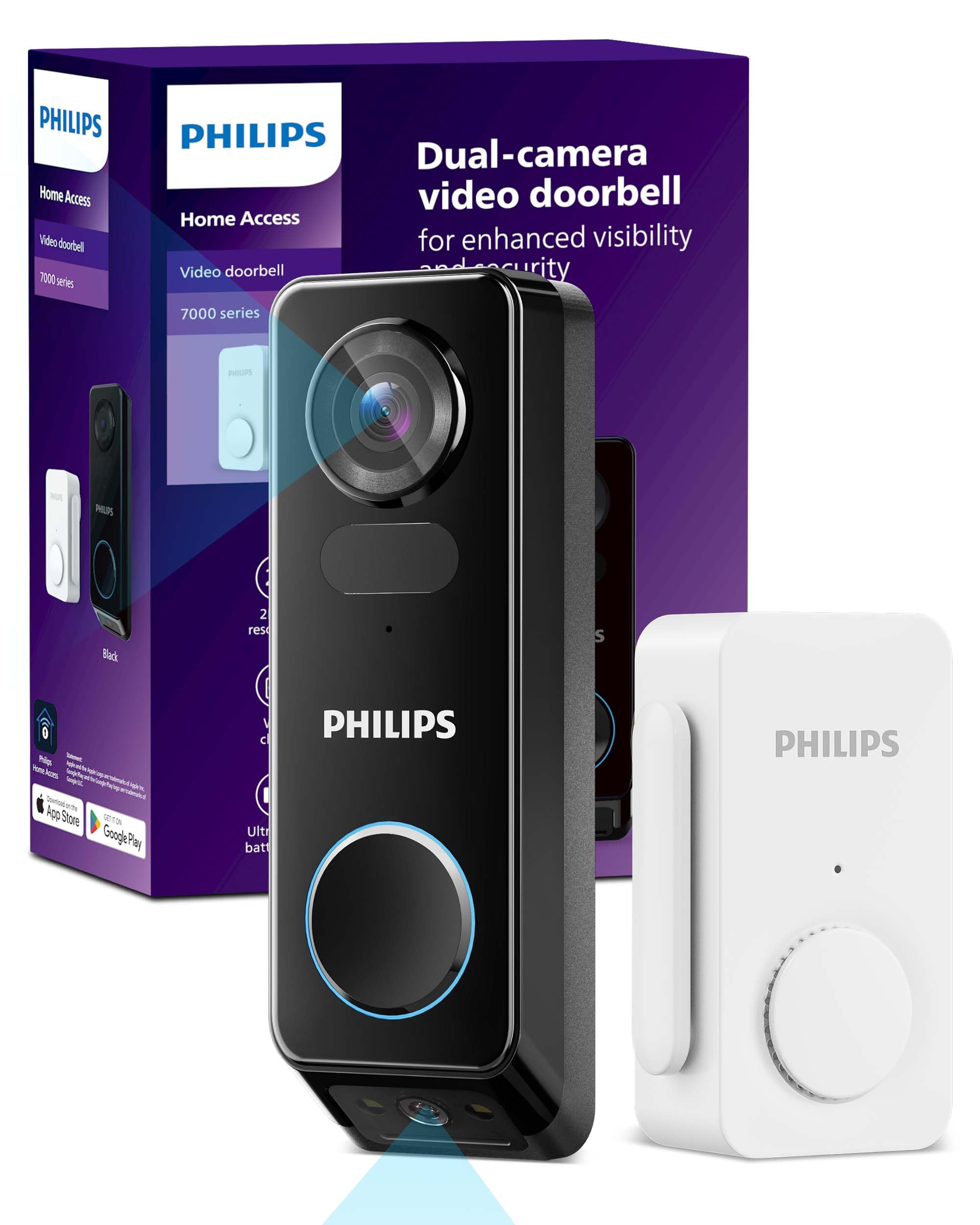
A 10,000mAh battery in a doorbell — that is twice the pack of the eufy and the aosu.
PHILIPS put a genuinely huge battery in this doorbell. The 10,000mAh pack dwarfs the 5200mAh cells in the eufy E340 and aosu doorbell, and owner reports on battery life here land firmly on the positive side. If you refuse to be the person swapping a doorbell battery every other month, this is the model that makes the argument for you.
The dual-camera setup matches the eufy’s approach — a front camera for approaching people plus a downward camera for the ground and packages right at your step. Video is 2K QHD with infrared night vision, and detection combines radar, PIR sensors and human detection with adjustable zones. It can be hardwired at 8–24V, above 10VA, if you want continuous power, and it includes a chime in the box.
One storage note to read carefully: no subscription is required, but the recording path is “up to 8GB of secure, motion-activated videos” encrypted with AES 128-bit encryption (a common security standard) — not a microSD slot you can swap for a bigger card. Live stream reaches the app from the front camera only. Reliability reports are split, with some reporting the unit stops after a month, and reconnection issues appear in the mix.
The headline: a 10,000mAh battery and dual cameras at a premium price point, with no subscription on the recordings.
The catch: 8GB of motion-activated storage is a fixed ceiling, so this is a “recent events” doorbell rather than a long archive — and some units have needed a reset.
Pick it if: a big battery and long runtimes beat an expandable card slot in your priorities.
skip it if: you want a microSD card you can upgrade to 512GB and rewind weeks of footage.
9. 8″ Wireless Video Doorbell with Touchscreen Monitor
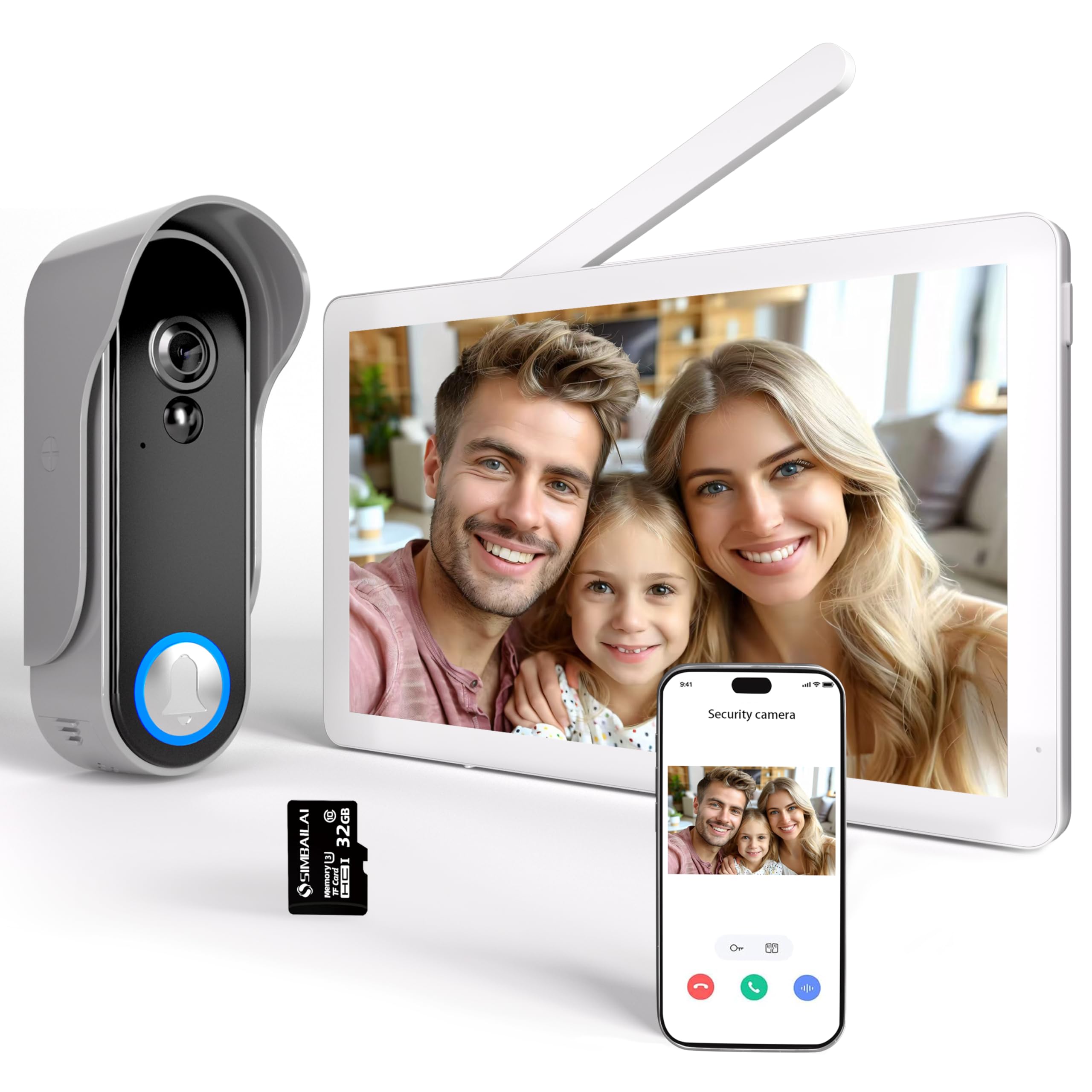
The doorbell your mom can answer without opening the door or finding her phone.
This is a different shape of local-storage doorbell. Instead of a card in the camera, the 32GB microSD card sits inside the indoor monitor — an 8mm-thin 8-inch touchscreen panel that mounts on a wall or stands on a counter. That monitor carries the recording, so a stolen or smashed doorbell leaves your footage on your shelf. Card capacity expands to 128GB, so the ceiling is modest but the safety factor is real.
The camera and monitor run on their own private 2.4GHz link, which means the bell rings and the screen lights up during a power outage — a feature almost no cloud-first doorbell can match. Reach is about 2 interior walls or 165ft in open air, and concrete or metal will weaken it. The camera streams 1080P at 160-degrees, wider than the 105-degree lenses common in this bracket, and the monitor panel is 1280×800 — a step up from the 1024×600 many listings quietly use.
A 7000mAh battery (a measure of charge capacity) lasts about 45–60 days per charge, with Type-C recharge (a common USB connector) or 12–24V hardwiring. IP65 weatherproofing (protection against dust and water jets) covers the outdoor unit, and a 2-year warranty backs it. Where it is a harder sell: 1080P (a resolution of 1920×1080 pixels) is below the resolution of every other doorbell in this guide, and the indoor monitor is the only display that gets full camera control — the phone app handles remote viewing but not the full picture.
Why it makes the list
- 32GB card in the indoor monitor — footage stays safe if the doorbell is taken
- Works during a power outage on its own private 2.4GHz link
- 8-inch 1280×800 monitor readable by two people at once
- 160-degree lens and three PIR sensitivity levels
What you trade away
- 1080P resolution is the lowest on this list
- Storage caps at 128GB
- The private link weakens through concrete and metal walls
The right door for: a parent, grandparent or anyone who wants to see and talk to a visitor on a big screen without a phone in hand.
Not the one if: sharp resolution and long archives matter more than a dedicated indoor display.
Know the Specs
Local Storage: Card, Hub, or Monitor
“Local storage” means the recording stays on hardware you own, not on a company’s server. The location of that hardware matters. A microSD card inside the outdoor camera can be pried off with the unit. A card inside an indoor HomeBase or touchscreen monitor stays in your house. Before buying, check the maximum card size — the Aqara G400 and Anona accept 512GB, the aosu caps at 256GB, the SIMBAILAI monitor at 128GB, and the Philips records to a fixed 8GB block. More capacity means you can rewind further back if a package goes missing.
Field of View and Aspect Ratio
Field of view is measured in degrees — the aosu’s 166 degrees and the Aqara’s 165 degrees look nearly identical on paper. The shape of the frame matters more. A tall 3:4 or 1:1 frame shows a standing visitor plus the parcel on the ground. A squat 16:9 frame crops the floor. The Wyze Pro and REOLINK both lean into 1:1, the Aqara uses 3:4, and the SIMBAILAI uses 160 degrees wide with a standard frame. If packages matter most, pick a tall 3:4 or 1:1 frame over a squat 16:9 one.
Power: Battery, Wired, or PoE
Battery models trade an easy install for a recharge cycle. The eufy E340, aosu and WUUK all run on 5200mAh packs; the PHILIPS jumps to 10,000mAh; the SIMBAILAI sits at 7000mAh. Wired models reuse existing doorbell wiring — usually somewhere in the 8–24V range — and never need a swap. PoE is a single cable carrying both power and data; the Aqara G400 supports PoE, which makes it ideal for a new build where you can fish a cable. Two-way models let you start wireless and hardwire later.
No Subscription, But Read the Fine Print
Every pick here records locally without a required subscription, which is exactly the point. That does not mean every feature is free. The Wyze Pro’s human detection and 14-day cloud storage sit in the Cam Plus plan. The REOLINK free plan caps rich notifications at 25 per day. The Aqara’s HomeKit Secure Video needs an iCloud+ plan and an Apple home hub. The base local recording on all of these runs subscription-free — just know which extras have a fee attached.
Common Questions
Does a local-storage doorbell still work if the Wi-Fi goes down?
Can a thief steal the doorbell and take my recordings with it?
How much storage do I need for a month of doorbell footage?
Is 2K video noticeably better than 1080P on a doorbell?
Will any of these work with my existing doorbell chime?
What is a PoE doorbell and why choose one?
Do I still pay a monthly fee for any of these?
Which doorbell offers the widest field of view?
Can I hardwire a battery doorbell so I never recharge it?
What happens to old footage when the card fills up?
Final Thoughts: The VerdictThe winner of this video doorbell with local storage search is the eufy Security Video Doorbell E340 because it pairs a downward-facing package camera with a face-level lens — two views of your step at once — and keeps the footage on a eufy HomeBase indoors with no monthly fee. If Apple HomeKit is your ecosystem and you want 512GB of card space, the Aqara Doorbell Camera G400 is the wired pick to beat. And if you want a big screen on the counter that a parent can answer without finding a phone, the 8″ Wireless Video Doorbell with Touchscreen Monitor puts your footage on a shelf indoors where theft cannot reach it.
One honest nudge to close on: if you want the doorbell with the deepest owner track record behind it, the aosu has thousands more ratings logged than any pick here — but the eufy still takes the top spot because of its dual-camera package view. Buy the eufy if dual views matter, the aosu if a proven crowd matters more, and the Aqara if you already live in HomeKit (Apple’s smart-home system) with wiring at the door.
How we choose
We do not accept paid placement. Every pick is matched to a real buyer and a real use-case; we do not hands-on test units.
Sources
Specifications: manufacturer listings and product documentation. Review insights: verified customer reviews, as of November 2026. Pricing: not shown on this page (it changes often); check the current price via the retailer link.
As an Amazon Associate, Tactical Gear Guy earns from qualifying purchases. This does not affect which products we feature.