Specs are compiled from manufacturer listings and verified buyer reviews and can change over time — please confirm the key details on the product page before buying.
If you want the shortest answer: buy a hammock tent that keeps its bug net off your face, packs under about four pounds, and comes with its own rain tarp. Everything else is detail. The Hennessy Expedition Classic gets that combination right and has the deepest track record of the group here, which is why it heads this list.
This guide is built by comparing the manufacturers’ published specifications and the patterns across verified customer reviews, so you get each pick’s real strengths and trade-offs instead of marketing spin.
Below you’ll find the eight shelters worth your pack space sorted by who they actually suit, from a sub-three-pound jungle classic to a flat-lay triangle rig. Every figure comes straight from the maker’s own spec sheet, so you can weigh the trade-offs yourself before committing to the ultralight hammock tent that fits your route.
Top Picks

How To Choose The Best Ultralight Hammock Tent
The mistake most first-timers make is buying on packed weight alone. A three-pound shelter that soaks through in a downpour or lets mosquitoes bite through the floor is heavier in practice than a four-pound one that actually works. Weigh the numbers against the night you’ll actually have.
Start with fabric denier, not gram-counting
Denier (the thickness rating of the nylon thread, written as a number plus “D”) is your durability guide. A 20D fabric is thin and light; a 70D fabric is noticeably tougher against abrasion and branches. Ultralight shelters tend to sit at the low end, so check whether the maker reinforced the floor where your heels and pack rest.
Know your entry style before you buy
Bottom-entry hammocks close under your body weight, which seals out bugs without a zipper to snag. Side-zip and top-load designs are easier to get into with a sleeping pad already inside. Neither is better — one suits a fast solo camper, the other suits someone who tosses and turns and gets up at night.
Check the rainfly rating and coverage
A rainfly rated at PU3000mm (a waterproof-pressure measure — higher means more resistance to water pushing through) handles sustained rain better than a bare PU2000mm sheet. Coverage length matters just as much as the rating, so match the tarp to the hammock’s full length, not just its middle.
Look closely at what’s included
Tree straps, carabiners, poles, and a stuff sack can add real weight and cost if sold separately. Suspension rated well above the hammock’s weight limit — like a 1500lb test rope on a 250lb-rated body — gives you margin for sway and settling. Confirm the whole kit fits your pack before you commit.
Side-by-Side Comparison
| Model | Best For | Weight | Load Rating | Setup Length | Amazon |
|---|---|---|---|---|---|
| Hennessy Expedition Classic★ Best Overall | Solo jungle and 3-season camping | 2.5 lb | 250 lb | — | Amazon |
| WintMing 3 in 1 Hammock TentBest Value | Budget backpacking with rain cover | 3 lb | 440 lb | 107 in | Amazon |
| Night Cat 4 in 1 Hammock TentMost Room | Long-body campers wanting room | 3.5 lb | 440 lb | 132 in | Amazon |
| Rivenlo 3 in 1 Camping Hammock Tent | Fast solo setups on trails | 3.3 lb | 440 lb | 106 in | Amazon |
| SkyNest 11ft 4-in-1 Double | Versatile shelter with porch mode | 3.3 lb | 440 lb | 131.8 in | Amazon |
| Night Cat Flat Lay Tent | Side and back sleepers wanting flat | 5 lb | 330 lb | 86.6 in | Amazon |
| Lawson Blue Ridge Hammock Tent | Tree-free camping with arch poles | 4.3 lb | 275 lb | 90 in | Amazon |
Detailed Reviews
1. Hennessy Hammock – Expedition Classic
Our pick — 4.0+★ from 200+ verified ratings; the strongest balance of quality and price.
The jungle classic that seals itself shut the moment you lie down.
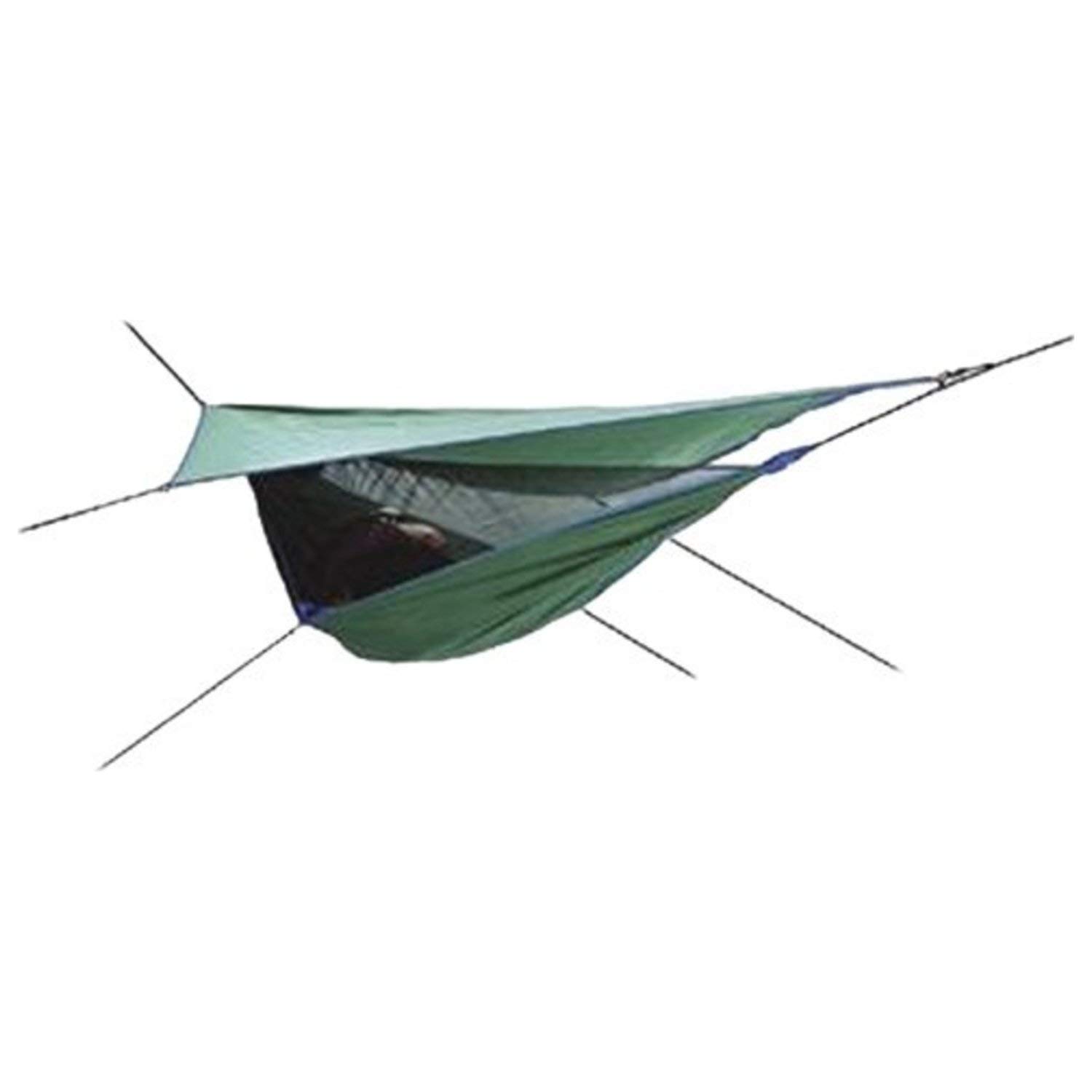
The 2.5-pound body handles anyone up to 6ft and 250lbs, and the bottom entry is the clever part — the fabric snaps closed under your body weight and seals with velcro, so there’s no zipper to snag and no gap for mosquitoes at 2 a.m.
What wins people over is the sheer build quality, and the set-up speed runs a close second. The asymmetrical cut (a patented shape that lets you lie on the diagonal) works with a structural ridgeline — a fixed cord above you that locks the hang angle — so you get the same flat lie every single night. Compared with the Night Cat 4-in-1 further down the list, this one is lighter at 2.5 lb against 3.5 lb, though it costs you length and load headroom.
The rainfly is 70d ripstop polyester, the bug net is 30D no-see-um mesh (fine enough to block the tiny biting midges that pass through coarser netting), and the suspension is 1500lb test spectra rope — over six times the 250lb weight limit, in the company’s own wording. Webbing straps come bundled to protect the bark. Owners who’ve ridden out real storms report staying dry, and many describe the rig lasting years of service. The catch: 9 inches of spread is a snug solo bed, so if you want to stash a pack inside or you’re broad-shouldered, look at the wider options here.
Why backpackers commit to it
- At 2.5 lb it is the lightest full shelter here, and the complete system ships with hammock, mesh, and rainfly in one box.
- Bottom entry snaps shut under body weight and seals with velcro — no zip to fumble in the dark.
- Structural ridgeline and patented asymmetrical shape give you a repeatable flat lie.
- 1500lb test suspension rope against a 250lb rating leaves a wide safety margin.
Where it asks you to compromise
- The 250lb load rating and 6ft ceiling rule out bigger or taller campers.
- Bottom entry takes getting used to on the first night.
Reach for this if: you’re a solo camper under 6ft who wants a proven, self-sealing jungle shelter that packs light.
Think twice if: you’re near the top of that weight or height limit — the margin gets thin.
2. WintMing Hammock with Mosquito Net
The entry-level three-in-one that packs bug net and rain cover so you don’t buy them twice.
For a first hammock tent, the WintMing delivers the full package — bug net, rain fly, aluminum poles, ropes, and storage bag all in one. The 107-inch length is shorter than the Night Cat 4-in-1’s 132 inches, so it suits shorter frames better, but it carries a 440lb load rating and only weighs 3 pounds.
Buyers tend to praise the quick pop-up setup and the mosquito net holding up on muggy nights. The rainfly adds a second layer against condensation drip and sun, and the included loop straps get the suspension up in minutes. For an inexpensive first foray, that’s a lot of function.
Be honest about the durability picture: while many find the fabric sturdy, some report netting tearing on first use and zips breaking repeatedly. That’s a real quality variance to weigh — the zipper quality is the piece to treat gently. If you want a low-risk starter and you’re careful with the net, this is the budget-friendly gateway.
Where the budget really goes: the money buys you a complete kit — rainfly, poles, and straps — at a fraction of premium cost, and the 440lb rating gives light users plenty of margin.
The honest trade-off: build consistency is uneven, with netting and zippers drawing the most complaints. Treat the mesh and zip as the wear points and this holds up for casual trips.
Good first hammock tent if: you want a full shelter bundle cheaply and mostly camp a few nights a season.
Look elsewhere if: you need bombproof seams for hard nightly use — the durability stories vary.
3. Night Cat Camping Hammock Tent
A 132-inch bed that gives tall campers and restless sleepers real stretch-out room.
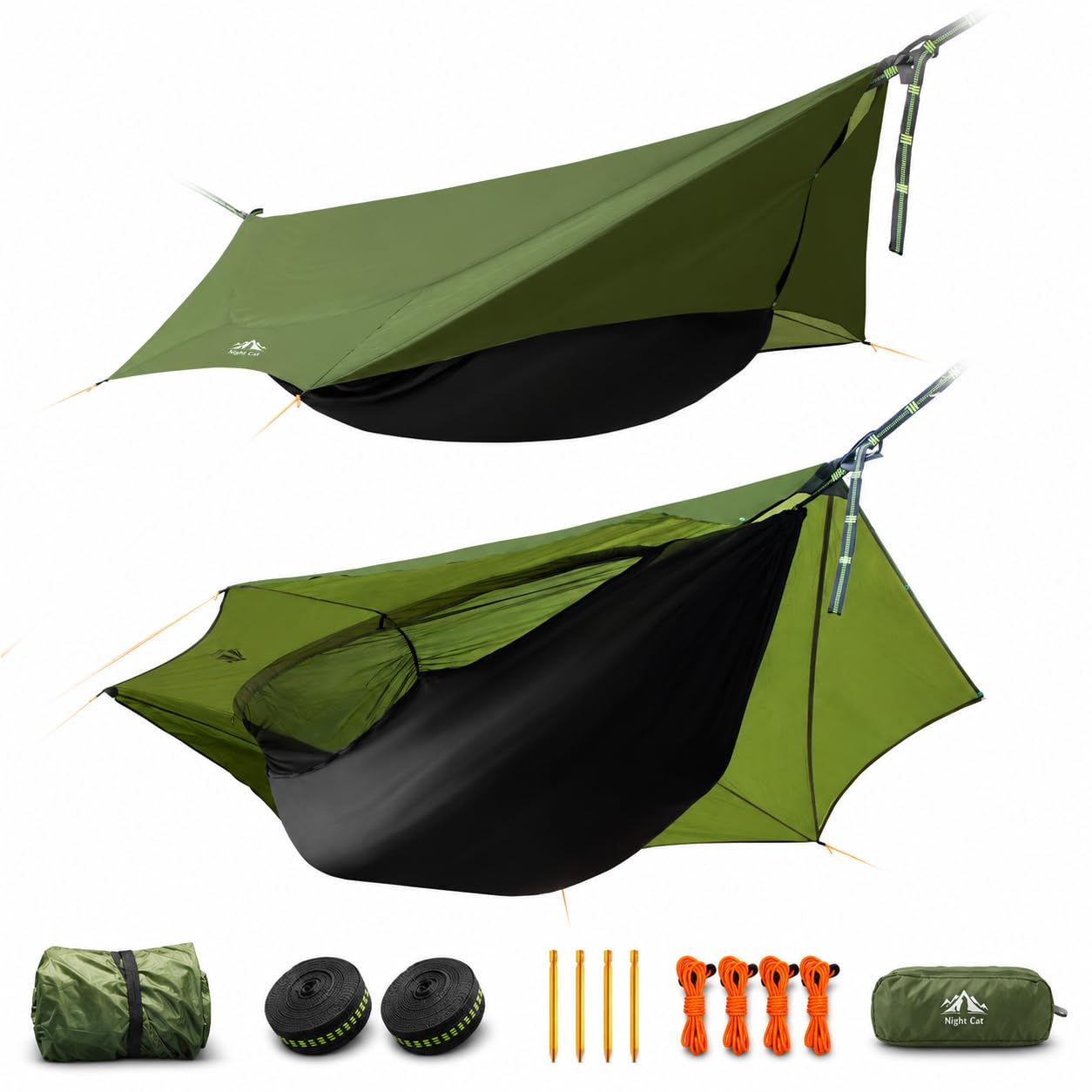
Length is the headline here: at 132 inches this is by far the longest shelter in this roundup, and that extra real estate matters if you’re over average height or you like to sprawl. The 440lb rating gives big users headroom, and at 3.5 pounds packed it stays in the ultralight zone.
The four-in-one kit wraps a rainfly and built-in mosquito net into one carry, and the quick set-up is a common praise point. The waterproof tarp sheds rain while the mesh keeps bugs off — a solid all-rounder for hiking and jungle trips where you want one integrated system.
Durability is the mixed story. Some owners have ridden out big thunderstorms in it, while others report the fabric ripping down the center. Getting in and out also gets a split verdict from owners — some find it easy, some wrestle with the entry. If you want maximum length and can accept that the seams are the soft spot, this is a roomy mid-range pick.
The stretch-out factor: 132 inches is genuinely generous and the 440lb load suits larger campers. Combined with a full rainfly and bug net, it covers tall or broad users better than most of the field.
Keep an eye on: durability reports split between surviving storms and center rips, and entry can be awkward. Careful handling at the seams keeps it going.
Best for: taller campers and anyone who wants a longer, roomier hang without much weight penalty.
Skip if: you’re rough on gear nightly — the center fabric is the weak point some owners hit.
4. Camping Hammock Tent with Mosquito Net

Fold-out poles and 10-loop straps make this the one you pitch in the fading light.
Where some hammocks make you fiddle with rope to hold up the bug net, this Rivenlo uses two foldable aluminum support poles and includes 110-inch tree straps with 10 loops for length adjustment. That’s the difference between ten minutes of fiddling and a fast, repeatable pitch — a real edge when you roll into camp late.
Weight lands at 3.3 pounds thanks to 30D nylon spinning as the main fabric, with a 70D nylon body carrying up to 200KG (440 LBS). It’s rated for one person with roomy space, and two people can sit as a swing if needed. The flip: rotate the hammock for a plain tree hang, or add the rainfly to convert it into a waterproof tent with airflow.
Owners respond to the all-in-one convenience — the built-in mosquito net and rainfly keep rain and morning dew off, and it packs into a 15.7 x 5.5 x 4.7-inch stuff sack for trail, patio, or travel duty. A sleeping pad slips inside (sold separately) to support back and side sleepers overnight.
What earns it a spot
- Two aluminum poles and 110-inch, 10-loop straps give a quick, adjustable pitch.
- 3-in-1 flexibility: plain hang, bug-protected, or fully rain-covered tent.
- 3.3 lb packed and a compact 15.7 x 5.5 x 4.7-inch bag slide into most packs.
What to weigh first
- Sleeping pad is not included, so comfort depends on adding your own.
- Poles add a small fixed weight and one more piece to keep track of.
Made for: solo trail campers who value a fast, tool-light setup over deep jungle toughness.
Not ideal for: those who don’t own a sleeping pad yet — you’ll want one for a full night’s sleep.
5. SkyNest 11ft Camping Hammock

A rainfly that detaches into an awning — the swiss-army shelter of the bunch.
The SkyNest’s rainfly is the star. Made of 20D ripstop nylon coated with silicone, it’s waterproof rated at PU3000mm (a waterproof-pressure figure — higher means more rain resistance) and UPF50+ for sun protection. Unzip the two hammock zips and the tarp separates entirely, so you can rig it as an awning, a waterproof shelter, or a canopy while the hammock stays stowed.
That modularity carries into the hang itself. Roll the net up under the tarp, or use two separately sold poles for porch mode with room to cook and sit. With no trees, combine the straps and tent stakes for ground-tent mode. Two poles you must supply open up that porch setup.
Specs are steady across the board: a pentagonal internal design with an outward-extending net keeps mesh off your face, the double-layer bottom lets you tuck a mat between the layers for back support, and the 440lb rating gives side sleepers room to stretch. It packs to 11 x 6.7 x 6.7 inches at 3.3 pounds.
Why it stands out: the detachable PU3000mm rainfly and porch mode turn one purchase into a hammock, awning, and ground shelter. For unpredictable trips, that flexibility is worth more than saved ounces.
Plan around: porch mode requires two poles bought separately, and the double-layer comfort depends on adding a sleeping mat. Without those extras, you get a standard ridge hang.
Worth it when: you want one shelter that adapts to trees, weather, or bare ground across a trip.
Be ready for: buying poles and a mat separately to open up the porch and flat-comfort modes.
6. Night Cat Flat Lay Hammock Tent
Hangs from three trees to give side sleepers a genuinely flat, bed-like lie.
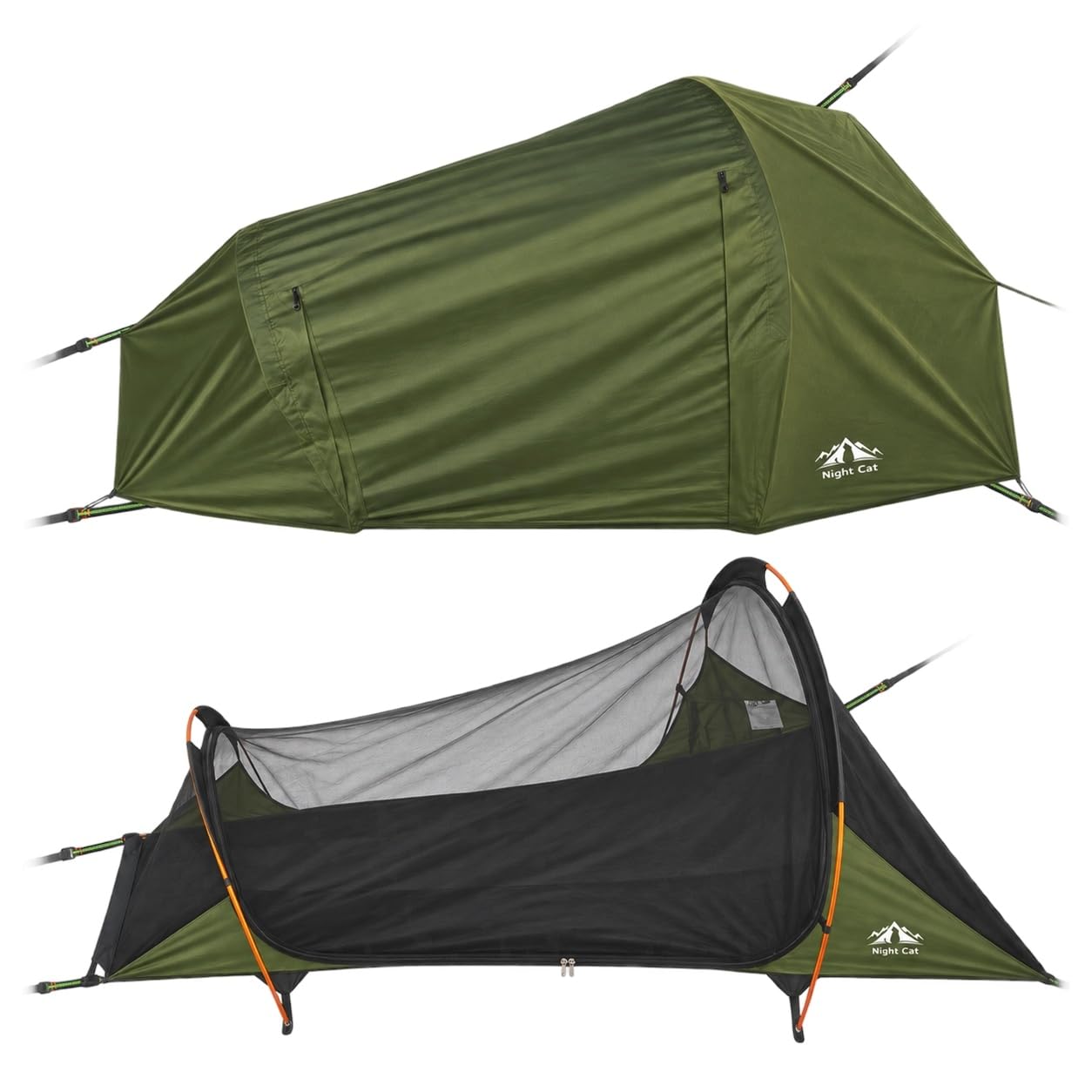
If you’ve tried a hammock and hated the banana curl, this is your answer. The Night Cat Flat Lay uses a three-point stability system — you hang it from three trees forming a triangle — so you rest completely flat like on a bed, which suits side and back sleepers that traditional hammocks leave aching.
The build is 150D nylon fabric (heavier than the 20D and 30D fabrics elsewhere here, and noticeably tougher), with reinforced straps holding up to 330 LBS (150 kg). A fine-mesh mosquito net keeps bugs out, and a waterproof rainfly converts it into a weatherproof tree tent. Owners praise that rainfly for keeping everything dry, even through heavy dew.
The honest trade-off is stability and setup: some owners find it easy to put up, while others report it being complicated and even ripping in the first five minutes. It also needs three anchor trees — a real constraint on tight trails. At 5 pounds it’s the heaviest standard option here, so reserve it for car camping or short approaches.
The flat-lie payoff: three anchor points and the 150D shell deliver a flat bed and dry nights that curled-up hammocks can’t match — the reason side sleepers seek it out.
Know before you go: it needs three trees, weighs 5 pounds, and setup quality varies. Good for basecamp, awkward on dense single-track.
Pick this if: you’re a side or back sleeper who wants a flat bed and can camp where three trees stand close.
Pass if: you hike tight trails with two anchor points or want a sub-4-pound carry.
7. Blue Ridge Camping Hammock and Tent
The award-winning hybrid that sets up as a hammock or a ground tent on the same trip.
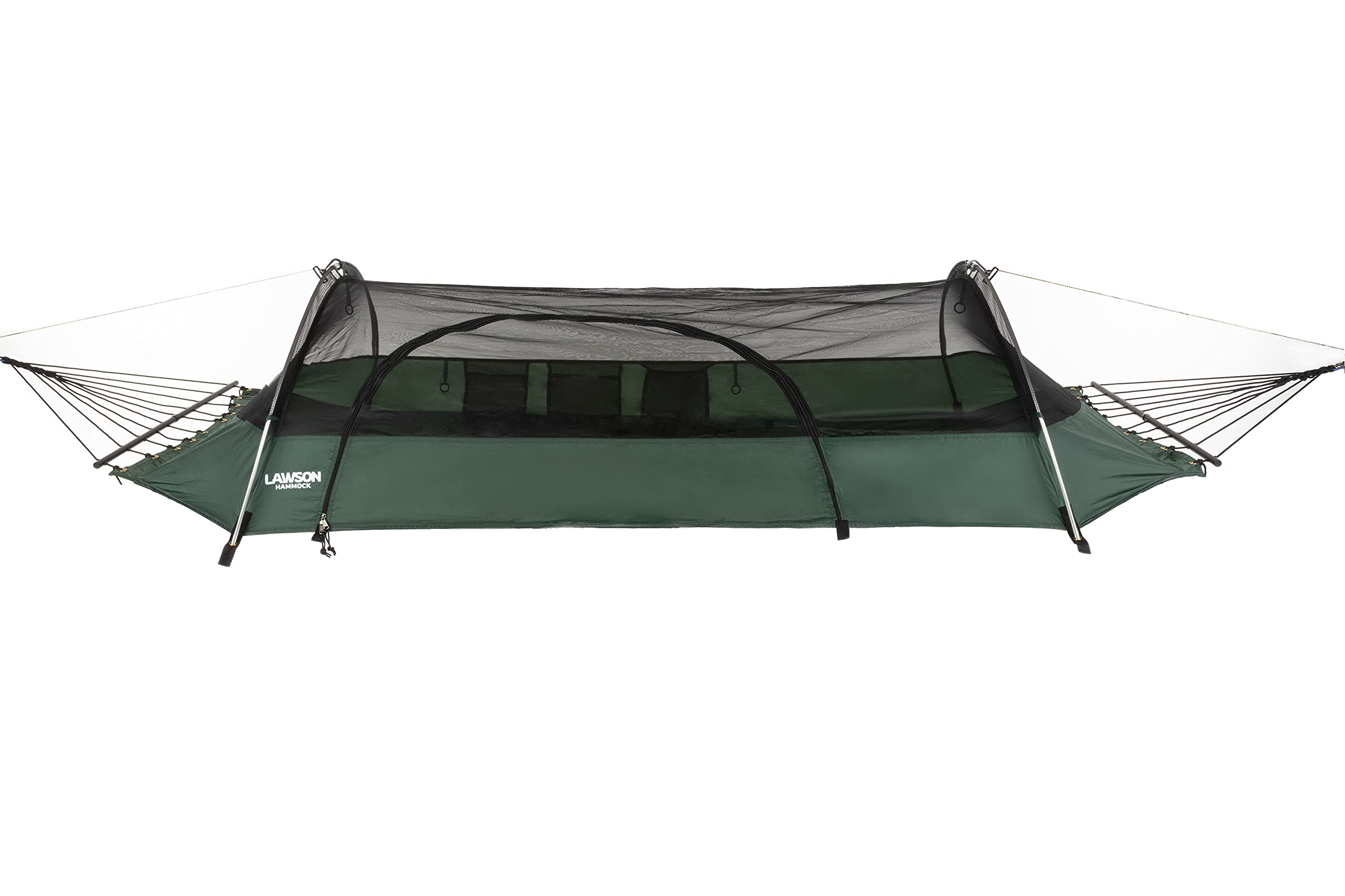
A patented arch-pole and spreader-bar system is what separates the Lawson Blue Ridge from the pure hammocks here. Those poles hold the bed flatter, cutting the “cocoon” curl you feel in a standard hang, and they let the same shelter stand as a ground tent when trees run out. It’s the most versatile single-shelter design in this list.
Comfort is where it shines — the pole-supported flat bed draws the strongest praise, and setup is quick. A detachable waterproof rainfly and bug netting keep weather and insects out, and it packs to 22 x 6 inches at 4.3 pounds with the poles.
The trade-offs are weight and stability. Some find the packed kit heavy for long carries, and a few report the mesh feeling flimsy or the rig feeling tippy when you shift around. Straps are sold separately too, so budget for a suspension. For a car camper, biker, or scouter who wants flexibility over minimum grams, the versatility is worth it.
Where the Blue Ridge wins
- Arch poles and a spreader bar flatten the bed and cut the cocoon curl.
- Converts between hammock and ground tent — no trees needed for the second option.
- Detachable rainfly and bug netting come included with the shelter body.
The catches worth noting
- 4.3 pounds with poles is on the heavy side for a long backpack.
- Straps are sold separately, and some find the mesh flimsy or the hang tippy.
Ideal for: car campers, bikers, and scouts who want hammock-or-ground flexibility from one shelter.
Less suited to: gram-counting thru-hikers — the poles and separate straps add up.
Know the Specs
Denier and Fabric Weight
Denier is a rating of how thick the nylon thread is, shown as a number plus “D.” A 20D fabric is thin and light; a 70D fabric is thicker and resists abrasion better. Ultralight shelters often use 20D or 30D bodies to save weight, so check whether the floor and wear points are reinforced. Lower denier means lighter packing, but it also means you treat branches and rocks with more care.
Load Rating vs. Suspension Strength
The load rating is how much weight the hammock body is built to hold. The suspension — ropes or straps that attach to the trees — should be rated well above that number so it never becomes the weak link. A hammock rated at 250lb paired with rope tested to 1500lb, for example, gives a wide margin for sway and settling. Always check both figures, not just the body rating.
Rainfly Waterproof Rating
The PU number (like PU2000mm or PU3000mm) measures how much water pressure the rainfly coating resists before water pushes through. Higher values handle heavier, sustained rain; lower values may be fine for light showers and dew. Match the rating to the weather you expect, and pair it with full-length coverage so rain doesn’t run down past the tarp’s edge.
Mesh and Bug Protection
The bug net’s mesh size (often described as no-see-um) decides whether tiny biting midges get through. Finer mesh blocks more insects but cuts airflow slightly. Look for netting that stays off your face — either held up by poles, a structural ridgeline, or an outward-extending design — so you can sleep without something brushing your skin all night.
Common Questions
How much does an ultralight hammock tent typically weigh?
Can I use a hammock tent if there are no trees?
What is a flat-lay hammock and who needs one?
Will a hammock tent keep me dry in heavy rain?
Do I need to buy tree straps separately?
How do I stop bugs biting through the bottom of the hammock?
What load rating should I look for?
Is a longer hammock more comfortable?
How long should a hammock tent last?
The Bottom Line
For most campers, the ultralight hammock tent winner is the Hennessy Expedition Classic because its bottom-entry seal, structural ridgeline, and 2.5-pound pack weight make it a night-after-night shelter that just works. If you want a longer, roomier hang without much weight penalty, the Night Cat 4-in-1 gives you 132 inches of bed. And if you want one shelter that shifts from hammock to awning to ground tent, reach for the SkyNest 11ft. Whatever you choose, pick the fabric and load rating that match your real trips, not the lightest number on the page.
How we choose
We do not accept paid placement. Every pick is matched to a real buyer and a real use-case; we do not hands-on test units.
Sources
Specifications: manufacturer listings and product documentation. Review insights: verified customer reviews, as of November 2026. Pricing: not shown on this page (it changes often); check the current price via the retailer link.
As an Amazon Associate, Tactical Gear Guy earns from qualifying purchases. This does not affect which products we feature.