Specs are compiled from manufacturer listings and verified buyer reviews and can change over time — please confirm the key details on the product page before buying.
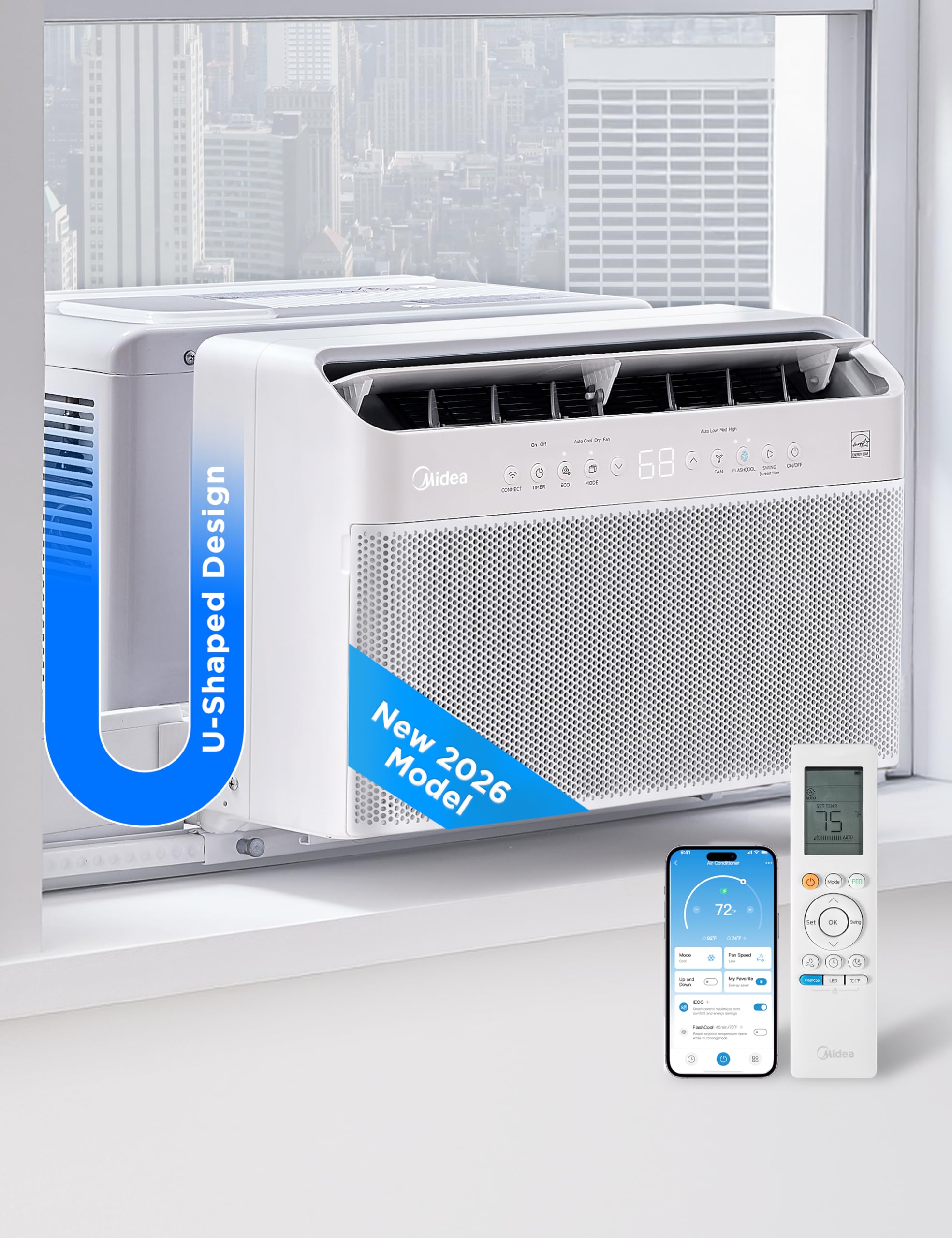
If you want the short answer: buy a U-shaped inverter unit for the noise and the window, not for the spec sticker. The U-shape cradles the noisy compressor outside your glass, so the sash can close over the channel and the room goes quiet. The inverter (a variable-speed compressor that idles down instead of slamming on and off) is what keeps the temperature steady and the power draw low. That combination is the whole reason this shelf exists. Everything below is judged on those two things first, then on cooling power and fit.
This guide is built by comparing the manufacturers’ published specifications and the patterns across verified customer reviews, so you get each pick’s real strengths and trade-offs instead of marketing spin.
You want a cool room without a machine roaring at the window, and seven U-shaped inverter models here are sorted by what each does best and matched to window sizes. For most rooms, buy the Midea 12,000 BTU U Shaped Window Air Conditioner: it cools up to 550 square feet, and it is the crowd favorite at 4.0+ stars across 500+ owners. That is why it leads this list of the best u-shaped inverter air conditioner picks.
Top Picks
How To Choose The Best U-Shaped Inverter Air Conditioner
Start with the window, not the BTU number. A U-shaped unit hangs its body over a bracket that sits in the sash channel, so the glass closes above the unit instead of resting on it. That means you need a specific opening, and every model here lists its own. Measure the width of the opening and the height of the sash travel before anything else. A unit that does not fit your window is not a deal, no matter how quiet it runs.
Match BTU to the room, and understand the two rating systems
Cooling power is measured in BTU (British thermal units — the standard unit of heat a unit can pull out of a room per hour). A 6,000 BTU unit covers roughly a small bedroom, a 10,000 BTU unit a living room, and a 12,000 BTU unit a large open space. The published square-footage figure on each listing is the manufacturer’s own recommendation, so treat it as a ceiling, not a target. One catch worth knowing: some listings quote ASHRAE BTU and DOE BTU side by side. The ZAFRO lists 10000BTU ASHRAE (6200 BTU DOE) — two different measuring standards on the same machine. Size your room against the number the maker gives for square footage, not the bigger of the two BTU figures.
Why the U-shape and the inverter are two separate wins
The U-shape is a mechanical trick: the compressor and condenser sit outside the window in the U channel, so the loud half of the machine is outdoors and the glass blocks the sound. The inverter is an electronic one: instead of the compressor switching fully on and fully off, it varies its speed to hold a target temperature. Together they are why these units are quoted as low as 32 dBA (decibels — a whisper is roughly 30, normal conversation about 60). A flat-back window unit with a fixed-speed compressor cannot match either number, because the whole machine is inside the room and the compressor only knows two speeds.
Smart control, drainage, and what you will actually touch
Most of these run on Wi-Fi through a phone app, and several answer to Alexa or Google Assistant, which is genuinely useful when you want the room cool before you walk in. Drainage matters more than people expect in humid months, so check where the water exits on the model you pick. And look at the remote situation honestly — some units ship a bare-bones remote that only does the basics, while the app covers everything else.
Side-by-Side Comparison
| Model | Best For | Cooling Power | Room Size | Quoted Noise | Amazon |
|---|---|---|---|---|---|
| Midea 12,000 BTU U Shaped | Large rooms and open living space | 12000 BTU | 550 sq ft | 32 dBA | Amazon |
| Midea 8,000 BTU U-Shaped Smart Inverter | Smart-home setups and mid rooms | 8000 BTU | 350 sq ft | 32 dBA | Amazon |
| ZAFRO U Shaped Inverter | Humid climates and fine temperature control | 10000 BTU ASHRAE (6200 BTU DOE) | — | 32 dB | Amazon |
| Kinetheme 10,000 BTU U-Shaped | Budget-friendly 6-in-1 flexibility | 10000 BTU | 450 sq ft | 42 dB | Amazon |
Detailed Reviews
1. Midea 12,000 BTU U Shaped Window Air Conditioner
The one that cools a whole open floor and still lets you sleep in the same room.
Twelve thousand BTU is the headline, and it is the number that earns this unit first place: enough cooling power to cover up to 550 square feet, which is a big living room or an open plan kitchen-and-lounge. It runs on an inverter rotary compressor (a variable-speed pump that trims its own output instead of cycling hard on and off), so the room holds its temperature rather than swinging between too warm and too cold. Midea quotes operation as low as 32 dBA, roughly a whisper, and credits the U channel with putting the mechanical noise outside your glass.
Raw cooling muscle is what wins people over here. The room depends on temperature in a few minutes rather than a slow creep, and it does that in older homes where window units usually struggle. Quiet operation is the close second. The U-shape sends the compressor (the noisy part that makes the cold) outdoors, the sash closes over the top, and what is left inside is airflow rather than machinery. That is the whole pitch of this category in one machine, and here it runs on the biggest scale of the group.
The honest limit is the remote. It is the one part of the package that splits opinion — some find it perfectly usable, plenty find it thin — so plan on running this through the SmartHome app or by voice with Alexa and Google Assistant instead. The other thing to know is that 12,000 BTU (British thermal units — the standard measure of cooling power) is a lot of cooling. In a small bedroom it will be more machine than you need, and the 6,000 BTU models further down are the smarter fit there.
Where it pulls ahead
- Cools up to 550 square feet on 12000 BTU — the largest coverage in this group
- Quoted as low as 32 dBA, with the U channel holding the compressor outside the glass
- Inverter rotary compressor keeps the room steady instead of cycling hot and cold
- Midea claims it is the first window AC to earn ENERGY STAR certification, with more than 37% savings over traditional units
- Window opens for fresh air, and the Anti-Theft Mechanism locks it when closed
What to weigh first
- The bundled remote is the weak link — the app and voice control are the better controls
- Needs a single- or double-hung window 22″ to 36″ wide with at least 13.75″ of height
- More cooling than a small bedroom needs
Point this at: a large living room or open plan space where you want fast, quiet cooling and a window that still opens.
Reconsider if: your room is a small bedroom — step down to a 6,000 BTU model and save the extra capacity.
2. Midea 8,000 BTU U-Shaped Smart Inverter Window AC
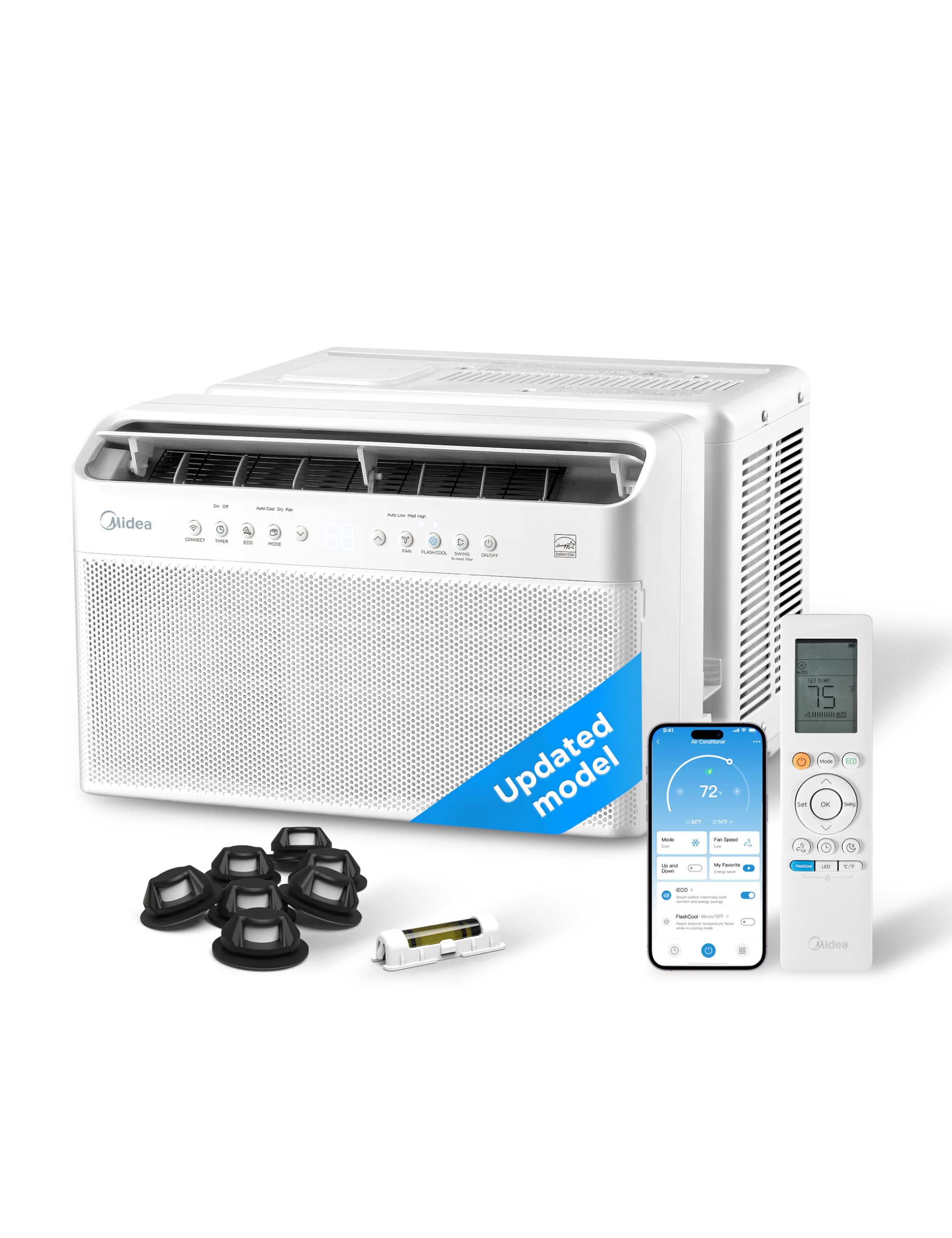
The mid-room model that answers to your phone and barely registers on your ears.
Eight thousand BTU for up to 350 square feet puts this squarely in the mid-room bracket — a primary bedroom, a home office, a converted garage. What separates it from the step-down 6,000 BTU units is the control stack: Wi-Fi through the SmartHome app on iOS or Android, plus Alexa and Google Assistant voice commands, plus the physical remote and panel buttons. The airflow number tells you how it feels in use. It moves 215 CFM on high and 150 CFM on low (cubic feet per minute — the volume of air pushed through the room), so it shifts a real column of air without blasting you out of the chair.
On sound, Midea claims up to 10x quieter than traditional units at as low as 32 dBA — a step above the 9x claim on the rest of the Midea family here. Either way, what you hear is the fan rather than the compressor, because the compressor sits outside the sash. On running cost, Midea labels it 5 Star in its own efficiency rating and claims more than 35% savings versus traditional units in this listing. The stated cooling draw is 710W with rated cooling amps of 8.78, and it uses R32 refrigerant.
The trade-off is one of expectation, not quality. This model sits in the same family as the 12,000 BTU pick above, so the headline cooling figure is smaller — 8,000 BTU and 350 square feet versus 12,000 BTU and 550 square feet. If your room is genuinely big, the smaller unit will run harder and longer to keep up. Match it to the room and it is the better smart-home buy of the two.
Best fit for a connected home: Wi-Fi, Alexa and Google Assistant all work from one app, so you can cool the room before you get home without touching the panel.
The sizing catch: 350 square feet is the ceiling — push past it and you will notice the unit fighting the heat all afternoon.
Worth choosing when: your room is around 350 square feet and you want voice plus app control without paying for extra cooling capacity.
Not the pick for: open-plan spaces — the 12,000 BTU model carries that job.
3. ZAFRO U Shaped Inverter Window Air Conditioner 10000BTU
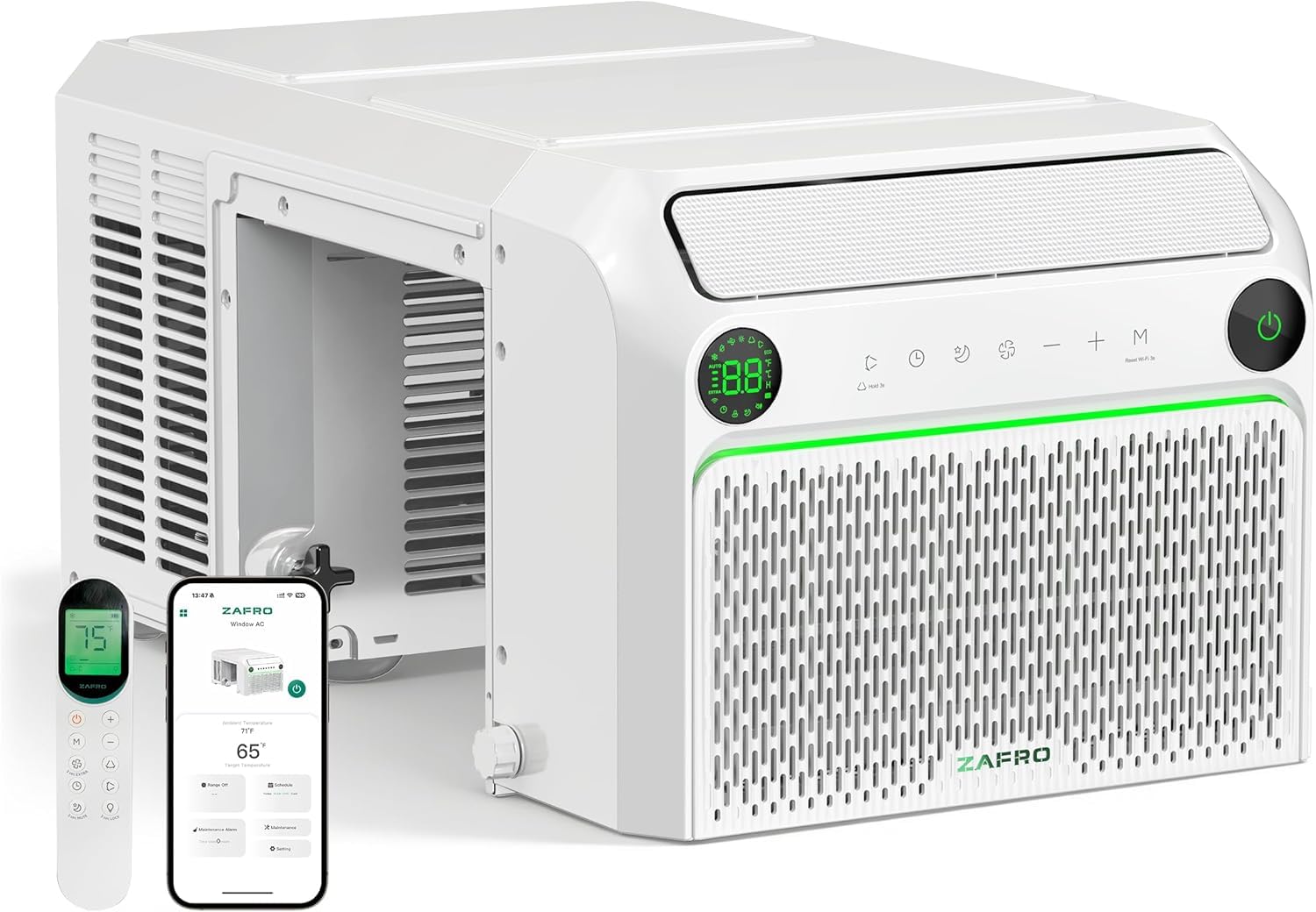
Six modes, a 32 dB whisper, and a drain that lives inside the unit.
Where this one earns its keep is dehumidifying. The Dehum mode is rated to pull up to 70 pints of moisture per day, which turns a sticky room that feels cold into a dry room that feels cool. It also carries the tightest temperature claim of the group at plus or minus 1°F, with the inverter compressor trimming output finely enough to hold the setpoint. Four fan speeds and 4-way 3D airflow spread the output corner to corner rather than straight ahead.
The capacity figure needs a plain-English read, because it is the one that trips people up. This is listed at 10000 BTU ASHRAE (6200 BTU DOE) — two measuring standards on one box, and the DOE figure is the smaller, stricter number. Do not assume you are buying a 10,000 BTU machine in the way the other Midea listings use the term. Size your room against the square footage and be aware that this is a mid-size unit wearing a larger label. The control set is genuinely generous: App, remote, touch panel, and voice via Alexa or Google Home, plus six modes (Cool, Dehum, Fan, Eco, Sleep, Mute).
Quoted noise is 32 dB with the compressor banished outside the window, and the operating range runs from 27 to 113°F. The one recurring note from the review pages is the drain: it sits inside the unit, and buyers flag that as the thing to plan around. If your window sill is awkward or you are running the unit in a very wet climate, know where that water is going before you install.
The case for it
- Removes up to 70 pints of moisture per day in Dehum mode — the standout figure here
- Plus or minus 1°F temperature hold from the inverter compressor
- Six modes: Cool, Dehum, Fan, Eco, Sleep, Mute
- Quoted 32 dB, with the window keeping your view clear
- App, voice, touch and remote all built in
The other side
- The drain is positioned inside the unit — the most-discussed issue on this listing
- The ASHRAE and DOE BTU figures on the same box read very differently, so check the smaller one before you size your room
The right unit if: your summers are humid and you want dry air plus fine temperature control from one machine.
Look past it if: drainage routing at your window is tricky — check that internal drain position first.
4. Midea 10,000 BTU U Shaped Window Air Conditioner
No bracket, no special tools — the install here is the simplest on the list.
Most U-shaped units ask you to bolt a quick-snap bracket into the sash and level it. This one skips that entirely: no bracket, no special tools, and an adjustable depth that fits standard double-hung windows 24 to 48 inches wide with a minimum 16-inch sash opening. That window range is wider than the Midea units, which stop at 36 inches. If your opening is on the wide side, this is the one that will actually go in without a fight.
Cooling is 10,000 BTU across up to 450 square feet, with an adjustable setpoint running from 62°F to 92°F so you can dial in a precise room temperature. Six modes cover Cool, Dry, Fan, Auto, Sleep and Energy Saver, which means one box handles both the sticky dehumidifying days and the silent night runs. A reusable washable mesh filter slides out for rinsing, and the touch panel runs the whole thing — the remote is included for the basics.
Read the noise number carefully. This listing quotes 42 dB in its own heading and then describes 44 dB in the body text, which is noticeably louder than the 32 dB units here. It is still library-adjacent quiet in practice, but if the whole reason you are shopping U-shaped is silence at night, the Midea and ZAFRO options go lower. Weigh that against the easier install and the wide window range.
Why it earns a slot
- Installs without a bracket or special tools
- Fits double-hung windows 24 to 48 inches wide — a broader range than the Midea models
- Six modes including Dry, Sleep and Energy Saver
- Setpoint adjustable from 62°F to 92°F
- Washable mesh filter slides out for rinsing
The honest caveats
- Quoted quietness sits at 42 to 44 dB — not as low as the 32 dB units in this group
- Touch panel and remote only, with no app or voice control
Reach for this if: your window is wider than 36 inches and you want a straightforward install without a bracket kit.
Skip past if: bedroom silence is the whole goal — the 32 dB models are the quieter buy.
5. Midea 6,000 BTU U Shaped Window Air Conditioner
ASHRAE versus DOE BTU
Some listings quote two BTU numbers on the same box because two different measuring standards are in play. The ASHRAE number is typically the larger and the DOE number the stricter, smaller one. When you see both, size your room against the square footage the maker recommends rather than picking the bigger figure off the label.
Inverter compressors
An inverter compressor varies its speed to hold a target temperature instead of switching fully off and on. That is why these units hold a room steady and run quietly — the machine idles near the setpoint rather than restarting hard every few minutes.
Decibels and the U channel
A decibel is a measure of sound, where roughly 30 is a whisper and 60 is normal conversation. The U-shape cradles the compressor outside the window sash, so the loud half of the machine is outdoors and the glass blocks the rest. A flat-back window unit cannot do this because the whole machine sits inside the room.
Window fit and the bracket
Every U-shaped unit publishes a window width range and a minimum sash height, because the glass has to close into the channel. Measure the actual opening, not the frame, and check the bracket requirement — some ship a quick-snap bracket and one here installs with no bracket at all.
Annual energy consumption
This figure estimates kilowatt hours used across a year of typical use. It is the cleanest way to compare running cost between two units in the same family, and it scales with cooling power, so a small unit will always show a far lower annual figure than a large one.
Common Questions
Will a U-shaped window AC fit my existing window frame?
What is the difference between ASHRAE BTU and DOE BTU on these listings?
Does the window really close with a U-shaped unit installed?
How quiet is 32 dBA compared with a normal window AC?
Do I need an inverter compressor, or is a standard one enough?
Where does the water drain on a U-shaped window AC?
Can I control these units from my phone or with voice commands?
How much does a bigger BTU unit actually cost to run compared with a small one?
Is the built-in remote worth relying on?
Can a 6,000 BTU U-shaped unit cool a living room?
The Bottom Line
For most rooms, the model to buy is the Midea 12,000 BTU U Shaped Window Air Conditioner — 12000 BTU across up to 550 square feet, quoted as low as 32 dBA, and the strongest combination of cooling power and quiet in this group. It is the crowd favorite for a reason, and it holds up under the closest scrutiny. If your room is around 350 square feet and you want app and voice control, the Midea 8,000 BTU U-Shaped Smart Inverter is the smarter size. For humid summers where dry air matters as much as cold, the ZAFRO and its 70-pint dehumidifying mode is the one to reach for. And if this is a small bedroom, either 6,000 BTU Midea gets you the same 32 dBA quiet for a fraction of the capacity — just check the window width first, because the opening decides more than the spec sheet does.
How we choose
We do not accept paid placement. Every pick is matched to a real buyer and a real use-case; we do not hands-on test units.
Sources
Specifications: manufacturer listings and product documentation. Review insights: verified customer reviews, as of November 2026. Pricing: not shown on this page (it changes often); check the current price via the retailer link.
As an Amazon Associate, Tactical Gear Guy earns from qualifying purchases. This does not affect which products we feature.