Specs are compiled from manufacturer listings and verified buyer reviews and can change over time — please confirm the key details on the product page before buying.
Forty people on a noisy street lean in to catch your voice, and you finish the tour with a raw throat. A portable voice amplifier or a wireless tour guide system fixes that — a small speaker plus a clip-on lapel microphone (a tiny mic that clips to your collar) that carries your voice to the back of the group so you can talk normally. Nine of them are covered here, sorted by how they behave in a real classroom, tour group, or factory floor.
This guide is built by comparing the manufacturers’ published specifications and the patterns across verified customer reviews, so you get each pick’s real strengths and trade-offs instead of marketing spin.
A range claim means almost nothing without a number attached, and these specs vary wildly. So the actual figures — battery hours, wattage, wireless range — are lined up side by side below to build this tour guide microphone system comparison.
Top Picks


How To Choose The Best Tour Guide Microphone System
The real decision is crowd size versus walking distance: a speaker amp for a room or tight group, a receiver kit once the group spreads out. A voice amplifier works by pushing your voice out of a speaker so people standing in front of you can hear it. A UHF (ultra-high frequency) radio system works differently: the guide speaks into a mic, and each person wears a receiver and earpiece, so they hear your voice quietly and directly. Pick the amplifier for a room or a tight walking group. Pick the radio system once the group spreads out or the noise floor gets serious.
Wattage tells you how loud, not how far
Output wattage (W) is the amplifier’s push — the raw power behind the sound. More watts generally means the voice carries further and cuts through background noise without distortion. The 15W units here are loud enough for a classroom or a small tour group, and they’re what teachers and guides typically choose first. The 18W and 20W units push further into large gyms and outdoor spaces, and the 30W model climbs into the big-room tier. A 15W amp will not credibly cover a crowded factory floor — that’s what the radio systems at the bottom of this list are for.
Wireless range is where the spec sheet lies
Stated wireless range is the distance between the transmitter and the speaker, measured line-of-sight with no walls. Real tour conditions add bodies, walls, and radio interference, so treat a published figure as the ceiling, not the expectation. The tightest unit here claims 20 meters (about 66 ft), which is fine in a classroom. The B006 claims at least 98 ft (30 m). The EXMAX radio system claims 50-100 meters (164-328 ft), and the AGJ claims 150-180 meters (165-200 yards) — that system is built for a group physically spread across a factory floor or a large site.
Battery hours versus your actual shift
A teaching shift runs 6 to 8 hours. A multi-day tour can push 10 hours a day. Look for the number on the amplifier side, not the mic side — the speaker is what drains. On this list, the range stretches from 6-8 hours on the voijump up to 24 hours on the S67. Anything past 12 hours gives you room to run the thing for a full day and charge overnight without anxiety, and the radio systems claim 20-25 hours on the receiver side.
The lapel versus headset question
A lavalier (lapel) mic clips on your collar and leaves your hands free without a metal band pressing on your ears. A headset sits on your head and typically holds the mic closer to your mouth. Guides and teachers who wear glasses or have elaborate hair overwhelmingly choose the lavalier. The EXMAX and AGJ radio systems and the 30W Giecy use headsets, while the B006, voijump, SHIDU and S67 use lavalier clips — match the form factor to how you actually dress and move.
Side-by-Side Comparison
| Model | Best For | Output Wattage | Battery Life | Wireless Range | Amazon |
|---|---|---|---|---|---|
| Voice Amplifier B006 15W★ Best Overall | Best overall for lapel-wearers who roam | 15W | 15 hrs (mic) / 7 hrs (speaker) | At least 98 ft (30 m) | Amazon |
| Wireless Voice Amplifier voijumpBudget Champion | Budget-friendly first amplifier | — | 10-12 hrs amplification / 6-8 hrs mic | 20 meters (about 66 ft) | Amazon |
| SHIDU Portable Voice Amplifier for TeachersBig Room Rival | Large lecture halls and loud rooms | 18W | 10 hrs | 360-degree reception | Amazon |
| S67 Voice Amplifier Wireless Microphone Dual | Full-day shifts without charging | 18W | 24 hrs | — | Amazon |
| 30W Portable Voice Amplifier with Wireless Microphone Headset (Giecy) | 100+ people and outdoor crowds | 30W | 12-15 hrs voice / 8 hrs music | 33 ft Bluetooth | Amazon |
| WinBridge Wireless Voice Amplifier with Clip-On Lapel Mic | Teachers who want feather-light lapel wear | 15W | 12-15 hrs speaker / 10+ hrs mic | — | Amazon |
| Voice Amplifier M801 20W | Rain, splashes, and outdoor events | 20W | Up to 15 hrs | Wireless headset | Amazon |
| EXMAX ATG-100T Wireless Tour Guide System (1 Transmitter 6 Receivers) | Multi-group conferences and church translation | — | 20 hrs (TX) / 25 hrs (RX) | 50-100 meters (164-328 ft) | Amazon |
| AGJ Wireless Tour Guide System (1 Transmitter 15 Receivers) | Big groups spread over a wide site | — | 8 hrs (TX) / 15 hrs (RX) | 150-180 meters (165-200 yards) | Amazon |
Detailed Reviews
1. Voice Amplifier B006 15W
Our pick — 4.0+★ from 150+ verified ratings; the strongest balance of quality and price.
The clip-on amp that keeps you connected from across the tour bus — without a headset digging into your ears.
The B006 earns its spot on range and mic comfort: its lavalier microphone clips to your collar instead of pressing on your head, so glasses and hairstyles stay untouched. It runs on 2.4GHz wireless (a common frequency that pairs fast and holds a stable link) across a claimed range of at least 98 ft (30 m) in open areas. That is enough to walk the length of a bus aisle, cross a museum room, or step ten paces ahead of the group while the speaker stays on your waist.
You get up to 15 hours from the mic and up to 7 hours from the speaker. Those two numbers are the useful ones: the transmitter clips to your shirt, the speaker rides on your belt or a strap, and the speaker is what drains first. A 15W output — that’s 15 watts of amplifier push — stays loud and clear for classrooms, training rooms, meetings, and small tour groups, which is the balance for most guides. Bluetooth music playback runs at the same time, so you can drop a background track under your commentary between stops.
Owners keep coming back to the one-touch mute on the mic and the solid build feel. The one-touch mute is a small feature with outsized value: walk back to the group, press one button on the mic, and cut your voice instantly instead of scrambling for the speaker. If you want a demonstration of how a lapel mic with a real mute button changes the experience, this is it.
Where it shines
- At least 98 ft (30 m) of wireless range between mic and speaker in open areas
- One-touch mute button sits on the microphone itself, not the speaker
- 15 hours of mic runtime and up to 7 hours of speaker use on a charge
- 15W output with Bluetooth music playback layered over voice
The catch
- The speaker’s 7-hour runtime is the real limiter — a back-to-back double shift needs a mid-day top-up
- A 15W amp suits a room or a walking group, not a shouting-distance outdoor crowd
Best for: tour guides, teachers, fitness instructors, and presenters who want a lightweight lapel mic and real walking range around a small group.
Think twice if: your day runs past seven hours of continuous speaker use — plan a charging break, or look at the S67’s 24-hour battery.
2. Wireless Voice Amplifier voijump
Turn it on, and the mic and speaker find each other — no menu scrolling, no pairing headaches, no fuss.
For anyone new to voice amplifiers, the voijump’s auto-pair is the feature that matters most. Switch on the receiver, switch on the mic, and the two connect automatically — the manual notes you just power off and retry if they don’t catch. When the goal is walking into a classroom and being live in twenty seconds, that simplicity is worth real money. The included strap and rear clip mean you can wear it around the waist or clip it on pants and move without holding anything.
Its spec sheet is honest about the strengths: an upgraded 2200mAh (milliamp-hour, the battery’s capacity) rechargeable battery takes 3-4 hours to charge and delivers 10-12 hours of amplification, while the wireless mic itself runs 6-8 hours after a 1-1.5 hour charge. Compare that to the B006 above and the gap is real — the B006’s mic runs 15 hours against this one’s 6-8. If you never work past a normal class day, that difference never bites. If you do, it will.
Your voice is meant to come through clean even in a loud room, thanks to an omnidirectional mic (one that picks up sound evenly from all directions) paired with an AI noise-reduction chip and an anti-spray sponge. The receiving range is 20 meters (about 66 ft), which covers a standard classroom but not a wide outdoor tour route. It’s a sensible starter amp, and the included gift-friendly packaging makes it an easy pick for a teacher starting out.
Reach for this if: you’re a teacher or presenter who wants a lightweight, quick-setup amplifier for indoor rooms with a modest crowd.
Look elsewhere if: your tour or lecture spills across more than 66 ft, or the whole day runs on a single charge — the mic’s 6-8 hour pull-down is tight.
3. SHIDU Portable Voice Amplifier
Built to cover a lecture hall of 150, with a battery and body size that still ride easily on a strap.
In a genuinely large room, output wattage is your first checkbox, and the SHIDU’s 18 watts out is the point where the voice starts to push back against a noisy corridor. The microphone picks up in a 360-degree range, so it hears you from any angle rather than needing to be aimed at your mouth, and the amp is rated for 15,000 sq.ft (1400 sq.m) — enough for up to 150 students. That is the biggest stated coverage on this list from a single non-radio amp.
Battery is a 2500mAh cell rated for up to 10 hours, with a 3-5 hour recharge — between the S67’s 24 hours and the voijump’s 10-12. The SHIDU also packs extras: MP3 playback via TF card or USB, and a 3.5mm AUX input to plug in a phone or computer as a speaker. Its 0.52 lb body is one of the lighter amps in this table, and the product carries a 36-month warranty.
The honest trade-off is reliability. The specification sheet is strong, but buyers report a recurring theme: some units work beautifully and others don’t. So test yours thoroughly in the first week and lean on that warranty if a bad unit shows up. One quirk worth knowing: if you point the mic directly at the speaker you’ll get harsh feedback, and if the mic is clipped to your collar and the voice sounds low, the fix is to raise the mic’s own volume.
What it’s packing: 18W out, 15,000 sq.ft coverage, a 2500mAh battery rated at 10 hours, MP3/AUX playback, and a 36-month warranty — a genuinely large-room amplifier with real extras.
The reality check: reliability is mixed enough that a first-week test run matters — buy with the warranty in mind, not against it.
Suits: teachers and presenters filling lecture halls where 15W won’t cut it and the room needs the extra juice.
Not for: anyone who wants zero setup intervention — the feedback and mic-volume quirk mean you’ll adjust settings before the first class.
4. S67 Voice Amplifier Wireless Microphone Dual (ZERFUN)
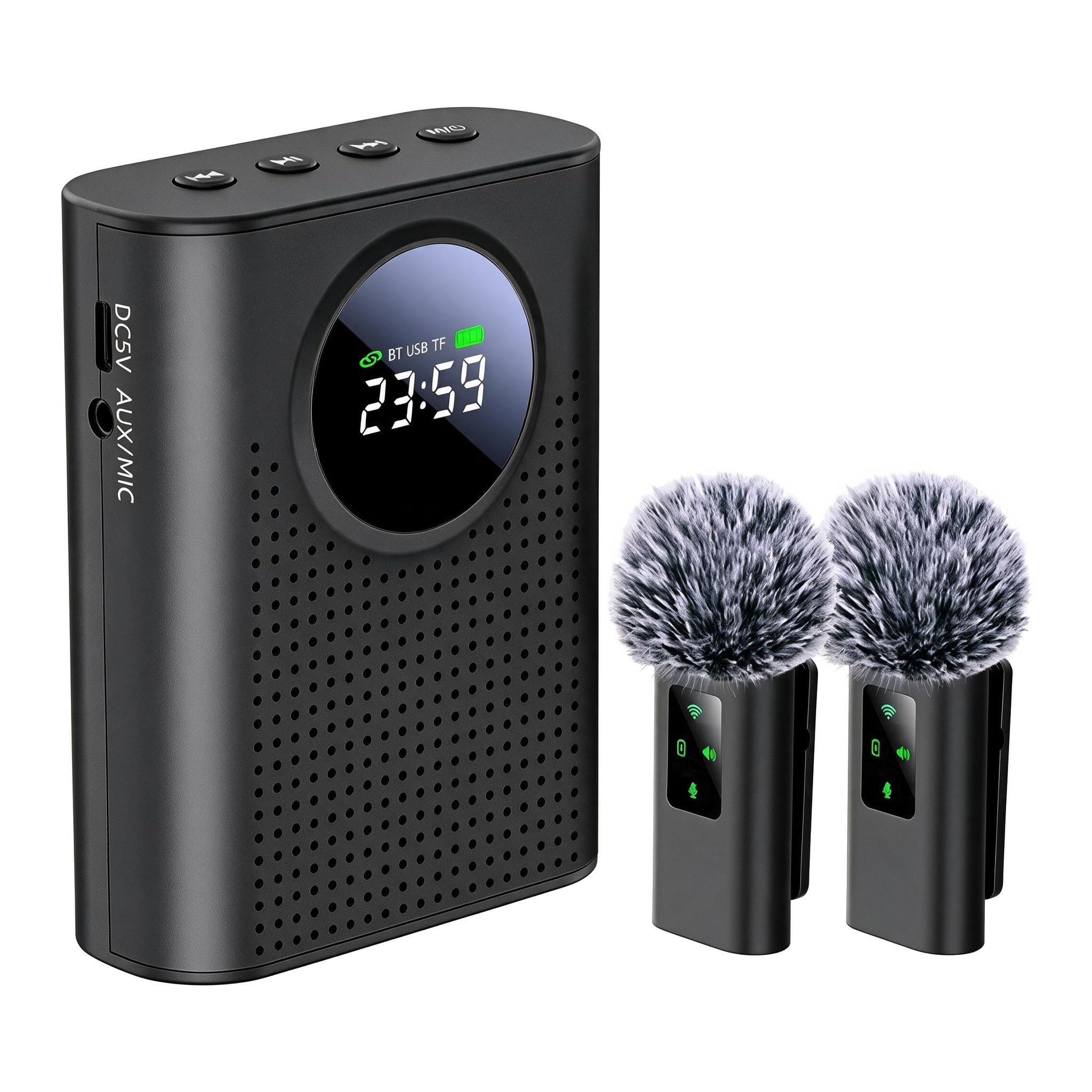
Twenty-four hours of amplification on a single charge — enough for a full tour week with one wall plug.
The S67 wins the battery race outright. It runs a 2000mAh rechargeable cell rated for up to 24 hours of continuous use, which is 2.4x the SHIDU’s 10 hours, and the practical effect is a guide who never thinks about charging mid-event. Compare it to the SHIDU’s 2500mAh cell and the capacity is actually lower — 2000mAh versus 2500mAh — yet the runtime is more than double, so the efficiency here is the headline. Fast Type-C charging restores the battery when you do need it.
The 18W dual voice-coil speaker matches the SHIDU’s power, and a DSP (digital signal processor, a chip that cleans the audio) anti-howling circuit is designed to suppress the feedback squeal that plagues tight rooms. Two wireless lavalier microphones ship in the box — useful if a second guide steps in, or if you want a spare ready to go. The 11g (about a third of an ounce) lapel mic is light enough to forget you’re wearing it, and the flexible clip holds position on a collar.
An LED display shows battery, volume, and mode at a glance, which is more dial-in information than most competing amps give. The catch is that 18W is still an amplifier — it’s not a 30W room-filler, and a 24-hour rating only pays off if your event actually runs long.
Strongest plays
- Up to 24 hours of runtime on a 2000mAh battery — 2.4x the SHIDU’s 10 hours
- Two lavalier mics included for a backup or a second speaker
- 18W output with DSP anti-howling and noise reduction
- 11g mic body and Type-C fast charging
Where it gives ground
- 2000mAh capacity is lower than the SHIDU’s 2500mAh — the runtime lead comes from efficiency, not raw storage
- An 18W ceiling means outdoor crowds and factory floors are beyond it
Best fit: the multi-day guide or back-to-back-lecture presenter who cannot afford to stop and charge.
Skip if: your problem is crowd size rather than time — the wattage ceiling here is 18W, and the Giecy’s 30W is the better room-filler.
5. Giecy G300Pro Voice Amplifier

The 30W outlier that’s built for outdoor gatherings and groups over 100 — where every other amp on this list tops out.
30W out is the biggest amplifier on this list, and that number is the reason this model exists. The manufacturer rates it for classrooms, outdoor activities, and gatherings of 100+ people — the pick when the audience is genuinely large. The 2800mAh lithium battery charges in 3-5 hours and delivers 12-15 hours of voice amplification, or up to 8 hours of music playback, so a full event day is comfortable.
The amp doubles as a Bluetooth speaker: connect a phone or laptop within 33 feet to stream music, or run your voice and a background track side by side. There’s a comfortable headset mic rather than a lapel clip, and the body is metal and plastic with a graphite finish. Playback options are wide — TF (Micro SD) card, USB flash drive, single-song repeat, loop playback, and a wired audio input — which makes it flexible as an event speaker when you’re not guiding. The XLR connector is an unusual touch at this tier.
The trade-off is that it’s a headset, not a lapel — if glasses or long hair make headset wear uncomfortable, the B006’s clip-on lavalier is the better fit. And 30W of output is overkill for a standard indoor classroom.
Who it’s for: outdoor activities, large gatherings of 100+ people, event speakers, and instructors who need their voice to carry across open space.
Who it isn’t for: a small indoor classroom, or anyone who prefers a clip-on mic over a headset.
6. WinBridge Wireless Voice Amplifier
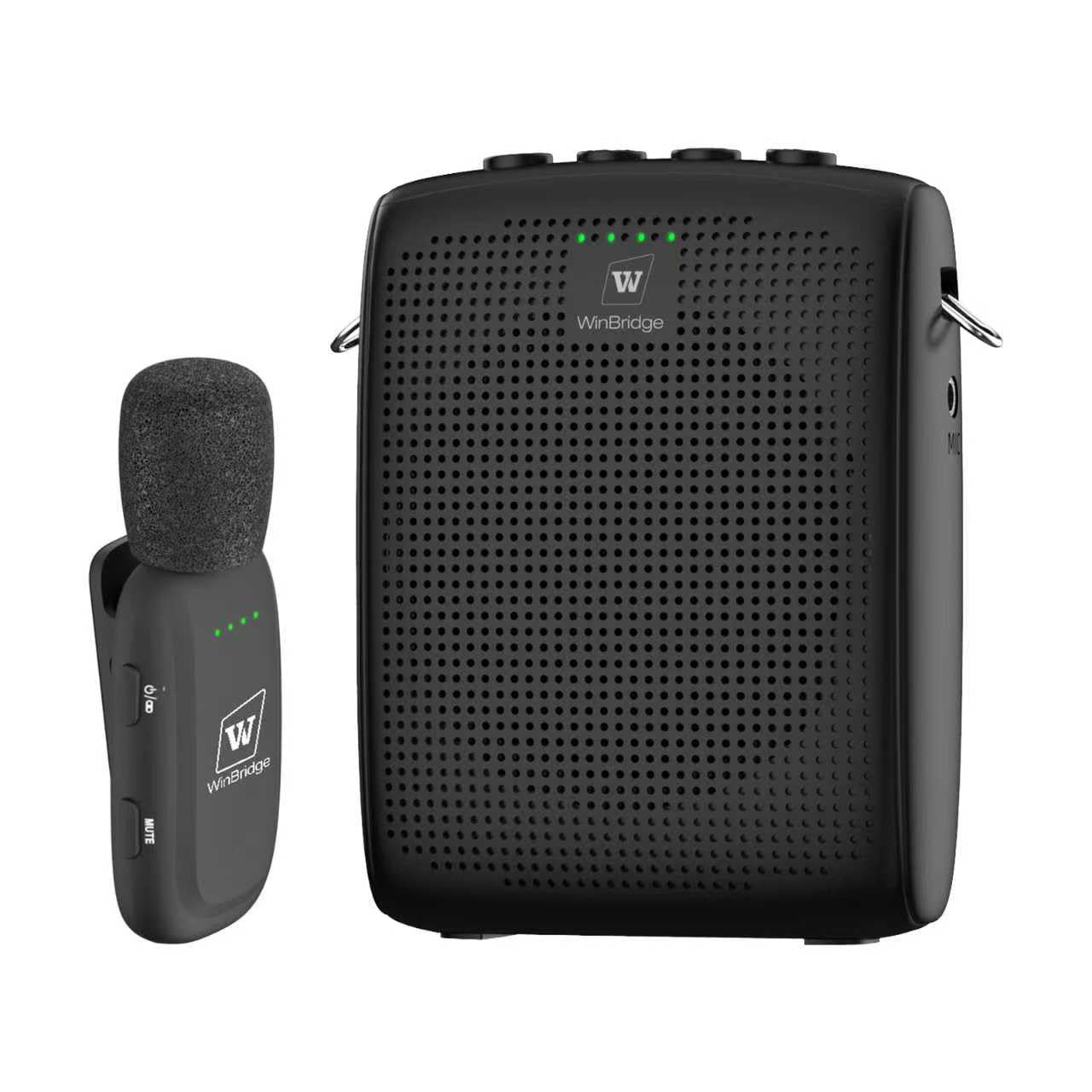
A 0.64 oz lapel mic that disappears on your collar — built for the teacher who forgets it’s there by second period.
Sound quality is what people come back to this one for. The 15W amplifier is rated to carry your voice through a small-to-medium classroom without projection effort, and the recurring theme in the review record is how much easier students find it to hear the instructor. The mic itself weighs 0.64 oz — lighter than most competing lapel mics, and light enough that its weight isn’t noticed even through a multi-hour teaching block.
Battery coverage is split cleanly: the speaker carries a 2600mAh battery rated for 12-15 hours of voice amplification, and the mic carries a 300mAh battery rated for 10+ hours. The manufacturer notes teachers running it for five consecutive days without charging, thanks to an auto power-down that cuts the drain when it’s idle. The included Type-C dual charging cable tops both units up at once.
Both the amp and the lapel mic have their own mute button, so pausing for a private conversation or an interruption doesn’t require shutting the whole system down. Auto-pair handles the setup — the amp and mic pair as soon as both are on. Bluetooth music playback covers a phone or laptop for background audio, and the compact body fits easily into a purse or bag for moving between rooms.
The standout: 0.64 oz mic, 12-15 hours of speaker use, 10+ hours of mic use, and a dual mute setup — the lightest lapel-battery combination on this list.
The note: 15W is the ceiling, so a genuinely loud gym or outdoor crowd will out-pace the output.
Right pick for: classroom teachers and small-group presenters who wear a lapel mic for hours and want it to feel like it isn’t there.
Wrong pick for: outdoor tours or big halls — the 15W ceiling sets a real limit on how much room this can fill.
7. Voice Amplifier M801 20W
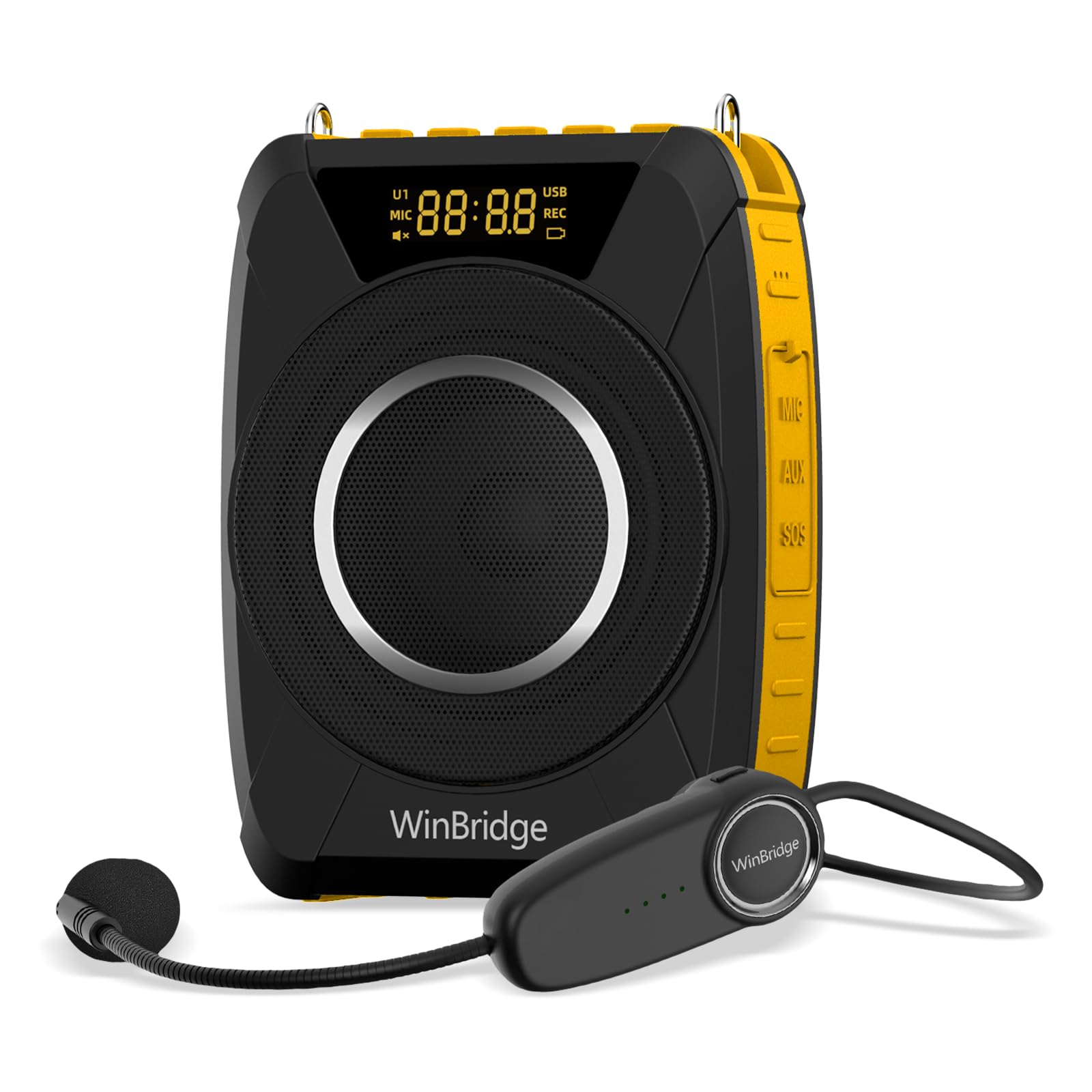
IPX6-rated against splashes and light rain — the one amp on this list built for a wet outdoor field trip.
IPX6 is a water-resistance rating — the housing handles splashes and light rain without water getting inside — and that single spec is what separates this amp from every other on the list. For outdoor tour guides, field trips, or events that could get wet, it’s the practical choice. The 20W speaker is rated for large classrooms, gyms, or outdoor spaces, sitting between the 18W amps and the 30W Giecy above.
A 5000mAh battery is the largest capacity on this list, and it’s rated for up to 15 hours of runtime. Both the amplifier and the microphone are rechargeable — 1-3 hours to a full charge covers a full day of voice amplification. The wireless headset has fast, stable signal, and Bluetooth 5.0 handles music streaming and TWS stereo (two units paired for stereo audio). That’s an unusually full feature set at the 20W mark.
There’s a real PA system inside: TF card, USB, AUX input, and multiple sound modes (Original, Acoustic, Karaoke), plus record and mute functions. An SOS emergency siren is included for safety on the go. The mic is a headset, not a lapel, so if you prefer a clip-on this isn’t the shape.
What stands out
- IPX6 waterproof housing rated for splashes and light rain
- 5000mAh battery rated for up to 15 hours — the largest capacity here
- 20W output in a compact amp with Bluetooth 5.0 and TWS stereo
- SOS siren and record functions built in
Where it lands short
- A headset mic, not a lapel clip — glasses wearers may find it less comfortable than the B006
- 20W is below the 30W Giecy at the top end of output
Built for: outdoor guides, field trips, and event hosts who face splashes, rain, or wet conditions and need a large battery to last the day.
Not the pick if: you work only indoors and want a lapel mic — the IPX6 housing is wasted on a dry room.
8. EXMAX ATG-100T Tour Guide System

This is the radio-system jump — one guide speaks, six people hear through earpieces, and the street stays quiet.
This is not a speaker. It’s a one-way UHF (ultra-high frequency) transmission system: your mic feeds a transmitter, each listener wears a receiver and single-sided ear-hook, and your voice goes straight into their ear at a whisper. The practical payoff is that each listener hears you through an earpiece at a whisper, so the street stays quiet. Operating on 195MHz, it has 99 frequency channels and 99 IDs, allowing at least 40 groups to work simultaneously in the same space without interfering. The transmission range is about 50-100 meters (164-328 ft) line-of-sight.
Battery is a serious strength. The 1200mAh transmitter gives up to 20 hours, and the 900mAh receivers give up to 25 hours — that’s 2.4x the SHIDU’s 10 hours. A 32-slot charging case recharges the whole set, which is the detail that makes multi-day events workable. A high signal-to-noise ratio (≥90dB) keeps the voice clear. Weight is light: 56g on the transmitter and 46g on the receiver, small enough to wear all day.
The real catch is the operating model. Twenty-six receivers in a box is a crowd kit, not a solo tool — if you guide alone with a five-person group, the amplifier products above are the simpler buy. And you have to set the same channel ID across the transmitter and every receiver, or the group hears silence. The transmitters need the wire unfolded to act as the antenna, so fold it and the signal weakens.
The numbers that matter: 20 hours on the transmitter, 25 on the receivers, 50-100 meters line-of-sight, and 99 channels across at least 40 simultaneous groups — this is a genuine multi-group radio system.
What you’re signing up for: channel-matching and antenna care, and a receiver-per-listener hand-out that suits a crowd kit rather than a solo guide.
Pick this if: you run church translation, silent conferences, multi-group tours, or factory floor walkthroughs where each listener needs a private earpiece and the room needs to stay quiet.
Pass on it if: you guide small groups alone and want the simplest possible setup — a single amp up above does the job with no channel matching.
9. AGJ Wireless Tour Guide System 1 Transmitter 15 Receivers

Fifteen receivers and a 180-meter range — built for the factory tour that stretches across the whole site.
The headline on the AGJ is walking distance. The transmitter-to-receiver range runs 150-180 meters (165-200 yards) line-of-sight, which is the widest on this list — the EXMAX covers 50-100 meters by comparison. That matters for a factory tour, a large campus, or a bus-and-walking route where the guide can drift far from the group and still be heard. The working frequency is UHF 902-928 MHz, tuned for North America, with 26 channels to keep neighboring groups separate in the same space.
The kit ships with one transmitter and 15 receivers, plus a 15-slot charger that refills the whole set in 3 hours. Each device carries a 1000mAh rechargeable battery: 8 hours on the transmitter and 15 hours on the receivers. Those are shorter than the EXMAX’s 20- and 25-hour figures — a full tour day works, but a multi-day event needs a nightly charge cycle. Each device weighs 59 grams, and both a head microphone and a straight plug-in small mic are included.
Only one transmitter can work in the same group or channel — the system is strictly one-way, meaning the guide speaks and listeners listen, with no reply path. Channel changes happen with a Left or Right button, and a lock switch prevents an accidental channel slip mid-tour. For a hearing-aid user in the group, the receiver output feeds directly to the ear, which is the main reason to choose a radio system over an amplifier.
Matches best with: factory tours, large campus walks, church translation, and court or conference setups where 15 listeners need to hear one guide across a wide site.
Doesn’t match: a five-person walking tour or a single classroom — 15 receivers and a 15-slot charger are more kit than that job needs.
Know the Specs
Output wattage (W)
Wattage is the amplifier’s push — how hard the speaker drives your voice out into a room. Low-to-mid wattage suits a classroom or small tour group. Higher wattage is what you need for a gym, an outdoor crowd, or a hall with a lot of background noise. Match the number to your room, not to the biggest figure on the page — an overpowered amp is just heavier in the bag.
Wireless range
Range is the maximum distance between the microphone/transmitter and the speaker, measured line-of-sight with no walls. Real rooms shrink it. If your tours stretch across a large site or a factory floor, look for a UHF radio system (ultra-high-frequency radio, a licensed-free band that carries farther than 2.4GHz) with a receiver per listener — that’s a fundamentally different architecture from a single speaker amp and holds up across longer distances.
Battery capacity vs. battery hours
Capacity (mAh) is how much charge the battery can store. Hours is how long the device runs on that charge. They aren’t the same thing — a 2000mAh battery can outlast a 2500mAh battery if the device draws power more efficiently. Read the hours figure for a real-world judgment, and use capacity only to compare closely matched devices.
Lavalier vs. headset vs. receiver
A lavalier clips to your collar — hands-free, no head pressure, good for glasses and long hair. A headset sits on your head with the mic close to your mouth, which can hold a stronger signal but is less comfortable for long sessions. A receiver-and-earpiece system is a one-way radio kit: each listener wears an earpiece, so a crowd can hear you without hearing each other, and the room stays quiet.
Common Questions
Will a voice amplifier work for a group of fifty on a city street?
How far can a tour guide walk from their amp before the signal drops?
Will a lavalier mic hold up if I wear glasses?
How many hours do I actually need from the battery?
Why does my amplifier squeal when I turn it up?
Can I use a voice amplifier as a Bluetooth speaker for music too?
What’s the difference between a voice amplifier and a tour guide radio system?
Do I need a license to use a UHF tour guide system?
How many receivers do I need for a given group size?
Can these systems handle more than one language at the same time?
The Bottom Line
For most guides and teachers, the tour guide microphone system that gets the job done is the ResponseBridge B006 — a clip-on lavalier mic with 15 hours of mic runtime, at least 98 ft of wireless reach, and a one-touch mute right on the mic where your hand already is. If your day runs longer than a single speaker charge can cover, the S67 stretches to 24 hours and throws in a spare mic. When the crowd hits 100 or you’re outdoors, the Giecy G300Pro is the 30W answer. And once your group spreads across a factory floor or you’re running simultaneous interpretation, the move is a receiver-per-listener kit like the EXMAX ATG-100T or the wider-reaching AGJ.
A 15W lapel amp that fits in your bag and clips to your collar will serve a classroom or a walking tour better than a 15-receiver radio kit that needs channel matching before every stop.
How we choose
We do not accept paid placement. Every pick is matched to a real buyer and a real use-case; we do not hands-on test units.
Sources
Specifications: manufacturer listings and product documentation. Review insights: verified customer reviews, as of November 2026. Pricing: not shown on this page (it changes often); check the current price via the retailer link.
As an Amazon Associate, Tactical Gear Guy earns from qualifying purchases. This does not affect which products we feature.