Specs are compiled from manufacturer listings and verified buyer reviews and can change over time — please confirm the key details on the product page before buying.
Buying a chainsaw is really a question about your power source, not your brand loyalty. Gas saws cut all day anywhere but demand fuel mixing and a pull cord that fights back. Corded electric saws run forever as long as an outlet is within reach. Battery saws split the difference and keep the noise down. This guide sorts nine real saws by what they actually do well, so you can match one to your yard, your branches, and your patience level. For most homeowners, the Makita 36V kit at 4.5+ stars across 900+ ratings is the one to start with.
This guide is built by comparing the manufacturers’ published specifications and the patterns across verified customer reviews, so you get each pick’s real strengths and trade-offs instead of marketing spin.
Every saw below is grouped by power source so you can see at a glance which one fits how you actually work. By the end you’ll know which horsepower, bar length, and battery setup suits your jobs — and which Types of Chainsaws are worth your money.
Top Picks

How To Choose The Best Types of Chainsaws
Start with the job, not the spec sheet. A saw that fells a 20-inch trunk is miserable for pruning an apple tree, and a pruning saw will stall out on firewood. Once you know your biggest regular cut, the rest of the spec sheet narrows itself.
Match the bar length to your thickest cut
The bar length in inches is the guide bar — the metal rail the chain. It sets the maximum trunk diameter you can cut in one pass. A 16-inch bar handles most homeowner storm cleanup. A 12-inch bar is a limb saw. A 20-inch bar belongs to someone cutting firewood in volume.
Pick your power source by where you cut
Corded electric saws never run out of runtime, but the cord limits you to roughly the length of an extension lead from an outlet. Battery saws go anywhere but need a spare pack for long sessions. Gas saws run indefinitely on refills, though you take on fuel mixing, exhaust, and pull-starting.
Check the chain brake and kickback design before anything else
Kickback is the saw bucking up toward you when the nose of the bar catches wood. A chain brake stops the chain in an instant when that happens. Look for an inertia-activated brake, a low-kickback chain, and a bar tip that is clearly marked. These are the features that keep a bad moment from becoming an injury.
Weigh the saw the way you’ll actually hold it
A 6-pound saw and a 13-pound saw feel identical on the shelf. They do not feel identical after 40 minutes of overhead pruning. If you plan to cut above your head, weight and a shoulder strap matter more than horsepower.
Side-by-Side Comparison
| Model | Best For | Power Source | Bar Length | Rated Power | Amazon |
|---|---|---|---|---|---|
| Makita XCU04PT1 36V Kit★ Best Overall | All-round home and property work | Battery (2x 18V) | 16 inches | 32cc gas equivalent | Amazon |
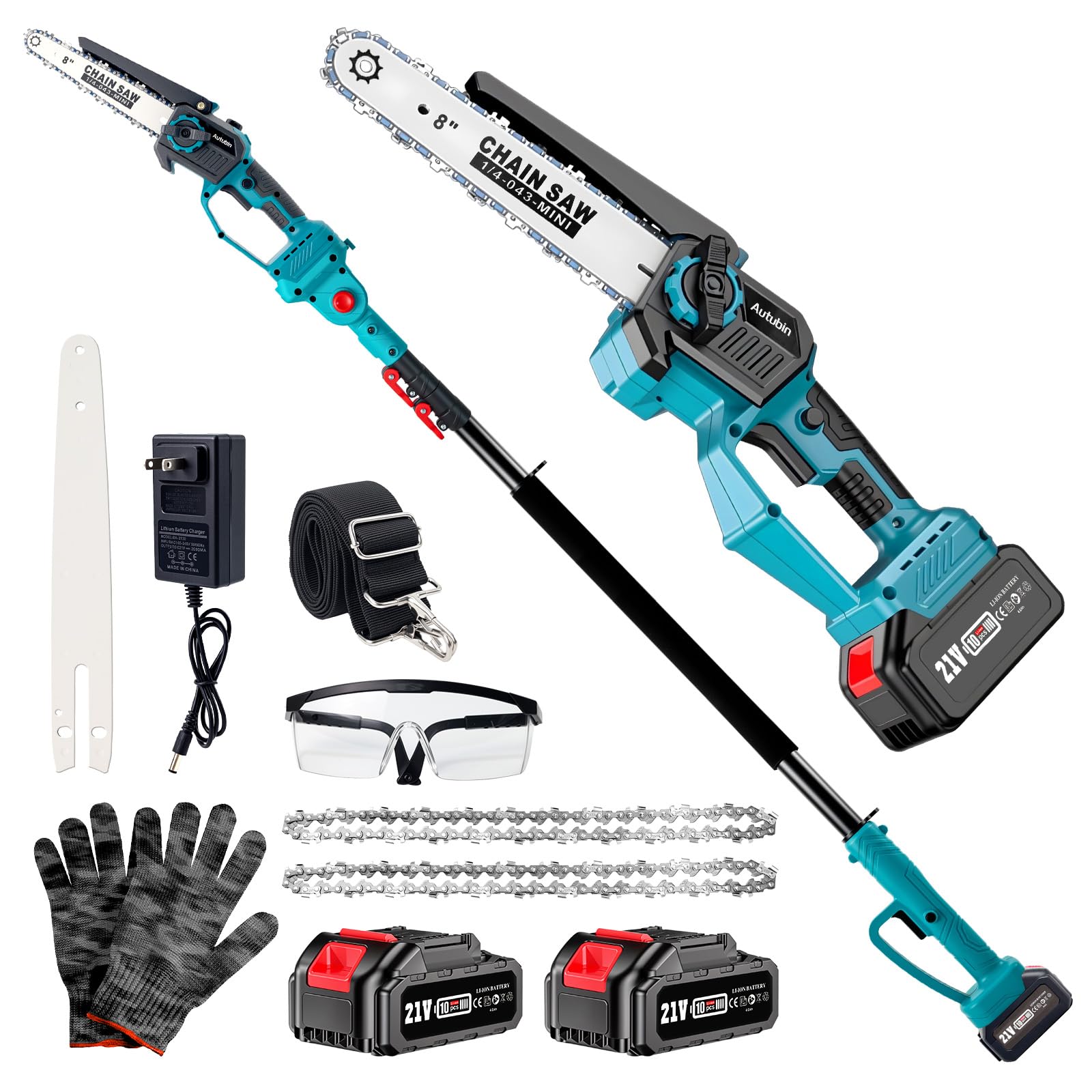
| Autubin 2-in-1 Pole SawBest Reach | Reaching high branches without a ladder | Battery (21V) | 8 inches | 1200W motor | Amazon |
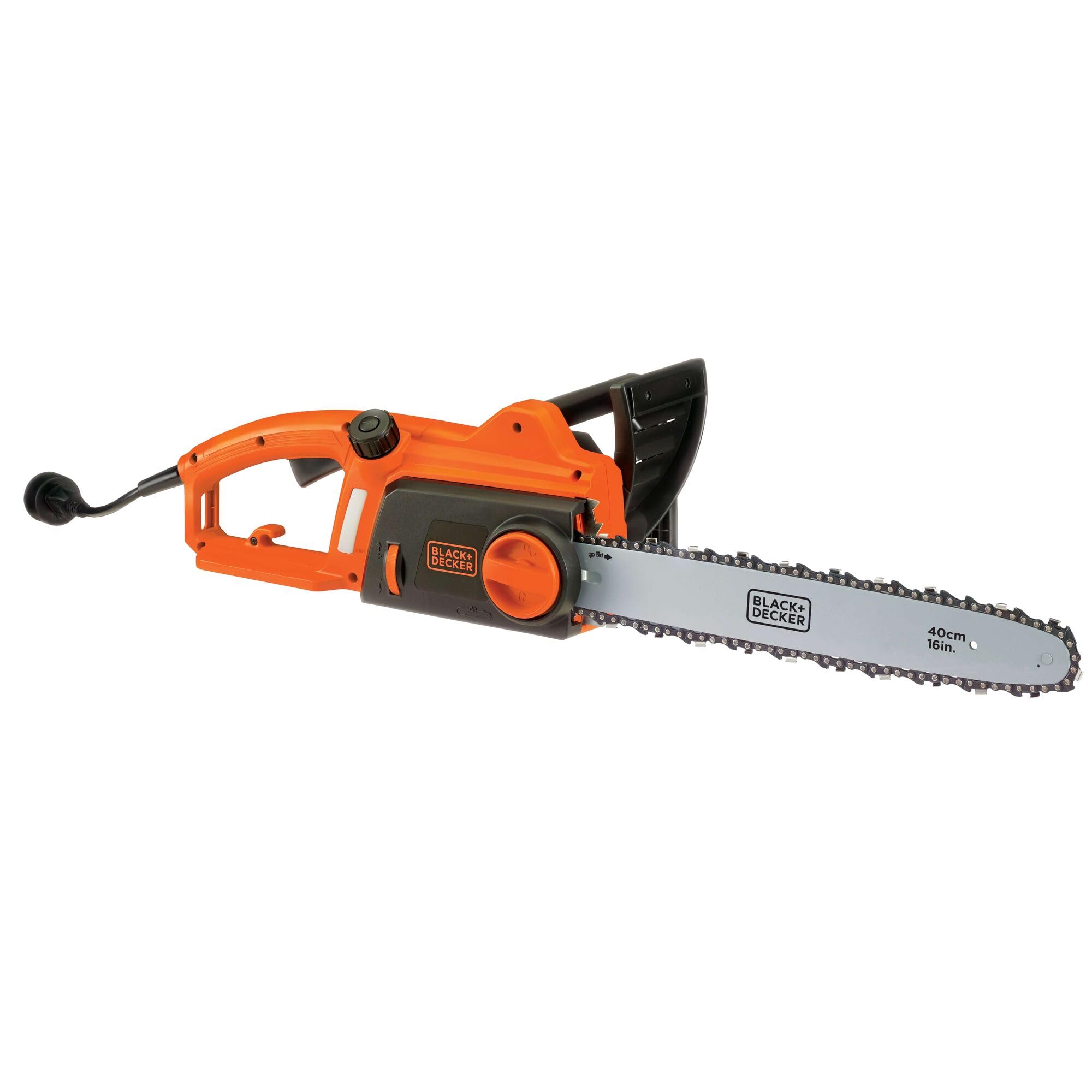
| BLACK+DECKER CS1216Budget Champion | Unlimited runtime near an outlet | Corded Electric | 16 inches | 12 Amp motor | Amazon |
| NEO-TEC NCS2500 | Climbing and one-handed limbing | Gas (2-stroke) | 12 inches | 1.2 hp / 25.4cc | Amazon |
| Greenworks CS40B210 | Light storm cleanup and camping | Battery (40V) | 12 inches | 0.73 hp | Amazon |
| Oregon CS1500 | Homeowners who hate sharpening | Corded Electric | 18 inches | 15 Amp / 2400W | Amazon |
| Husqvarna 130 | Lightweight gas for yard work | Gas (2-stroke) | 16 inches | 38cc / 2 hp | Amazon |
| EGO POWER+ CS1611 | Quiet cordless power without gas | Battery (56V) | 16 inches | 40cc gas equivalent | Amazon |
| Husqvarna 455 Rancher | Firewood and bigger timber | Gas (2-stroke) | 20 inches | 55-cc / 3.5 hp | Amazon |
Detailed Reviews
1. Makita XCU04PT1 36V (18V X2) LXT Brushless 16″ Chain Saw Kit
Our pick — 4.5+★ from 950+ verified ratings; the strongest balance of quality and price.
A brushless motor that pulls like a 32cc gas saw — with no fuel can in sight.
This is the saw for the homeowner with real trees and no appetite for gas. The brushless motor — a motor with no carbon brushes to wear out — is rated to deliver the power of a 32cc gas chain saw. Chain speed runs 0 to 3,940 FPM (feet per minute), and the variable-speed trigger lets you feather it down to a slow, controlled cut. That range is why it handles both a clean limb cut and a slow plunge into a stump without bogging.
What wins people over is the cutting itself. It goes through limbs and logs up to 6 inches in diameter without complaint, and the weight stays easy to manage through a whole afternoon. Tool-less chain adjustment means you can tighten a stretched chain with your fingers in the driveway rather than hunting for a wrench. You also get four 5.0Ah batteries in the kit, so one pair charges while the other pair works — that is the practical fix for any cordless runtime worry.
The catch is the cost of entry. The saw is the priciest battery option here, and a fair number of buyers feel the outlay is steep for what is still a homeowner saw. It also stays inside the Makita 18V LXT platform, which only matters if you already own Makita batteries. If you don’t, you are paying for the ecosystem as much as the saw.
Where it earns its keep
- Brushless motor rated at the power of a 32cc gas saw
- 0–3,940 FPM chain speed with a variable-speed trigger
- Four 5.0Ah batteries included — charge one pair, run the other
- Tool-less chain adjustment with no wrench needed
- 3-year limited warranty on tool, battery, and charger
What to weigh first
- The highest spend of any battery saw in this list
- Best value only if you’re already on the 18V LXT platform
- No gas-grade torque for the biggest trunks
Reach for this if: you want gas-level cutting on a battery platform, with four packs so runtime is never the question.
Think twice if: the spend is hard to justify for occasional limb work — the corded alternatives below cost far less for that job.
2. Autubin 2-in-1 Cordless Pole Saw
Two tools in one box, and neither one makes you climb a ladder.
If your problem is branches you can see but can’t reach, this is the answer. The 8-inch bar pops off the body and mounts on a telescoping pole that extends to a claimed 16 feet when a 6-foot person raises it overhead. That puts the cutting head well above a hedge line or a low canopy with both feet on the ground. The 1200W pure copper motor drives the chain at 26.2ft/s, with variable speed for finer control on thin wood.
The specs here are unusually generous for the money. Two 4000mAh batteries ship in the box, and each one is rated for 100 minutes of continuous use or 80+ branches. A small LED screen shows remaining charge so you are not guessing mid-job. The cutting head rotates from 5° to 175° to keep your wrists out of awkward angles, and an automatic oiler feeds the bar so the chain stays lubricated. A shoulder strap is included to take the weight off your hands. Set against the BLACK+DECKER corded saw below, this unit measures 49.8″L x 8″W x 5.3″H against its 19″L x 9″W x 12″H — far longer with the pole, and 6.9 pounds against 10 pounds.
The honest limit is the chain. It has a tool-free tensioning knob, but the chain has a habit of loosening and slipping off during use, and owners say the tightening mechanism doesn’t always hold. Treat it as a saw for branches 1 inch and under rather than a felling tool, and check tension before every session. Lubricating oil is not included, so buy a bottle with the saw.
The math that matters: you can hold this 6.9-pound saw overhead with one hand, because it is 45% lighter than the 10-pound BLACK+DECKER corded saw in this guide. That is the difference between one-handed overhead work and a two-handed strain. Its 8-inch chain is half the length of that saw’s 16-inch bar — so it reaches high, but it cuts small.
Here’s the fit: orchard owners, hedge-line trimmers, and anyone with high limbs who refuses to rent a ladder.
And the trade-off: the 8-inch bar and the loosening chain cap it at branch work — it will not fell a trunk.
3. BLACK+DECKER 12 Amp 16 in. Electric Chainsaw (CS1216)
The cord is the feature: plug in and cut until your arms give out, not the battery.
A 12 Amp motor on a 16-inch bar is a straightforward recipe, and it’s the one to pick when your cutting is near the house. Because it runs on a cord, runtime is unlimited — no packs, no charging, no fuel. The automatic oiling system feeds the bar continuously and a clear window lets you watch the oil level without tipping the saw over. Tool-free chain tensioning means adjustments happen in seconds.
The bar length is the headline. At 16 inches it is twice the chain length of the Autubin pole saw’s 8-inch bar, which is exactly why this one cuts logs while that one cuts limbs. It handles medium-sized jobs and will take down trees up to 15 inches in diameter, which covers most residential storm damage. Low-kickback bar and chain help keep the saw steady from any cutting angle, and at 10 pounds it is heavy enough to feel planted but still manageable. It runs clearly heavier than the 6.9-pound Autubin above — 10 pounds against 6.9 — so plan on two hands.
Fifty feet of extension cord is not a limitation most people notice until the tree is at the back fence. And the chain is the recurring weak point — it can jump off the bar even when correctly tensioned, so keep a spare and learn the tensioning routine. Neither issue makes the saw a bad buy; both make it a saw for the parts of your yard within cord reach.
The verdict on value: you get a 16-inch bar, automatic oiling, and unlimited runtime for the price of an entry-level battery pack. For a first chainsaw on a suburban lot, that trade is hard to argue with.
Buy it if: your trees sit within extension-cord distance of an outlet and you want a full 16-inch bar without fuel or batteries.
Walk away if: the work is out past the reach of a lead, or you’d rather not manage chain tension yourself.
4. NEO-TEC 25.4cc 12 Inch Top Handle Gas Chainsaw

A top-handle gas saw built to hang off a harness and start on the first pull.
The top handle is the defining feature here. Unlike a rear-handle saw, the grab bar wraps over the top of the body, which lets you hold and cut one-handed while your other hand keeps you anchored. That is why this saw is aimed at climbers and arborists doing limbing work up in the canopy. It weighs 8.22 pounds with a 12-inch bar, a tail mount of 0.322″/8.2mm, and a 0.050″ 3/8LP 44DL chain.
The engine is a 25.4cc 2-stroke making 1.2HP and turning up to 12,000 RPM. A spring-assisted ignition gives you a one-pull start once it’s set up, so you aren’t yanking a cord while dangling in a tree. The wrap-around handle is shaped to cut vibration, which matters when you’re holding the saw out at arm’s length. A metal lanyard ring lets you clip it to your harness.
The handle is where your attention belongs. The grip and its attachment point draw steady criticism for cracking under load, and the saw’s durability overall earns mixed marks — some units run for dozens of hours, others give out much sooner. Fit it, check the mounting bolts before every climb, and treat it as a limb saw that you service, not a saw you abuse. Buyers overwhelmingly like how small and affordable it is for a gas saw.
Who it’s built for: the climber or arborist who needs a light gas saw overhead — 8.22 pounds with a 12-inch bar, fired by a spring-assisted one-pull start.
The caveat that matters: the handle mounting is the known weak spot, so inspect it before each use.
Made for you if: you climb or limb overhead and need one-handed gas power at a low entry point.
Pass it by if: you want a firewood saw for the ground — the 12-inch bar and top handle aren’t built for that.
5. Greenworks Cordless Chainsaw Kit, 40V, 12-Inch

The grab-and-go saw for storm mess, campsites, and quick pruning runs.
Twelve inches of bar on a body that’s meant to go in the truck bed and stay there. Greenworks rates the included 40V 2.0Ah battery at 50 cuts through 4×4 treated wood on a single charge, which is a realistic afternoon’s cleanup. The 12-inch low-recoil chain is sized for storm branches and pruning rather than felling. Dual safety start — a lockout button plus the trigger — keeps it from firing accidentally, and tool-free auto-tensioning means you don’t need any extra tools to snug the chain.
The weight is the reason to buy it. At 6 pounds with a wrapped grip, it is light enough to carry to a campsite or hold for long trimming sessions. The 40V battery doubles as a power bank for charging phones and tablets, which is a genuinely useful thing when you’re off-grid. A 3-year warranty covers both tool and battery, and the battery works across the wider Greenworks 40V line if you already own those tools.
What you’re really buying is size and ease, and the parts people like most are exactly that. The chain is the place to be careful — it earns mixed marks for staying tensioned and steady criticism for coming loose fast, so check it before each use and keep the auto-oiler topped up. This is a limb saw, not a log saw, and it will stall on anything much past 8 inches thick.
Reasons it stays in the truck
- Rated for 50 cuts through 4×4 wood per charge
- 6-pound body with a wrapped grip
- Dual safety start: lockout button plus trigger
- 3-year tool and battery warranty
Where it asks for care
- Chain loosens quickly and needs regular checking
- 12-inch bar tops out around 8-inch limbs
- One 2.0Ah pack means a recharge for longer days
Right call for: tailgaters, campers, and homeowners who want a 6-pound saw for cleanup duty.
Wrong call for: anyone planning to drop a full tree — the small bar and single pack will run out of both reach and charge.
6. Oregon CS1500 Self-Sharpening Electric Chain Saw
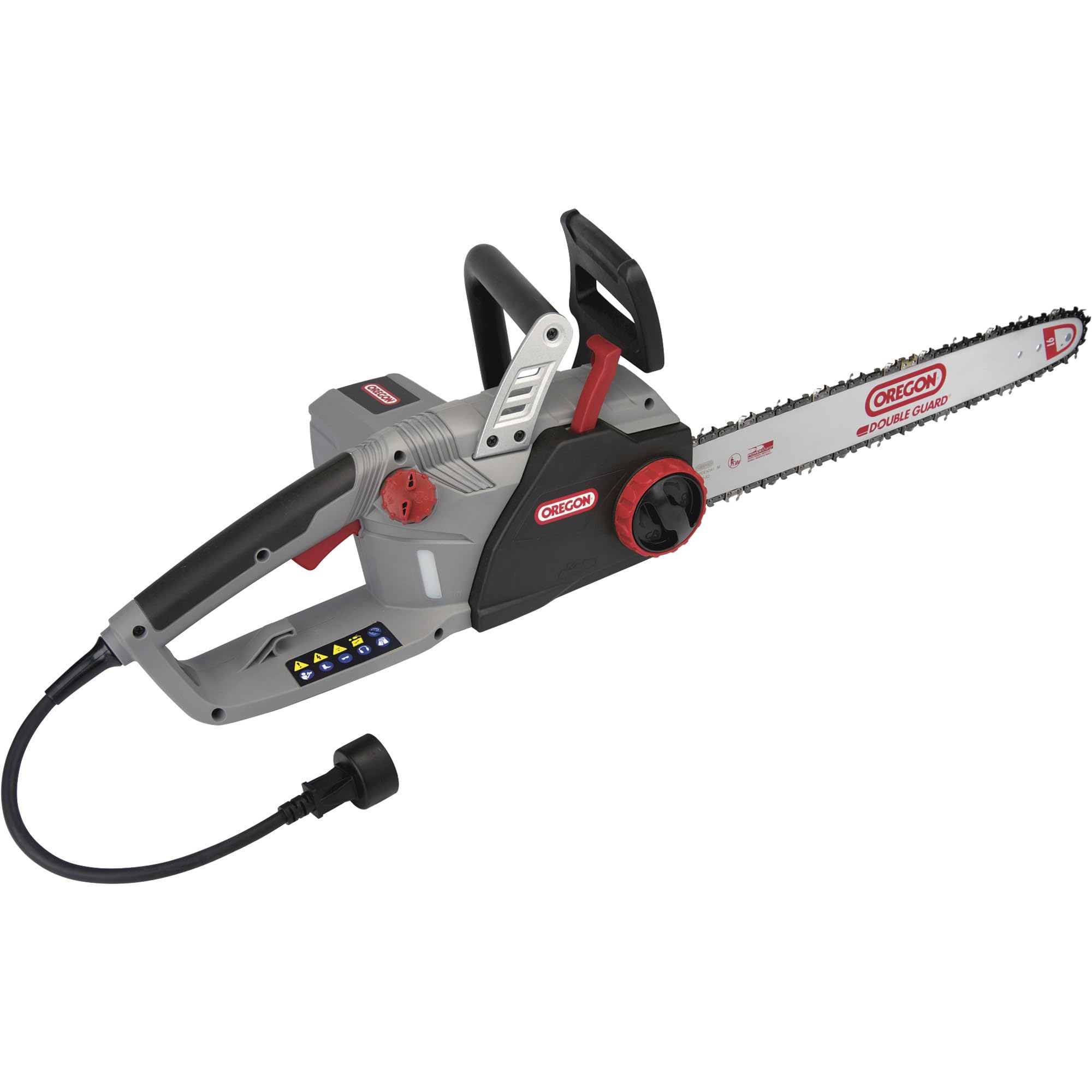
A bar that sharpens itself in 3 to 5 seconds, so dull never slows your afternoon.
The feature that defines this saw is the built-in PowerSharp system. Pull the lever and the saw sharpens its own chain in 3 to 5 seconds — no file, no vise, no skill. For a homeowner who cuts irregularly and has never learned to hand-sharpen, that removes the single biggest reason a chainsaw stops cutting straight. The 18-inch bar is the longest among the corded saws here, and a 15 Amp, 2400W motor gives it the muscle to match.
It arrives fully assembled, so you can plug in and cut on day one. Automatic oiling lubricates the bar and chain continuously while a tool-free tensioner lets you snug the chain by hand. A chain brake (a safety lever that stops the chain fast) adds a layer of safety, and it runs noticeably quieter than a gas saw, which neighbors and eardrums appreciate. Buyers call out the self-sharpening chain most: it stays keen and is simple to operate.
Two things to know going in. First, it’s corded, so your cutting range is your extension cord. Second, the chain is the weak link — it can slip off the drive sprocket and guide bar, and that is a maintenance routine rather than a defect. Learn to reseat the chain and the saw runs happily for years. The 18-inch bar against the 12-inch NEO-TEC bar above is a 6-inch difference, which is why this one takes down trees that the little gas saw merely limbs.
The standout: the PowerSharp self-sharpening system saves you 3 to 5 seconds per sharpen and a lifetime of learning how to file a chain — the one feature no other saw in this list carries.
Pick this one if: you want a long 18-inch bar, a powerful 15 Amp motor, and you’d rather never learn to sharpen a chain.
Look elsewhere if: the yard has no outlet nearby, or you want a saw you can take deep into the woods.
7. Husqvarna 130 Gas Powered Chainsaw, 16 Inch

A 5.7-pound gas saw with a sharp chain and an easy-start fuel pump.
Gas power without a workout. At 5.7 pounds this is the lightest gas saw in this lineup, and that’s the whole point — it’s comfortable to hold for a full afternoon of yard work. The 38-cc X-Torq engine makes 2 HP and is built to hold power even at low RPMs, so it pulls through a bind instead of stalling. A fuel pump plus a combined choke/stop control make cold starts easier and lower the risk of flooding the engine.
The bar range is 14 inches minimum to 16 inches maximum, and it ships with a 16-inch bar. An inertia-activated chain brake cuts power to the chain when kickback hits, which is the safety feature you want on a gas saw. Air Injection uses centrifugal force to throw dust and debris clear before it reaches the air filter, which keeps the engine breathing and cuts down on filter cleaning. LowVib dampeners reduce the vibration that numbs your hands after long use.
Where this saw divides people is reliability. It is delightfully simple to start and cut with when it’s running well, but the overall build and reliability reviews are mixed, and some saws falter early. It is not the saw for proven long-haul toughness. It is the saw for a light, easy-starting gas homeowner saw you’ll service as directed.
The honest read: 5.7 pounds and a 2-HP 38-cc engine make this the easiest gas saw here to live with day to day, but it isn’t the one to trust for hard, repeated use.
It suits: homeowners who want lightweight gas power, easy starts, and X-Torq low-end torque for yard work.
Not for: heavy or commercial use where a proven track record matters more than a light frame.
8. EGO POWER+ CS1611 16″ Battery Chainsaw
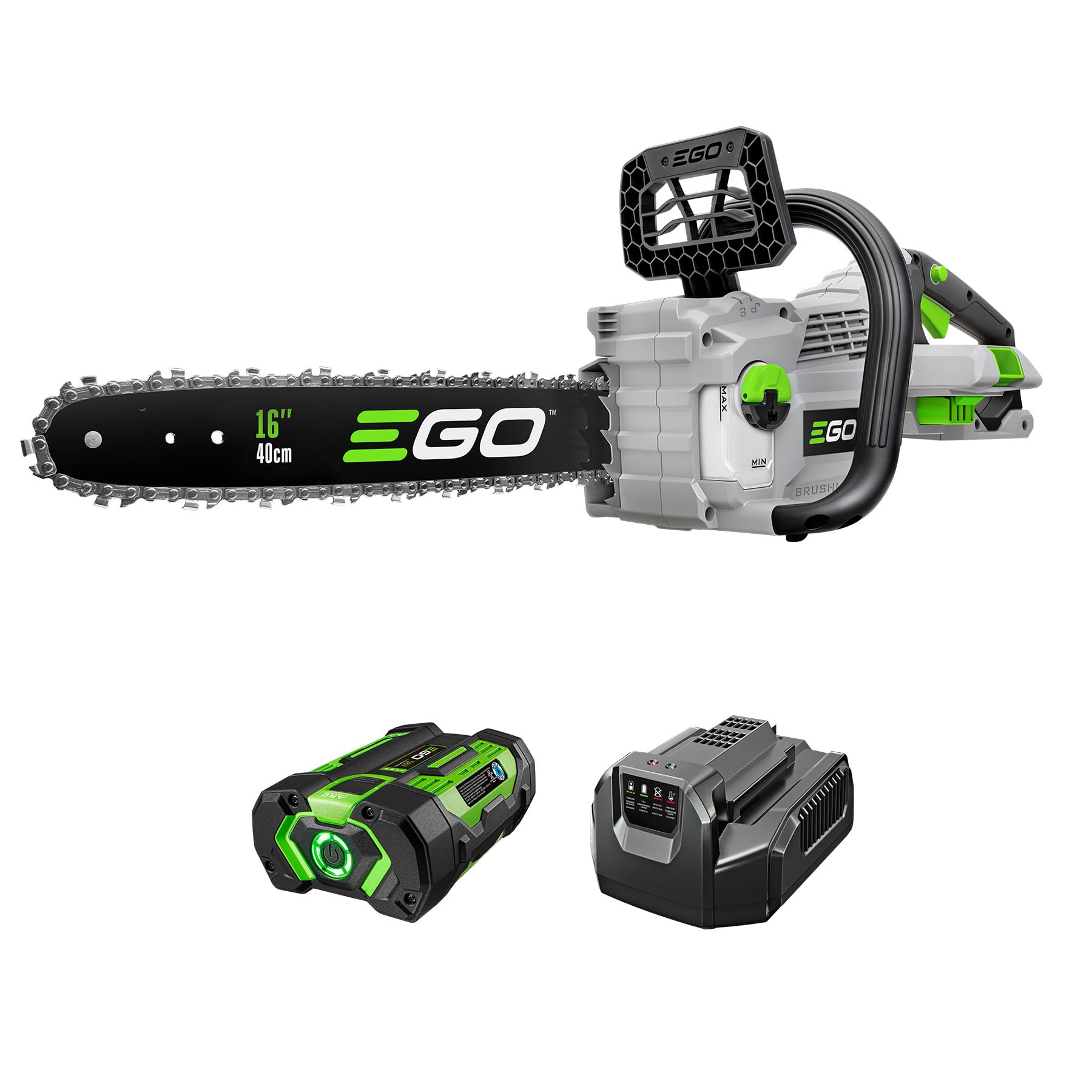
Gas-saw cutting without the pull cord, the oil mix, or the noise.
This is what a cordless saw looks like when it stops apologizing. The 56V battery feeds a 16-inch bar and chain that EGO rates at a 40CC gas equivalent, with a chain speed of 20 m/s. It ships with a 2.5Ah ARC Lithium pack rated for up to 130 cuts on 4×4 lumber, and the automatic oiler feeds the bar from a spill-free reservoir. A low-kickback chain with a brake indicator adds the safety layer you’d expect on a gas saw.
The easy-operation point is the one that converts gas owners. There is no choke, no priming, no cord to yank — press and cut. A tool-free tensioner takes the fuss out of chain adjustments, and an IPX4 rating means the housing shrugs off rain spray, which matters when a storm cleanup happens in wet weather. At 9 pounds it balances well against the 16-inch bar. Owners routinely say it feels stronger than the gas saw it replaced.
The honest trade-off is battery capacity. The included 2.5Ah pack will handle an afternoon of limb work but drains fast on continuous heavy cutting, and if you’re dropping big trees in volume you’ll want a larger pack or a spare. It is also pricier than an equivalent-output corded saw — you’re paying for the freedom to leave the outlet behind.
Why it competes with gas
- Rated at a 40cc gas equivalent with a 20 m/s chain speed
- Up to 130 cuts on 4×4 with the included 2.5Ah pack
- IPX4 weather-resistant housing for wet-day cleanup
- Tool-free tensioning and automatic oiling
- Low-kickback chain with a brake indicator
Where it needs a spare
- The 2.5Ah pack drains quickly on heavy, continuous cuts
- Costs more than a corded saw delivering similar cut power
- 16-inch bar limits it on big trunks
Choose it for: escaping gas maintenance while keeping 16-inch, 40cc-class cutting and rain-ready IPX4 housing.
Pair it with: a larger or spare battery before you commit to big-tree work — the 2.5Ah pack is an afternoon tool, not an all-day one.
9. Husqvarna 455 Rancher Gas Chainsaw, 20 inch, 55-cc 3.5-HP
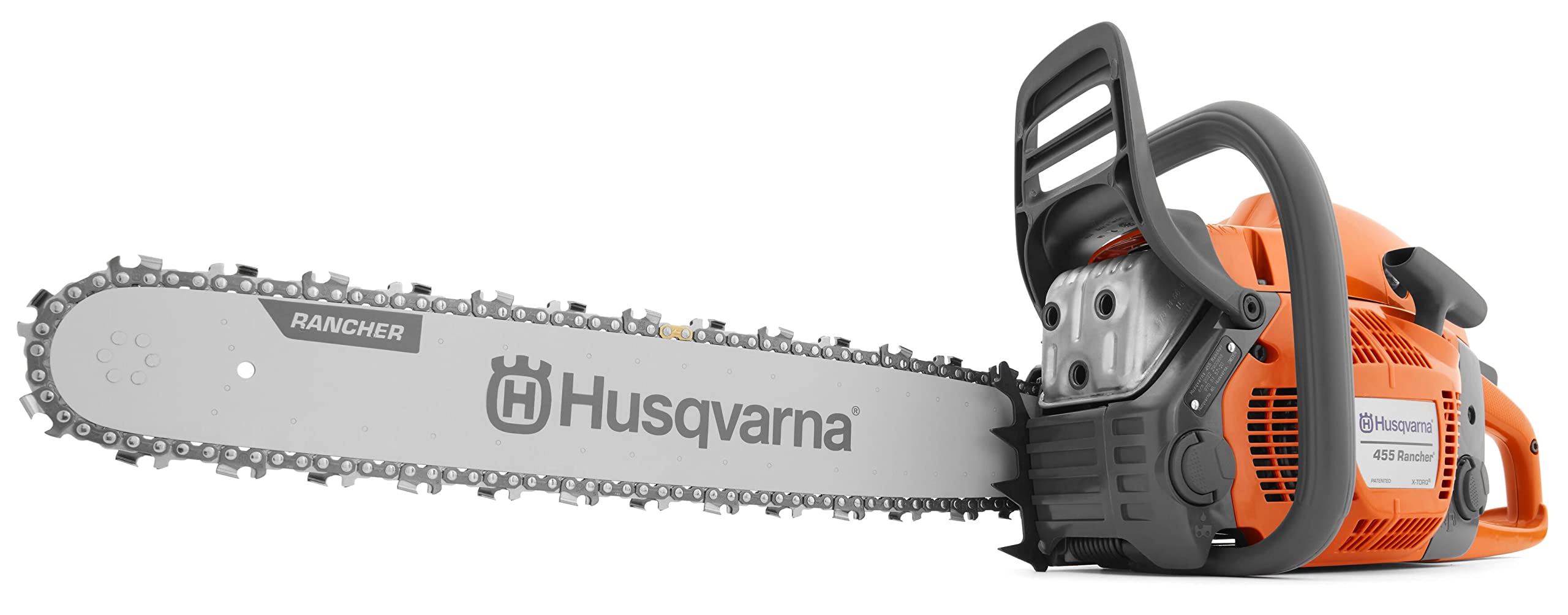
Twenty inches of bar and 3.5 horsepower for the woodpile that won’t cut itself.
When the job is firewood and felled timber, this is the saw that arrives with enough of everything. The 20-inch bar is the longest here, rated for use with bars from 13 inches minimum to 24 inches maximum. The 55-cc X-Torq engine makes 3.5 HP and holds power low in the rev range, so it keeps pulling in a deep cut instead of bogging. Smart Start reduces the effort of getting a gas saw going, and the inertia-activated chain brake responds to kickback.
The handling is thought through. A 7-degree offset front handle puts your wrist in a stronger position, and LowVib dampeners keep vibration away from your hands during long sessions. Air Injection throws dust clear before it reaches the filter to extend engine life. At 13.2 pounds it’s the heaviest saw in this list — that weight is the engine and the 20-inch bar, and it’s what lets it cut through big logs without whining. Buyers praise its performance and cutting power above all.
Its honest limits are weight and long-term dependability. Thirteen pounds is a two-handed saw and it will tire you out faster than the 5.7-pound Husqvarna 130 above. Durability and value both draw mixed reactions, with some saws running strong and others faltering. Keep up the fuel mix and routine servicing and it’s a workhorse; neglect it and it will let you know.
The bottom line here: 20 inches of bar and 3.5 HP make this the only saw in the lineup built for serious firewood — and at 13.2 pounds, the only one you’ll want to rest between logs.
This is your saw if: firewood volume and big timber are the job, and you want 3.5 HP with a 20-inch bar.
Keep looking if: you cut above your head or want a saw you can carry all day — the weight is the price of the power.
Know the Specs
Bar length in inches
The guide bar is the metal rail the chain runs on, and its length sets the biggest trunk you can cut in one pass. A 12-inch bar is a limb saw that reaches around 8-inch branches. A 16-inch bar takes down moderate trees. An 18- to 20-inch bar is firewood territory. Longer bars also weigh more, so match the length to your thickest regular cut rather than buying the biggest bar you can find.
Chain speed in FPM or m/s
Chain speed is how fast the teeth move past the wood — measured in feet per minute (FPM) or meters per second (m/s). Higher speed means a faster cut and a smoother finish through green wood. It also demands more from the motor and the chain brake. A saw with a variable-speed trigger lets you slow the chain for precision work and speed it up for bucking. Speed is a performance number, not a safety number, so pair it with a real chain brake.
Motor wattage and horsepower
On electric saws, wattage measures the motor’s electrical draw — higher watts generally mean more cutting muscle. On gas saws, horsepower and cubic capacity (cc) tell the same story. A 12 Amp motor is a homeowner saw. A 15 Amp, 2400W motor sits near the top of the corded class. A 55-cc, 3.5-HP gas engine is professional-adjacent. The number is a ceiling, not a promise; chain sharpness and tension decide how much of it reaches the wood.
Chain brake and kickback protection
The chain brake is a guard that stops the chain instantly when the saw kicks back. Kickback happens when the nose of the bar catches in wood and flips the saw toward you. An inertia-activated brake triggers automatically on that jolt. A low-kickback chain reduces how hard the saw bucks in the first place. Add a clear bar-tip guard and you have the three safety layers worth insisting on in any saw.
Common Questions
Is a battery chainsaw as powerful as a gas chainsaw?
How long does a chainsaw battery last on one charge?
What bar length do I need for cutting firewood?
Can I use an electric chainsaw without an extension cord?
How often do I need to sharpen or tighten the chain?
Is a top-handle chainsaw safe for a beginner?
What does IPX4 mean on a chainsaw?
Do I need to mix oil and gas for every gas chainsaw?
What’s the lightest chainsaw for overhead pruning?
How much does a chainsaw weigh, and does weight matter?
The Bottom Line
For most people, the strongest pick among these Types of Chainsaws is the Makita XCU04PT1 because its brushless motor (a motor without carbon brushes, so it runs cooler and lasts longer) is rated to the power of a 32cc gas saw, it runs a 0–3,940 FPM chain (feet per minute), and four batteries in the box make runtime a non-issue. If you want to reach high branches without a ladder, grab the Autubin pole saw — its extension pole tops out around 16 feet and it comes with two 4000mAh batteries. And for a firewood saw with real muscle, the Husqvarna 455 Rancher is the one to reach for, with its 20-inch bar and 55-cc, 3.5-HP engine built for big logs. If you’d rather never sharpen a chain, the self-sharpening Oregon CS1500 takes that job off your hands, and its 18-inch bar and 15 Amp motor make it a serious corded choice for the suburban lot.
One caveat: the Makita’s 4.5+ stars come from fewer owners than some budget picks here, so it earns its spot on specs and a steady performance record rather than review volume. Match the saw to your power source and your thickest regular cut, and any of these nine will earn its place in the shed.
How we choose
We do not accept paid placement. Every pick is matched to a real buyer and a real use-case; we do not hands-on test units.
Sources
Specifications: manufacturer listings and product documentation. Review insights: verified customer reviews, as of November 2026. Pricing: not shown on this page (it changes often); check the current price via the retailer link.
As an Amazon Associate, Tactical Gear Guy earns from qualifying purchases. This does not affect which products we feature.