Specs are compiled from manufacturer listings and verified buyer reviews and can change over time — please confirm the key details on the product page before buying.
You want AI features that actually change what you see on screen. So buy a TV with a named AI picture processor (a chip that adjusts the picture automatically), not one that just has a voice assistant added on. That one difference separates the ten televisions below. It is also why a cheaper screen can beat a more expensive one once the lights in your room come on.
This guide is built by comparing the manufacturers’ published specifications and the patterns across verified customer reviews, so you get each pick’s real strengths and trade-offs instead of marketing spin.
The short version: AI processing matters most when it sharpens old footage and calms the glare coming through your window, so pick a set whose processor and screen treatment you can actually name. That is exactly the logic running through these tvs with ai picks.
Top Picks


How To Choose The Best TVs with AI
The AI label on a television box can mean almost anything. On some it means a processor that studies each frame and adjusts brightness and color on its own. On others it means a microphone and a chatbot. You want the first kind, because that is the one that changes what you see.
Look for the processor by name, not the AI badge
A named picture engine — Samsung’s NQ4 AI Gen3, LG’s Alpha 8 or a11, Hisense’s Hi-View AI Engine, TCL’s AI suite — is the part doing the real work. It splits each scene into pieces and reshapes contrast, color, and sharpness dozens of times a second. Ask what the processor is called before you ask anything else.
Upscaling is the feature you will notice most. An AI upscaler takes a low-resolution stream — an old sitcom, a cable news feed, a YouTube clip — and rebuilds detail instead of stretching it. Without it, older content looks soft and smeared on a large panel.
Match the panel type to your room, not your wish list
Mini-LED sets use thousands of small backlights split into dimming zones. Those zones make bright highlights pop, which is what you want in a room with windows. OLED sets light every pixel individually, so blacks go truly black — better for a dim room and movie nights.
The trade-off is glare. A glossy OLED in a sunlit room shows you the window more than the show. Anti-glare coatings and matte finishes are the fix, and several picks below build that in.
Decide how much refresh rate you truly need
A 120Hz panel refreshes the image 120 times per second. Higher numbers like 144Hz and 165Hz smooth out fast camera pans and console gameplay. If you mostly watch dramas, 60Hz content will look identical. If you watch live sports or game, the extra speed is worth checking.
Check the smart platform and the AI assistant separately
Google TV, Fire TV, and webOS are the three platforms you will meet here, and each has its own AI helper — Gemini on Google TV, Alexa on Fire TV. The assistant helps you find something to watch. The picture processor helps what you found look good. You need both, but only one of them is the reason to buy.
Side-by-Side Comparison
| Model | Best For | Screen Size | Refresh Rate | Panel Type | Amazon |
|---|---|---|---|---|---|
| Samsung 50″ Neo QLED QN90F★ Best Overall | Bright rooms and tight spaces | 50 inches | Up to 165Hz VRR | Neo QLED Mini LED | Amazon |
| Hisense 75″ E7 Cinema SeriesBig-Screen Value | Big-screen movie nights | 75 inches | Native 144Hz | Hi-QLED Mini-LED | Amazon |
| Hisense 65″ U7 Mini-LED ULEDTop Performer | Serious gaming | 65 inches | Native 165Hz, VRR 330 | Hi-QLED MiniLED Pro | Amazon |
| TCL 65″ QM8L Series | Peak brightness hounds | 65 inches | 144Hz | SQD-Mini LED | Amazon |
| LG 65″ OLED AI B5 Series | Dark-room cinema | 65 inches | Up to 120Hz | OLED | Amazon |
| LG 65″ OLED evo AI C6 | Gamers who want OLED | 65 inches | 120Hz, VRR up to 165Hz | OLED evo | Amazon |
| Sony 77″ BRAVIA XR8B | Creative-accurate color | 77 inches | — | OLED | Amazon |
| Sony 77″ BRAVIA 8 | PlayStation 5 owners | 77 inches | — | OLED | Amazon |
| Samsung 77″ OLED S90C | Wall-hung statement piece | 77 inches | Up to 120Hz, Game Motion Plus to 144Hz | OLED | Amazon |
Detailed Reviews
1. Samsung 50-Inch Class Neo QLED 4K QN90F Series, Vision AI
Our pick — 4.5+★ from 350+ verified ratings; the strongest balance of quality and price.
The small-screen set that treats glare as a design problem, not an excuse.
Buy this one if your TV lives in a room where the sun wins. The QN90F’s Glare Free screen is the headline here — it knocks down reflections from a window or a lamp so the picture stays readable instead of turning into a mirror. That is the single feature that decides whether a television is usable in a bright living room, and this set builds it in rather than selling you a coating later.
Behind the glass sits the NQ4 AI Gen2 processor, which runs 128 neural networks (layers of pattern-matching math) to upscale everything to 4K. In practice, that means an old sitcom or a cable news feed arrives sharper than its source, with the processor filling in detail the broadcast never sent. The same engine analyzes each scene and lifts brightness so small details do not vanish in dark corners.
It is also the smaller sibling in this lineup: a 50-inch panel where the Hisense E7 Cinema Series is a 75-inch, so it fits a bedroom or a small flat where a 75-inch slab would swallow the wall. Gaming holds up too, with VRR (variable refresh rate, which syncs the screen to your console to avoid tearing) running at up to 4K 165Hz. Owners consistently single out the picture and build quality, and the anti-glare finish comes up again and again as the reason the set works in daylight. One honest limit: the stand’s 20.4-inch base width means you need a surface at least that wide, and the AI motion smoothing needs dialing back for film buffs who dislike the soap-opera look.
What wins people over
- Glare Free screen keeps the picture visible with sun streaming through windows
- 128 neural networks drive the AI upscaling and scene-by-scene brightness boost
- VRR gaming up to 4K 165Hz for tear-free console play
- AI Motion Enhancer smooths fast-moving balls and on-screen text
Where it asks you to compromise
- 50-inch panel is the smallest in this group, so it suits a den more than a main room
- Motion smoothing is aggressive until you tune it down
- Value-for-money feedback is mixed — spendy for the size
Reach for this if: your wall gets direct light and a 75-inch panel will not fit.
Look elsewhere if: you want sheer screen acreage for movie night — the Hisense E7 gives you 75 inches.
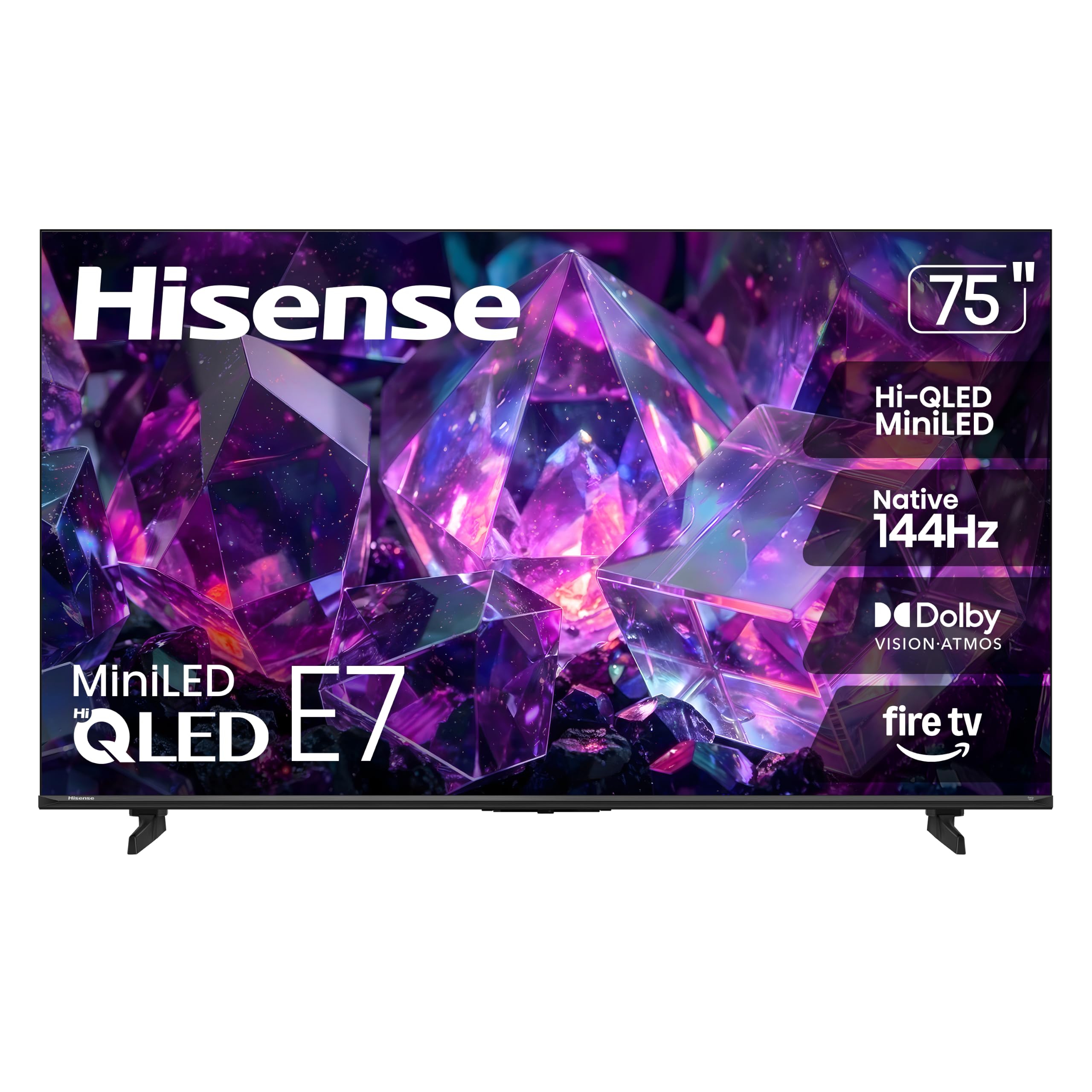
2. Hisense 75″ E7 Cinema Series Hi-QLED Mini-LED 4K Smart Fire TV
Seventy-five inches of mini-LED that undercuts the big names without begging forgiveness.
This is the set that makes you wonder why the 65-inch screens cost more. The E7SF gives you 75 inches for well under what the premium OLEDs ask. The gap next to the Samsung QN90F is dramatic: 75 inches against 50, a 25-inch difference in diagonal — enough that a face on screen is genuinely larger in the room.
Hi-QLED Mini-LED backlighting breaks the screen into thousands of precise light zones, so a night scene keeps its shadow detail while a daylight sports broadcast stays punchy. The AI picture processing reads each scene and rebalances brightness, contrast, and color without you touching a menu. AI motion smoothing with MEMC (motion estimation, which predicts where a moving object should be between frames) keeps a fast break or a car chase crisp. There is a genuine AI Sports Mode that detects a game and boosts the crowd audio, plus an AI light sensor that dims and brightens to match the room.
Refresh rate is native 144Hz, which is a step above the 120Hz you would expect at this size. Paired with Dolby Vision IQ and HDR10+ Adaptive, bright windows do not wash the picture out. Owners call it a beast of a screen with deep color and clean setup, though reliability reports are mixed — most sets run fine, a handful fail early. Fire TV with Alexa+ handles the voice side.
Do you want the biggest picture or the blackest one? If you want the biggest, here is the short answer.
File under
- 75 inches at a mid-range friendly outlay
- Native 144Hz keeps sports and games fluid
- Dolby Vision IQ and HDR10+ Adaptive for daylight viewing
- AI Sports Mode recognitions the action and boosts crowd audio
The fine print
- Reliability reports run mixed — a small number stop working early
- Wi-Fi 5 rather than the newer generation
- Film fans will want to tame the MEMC motion smoothing
Best fit: a family room where everyone wants the big game, not a frame-by-frame analysis.
Second thoughts: if you need a five-year set-and-forget purchase, the bigger brands have stronger reliability records.
3. Hisense 65″ U7 Mini-LED ULED 4K Google TV (65U7SG)
The gaming-first set with a refresh rate that makes everything on the wall look smooth.
Start with the number that defines this television: native 165Hz. That is more than double the 60Hz you might assume is standard, and it is what keeps a racing game or a fast break from smearing across the screen. Compare it to the Hisense E7, which runs at 144Hz — 21Hz higher here. When a ball crosses the frame in a hurry, that headroom shows.
The Hi-View AI Engine Pro is the picture brain, constantly analyzing the scene and correcting color, contrast, and detail as it plays. On top of that sits up to 3000 local dimming zones and up to 3000 nits peak brightness, which translates to bright highlights that hold their punch in a lit room. The anti-reflection treatment uses a dual-layer screen setup, stepping beyond the single-layer finish most sets carry, so a sunny afternoon does not turn your drama into a guessing game.
Google TV here includes Gemini for conversational search — describe what you want, and it hunts through 10,000+ apps. The audio is a 2.1.2 channel surround system tuned by Devialet, which is a real step up from the thin speakers most TVs bury. Owners rave about the brightness and deep blacks, and plenty note it delivers OLED-adjacent contrast at a fraction of the cost. The caveat is that the upscaling and the limited zones of the 65-inch panel mean a large room may not be the dramatic upgrade it looks like on paper.
The winning argument
- Native 165Hz plus Game Booster 330 and VRR to 330 for competition-grade smoothness
- Up to 3000 local dimming zones and 3000 nits peak brightness
- Dual-layer anti-reflection that handles windows and overhead lights
- 2.1.2 channel surround tuned by Devialet
- Google TV with Gemini for conversational search
The counterpoint
- Only 65 inches — the E7 gives you a bigger canvas
- Peak brightness and zone count come from marketing “up to” figures, so real-world output varies
- Gaming extras matter far less if you only stream dramas
Pick this when: you game competitively or watch live sport and cannot tolerate motion blur.
Pass on it if: you want the largest possible screen and never touch a controller.
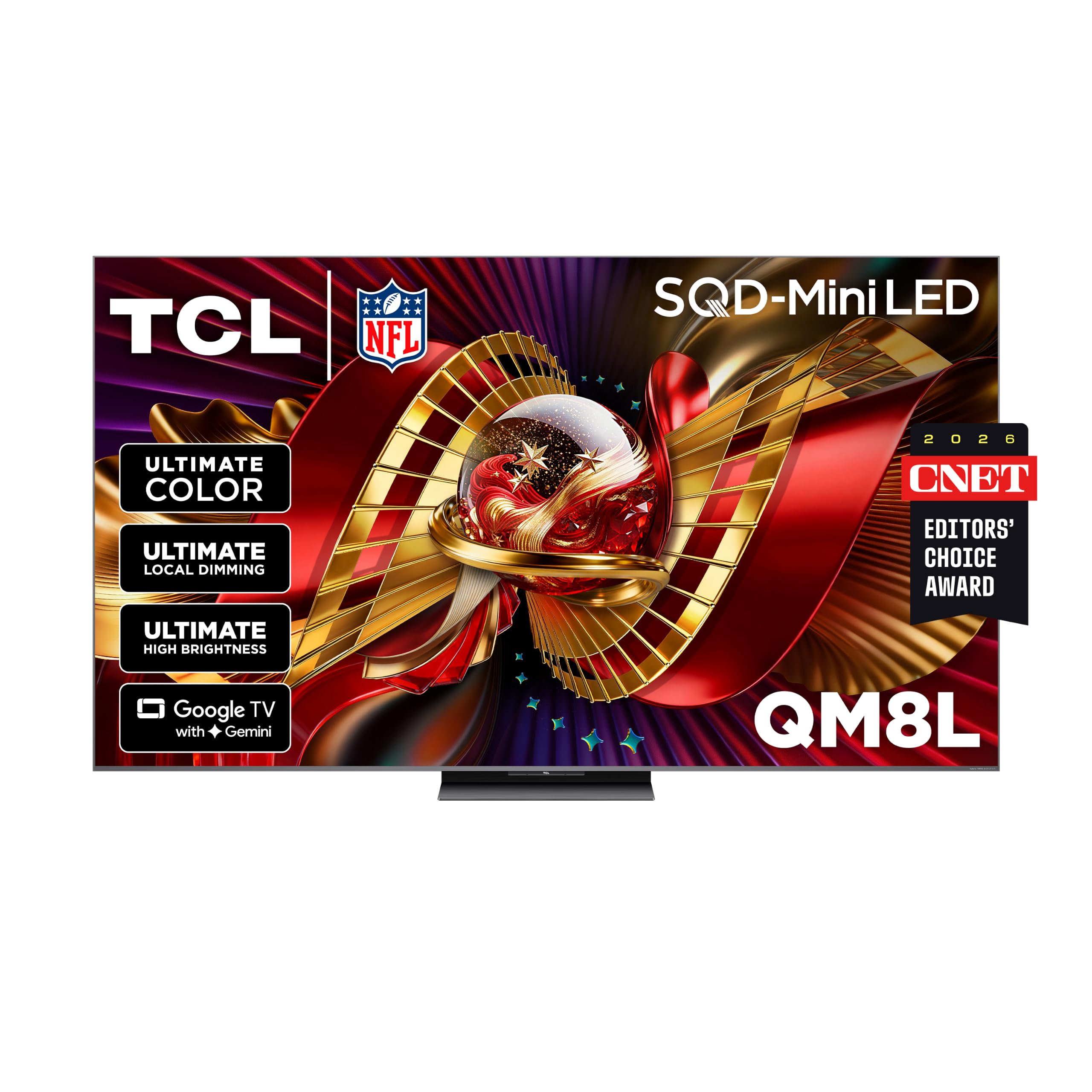
4. TCL 65 Inch QM8L Series SQD-Mini LED QLED 4K Google TV
Built like a tiny cinema screen for people who watch with the lights on.
If the room you watch in has big windows and a lamp you refuse to switch off, this is the one that fights back. Up to 6,000 peak nits and up to 4000+ discrete dimming zones mean the bright parts of a scene hit hard while the dark parts stay detailed — and a 7000:1 contrast ratio keeps the separation sharp. Compare that raw brightness against the Hisense U7’s 3000 nits and the difference in daylight is immediately obvious.
The SQD-Mini LED setup pairs a Deep Color System with TCL’s Halo Control System — a set of technologies meant to stop bright objects from bleeding a fuzzy glow into the surrounding dark. Its Ultra Color Filter uses 5 nanometre particles against standard 60 nanometre particles, a finer filter that pushes color accuracy closer to true. The AI suite runs six separate jobs: AI Color, AI Contrast, AI Clarity, AI Motion, AI Upscaling, and AI Sound, each tuned to a different aspect of what you see and hear.
Audio gets an unusual lift with Bang & Olufsen tuning and optional wireless subwoofer and satellite speakers. Gamers get Game Accelerator 288 VRR with AMD FreeSync Premium Pro, and Google TV adds Gemini for search. The recurring theme from owners is the brightness and the build quality — this feels like a premium set, and the price-to-performance crowd notices. Be aware the max brightness figures depend on what you are watching, and 144Hz is a notch below the U7’s 165Hz.
For a bright, open-plan room, the luminance headroom is the argument.
What it delivers: You get a picture that stays visible even with the sun beating into the room, thanks to a 7000:1 contrast ratio (the difference between the darkest and brightest parts of the image) and up to 6,000 peak nits (a measure of brightness). The Halo Control System stops bright objects from smearing glow into the shadows around them.
What to think about: The “up to” brightness and zone figures shift with content, so judge the set in a store if you can. Bang & Olufsen audio is tunable but you may still want a soundbar for a large room.
Suits: the buyer who cannot control their room’s lighting and refuses to compromise on brightness.
Not for: dark-room purists who would trade some nits for the inky blacks of OLED.
5. LG 65-Inch OLED AI 4K B5 Series Smart TV

Eighty-three million pixels that switch themselves off to make black truly black.
Here is what OLED does that mini-LED cannot: it turns individual pixels off. That panel has 8.3 million self-lit smart pixels, so a black scene is genuinely black — no backlight shining through, no grey haze. The Alpha 8 AI Processor Gen2 watches what you are watching and adjusts picture and sound to your tastes on its own, which is what makes the AI label honest rather than decorative.
Gaming is a real strength. A 0.1ms response time and up to 120Hz refresh rate keep up with fast console play, and the set carries NVIDIA G-Sync, AMD FreeSync Premium, and VRR plus 4 HDMI 2.1 inputs so every device plugs straight in. Dolby Vision and Dolby Atmos handle movie sound, and FILMMAKER MODE shows you the frame the director signed off on.
The AI side goes a step further with AI Search and AI Concierge: the set learns what you tend to choose and suggests based on what you are watching, and you can hit the mic button any time. Owners describe it as the best set they have owned, with black levels and 1080p upscaling standing out as the highlights. One honest note — the remote control comes in for criticism more than any other part of the package, and the setup process draws mixed opinions. Pair it with a dark room and the contrast is the reward.
Why it earns the slot
- 8.3 million self-lit pixels create true black and stellar color
- 0.1ms response time and up to 120Hz for responsive gaming
- Four HDMI 2.1 inputs so all your gear connects without a hub
- AI Concierge learns your tastes and suggests what to watch
The honest trade-offs
- Brighter rooms will test the panel more than a mini-LED would
- The remote is the weakest part of the experience
- Mixed feedback on the setup flow
Made for: a dim room where movie night is a ritual.
Think twice: if your wall gets all-day sun, a mini-LED will serve you better.
6. LG 65 Inch Class OLED evo AI C6 4K Smart TV

The step-up OLED where the processor numbers get genuinely wild.
LG’s own figures make the case: the a11 AI Processor Gen 3 delivers 5.6x greater AI neural processing than the LG a9 AI Processor Gen8, with 50% faster operation and 70% improved graphics, per the maker. Those are LG’s claims, but they point at a real leap in how quickly the set can reshuffle a scene — motion, tone mapping, and upscaling all benefit from a faster brain.
It overlaps with the B5 on panel technology (over 8.3 million self-lit pixels, Perfect Black and Perfect Color), then pushes past it on speed. VRR runs up to 165Hz here against the B5’s 120Hz — 45Hz more headroom for high-frame-rate gaming. The 0.1ms response time is unchanged, and NVIDIA G-Sync and AMD FreeSync both appear. Brightness Booster addresses OLED’s oldest weakness, lifting peak brightness so daylight scenes do not look dim. OLED CARE is built in to protect the panel over time.
For the money, the C6 puts an AI processor and a 165Hz gaming ceiling in one frame. webOS and Google Gemini sit on top for search and voice, and Amazon Alexa plus Hey Google both work. Pick this above the B5 if you game at high frame rates and want the extra speed. Owners on this model are thinner on the ground than the B5, so expect the same OLED strengths — contrast and black level — to carry the experience.
On the specs: A 120Hz panel with VRR up to 165Hz, a 0.1ms response time, and G-Sync plus FreeSync compatibility add up to a set that keeps up with a fast console.
On the caveat: OLED evo still wants a darker room to show its best, and the Brightness Booster does not turn it into a daylight TV.
Worth it for: the gamer who wants OLED contrast without giving up high-frame-rate performance.
Not the one: if you mostly watch daytime TV, the extra speed is money on the table.
7. Sony 77 Inch BRAVIA XR8B OLED 4K HDR Smart Google TV

The one tuned to show the film the way the director graded it.
Seventy-seven inches of OLED is a big commitment, and this set earns it with the XR Processor, which enhances color, contrast, and clarity in real time on every scene. Where Samsung chases brilliance and LG chases speed, Sony aims at accuracy. Studio calibrated picture modes built for Netflix and Prime Video put the image where the creators set it, so skin tones and shadows land where they were meant to.
Over 8 million self-lit pixels (each pixel makes its own light) produce pure black without a backlight bleeding through, so dark scenes stay deep. XR OLED Motion keeps fast sports and action films blur-free. XR Clear Image upscales HD content and pulls back detail that a lesser processor would smear. Dolby Vision (a high dynamic range picture format), Dolby Atmos (object-based surround sound), IMAX Enhanced, and DTS:X (another surround sound format) cover the audio and the picture together. PlayStation 5 owners get a specific edge: Auto HDR Tone Mapping and Auto Genre Picture Mode switch the picture for games and streaming automatically.
Acoustic Surface Audio+ is Sony’s unusual approach — the screen itself vibrates to make sound, rather than relying on speakers behind it. AirPlay 2 and Google Cast handle streaming from your phone, and Google TV with Google Assistant keeps the apps in one place. Buyers call the picture magnificent, singling out natural skin tones. The other side of that coin is reported reliability trouble, with some units restarting or switching off at random, so weigh the warranty carefully.
The case for the 77-inch: Over 8 million self-lit pixels with a processor built for real-time enhancement give a 77-inch image that holds detail and depth.
The caution: Reliability reports mention random shutoffs and restarts, and you pay a premium for the size. Confirm the return window before you buy.
Choose this if: you want a huge OLED that respects the director’s grade and you own a PlayStation 5.
Choose another if: maximum reliability at 77 inches is non-negotiable.
8. Sony 77 Inch BRAVIA 8 OLED 4K HDR Smart Google TV

The OLED that comes bundled with movies, not just a promise of a good picture.
Most of these sets sell you hardware. This one includes 5 credits to redeem on latest release movies and 12 months of subscription access to hundreds of classics through the Sony Pictures Core app. For a household that rents films regularly, that is a real benefit baked into the purchase rather than a subscription you set up separately.
Underneath, it is the same OLED foundation as the XR8B — over 8 million self-lit pixels, pure black, high brightness — with XR Contrast Booster 15 pushing the deep blacks and dazzling highlights. XR Triluminos Pro reaches billions of accurate real-world colors, and the XR Processor handles the real-time enhancement of color, contrast, and clarity. Three studio calibrated modes span Netflix, Prime Video, and Sony Pictures Core. PlayStation 5 owners get the same Auto HDR Tone Mapping and Auto Genre Picture Mode as the higher model.
Owners genuinely like the vivid, bright OLED picture and the setup flow. The concern worth naming is durability: some units reportedly stop working after 11 months, and others fail after 17. That is a serious outlay to risk on an unreliable panel, so lean on the warranty and buy from a seller that handles returns cleanly. It draws 449 kWh a year, which is on the higher side.
Reasons to shortlist it
- 5 movie credits and 12 months of classics included on Sony Pictures Core
- XR Triluminos Pro brings billions of real-world colors
- Three studio calibrated modes across major apps
- 77 inches of self-lit OLED with over 8 million pixels
Reasons to hesitate
- Durability reports run poor — some fail within 11 to 17 months
- 449 kWh a year is a high energy draw
- Costs more than the XR8B with similar core OLED specs
A good match for: the film lover who wants a built-in movie library and a big Sony panel.
Keep looking if: long-term reliability is your deciding factor.
9. Samsung 77-Inch Class OLED 4K S90C Series Quantum HDR Smart TV

A 4mm slab of OLED built to look like art on your wall, not electronics on a stand.
The defining spec is the depth: 4mm. A television is usually a black box with a width; this one is a sliver. The LaserSlim design with its virtually bezel-free face is meant to disappear when wall-mounted, and it works that way — the panel reads as a window rather than a piece of furniture. Few sets in this lineup are built to be looked at when switched off.
The picture comes from OLED technology across a full range of colors, with the Neural Quantum Processor handling 4K upscaling of HD streams, sports, and home video. Quantum HDR OLED analyzes each scene to tune brightness and contrast on self-illuminating pixels, and Pantone Validated color keeps what you see close to real life. Object Tracking Sound Lite moves the audio to follow the action, so a dragon swooping across the screen has sound that travels with it.
Gaming reaches up to 120Hz with Motion Xcelerator Turbo Pro, and Game Motion Plus stretches to 144Hz with compatible PC-connected content. The SolarCell Remote charges itself on ambient light and has a built-in microphone for the voice assistant. Q-Symphony 3.0 pairs the set with a Samsung soundbar so both speaker systems operate as one. Owners rave about the black levels and the built-in speaker quality, and the 4mm design gets frequent praise. The functionality side draws negative attention, though — some owners hit snags with the platform and the app experience, so expect the occasional software annoyance.
Why the design matters: A 4mm depth with a near bezel-free face and a flush-fit wall mount makes the set read as a design feature rather than a gadget.
What to know: At this size and price it is a statement purchase, and the software side generates more grumbles than the picture does. Bluetooth 4 is an older version than the newer sets here carry.
The right buyer: someone who wants a 77-inch OLED hung flush on the wall and intends to pair it with a Samsung soundbar.
The skip: if you want the newest processor generation, this model is a couple of steps behind the S90H above.
Know the Specs
AI Processor and Neural Networks
An AI processor is the chip that reads each scene and adjusts brightness, color, and sharpness on its own, without you touching a menu. The “neural networks” number — 128 on the Samsung NQ4 AI Gen3, for example — is a rough measure of how many pattern-matching layers the chip runs. More layers mean faster, finer scene analysis, so old shows get upscaled and fast motion gets smoothed. A faster processor matters most for lower-resolution content and live sport, where the set has to fill in gaps live.
Upscaling vs Native 4K
Native 4K means the source is already 4K. Upscaling means the processor rebuilds detail from a lower-resolution feed — a cable channel, an old sitcom, a YouTube clip — so it looks sharper than a straight stretch would. This is the AI feature you will notice every week, because most of what you stream is not native 4K. A good upscaler keeps faces and text crisp on a large panel.
Mini-LED Dimming Zones and Nits
Mini-LED sets split the backlight into many small zones, each dimmed independently so the bright parts of a scene pop and the dark parts stay dark. Nits measure brightness, so a higher nit figure means stronger highlights in a lit room. More zones and more nits usually mean a more controlled picture, which is why the TCL QM8L and Hisense U7 advertise both.
Refresh Rate and VRR
Refresh rate is how many times per second the screen redraws — 60Hz, 120Hz, 144Hz, 165Hz. Higher rates smooth fast motion for sport and gaming. VRR (variable refresh rate) syncs the screen to your console’s frame output so you do not get tearing. If you game, both numbers matter; if you mostly watch dramas, 60Hz content looks the same on every set.
OLED vs Self-Lit Pixels
OLED lights every pixel individually, so black areas switch off completely and give true black. Mini-LED shines a backlight through a dimming layer, which can leave a little glow in dark scenes. The trade-off is brightness — mini-LEDs can push higher nits in a bright room, while OLED wins on contrast in a dim one.
Anti-Glare and Screen Treatment
A matte or glare-free finish diffuses reflections from windows and lamps so the picture stays visible in daylight. It is not cosmetic — in a bright room, it is the difference between watching a show and watching your own window. Several sets here, including the Samsung QN90F and S90H, build it in.
Common Questions
Does an AI TV actually improve the picture or is it just marketing?
Do I need an internet connection for the AI features to work?
What is the difference between an AI upscaler and native 4K?
Is a 144Hz or 165Hz refresh rate worth it over 120Hz?
Should I pick mini-LED or OLED for a bright living room?
Why do some TVs list Bluetooth 5.3 and others Bluetooth 4 or 5.4?
Can I wall-mount a large OLED, and does the design affect that?
What does Gemini on Google TV actually do?
Does a faster AI processor mean worse motion smoothing for movies?
How much energy does a large OLED use compared to mini-LED?
The Bottom Line
The winner among these tvs with ai is the Samsung 50-Inch Neo QLED QN90F. It is the crowd favorite at 4.5+ stars across 300+ ratings, and the only set here that pairs a Glare Free screen with 128 neural networks and 4K 165Hz VRR gaming. If your wall wants a bigger canvas and you can live with mixed reliability reports, the Hisense 75″ E7 Cinema Series gives you 75 inches for a mid-range outlay. And for the gamer chasing the sharpest motion, the Hisense 65″ U7 and its native 165Hz panel is the one to reach for.
Beyond those three, decide by room. A dim den rewards the LG B5 or C6 OLED. A bright, open-plan living room rewards the TCL QM8L’s up to 6,000 peak nits. A PlayStation 5 owner who wants a huge, accurate panel and a bundled movie library should shortlist the Sony pair, keeping the warranty in mind. Above all, read the processor name before you read the price tag — that is what makes the AI real.
How we choose
We do not accept paid placement. Every pick is matched to a real buyer and a real use-case; we do not hands-on test units.
Sources
Specifications: manufacturer listings and product documentation. Review insights: verified customer reviews, as of November 2026. Pricing: not shown on this page (it changes often); check the current price via the retailer link.
As an Amazon Associate, Tactical Gear Guy earns from qualifying purchases. This does not affect which products we feature.