Specs are compiled from manufacturer listings and verified buyer reviews and can change over time — please confirm the key details on the product page before buying.
Backing a travel trailer into a campsite blind is the part of RV life nobody enjoys. A rear view camera fixes that — it puts a live picture of what is behind you on a screen in the cab, so you can see the site marker, the low branch, or the kid on a bike before you touch them. This guide covers nine camera systems built specifically for trailer and RV mounting, not passenger-car dashcams dressed up for the job.
This guide is built by comparing the manufacturers’ published specifications and the patterns across verified customer reviews, so you get each pick’s real strengths and trade-offs instead of marketing spin.
The differences that actually matter are signal range, monitor size, and how the camera gets power — wired to your marker lights or running on its own battery. Below you will find the range numbers, the mounting setups, and the honest catches on each system so you can pick the one that matches your rig. This breakdown of the best travel trailer rear view camera focuses on what holds a signal on a 40-foot trailer at highway speed.
Top Picks


How To Choose The Best Travel Trailer Rear View Camera
The first thing to sort out is not the screen size or the night vision — it is how the camera gets power. A trailer camera either taps into your existing marker-light wiring or runs on its own battery. That single choice decides how much of your Saturday the install eats, and it decides how much fiddling you do every trip after that.
Wired to your lights, or free-standing on a battery
A wired camera powers up when you switch on your running lights, and it stays powered for as long as the trailer is hooked up. Nothing to charge, nothing to remember. The trade-off is that you have to route a power cord to the camera, unless your RV already has a pre-wired mount waiting for it.
A battery camera skips the wiring entirely and usually attaches with magnets, so you can move it between the trailer and the hitch. The catch is a charging routine — you swap it onto a charger or lean on a solar panel to top it up, and some buyers find the battery does not hold a full day the way they hoped.
What “wireless range” honestly means
Every listing quotes a big range number, and every one of those is measured in open air with nothing in between. Metal trailer walls, the distance from the rear cap to the cab, and highway interference all eat into that figure. Look for a system that also states a working distance between vehicles, because that is the number you actually live with.
The pre-wired RV shortcut
Plenty of trailers ship with a Furrion pre-wired bracket already on the rear cap — a mounting plate and a power connector waiting for a camera. If yours has one, buy a camera that fits that mount and the install becomes a screwdriver job in minutes. Just check the listing carefully: some cameras fit the Furrion mounting bracket without being compatible with Furrion’s own electronics, and that distinction matters.
Trailer length and signal stability
A 20-foot camper and a 40-foot fifth wheel are not the same problem. Longer rigs need dual antennas and a stronger wireless standard to keep the picture from dropping out at highway speed. If you tow a gooseneck or a long fifth wheel, pay more attention to the signal tech than to the screen.
Side-by-Side Comparison
| Model | Best For | Monitor | Stated Range | Waterproof Rating | Amazon |
|---|---|---|---|---|---|
| Haloview BT7★ Best Overall | Long trailers and goosenecks | 7″ LCD | Up to 984 ft | — | Amazon |
| eRapta A2Y5 (Furrion fit)Best Value | Pre-wired RVs on a tight budget | 5″ IPS | Up to 140 ft | IP69K | Amazon |
| Fookoo DW7Y5Big-Screen Value | Big screen at a mid-tier price | 7″ IPS | Up to 200 ft | IP69 | Amazon |
| VOONOA VN003 | No-drill magnetic mounting | 7″ IPS | Up to 120 ft | Waterproof | Amazon |
| ZEROXCLUB BY5 | Widest view in the cab | 10.1″ | Up to 100 ft | IP69K | Amazon |
| eRapta ACT702 | Two-camera magnetic setup | 7″ LCD | Up to 328 ft | IP69K | Amazon |
| AUTO-VOX WF4 | Rear and side coverage together | 7.2″ HD | Up to 500 ft | IP69 | Amazon |
| ZEROXCLUB 4-CAM Solar | Four-camera coverage, no wiring | 10.1″ Touchscreen | Up to 300 ft | — | Amazon |
| Furrion Vision S+ | Factory-match install on a Furrion-prepped RV | 7″ Touchscreen | Up to 492 ft | IP65 | Amazon |
Detailed Reviews
1. Haloview BT7 RV Backup Camera
Our pick — 4.5+★ from 500+ verified ratings; the strongest balance of quality and price.
The long-haul pick that keeps a picture on a 40-foot gooseneck when weaker systems drop out.
If you tow long, this is the one to beat. The Haloview BT7 pairs a 7″ LCD monitor with a stated wireless range of up to 984 feet in line of sight — a figure no other system on this list comes close to. In practice that headroom is what lets a camera stay usable across the full length of a big fifth wheel or a gooseneck trailer, and it is exactly where owners say it earns its keep. Owners rate it 4.5+ stars across 500+ reviews, and the recurring theme is a clear 1080p picture that holds up on the rear cap of a long rig.
The camera records at 1080P@30fps and the monitor has a built-in DVR, so you get loop recording on the monitor itself instead of juggling a separate card reader. A 120° viewing angle covers the lane beside and behind you, and the full-color sensor is rated down to 0.1 lux — a low-light figure that means it keeps showing color in dim conditions rather than flipping to a grainy black-and-white feed. There are night-vision fill lights too, and you can switch them on or off from the monitor when the light drops further.
Power runs on a 10-32V wide voltage input, which is the range that lets the same unit work on a 12V trailer circuit without complaint. It supports up to four wireless cameras, and the listing states fitment up to 65ft of vehicle, so a big toy hauler or long fifth wheel sits inside its lane. Installation is a surface-mount job with an adapter for Furrion pre-wired RVs, and the brand keeps the camera, monitor, and recorder in one ecosystem rather than making you pair parts from different makers.
Why it takes the top spot
- 984 ft stated line-of-sight range is the longest on this list by a wide margin
- Built-in DVR records at 1080P@30fps so trip footage lives on the monitor
- Full-color low-light sensor rated to 0.1 lux keeps detail in dim campgrounds
- 10-32V input and four-camera support suit big rigs and long trailers
What to weigh before you buy
- The 7″ screen is smaller than the 10.1″ panels further down this list
- The DVR records to the monitor, so there is no separate card slot on the camera
- Premium-tier spend for a system whose main advantage shows up on long trailers
Reach for this if: you pull a gooseneck, a fifth wheel, or any trailer long enough that signal drop-out is a real fear.
Look elsewhere if: a compact 20-footer plus a tight budget is your situation — a shorter-range system will do the same job for less.
2. RV Backup Camera Furrion 5-Inch Monitor
The budget play that plugs straight into a Furrion-prepped trailer and gets you seeing behind it.
This one is aimed squarely at the owner whose trailer already has a Furrion-style mounting plate and power connector sitting on the rear cap. The eRapta A2Y5 fits that pre-wired setup for a plug-and-play install with no drilling, and if your rig is not pre-wired you simply screw the camera down and tap the reverse, running, or tail light circuit. Its 5″ IPS monitor is the smallest on this list — notably smaller than the 7″ Haloview, and 2 inches down on the 7.2″ AUTO-VOX further along.
The camera shoots 1080P with six infrared lights for night vision, and it holds an IP69K waterproof rating — a rating that means it is built to survive high-pressure spray, not just rain. The temperature spec runs from -4°F to 158°F, so a cold-weather trip or a baking parking lot is inside its range. Signal comes over a 2.4GHz connection with dual antennas and a stated range of up to 140ft, and it supports up to four cameras split across a quad screen.
Where this one asks you to be honest with yourself is reliability. The overnight-return story on this system is that the picture quality and install are what win people over, and the durability record is more mixed — some units run for years, and a small number stop working within a month. Expect to use your one-year after-sale support window if you land a bad unit. GMC, Chevrolet, and Ford owners should also check for PWM-type lighting circuits, since those can interrupt the video feed and may call for a 7-way adapter or filter that is not in the box.
Where it wins: the IP69K body and 1080P night vision are serious hardware for an entry-tier camera, and the Furrion-compatible mounting is the whole point of buying it.
What you accept: that 5″ screen is small on a long trailer, and the reliability odds are the reason this system is easy to find at a low price rather than a reason to skip it outright.
Pick this one for: a pre-wired trailer where you want a working rear view without spending much.
Spend more if: you tow long and want the range and backup of a system with a stronger durability record.
3. HD 1080P 7″ Backup Camera Furrion
A 7-inch screen and Furrion-style bracket fit without the premium-tier bill attached.
Seven inches is the size that makes a difference on a rear view camera — big enough to read the corners of a campsite, small enough to live on a windshield. The Fookoo DW7Y5 gives you that 7″ IPS panel with touch buttons, auto-dimming that adjusts for night driving, and parking lines on screen. It also does split-screen across up to four cameras, so a second or third camera feeds in without a separate monitor.
Its 2.4GHz dual-antenna signal is stated at up to 200ft in the open, and the listing says it holds real-time images at highway speed. The camera itself is IP69 waterproof with a 120° view, six infrared lights, and a light sensor that switches the IR on automatically when the light drops. Loop recording runs off an SD card, so you can keep footage as evidence or as a record of the trip.
The honest bit: it fits a Furrion pre-wired mount, but it is not compatible with Furrion’s own electronics — the technologies differ, and the listing says so plainly. That is fine as long as you understand the bracket is shared and the system is not. There is also a 24-month replacement and after-sales window behind it, which softens the risk on a mid-tier camera. Buyers keep coming back to the 1080P picture and the easy install; as an affordable stand-in for a factory Furrion camera, it does the job without the factory-brand price.
The case for it: a 7″ auto-dimming touchscreen and IP69 camera for mid-tier money, with a stated range of 200ft that leaves the entry-level 140ft system comfortably behind.
The fine print: Furrion mount fit does not equal Furrion system compatibility — if you already own a Furrion monitor, this camera will not talk to it.
Suits: the trailer owner who wants a bigger screen than the budget picks offer without stepping into premium-tier spend.
Skip if: you need a camera that integrates with an existing Furrion electronics system.
4. VOONOA VN003 Magnetic Backup Camera

No wires, no drill — a magnet, a 15000mAh battery, and a solar panel do the whole install.
This is the pick for anyone who winces at drilling into a fiberglass or aluminum trailer cap. The VOONOA VN003 attaches via six magnets on the base, runs entirely off a built-in 15000mAh battery pack, and tops up with a solar panel on sunny days. A 7″ IPS screen and a 170° field of view — the widest angle in this list — give you a broad picture of the trailer’s rear. The camera is remote-controlled from the monitor, so you can switch it on or off without climbing out of the cab.
The 2.4G digital wireless link is stated at up to 120ft in confined environments, which reflects the realistic number you will see between a camera on the rear of a trailer and a cab that is separated by a metal wall. Charging runs off a fast charger in the box or the solar panel. Owners highlight build quality and smooth operation, and describe the magnetic base as staying put on the road.
The trade-off is power management. The battery life is the one thing with mixed readings — some buyers report a full day of use, others find charging to be the weak point. If you plan to run it daily, treat the solar panel as a top-up rather than a replacement for plugging in, and build a charging habit around it. It is also worth remembering that a magnet mount is only as good as the metal underneath: fiberglass or aluminum trailer surfaces will need a steel plate to stick to.
What sells it: 100% wireless install in about 3 minutes with a 170° view — the widest angle here — and no cutting into the trailer at all.
Plan around this: the 15000mAh pack means battery is now your job, and the solar panel works best as a supplement rather than the long-term answer.
Ideal for: renters, seasonal campers, or anyone who wants to move the camera between a trailer, a hitch, and a truck without wiring anything.
Not for: the owner who wants to set it and never think about charging again — a wired camera suits that better.
5. ZEROXCLUB BY5 10.1″ Backup Camera

Ten inches of screen read at a glance — the biggest panel without stepping into the top tier.
Screen size is the first thing you notice climbing in with a 10.1″ monitor staring back at you. This ZEROXCLUB puts that panel on a mount for your dash or roof and displays a HD 1080P picture with a much clearer detail view than a 5″ or 7″ unit can manage. Park it next to the 7″ Haloview and the advantage is obvious. It takes an SD card for loop recording and supports up to four cameras in dual, triple, or quad splits.
The camera carries an IP69K rating and 120° view with six infrared lights and a light sensor that switches the IR on in low light. Signal runs on a 2.4GHz dual-antenna system, stated at up to 100 feet — a shorter figure than the 140ft eRapta or the 200ft Fookoo, and that is the trade you make for the big screen. Installation starts from a Furrion pre-wired jack where your RV has one, with a no-drill path for pre-wired rigs and a straightforward screw-and-power path for the rest.
The honest catch with this system is that the 100 ft stated range and PWM flicker on newer GM trucks are the softer spots, even though the easy install and picture clarity carry the day. Wireless here means video only — the camera and monitor each still need a wired power connection, and the listing says so. Newer GM vehicles using PWM-style signals can see flickering, so a 7-way adapter or filter may be on your shopping list.
What earns it a place
- 10.1″ screen makes the rear view readable at a glance
- IP69K camera and IR night vision are real hardware, not marketing
- SD-card loop recording for trip footage or evidence
- Furrion pre-wired installation path with a simple fallback
Where the trade-off sits
- 100 ft stated range is shorter than several cheaper systems here
- Not compatible with Furrion cameras or electronics
- The big screen takes more dash or windshield space
Best for: the driver who values a legible picture over the longest stated range, especially on a mid-length trailer.
Think twice if: you tow a very long fifth wheel where 100 ft of stated range may be the limiting factor.
6. eRapta ACT702 Dual Magnetic Backup Cameras
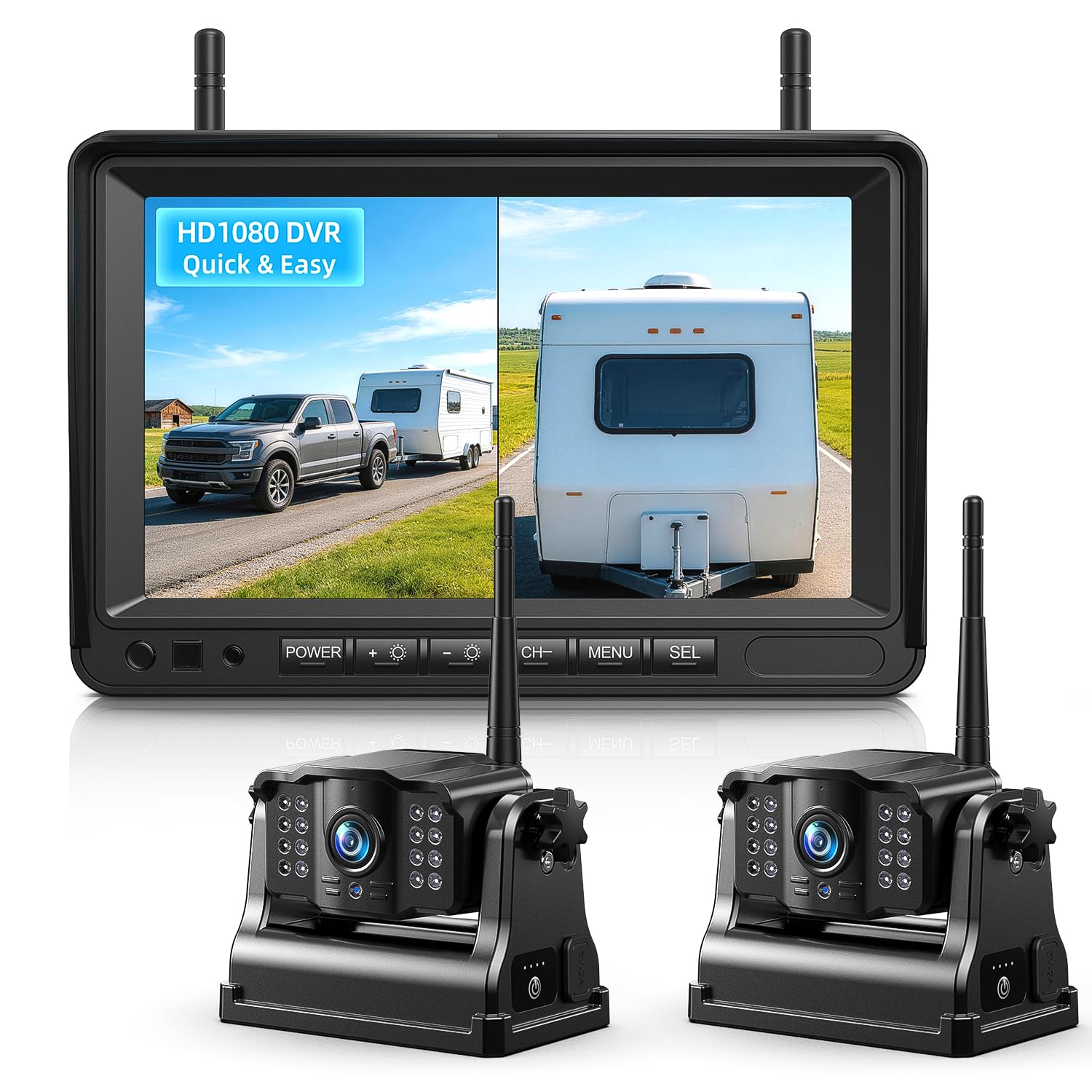
Two magnetic cameras and a 9,600mAh battery — built for rigging up without touching a drill.
The reason to pick the ACT702 over the single-camera systems is right in the name: two magnetic cameras in the box. That gives you a rear view plus a second angle — a horse trailer interior, a hitch view, or a campground security view — on one 7″ monitor, with dual, triple, or quad splits to manage up to four cameras total. Mounting is a one-minute job: stick the magnet base on any ferrous metal surface and plug the monitor into the cigarette lighter. No holes, no wiring.
Power comes from a 9,600mAh rechargeable battery, and eRapta says it puts the camera into sleep mode when the monitor is off — a smart way to stretch a charge. The camera is IP69K rated and rated from -6°F to 151°F, and the 150° wide view with adjustable parking lines helps line up a reverse into a campsite. The 2.4GHz dual-antenna signal is stated at up to 328ft in open space, dropping to 40ft between vehicles — the number that matters when the camera is on the trailer and the monitor is in the cab.
Owners rank reliability in horse trailers and harsh use as its second-strongest trait after overall quality. Owners mention the magnetic base holds through off-road conditions. The caveat is battery life and connectivity — both read as mixed, so plan a charging routine and keep the monitor and camera reasonably close when the trailer is long.
The standout: two cameras means one rear view and one utility view at once — a real advantage for horse trailers or hitch alignment, at a price below most single-camera premium picks.
Worth knowing: the 40ft vehicle-to-vehicle stated range is the honest limit for a long trailer — check your rig length before committing.
Worth it if: you need two angles and no drill, especially in a horse trailer or a rig where cable routing is a nightmare.
Consider the alternative if: you tow long and need maximum range over flexibility.
7. AUTO-VOX WF4 Wireless Backup Camera
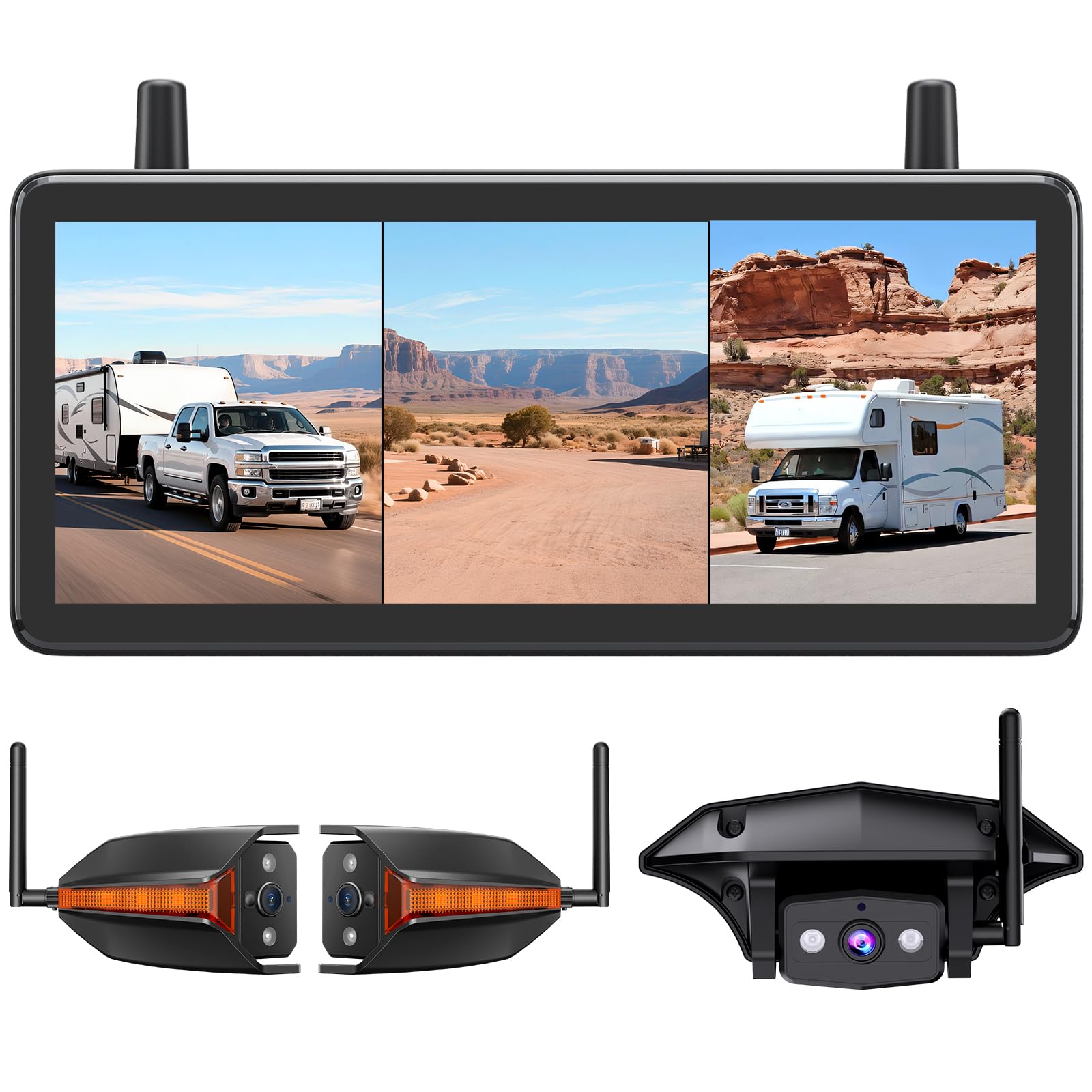
Rear plus both sides on one 7.2-inch panel — the system for tight campsites with blind corners.
Backing a big RV into a campground slot is where this one makes its case. The AUTO-VOX WF4 puts a rear camera plus two side cameras on a 7.2″ HD screen, with the side units installed in place of the original marker lights using the pre-drilled holes. A triple-split lets you watch both sides and the rear at once, and you can flip to single or dual when you just want the full rear view. That is a different job than a plain rear camera does — it is about seeing the curb your trailer swing is about to clip.
The signal is stated at up to 500ft in open areas via dual antennas — the second-longest figure in this list — with the aim of staying steady for campers and fifth wheels at highway speed. Picture quality is 1080P with IR night vision and a CMOS infrared sensor. The built-in DVR loops continuously for insurance or trip footage, and it takes either USB or 12V car-charger power so it does not need to eat a socket. The housing is IP69 rated for rain, snow, and dusty off-road use.
Where this one asks patience is signal stability on the move. Owners like the functionality and 1080P picture, but the connection draws mixed reports — some get strong signal and fast pairing, others lose the feed while driving. Treat that as a setup-and-positioning task: side cameras mounted in marker-light holes and antenna placement matter more here than on a simple single-camera system. Applying sealant around the side units, as the listing advises, keeps water out of the holes.
The real edge: three views at once on a 7.2″ screen with a stated 500ft range — the strongest case here for tight reversing and lane changes.
Set-up depth: this is the most involved install on the list since the side cameras replace marker lights, and the connection reliability rewards careful placement.
Built for: fifth-wheel and motorhome owners who want side coverage while reversing, not just a rear picture.
Stick with a simpler system if: you only need a rear view and would rather not wire and seal side cameras.
8. ZEROXCLUB 4 CAM 10.1″ Backup Camera

Four magnetic cameras, a 10.1-inch touchscreen, and a solar-topped battery on every unit.
This is the setup you buy when one camera is not enough. The ZEROXCLUB 4-CAM kit ships with four magnetic cameras and a 10.1″ HD1080P touchscreen that displays them in dual or quad view. Every camera runs off its own 9600mAh rechargeable battery, topped up with a solar panel and Type-C when the sun is not cooperating. The screen is a touch panel, so no memorizing a button layout — just tap what you want to see.
Signal runs on dual antennas with a built-in booster and a stated 300ft in open distance, dropping to 50ft on-vehicle for reversing and 36ft on-vehicle for continuous use. That on-vehicle figure is the one to plan around, because it defines how far the cameras can sit from the monitor. A 32GB memory card is included for the DVR loop recording, so you are not hunting for a card on day one. The cameras shut off with the screen and wake with it, which saves battery without you remembering.
Two practical notes. First, the magnetic base wants ferrous metal — fiberglass or aluminum trailer caps need a steel plate behind the magnet to hold properly. Second, battery life reads as mixed across the review pages, so while the low-power wake/sleep design helps, you should expect to plug in during overcast stretches or winter. That is the price of going wiring-free on four cameras at once.
The selling point: four solar-battery cameras and a big touchscreen, all in one box — genuinely more coverage than any single- or two-camera system here.
The routine: four batteries and four solar panels to mind, and the reviews put battery life in the mixed column.
Good match for: a large rig where you want front, rear, and two side angles, and you would rather manage charging than run cable.
Not the one for: a small trailer where one camera does the job and a charging routine for four is more hassle than it saves.
9. Furrion Vision S+ FOS7HTASF Observation System
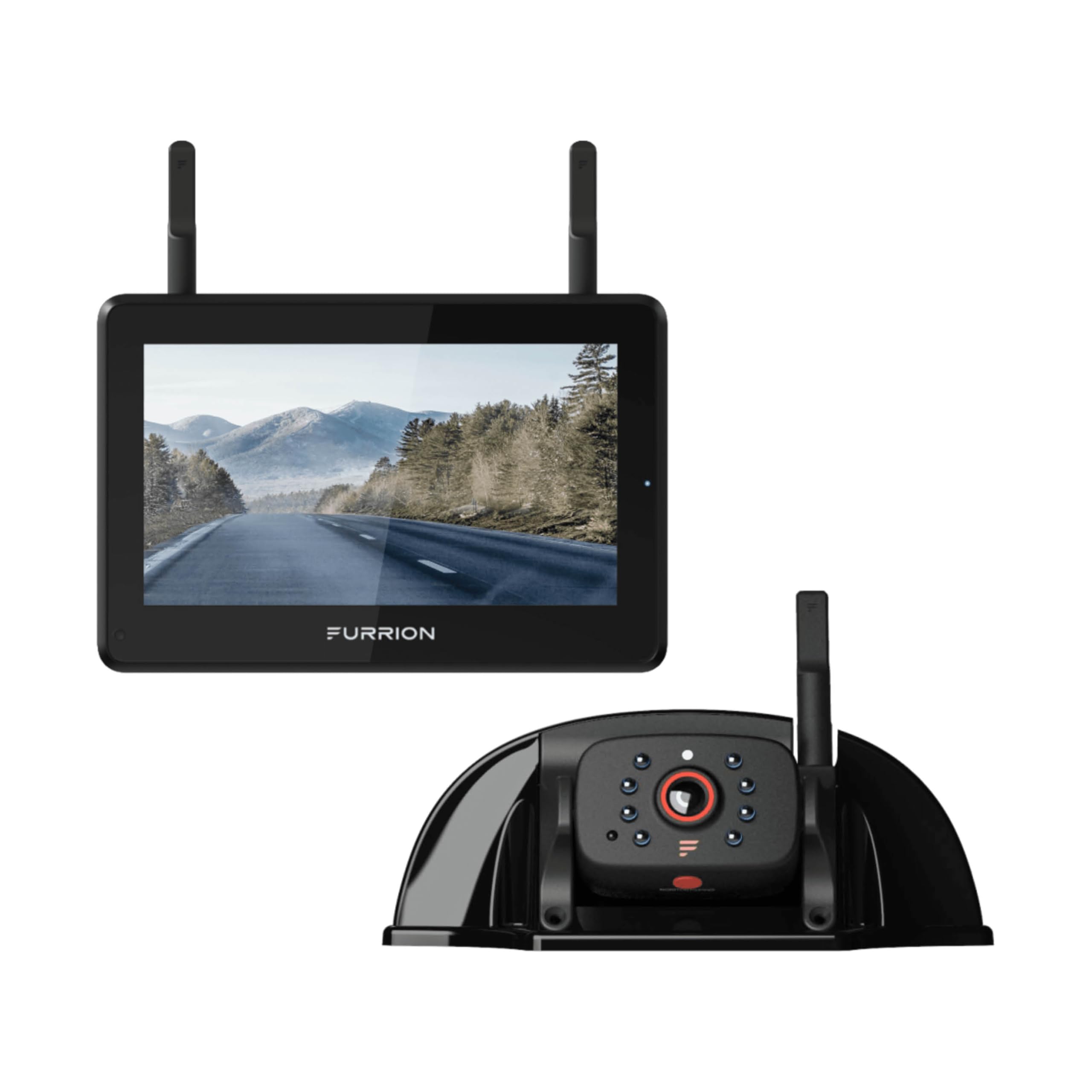
The one that slots straight into a Furrion-prepped RV — and works as a parked security camera too.
If your trailer left the factory with Furrion’s Vision S+ prep already on the rear cap, this is the cleanest match you can buy. The durable sharkfin camera carries a 1080p sensor, a 140° wide viewing angle, IP65 water resistance, and infrared night vision. The 7″ touchscreen is anti-glare with park assist marker lines and holds up to four camera views, and the windshield and table stands let you place it where you like.
The signal runs on 2.4GHz proprietary wireless and is stated at up to 100 ft at high speed, extending to 492 ft in open space — the second-longest open-air figure here, behind only the Haloview. The 140° angle is also the widest single-camera view from Furrion among the picks. The interesting party piece is security: you can wire the camera to act as a parked security system, with motion sensors that auto-wake the display and a mic that carries audio for parking guidance.
The blunt truth is cost and connection. Furrion’s own build quality and signal quality are what owners rate highest, and the fit on a 42ft fifth wheel is called out as working well. But value reads mixed — a lot of buyers find it overpriced against the alternatives — and connection is the other mixed spot, with some owners reporting frequent drop-outs. If you are already inside the Furrion ecosystem or want a factory-look install, those trade-offs are easier to accept than if you are coming from scratch.
Why it earns the premium badge
- Furrion Vision S+ factory prep means a fast, clean install on an equipped RV
- 140° sharkfin camera with 1080p and IR night vision
- 492 ft stated open-air range and 100 ft at highway speed
- Motion-sensor auto-wake and mic audio turn it into a parked security camera
Where the money goes and stops
- Top-tier spend, and value is the most-mixed reading on this system
- Connection drop-outs are reported by some owners
- Best value only if your RV already has Furrion prep
For the right rig: a Furrion-prepped RV where matching the factory bracket and wanting a parked security mode make the premium price sensible.
For everyone else: the Fookoo and ZEROXCLUB systems cover the same rear view for far less, at the cost of factory integration.
Know the Specs
Stated wireless range
The range in a listing is measured in open air with a clear line of sight between camera and monitor. A metal trailer wall cuts into that. That is why a 984 ft figure and a 140 ft figure are not comparable at the campsite — rather, look for a system that also quotes a working distance between vehicles, because that number reflects the trailer-to-cab reality you drive with.
Monitor size and panel type
A 5″ screen is enough to confirm a clear lane; a 7″ screen lets you read a campsite corner in one glance; a 10.1″ panel is the most glance-friendly of the bunch. IPS and LCD panels differ in how they hold color at an angle, and auto-dimming matters more than size at night, when a bright screen washes out the windshield.
IP waterproof ratings
IP69 and IP69K indicate a camera is built to survive high-pressure, high-temperature water spray — the sort a trailer sees on a highway in a storm. IP65 handles lower-pressure spray and rain. Treat a lower rating as fine for normal weather but less forgiving of a pressure washer pointed at the camera housing.
Battery capacity and solar
A camera battery in mAh (milliamp-hours) measures how much charge it stores, but real use depends on how often the camera wakes and how much sun the panel gets. A bigger number is better, and a wake-on-screen design saves charge — but in overcast stretches or winter, plan to plug the camera into Type-C rather than wait for the sun.
Field of view
A 120° camera shows the lane behind you; a 150° or 170° lens widens the picture to catch the trailer’s corners and the campsite edges. Wider is not automatically better — too wide and objects at the edges look smaller and farther than they are, which makes judging distance in a tight spot harder.
PWM power signals
Newer GMC, Chevrolet, and Ford trucks use PWM (pulse width modulation) on some lighting circuits — a pulsing power signal that can confuse a camera and cause flickering or drop-outs. A 7-way adapter or a 12V PWM filter smooths the power and usually clears it up, and neither is always in the box, so budget for one if your truck is affected.
Common Questions
Will a travel trailer rear view camera work if my RV is not pre-wired?
Do these cameras stay connected at highway speed?
Is a battery camera better than a wired one for a travel trailer?
Why does my camera flicker on a newer Ford or Chevrolet truck?
Does a Furrion pre-wired mount mean I have to buy a Furrion camera?
How much trailer length can a wireless camera cover?
Do I need a monitor mount for the dashboard or windshield?
Can I run more than one camera on the same system?
Will a magnetic camera hold on a fiberglass trailer?
Does wireless mean no power cable at all?
The Bottom Line
The winner of this travel trailer rear view camera shortlist is the Haloview BT7, because its 984 ft stated line-of-sight range and built-in 1080P DVR give a long trailer the headroom to keep a picture at highway speed. If you want the biggest screen without the top-tier bill, the ZEROXCLUB BY5 puts 10.1 inches of HD panel in front of you for mid-tier money. And if the words “no drilling” are the deciding factor, the VOONOA VN003 attaches with magnets and a 15000mAh battery and can move between trailer and hitch without any wiring at all.
Most of these picks sit in the same 4.3 to 4.5 star band, so the real difference is whether your rig needs long range, a big touchscreen, or a no-drill install. Match that one priority to the pick and you will spend the money once.
How we choose
We do not accept paid placement. Every pick is matched to a real buyer and a real use-case; we do not hands-on test units.
Sources
Specifications: manufacturer listings and product documentation. Review insights: verified customer reviews, as of November 2026. Pricing: not shown on this page (it changes often); check the current price via the retailer link.
As an Amazon Associate, Tactical Gear Guy earns from qualifying purchases. This does not affect which products we feature.