Specs are compiled from manufacturer listings and verified buyer reviews and can change over time — please confirm the key details on the product page before buying.
Roasting at home sounds romantic until the smoke alarm goes off and your beans come out baked instead of roasted. The real question is which machine gives you repeatable results without filling your kitchen with haze. The answer depends on if you want a drum roaster (a rotating metal cylinder that tumbles beans over heat), an air roaster (a machine that uses hot air to roast beans), or a gas-fired setup you watch by eye. This guide covers the eight models worth your attention, what each one actually does well, and where each one will test your patience.
This guide is built by comparing the manufacturers’ published specifications and the patterns across verified customer reviews, so you get each pick’s real strengths and trade-offs instead of marketing spin.
You will see capacity figures, smoke-handling designs, and control setups side by side, so you can match a roaster to your counter space and your weekly bean habit. Every pick below earns its place for a specific kind of roaster, and the honest limits are stated plainly so you can choose the top rated home coffee roasters for your own kitchen rather than someone else’s.
Top Picks


How To Choose The Best Top Rated Home Coffee Roasters
Before you compare models, decide what a roast session actually looks like in your house. Do you want to press one button and walk away, or do you want to listen for first crack and pull the beans at the exact moment you like? That single answer narrows the field faster than any spec sheet.
Batch capacity in grams versus your weekly habit
Capacity tells you how many green beans go in per roast, and green beans lose weight as they roast. A 100 g batch yields roughly a small jar of finished beans, which suits one or two people drinking a few cups a day. A 400 g to 500 g drum suits a household that goes through coffee quickly, though several makers recommend running below the maximum for the most even results.
Smoke handling: filter, vent pipe, or both
Every roast produces smoke, and darker roasts produce more of it. Some machines ship with a smoke purifier for light roasts plus vent pipes you route outdoors for medium and dark profiles. If you live in an apartment without a window vent, a roaster with an efficient chaff collector and low-smoke air design matters more than raw capacity.
Drum, air, or direct-fire heating
A drum roaster tumbles beans against a heated surface, which tends to give you body and depth. An air roaster lifts beans in a stream of hot air, which tends to give you brightness and clarity. Direct-fire designs put the heat close to the beans and let you watch color change through a glass drum, which is why so many home roasters love a transparent chamber.
Controls: automatic profiles versus manual knobs
Automatic modes with built-in profiles remove the guesswork for beginners. Manual mode with adjustable heat, fan, and timer gives you room to develop your own curves. A digital display showing temperature and time, plus a Celsius and Fahrenheit switch, makes repeatability easier once you find a roast you love.
Side-by-Side Comparison
| Model | Best For | Capacity | Control Type | Heating Style | Amazon |
|---|---|---|---|---|---|
| NIASIA 500g Automatic Roaster★ Best Overall | Hands-off batch roasting with smoke control | 500 g | Manual / Automatic | Stainless drum | Amazon |
| Precision 1 Pound Electric RoasterTop Performer | Programmable roasting with ventilation built in | 16 ounces | Fully Automatic | Stainless drum | Amazon |
| KAKA-G400 Gas RoasterBest Display | Watching the roast through glass | 400 g | Manual / Buttons | Gas burner, quartz drum | Amazon |
| Roma Pro Smart Roaster | Beginner-friendly fluid bed roasting | 300 g | Semi-Automatic | Hot air | Amazon |
| Fatamorgana 450g Roaster | Multi-purpose nut and bean roasting | 450 g | Manual | Direct-fired electric | Amazon |
| BAMI-T500 Electric Roaster | Direct-fire imitation roasting with smoke purifier | 500 g | Auto / Assistant / Manual | Patented direct-fire drum | Amazon |
| Sandbox Smart R1 Roaster | App-guided roast profiles and history | 100–150 g | App / Manual | Direct-fired electric | Amazon |
| CAFEMASY Air Coffee Roaster | Small daily batches on a tight budget | 100 g | Touch Control | Air heating | Amazon |
Detailed Reviews
1. NIASIA 500g Coffee Roaster
Our pick — 4.0+★ from 100+ verified ratings; the strongest balance of quality and price.
A 500 g drum that roasts a pound while you get on with your morning
What makes this the pick for most households is the amount of coffee it turns out per session. The stainless drum holds up to 500 g of green beans (unroasted beans), and the maker suggests a best working range of 350 to 400 g per batch for even results. That still means a serious jar of finished beans from one roast. You load it, pick a profile code, and the automatic sequence runs to completion.
Nine built-in roasting profiles cover light, medium, and dark levels, plus separate curves for sun-dried, washed, and honey-processed beans (different ways beans are prepared after picking). That is a real advantage for a first-time roaster, because processed green beans behave differently in the drum and the machine already knows the curve. Manual mode is there when you want airflow and heat in your own hands. Keep airflow at 60 or above through the roast, then push it to 90-100 once first crack arrives (the popping sound that signals the beans are expanding).
Smoke is the part most buyers underestimate, and this one handles it two ways. A smoke purifier ships in the box for light roasts, and two aluminum alloy smoke pipes let you vent medium and dark roasts outdoors. A high-speed cooling fan paired with a separate cooling tray pulls the beans down in temperature fast so the flavor settles where you left it. The machine stands 20 inches tall with a 16-inch depth and a 12-inch width, so measure your counter and overhead clearance before it arrives.
Where it earns the top spot
- Roasts up to 500 g per batch, with a recommended working range of 350 to 400 g for consistency
- Nine profiles cover roast levels and bean processing types, so beginners have a starting point
- Smoke filter for light roasts plus two vent pipes for the heavier smoke of medium and dark profiles
- Separate cooling tray and high-speed fan lock in flavor right after the drop
What you should weigh first
- Heavy use shortens motor and component life, so this is a home machine only
- Defective or uneven green beans can jam the drum, which means your bean supplier matters
- You need somewhere to route the vent pipes for darker roasts
Go for it if: you want a pound-scale roaster that runs itself and comes with real smoke management in the box.
Think twice if: you only roast small single-serve batches, since a 100 g machine will save you counter space.
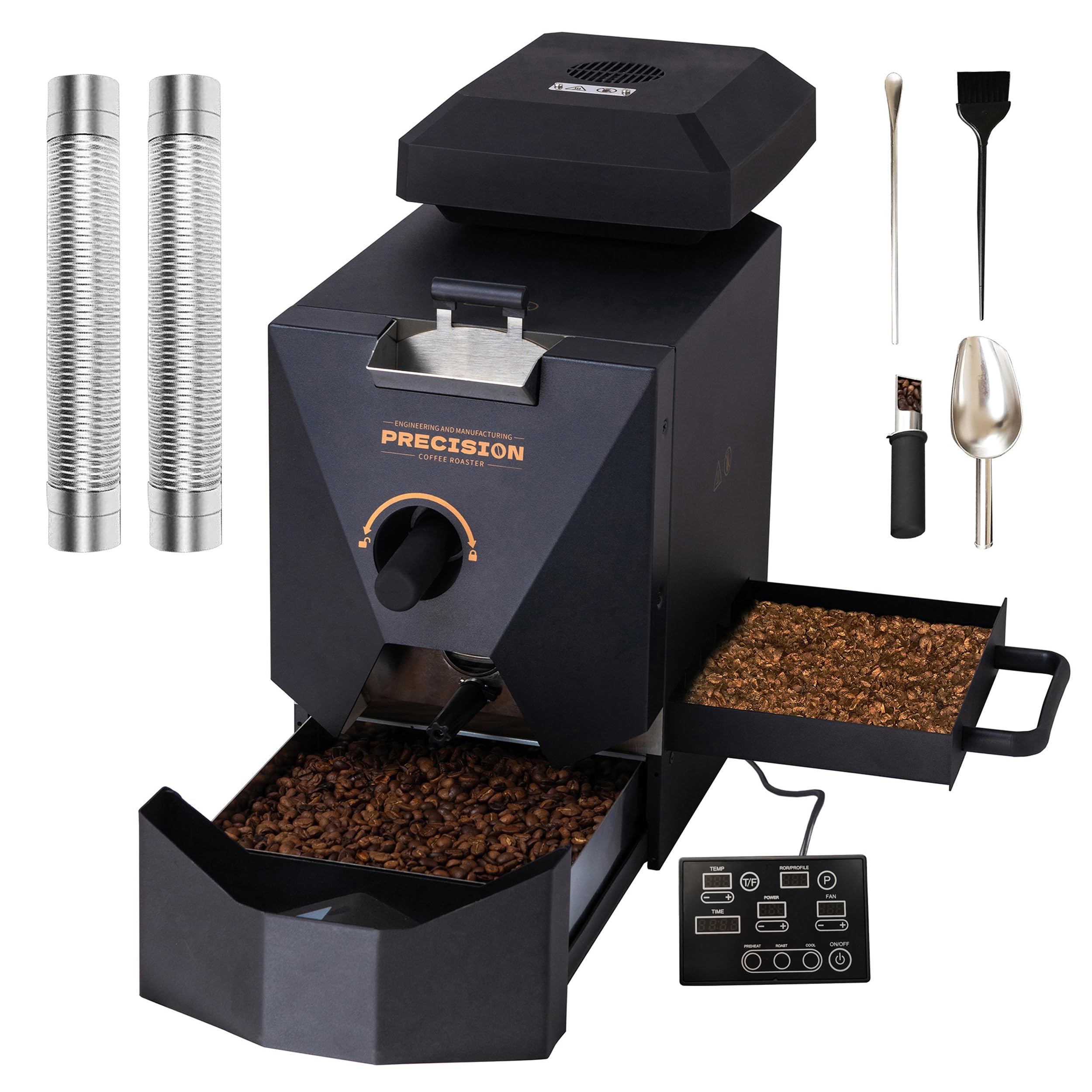
2. Precision 1Pound Coffee Roaster
A full pound of capacity with three levels of control and a filter for indoors
Sixteen ounces is the headline here: that is a pound of green beans going into a single roast, which puts this right alongside the biggest drums on this list. What most buyers end up valuing, though, is how far the mode system goes. You get automatic, assisted, and manual roasting, so a beginner can start hands-off and graduate to shaping the roast themselves without buying a second machine.
The ventilation design is more thorough than most. A smoke filter and vent pipe work together to push smoke and dust outdoors, and a microfilter catches fine particles on the way. Add the chaff collector and the observation window plus sample spoon, and you have a machine set up for monitoring a roast in real time rather than guessing from the clock. It measures 19 inches deep, 10.01 inches wide, and 15 inches tall, with a stainless steel body.
Compare that ventilation package with the CAFEMASY air roaster, which handles smoke through its air flow and chaff basket alone. If your roasting happens in a kitchen with a window or an exhaust path, this drum’s filter-and-pipe arrangement gives you an easier time on medium and dark roasts. The touchscreen interface keeps the controls in one place, and it is not built for commercial duty, so plan on home-scale sessions.
What stands out: a full pound of batch capacity paired with automatic, assisted, and manual modes means one machine can serve a nervous beginner and a tinkering veteran.
The honest caveat: all that capacity and ventilation comes in a footprint about 19 inches deep, so it wants a dedicated spot rather than a shared counter.
Built for: households that roast a pound at a time and need the smoke routed away properly.
Not the fit if: your kitchen is short on depth or you only want a couple of cups a week.
3. DYVEE KAKA-G400 Coffee Roasting Machine
The glass drum that turns every roast into something you can watch
If you have ever wondered what happens between green beans and first crack, this is the machine that answers it. The quartz glass drum lets you see the color shift from pale green all the way to a deep roast while the gas burner heats directly. You stop at first or second crack by eye and ear, which is exactly how roasters learn.
The build uses a 304 stainless steel frame (a common, durable stainless grade), a stainless steel base, and a wooden handle. The drum is rated for up to 400 g with a recommended batch of 200 to 300 g for the best results. A 12 V electrical motor runs the drum, which the maker points out is safer than a higher-voltage setup, and the power adapter comes in the box. The roasting performance is what wins people over — it is solidly built and runs well, and the four-step process keeps a session simple. The package includes the roaster set, a funnel, the power adapter, and a manual.
One thing to plan around: this is a gas-fired machine, so you need a burner and a safe, ventilated place to use it, not just a wall outlet. The learning curve is real, and ease of use is a genuine split in the feedback, so come in expecting to make a few imperfect batches while you dial in the flame. It weighs 17 pounds, and it can roast peanuts and other nuts too, which widens its usefulness beyond coffee.
Why roasters like it
- Quartz glass drum shows the full color change from green to roasted
- 400 g maximum with a 200 to 300 g sweet range for even results
- Stainless steel frame, base, and wooden handle stand up to heat
- 12 V motor with the power adapter included
What to plan around
- Needs a gas burner and a ventilated spot rather than a simple counter outlet
- The manual flame control takes practice before roasts come out consistent
Reach for this if: you learn by watching and want a transparent drum with honest manual control.
Leave it if: you would rather press a button and have the machine decide the curve for you.
4. Roma Pro Smart Home Coffee Bean Roaster, 120V (MAGO MAGA)
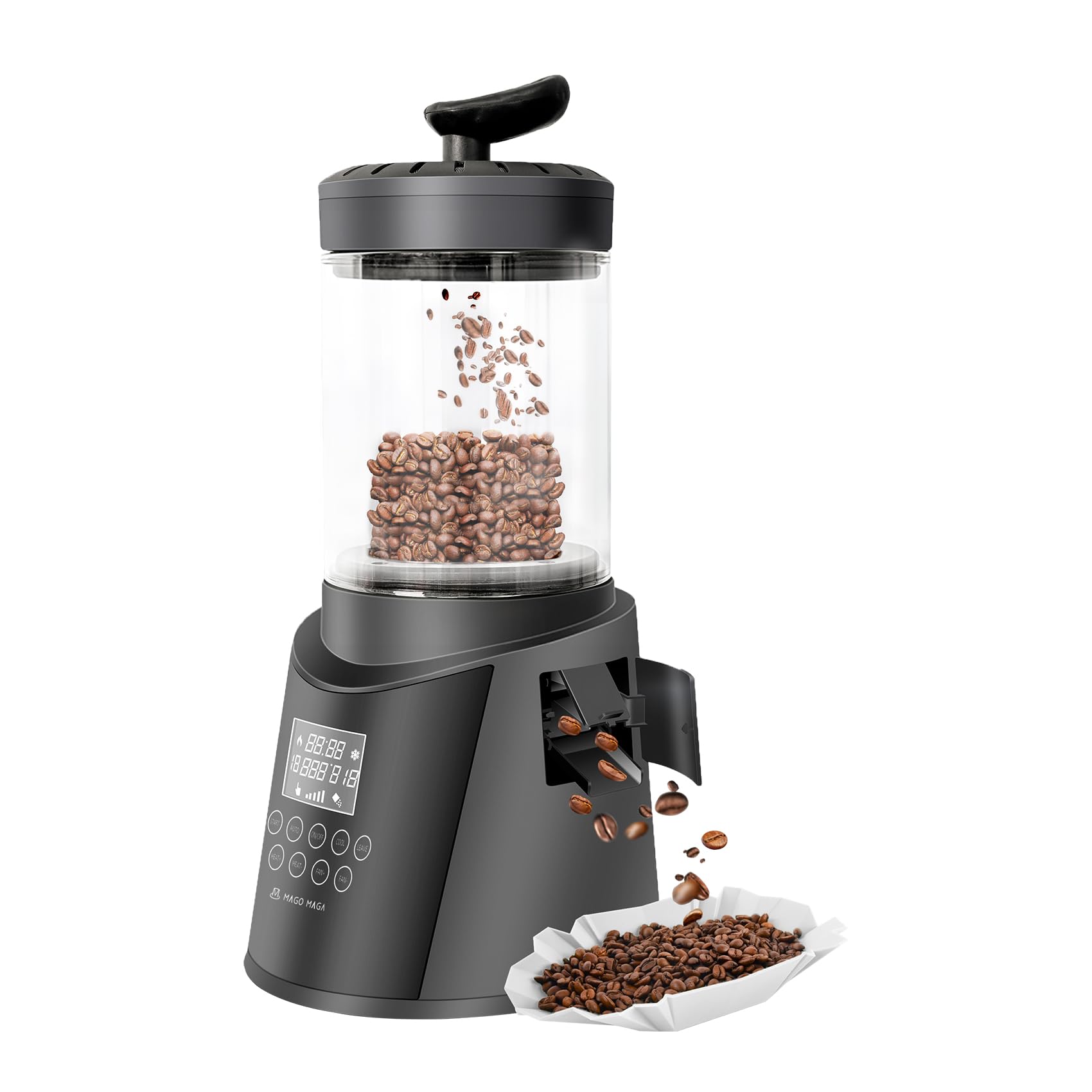
A fluid bed roaster with a temperature display that flips between Celsius and Fahrenheit
Hot air does the roasting here, lifting 300 g of green beans per batch in a stream of heated air. That method tends to give you a cleaner, brighter cup than a drum, and the double-layer glass window lets you watch the beans move the whole time. Auto-cooling kicks in at the end to pull the temperature down quickly so the flavor stops developing where you want it to.
The digital display shows temperature and time together, and you can switch between Celsius and Fahrenheit with a button. Auto mode handles most regular green beans, while decaf green beans tend to do better in manual mode — a detail worth knowing if decaf is your daily drink. This is a version 1.6 build with a beefed-up bean bin door switch, and it carries CE and ETL certification. It only roasts green coffee beans and is not a coffee maker, so budget for a brewer separately.
The footprint is compact at 8.3 inches wide, 6 inches deep, and 18.5 inches tall, which slides into a narrower space than the KAKA-G400. The efficient chaff collector and hot air design keep smoke low, which helps in a kitchen without a dedicated vent. Do expect some unevenness at the edges of a full 300 g batch, and a small number of units lose reliability over time — worth a warranty check at purchase.
The draw: fluid bed roasting plus a dual-unit temperature display makes this easy to learn on and easy to read at a glance.
Weigh this: the low-smoke design is a genuine plus for apartment roasting, but consistency across a full 300 g load is where it asks for patience.
Fits you if: you want a compact hot-air roaster with a clear window and a readable temperature display.
Probably not if: you need every batch to be dead even at max capacity.
5. Fatamorgana 450g Direct Fired Nut and Coffee Roaster
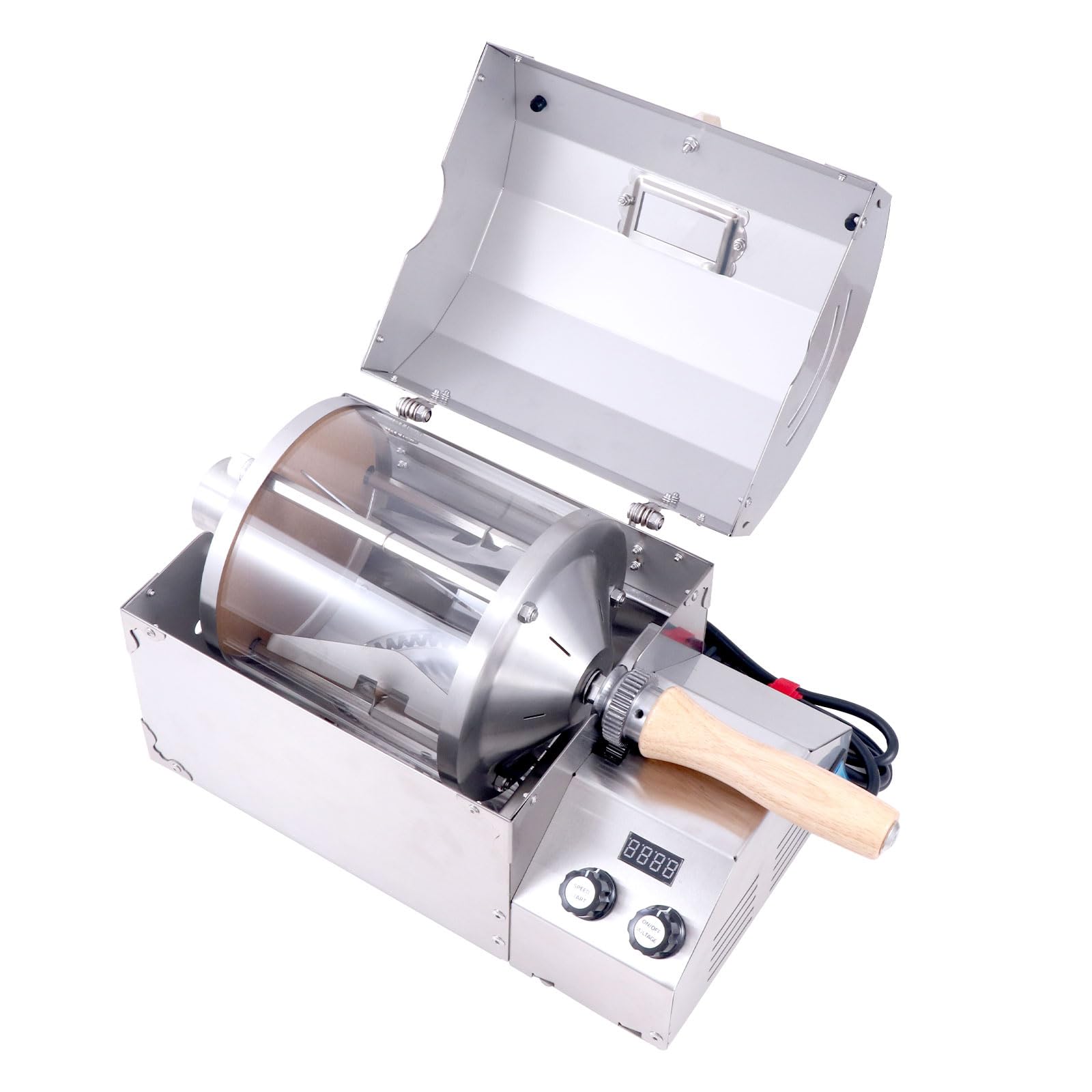
A 5mm quartz drum built for beans and nuts alike, at 1000 watts
This one simulates a direct flame rather than blowing hot air, and the maker says that method gives better flavor than air roasting. The drum is 5 mm thick quartz glass, so you can watch the color shift from light to dark without pulling samples with a scoop. It runs at 1000 watts and holds up to 450 g, which sits between the smaller air roasters and the pound-scale drums.
Its footprint is the most compact of the direct-fire options at 7.9 inches deep, 15 inches wide, and 9.5 inches tall, next to the BAMI-T500 at 19.29 by 10.24 by 15.75 inches. That makes it easier to tuck away, and the stainless steel housing is built to hold up without melting even during deep roasting. Cleaning is a hand job with no tools: you rotate the three spring screws on the front of the drum to lift out the quartz glass. It also roasts cashews, peanuts, melon seeds, pine nuts, lotus seeds, and pistachios, though it is not for nuts under 2 mm in diameter.
Here is the part a buyer needs to hear straight. Reliability is the most-discussed topic around this machine, and buyers report a mixed picture — some say it works exactly as expected, while others report it stops working after about 3 minutes of use. The maker says defective motors in an earlier batch have been replaced with updated motors. Quality of build is what wins people over, so treat this as a machine to buy with a clear return window and a warranty in mind.
The strong points
- 5 mm quartz glass drum shows every color change clearly
- Roasts coffee alongside nuts and seeds like cashews and pistachios
- Tool-free cleaning via three hand-turned spring screws
- Compact footprint for a direct-fire machine
The fit note
- Reliability is the most-discussed point in buyer feedback, with reports of units stopping after a few minutes
- Not suited to very small nuts under 2 mm in diameter
Pick this if: you want one machine that handles coffee and a range of nuts, with a glass drum you can watch.
Buy with care if: long-term reliability matters most — check the return terms before you commit.
6. BAMI-T500 Coffee Bean Roaster

A direct-fire drum with bean temperature and rate-of-rise readouts on the panel
The panel is what separates this from the crowd. You get bean temperature detection, ROR detection (the rate at which the bean temperature is climbing), firepower control, and damper control, all built into a patented drum that puts the heating element close to the beans. For someone who wants to understand a roast curve rather than just follow one, that readout set is the reason to look here.
Three modes cover the range. Auto mode runs a balanced flavor curve with a three-stage temperature rise, assistant mode lets you decide the drop time based on color, popping sounds, and aroma, and manual mode hands you every parameter. It can also run back-to-back: while the last batch cools, you start preheating the next one, so an uninterrupted session is possible. Maximum capacity is 500 g, and a purifier cleans smoke and dust before discharge.
Weigh the firepower and the control against the track record. Performance earns the most praise, with each roast performing well and the common comparison being a step up from a popcorn popper. Reliability is the most-discussed topic and the feedback splits — some machines run great, others have been reported malfunctioning. It weighs 22 pounds, so clear a sturdy, permanent spot for it.
Best for the data-minded: ROR, bean temperature, firepower, and damper controls give you the numbers to chase a specific flavor.
The trade-off: reliability is the most-discussed point in the feedback and it is genuinely split, so buy from a seller with a clean return path.
Great match for: roasters who want rate-of-rise data and back-to-back batch capability.
Wrong call if: you want a set-and-forget machine with a proven long track record.
7. Sandbox Smart R1 Home Coffee Roaster with Cooling Tray

Sixteen roast curves and an app that saves every profile you build
The app is the whole idea behind this roaster. The Sandbox Smart Roaster app walks you through a roast step by step, and every profile you use gets saved automatically, so a roast you liked last month comes back with a couple of taps. Sixteen built-in curves run the light-to-dark span, and you can also load user-created profiles and community-shared recipes, plus review your personal roast history. A VIP tier adds more curves and storage if you want the deeper library.
Batch size is the smallest of the direct-fire group here. You roast 100 to 150 g of beans in about 15 minutes, which the maker says brews roughly 7 cups. That is a daily-drinker pace rather than a stockpile model, and it means fresh beans more often. Manual mode gives you adjustable power and fan speed for flavor control, the cooling tray is a separate pack-in to settle the beans quickly, and a drawer collects silverskin for fast cleanup. It runs on 110 V and comes with a 1-year warranty.
The app is also where the friction lives. Ease of use splits — some find the roaster really easy to operate, others find the app is not intuitive. Functionality is a mixed split too, with a few reports of the drum stopping. What wins people over is quality and roast quality, both of which earn steady praise. It weighs 17.82 pounds, and the package measures 22.2 by 14 by 13.7 inches, so unbox in the room where it will live.
The app-driven upside
- 16 built-in curves plus saved history make repeat roasts repeatable
- Drawer for silverskin collection keeps cleanup quick
- Manual power and fan control for advanced tuning
- Backed by a 1-year warranty
The friction points
- Small batches of 100 to 150 g mean you roast more often
- The app is where the split feedback lands — some find it less intuitive than the machine itself
Worth a closer look if: you love the idea of saved roast profiles and community-shared curves guiding your sessions.
Better avoided if: you want to fill a big batch once and be done for the week.
8. CAFEMASY Coffee Bean Roaster Machine with Adjustable Timer

A small air roaster for 100 g batches and first-time buyers
This is the way to try home roasting without committing a big machine to the counter. It holds 80 to 100 g of green beans per roast, which the maker describes as about 13 shots of coffee — a daily-cup amount rather than a stockpile. Press AUTO and roughly 10 minutes later you have a consistent roast, which is about as low-friction as roasting gets.
Manual mode is where you take over. A knob sets the timer from 1 to 15 minutes and the roast heating from 1 to 8 levels, and the machine holds a constant temperature so the beans get even heat throughout. The clear high-boron glass jar lets you watch the color change without opening anything, and a chaff collection basket makes cleanup simpler. Air heating doubles as cooling: when the roast finishes, the system switches to cold blowing at once to stop the beans developing further. The body is heat-resistant ABS plastic with a bakelite lid.
Weigh the accessible entry point against a real reliability split. Some owners call it the best entry-level home roaster they have tried, and the easy operation is what most people like. Others report the fan stopping mid-roast and results that vary batch to batch, so buy it understanding the smaller scale and a possible rough patch. Its 9.4 by 10.8 inch frame tucks neatly into a corner.
What it gives you: a real air-roasting machine with an AUTO mode, adjustable timer from 1 to 15 minutes, and 8 heating levels for the smallest entry cost on this list.
Be realistic about: 80 to 100 g batches and a fan that has been reported to stop mid-roast — the upside is a cheap way to find out if home roasting is for you.
A smart start if: you want to roast small daily batches and learn the basics without a large outlay.
Hold off if: you need bigger batches or proven reliability from day one.
Know the Specs
Batch capacity in grams
Capacity tells you how many raw green beans go into the drum or chamber per roast. Green beans lose weight as moisture leaves, so a 500 g batch produces a smaller finished weight. Many makers recommend running below maximum — the KAKA-G400 does best at 200 to 300 g of its 400 g limit, and the NIASIA suggests 350 to 400 g of its 500 g. If you drink a few cups a day, a 100 g air roaster covers it. A household of heavy coffee drinkers will want a bigger drum to avoid roasting every other day.
Heating method and flavor
Drum roasting tumbles beans against heated metal or a heated drum surface, which tends to build body and depth. Air roasting lifts the beans in hot air, which tends to produce a brighter, cleaner cup. Direct-fire designs put heat close to the beans and often pair with a glass drum so you can watch color change. The Fatamorgana uses a direct-flame simulation at 1000 W, and the BAMI-T500 uses a patented drum built around the heating element. Neither method is better — they simply suit different tastes.
Smoke, chaff, and ventilation
Every roast makes smoke, and it gets heavier as the roast gets darker. A smoke purifier or filter handles the lighter smoke of a light roast. For medium and dark roasts, many machines expect you to vent smoke outdoors with a pipe or chimney tube. A chaff collector captures the papery skins that come loose during roasting so they do not end up on your counter. If you roast indoors without an exhaust path, the smoke handling design matters as much as capacity.
Temperature readouts and control
A digital display or panel showing temperature and time lets you repeat a roast you liked. Some machines switch between Celsius and Fahrenheit. More advanced panels add bean temperature and rate-of-rise (how fast the bean temperature is climbing) so you can shape a roast curve (the path of temperature over time). Automatic modes hold a built-in curve; manual modes hand you heat, fan, and timer. The best setup depends on if you want a repeatable result or full control of flavor development.
Common Questions
Can a home coffee roaster be used indoors without a vent?
How many cups of coffee does a 100 g batch make?
What is the difference between a drum roaster and an air roaster?
Do I need a gas burner for the KAKA-G400?
Can I roast nuts in a coffee roaster?
How do I clean a home coffee roaster?
Is a home coffee roaster worth it over buying roasted beans?
What does rate-of-rise mean on a roaster panel?
Can a home coffee roaster run back-to-back batches?
Do these roasters require green coffee beans?
The Bottom Line
For most homes, the winner is the NIASIA 500g Automatic Roaster because it combines a 500 g drum, nine built-in profiles, and a smoke filter plus vent pipes — the rare combination of hands-off roasting and real smoke management in one machine. If you want a full pound of capacity with a ventilation setup and three control levels, the Precision 1 Pound Roaster is the strong alternative. And for a compact hot-air roaster with a readable temperature display, the Roma Pro is the one to reach for.
Start with the batch size your kitchen can support and the smoke path you can give it — those two facts narrow the list faster than any feature list. Then pick the control level that matches your experience, and buy from a seller with a clear return window while you learn the machine.
How we choose
We do not accept paid placement. Every pick is matched to a real buyer and a real use-case; we do not hands-on test units.
Sources
Specifications: manufacturer listings and product documentation. Review insights: verified customer reviews, as of November 2026. Pricing: not shown on this page (it changes often); check the current price via the retailer link.
As an Amazon Associate, Tactical Gear Guy earns from qualifying purchases. This does not affect which products we feature.