Specs are compiled from manufacturer listings and verified buyer reviews and can change over time — please confirm the key details on the product page before buying.
You want one small camera that actually beats your phone — and the honest answer is that a compact camera only wins when it does something your phone physically cannot. That means optical zoom you can’t fake with software, a sensor that handles dim rooms, or a body that survives water and drops. This guide sorts nine top rated compact digital cameras by what each one genuinely does better than the rest, so you can pick the one that matches your shooting instead of the one with the loudest spec sheet.
This guide is built by comparing the manufacturers’ published specifications and the patterns across verified customer reviews, so you get each pick’s real strengths and trade-offs instead of marketing spin.
Below you’ll find zoom ranges, sensor sizes and ruggedness ratings explained in plain English, plus the trade-offs that only show up after the honeymoon period. Every pick here earns its place for a specific kind of shooter, and this breakdown of the top rated compact digital cameras tells you exactly which one fits your pocket and your subjects.
Top Picks


How To Choose The Best Top Rated Compact Digital Cameras
Start with the subject, not the camera. A birder needs reach, a snorkeler needs a sealed body, and someone filming a vlog needs a screen that faces them and clean audio. Once you know your subject, the specs below narrow the field fast.
Optical zoom versus digital zoom
Optical zoom moves real glass to magnify your subject, so the image stays sharp. Digital zoom simply crops and enlarges the pixels, which softens detail. A camera advertising “5X optical zoom” uses the lens; anything labelled “Intelligent” or “Dynamic Fine” zoom adds digital cropping on top, so treat the optical figure as the honest one.
Sensor size and low-light performance
A 1-inch sensor gathers more light than a smaller one, which usually means cleaner shots indoors and at dusk. Megapixels only tell you how large the file is, not how good it looks. Pay attention to the aperture too — a lower F-number like F2.0 lets in more light than F3.3.
Ruggedness ratings explained
Waterproof depth is given in feet and metres, shockproof drop height in feet and metres, and freezeproof in a minimum temperature. These are tested limits for the body, not a licence to treat the camera roughly — seals and lens glass still need care.
Side-by-Side Comparison
| Model | Best For | Optical Zoom | Sensor / Resolution | Video | Amazon |
|---|---|---|---|---|---|
| KODAK PIXPRO FZ55 Bundle★ Best Overall | First-timers and travel | 5x | 16MP | 1080p Full HD | Amazon |
| KODAK PIXPRO AZ528Biggest Reach | Wildlife and sports reach | 52x | 16MP BSI CMOS | 1080p Full HD | Amazon |
| Canon PowerShot V10Vlogger’s Choice | Vlogging and solo shooting | Fixed 19mm | 15.2MP 1-inch CMOS | 4K up to 30fps | Amazon |
| FUJIFILM X Half | Retro style and instant prints | — | 18MP | 2-in-1 stills/video mode | Amazon |
| OM SYSTEM Tough TG-7 | Water, snow and macro | 4x | 12MP BSI CMOS | 4K up to 30fps | Amazon |
| Panasonic LUMIX FZ80D | All-in-one superzoom | 60x | — | 4K Photo / 4K video | Amazon |
| Panasonic LUMIX TZ/ZS99 | Travel and concerts | 30x | — | 4K at 30p | Amazon |
| Nikon COOLPIX P950 | Birds and the moon | 83x | 16MP | 4K UHD | Amazon |
| Sony RX100 VII | Premium pocket all-rounder | 8.3x (24-200mm) | 20.1MP 1-inch stacked CMOS | 4K | Amazon |
Detailed Reviews
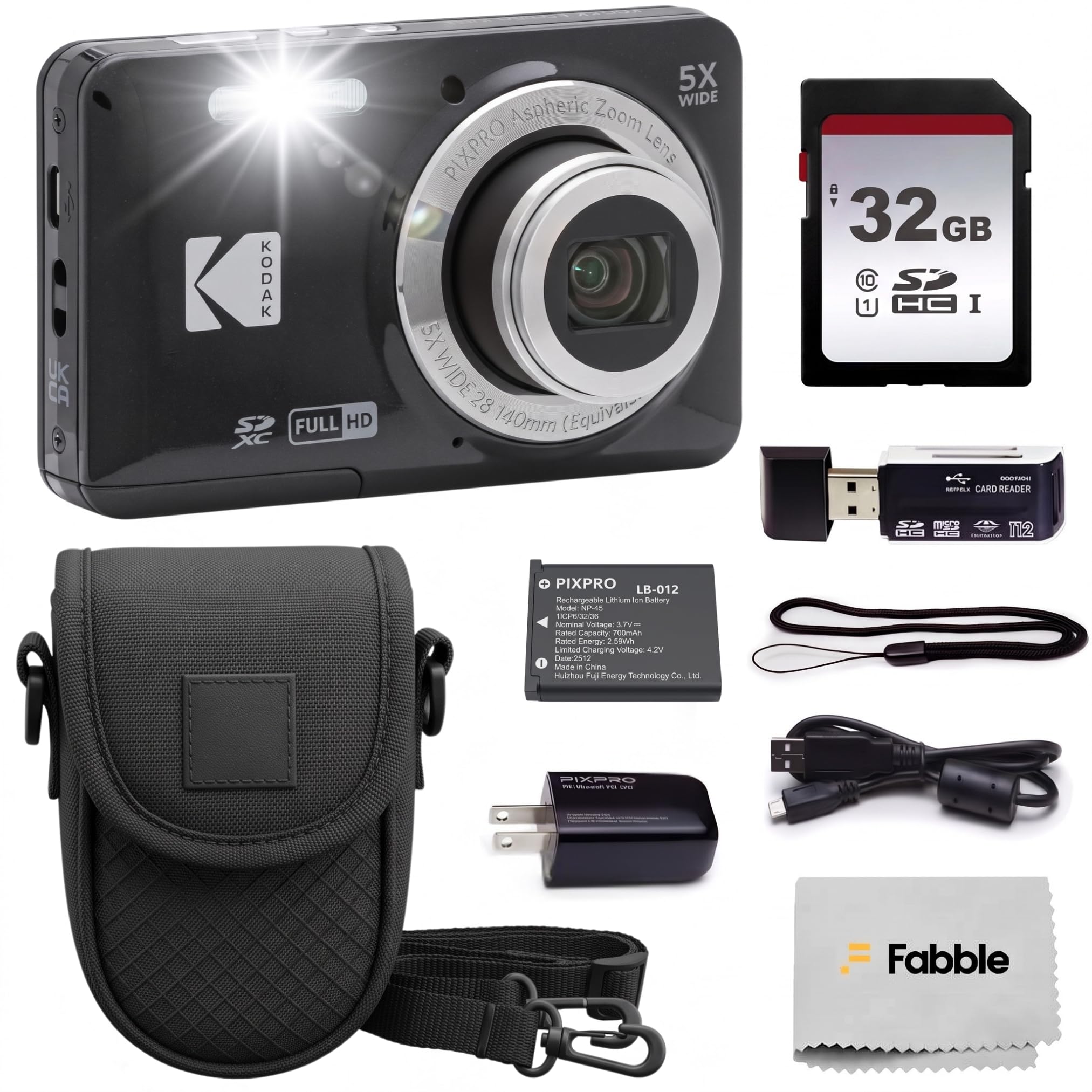
1. KODAK PIXPRO FZ55 Digital Camera
Our pick — 4.5+★ from 350+ verified ratings; the strongest balance of quality and price.
The camera that quietly wins the beginner crowd: easy to hold, easy to shoot, and priced like a starter kit.
What makes the FZ55 land at the top is how little it asks of you. It carries a 16MP sensor — 16 million pixels, enough for clean prints and cropped social posts — paired with a 28mm wide-angle lens that fits a whole room or landscape into the frame. The 5x optical zoom then closes the distance for portraits and stage shots without the soft, smeared look you get from cropping a phone image.
Video tops out at 1080p Full HD, which is sharper than the screen most people watch on. Composition happens on the 2.7-inch LCD screen, and reviewer feedback keeps circling back to how intuitive the layout feels — the recording button in particular gets called out as the kind of detail that stops you fumbling mid-moment. At 1 ounce the battery keeps the body genuinely pocketable, and buyers describe it as a travel companion that slips into a bag without bulk.
The catch sits in the word “compact” itself. That small body is not sealed against water or drops, so beach days and trail runs need a case and a bit of care. It also leans on contrast-detection autofocus, so very low light or fast movement can hunt a little. Neither is a flaw at this level — it is simply a small-sensor point-and-shoot doing exactly what it was built to.
What the FZ55 gets right
- 28mm wide-angle glass frames a whole scene without stepping back — the 5x zoom then reaches the subject.
- Light 1-ounce battery keeps the body easy to pocket and carry all day.
- Simple 2.7-inch LCD and one-press recording make the first hour painless.
- That 2000s film-camera look earns genuine affection in the reviews.
Where it asks you to adjust
- No weather sealing — rain and sand need a cover.
- Contrast-detection autofocus is not fast enough for sprinting sports.
Reach for this if: you want a first real camera for holidays, family events and everyday snapshots that looks good doing it.
Think twice if: you shoot in wet, dusty or hard-knock places — that is the TG-7’s job further down.
2. KODAK PIXPRO AZ528 Digital Camera
Fifty-two times into the distance, from a camera you can still carry in one hand.
If the FZ55 is the friendly starter, the AZ528 is the reach monster of the value tier. Its 52x optical zoom spans a 24mm wide-angle for landscapes all the way to tight telephoto shots of birds, wildlife and athletes. That is real glass doing the magnifying, not a digital crop, so the detail holds up instead of falling apart. For comparison, the OM SYSTEM Tough TG-7 tops out at 4x — a huge gap in reach in the AZ528’s favour.
The 16MP BSI CMOS sensor is built for better low-light results, and built-in optical image stabilization counters hand shake even at full reach, so handheld telephoto shots stay crisp without a tripod. Burst mode fires at 6fps to catch fast action, and the 3-inch LCD is bigger than the FZ55’s 2.7-inch screen for reviewing those sequences. Wi-Fi lets you push photos to your phone and post straight from the field, or use the phone as a remote viewfinder.
Here is the honest trade-off: at 52x, this is a demanding camera to hand-hold, and buyers report that picture quality and reliability split opinion — some love the results, others fight blurry frames. The tighter 25 autofocus points also mean fast, erratically moving subjects can slip focus. Give it good light and a steady brace and it delivers; expect point-and-shoot ease at full zoom and it will frustrate.
Who it suits: anyone who wants long-distance photos of wildlife or sports on a travel-friendly body — the 6fps burst and Wi-Fi sharing make it a field camera, not a shelf camera.
The honest limit: that reach rewards a steady hand and bright conditions, and the 25 autofocus points are modest for tracking quick movement.
Best matched to: birders, sideline parents and travellers who need distance on a value-tier budget.
Pass on it if: you mostly shoot dim interiors — the sensor is small and the extra reach buys nothing indoors.
3. Canon PowerShot V10 Compact Vlogging Camera
A camera built around the person talking to it, not the landscape behind it.
Canon did something clever with the V10: it folded the screen to face you instead of leaving you guessing. The 15.2-megapixel 1-inch back-illuminated CMOS sensor is the largest in this value group, and that size is why the camera holds up in low light where smaller sensors go grainy. A fixed 19mm wide-angle lens takes in tight interiors and group shots, and it is this camera’s character — wide enough for a selfie frame, not so wide that faces warp at the edges.
Video is where the money goes. You get 4K at up to 30fps and Full HD at up to 60fps, plus 14 movie color filters for mood. Three image stabilization modes — IS Off, IS On and IS Enhanced — arrived with firmware version 1.2.0 or later, so update it if you buy. Audio comes from a pair of stereo microphones, with a third in the middle working to cut background noise, and there is a dedicated external mic port plus micro-HDMI output if you want to grow.
The built-in stand folds front or back, which turns a tabletop or a shelf into a tripod-free filming spot. Battery life is rated around 2 hours, and that is the number reviewers push back on hardest — for a camera whose whole job is long takes, pack a spare or plan around shorter sessions. Otherwise this is the most purpose-built video tool in the value tier.
Why creators gravitate to it
- Front-facing retractable screen means you frame yourself without guesswork.
- 1-inch sensor outpaces the small-sensor crowd indoors and at dusk.
- Folding stand gives hands-free angles on any flat surface.
- Stereo mics plus a center mic tackle room noise; an external mic port is there to upgrade.
The trade-offs to know
- Roughly 2 hours per charge is tight for all-day shooting.
- The fixed 19mm lens cannot zoom — you move or you crop.
Made for talkers: vloggers, streamers and anyone filming themselves first and scenery second.
Not the pick for: stills-focused shooters who need zoom range or a long battery day.
4. FUJIFILM X Half Premium Compact Camera – Black

Dial-driven dials, film-era looks, and the option to hold a print in your hand minutes later.
The X Half leans hard into the retro idea and makes it functional rather than decorative. Its 18MP effective resolution is the highest among the value picks here — ahead of the Tough TG-7’s 12MP — so there is detail to work with. Dial-based controls put aperture and exposure under your fingers instead of buried in menus, which is exactly the tactile appeal that draws people away from their phone. A 2-in-1 mode blends stills and video into one creative capture.
The personality comes from 26 analog-inspired film and filter options, plus a dedicated Film Camera mode. You can print straight to a compatible instax printer for a physical keepsake, or send shots to your phone via the dedicated app.
What you give up is flexibility on the tech side. The ISO range runs 100-3200, which is modest for really dim interiors and candlelit scenes, and files save as JPEG rather than RAW for later editing. Battery life is rated around 2 hours. So this is a delight-first camera, not a low-light powerhouse — the trade you make knowingly for looks and manual dials.
The draw: manual dials, 26 film looks and instax printing make photography feel like play instead of data entry.
Know before you buy: a 100-3200 ISO ceiling and JPEG-only files mean less room to push dark shots later in editing.
Choose it for: the joy of dials, film-inspired colors and instant prints you can give away.
Look elsewhere if: you shoot night scenes or want RAW files to edit hard.
5. OM SYSTEM Olympus Tough TG-7 Underwater Camera

The one you can dunk, drop, freeze and still use the next morning.
Ruggedness is the TG-7’s whole argument, and the numbers are real limits: waterproof to 50 ft (15m), shockproof to 7 ft (2.1m), crushproof to 220 lbf (100kgf), freezeproof to 14°F (-10°C), and dustproof. Anti-fog dual-pane lens glass stops condensation fogging your shots as you move between warm and cold. Five dedicated underwater modes cover snorkeling, diving and pool shots, so colors stay usable beneath the surface.
Imaging holds up too. A 12MP back-illuminated CMOS sensor and TruePic VIII processor pair with a 25-100mm equivalent lens and a bright F2.0 aperture that pulls in light when conditions turn dim. The macro system is the sleeper feature: four modes, from Microscope to Focus Stacking, let you focus as close as 1cm from the front of the lens for insects, flowers and textures. Video reaches 4K at up to 30fps, or Full HD at 120fps for slow motion.
Its 4x optical zoom is the narrowest reach on this list, so this is not a wildlife-distance camera — the AZ528’s 52x exists for that. Photo quality divides opinion in the reviews, with images that some find crisp and others find soft, and the 9 autofocus points are on the low side. Buy it for the sealed, drop-ready body and the macro reach; buy a superzoom for distance.
Built for the elements
- Waterproof to 50 ft (15m) and shockproof to 7 ft (2.1m) — real adventure limits.
- 1cm close focus and four macro modes reveal details a phone cannot reach.
- F2.0 aperture on a 12MP back-illuminated sensor keeps dim shots usable.
- Anti-fog glass stops condensation ruining the shot as temperatures shift.
Stay realistic about
- 4x optical zoom is the shortest reach here — no distant wildlife.
- 9 autofocus points and mixed reports on fine detail at a distance.
The adventure answer: snorkelers, hikers, campers and anyone whose camera meets water, snow or rock.
Wrong tool if: your subject is far away — this is a close-and-rugged camera, not a long lens.
6. Panasonic LUMIX FZ80D Compact Camera with 20-1200mm Zoom

Wide landscapes and super-telephoto birds from the same fixed lens, no bag of glass required.
The FZ80D replaces a whole camera bag with one body. Its 60x optical zoom runs from 20mm wide to 1200mm super-telephoto, so a sweeping view and a distant athlete come from the same lens with no swapping. The F2.8-F5.9 lens works alongside Power Optical Image Stabilizer, which fights the hand shake that gets amplified at long focal lengths, so those far shots stay usable without a tripod.
Framing is unusually comfortable for a compact. There is a bright 0.39-inch OLED viewfinder for eye-level shooting plus a 3.0-inch touch LCD with roughly 1.84M dots for playback — the viewfinder is what separates it from screen-only rivals and helps outdoors where glare kills a rear display. 49 autofocus points and 4K Photo let you fire bursts at 30fps and pull the perfect frame, and creative tools like Focus Select and Brightness Composite refine the result. USB-C charging keeps it travel-ready.
The trade-off is size versus reach. A 1200mm-equivalent lens makes this the bulkiest body in the mid group, and the small sensor that enables that zoom will show its limits in low light and at high ISO. Battery life runs around 1.5 hours. If you want one camera for everything from scenery to distant subjects, that is the deal; if you want pocket-slim, keep reading.
One lens, huge range: 20mm to 1200mm means landscapes and distant subjects are both covered, with stabilization keeping the far end steady.
Bulk is the price: this is the largest body in the mid group, and small-sensor low-light performance is the compromise that reach demands.
Pick it when: you want a single camera that covers wide scenes and long-distance subjects without extra lenses.
Skip if: pocketability or dim-venue shooting matters most — the body is big and the sensor is small.
7. Panasonic LUMIX TZ/ZS99 Point and Shoot Travel Camera

The concert-and-coast camera that disappears into a jacket until the moment you need it.
Panasonic built this around the traveler’s real problem: reach without bulk. A 24-720mm LEICA lens delivers 30x optical zoom in a body that slips into a pocket, so a wide harbor shot and a tight stage shot come from one small camera. That 30x sits between the FZ80D’s 60x and the FZ55’s 5x, and for travel it is arguably the right middle — enough reach for concerts and wildlife, not so much glass that you leave it behind.
Shooting ergonomics are thoughtfully done. The 1,840k-dot touchscreen tilts so you can frame from any angle, and a tilting screen matters at concerts and overhead crowds where a fixed screen forces guesswork. Video covers 4K at 30p and 4K PHOTO bursts at 30fps, plus HD high-speed at 120fps for slow motion. Bluetooth v5.0 supports a dedicated Send Image button that pushes shots to your phone for the Panasonic Image App, and USB Type-C charging means one cable for the whole trip.
The camera’s weak spots are honest ones: the reviews peg the menu system as the least-loved part, and image quality splits between admirers and critics. Autofocus is hybrid with 19 points, good for everyday scenes but not a sports rig. There is also no built-in flash, so low-light work relies on the sensor and stabilization alone.
Where the ZS99 shines
- 30x LEICA lens in a pocket body balances reach and portability better than most.
- Tiltable 1,840k-dot touchscreen lets you shoot from high or low angles.
- USB Type-C charging and Bluetooth Send Image keep travel simple.
The fair caveats
- No built-in flash — rely on light and stabilization for dark venues.
- Menu navigation is the most criticised part of the experience.
For the traveler: anyone who wants big zoom without a big bag, from city breaks to concert seats.
Otherwise consider: a flash-heavy compact if low-light party shots are your priority.
8. Nikon COOLPIX P950 Superzoom Digital Camera

Eighty-three times of reach, aimed squarely at the bird on the far branch.
The P950 exists for one reason: distance. Its 83x optical zoom with 166X Dynamic Fine Zoom (digital cropping on top of the optical reach) and a 2000mm maximum focal length turn far-off subjects into frame-filling shots. Built-in Bird and Moon modes plus scene modes handle the tricky exposures automatically, so you point and let the camera work out the settings. A 16MP sensor and 4K UHD video round out the capture side.
For birders specifically, that reach is the point. Reviewers compare it to carrying a DSLR with a long zoom lens in one body, and it is praised for getting shots of birds at 200-300 yards. Continuous shooting runs at 7fps to catch wing movement, the rotating LCD allows awkward angles, and Wi-Fi and Bluetooth with GPS let you log and share from the field. RAW format is there if you want to edit seriously later.
The realistic downsides are weight and handling at full reach. The reviews flag weight as a mixed point, and 83x is unforgiving of shaky hands, so a steady brace or support helps at the far end. Small-sensor performance also softens after sunset. But for pure birding and moon shots from a single handheld body, that reach is why it sits in the premium tier.
The headline: an 83x optical zoom with Bird and Moon modes is a birding and astro reach tool in one handheld body.
The honest toll: it is heavier than the pocket compacts, and holding 2000mm steady demands deliberate technique.
Best for the long view: birders, moon-gazers and anyone who shoots subjects they cannot approach.
Not the first pick if: you want something that lives in a pocket or travels ultra-light.
9. Sony RX100 VII Premium Compact Camera
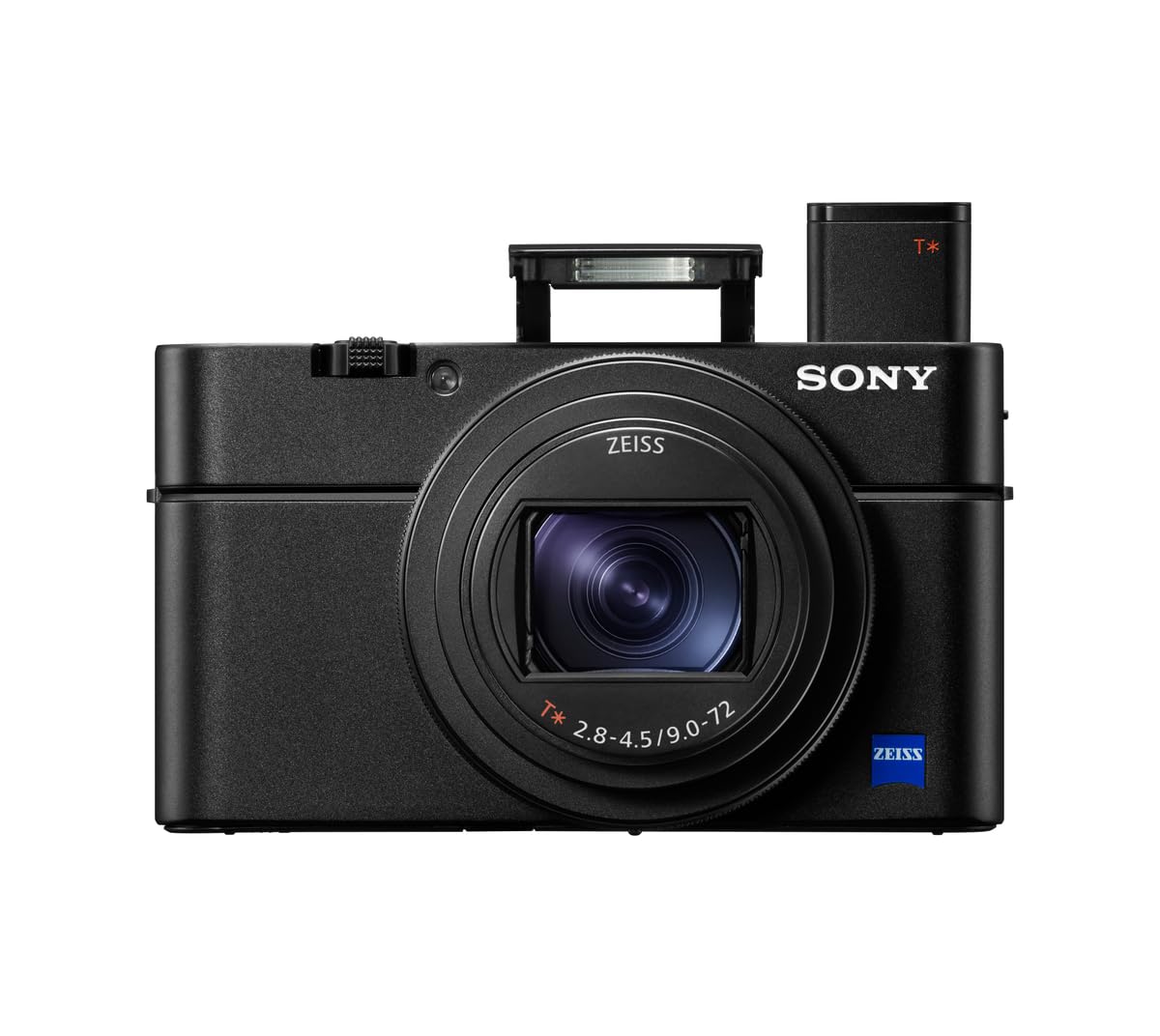
The pocket camera that thinks like a pro body — and charges accordingly.
At the top of the stack, the RX100 VII is the most capable compact here on paper. A 20.1MP 1.0-type stacked CMOS sensor feeds a Zeiss Vario Sonnar T 24-200mm F2.8-F4.5 lens, so it gathers more light than any small-sensor rival and its 24-200mm zoom covers everyday wide to portrait-and-event telephoto. That combination is why it pulls ahead of the smaller-sensor picks in dim venues and indoors.
The speed features read like a flagship. High AF speed of 0.02 sec plus 357-point focal plane phase-detection AF and 425-point contrast-detection AF make tracking quick and decisive, and that 425-point figure dwarfs the AZ528’s 25 points. Up to 20fps blackout-free shooting, with up to 60 times/sec AF/AE calculations, keeps fast subjects sharp. AI-based real-time tracking and Real Time Eye AF handle humans and animals, and 4K video adds S-Log3, a microphone jack and Active mode stabilization for serious filming.
Its limitation is grip and size, not image quality. That stacked sensor and fast autofocus earn the strongest image-quality praise in this list, but the value and reliability aspects read as mixed — a nod to the premium outlay relative to a small body’s handling. This is the pick for someone who wants the best possible images and speed from a pocket-sized camera and accepts the cost of getting there.
Why it tops the pro grade
- 20.1MP 1-inch stacked sensor offers the biggest light-gathering advantage here.
- 0.02 sec AF speed plus 357-point phase and 425-point contrast detection.
- Up to 20fps blackout-free bursts keep fast action locked in.
- 4K with S-Log3 and a mic jack make it a real video tool, not an afterthought.
Set expectations
- Premium outlay relative to a small body’s ergonomics and grip.
- At 200mm max reach, the superzooms still out-distance it.
For the demanding pocket shooter: travelers and event shooters who want the fastest autofocus and best light capture in a small body.
Different tool if: you need 50x-plus zoom or a weather-sealed body — this is speed and image quality, not reach or toughness.
Know the Specs
Optical zoom versus digital zoom
Optical zoom is the lens physically magnifying your subject, which keeps detail intact. Digital zoom (often dressed up as “Intelligent” or “Dynamic Fine” zoom on top of the optical figure) simply crops and enlarges pixels, so sharpness drops. Always buy on the optical number: the AZ528’s 52x and the P950’s 83x are real glass, while any extra tail on those figures is digital.
Sensor size and aperture
A larger sensor and a lower F-number both gather more light. The Sony’s 1-inch sensor and the Canon V10’s 1-inch design pull ahead indoors compared with the smaller sensors on the KODAK picks, and a bright F2.0 lens like the TG-7’s helps when light is short. Megapixels only set file size, not image quality, so weight sensor size over megapixel count.
Autofocus points and speed
More autofocus points, and faster focus, mean moving subjects stay sharp more easily. The Sony’s 357 phase plus 425 contrast points and 0.02 sec AF speed are the most advanced here, while the TG-7’s 9 points and the AZ528’s 25 are more modest for tracking fast movement.
Video resolution and frame rate
Resolution sets detail and frame rate sets motion smoothness. 4K at up to 30fps appears on the Canon V10, TG-7, FZ80D, ZS99 and Sony, while the KODAK picks cap at 1080p Full HD. Full HD at 120fps on the TG-7 and ZS99 enables slow-motion footage — a detail slow-mo editors will want.
Common Questions
Will a compact camera beat my phone for zoom photos?
How much optical zoom do I need for bird photography?
Can I take a compact camera underwater?
Is a 1-inch sensor better than a smaller sensor for indoor shooting?
How long does the battery last on these compact cameras?
What is the difference between 4K and 1080p video on a compact?
Do these cameras shoot RAW for editing?
Which compact camera travels lightest in a pocket?
Is a superzoom or a rugged camera better for hiking and camping?
Can I share photos from these cameras straight to my phone?
The Bottom Line
If you want one camera that does the most for the least fuss, the KODAK PIXPRO FZ55 is the everyday pick — a 16MP sensor, 5x optical zoom and a lightweight body that suits an ordinary day out. For reach, the KODAK PIXPRO AZ528 gives you 52x optical zoom and Wi-Fi in a value-tier body. And when the best image quality and fastest autofocus in a pocket are what matter, the Sony RX100 VII is the one to reach for.
How we choose
We do not accept paid placement. Every pick is matched to a real buyer and a real use-case; we do not hands-on test units.
Sources
Specifications: manufacturer listings and product documentation. Review insights: verified customer reviews, as of November 2026. Pricing: not shown on this page (it changes often); check the current price via the retailer link.
As an Amazon Associate, Tactical Gear Guy earns from qualifying purchases. This does not affect which products we feature.