Specs are compiled from manufacturer listings and verified buyer reviews and can change over time — please confirm the key details on the product page before buying.
If your juice bar dies on a Saturday morning, it is almost never the fruit — it is the machine. Commercial juicers fail on three things: a weak motor that overheats mid-rush, a base that walks across the counter from vibration, and a basket that clogs before the lunch crowd. The picks below are the ones built for continuous service, not a Sunday hobby. Start with the Waring 6001C if you want the most recognisable name in foodservice at a mid-range price.
This guide is built by comparing the manufacturers’ published specifications and the patterns across verified customer reviews, so you get each pick’s real strengths and trade-offs instead of marketing spin.
Below you get six machines ranked by what actually survives a busy counter. Every figure comes from the maker’s own spec sheet. Each pick is weighed against real owner experience with these — juice bars, cafés, hotels. That is how these top rated commercial juicers were separated from the pretenders that fold under a morning rush.
Top Picks

How To Choose The Best Top Rated Commercial Juicers
Buying for a counter that never stops is a different job from buying for your own kitchen. A home juicer gets five minutes of work and a rinse. A commercial unit gets four hours of carrots, a barkeep shouting for lime juice, and a scrub-down at close. The spec sheet tells you half that story.
Match the motor type to your menu
A centrifugal juicer spins a cutting disc very fast and throws juice against a mesh basket. It is the fast pour you want for a smoothie line. A masticating juicer crushes produce slowly with an auger, which pours slower but runs quieter. Choose centrifugal for a fast pour at volume, or masticating for a slower, quieter press. If you sell mostly citrus, a dedicated orange press saves you the peeling step entirely.
Check what the basket and housing are actually made of
Stainless steel is the material that survives daily acid exposure from citrus and pineapple. A polycarbonate housing (a tough clear plastic shell) is lighter and cheaper to replace, but a stainless basket inside it is what actually takes the wear. Look for both spelled out, not just “durable construction”.
Read the duty rating, not the headline wattage
A high wattage number impresses on the box, but it means nothing if the motor is not rated for continuous use. Commercial duty means it can run through a service without a cool-down break. Ask whether the machine is described as built for all-day operation. A continuous-duty rating is what separates a real workhorse from a bigger home unit.
Factor in the cleanup minutes
The fastest way to kill staff morale is a machine that takes twenty minutes to strip down at close. Dishwasher-safe parts and a pull-out filter box cut that down to minutes. Check what cleaning tools come in the box, too — a proper brush is worth more than a folded leaflet.
Side-by-Side Comparison
| Model | Best For | Motor / Power | Weight | Capacity | Amazon |
|---|---|---|---|---|---|
| Waring 6001C★ Best Overall | Compact bar counters | 3600 RPM / 120V | 11.1 lb | 10.25″D x 10.25″W x 12.5″H | Amazon |
| Waring WJX80Most Powerful Centrifugal | All-day smoothie shops | 1000W / 1.2HP | 17 lb | 12 quarts | Amazon |
| VEVOR Automatic Orange Juicer | High-volume citrus | 120W | 121.3 lb | 25 oranges per minute | Amazon |
| Kuvings CS600 | Quiet, slow-press juice | 200W | 20.5 lb | 400 ml | Amazon |
| Robot Coupe J80 Ultra | Fast service-line juicing | 700W / 3000 RPM | 16 lb | 6.5 liters | Amazon |
| Nutrifaster N450 | Heavy citrus and root veg | 1056W / 3450 RPM | 64 lb | 12 ounces | Amazon |
Detailed Reviews
1. Waring Medium-Duty Juice Extractor
The compact bar workhorse that fits where a full-size machine will not.
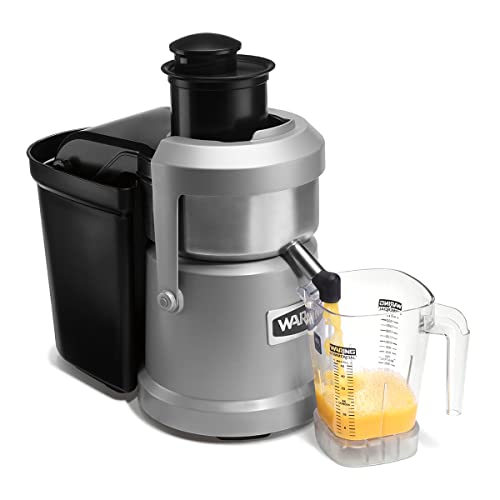
What sells this machine to a small bar is the footprint. Its housing measures 10.25 inches deep by 10.25 inches wide by 12.5 inches tall, so it slides onto a back-bar ledge where nothing else will sit. That is a real constraint for a coffee shop squeezing lemons for a single cocktail list.
The extraction side is genuinely beefy for the size. A 3600 RPM induction motor (a sealed, brushless motor that holds speed under load) spins the cutting disc hard, and a patented gyro base is designed to cancel vibration on the counter. The basket and blade are stainless steel, which is the material that matters when citric acid hits it daily. At 11.1 pounds it is the lightest pick here by a wide margin — the VEVOR unit weighs 121.3 pounds, so moving this one between stations is a one-person job. It takes a standard 120V 5-15 plug, so it drops into any normal wall outlet without a rewire.
Here is the honest part. Owner experience with this model splits hard, and the complaints are specific rather than vague: the lid lifting off its track, the top jumping, and vibration strong enough to work parts loose under load. The safe read is that this is a light-to-medium duty bar machine being pushed into all-day service. If your output is a few dozen drinks a night, it fits. If you are running a dedicated juice line at volume, put your money into the 1000W WJX80 instead. That said, it still holds the top spot here for the compact-counter operator who needs stainless guts without a floor-standing footprint.
What earns it the top rank
- Smallest footprint on the list at 10.25″D x 10.25″W x 12.5″H — fits tight bar counters
- 3600 RPM induction motor with a gyro base built to cancel vibration
- Stainless steel basket and blade handle daily citrus acid
- 11.1 lb makes it portable between stations
What you should know before committing
- Lid and top assembly have a track record of jumping off under vibration
- Built as medium-duty, so a high-volume line needs a bigger motor
- Reliability is the recurring theme in owner write-ups
Buy this one when: you run a compact bar or café with steady but modest juice output and need stainless extraction in a small footprint.
Go bigger instead if: your machine will be running back-to-back through a full lunch service.
2. Waring WJX80 Juice Extractor
Built to run all day with pulp ejecting straight into the bin behind it.
This is the machine for the smoothie shop that never gets a gap in the queue. The spec that matters most here is the power figure: 1000 watts, which is 8.3 times the 120 watts of the VEVOR orange press in this same list. That extra grunt is what lets it hold speed pressing kale stems and ginger root rather than just oranges.
Continuous pulp ejection is the other reason this one earns a premium placement. Instead of stopping to empty a basket, the machine throws pulp out of the way while it spins, and the stainless steel filter basket and shredder disc are designed to squeeze more juice per pound of produce. That directly protects your produce cost. The 12-quart capacity means fewer stops, and the whole lot is dishwasher-safe, with a cleaning brush included so close-down does not drag on.
The catch is the shape it asks of your kitchen. It measures 18 inches deep by 10.75 inches wide by 20 inches tall and weighs 17 pounds, so this is a permanent counter resident, not something you tuck away. Budget the space before you commit. For a café running a fixed juice menu with steady morning volume, that footprint is the fairest trade on this list.
Why it earns its place: 1000 watts and continuous pulp ejection together mean a machine that keeps pouring while the line grows, which is the whole point of buying commercial grade.
The space cost: 18-inch depth and a 17-pound body make it a fixture on the counter rather than a stowable appliance.
It beats: any smaller-motor centrifugal unit when kale and ginger are on the menu.
It does not suit: a counter with no depth to spare or a menu that only needs citrus.
3. VEVOR Commercial Orange Juicer Machine

Load whole oranges up top, flip one switch, and fresh juice pours without a peeler.
If your menu is citrus-first, this machine attacks the labour every other juicer here ignores: peeling. It strips, presses and filters in one pass and handles up to 25 oranges per minute. A 120W motor drives the whole cycle, with concave-convex pressing balls doing the squeezing. The feed chute takes oranges from 55mm to 80mm — roughly 2.2 to 3.2 inches — which covers most of what a supplier will drop off.
Safety is thought through in ways that matter on a busy line. A transparent PC cover houses a pressure sensor that cuts the machine when the cover comes off, and the power switch sits under a waterproof cover. The body is food-grade SUS304 stainless with PC components, and the filter pulls out as a single box for cleaning. Two peel-collecting buckets ride underneath, and a spare parts set ships in the box.
The trade-off is size and the build quality of the moving parts. This is a 121.3-pound floor-standing unit at 18 inches deep by 20.6 inches wide by 35.4 inches tall, so plan a dedicated station. Also worth knowing: what wins people over is the convenience of the hands-free cycle, but the handle assembly is the recurring weak point in owner write-ups, and citrus below the chute range is out — lemons do not work in it. Treat the moving parts gently and this is a serious volume citrus press.
The labour saver: full auto peel, press and filter at 25 oranges per minute removes the single biggest time cost in a citrus bar.
Where it needs care: a 121.3-pound floor-standing footprint, a handle assembly that owners say wants gentle handling, and no support for fruit smaller than the chute range.
Reach for it if: orange juice is a top-selling line and you want to cut the peeling labour out entirely.
Look elsewhere if: your menu leans on lemons, limes or leafy greens.
4. Kuvings CS600 Whole Slow Juicer

The slow-press machine you can run around the clock without it overheating.
Speed is not the story with this one — endurance is. Kuvings rates the CS600 for 24-hour operation, backed by a cooling system that lets it keep running without overheating. For a wellness café or a hotel spa where the machine is on from open to close, that rating is the entire pitch. The low-speed masticating design crushes the produce slowly instead of shredding it, and Kuvings states this slow-crush method preserves more nutrients than fast centrifugal spinning.
The feed side is unusually generous. An 88mm flip gate opens a wide chute so you can drop whole fruit and vegetables in rather than chopping first. A second top set ships in the box for switching between recipes fast, and the drip-free Smart Cap lets you blend a mixed juice in the cup or rinse between orders. It is also the most counter-friendly of the premium machines: 7.5 inches deep by 10.5 inches wide by 20 inches tall at 20.5 pounds, against 19.75 inches of depth on the Robot Coupe. Materials are stainless steel with BPA-free components, and it runs at just 200 watts.
What you give up is volume and versatility. The 400 ml capacity means small pours, so this suits a menu of high-quality small glasses rather than a lunch rush of large ones. The sorbet and smoothie strainer for extra recipes sells separately. For a spa or a wellness counter where quiet operation matters more than throughput, this is the clean pick.
Why a slow press wins here
- Rated for 24-hour operation with a cooling system to match
- 88mm flip gate takes whole produce without pre-cutting
- 20.5 lb and 7.5-inch depth — the smallest premium machine here
- Drip-free Smart Cap for mixed juices and quick rinses
Where the limits sit
- 400 ml capacity means small pours, not high volume
- 200 watts runs slow compared with a 1000W centrifugal unit
- Sorbet and smoothie strainer sold separately
The right call for: a quiet spa, wellness bar or hotel setting that values steady low-speed juice over fast output.
Wrong call for: a shop that needs large glasses poured quickly through a lunch rush.
5. Robot Coupe J80 Ultra Automatic Juicer
A 3000 RPM service-line machine with a waste bin big enough to stop refilling.
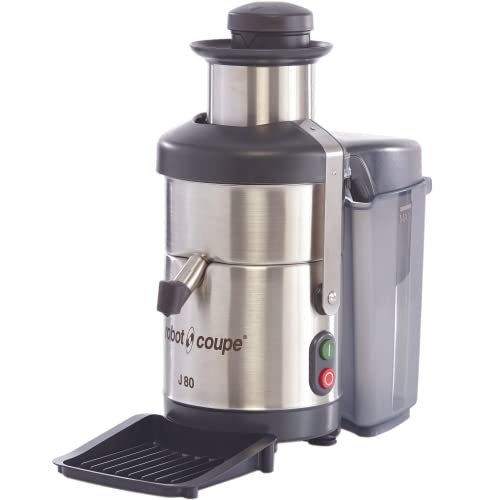
The number that decides this one is 6.5 liters. That is the waste container volume, and it is what keeps your staff from stopping mid-rush to empty pulp. A 1.25 HP motor spinning at 3000 RPM drives the centrifugal extraction, with auto-feed and continuous pulp ejection keeping the flow moving. For a fast juice bar or café where the queue matters, that combination is what you are paying for.
Juice clarity is handled by a 2.5mm grating disc feeding a fine mesh filter basket, so the pour comes out cleaner than a coarse setup. The motor base is stainless steel and the spout is anti-drip, which keeps the counter dry through service. Power draws 700 watts — well under the 1056 watts of the Nutrifaster, but adequate for fruit and vegetable work. At 16 pounds and 19.75 inches deep by 16.5 inches wide by 9.25 inches tall, it is a manageable station footprint for a fast centrifugal unit.
The structural catch is height. That 9.25-inch profile is a low, wide shape, so measure your under-counter clearance before you order. This is a machine for the operator who wants speed and a big waste bin rather than a quiet press. The trade you are making is a fast, service-friendly pour with a short body that needs the right nook.
The service-line edge: a 3000 RPM, 1.25 HP motor plus a 6.5-liter waste container keeps juice pouring through a rush.
The fit check: a low 9.25-inch height needs the right under-counter space, and 700 watts asks less of your circuit than the Nutrifaster’s 1056.
Pick it for: a busy juice bar that wants fast centrifugal output and fewer pulp-emptying stops.
Pass if: your setup is under-counter and short on vertical clearance.
6. Nutrifaster N450 Multi Purpose Juicer

The heavy, simple press that has been a juice-bar fixture for years.
There is nothing clever about the N450, and that is its appeal. A 1056-watt motor at 3450 RPM with a 1.25 HP stainless steel shaft drives immediate pulp ejection for non-stop juicing. It pours a glass in seconds, all without any assembly — it arrives ready to run. For a busy juice bar, that simplicity is a virtue: fewer parts to break, nothing to fit together at open.
The metalwork is where the money went. A polished aluminum body and stainless steel construction hold up to daily citrus and root vegetables, and the 12-ounce capacity suits a fast single-serve pour. The trade is weight: 64 pounds on a 12-inch by 16-inch by 19-inch footprint, so this is a floor-anchored workhorse rather than something you shift. It draws 10.8 amps on a 110V supply, which is the one spec to check against your circuit before ordering.
On performance, the record is strong — most owner feedback is positive and the machine does what it claims. Where opinion splits is value, with some operators feeling the outlay is steep for what is, at heart, a simple centrifugal press. If you value proven simplicity and heavy gauge metal over a big feature list, this is the choice. If you are chasing quiet operation or a slow-press yield, look at the Kuvings above instead.
Strengths to weigh
- 1056W motor and 3450 RPM for fast single-serve pours
- Immediate pulp ejection keeps juice flowing non-stop
- No assembly required and simple to use and clean
- Polished aluminum and stainless steel body
Honest limits
- 64 pounds and a 12x16x19-inch footprint need a fixed station
- 10.8 amps on a 110V supply — verify your circuit
- Value is debated by operators given the simple design
It wins with: operators who prize a heavy, simple machine that pours fast and needs no assembly.
It loses to: anyone wanting quiet slow-press operation or a compact countertop body.
Know the Specs
RPM and Motor Power
RPM (revolutions per minute, how fast the cutting disc spins) and wattage both describe the motor, but they answer different questions. A high RPM like the Waring 6001C’s 3600 spins the disc fast for a quick pour. The wattage tells you how hard the motor can push before it bogs down. A 120W orange press and a 1000W extractor are both commercial machines, but they handle very different produce. Match the power to the hardest item on your menu.
Pulp Ejection and Waste Capacity
Pulp ejection means the machine throws the spent pulp out of the way while it spins, rather than collecting it in a basket you stop to empty. The waste container size then sets your refill rhythm: a 6.5-liter container runs far longer between empties than a small basket. A 6.5-liter waste container on the Robot Coupe J80 Ultra runs far longer between empties than a small basket, so staff clear pulp once a shift instead of once an hour.
Feed Chute Width
The feed chute is the opening you drop produce into. A wide chute like the Kuvings 88mm flip gate lets you load whole fruit without pre-cutting, which cuts prep time. A narrower chute means chopping first. For citrus-only machines, the chute is sized to the fruit — the VEVOR takes oranges from 55mm to 80mm but not lemons.
Duty Rating and Footprint
Continuous-duty simply means the machine is rated to run through a service without a cool-down break. It is the line that separates a real workhorse from a beefy home juicer. Alongside it, check the footprint: a 121.3-pound floor unit needs a dedicated station, while an 11.1-pound countertop model moves with your layout. Match the duty rating to your busiest hour and the footprint to your counter depth.
Common Questions
What makes a juicer commercial grade rather than just a big home juicer?
Does RPM or wattage matter more for a commercial juicer?
Will a commercial juicer fit on a standard back-bar counter?
Can the VEVOR orange juicer handle lemons and limes?
What is pulp ejection and why does it matter for speed?
Is a slow masticating juicer better than a centrifugal one for a juice bar?
What electrical supply does a commercial juicer need?
How much juice does the Kuvings CS600 make per batch?
How easy is a commercial juicer to clean at close?
The Bottom Line
For a compact bar that needs stainless extraction without a floor-sized footprint, the Waring 6001C is the one to beat — its 11.1-pound body and 10.25-inch footprint fit where nothing else will, provided you keep it to medium duty. If your queue is the priority, the 1000W Waring WJX80 with continuous pulp ejection keeps juice moving without stops. For dedicated citrus volume, the VEVOR orange press removes the peeling labour entirely. Size the motor and waste bin for your Saturday rush, not your Tuesday afternoon.
How we choose
We do not accept paid placement. Every pick is matched to a real buyer and a real use-case; we do not hands-on test units.
Sources
Specifications: manufacturer listings and product documentation. Review insights: verified customer reviews, as of November 2026. Pricing: not shown on this page (it changes often); check the current price via the retailer link.
As an Amazon Associate, Tactical Gear Guy earns from qualifying purchases. This does not affect which products we feature.